Holidaying in the UK, 2023
Well, this year, we decided to keep our holiday simple – UK, one location for accommodation and lots of train options. Yes, of course, the West Country. We drove to Plymouth, coming off at the Devon Expressway to stay at the IBIS Hotel (more of a motel, really). From there buses to Plymouth and from there trains to St Ives, Newquay and Torbay. All good. We used the van only to get to Dartmoor for a couple of walks.
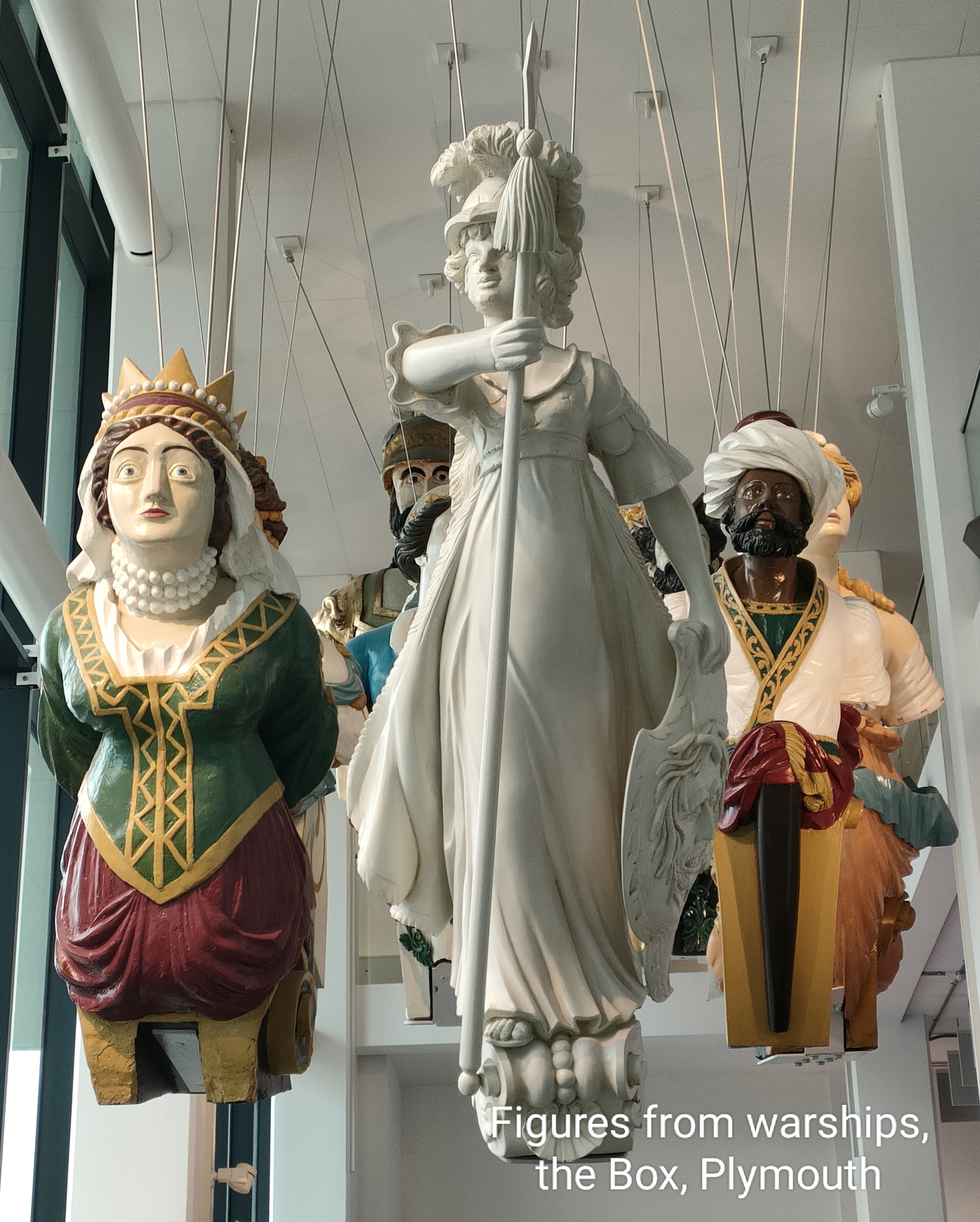
Our first day, naturally, was in Plymouth. It is years since I have been there. Short of remembering Plymouth Hoe, it was a new place. And whilst it is nice to walk around the bay, observe its great breakwater, marvel at the Tinside Lido and raid the tourist information office, there are three highlights. A day at the Box – the city’s museum and art gallery, the Guildhall (not actively open to the public, but certainly allowed) and food.

The Box is everything a municipal museum should be. It is full of the place’s history – however (in)auspicious it may be. Plymouth certainly celebrates Napoleon’s capture and exile to St Helena as he was quite a tourist attraction when he landed. Immediately inside the box the grand figures that guided the town’s ships now hang from the ceiling (above left). It also has temporary displays in its magnificent galleries. We enjoyed very much a display of work by (Sir) Joshua Reynolds, a locally-born portrait painter of the rich. The I’m no expert, but the pictures a fine works, at scale and full of questions that artists pose because they can. One big question is around the identity of the black woman in his picture of Lady Elizabeth Keppel (painted somewhere around 1762, right, after at least two live sittings compared with Keppel’s eight). The question is asked for two reasons, first, she is not named, but second, she is depicted not as an equal, but neither as an absolute subordinate. Her clothes and jewellery may have been donated by the family, but that in itself is significant such that she can be represented as a woman of status, albeit as a maid servant. The likelihood of Reynolds seeking to represent a black woman as one with status is not high, but it is one of the quirks of art that inadvertently demonstrate more than perhaps intended.

Maybe I do Reynolds a disservice as there is another picture in the collection (left) of a black man – just his portrait; he too, is depicted as a noble. He could have been Samuel Johnson’s servant, Francis Barber (originally named Quashey), born in Jamaica and came to England as a valet. He may have assisted Johnson in his dictionary. What is clear, he became Johnson’s heir. He could also have been Reynolds’ own servant (footman), is written about in his memoirs (without actually naming him).
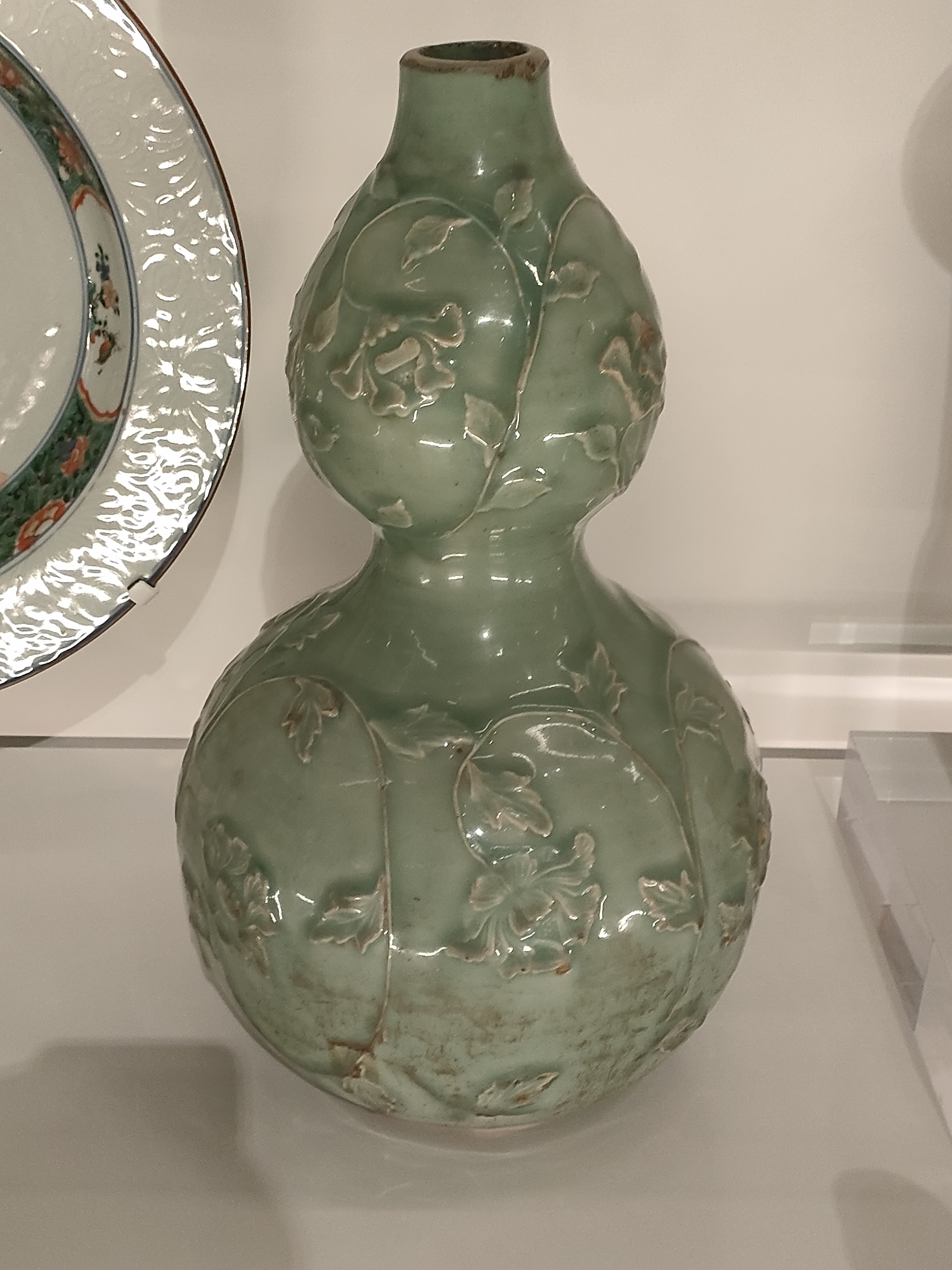
The museum’s permanent collection includes some fabulous ceramics, some of which are nearly 400 years’ old from China – at the time when the porcelain was a unique Chinese export. A first glance the pot (right) is rather dull, but the “double gourd” has a form that is one of the most ancient of Chinese ceramic shapes (undated, unfortunately). The colour jade was seemingly extremely difficult to achieve!

Also, Barbara Hepworth’s work gets a look in. Three paintings (Opposing forms, 1970; Autumn Shadow,1969 and Oblique Forms, 1969) are on display, probably just to point to the people at St Ives, where she lived and worked, they do not have exclusivity. Though with Hepworth, there are many public examples, not least the work, Winged Figure (1963), adorning the side of the John Lewis shop on Oxford Street, London.

The Guildhall is for fans of 20th Century Guildhalls or – what I prefer to see them as – public spaces for citizens to attend functions, exhibitions, entertainment, etc. The main hall in the Guildhall has it all – height, a painted ceiling, natural light, a stage, an upper circle. We stumbled into it and the caretaker was delighted to share his own knowledge of the place, open the curtains, put on the lights and leave us to it, basically.
Finally food. I sense there is a single place for vegetarians to consider eating in Plymouth – though happy to be corrected). That place is Cosmic Kitchen, run by twin sisters, Gabriela and Lucia Evangelou, serving Mediterranean-style food, including their vegan moussaka and a regular specials board. The venue is worth a visit in itself (old chapel) and at the weekend it doubles up as a club (for younger people than us, I predict).
 Be informed
Leave a comment