Archive for March, 2024|Monthly archive page
Electrifying UK railways and climate change
Filed under: Politics, Railways, Transport, Travel | Tags: Battery train, Great Western Railway, GWR
 Leave a comment
 I use the case of the electrification of the railways as an example of climate mitigation. Diesel trains are hugely polluting, particularly in the context of carbon dioxide; electric trains much less so. Seemingly a switch from car to diesel train can cut an individual’s carbon emissions by 70 per cent and a whopping 90 per cent if the train is electric.

The electrification of the network has always been rather piecemeal. The East Coast Mainline was electrified in the 80s, but missed out key towns and cities such as my home town, Hull. Diesel trains still run under the wires from London to the city. More startling, but not surprising is the account given by Aneurin Redman-White, a railway design consultant, of the mess that is Brunel’s original railway Paddington to Bristol/Cardiff and Penzance. The Penzance bit was abandoned by Chris Grayling, the former secretary of state for transport, even though it had been used as a reason for price increases! It’s like watching a mini-series on TV but not watching the concluding episode. But, actually, it is not like that at all.
Unfortunately, the current British Government, like many before it, believes that private mobility – cars – are still the future and perennially electorally popular. Notwithstanding the fact that governments should always lead rather than follow, especially on global challenges such as climate change, the decision not to electrify the railways on cost grounds, whilst continuing to build roads, is short sighted and wrong.

There is another option, instead of electrifying the infrastructure – at least for short or middle distance routes – battery trains are becoming an option. Great Western Railway in England has now publicly trialled such a train (right – with Mark Hopwood, MD). This train is giving 86 miles (138km) per charge. And charging takes – wait for it – 31/2 minutes.
There are hybrid electric trains, too. Hitachi Rail runs 20 so-called tribrid trains across Italy. The battery is charged when the train decelerates by braking or when it is collecting charge from an overhead wire. There is only 10 miles manageable per full battery, however.
Network Rail, the owner of the UK infrastructure such as track and signalling, has a net zero carbon target for 2050. To meet that target about 500kms of new electrified railway is needed each year. At the moment, a mere 38 per cent of the UK rail network is electrified. The German railways, by contrast, are reported to be 90 per cent electric operation (slightly different terms, I appreciate, but even then, a significant difference).
The argument that the UK railways contribute only about 2 per cent of greenhouse gases across all sectors is a classic response. What is 2 per cent? For that amount, it is not cost-effective. Investment in public infrastructure can be cost-effective, especially if we consider wider social returns in terms of employment and mobility more generally (just look at what CrossRail/Elizabeth Line has done for the Capital). Moreover, maintaining the capability to design, build and maintain infrastructure is, arguably, a requirement of a post-carbon (aka civilised) world.
Banksy’s artworks
Filed under: Art, Environment, Politics | Tags: art and climate, Banksy, Islington
Leave a comment Gio Iozzi asks, why does it take an artist to expose the assault on our urban trees? This in light of Banksy’s latest addition to his portfolio recently found in Finsbury Park, London. It is an interesting work, and slightly different from his usual work, as it requires a significant prop. A tree. The tree is special because it has been “pollarded” – severely pruned in normal parlance. It has been pollarded because, according to the Council (the owners of the land on which the tree stands) it was diseased. It is a cherry tree, and they do not, it seems, respond well to radical pruning. There is also a question of whether diseased trees need to be pruned or felled. Many of us are a little diseased, but we do not lob off all of our limbs to deal with it. Or at least not as the first option.
It seems that Banksy, whoever he is, saw the opportunity to provide this sad tree with leaves by painting them – or spray painting them – onto an adjacent side wall. Viewed from one angle, the tree looks healthy and with full plumage. And like all Banksy artwork, there’s a message.
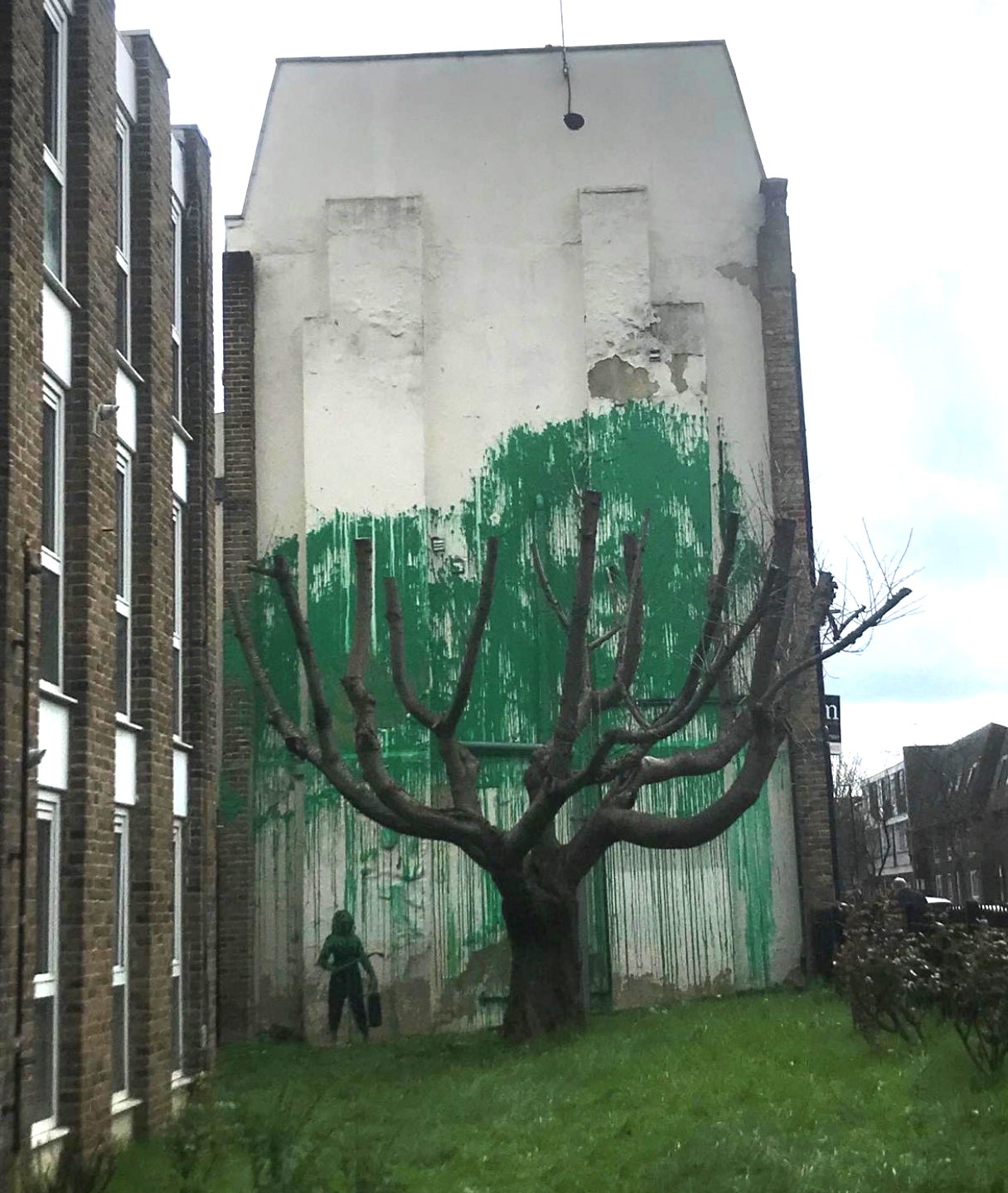
Art is there for the receiver to interpret, even if the artist provides the artwork with their own meaning. So we take liberties – rightly – with interpretations. So let us interpret this widely. This is a dual statement about the state of our urban trees and about climate change. Urban trees are under threat, just at a the time when we need them most. Our cities are getting hotter. Trees provide shade, for sure. But they also cool the air. Even diseased ones. So much urban landscape is devoid of trees. Devoid of ways of cooling and, increasingly, draining.
More broadly the onslaught against the planet’s forest ecosystems is relentless. The cutting and burning of the Amazon has slowed, but not stopped. Forests elsewhere in Indonesia and Africa are also in retreat. In Brazil particularly to provide land and feed for cattle. So not only do we lose carbon-capturing trees, we also increase our emissions through bovines, notorious methane producers. All because we want to eat large quantities of beef.
In response to Iozzi’s opening question about artists, I respond simply by saying, it is what artists do. It is why they are an essential part of the democratic process. Throughout history artists (not all, for sure) have made statements about society, power and morals. Degenerate art in Nazi Germany was degenerate for a reason. Artists have been subtle sometimes in their representations. Messages that eluded the censors because they were unable adequately to understand what they were actually looking at. Even Picasso, not known for his political statements, produced his masterpiece, Guernica, to say something to the perpetrators of the destruction of the Spanish town in 1937. Famously when asked by a Nazi Officer at his Paris studio whether he had “done” this painting, his reply was “no, you did this”.
To add value to the picture and to the metaphor, Islington Council put a protective fence around the work, but within 48 hours it had been defaced. I am pretty sure that Banksky was smiling. I rest my case.
Original picture source: https://twitter.com/IslingtonBC/status/1769722470355828821/photo/1
The Garrick Club
The Guardian’s recent exposé on the Garrick Club in London is troubling. It took a data breach for us to know who the club’s members are.

Not only is this a “gentlemen’s” club, it is also an elite club where state/government policies are discussed and made. As a man I do not have the resources to join and even if I did, I think it is unlikely that existing members would nominate me. I could at least try; but if I was female, it would be harder despite David Pannick KC’s best efforts to justify its existence. There is, argues Pannick, nothing in the language that bars women – even the word “gentleman” seemingly has a defence. Here is Pannick quoted in the Guardian article: “[t]he term ‘gentlemanly’ is plainly being used here in the sense of the meaning ‘[o]f a pastime, behaviour or thing’ that is ‘of high quality; excellent’”. I’m not about to buy that. It is not surprising that lawyers can offer such a defence as we discover that a large tranche of senior [read influential] figures in the profession are members. Many environmental campaigners, for example, have found themselves judged by them. And that raises bigger questions about the profession itself.
Picture: By Cambridge Law Faculty – https://www.youtube.com/watch?v=fxB59qEi6i0, CC BY 3.0, https://commons.wikimedia.org/w/index.php?curid=104993515
Fossil fascism
Filed under: Environment | Tags: Andreas Malm, climate change, climate change ad nationalism, Climate change denial, climate scepticism, Fossil Capital
Comments (1) 
When I came to write my textbook on business strategy in the age of climate change, it was not until I had read Andreas Malm’s book, Fossil Capital that I felt I had a proper foundation. Malm’s thesis was relatively simple: the mechanisation underpinning the industrial revolution did not need to be a fossil-driven revolution. Water would have done (I understand why that is contested). But, the capital owners saw a number of benefits (to them) of steam power (fuelled by coal). Many of the early mills in the North of England and Scotland required the owners not only to build factories, but also villages for employees (one example, Saltaire, West Yorkshire (right). Villages with schools, sports, places of worship, etc. These were expensive, they also promoted labour power. The steam engine was not geographically hidebound. The fuel could come to the factory rather than the other way around. More expensive, maybe, but the plutocrats no longer needed to provide housing and labour power was neutralised.
This realisation enabled me to frame my book in terms of the continued burning of fossil fuels as a choice. It did not need to be that way in the past, and it does not need to be that way in the future. We can have a zero carbon economy. We choose not to.

Many writers and thinkers may have stopped there, but Malm is driven. He followed that up with a book about climate and Covid and, controversially, enlightened us on how to blow up a pipeline. In between all of that, Malm, along with the Zetkin Collective, wrote an extraordinary book entitled White Skin, Black Fuel about the relationship between climate change denial/scepticism and fascism. It is like his earlier book, Fossil Capital rather sprawling. Readers need to persevere, it is easy to say that it is too difficult. Malm takes us through time and space locating as he does the origins of fascism, its contemporary manifestations (Europe, North America and South America) and, crucially, why fascism and climate scepticism/denialism are aligned.
Consider this (which I had not done before), why has no far-right party ever endorsed renewable energy? Indeed, why do far-right parties commit to dismantling renewable energy installations, particularly wind? Now this is only a small part of the book, but for me it is the most intriguing and the one that augments my own understanding of the challenges ahead – maybe not absolutely for my generation, but certainly for anyone under 50.
Malm’s plausible hypothesis rests on an understanding of ultra-nationalism (he takes close to 260 pages to tell us what that is). Let me stick with nationalism, the sense that the homeland and its authentic peoples should be prioritised over so-called invaders, immigrants, alien faiths and, basically, anyone with a dark skin. Not only prioritised, but cleansed. We see it in today’s politics. Fossil fuels, argues Malm, fit a nationalist narrative. The is “our” oil. It is independent and we use it for our own development and wellbeing. Of course, oil usually belongs to oil majors that trade it in global markets, so that argument is flawed, but it is surprisingly potent when it comes to electioneering/power grabbing. The sun and the wind cannot be appropriated in the same way even though it provides energy security that no fossil fuel can match (in terms of availability and price). I hear readers now asking, what about countries that do not have a store of fossil fuels in their territory, why are nationalists in those countries so opposed to renewables?
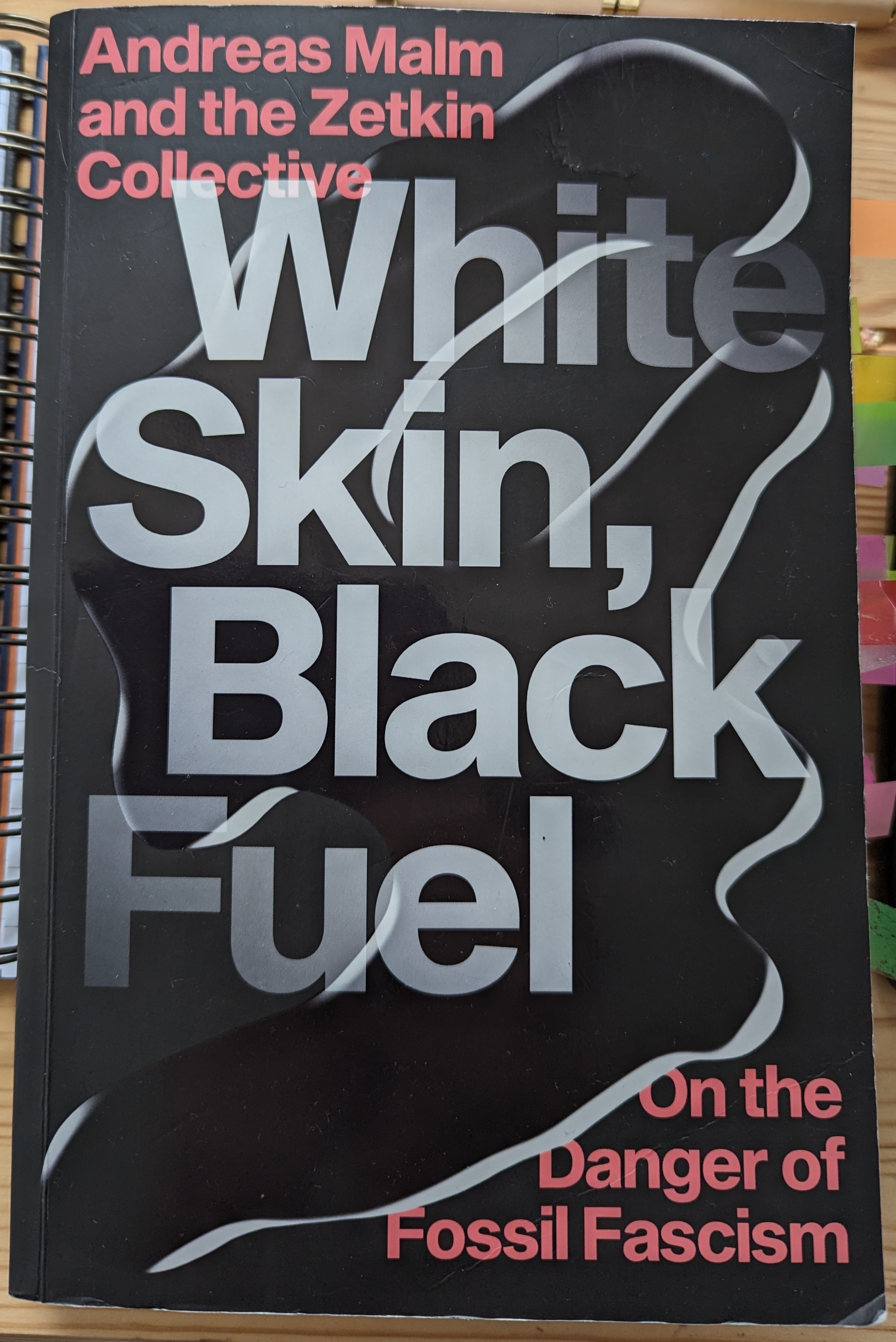
Malm is clear. Colonialism and whiteness! Particularly rich whiteness. For it is the rich off the back of colonial exploitation that have so much to lose from decarbonisation. Their assets are sunk – literally – in the ground. Their lifestyles are high carbon. They fly so much more than most of us, and often in their own planes. Carbon is so much a part of who they are that to decarbonise is to lose their very identity. And what is more, decarbonisation (for them, a Marxist plot) is to enforce an unfair (to them) equality. How else do we explain a global carbon budget that is shared between countries representing some element of fairness? For example, the USA and Europe (particularly the UK) have a tendency to deny historic emissions, and cannot countenance coming down to the level of developing countries. How fair is that?
Malm argues that such an approach by the right (not even the far-right) can be traced back to the fall of the Berlin Wall and the loss of a tangible enemy – communism – that imposed equality in places where it was the dominant ideology. (Arguably not, as the Soviet Leadership and acolytes seemed not to be too constrained in their consumption.) To prove the point, Earth Day (22 April) is the the birthday of Lenin – no coincidence. So, those proclaiming a climate crisis and the need for action became the new targets of the right. Denialism and then a rejection of mitigation (cutting carbon emissions) in favour of a West-friendly adaptation (the West/North is better able to cope with temperatures of 2, 3 and even 6 degrees of warming so much better than other less-developed regions). Malm is thinking about people like Jordan Peterson and William S Lind. The attacks on Greta Thunberg feature in the analysis, too. The picture of her wearing an antifascist “Allstars” t-shirt, for critics, was proof that she was both Antifa and in the pocket of George Soros.
There are some other interesting elements to this approach. Denialists do not present counter evidence (largely because there is none), rather they present their narrative over and over again. The more it is repeated, the more it is liked and re-tweeted, the truer it becomes. Repetition is key. Our media tend to allow them to repeat their lies at will and without challenge. With this in mind, argues Malm, if one can lie about climate change, anything can be successfully lied about. Despite the evidence to the contrary, the lies carry more currency. That is partly because white people, increasingly turning their territories into fortresses, will survive it longer than people of colour in vulnerable countries.
This is not the end of the book at all. The race discussion occupies the subsequent chapters. But just like Fossil Capital, perseverance pays off. The reader is rewarded with insights (you do not have to agree totally with them). Malm has plenty of critics. By goodness, though, he does a lot of heavy lifting for us.
 Be informed