Burtynsky – Extraction/Abstraction (Saatchi Gallery, April 2024)
I am not a little impressed by photographers that work at scale. I have been the subject of one such photographer, Spencer Tunick, in London. His subjects were always without clothes. It was late April 2003. There were thousands of us. It was quite an experience. And for the exhibitionists amongst us, it was possible to visit the adjacent Saatchi Gallery (then in the old County Hall building) before re-robing.
Then there is the wife-and-husband couple of Hilla and Bernd Becher who spent their careers taking black and white photographs of industrial sites and machinery such as mines, steel plants, water towers, etc. I suppose what really impressed me was the fact that they hit on recording something that I, as a child, thought would be there forever and they, not being children, knew they would not. Hence I regret not taking more photographs of buses, trains and shops in my home town when I was growing up. But there you go.
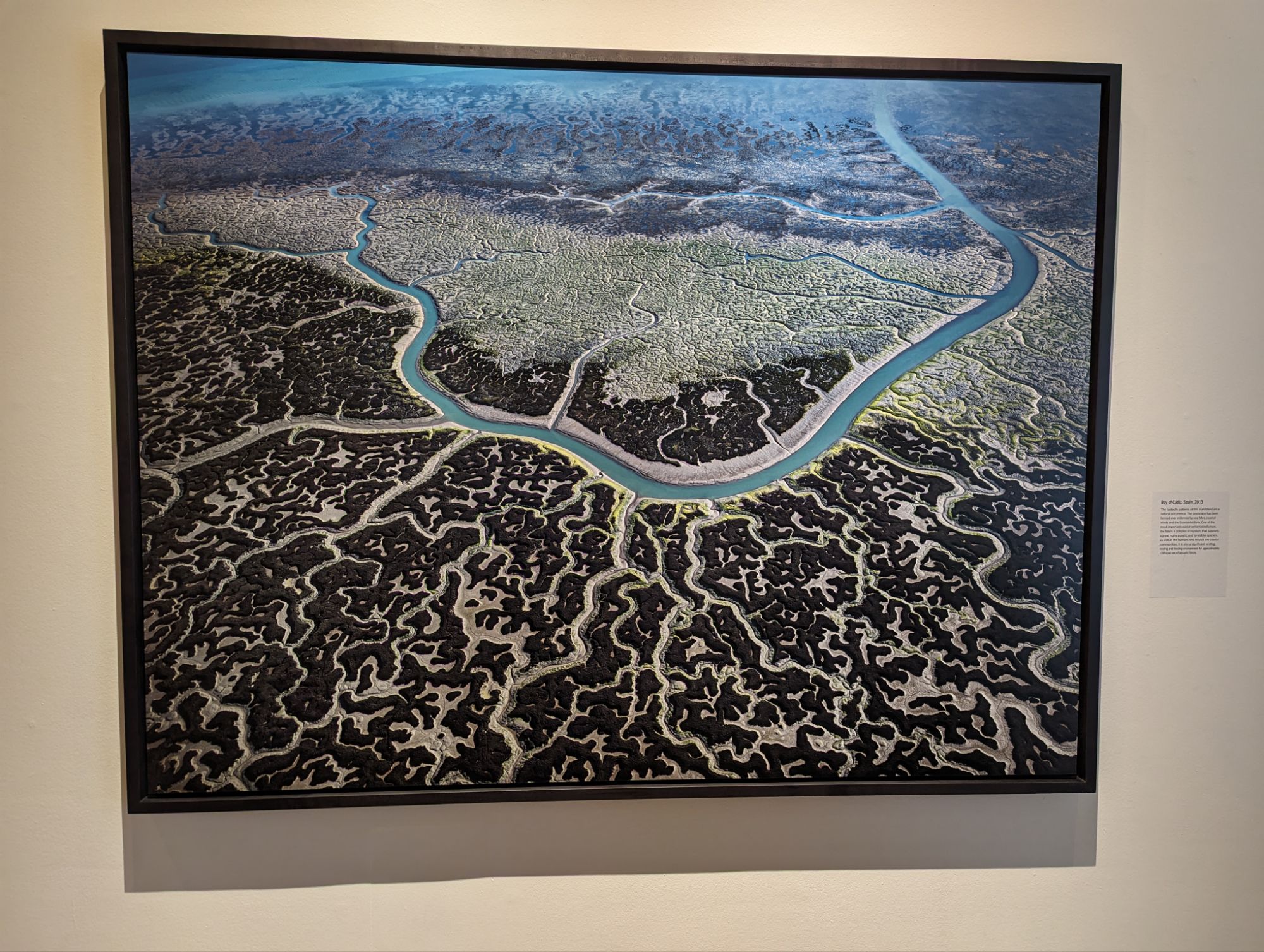
And then there is American photographer, Edward Burtynsky. His father worked in a steel plant. Burtynsky himself funded his studies by working in that very same plant for a sufficiently long time for him to latch on to the idea that such plants may provide a subject for his photographic career. As it turned out, his most influential work is not the plant itself, rather the extraction of the raw materials that ended up in those plants – iron ore, copper, coal, etc. For that reason, this exhibition was a must (subject to my busy schedule).
I’ve now been and the images are extraordinary. They are presented in very large format and, mostly, as aerial shots, look nothing like what they depict. They come across as abstract art – hence the title of the exhibition. On the whole, however, they are not art, they are a record of environmental destruction. There are a few exceptions where the extraordinary patterns actually record profuse wildlife habits such as the landscape around Cadiz in Southern Spain (above left).
Like most artists Burtynsky has a team working for him. The drone technology he uses relies on an expert to make them fit-for-purpose. For example, high altitude photography creates a challenge to get sufficient lift to get the drone in the air (there is a part of the upstairs gallery that reveal his methods, equipment and projects).

By far the most interesting galleries show the scale of the impacts on the landscape of mining – whether it be the scars of the opencast mines themselves, or the spoil heaps or tailing ponds. With the possible exception of coal, the ores and minerals are not neatly packaged by nature for extraction. They require significant refining, often with toxic chemicals that tend to be dispersed into the natural environment. At scale.
So, anyone with a diamond may well have contributed to the large deposits of “waste” displaced to find diamonds. The picture (above right) is of the Wesselton Diamond Mine, Kimberley, Northern Cape, South Africa (2018). If readers look closely a conveyor belt can be seen on which the tailings are transferred to the pond.

A metal that we hear so much about for the necessary electrification of our world is lithium. There are a number of extraction methods for lithium; however, one mine in the Atacama Desert in Chile (left) pumps up a liquid from beneath a salt flat into ponds. The ponds are exposed to the sun, the liquid evaporates and the lithium carbonate is then harvested, before being processed. And then there’s agriculture.

Do readers ever go to the supermarket and see that broccoli or some other vegetable is from Spain and think, “ah, that’s fine”? Well, maybe it is not fine. Burtynsky shows the true scale of such operations and their impact on the environment (right). The greenhouses on the Almeria Peninsular harvest between 2.5 and 3.5 million tons of fruits and vegetables annually, including “out-of-season”. These greenhouses require huge amounts of precious water along with a heavy use of chemicals. Climate change is making the water situation more difficult.
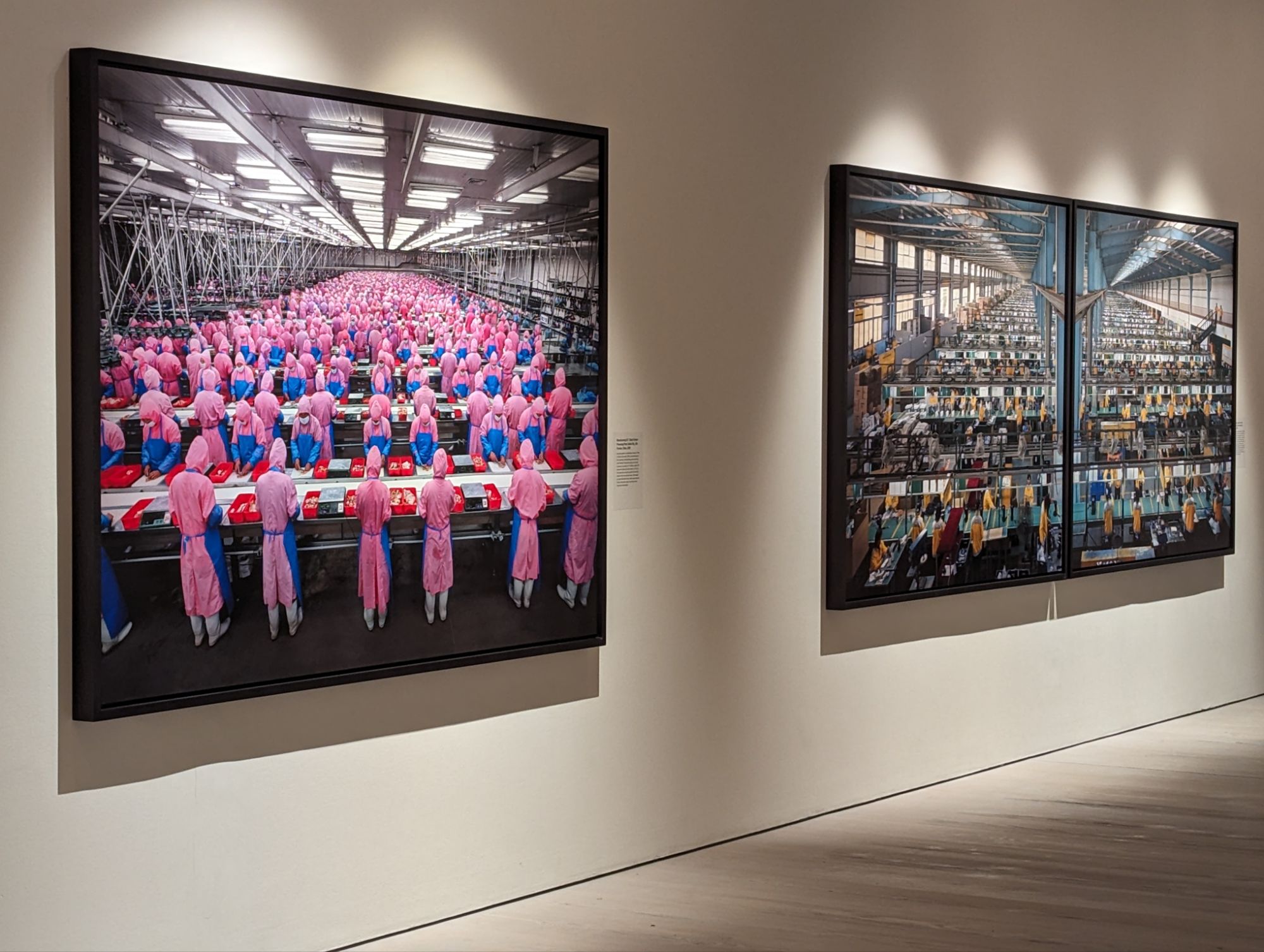
I could go on. I have one last thought. Scale is a problem for us as humans. Burtynsky has taken some revealing pictures of people at work (left) of particular alarm is a picture showing people working in a chicken processing factory in China (everyone wears pink, left). The scale here is twofold really. First, the people. The thought of 8/10 hours per day chopping up chickens is hard to comprehend. We try to present work as something that offers meaning to humans and the opportunity to work with others and exchange ideas, thoughts and stories. There is not much of that going on in this factory. And then there is the chickens. The sheer scale of this one factory tells of the huge number of chickens slaughtered daily to keep these people employed (and presumably fed).
This is an exhibition at scale. Bigger than I thought it would be. It took about 21/2 hours to get through and that included a 30 minute film at scale (worth the visit, for sure). It is thought provoking. There’s a big chalk board to write one’s thoughts – mostly about human stupidity. And then there is a shop in which visitors can contribute to the further exhaustion of finite resources. I had a poster in my hand. And then I put it down and left.
Nothing in this exhibition is human scale. Arguably the Bechers’ work in the 1960s was a little more human scale. Spencer Tunick’s work is by definition human scale.
If readers want to know more about extraction, I suggest Ed Conway’s book, The Material World.
 Be informed
London 2003 Saatchi Gallery. There were not “thousands of us.” We numbered about 120, after which I set up “The Spencer Tunick Experience” website, which morphed years later into Gilead’s Facebook page. Mike Carter