Book Review: Margaret Atwood, Oryx and Crake
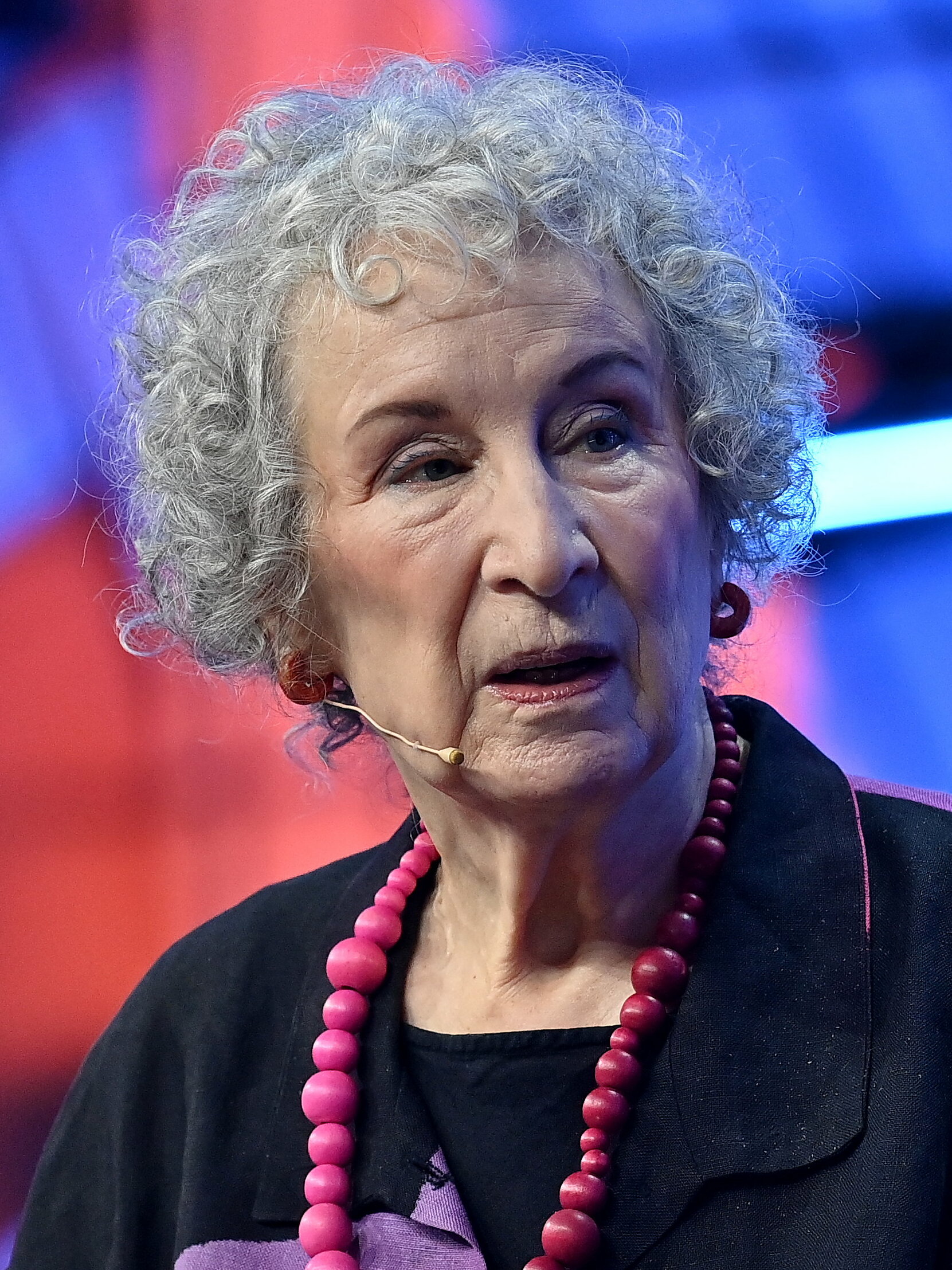
This is my first Margaret Atwood (left) experience. I was gripped. And I was taken somewhere not unfamiliar: a dystopian view of the future. Now bearing in mind this book predates Covid-19, it is quite chilling. Bearing in mind this predates Trump and tech billionaires, doubly so. One has to give her credit for what follows. Once again, please note, I am a novice literary critic and my review here has spoilers. This book is also the first part of a trilogy (the subsequent books are not reviewed).
The story is told through the experiences of two men, Crake and Jimmy. Only Jimmy exists before and after the thing that happens to humanity. Jimmy grows up in a family where his parents work for a corporation, HealthWyzer, that, essentially, makes organic life forms. For example, Happicuppa is coffee plants where the beans all ripen together so can be harvested by machines. However, foremost amongst the animal lifeforms are pigoons – pigs that grow organs for human transplant that can be harvested whilst the animals are still alive. Essentially reusable pigs. But there are many other hybrid-type creatures made by corporations: rakunks (make good pets), wolvogs (great guard creatures), spoatgiders (goat-spider – good for bullet-proof vests), rockulets (absorb water high humidity/let it out in low humidity), snats (snake-rats) and crakers (named after their creator) – humanoids that drop dead at 30, bear no malice, enjoy enhanced immune systems…monetisable.
Jimmy and Crake are friends. In their youth, they experience together some of the worst facets of the digital world they inhabit, including violent and gruesome pornography and executions (hedsoff.com). They also play games such as Blood and Roses (pp89-92), a trading game in which players trade atrocities (blood) for human achievements (roses). This game is part of a wider gaming eco-system of Extinctathon monitored by Maddaddam. And it was from this game that Crake got his name which stuck (his real name was Glenn) from an extinct Australian bird. Jimmy’s codename was Thickney from an Australian double-jointed bird that inhabited cemeteries.
Oryx from the title is rescued from child sex slavery and becomes an intimate companion of both characters. Crake, we discover, is the evil genius heading up RejoovenEsense, the ultimate in unregulated mega corporation designing the future. For example, in this world, there is:
“No more prostitution, no more sexual abuse of children, no haggling over the price, no pimps, no sex slaves. No more rape. The five of them will roister for hours, three of the men standing guard and doing the singing and shouting while the fourth one copulates, turn and turn about. Crake has equipped these women with ultra-strong vulvas – extra skin layers, extra muscles – so they sustain these marathons. It no longer matters who the father of the inevitable child will be, since there is no more property to inherit, no father-son loyalty required for war.” (pp194-5)
Jimmy and Crake have very different university experiences. Crake goes to the elite Watson-Crick Institute: “Once a student there and your future was assured. It was like going to Harvard had been, before it got drowned.” (emphasis added, p203). By contrast, Jimmy went to the down-at-heel Martha Graham Academy: “The Academy had been set up by a clutch of now-dead rich liberal bleeding hearts from Old New York as an Arts-and-Humanities college at some time in the last third of the 20th Century, with special emphasis on Performing Arts – acting, singing, dancing and so forth. To that had been added film-making in the 1980s and Video Arts after that.” (p219).
Where Crake after graduation gets access to mega corporations, Jimmy settles for working in advertising for a company called AnooYoo before being invited by Crake to join him to promote their big product, BlyssPluss: The aim was to produce a single pill that, at one and the same time would:
- protect the user against all known sexually transmitted diseases, fatal, inconvenient, or merely unsightly;
- provide unlimited supply of libido and sexual prowess, coupled with generalized sense of energy and well-being thus reducing the frustration and blocked testosterone that led to jealously and violence, and eliminating feelings of low self-worth;
- prolong youth.
What is not on the label is that prolonged use renders one infertile.
In parallel to this we learn of life after the event in which Jimmy, known now as Snowman, lives in the forest and oversees the security of the Crakers that Crake had entrusted to him with in the post-corporate world. This we discover is only possible because of Crake’s scientific intervention that protects him where others perish. Snowman’s life revolves around trying to find food for himself left behind in old settlements – the corporation compounds – amongst the bodies. But venturing further into the forest and towards these places is dangerous. the Pigoons are now feral and themselves hungry. Finishing off what is left of humanity for the sake of a meal would not bother them.
This book is only marginally about climate change. We know it is hot. And we know that perhaps the East Coast USA flooded due to rising sea levels. We know that corporations and their technologies determine the future. And these corporations are in the hands of people for whom profit and power are central to their thinking. They and the corporations they lead are not founded on an overtly ethical platform. Business is simply business. That said, in true Bond villain style, there is more to it. The power to create life forms is balanced by the power to destroy lifeforms, too. Human, in particular.
Critique
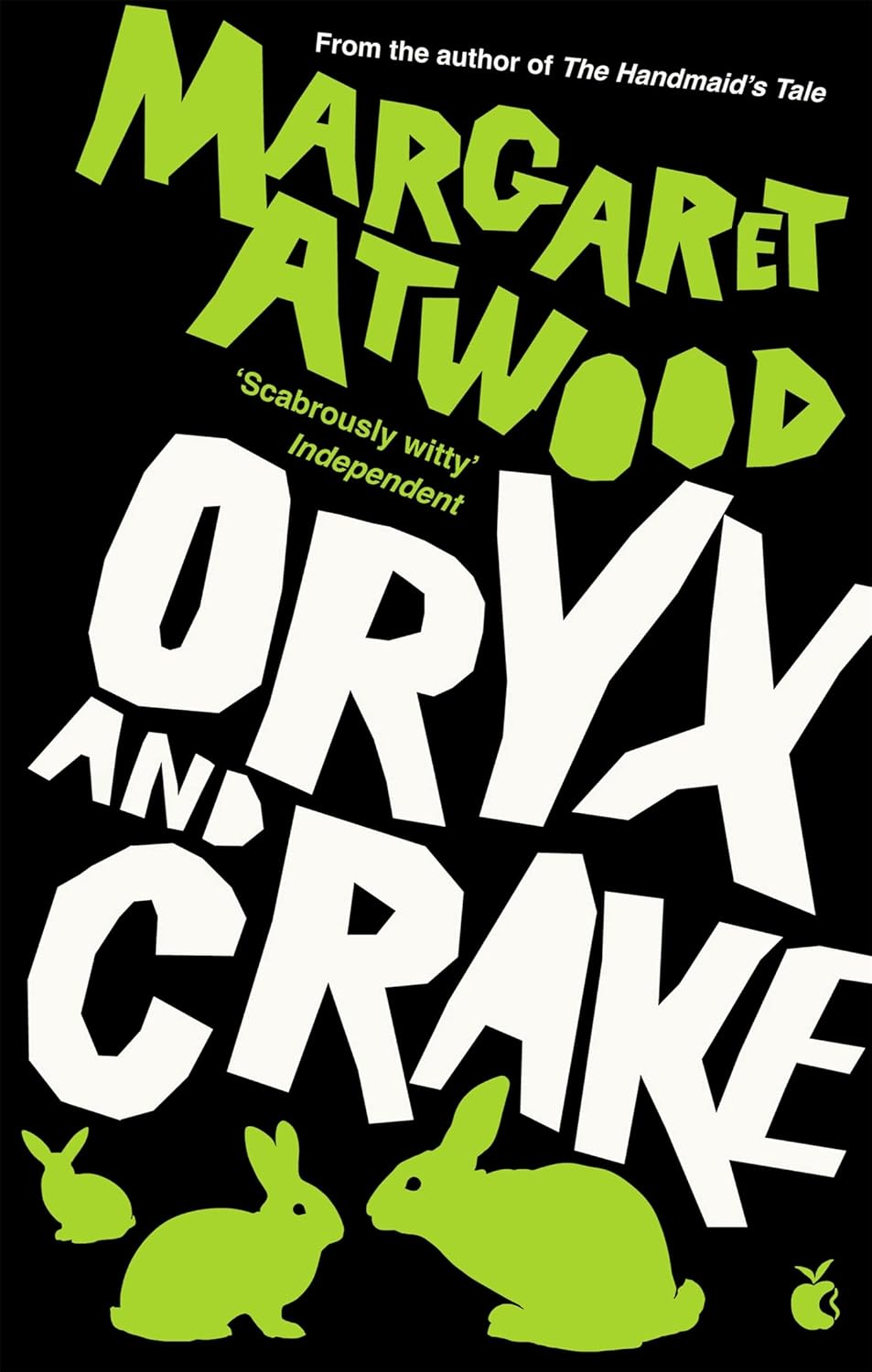
On the face of it this is a straightforward dystopia novel. The world is controlled by corporations seeking to refine humanity to secure profit – through idealized/designer babies, disease control/vaccines/organs, human reproduction, etc. There is no real government or regulation. Something catastrophic happens by accident or design. There is no way back. In this case there is a relative peace because there are few other survivors. In many other dystopian novels, civilization breaks down leading to savagery in pursuit of resources.
The parallel stories work well. Atwood does not expect us to understand fully what is going on until quite late – probably at the point at which the two stories converge. The dystopia is plausible now, in 2026, though perhaps not so much in 2003 when it was first published. Though it is not the first dystopia novel. On that basis, it is not very revealing. Maybe it has not aged very well, or maybe it lacks something to say in a way in which 1985’s The Handmaid’s Tale perhaps does.
The friendship between Crake and Jimmy is explored at length. I have to say whilst Crake and Jimmy explore pornography in their bedrooms I, with my childhood friend, marvelled at coloured vinyl records and Matchbox die cast models (two things that we both collected). I will give Atwood credit here; she understands boys and men as well as any male author understands women and girls. I felt the bond between them. It leads neatly to the conclusion. Crake needed someone whom he could trust to protect his legacy in the event of catastrophe (which seems about 90 per cent certain it was planned rather than accidental).
More interestingly is the subtle surveillance state. There is resistance to the corporations with sporadic violence and internment. If I read it correctly, the Maddaddam movement is the focus of the resistance. Both of the main characters are being monitored and controlled arising from their family involvement in the corporations. Jimmy, for example, is often questioned by the pervasive CorpSeCorps armed security forces. They remind him to stay compliant, not least when they show him a video of the execution of his mother, convicted of treason, having rebelled against the corporation and paid the ultimate price (p302). Though in the video her words were clear: “Goodbye. Remember Killer [Jimmy’s pet rakunk]. I love you. Don’t let me down.” (p303).
Once again, then, Atwood is on top of the surveillance state. Something that is now normalized in China and now increasingly in the USA as the corporations take control of our data. The question for me is a simple one, did I need to read 430 pages of Margaret Atwood prose to reveal what is for me self-evident? The answer is, I think, “it depends”. For too long I have avoided fiction and I had forgotten how important it is for creating alternative worlds (the Sci-Fi genre) or at least taking us into the worlds of others who may have had very different life chances and experiences. More critical though is building narrative around relationships – this novel is particularly good in this respect. A number of years ago I was in a book group and we read quite a bit of women’s literature. Actually, that is the wrong term. It is literature that prioritizes the issues relating to women, primarily family and friends. As a younger man, I was quite dismissive of that literature and rebelled, when it was my turn to select a book by foisting on to others work by Will Self, for example. It is good to see here that Atwood can do men. There is only one female character in the book for a reason; namely, the cause of the event that sees off much of humanity is men. And my goodness, we can see that in the contemporary world where three old men in particular seem to engineering dystopia.
Picture: Margaret Atwood Photo by Piaras Ó Mídheach/Collision via Sportsfile
 Be informed
Leave a comment