Author Archive
The attack on Hama
 Leave a comment
1 August 2011
President Bashar al-Assad sent in the tanks to Hama, a non-conforming town to the north of Damascus. Hama had been attacked by his father in 1982 with 10 thousand deaths when the City was literally razed to the ground. The reports coming out of the city today, such that they are, talk of indiscriminate arms firing, tanks and explosions. The story is familiar; however, this time, UK and Nato forces are not there in support of the citizens.
Listening to William Hague, the UK foreign Secretary this morning on Radio 4 was pointless as he dishonestly explained the West’s absence. It is different, of course, but not because the Arab League has not asked for assistance.
This has got to stop
Catherine Pepinster, again, has used her 3 minutes on national radio to defend her religion’s approach to child abuse, in the context the Irish Government’s call for priests to pass details of child abusers in confession on to the police. This is unacceptable, BBC. This is not a ‘thought for the day’; this is pure religious propaganda, and in this case Vatican propaganda. Stop it!
Goran Hadžić
Picked up – the final of the wanted by the International Criminal Court from the Yugoslav conflict. http://www.guardian.co.uk/world/2011/aug/03/former-yugoslavia-war-crimes-hunt
News Corp
So, no bid at the moment for BSkyB. It all seemed so easy in the end. There is still time to ressurect the News of the World for an edition this weekend. No need to have closed it, one senses?
Magritte at Tate Liverpool
This exhibition, The Pleasure Principle, has all the favourites – the bowler-hatted ordinary men raining down over the houses, the train coming through the fireplace, the pipe (the one that is not), the daylight darkness (the streetlights shine whilst the sky is bright and blue), the couple kissing shrouded from one another, etc.
In all, it took about 3 hours to go round the whole exhibition. To a painting, they are mostly familiar. One possible exception is the gallery with examples of his commercial work – artwork to advertise cigarettes, fashion, theatre and cinema posters. Some of the motifs are visible, but not quite so strident. Rarely was he political. Though he did depict the Belgian fascist leader, Léon Degrelle, looking into a handheld mirror (one of Magritte’s motifs) and seeing Adolf Hitler. And on only one occasion is a picture with a grey sky depicted; again a scene from the war.
Equally unfamiliar are the home movies that he made with his wife and other members of the surrealist movement in Brussels. Their playfulness is enchanting as they do strange things, using their bodies as objects for Magritte’s moving art (he was not a very good cameraman; reassuringly, the movies are no better than the ones I made on Super 8 when I was 10 years old).
http://www.tate.org.uk/liverpool/exhibitions/renemagritte/default.shtm
http://www.guardian.co.uk/artanddesign/2011/jun/10/rene-magritte-pleasure-principle-exhibition
Björk – Biophilia
Yesterday I had my chance to see Björk perform Biophilia at the Campfield Market in Manchester. It was a curious event. There are 8 new songs, not really enough for a show in its own right so she interspersed the new songs with old ones for which I have no explanation of the choice (other than the fact that they are great songs). Indeed, pure genius to end the whole show with her revolution anthem, Declare Independence. In these times of instablility in the Arab world and Europe (was there ever a better anthem for Greece with its call to ‘set up your own currency’?) ‘Raise your flag’, she implores. Rousing stuff.

- Sharpsichord
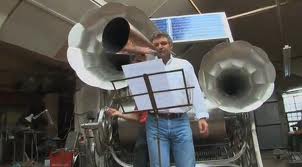
As for the new songs, most are great, a few not so, but any body of work has weak links. Björk has more of those than most. But she is forgiven by virtue of her uncompromising creativity and sheer talent and commitment. The new instruments, particularly the Tesla Coil with its electrical sparks providing an incredible percussion along with awesome visuals, are worth investigating. The ‘Sharpsichord’ with its over-sized ‘ear trumpets’ looked like H.G Wells’ time machine (http://news.bbc.co.uk/1/hi/england/kent/8481926.stm). The Pendulum Harps – four swaying rods with strings at the weighted end – accompanied a lone Björk on the final song, Solstice. These curious artefacts, however, pale into insignificance against Björk’s own voice and the glorious backing given by the ’30 piece’ female choir that provided the wall of sound – the Biophilia sound – that one takes away.
On first hearing, it is difficult really fully to digest Biophilia’s profundity. The stunning visuals projected onto both sides of screens circling the stage gave a flavour the the complexity of Biophilia and its ‘unseenness’ – small, inside us, under water and under the surface of the earth. Also, as some commentators are describing it, the genius of getting David Attenborough to voice-over the scene setting introduction and to announce each new track. The start, consequently, is a ‘hairs on the back of the neck’ moment, at least for those of us of a certain age.
News International Crisis
And now they have closed the News of the World. What would Woodrow Wyatt have said?
It has really taken off. Rebekah Brooks is really in the firing line. Fortunately she was on holiday when the phone of Milly Dowler was hacked.
The Attorney General has told the Commons, however, that the Government CAN block the sale of BSkyB to News Corporation. Let us see.
Sky News
So, Rupert Murdoch will be able to buy BSkyB, but only if he makes Sky News an arm’s length operation.
- Rupert Murdoch

The issue is one of news pluralism. Murdoch represents a significant media magnate for the first time attempting to link both print and broadcast media.
Some media organisations, for example, the Guardian, are naturally opposed to this and have made their concerns clear to Jeremy Hunt, the Culture Secretary. Hunt along with his boss, Cameron, have paid many visits in recent weeks to Murdoch Towers. Purely social, of course. See http://www.guardian.co.uk/media/organgrinder/2011/jun/20/news-corporation-rupert-murdoch?INTCMP=SRCH
The political concerns have been largely commercial; notably, the impact of cross-advertising of newspaper titles and general television entertainment. But let us not forget all of that phone tapping that has been going on within the Murdoch newspapers; particularly disturbing is the news today (4 July) that those journalists tapped into the mobile phone of Milly Dowler that may have impacted on the police investigation into her murder (http://www.guardian.co.uk/uk/2011/jul/04/milly-dowler-voicemail-hacked-news-of-world). Maverick journalists, of course.
These worries are bad enough, but when one reads the adulatory words of former Sun editor Kelvin McKenzie in Friday’s Guardian (1 July 2011), one can see that the plot has not been understood. MacKenzie’s headline, ‘Thank God for Murdoch’, is sufficiently illustrative of his position. It is true that Murdoch was bold in building his satellite TV operation. The risks were high and he has been rewarded for taking them. But Sky News is a problem. It is not, argues MacKenzie, Fox News in the US. That is a very interesting statement. It suggests, rightly, that Fox news is far from plural, unbiased and legitimate. Whether Murdoch would want to turn Sky News into Fox News is a debateable point (would it serve his objectives in the UK?), but the maintenance of particular news values are certainly important.
 Those values have served him well and maintain him as a serious power broker in UK politics despite being neither a UK national nor being elected. Good journalism is an essential part of any healthy democracy, but power of the Murdoch flavour is such that journalists do not need to be asked to ‘report’ in the right way. They do it as a matter of course. In Bachrach and Baratz’s famous phrase, this is the ‘power of non-decision making’. Journalists instinctively know what is the right way to do their (Murdoch’s) journalism. Murdoch simply does not need to make that call to the editor to achieve compliance.
Why Journalism is Culpable
Journalism in the UK is poor. The media outlets they support foster this. They report a very sanitised and formulaic news. Fortunately there are some alternative sources out there. Media Lens contributors (www.medialens.org) constantly re-interpret reportage for us. Aljazeera provides reportage that is unmatched in the UK (www.aljazeera.com) and John Pilger in the New Statesman is compelling; always challenging.
The Independent released in 2009 as a podcast a roundtable discussion between Ann Leslie of the Daily Mail (oddly), Robert Fisk, the Independent’s Middle East correspondent and Martin Bell formerly of the BBC. Readers of this blog may care to listen to it here: http://tinyurl.com/yzdguas
Open Space Learning event
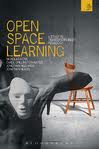
The concept is discussed at length in a book authored by Nicholas Monk, Carol Chilington-Rutter, Jonothan Neelands and Jonathan Heron.
 The dissemination conference on 27 June 2011 included both theoretical and practical elements. The book authors provided the background drawing on theories of pedagogy (Augusto Boal, Paulo Freire, Howard Gardner and David A Kolb), sociology (e.g. Stuart Hall, Fernando Ortiz), performance (the concept of the ensemble) and the ‘trans’ (for example, transgressive, transcultural, transdisciplinary, transcendent, etc.).
OSL is challenging for all. Tutors have to accept that in this situation they are there to be ‘dethroned’ of their knowledge; i.e. students discover their tutors do not have all of the knowledge in the room. Criticially, the interaction in creative spaces involving play renders the learning experience both memorable (students remember the sessions) and memorisable, in that the content is also captured.

Rehearsal Room
The learning spaces themselves are interesting. The University of Brighton’s and Sussex’s inQubate creativity centres came from the same conceptual space. Warwick elected – by virtue of their proximity to, and collaboration with – the Royal Shakespeare Company, to create a rehearsal room and a studio space (pictured). No desks.

Studio
The ensemble of students at the heart of the method, in some cases, act out roles. For example, first year chemistry students acted out elements in the periodic table, capturing their properties and those of the elements next to them in the table (see notes below). This built up a rapid knowledge about both elements and the table. As a foundation for, and complementarity to, more traditional chemistry teaching, it certainly seemed to capture the imaginations of both students and professors.

Jonathan Heron
There are a number of dependencies. This trial had the skills of a very talented facilitator, Jonathan Heron. Be under no illusions, he is a rare resource. Secondly, ‘lead learners’ acted as conduits and evaluators. Naturally, they were self-selected and all very keen and evangelical about the method. Students are known to be sceptical of activities that do not carry grades. Lead learners, therefore, carry the metaphorical torch for an alternative experience that potentially does more than enhance the learning experience.
The team’s technical lead, Robert O’Toole, has integrated a platform called Evernote. The platform enables the uploading of content relating to events immediately. In the session, content was being generated throughout by users with iPads and other mobile devices. Evernote is demonstrated here: http://www.evernote.com/getit
My notes from the event are here: OSL
 Be informed