Archive for the ‘Environment’ Category
Processed meat and health link – a red herring?
 Comments (1)
 Notwithstanding the intended pun, there is one aspect of this debate I had not thought about. So, last Thursday, we witnessed the publication of a Europe-wide survey highlighting the dangers of processed meat. In fact, we should not eat more than 20g per day, it seems. But Tim Lang, professor of food policy at City University London, noted on The Today Programme on Radio Four (7 March), that processed food is a direct consequence of the production of fresh meat, or at least the over production of beef, lamb, pork and indeed, chicken. The industry is so ‘efficient’ that it processes the less prime pieces to maximise the value of any animal carcass. The consequence of this, however, is the ubiquity of processed food, and its relative cheapness.
The debate on the Today Programme can be heard here: Lang on Today
For anyone interested in the work of Tim Lang, The Guardian newspaper offers the following: http://www.guardian.co.uk/lifeandstyle/2007/mar/25/foodanddrink.features5; his university profile can be found here: http://www.city.ac.uk/arts-social-sciences/academic-staff-profiles/professor-tim-lang
Horsemeat
 The discovery of horsemeat in ‘value’ burgers in UK supermarkets comes as no surprise. Whether the ‘mafia’ – as alleged by yesterday’s Guardian newspaper – is at the root of it, who knows? And any debate about whether the British have a problem with eating horses is a red-herring. The safety concerns are, of course, a factor. The content of manufactured food is supposed to be traceable. Clearly the inclusion of horse renders the contents far from traceable. Rather amusing really. Though the question is, what type of horse has been included. I do not mean the difference between a pony and a cart horse. I do mean the difference between one full of drugs or disease – or both – that should not be in the food chain and those that are not.
Rather, the issue is about price. Animal protein is expensive to produce. Using traceable meat particularly so, even if it is mechanically re-configured, or whatever they call it. The pressure on food producers is to cut costs in order to produce – for many people – affordable meat products. The pressure often comes from the supermarkets – and it is no surprise that it is the discounters and those offering ‘value’ level products particularly affected here. That said, there is no evidence so far that ‘premium’ products are not also contaminated.
Maybe this is just a critique of global capital. There are so many non-UK subcontractors in this story, one can see how messed up is the food industry. The eventual supply has been traced to Romania (via Cyprus and the Netherlands and France). Why Romania? Arguably, there are still many working horses there. Perhaps more importantly, the cuts in funding for trading standards departments in local authorities has reduced the detection capabilities.
I do not eat meat, but I do often cook from scratch – beans, vegetables and fruits. It takes time to prepare and cook, but I am pretty sure it is cheaper than cooking with meat.
Picture source: Wikipedia (Waugsberg)
You’ve been Trumped
 I’ve just watched this documentary in amazement. The corruption story is contemptible. Trump is building a golf resort on the East Coast of Scotland south of Aberdeen. Planning permission was originally rejected by the council – not least because the plan involved the destruction of a unique habitat with SSI (site of special scientific interest) status. The decision was called in by the Scottish Government, led by Alex Salmond, and overturned.
However, there are good people in Trump’s way. Local people whose houses, for Trump, are unwelcome features in the landscape. It is the story of how they have resisted and how the forces of the state have facilitated Trump against the locals. There is an extraordinary scene where the police manhandle the amiable journalist, handcuff him, and bundle him off to the police station in Aberdeen. But that is nothing against the despicable acts being perpetrated against the locals. Their water was cut off and not restored. There is footage of the electricity supply being cut by a digger; and the locals being billed for fences that they did not ask for or need.
Please watch.
The nonsense that is badger culling in England
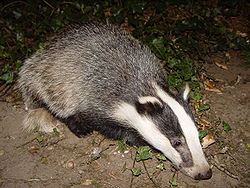
Source: BadgerHero, wikipedia
The long-fought for badger cull in England is about to start. The plan is to kill – systematically – 100,000 badgers; one third to the UK population. That, to reduce the infection of cattle by 15-20 per cent – not even to eradicate it.
Now the case against the cull has reached a new high with a number of eminent scientists at last speaking out. Lord John Krebs: “The scientific case is as clear as it can be: this cull is not the answer to TB in cattle. The government is cherry-picking bits of data to support its case.”; Lord Robert May, a former government chief scientist and president of the Royal Society, said: “I have no sympathy with the decision. They are transmuting evidence-based policy into policy-based evidence”; and the current government chief scientist, Professor Sir John Beddington, said: “I continue to engage with Defra [the Department for Environment, Food and Rural Affairs] on the evidence base concerning the development of bovine TB policy. I am content that the evidence base, including uncertainties and evidence gaps, has been communicated effectively to ministers.”
Not surprisingly, David Cameron, the UK Prime Minister, is quoted as saying: “I believe this is the right policy for healthy badgers as well as healthy cattle.” Even though, according to Professor Rosie Woodroffe of the Zoological Society of London “…all the evidence shows that culling badgers increases the proportion of badgers that have TB”. Dead badgers are always healthy.
So what is going on? Farmers and landowners have always had a penchant for destroying the countryside and anything else in it that offers a hint of competition to their activities. Foxes and birds of prey are persecuted incessantly on this basis. There is nothing like a land-owner’s whim – backed by the National Farmers’ Union – to base policy. Why do they never look at their own husbandry practices? Mad Cow disease, for example, was the farmers’ own doing. Though, we, the taxpayer, and the cattle, ended up paying for it.
http://www.guardian.co.uk/environment/2012/oct/13/badger-cull-mindless
Rising food prices
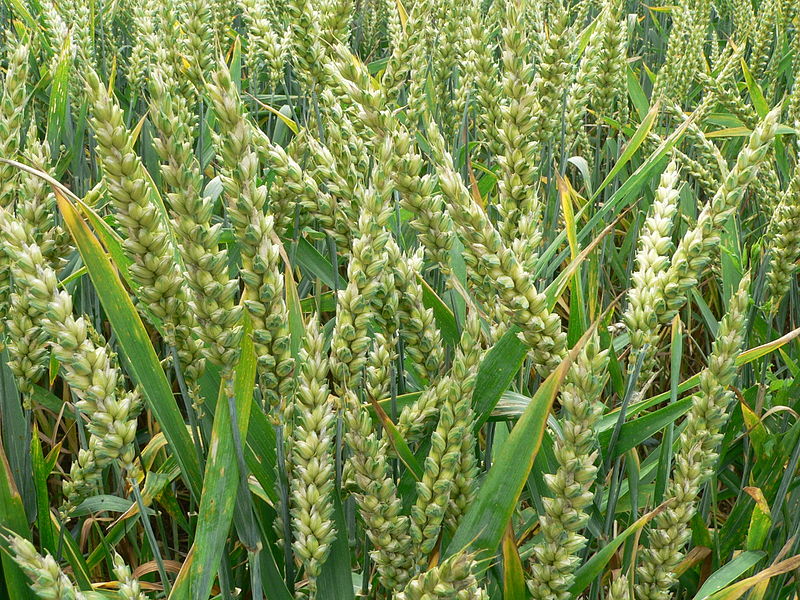
Source: David Monniaux, Wikipedia
I woke up this morning to the not unexpected news that food prices are rising. Particularly wheat. In the UK we are talking about yields being 15 per cent down. The dry spring and wet summer are the key factors for the UK. Drought in the prairies in the US and Russia have just compounded the situation.
Speculators are, clearly, going to do well out of this. It strikes me that a monkey could have speculated on this when the seeds were originally sown. I’m told that it will be hard for poultry and pig farmers as half of the grain crop goes to feeding these secondary sources of protein. I do feel that it is about time that the price of chicken and pork reflected the real world a little better. Maybe more of us can cut down or even eradicate meat from our diets. It is not going to get any better.
However, rising food prices do hit the poor disproportionately. The Guardian quotes Tim Lang, professor of food policy at London’s City University speaking on the Today progamme on the BBC. “Lang said the poorest 10% of households in the UK had seen a drop in food affordability of 20% in the last eight years and that this was also a “disaster for public health” as the price of healthier produce such as fruit had risen by 34% in the last five years. Lang, who coined the phrase “food miles”, said: “Most analysts think the long drop in food prices, of affordability, is over. We are now in a new world, a world of new fundamentals, not just bad weather this year but a long-term squeeze.””
http://www.guardian.co.uk/environment/2012/oct/10/food-prices-rise-wettest-summer
Arctic sea ice

Source: NASA
My most recent blog entries have been a shade indulgent. I write about my holiday; actually, a rare occasion when I do not add an awful lot of CO2 into the environment. That said, the tandem’s manufacture probably added considerably to my carbon footprint. The holiday was made by the beauty of the natural environment fed by a powerful river (the Rhine).
It has been a long time since I have been a serious environmentalist. I cut my campaigning teeth with Friends of the Earth in the early 1980s; and I bought the Guardian newspaper specifically to read the environment stories. Today I am reminded – as a somewhat older man – that the issues have not only not gone away, but rather they have worsened. Our knowledge about what is happening has increased, but the denial across the developed world is not retreating.
What has actually reminded me? The Guardian newspaper has published a short article quoting Professor Peter Wadhams of Cambridge University. This year has been catastrophic in terms of arctic ice melt. It is now down to a mere 3.5m sq km down from the previous lowest recorded in 2007 of 4.17m sq km. He predicts this will have retreated fully by 2015/16. “As the sea ice retreats in summer the ocean warms up (to 7C in 2011) and this warms the seabed too. The continental shelves of the Arctic are composed of offshore permafrost, frozen sediment left over from the last ice age. As the water warms the permafrost melts and releases huge quantities of trapped methane, a very powerful greenhouse gas so this will give a big boost to global warming.”
http://www.guardian.co.uk/environment/2012/sep/17/arctic-collapse-sea-ice?INTCMP=SRCH
 Be informed