Archive for the ‘Politics’ Category
Women Fashion Power – Design Museum, London (part 2)
 The second part of the show continues the chronology but also introduces biography. So for example, various designers are introduced; notably Coco Chanel on the one hand, and Vivienne Westwood on the other. Chanel drew her inspiration from the functional male wardrobe including cardigans, waistcoats, tweeds, trousers, cufflinks, etc. Not forgetting her iconic Little Black Dress of 1926 (left is a version of the LBD from Chanel’s chief designer, Karl Lagerfeld of 1991).
There are some lovely garments capturing the ‘flapper’ period in the 1920s. This seems to have been a opportunity to work shoes into the story. Even I was taken by some of them (see right) .
.
 Elsa Schiaparelli, a name with which I was not familiar before the exhibition, designed on the basis that clothes had to be architectural. The body should never be forgotten and must be used as a frame as used in a building. Whilst I am not entirely sure what this means, and hence convinced, she had a most exquisite jewellery box (left).
Zips arrived in the 1930s along with Rayon, a cheap alternative to silk. There is a whole section on nylon stockings, naturally! And then on to Dior’s so-called New Look. This was, of course, an old look and reverted back to hour-glass figures and generated a market for ‘waspie’ corsets, with Triumph International leading the market.
The 1930s also saw the influence of Hollywood. Female stars were becoming important figures for designers to be associated with. Their ability to popularise designs is familiar to us today. Madeleine Vionnet is credited in the exhibition for introducing the bias cut enabling a flattering cling of clothes to the body and a further release from strict undergarments enabling ever-more revealing evening wear to be worn by the stars. Marlene Dietrich, Ginger Rogers and Bette Davis are three of the stars featured.
 However, these clothes were still out-of-reach for many women. Publishing houses like Condé Nast guided women in the art of dressmaking and the Hollywood Pattern Company sold patterns to make the stars’ dresses at home (left). All that was needed was a sewing machine.
This link with fashion, entertainment, industry and machines is fascinating. The power, element, however, short of progressive loosening of undergarments, is less well articulated. The re-emergence of the corset in the 1940s indicates how fashion has power over women rather than the other way around. One way of getting round this for the curators of the  exhibition is to dedicate a large section to the dress selection of modern powerful women. A couple of dozen women – for example, designers Zandra Rhodes and Vivienne Westwood, lawyer Shami Chakrabarti, journalist Kirsty Walk, children’s campaigner Camila Batmangehlidjh – donate a garment and explain why it is important to them. This is a bit self-indulgent, a bit of a filler. That said, as the picture (right) shows, one can get up really close to the garments and look at that stitching.
I would say visitors need at least 2 hours to do the exhibition justice. There is a café in the museum, it is worth visiting half-way through to recharge. There is a lot of information to process. A break is needed.
Women Fashion Power – Design Museum, London (part 1)
 This is my second visit to the Design Museum this year. And as small museums go, this is one of the best. The exhibitions are exceptional in their content, presentation and accessibility. I have already railed against the British Museum. The contrast could not be greater. Whilst there are no opportunities to touch the artefacts (mainly items of clothing), they are all exhibited in such a way that one can view at close quarters. If you want to look carefully at the stitching, you can.
The exhibition runs until 26 April 2015. It starts, naturally, with corsets (examples above left). These were essentially garments of control with dress makers designing only for those – largely wealthy – women with hour-glass figures. Change comes with the arrival of the concept of, what seemed to me, commercial fashion. French couture became showcased bi-annually in Paris. And that many shows requires constant change. And for women, this was progressive change.
In parallel, Amelia Jenks had the audacity to offer women ‘bloomers’ (right) and the ‘shirtwaist’ – essentially, women were able to wear 2-pieces made up of a shirt and skirt.
 But then women took to sport: sea bathing could not realistically be undertaken with even Jenks’s liberated wear. The bathing costume then appears (example left) along with clothes suitable for cycling (another piece of technology eagerly adopted by women). And tennis. And motoring. The brands then emerged led by Creed, Redfearn and Burberry.
The campaigning Suffragettes in the early 20th Century deliberately dressed modestly so as not to conflate political liberation and  decency. But Suffragettes did adopt uniform colours – purple white and green. They also had accessories such as the medal (right). This is a reproduction, but it is a beautiful piece.
The next driver identified in the exhibition is the rise of the department store and mass production itself driven by the rise of the middle-classes, mass consumption and the growth in women’s disposable income.
And finally, in this section, is the patenting in the brassiere by Mary Phelps Jacob. The concept was liberating, it is argued, because it was designed to flatten breasts rather than accentuate them. It was an important de-sexualisation of women.
The landed rich fluff up their feathers
 So, a quarter of a million people turned out on a sunny bank holiday yesterday to pledge their support to their local hunts, for ten years now deprived, by law, of the right to hunt live foxes. This turnout is supposed to be a clear signal that the law should be overturned to allow the rich, again, to tyrannise the countryside in the name of fun. There are seemingly something like 60 million people in the UK. It is going to take more than 250 thousand rich people and their employees to overturn this law.
And then there is architecture. Charles Windsor (aka the Prince of Wales) has apparently come up with 10 principles of architecture that have traction only because he is rich, powerful and the heir to the throne. The principles all reflect his worldview – privilege, aesthetic, means, wealth, ownership, to name but a few. His principles have been put to the sword by architecture critic, Douglas Murphy, in the Guardian newspaper. I have to say that I enjoyed reading the demolition job which concludes with the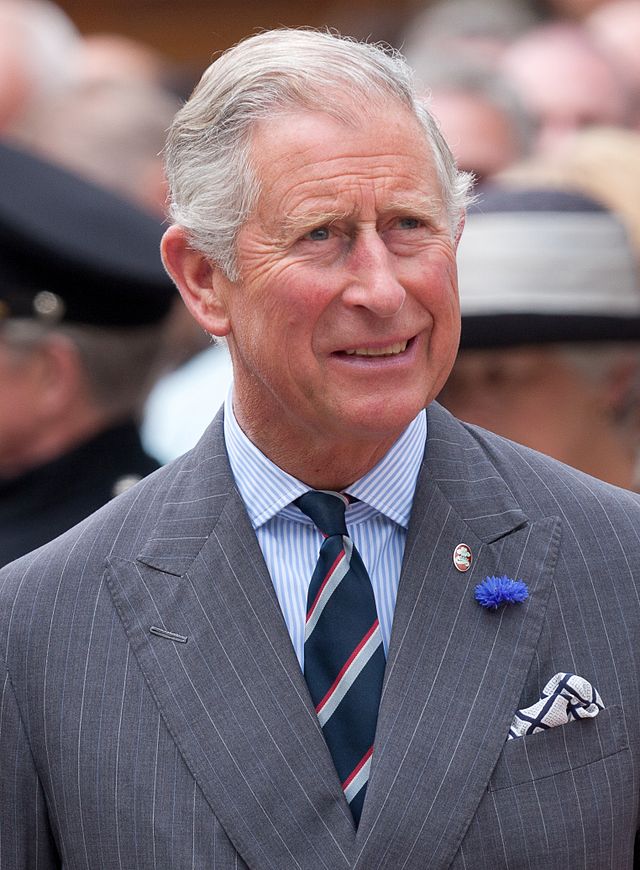 following:
“[W]hen Charles blasts modern architecture, he is essentially blasting the historical processes set in motion by the industrial revolution, and lamenting the diminution of his royal power in the world that it brought about. His dreams of traditionally designed cities are dreams of a world where people forever know their place.”
There’s a lot of architecture that I do not like, but there is an awful lot of architecture that reflects my own origins, sense of place and aspirations. My former university, the University of East Anglia, is one big block of concrete. But I owe so much to that place and the people within it.
Pictures: Master of foxhounds leads the field from Powderham Castle in Devon, England:
Charles Windsor:
Magazine subscriptions
Filed under: Environment, International, Journalism and News Reportage |
 Comments (1)
 I subscribe to two weekly magazines – the New Statesman and The Economist. The former for twelve years, the latter perhaps four years. The Economist is an essential read for my work. The New Statesman feeds my interest in political debate. I took up reading it when I ended my daily subscription to the Guardian newspaper.
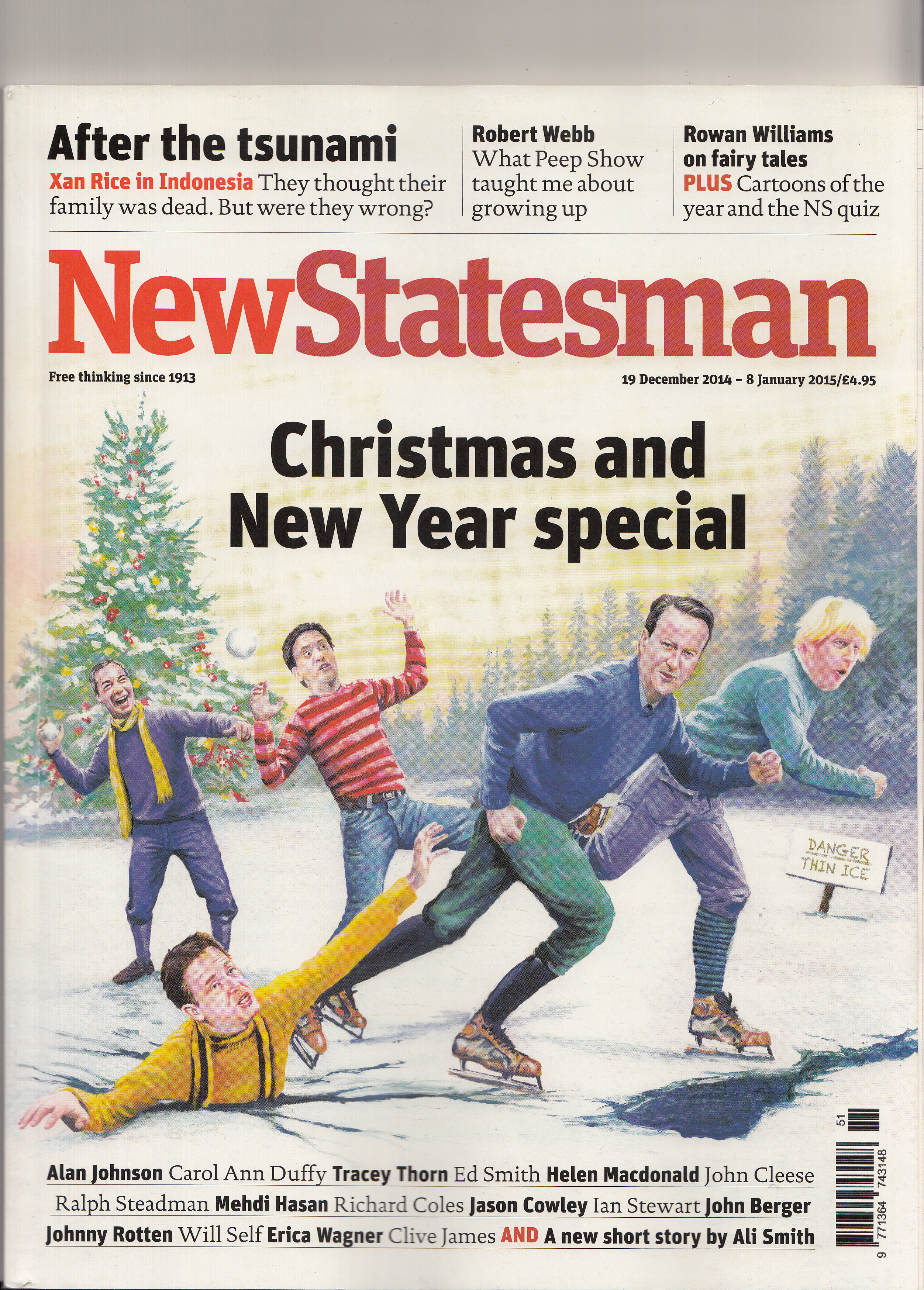 When big public holidays arrive, both magazines publish bumper editions – sufficient to keep readers satiated for the two weeks that the magazines are on holiday, as it were. The New Statesman’s bumper edition is, generally, full of pap and even some of my favourite columnists let the side down. This year, for example, Will Self has taken to writing about another columnist in the same magazine! And to make matters worse, when that columnist started a few years ago, I only managed a couple of weeks before I lost the will to read any more, life being too short and all that. Holding the fort are the veterans Peter Wilby and Hunter Davies.
The Economist, however, fills out its pages with features on history, culture and science. Although it is unashamedly 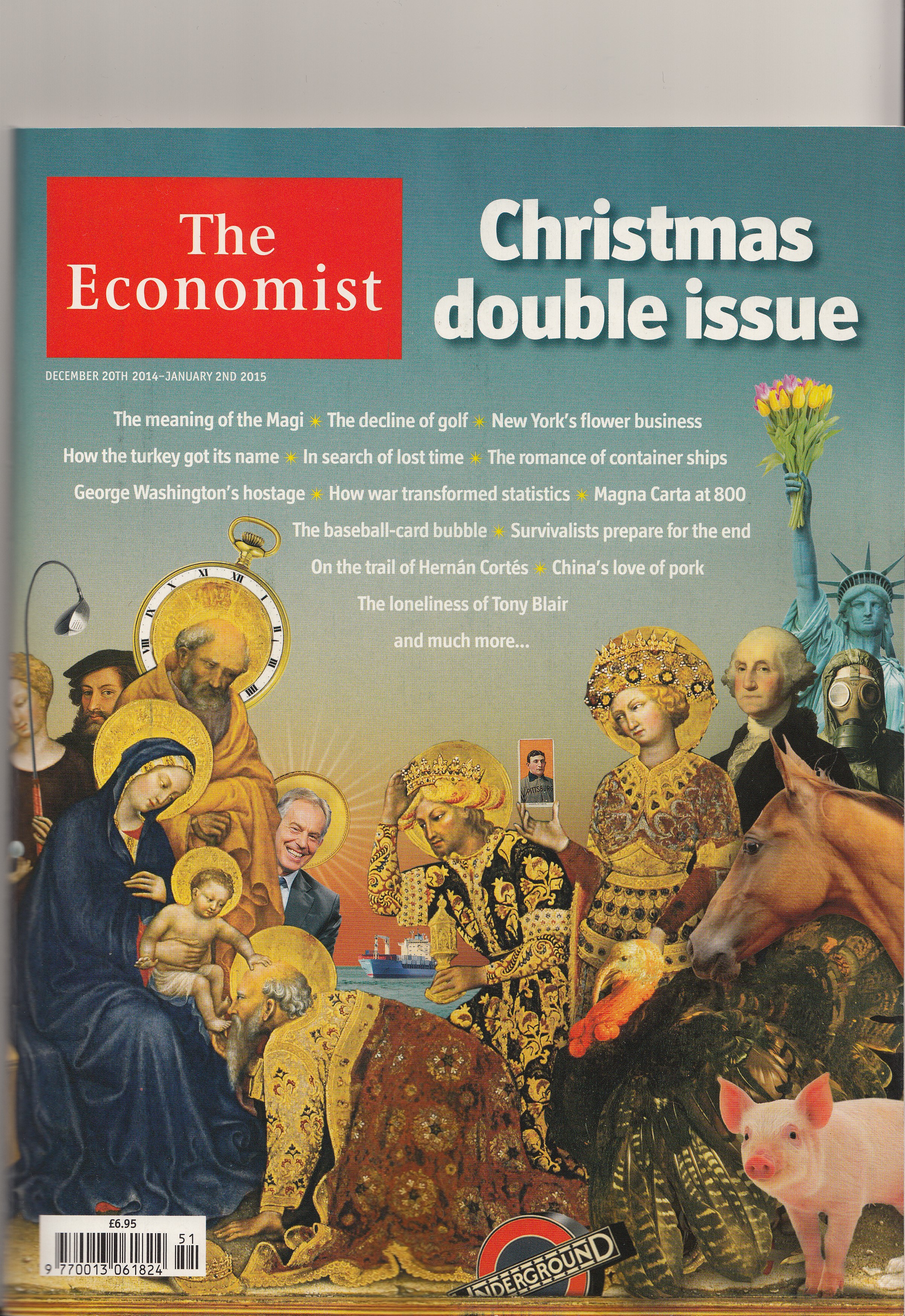 conservative, neo-liberal, it is at least well written and thoughtful. Hence I’m prompted to relay one of those features to readers (20 December 2014, pp82-84). It tells the story of the rise of pork as a symbol of affluence in China. It is a favourite food. Seemingly, Chinese citizens eat the equivalent of half a pig each per year (that is 500 million pigs annually). Such is its importance for the Chinese government seeking social stability, it is subsidised to the tune of $22bn per year. However, this leads to environmental and resource challenges.
Most are factory reared. Consequently they are routinely fed antibiotics to stave off disease that could decimate what is increasingly an in-bred, non native pig population. They are mainly fed on cash crops, particularly imported soy beans. These are grown predominantly in South America on land much of which has been cleared of rain forest. Moreover, the Chinese pork industry is responsible for 50 per cent of the total global soy market. Each kilo of pork requires 6kg of feed.
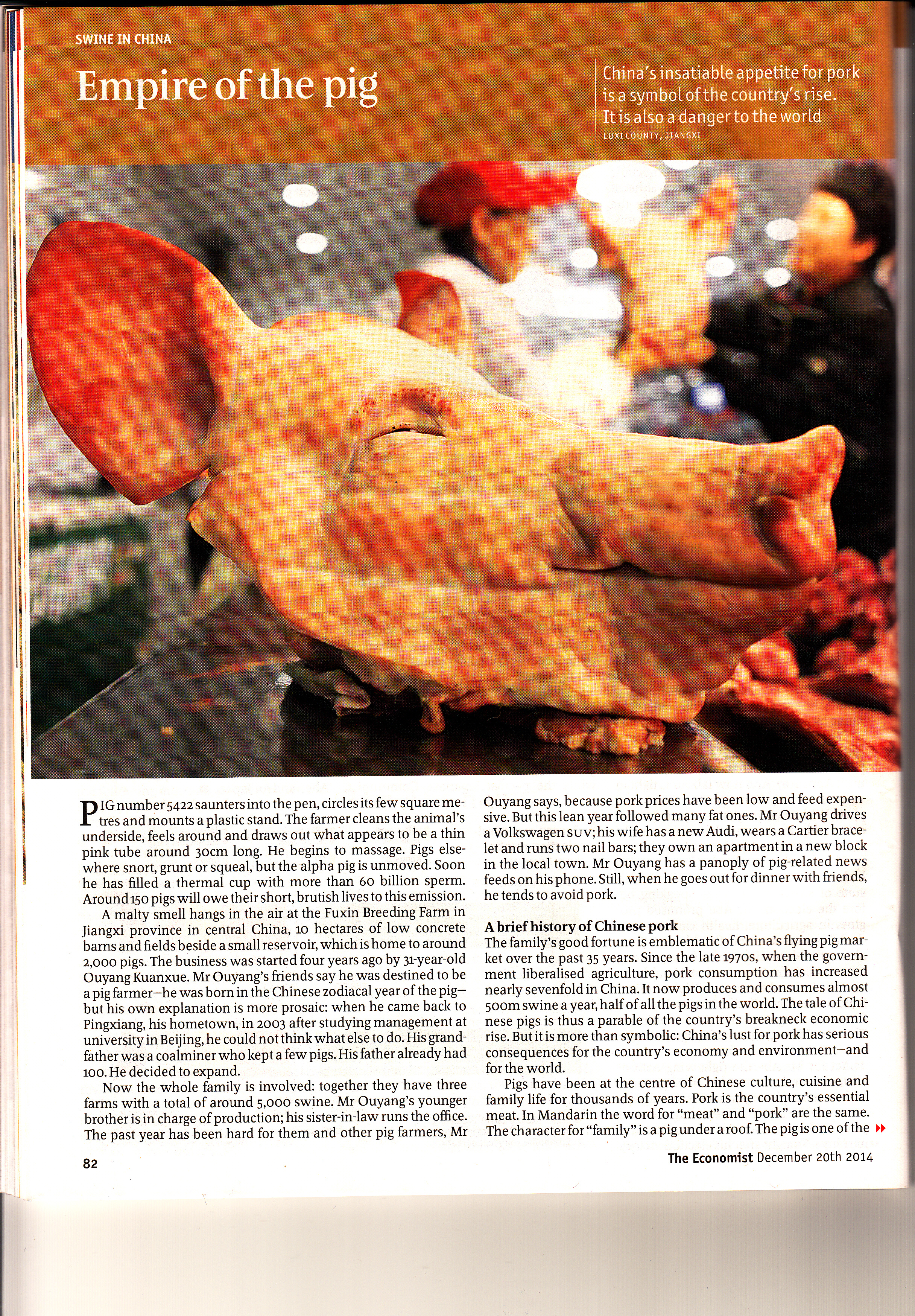 Then there is the waste. Each pig produces, apparently, 5kg of waste per day. Traditionally, pig excrement was highly valued as a fertiliser; however, mass produced pigs generate contaminated waste – antibiotics, hormones, pesticides, etc., not suitable to spreading. There is also too much of it. Pigs and pig waste have become increasing sources of water and soil pollution.
Moreover, the pigs themselves produce methane and nitrous oxide. These are potent greenhouse gases somewhat more damaging than carbon dioxide (300 times more so, it is argued).
I gave up meat 35 years ago. I may give up the New Statesman in 2015.
Why calls to keep the East Coast rail franchise in the public sector are folly
 The East Coast rail franchise has been successfully run by the UK state organisation, Publicly Operated Railways (POR), since it was abandoned by National Express in 2009 when it failed to meet its financial targets.
East Coast will return to the private sector in April 2015 after a protracted bidding process was finally won by the joint Stagecoach/Virgin venture (90/10 shares respectively). The Department of Transport somehow avoided awarding the franchise to the French state railway bid (Keolis and Eurostar joint venture).
The anti-privatisation debate has been championed by the Labour party and is logical. DoR has made healthy returns to the Treasury, why hand these to a private company when the public sector has done so well? At the very least, why could DoR not bid to run the franchise?
The Conservative government’s response, essentially, is that anything that the public sector can do, the private sector can do better. Notwithstanding the fact that often they cannot as two of the franchisees for this route – GNER and National Express – have failed. However, the Stagecoach/Virgin alliance has worked on the West Coast route and Stagecoach has been running the London commuter franchise, South West Trains since privatisation in 1996. But ultimately, the Conservative government has an ideological fixation with the private sector. Many of its members have positions in private sector firms that benefit from government contracts.
For me, however, keeping individual franchises in the public sector is a red herring. These are companies that have no assets. Whilst they are the main channel for passengers to access railway services, they are far from being the railway. The assets of the railway are arguably where the value is. Now, fortunately, the key assets – the permanent way, signalling, stations, etc. – are public sector assets after the demise of Railtrack in 2002. But these assets do not generate surpluses. Quite the contrary. Despite announcing a pre-tax profit for 2014 of £1.035bn, the cumulative debt amounts to £20bn.
 By contrast, the owners of the rolling stock make a killing out of leasing trains to franchisees. There are three major players whose profit margins after tax seem to be around 10 per cent, according to a Channel 4 News investigation. Whilst there may well be some shrewd investment and management involved, ownership of these firms lacks transparency (two have registrations in Jersey and Luxembourg). Moreover, these businesses were sold at privatisation for a song. Porterbrook Leasing, for example, was sold in November 1995 for £527m. It was resold in July 1996 to Stagecoach for £825m. In essence, it costs a lot of money to lease trains to generate high profits for the leasing companies.
My argument, then, is this. The railway is only meaningful when it is an integrated whole in terms of its ownership and operation. Keeping franchises in the public sector when the real money is made by those with whom they must contract in order to provide train services; namely, rolling stock leasing companies, is to miss the point. It gets the Labour Party off the hook. But it is not public provision of public services.
Picture: Class 171 Mackensen
Public housing
 I was very pleased to hear Councillor Bill Randall being invited on to Radio 4’s Today programme yesterday to discuss current inequities regarding housing in the context of the acute shortage experienced in Brighton and Hove where he is a senior figure and a distinguished housing expert. This being the BBC, he was pitted against Adam Memon (right) of the Centre for Policy Studies an apologist for
 continued expropriation of public housing by private landlords and provision of public subsidy for this through high housing benefit allowances. Seemingly in Brighton and Hove, 6000 council dwellings have been sold since Thatcher’s flagship ‘right to buy’ policy of the early 1980s; one thousand of these have passed into the private rented sector. Another tranche have been resold to private sector buyers from outside the town – Brighton, in particular, is extremely expensive and ex-council houses are sought-after properties. A cursory glance in the window of an estate agent shows a three-bedroom example for sale at £275,000. The exchange has been captured here:
Picture: Bill Randall: brightonandhovegreens.org; Adam Memon: CPS
The oil price is a problem
Filed under: Environment, Finance and Economics, International | Tags: environment, fracking, oil price
Leave a comment  Whilst I am delighted to see that I can fill the tank of my ever-so reliable van for a fraction of what it cost this time last year and fly until my heart is discontent in the knowledge that the value of the airlines (share price) is increasing, they having done nothing more than survive three months since the oil price started to plummet, it is bad news. Why?
First, burning hydrocarbon fuels is bad for the environment and price is a key regulator of consumption. Second, many oil producing countries – some of them not the richest – have set their budgets at anticipated levels; for example, $100. The shortfall of $35 (reflecting today’s price-per-barrel) can make the difference between life-and-death. High oil prices, then, can be good transfer payments between rich and poorer countries.
Third, oil company shares are down sharply. With these stocks being some of the key investments made by pension funds, meeting obligations becomes more difficult. Fourth, investment in renewables will be hit. Suddenly it is only cost-effective to burn oil. Fifth, geopolitics. When demand goes down, price is often regulated by cutting supply. This is not happening for reasons which are currently unclear. However, there are some suggestions that it is a power battle between oil producing countries particularly in the middle-east rendering the region even more unstable than it already is. That is also not to mention the situation in Russia. Very much an oil economy that is suffering also from ludicrous EU sanctions. There is unrest ahead.
What about the positives? Well, I can think of one key positive. The glut in demand is, in part, caused by shale oil production in the USA and tar sands in Canada. These two practices are very damaging to the environment. $65 a barrel is not sufficient to warrant such production. Whether the firms will cease their activities remains to be seen, but what is clear is that where fracking has not yet started, it is unlikely to do so.
Picture: Flcelloguy/Wikipedia
Nick Robinson and friends
Nick Robinson is a familiar voice and image as the BBC’s political editor. With that, I always thought came responsibility. Of late, Nick Robinson seems to have been pushing the boundaries of his brief. During the Scottish Independence campaign, Robinson was accused of pro-union bias.
But Robinson is increasingly indiscreet when it comes to images of himself. For example, in posing in a ‘selfie’ by the Danish PM, Helle Thorning-Schmidt (right). Essentially, his though must have been that anything that is good enough for President Obama (he had a selfie with Helle Thorning-Schmidt at Nelson Mandala’s funeral) is good enough for him.
Well, maybe, but how does one explain his latest photo opportunity? At the election  count of the recent Rochester By-election in the UK, he allowed himself to be compromised with a shared picture with the fascist candidate Jayda Fransen, of Britain First (left).
He has argued that it was a mistake. He was invited to have his picture taken and without too much thought, he posed. But he is the political editor of the BBC, not some trainee. Moreover, his penchant for photographs featuring himself is worrying.
As for Jayda Fransen, what a coup. Let us not forget, also, that Britain First removed themselves from the ballot paper and pledged support to UKIP so as not to split the right-wing vote.
Picture: Fransen/Robinson, Britain First
Germany: Memories of a nation exhibition at the British Museum
 Naturally, this exhibition displays an authentic VW Beetle; though you do not need to pay the £10 admission fee to see it. It merely entices visitors in.
First, let me say that I went with my German partner. Her endorsement of the exhibition is praise indeed, knowing all too well that the English, particularly, focus on the country’s Nazi past. This exhibition has something else important to say about the German Nation’s history.
Okay, now to a few quibbles. First, normally I expect to be able to take photographs in an exhibition, not least to upload to this blog. But, here, photography is not allowed. And it is enforced. One assumes this is to protect the value of the accompanying products that one can buy in the shop including Neil MacGregor’s thick tome (right).
Second, the British Museum is huge. For some reason, the powers that be at the Museum have located this exhibition in, what amounts to, a cupboard. The space is far too small not only for the numbers of visitors, but also the exhibits themselves. And for some inexplicable reason, the British Museum does not seem to have learned too much about exhibiting.
For example, in the years of German hyperinflation, German towns produced their own currencies -they being as valuable as the national currency. Such is the nature of hyperinflation. The towns printed their own bank notes. They were often colourfully printed with very particular designs. In essence, they demanded a very close scrutiny. But the museum has made it virtually impossible to scrutinise these artefacts. They are locked in a glass case set against a wall. They are three or four abreast. Unless one is 2 metres tall, inspecting the detail is impossible.
 And even those artefacts that are not in glass cases (most seem to be), they are not exhibited at the height that best suits most of us. Take, for example, the exquisite Strasbourg Clock (left). This image features Neil MacGregor, the boss of the British Museum and the author of the book and presenter of the 30-part BBC radio series accompanying the exhibition. The clock enjoys amazing detail in terms of figures and engravings over-and-above the feat of timekeeping technology that makes it work. And rest assured, it is amazing. But actually, I saw more of it on the BBC website (http://www.bbc.co.uk/programmes/p028bdxq) than I did at the exhibition. I’m just not tall enough.
Landing on a comet
 The European Space Agency has, in the last 10 minutes, landed a probe (left) on the surface of a comet for the first time. This is important as it may help explain the origins of life on Earth as comets were there at the formation of the solar system. Notwithstanding the technical feat associated with achieving a landing on a rocky object travelling at 18km/s and is 510 million kilometers away (it takes over 30 minutes to get a signal back to Earth from the craft).
There is a real UK political dimension to this captured brilliantly in a tweet:
https://twitter.com/infuriousbeauty/status/532569277321449473
 Be informed