Archive for the ‘Politics’ Category
The entrepreneurial state
 Professor Mariana Mazzucato’s book, the Entrepreneurial State, contains some interesting observations about the role of the state in fostering innovation and hence creating wealth. It is evident that the private sector relies on public sector investment in research for its ideas, frameworks and technologies. The internet is a good example. Many drugs have their origins in publicly-funded laboratories (recent discussions around AstraZeneca and Pfizer have been caught up in this). Google is built on it. And even if the ideas, prototypes, patents do not originate in public research/educational establishments, the minds behind them do. The problem is, it seems, the private sector’s ability to appropriate these public goods for itself.
Professor Mazzucato’s recent lecture on this topic can be seen here: http://www.sussex.ac.uk/newsandevents/sussexlectures/2014?lecture=116&fmt=youtube; it was one of the best professorial lectures I have witnessed in recent years (notwithstanding Jonathan Chapman’s at the University of Brighton on Sustainable Design, 22 January 2014: http://www.youtube.com/watch?v=iBECx-L55Fg). Mazzucato demonstrates a number of indicators of disingenuousness on the part of knowledge-rich firms. One of the most startling and worrying is buy-backs. Large firms that spend their cash on buying back their own shares rather than investing in research are painted as villains. In the past, the exemplars were Xerox and Bell with their investment programmes that brought us spinouts such as Adobe, 3-Com and Lucent amongst many others in technology.
Buy backs take out investment from the economy. They put the burden on the public sector to do the risky stuff. Firms have become increasingly ‘financialised’. Pfizer, she argues, is just one example. There are many more spanning hi-tech industries across the globe. She explains this around 24 minutes into her lecture.
And so to remedies. Professor Mazzucato argues that states should be able to claw back some of the benefits accruing to firms when they win on the basis of public funding. Professor Mazzucato’s recommendations include: “golden shares of IPR and a national innovation fund”, “income-contingent loans and equity” and “development banks”. Stian Westlake of NESTA, the UK innovation investment fund, by way of critique, notes the following:
- Essentially, they all involve the government retaining a financial interest in companies that develop innovations based on public funding, with the idea that this money can be recycled to back more radical innovations. As far as I can see there are three problems with this idea: It would be nightmarish to administer It imposes costs on exactly the wrong businesses, creating both a presentational and a practical problem It’s worse than an already existing option – funding innovation from general taxation.
The full debate can be accessed here: http://www.nesta.org.uk/blog/how-not-create-entrepreneurial-state#sthash.eJoHD7wz.dpuf
Privatisation watch: the lingua franca (2)
Filed under: Politics, Privatisation | Tags: child protection privatisation
 Leave a comment
  Plans to privatise child protection services in the UK have been revealed. The proposal in a leaked document is for the Department for Education to allow local authorities – councils – to outsource children’s services. These powers include making decision to remove children from their families.
Private providers, reports the Guardian newspaper this morning, “will allow authorities to ‘harness third-party expertise’ and ‘stimulate new approaches to securing improvements’ for safeguarding services outside ‘traditional hierarchies’…”. Ah yes, there is that ‘expertise’ again. Along with securing…improvements and replacing ‘traditional hierarchies’ with presumably non-traditional private hierarchies.
On an interview on Radio 4 earlier, the word ‘innovation’ was used by a defender of the proposal. Again, only the private sector can innovate. G4S, one of the innovation-led private sector companies thought to be lobbying for this market to be opened up, has innovated in not providing security for the Olympics and overcharging for its offender tagging services. Actually making up some tagged offenders. Another company, Serco, innovated in manipulating figures showing it had met targets in outsourcing family doctor services. Let’s also talk about Atos which in March this year pulled out of its £500m capability assessment contract after evidence of widespread incorrect ‘judgements’ on claimants’ fitness-for-work, leaving many without benefits.
Picture: politicalscrapbook.net
Privatisation watch: the lingua franca
 For what is it worth, here are the phrases that justify the privatisation of public assets. Fill the gaps with the name of the organisation/agency earmarked for treatment:
The objective is to: “protect and enhance its [***] scientific capabilities in the long term” – Owen Patterson, UK Environment Minister on the proposed sale of the Food and Environment Research Agency.
It always seems to be the case that public agencies lack expertise, such that “[p]rocuring the right external partner, with the necessary commercial expertise and experience will help [***] to maximise its market potential and grow its non-government revenue”.
Let’s not forget the career prospects for the employees, should critics ask: “I am also confident that a joint venture would offer new opportunities to [***] staff.” That is reassuring from Owen Patterson.
And of course, according to Vince Cable, the Business Secretary talking of the privatisation of the Royal Mail last year, share ownership “energise[s] everyone … allowing employers and employees to share in the company’s future success”. My post is usually delivered by a man who looks newly energised. I’m sure he is also energised by the fact that 6 ‘priority’ investors made £750m out of the sale of shares on the first day of trading. But as Mr Cable told a select committee of the UK Parliament, “that is the market”.
Politicians and increasingly civil servants always tell us not to worry because: “[we] would only take forward specific measures where there was a clear public benefit and subject to suitable safeguards.” (official statement from UK Revenue and Customs regarding the sale of ‘anonymised’ tax data).
More to follow.
Privatisation watch – Land Registry
 After yesterday’s post on railways, I’ve concluded that the present British Government is again engaged in a scorched-earth policy of selling the remaining state assets to corporate interests in anticipation of losing the next election whilst ensuring, as the Thatcher/Major Governments did before them, that a subsequent Labour Government (if it is to be such) cannot reverse the transfers.
Next on the list – reported today in the Guardian newspaper – is the Land Registry. The land registry is the state body that records ownership of land and its value. It also adjudicates on disputes. Its clients are conveyancers (Law Society) and mortgage providers (Council of Mortgage Lenders).
In terms of financial performance, justification for privatisation is not based on improvement. According to the Guardian, “…it made a surplus of £98.7m in 2012-13, up from £86.1m the previous year, while revenue slipped by 3% to £347m.” Likewise with customer satisfaction, seemingly, very high. This translates into an estimation of its value as £1.225bn.
In order to get round the conflict of interest that may arise from a private company adjudicating on disputes, the Government plans to set up an “Office of the Chief Land Registrar” to manage this part of the portfolio. I’m reassured.
Rail nationalisation – think it through
 I woke up yesterday morning to a news story that 30 or so candidates for the Labour Party in the UK are arguing for a partial nationalisation of the railways in line with Ed Miliband’s indication that a new Labour Government would seek not just to ‘run’ the country but to ‘change’ it. In order to avoid paying compensation to incumbent franchise owners, franchise contracts will simply not be re-let when existing contracts expire. The East Coast franchise, they argue, having been run by DOP (a public-sector company) for four-and-a-half years after it was abandoned by National Express after failing to meet targets, has been a ‘success’. There is a better way to run the railways, seemingly. And one that will see a reduction in ticket prices.
Let us just examine this in a shade more detail.
First, what is success? DOP delivered returns to the Treasury (£208.1m last year according a Guardian Newspaper report, 26 October 2013), but did not match the National Express contract commitments; not least because they were flawed. Though customer satisfaction levels were, it seems, at a record high (2-3 percentage point higher than the Intercity averages).
Second, the railway is a capital intensive: infrastructure (already in the public sector as Network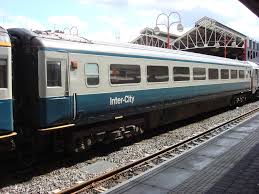 Rail) and rolling stock (trains – all privately owned by Angel Trains; Porterbrook; Eversholt Rail Group and QW Rail Leasing).
The Franchises own virtually nothing over and above a few ticket machines. The costs, therefore, are largely fixed. They pay track access charges (to Network Rail) and rental charges (to one of three rolling stock leasing companies). The profit comes from a margin between fares, subsidy and operating efficiency.
Should the franchises be transferred to the public sector, those costs will not change significantly. Certainly not significantly enough to see a reduction in ticket prices.
 Third, under the present structure of the transport industry, who benefits from reduced ticket prices? The unfortunate reality is that the main beneficiaries are the relatively wealthy middle classes. The routes in the South East of England – in and out of London – attract the most attention for this reason. Also because the routes encompass some of the most sensitive electoral constituencies. And richest. The least wealthy areas, even in London, do not enjoy links with either the national rail network or the Underground. Actually, these areas are much more dependent on buses than trains. On that basis, it makes much more sense to nationalise the bus industry than the railway industry.
Now I am not arguing against nationalisation. It is clear in the years before privatisation, the railway industry was efficiently managed. Privatisation was at best a scorched-earth policy by the outgoing Major Government and, at worst, asset stripping by foreign and national ‘operators’. Any nationalisation programme will need to find a way to bring back all of the assets, including the rolling stock, back into public ownership.
 However, the issue is not about the ownership of the railways, rather transport policy more generally. What are the railways for and how do they link into the provision of mobility ‘rights’ for citizens, by whatever mode? And what is that worth in terms of transfer payments from the taxpayer to operators whether public or private? Let us not also forget the role of public transport in meeting environmental protection targets, such as CO2 emissions. It is cheaper, in many cases, to use private motor vehicles, particularly over longer distances.
Then there is the question of demographics. So much public money goes into servicing passengers in the South East of England because of the London effect. Government policy surely has to consider equalising wealth and opportunities across the country rather than concentrating it in the Capital which perverts demand for transport services.
In essence, then, a radical policy is not about the ownership of a few railway franchises. A radical policy requires new thinking about transport, its function, value and impact on other policy domains such as housing and economic development (beyond the capital).
Picture:
InterCity coach and 125 in Hull Paragon Station: Oxyman/Wikipedia
Nationalisation graphic, Bring back British Rail: http://www.bringbackbritishrail.org/news/page/2/
Cigarette industry – grim prospects?
For a number of years this blog has reported, as irreverently as possible, cigarette advertising in Germany. Germany is one of the few places in Europe where it is still possible to advertise cigarettes. The contrasting campaigns are a source of endless fascination as the brands pit themselves against one another.
However, cigarette advertising is one thing, the continuation of the industry more generally is now in some doubt. I say this after reading an article in the Economist magazine (link below). Apparently, it is fifty years since the US Surgeon General declared smoking to be a ‘health hazard’ requiring appropriate ‘remedial action’. This remedial action led to a decrease in cigarette consumption from 43 to 18 per cent in the American adult population. Still, 20 million Americans have died from smoking-related diseases since then. The current Surgeon General has declared smoking deadlier than previously thought and has promised ‘end game strategies’.
 What does this mean for the tobacco companies? Traditionally, they have found new markets, particularly in Asia. But here, also, the regulatory environment is becoming hostile. Arguably, too, the firms have not seen the e-Cigarette phenomenon coming – dominated at the moment by new firms, a selection of which are represented on the panel (left). Perhaps they have failed to understand fully what is their business? The customer craves nicotine, not tar: e-cigarettes seem to be efficient deliverers of nicotine, and less riskily. Though this may well be scrutinised closer in coming months and years.
Another approach seems to be cigarettes that do not actually burn the tobacco. Rather they heat it to deliver their nicotine payload.
Picture: http://www.eciguserguide.com/promising-e-cigarette-brands-2014/
Making trains
 Finally, some good news for UK manufacturing. Bombardier, the Canadian engineering firm, which owns the former British Rail train factory in Derby, has won the competition to supply 66 units to Crossrail opening in 2017 (impression, below right). They beat off competition from Siemens and Hitachi. The former recently won the contract to make the Thameslink trains. Hitachi trains can be seen running on HS1 between St Pancras and Dover.
Whilst I understand that competition is necessary when placing orders for expensive long-lived kit to ensure some  degree of value-for-money and quality (British Rail supplied to itself a lot of over-priced un-tested stock in the 1950s that very quickly found itself decommissioned), I despair at the ease with which much of the UK’s supply comes from abroad. The train building capacity and capability in the UK has been lost.
I despair even more, however, at the madness that the structure of the railway industry in the UK. This week, we learned who were the preferred bidders for the re-privatisation of the East Coast Mainline ‘franchise’ between London, the North of England and Scotland. The current operator, 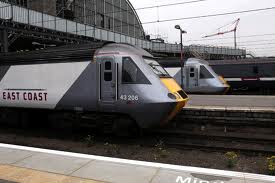 Directly Operated Railways (DOR), has been running the route successfully and profitably since National Express handed back the keys, so-to-speak, in 2009 after they failed to deliver the returns to the UK Treasury pledged in the contract (DOR has returned some £600m to the Treasury so far). National Express replicated the error made by its predecessor operator, GNER, that equally over-stretched itself and delivered those very same keys back to Department for Transport a couple of years earlier.
Three private-sector charlatans will slug it out in a race to the bottom. Here they are:
East Coast Trains Ltd/FirstGroup the very same that submitted an unsustainable bid for the West Coast route leading to a collapse in the bidding and its re-run at our expense (see post, 15 August 2012) .
Keolis/Eurostar East Coast Limited (Keolis (UK) Limited and Eurostar International Limited) – a nice little pairing of the soon-to-be-sold off British bit of Eurostar – the remainder is SNCF oddly publicly owned but allowed to run trains in the UK – and Keolis, a global French-owned public transport operators that ‘thinks like a passenger’. Apparently. They have a stake in the Southern Franchise that I use. If that is thinking like a passenger, this route is destined for exemplary bad service.
Inter City Railways Limited (Stagecoach Transport Holdings Limited and Virgin Holdings Limited) – ah yes, Richard Branson who is currently carving up a nice slice of the UK National Health Service for his ‘health’ business as well as good at picking up cheap banks that once were mutual (now Virgin Money). A favourite of a succession of UK  governments. And the brother and sister partnership of Brian Souter and Anne Gloag (right), the Perth-based tycoons who peeled off (allowed by the UK Government) much of the UK bus industry when it – or rather the land that housed depots, workshops and bus stations – was given away in the 1980s. It’s not their fault, we invited them to do it. But should they win, they will control all services to north of Border as they already command the rails on the parallel West Coast, at least for the time being.
Readers interested in DOR’s performance can get a summary here
Pictures: Bombardier Trains: www.crossrail.co.uk; East Coast trains: www.rail.co.uk; Souter/Gloag: This is money: http://www.thisismoney.co.uk/money/article-1201254/Stagecoach-pair-18m-court-battle-disappearing-fortune.html
What is this about?
 In my search for cigarette advertising today in Munich, I had the mis-fortune to come across this explicit piece of advertising for a local radio station. Just in case any readers are wondering what it is, it is a naked woman with her breast covered by the hand of some disembodied man. The strapline, I think, translates as ‘close-up on the hearing’.
I do not know this radio station. A quick visit to the website suggests it is a subsidiary of a group of stations with the same name in various cities pumping out pop music – old and new – and news. This photo was taken at a busy transport interchange in Munich! It is difficult to explain to adults what this is about. I’d be hard pressed to say much to a child who might notice it.
It breaks my heart
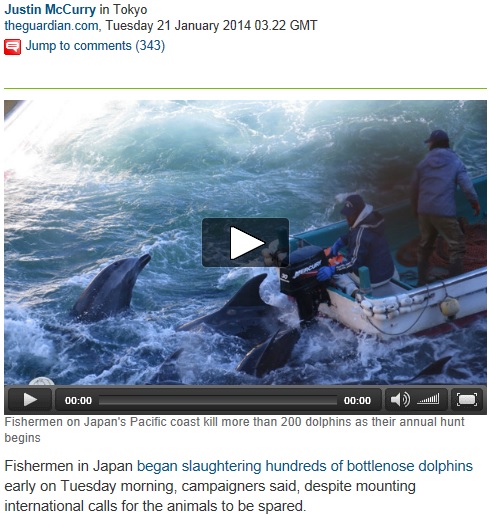 This blog has been a shade quiet since Christmas. I really did not want to reawaken with this post, but the image on the left has been haunting me since I saw it yesterday. My earlier years were dominated by my campaigning against animal abuse. Large aquatic mammals, especially. I even bought a Praktica SLR camera rather than support the Japanese optics industry back in the 1980s when the Japanese persistently blocked a moratorium against whale hunting; particularly humpbacks that were endangered at the time.
I knew that the Japanese had an annual barbaric killing of pilot whales, but this slaughter of dolphins had escaped me. It is the dolphin on the left that haunts me. It will soon be speared by the ‘fisherman’. It will drown. At the risk of anthropomorphism, I ask myself what is going through its head. On the one hand, it knows what its fate will be. But as a higher mammal with quite developed communication, not only is it trying to communicate with its rapidly diminishing peers, it is saying to humanity, ‘why are you doing this to us?’
The process is not random, it seems. The dolphins are rounded up and herded into coves. They are left for four days and then released. In the video, men in wetsuits are seen in the water securing the animals by their tails before they are speared. And so orchestrated is this slaughter, the ‘fishermen’ have built a very large screen to keep away the cameras.
This is not to feed people who are hungry. It is not even fishing. This is a crime against nature. And it breaks my heart.
Picture: The Guardian – http://www.theguardian.com/world/2014/jan/21/japanese-fishermen-begin-annual-slaughter-of-hundreds-of-dolphins
Industrial action, Quarks and Gravity
 I’ve just been watching an edition of Quarks and Co., a German-language science magazine programme on WDR with the ever-compelling musician turned astro physicist, Ranga Yogeshwar (http://www.wdr.de/tv/quarks/). Yogeswar (left) is a true polymath with considerable charm. I watch this when I can as part of my German learning programme. The Edition on 3 September was all about time. Why does it feel different, depending on what we are doing? And what do we do with time saved as a result of taking a fast train, plane, etc.? The answer to the latter question it seems is that we work more. However, being on strike, as I have today over the erosion of pay in the higher education sector in the UK, frees up time – after first doing the picket line duties – to go to the cinema for the first time in what may be two years.
Spoiler alert!
Was it worth it? No.
Gravity, directed by Alfonso Cuarón, according to the Guardian’s three reviewers, Xan Brooks, the ever unreliable Peter Bradshaw and Catherine Shoad, is amazing. Sandra Bullock stars as the sole survivor of a disastrous US mission on the space shuttle after the Russians detonate a satellite that generates considerable debris that destroys the shuttle, the International Space Station and a mysterious Chinese craft that we did not know existed. All are in the same unfortunate orbit around the Earth.
George Clooney’s character makes an unexpected – though not real – return to the capsule in order to stop  her suffocating herself out of sheer desperation. There is a lot going wrong and the Earth seems a long long way away. Bullock’s character comes back to life after a word with God – seemingly never needed before – and memories of her lost child.
I could go on. Others intelligently have: http://thepoliticsofexperience.net/tpoehome/?p=143
At least I did not squeeze this film into my normal free time. Had I done, I would have felt cheated. And lunch beforehand was most agreeable. Such is the nature of industrial action.
 Be informed