Archive for the ‘Privatisation’ Category
Capitalism is the problem
Filed under: Environment, Politics, Privatisation | Tags: Capitalism, Circularity, climate, climate change, Decoupling, Dutch East India Company, energy, environment, Erald Kolasi, GDP, renewable-energy, sustainability
 Leave a comment
 I have been reading some excellent books recently. You know the ones that you wish you had written? I have written a book, and I have just read The Physics of Capitalism by Erald Kolasi. It is brilliant and takes no prisoners. It also a book that I will need to incorporate into the next edition of my textbook if the publisher ever gets round to inviting an update. I know my book needs revision, not least because we’ve all been on generative AI catch-up. My bio needs an update, too.

Back to Kolasi. He’s a physicist. A physicist taking on economists in a way that economists should have been taking on economics in the 21st Century. Back to me. My book starts with a statement about the finite planet and argues that business strategy has to be devised and executed so as not to breach the planetary boundaries, of which there are nine. Kolasi’s genius (at least for me) is to use his knowledge of physics to critique arguments by economists (and others to be fair) about technological “solutions” in the context of climate change. It is hugely effective and it tells it bluntly and with humour (though totally unfunny if you are an economist).
At its bluntest, Kolasi likens economists to people who simply cannot accept that we cannot make light go faster than the speed of light (3×10⁸ m/s) or go below absolute zero (currently -273.15oC). More realistically, in terms of the efficiency of the stuff we use and rely on, internal combustion engines struggle to be more efficient than 35 per cent (conversion of liquid fuel into kinetic energy/Carnot cycle). 70 per cent is a theoretical maximum, but such an engine is unlikely to be put into a car; photovoltaics, 15 per cent (though theoretically possible, but never achieved, 90 per cent). And so it goes. As Kolasi notes, too, even if we could get 90 per cent conversion of solar energy to electrical energy we would still struggle to meet demand for panels and electrical energy as they need an energy source to extract raw materials and manufacture. There are limits (that neo-classical economists will not accept).
GDP and decoupling

The likes of Hannah Ritchie have been making a strong case for decoupling as a sign that capitalism can survive a climate crisis. We can grow economies (as defined by GDP) and reduce carbon emissions simultaneously and absolutely. It’s a dangerous myth.
Some definitions first: relative decoupling is simple reduction in carbon emissions whilst experiencing an increase in GDP. Absolute decoupling is a kind of safe zone where decline in carbon emissions outstrip growth and head towards zero. From what I can see, and have read, there is no absolute decoupling even using current measures of GDP. For Kolasi, the current measure is the problem as it does accurately measure change in the biophysical scale; namely, the use of natural resources in production and reproduction.
Then there is the question of permanence, assuming GDP is a fair measure of output. Kolasi tells us that with this perspective, economic growth and life expectancy have decoupled as Americans die earlier than previously. Where we thought there was a positive relationship between growth and life expectancy, that seems not to be the case. But no one is saying there has been a decoupling.
Then we can consider the data on emissions. They are to some extent estimates. We might have a handle on carbon dioxide, but we certainly do not have measures of methane, nitrous oxide, synthetic and fluorinated gases, all of which are more potent greenhouse gases than carbon dioxide. Even before the Trump administration, the Environmental Protection Agency in the USA relied on self reporting by corporations! Now it is unlikely that any degree of self-reporting will be needed.
Finance
Talking of changes in direction, up to 2021, banks had been reducing (not eliminating) lending for fossil-fuel projects. That has now changed. The Guardian newspaper has reported that “Two-thirds of the world’s largest 65 banks increased their fossil fuel financing by $162bn from 2023 to 2024.” The US Treasury has withdrawn from the Network of Central Banks and Supervisors for Greening the Financial System, essentially giving a green light to private banks to start lending again. Indeed, JP Morgan, Citigroup, Bank of America, Morgan Stanley, Wells Fargo and Goldman Sachs all withdrew from the net zero banking alliance. Here is a table of the worst offenders (apologies for the poor resolution, but if you download it, it is fine):

Be rest assured, banks have not changed.
The steam engine
A book that opened my eyes to the non-inevitability of industrial fossil economies was Andreas Malm’s, Fossil Capital. The argument was threefold: first, capitalists were not prepared to share resources such as flowing water. Second, flowing water was located in areas that required investment by capitalists in infrastructure such as housing, schools, medical. Thirdly, where this infrastructure existed, labour militancy was difficult to manage – wages were going down and work rates increasing. Capital is best optimised if it is mobile. The steam engine enabled capital mobility despite being less efficient than water, at least until major improvements were made to the design of steam engines (to stop them from exploding if nothing else). All this being true, it is not the whole story. Kolasi has helped me to refine this argument.
Let us compare changes over time (Kolasi 2025: 290):
| Year | Steam HP | Water HP | Wind HP |
| 1800 | 35,000 | 120000 | 15000 |
| 1830 | 160,000 | 160,000 | 20,000 |
| 1870 | 2,060,000 | 230,000 | 10,000 |
That brings us to two additional concepts that I did not get from Malm: exergy and spectralization. Exergy is a thermodynamic system’s maximum capacity for useful work (p290); spectralization is the “diversification and variation in the conversional methods of existing technologies in response to changing social and ecological conditions” (p222). And so…
“…Boosting the spectralization of conversional technologies was the main causal vector for the corresponding improvement in the efficiency of industrial devices. The Industrial Revolution in England and virtually everywhere else as well, followed a path of exergy-driven efficiency gains that spurred additional gains and butterfly effects in economic productivity. The English achieved this incredible growth through a huge increase in the aggregate output of mechanical work a process spearheaded by the spectralization of high-pressure steam engines, and eventually the spectralization of other types of engines as well.”
Kolasi, 2025: 290-1
Let me unpick that, probably imperfectly. Efficiency per se is not the point. It is exergy efficiency. And curiously, Kolasi demonstrates that steam engines had a negative impact on aggregate efficiency across the English economy as a whole. Indeed in their early days they were highly inefficient relative to water and wind. The more steam engines that were installed – at least until 1770 – the lower the efficiency of the economy in aggregate. My head hurts trying to get it around this idea.

In the 19th Century it is a different story. But steam’s impact is not that it could be used to power textile factories. Rather it is this spectralization whereby if became a significant component of the economy as a whole, not least in transportation (shifting coal to factories and shifting product to markets). And if we think that steam power is a thing of the past, we must remember that it is steam power that generates most of the world’s electricity.
Steam power does something else, too, which I had not considered. Steam enables capital to be used harder. By which we mean, it enables us to hit things harder – in a foundry, for example, that is useful.
That leaves a question as to why coal? Well here’s a thing, the answer lies is that great British phenomenon of the enclosures. Back in the sixteenth and seventeenth centuries, the aristocracy displaced many people from their traditional lands by enclosing it – fencing it off and turning it into private property. This displacement led to a rapid urbanisation. People were concentrated in towns and cities and used wood to heat their homes. More rapacious, though, was the state’s need for timber for warships. The nation’s forests disappeared. Coal was a suitable substitute and, as Kolasi writes, “…the northern parts of England were full of it”. Full of it for sure, but it was under ground. The mines were established but they needed pumping. That was first significant industrial use of steam power – to pump mines.
The steam engines then went through spectralization – the addition of condensers to improve thermodynamic efficiency; new gear configurations that allowed the engines to generate rotary motion and to power machines in factories; and the transition from low- to high-pressure machines as the driving motive force. Kolasi (p281) argues this was the “breakthrough moment of the entire industrial revolution”.
Colonialism

The English enclosures displaced many and created a work-hungry proletariat. International colonialism resulted in mass slaughter, disease and slavery. Kolasi (pp300303) goes into great detail about the activities of the Dutch East India Company (VOC). Most brutally, the company slaughtered the majority of the people of the Banda Islands (modern day Indonesia) because they had a monopoly in nutmeg growing. On discovering exactly where the fabled trees grew in 1621, 15,000 people lost their lives through brutal acts of beheading and being pushed over cliffs. These people were substituted for by slaves. The VOC set the stage for the Amsterdam Stock Exchange becoming the first publicly-traded company; but as is ever, the company declined as the secret of nutmeg was demystified and grown in other regions with suitable climates. The Dutch Government nationalised the assets in 1799.
The Circular Economy
We hear a lot about the circular economy…it is essentially another attempt at saving capitalism from itself. In its purist form, the waste from one cycle of production becomes the raw materials for the next. A weakness here is the issue of recycling. Many of us are asked to recycle our waste – my weekly doorstep collection is a case in point. I separate out my plastic, card, glass and metals to be collected. Notwithstanding the fact that turning glass and metals into reworked materials requires energy. Plastic…to much cannot be recycled, and even if it can, the capacity is rarely there to enable it. So, recycling is not realistically part of the circular economy – energy is lost in the circularity.

For circularity to be meaningful, materials have to be reusable or re-purposable. A glass bottle needs to be reused as a glass bottle (energy is required for transportation and cleaning. Textiles need to be re-tradable, up-cyclable and volumes need to come down, drastically. A recent story in the Guardian newspaper illustrates once again just how much textile materials find their way dumped in habitat and wilderness because we cannot absorb the volumes being disposed of.
Sources: Decoupling Chart – Hannah Ritchie (2021) – “Many countries have decoupled economic growth from CO2 emissions, even if we take offshored production into account” Published online at OurWorldinData.org. Retrieved from: ‘https://ourworldindata.org/co2-gdp-decoupling’ [Online Resource]
Bank investment table – Banking on Climate Chaos: Fossil Fuel Finance Report, 2025: https://www.bankingonclimatechaos.org/?bank=JPMorgan%20Chase#fulldata-panel (accessed 21 June 2025)
Steam Engine: Chris Allen / Steam engine, Nortonthorpe Mills, Scissett
VOC Plaque: By Stephencdickson – Own work, CC BY-SA 4.0, https://commons.wikimedia.org/w/index.php?curid=72939415
Ghana Wetlands – source unknown. Taken from Guardian story.
Why banks do not invest in renewables
Filed under: Environment, Privatisation, UK | Tags: climate change, Electricity markets, energy, environment, Feed-in-tariffs, investment in renewables, renewable-energy, renewables, spot prices, sustainability
Leave a comment 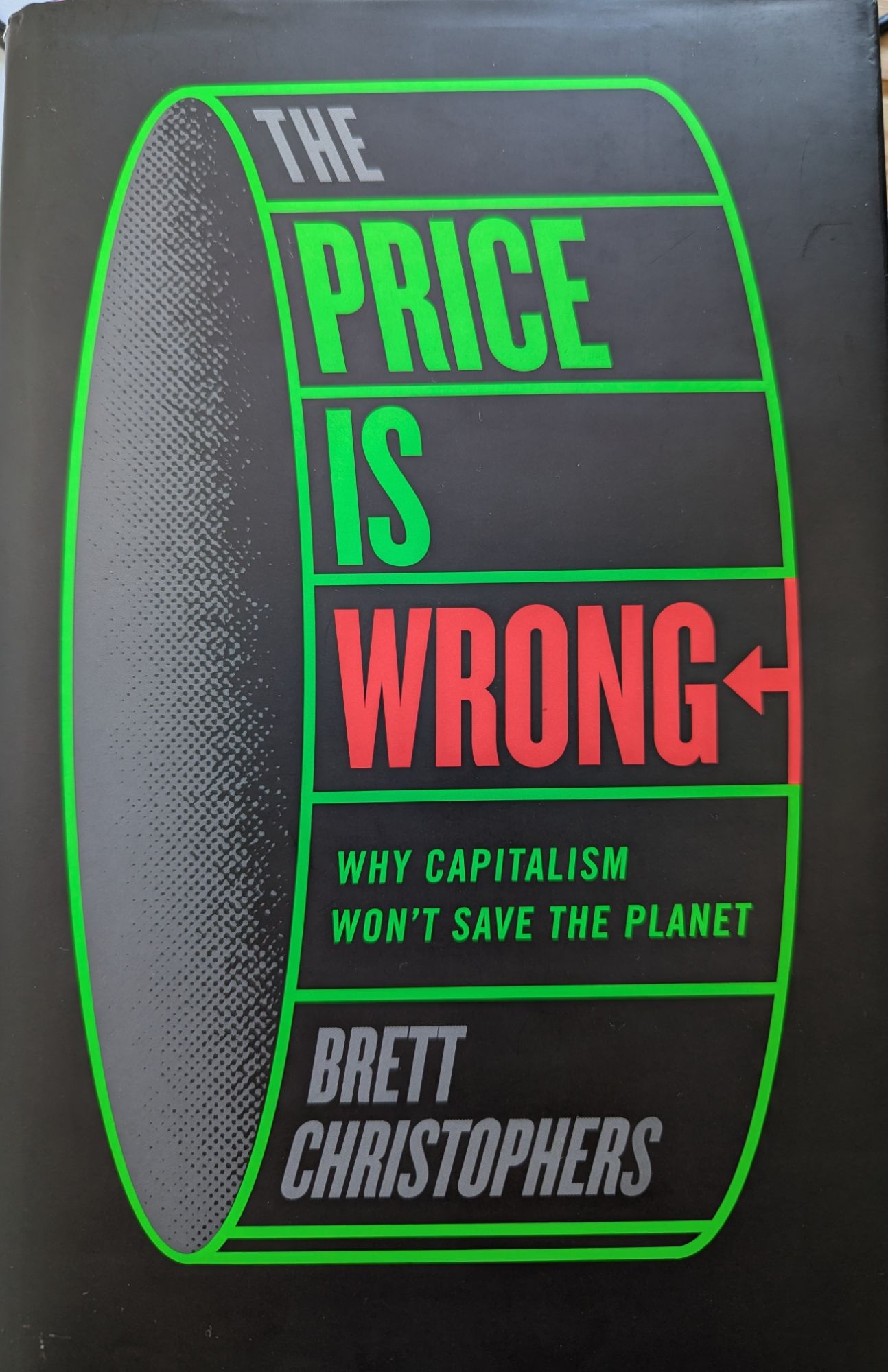
I wrote last month on Andreas Malm and Wim Carton’s book, Overshoot. Like all arguments – and their book is full of them – there are weaknesses. Or in my case, a failure fully to understand. In pursuit of that understanding, I have turned to an extraordinary book by Brett Christophers, the Price is Wrong – Why capitalism won’t save the planet (right).
Christophers waits until chapter 6 – appropriately entitled, The Wild West, to broach the point of why. It is not because the previous chapters were superfluous – far from it. Rather it is because electricity is complex, and despite out belief that all electricity is the same, Christophers has to make the case that not all electricity is the same.
First, we have to look at the structure of the liberalised (i.e. non-vertically integrated markets), of which the UK is a prime example after privatisation in the 1980s. Let me break down some of the stakeholders in the system:
- Generators – owners of power plants (some located outside of the country)
- renewables
- wind
- solar
- hydro
- non-renewables
- gas
- coal
- biomass
- nuclear
- renewables
- Last-mile suppliers.
- Buyers of wholesale electricity for supply to end users (domestic and businesses)
- Electricity System Operators (ESOs)
Markets
Increasingly the industry’s liberalisation has led to regulated markets being constructed by policy makers. In the UK there two distinct routes to market by generators.
- spot markets (electricity for immediate use)
- corporate – Power Purchase Agreements (PPAs) – generator contracts directly with corporate entity which is often a large user of electricity. There can also be PPAs between generators and utilities (retailers).
Spot markets trade in blocks of time, 30 minutes in the UK, for example. There is a base load, usually supplied by renewables and then a top-up, usually coming from the most flexible of supplies; namely, gas. In the UK the last coal-fired power station closed in September 2024.
Spot markets and volatility – why renewables are unattractive to investors and fossil-fuelled plant is attractive
The prices of electricity on spot markets are volatile. They are volatile over each day – demand can vary widely from the peak of the early evening to the overnight lull. But volitivity over a month…that seems to be more scary to investors. For example (p 170) in February 2022, spot market prices in Germany ranged from under €50 per MWh (day 19, Saturday) to just under €250 per MWh (day 25, Saturday). Demand is difficult to predict; indeed, we might ask, are there any other (commodity) markets with such pronounced volatility?
If you are an investor – a bank, for example – such volatility instils a sense of unease. It does not make investment impossible, but it makes it more expensive. Christophers’ research suggests that interest rates for renewable energy projects can be as much as 3x that of non-renewables.
We should then ask, why would a gas-fired power station – that sells into the same volatile market – not also be high risk? There are two things to be aware of here. First, banks have been investing successfully in fossil fuel projects for many years. Successfully. It is a known and tangible entity that has largely been low risk. Bankers, however, when making investment/loan decisions ask one simple question, will the client be able to pay back the loan on any terms agreed? The banker wants to know how much income the project will be generating to service the debt. The project owners will, of course, not be able to answer that question because of the volatility. It seems to be insufficiently adequate for the loanee to say that they are 100 per cent certain that all electricity they generate will be bought by suppliers because what they generate will always be cheaper than electricity generated by gas. The spot markets always include the lowest-priced electricity in a merit hierarchy.
There seems to be other issues here for investors. The returns on renewables is lower than that for fossil-fuelled plant. Typically, noted by Christophers (pp 211-221), fossil-based investments can generate returns of up to 20 per cent. Renewables come in at between 4 and 9 per cent. If we consider oil company shareholders, they are offered by the executive investments that will bring in double-digit returns, or equivalents that will deliver at best half of that. What will they choose? And what if the executive takes the decision to go with the renewables, knowing that their returns will be lower? Most will be out on the ears at the next shareholders’ meeting. These are so-called opportunity costs. Investing in renewables means that the investment will not be made elsewhere; i.e. something that brings in a higher return. But, argues Christophers, the shareholder concerns are minimal in comparison to that of the banks. Banks are looking for double-digit returns. It is also the case that many investments in renewables are made by companies that are not fossil-fuel based. They specialise in renewables. They will only deliver across their portfolio single digit returns to a market that is volatile, that exhibits the so-called merchant risk. Added to that, renewable plant is part of a “transition” – an energy transition. That transition, argues Christophers, has two elements. The first adds to the uncertainty. Transitions by definition are uncertain. The second is transition has no history. Generators are asked to project into the future with no historical data on which to make the calculations.
We might then ask, what about owners of plant fired by fossil fuels, how do they make the case to investors if they sell into the same volatile electricity market (because new gas-fired power stations are still being built)? Well, it seems quite simple, a traditional fossil-fuelled power plant is not part of a transition. It is proven technology and can demonstrate historical returns on investment. It is eminently bankable.
And here is another scenario. If the spot price of electricity (say in the UK) falls, so does the price of gas. The spot price is determined by the gas price (or the highest bid price in the bidding round, usually 30 or 60 minutes in each 24 hour period). In that scenario, the price of gas falls and the bid posted for electricity generated by a gas-fired power station is at a lower price because the primary cost of the power station is its fuel. If the gas price falls, so does the cost base of the plant. There is a hedge at work in the eyes of the bankers (p180).

The same is not true of wind-based renewables plant. The fuel – wind – is a gift of nature. It is free. The cost base of the plant, in the event of the spot price decreasing, does not decrease. That seems to indicate to bankers that there is a point where there is no return, and hence the ability of the plant owner to service the debt. In other words, finance cannot be secured because the fuel is renewable, meaning that even if the turbine is turned by the wind it can still be used by another wind turbine. But non-renewables once used are used. It is counter-intuitive that this is a positive and hence a challenge to bankers. In essence, then, there is a significant merchant risk; namely, “the risk associated with selling renewably generated electricity exclusively or predominantly at volatile merchant (wholesale) prices.” p174
Work arounds – how renewable plant owners can hedge the risk
Christophers offers three ways around this problem.
- Option 1: the futures contract. This is a situation whereby the electricity will be bought and sold at a predetermined price. The fear/danger is that the spot price falls such that revenue is flat and threatens not to cover liabilities. This is a balancing act where an option to sell (short) on the electricity futures contracts means that if the spot price does fall, the negative outcomes in terms of income “earned” in the spot market are compensated for by a gain in the futures market. Essentially, the trading value of the contract enables the sale to be transacted at a fixed future price which typically rises as the spot price declines. This is a common mechanism for hedging in liberalised electricity markets.
- Option 2 – swaps. These are more common in North America and Texas in particular. Swaps act as substitutes for futures contracts. The principle is that a party averse to risk relating to falling electricity prices can offset the risk by entering into a swap that pays out even if electricity prices fall.
Hedging, though, is complex. Only the largest producers have the so-called competence to hedge at scale. There are at the very least significant cash flow challenges. For example, if the spot market does decline, one party has to put up considerable cash to cover the decline. There is even a bigger challenge to contemplate. Christophers asks fairly, what happens if the renewable electricity supplier cannot supply the amount of power it is contracted to supply to the futures or swap markets? The above relate to Christophers’ arguments on pages 178-183.
- Option 3 – PPAs – these reassure banks that there will be a return sufficient for loan repayments.
- Option 4 – government subsidy/support. Such support has its own hazards.
- investment grants do not help in pricing
- Investment Tax Credits can help reduce the level of break-even spot price
- Price controls/Feed-in Tariffs (FiTs) – compensating generators when the spot market “reference” price drops below the contract “strike” price; though when the strike price climbs above the reference price, generators pay back into the pool. The net price is always the strike price.
Price controls stabilise markets and satisfy investors. But then introduces yet another source of uncertainty. Will governments – especially when they are fiscally stressed – honour or extend FiTs rates? Unless they do, renewable generators are back to spot price volatility. Christophers offers examples of state withdrawal in China and India (pp.
Notwithstanding problems with subsidies (option 4), markets can bankrupt renewables generators. In Texas in February 2021, a bolt of cold air caused a number of generators to cease as their equipment, not used to such extreme conditions, seized up. This was not just renewables generators. Fossil-fuel plant also seized up. As a result of the limited supply, electricity spot prises went up considerably. Renewables generators were supplying into a market with spot prices below $100 per MWh (as low as $50). During the crisis, prices were $9000 per MWh. Now if renewables generators were selling into that market, then there was money to be made (assuming the turbines were working, of which many were). But if the generators had PPAs at fixed prices, if they were unable to supply they had to go into the spot market to meet the terms of their PPA. That was enough to bankrupt generators (p310).
Nye – National Theatre, Spring 2024
Filed under: Privatisation, Reviews | Tags: Michael Sheen, National Theatre, NHS, Nye, Tim Price
Leave a comment I hit sixty this year. A milestone for anyone, but especially for those of us who never thought we’d get that far – not that we would die prematurely, rather that 60 years seems an impossible number of years ever to reach (despite the evidence of its absolute possibility). So what is to do to celebrate the milestone? Well, obviously, do something that I have not done before. For me, then, it was to go to the National Theatre in London with my beloved. Neither of us have been there before, it turns out. So what is on on the special day? Well, magically, it is Nye by Tim Price. It is the story of the founding of the National Health Service (NHS) told through the life of the man who made it happen, Aneurin Bevan, played by Michael Sheen. Expensive, but you only live once and it is down hill from 60.

I’m not a fan of theatre as some of my friends know. It is all a bit too representational for me. I’ve understood the purpose of theatre. I think. But here I was attracted to the combination of my own history (the NHS), Michael Sheen (left) and the National. Michael Sheen I have seen in films. The National – I always remember many BBC programmes ending with the statement that x and y were both National Theatre players. I did not really know what that meant. But it must have been important. 50 years on, I have an answer.
Not being a fan of theatre, I was additionally anxious that the performance took the best part of 3 hours. But in the end, I need not have worried. There was not a moment of boredom or anxiety. Nye Bevan is depicted honestly by Sheen. Sheen is in every scene wearing pyjamas even when making a speech in Parliament. See what I mean about being representational?
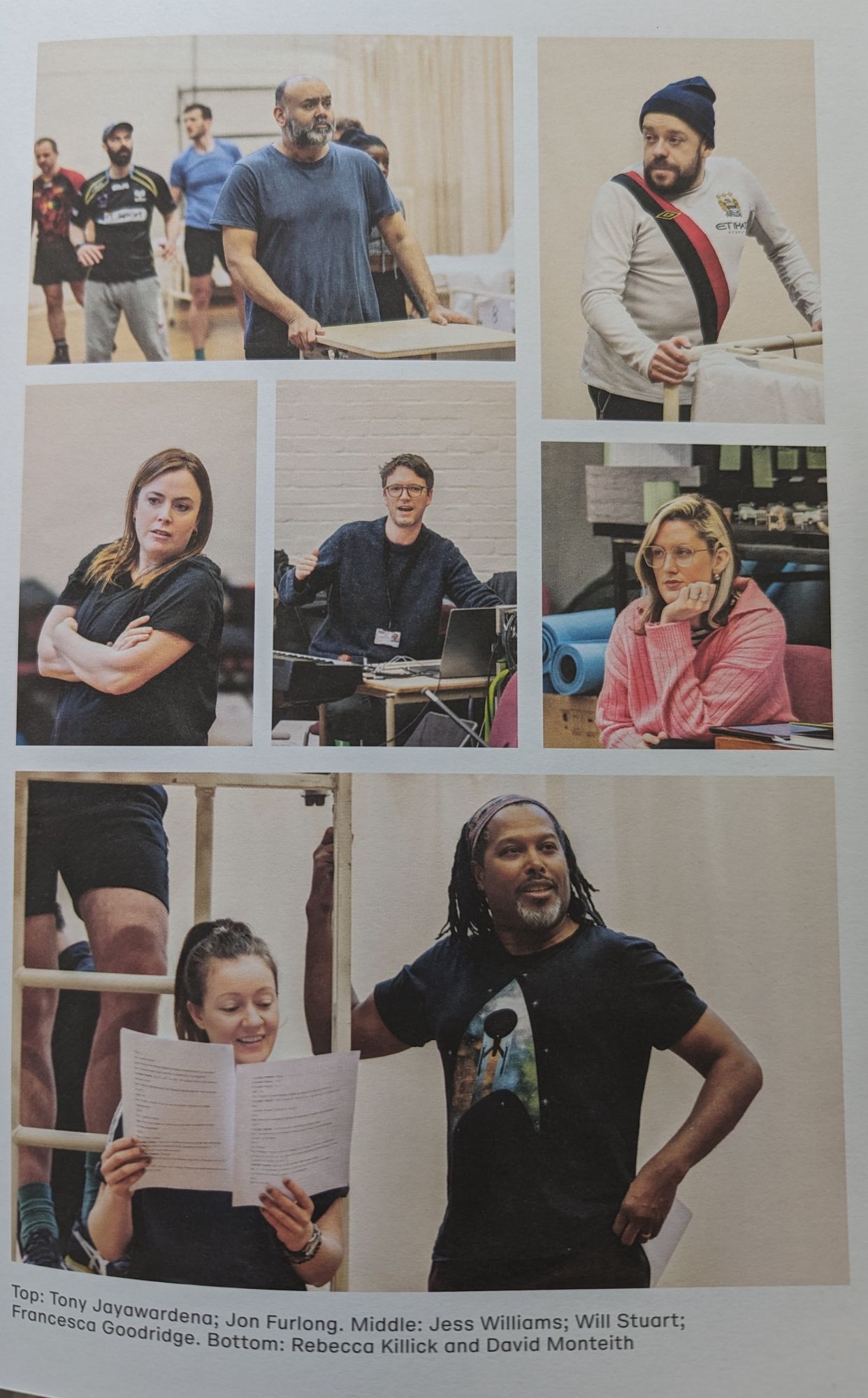
The play traces Bevan’s journey from being bullied by teachers in school because of his stammer – Sheen handles the stammer brilliantly – to the local council, to Parliament, to the Health Ministry and death. In hospital. There were for me three standout scenes. Getting over the stammer was facilitated by access to libraries – and books. There’s the realisation that if some words are unpronounceable, others with the same meaning are perhaps not. Focus on what is possible rather than what is not possible. The library scene is uplifting (literally). Those National Theatre Players show why all of those years ago they got an additional mention. The second scene was an exchange with Churchill, his parliamentary nemesis. Churchill taught him that compromise was sometimes needed to get what you want. Sometimes MPs have to go through government or opposition lobbies against their better judgment. And finally the scene where he takes on the doctors (supported by Tories in the Parliament, including Churchill) that are vehemently against the nationalisation of their profession. He wins them over through compromise. The NHS is founded. We now reflect on the extent to which the Tories of the 2020s have systematically undermined the service because of their seeming hatred of public provision of services that make our society and define civilisation.
There is a much more to this play than these three scenes, of course. My sixtieth birthday present from the NHS was a letter inviting me to provide them with some “poo” to test for bowel cancer. Bevan died of stomach cancer at the age of 62.
Book review: Yanis Varoufakis, Another Now
Filed under: Book reviews, Environment, Housing, Politics, Privatisation, Reviews |
Leave a comment I did not start reading this book (below left) as a piece of science fiction, I actually thought it was a straight political and economic manifesto by a radical thinker. Bless him (not in a God sense), he has tried another route into our consciousness.
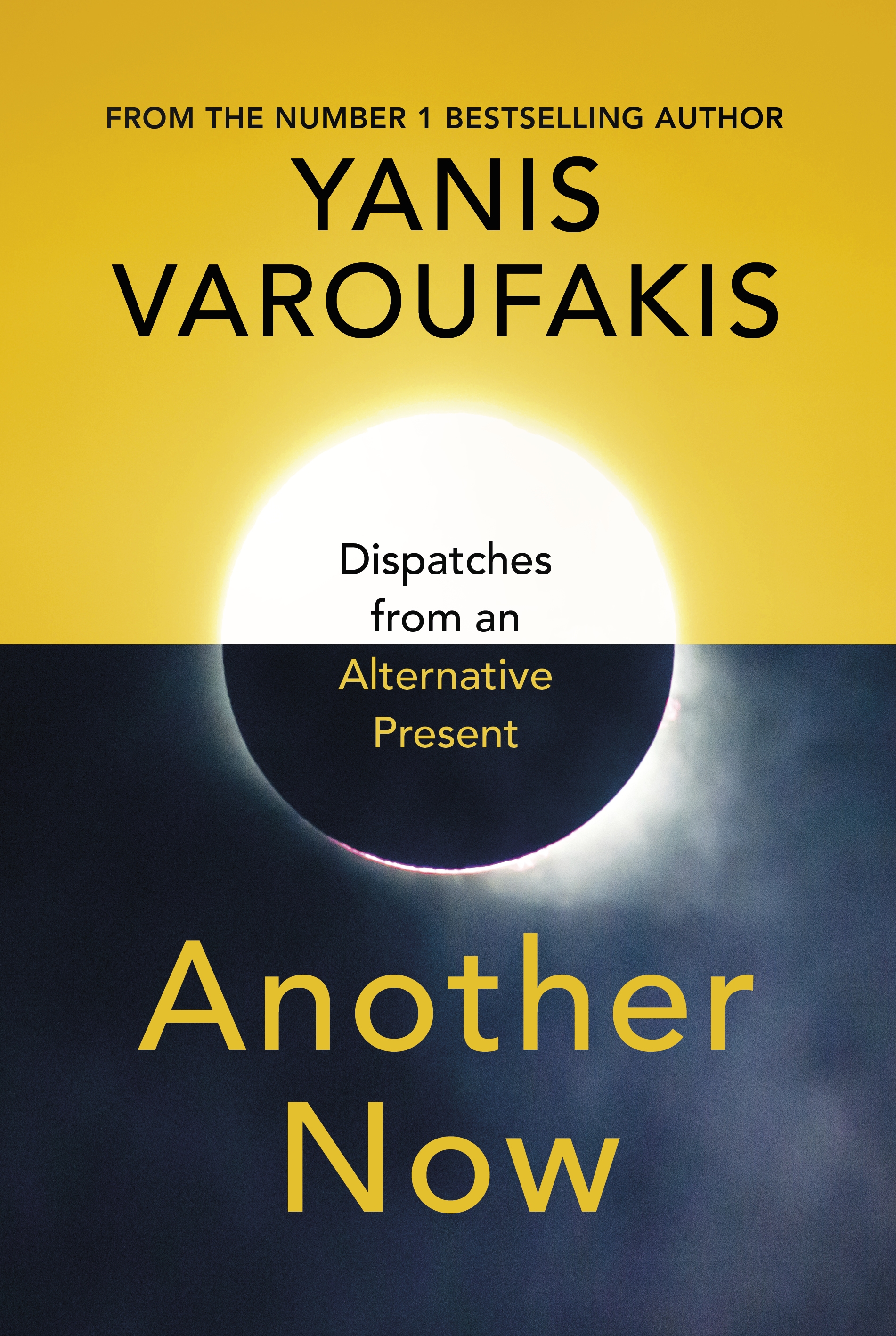
His construct is the following – three different people, all disaffected by the present, meet or are introduced to one another with the express – and contrived – purpose of “trialogueing” the ideas that are obviously keeping Varoufakis awake at night. One of his characters, Costa, is an IT expert liberated from daily work by having anticipated 2008 and bet against it (or for it, whichever way one thinks). Costa was working on an alternate reality that one could choose to enter but only in the Hotel California sense (“you can check out any time you like, but you can never leave”). Having created his new reality in a game called Freedom, he finds that holed up in it is another being, Kosti (also from Crete), who shares Costa’s DNA and past. Kosti inhabits a world know as the Other Now, in contrast to that which Costa inhabits; namely, Our Now.
Kosti engages with Costa until he becomes bored, at which point Costa visits once again his two other protagonists, an ageing Marxist academic who gave up on politics to create tapestries (Iris) and a libertarian banker (Eva) who became disillusioned about finance after the collapse of Lehman Brothers bank in 2008. This is the date, conveniently, that the fork in the realities occurred. So, these three characters interrogate the alternate future and its mechanisms.
So what is the alternate system that so successfully functions in Other Now that Our Now should aspire to? And how? I am loath to be a spoiler, but the object of the book is to achieve a mobilisation and create a coalition for change. Unless blogs like this share the ideas, then it really is just a limited work of science fiction. So here goes.
- elimination of retail and investment banks
- universal basic income (UBI)
- employee ownership of firms and the elimination of hierarchies
- socialisation of land
1 and 2: The elimination of retail banks is linked to the form and function of the UBI. The UBI in this alternate world has three components in a Personal Capital (PerCap) account. First, Accumulation made up of basic pay and democratically-allocated work bonuses; Second, Legacy – which is paid on birth, but not redeemable until adulthood and a plan for using it! Third, Dividend, which is the UBI element funded by a tax on corporations at 5 per cent of gross revenues. The payments are stored in an electronic wallet and transfers are made independent of retail banks. Borrowing is replaced by a peer-to-peer lending scheme rather than by banks as we currently know them. That does not quite amount to the elimination of the need for retail banks, but comes close. Investment banks disappeared because they no longer trade their complex derivatives and create fictitious money. They are reduced merely to lenders and have no advantage over peer lending.
3: Each employee is given one share of equal value to all other shares in the company on Day 1, or when they join. The stock market has been dispensed with by the radical activists who brought about the change (see below). Firms become democratic with no senior bosses telling others what to do. And the surpluses created by firms are allocated by peer assessment on a points system. Those who are particularly creative and/or productive are recognised by their peers and given credit points that equate with a portion of the excess. These points can also be used by future employers to assess the suitability of a candidate.
4: Landlords received inflated unearned income. The socialisation of land in Other Now resulted in a new commons being created through Ground Trusts/Commons (gComms). By law all freehold land passed to the gComms. Leases were awarded to landlords and democratic businesses were also privileged. Two zones – one for commercial housing, the other for commercial businesses, enable communities to extract maximum rents in these areas to pay for social housing.
Getting there
The mechanisms for getting there are radical. In the Other Now, movements such as Occupy Wall Street were not defeated as they were in Our Now. They were transformed into a guerrilla groups that organised successful payments strikes (delaying instalment payments on bank loans and utilities such as water and electricity) that brought down the banks and caused the nationalisation of the utilities. Guerrilla groups targeted firms with poor employee relations and environmental records sufficient to get pension funds to divest. Another guerrilla group set about big tech – succeeding in bringing down Facebook and gaining property rights over data for users of social networks. Those companies that avoided attack by these guerrilla groups did so only by investing in green technologies, leaving stock markets and transferring full voting shares to their employees.
International organisations such as the IMF were completely reformed. Instead of being an organisation that gave loans to defaulting nations in exchange for the privatisation of public assets, the International Monetary Project (IMP) has a remit to stabilise the world economy and invest in countries or regions without indebting them. The resources for this come from levies on exports and capital transfers.
Core to the success of the system and the security against exploitation and a return to some oligarchical system is transparency. The very systems that were turned on citizens to monitor and punish were instead directed at the powerful. An appropriately-named piece of software, the Panopticon Code, developed by a guerrilla group of coders, infected every computing device on the planet. Suddenly everyone could see everything about one another and particularly those “clinging to power”. As a reader, one can see that Varoufakis is perhaps not so keen on this as an absolute (everyone’s secrets are exposed with the negative impacts that would entail), but the longer-term impact on the Other Now was a democratisation of society on a global scale. Corporations were held in check by their internal democracy and Citizens’ Juries (with the power to dissolve bad companies). These, of course, required a high-level of engagement by the population to enact and maintain. A socialworthiness index (as a replacement for credit ratings and the agencies that generate them) helped to divert resources towards the good things in life that were not captured by GDP (a real bugbear of mine).
On immigration, states in the Other Now recognised the contribution of immigrants to host economies and also supported the communities in which they lived including providing sufficient school places, healthcare services and housing (the latter helped by the socialisation of land and management by gComms).
Other Now is a modern app-based world. There’s an app for PerCap and its funds. There’s an app for social media data trading – after all users of social media services were given property rights over their data. They now trade data with social media firms and receive payment for them. This had tragic implications – which are for readers of the book to discover (p169). Using an app and receiving the payment in the PerCap app! The proliferation of apps is an indicator of a vibrant digital sector, freed from the constraints of the former Techno-feudalism endured by Our Now citizens.
Why Other Now is not better than Our Now
Other Now is no Utopia. Varoufakis uses Iris to detail its residual failures that the elimination of capitalism did not banish. And in 2022, Other Now does have its own financial crisis caused by imperfections in the regulatory framework around gComms and PerCap. Again, I will not spoil it because this is the part where Varoufakis loses himself in his story telling. There is nothing original in what happens next – I am pretty sure that any seasoned SciFi fan would work this out before Varoufakis had written it, after all, he’s an academic economist. But we are asked, through his characters, whether we would elect to transfer to Other Now or stay in Our Now. This is an existential question. The identity of the characters prepared to transfer and which not, and their reasons for the choice, again, are not a surprise.
I bought the book without reading the cover. Fortunately. Readers know that fiction – and particularly science fiction -are not my thing. Varoufakis demonstrates that they are not his either, but he has a fair shot at it – and certainly his main points about the nature of change – and critically the process of change – are well made. Probably better in this format than a straight monograph, of which there are many. I come away with some ideas of my own. But also with a dilemma. Not only should I go to Another Now if I had the chance; but seeing as though I don’t have that option, should I try to create Another Now? Now. The answer…I am not into tapestry.
Picture: Twitter
Book Review – Rutger Bregman, Humankind
Filed under: Book reviews, Environment, History, Politics, Privatisation |
Leave a comment  I was going to start with what I dislike about this book, but that would be contrary to its whole ethos. I had in my head that there was something opportunist in Bregman’s prose, and hence the man himself. I have to say that this book could be life-changing, or in the case of oldies like me, a bit of a booster, like one gets to top up a vaccine every now and again. In life I can see myself slipping into pure cynicism. Bregman is a check on that. So I am going to change the criticism to give readers some idea of how I should be thinking rather than the way that I have come to think.
So, here is the re-writing of my original first paragraph (I’ve moved what was the original first paragraph to the end of the review for anyone who is remotely interested).
Regular readers know that I do not watch much television, though I did when I was a child. As I got older and was allowed to stay up later and watch adult television, my father insisted that we watch documentaries rather than sit-coms and soaps (we’re talking the 1970s). The format was always the same: an expert or knowledgeable person (or both, James Burke, right), would present in a quite succinct way some science or current affairs. There was never any music and the expert or knowledgeable person had no dress sense, even then. With hindsight, one of the reasons for the no frills was limited bandwidth. Broadcasting hours were fewer back then, and there were no specialist stations. It was broadcasting in the true sense. There was insufficient airtime to waste on unnecessary graphics, or choreography. In recent times, I have been reading much more than I used to – the pandemic has helped. I have noticed a style of writing in popular non-fiction (a genre that I have traditionally avoided out of snobbery). It is akin to current TV documentary style. There’s a soundtrack, an extended narrative with cliffhangers and expansive prose. I realise that this book in this style is not produced for me. Though if it gets people engaged with science, current affairs, art, philosophy, then all well and good.

SONY DSC
I started reading this book, not because I want to be convinced at how kind humans can be – which is the point of the book – but because I know Bregman is an important commentator. I finished it, incidentally, because I wanted to be convinced of how kind humans can be. Bregman made a big splash at Davos in 2020 in telling rich people that they should pay their taxes, and in the US when he took on Fox News’ Tucker Carlson. He is not going away in a hurry. I commend him for that because ultimately he is on the right side of history, albeit a white history. But the style of writing is not entirely to my liking but I know this view is not shared!
The first part of the book seeks to debunk the hypothesis that there is a human predilection to violence and being beastly to one another. I have not checked the veracity of many of the claims made in the book, but here are a few that I really want to be true:
- blanket bombing of populations in war does not result in the surrender of those subject to it
- soldiers do not like shooting at other soldiers, even if they are deemed to be the enemy
- Lord of the Flies is a work of fiction; left to their own devices, boys will create order and manage their way through
- the people of Easter Island did not engage in tribal warfare that decimated the population (colonialists did that)
- The Stanford Prison Experiment was a contrived hoax to enhance the reputation of social psychology and academics
 The philosophers at the heart of Bregman’s analysis are Hobbes and Rousseau. The Hobbesian world is that of the Leviathan – the human need for strong leaders, discipline and order to prevent a state of chaos, barbarism and cruelty. The Rousseau-ian world is one of the social contract, cooperation and common interests regulating behaviour. Bregman makes the argument that it all started going wrong when private property was conceived, when people – who became powerful and rich – were able to enclose common land and exploit it for private gain. These people built a civilisation on slavery, private property and the exploitation of natural resources. This has been a theme of other books that I have recently read; namely, Adreas Malm’s Fossil Capital and Tim Lang’s Feeding Britain.
There’s a chapter on Stanley Milgram and the “shock machine” – an experiment in 1961 where volunteers administered electric shocks of up-to 450 volts to so-called “learners” in an adjacent room. Milgram was Jewish and, claims Bregman, devised the study to to offer an explanation for the Holocaust. People follow orders, hypothesised Milgram, irrespective of the implications, genocide being one of them. All is not, however, as it seems. Bregman argues that the experiment did not test obedience, as stated, rather it tested goodness! The subjects, although paid, participated because they believed that the research would result in a contribution to knowledge. An explanation for the Holocaust was a worthy study. There was trust in the research and people in white coats who kept insisting that they needed to continue to administer the electric shocks for the research to be valid.
It was also the time of Adolf Eichmann’s trial in Jerusalem. Bregman’s case for human kindness could not exclude a discussion on the Holocaust. I do not have the authority or knowledge to engage with the terms of Eichmann’s guilt. What is recorded is that Eichmann presented himself as someone who just followed orders. Hannah Arendt who witnessed the trial first hand coined the term, banality of evil, to capture the essence of the Eichmann phenomenon as she saw it from the courtroom. There is much debate about exactly what she meant, though it was largely interpreted as her accepting Eichmann’s defence. Bregman concludes that Eichmann’s motive for his actions was actually a commitment to a cause that he believed would lead to a better society, however perverted.
What about the German citizenry who fought to the very end of the war, despite the inevitability of both the eastern and western fronts being breached? The evidence points to camaraderie, argues Bregman, rather than ideology as the cause of seemingly pointless resistance.
More optimism
Bregman takes us with him to visit some interesting people. For example trained nurse and economics degree dropout, Jos de Blok (right), not someone I’d previously been aware of. He runs a large healthcare company in the Netherlands called Buurtzorg. He does this not by d esign, but as a consequence of working in the sector and realising that it the care service was not fit-for-purpose. Care is not delivered optimally as a product (i.e. commoditised) and by people who get their orders hierarchically, rather by people who work in small autonomous teams. De Blok is not unknown; he is in receipt of the the Royal Society of Arts’ Albert Medal. Previous recipients of this medal have been Stephen Hawking (physicist), Tim Berners-Lee (the www) and Francis Crick (DNA). So, he’s in good company.
Then there is the story of the transition of South Africa from Apartheid state to inclusive democracy under Nelson Mandela. The period between Mandela’s release in 1990 and the presidential election in 1994 was precarious. I was aware of the ugliness of Eugène Terre ‘Blanche and his Afrikaner Volksfront. I was not aware of the Viljoen  twins. The family resource meant that only one of them could go to university. Constand said that brother Abraham should go. Constand (left) joined the army and became a senior officer in the South African Defence Force in Apartheid South Africa. Abraham studied abroad and found himself irreconcilably parted from his brother and aligned with the ANC and Mandela. Constand joined Terre ‘Blanche. I’ll leave it there – it is worth reading the book just for this section and only goes to raise my emotions. Mandela is the leader that we all need.
If any reader thinks that I have covered everything in this book, I have not. It is packed with ideas about positive reforms: education, democratic, penal, protest and warfare! The protest issue is so pertinent as I write at a time when the USA is convulsed by the racist Murder of George Floyd. Drawing on a study by American sociologist, Erica Chenoweth: “In the real world, she thought, power is exercised through the barrel of a gun. To prove it, she created a huge database of resistance movement going back to 1990. ‘Then I ran the numbers,’ she wrote in 2014. ‘I was shocked.’ More than 50 per cent of the nonviolent campaigns were successful, as opposed to 26 per cent of the militant ones. The primary reason, Chenoweth established, is that more people join nonviolent campaigns. On average over eleven times more. And not just guys with too much testosterone, but also women and children, the elderly and people with disabilities. Regimes just aren’t equipped to withstand such multitudes. That’s how good overpowers evil – by outnumbering it.” (p359). At a time of Covid-19, however, maybe not.
Bregman keeps caveating his narrative with admissions of imperfection in the characters and methods he presents. Deliberative democracy works sometimes, not others. There are some truly bad people around – power corrupts, absolute power corrupts absolutely in Lord Acton’s famous phrase. But Bregman is right, too, that if we treat one another badly in our places of work, jails, schools, communities, we cannot be surprised if it is reciprocated. We have seen during the pandemic real goodness in people, communities coming together to help one another and even the act of self-isolating and observing the lockdown are unexpected demonstrations of togetherness. Let us try to retain some of that as we move on, starting with the rewriting of my first paragraph.
Here is the original first paragraph:
The more I have been reading recently, the more I have seen this style of writing. Now, I do not watch much television these days. But when I was growing up – I know I keep going on about this – television documentaries used to have an expert or knowledgeable person (or both), would present in a quite succinct way some science or current affairs. There was never any music and the expert or knowledgeable person had no dress sense. One of the reasons for this succinctness, I imagine, was limited bandwidth. TV programmes did not start showing until late afternoon and TV stations shut down by midnight, apart from at the weekend. And then it was half-past midnight. There was such a shortage of airtime, so every minute mattered. Hence the quality of the output. Bregman’s book is a documentary with music, and is excrutiating for it. Moreover, it is extremely patronising: “This may get a little technical, but we need to understand where he went wrong” (p88). It then proceeds to be not very technical.
Pictures:
Bregman: Victor van Werkhooven
James Burke: https://archive.org/details/james-burke-connections_s01e10
Jos de Blok: https://www.josdeblok.com/biography/
Constand Viljoen: https://en.wikipedia.org/wiki/Constand_Viljoen
The Economist and the UK General Election – what a squirm
Filed under: Brexit, education, Environment, Housing, Politics, Privatisation |
Leave a comment 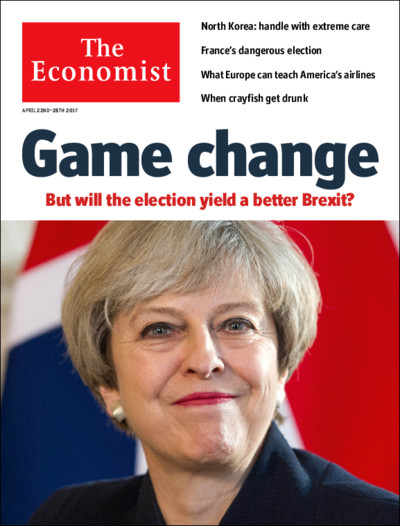 Two years ago I critiqued the Economist’s advocacy of the Conservative Party to form the next UK Government under David Cameron. The magazine, in my opinion, disingenuously dismissed Ed Miliband’s programme in favour of the “stability” offered by more economic-liberal austerity by the Conservatives. The magazine overlooked the commitment to an in-out referendum on Europe despite its avowed support for the European Union, at least in the context of a single market and customs union.
Fast-forward 2 years and here we are with another General Election having been called – we are told by Theresa May – to protect the will of the people translated as her vision of Brexit from those who would oppose it (saboteurs according to the Daily Mail), like parliamentary oppositions are supposed to do under the Country’s usefully unwritten constitution. May, not being a democrat, or not one that I recognise, duly called her General Election after having been on a walking holiday. Though I am minded that she first had a word with the architect of the Conservatives’ last election victory, the benighted Lynton Crosby.
I was waiting to see what stance The Economist would take this time. Let me have a look. First of all, the leader of the opposition is called “ineffectual”. However, that is not the real story. May looks to achieve a landslide victory and increase her majority from the current 17 to something approaching 100. “For the 48% of voters who, like this newspaper, opposed Brexit, this may look ominous” says the Economist, un-reassuringly. However, we have mis-read this. Indeed, argues the newspaper, “[i]nfact, it offers an opportunity for those who believe in a more open, Liberal Britain”. Really? We need to know more.
If I read it correct, if May gets her increased majority, she will fear the Commons less when it comes to the final deal. The House of Commons fought hard to have a say on the final deal and would, if the “deal” was not as good as what the country has at the moment with EU membership, tell her to go back and try harder. One assumes she is particularly fearful of her “hard Brexit” backbenchers. If she has a bigger majority, goes the argument, she can accommodate their wrath as well as that coming from the depleted opposition benches. This means, continues the argument, that she is more likely to be able to make compromises with the EU with this safety net. And that means a softer Brexit. Brilliant!
Dear Economist, that is nonsense. May wants to close the borders. Only a hard version of Brexit will enable that. Plus Guy Verhofstadt, the European Parliament’s Brexit coordinator, has himself described it as a “power grab”. Moreover, she also does not want to be bound by the current manifesto of her party written by her predecessor. So, her Finance Minister, Philip Hammond, who suffered ignominy when his budget tax increase was rejected, can now make this a manifesto commitment. Also, May herself is obsessed with selective education and already has in train a return to grammar schools at the expense of children from less privileged backgrounds. The Economist thinks that Theresa May with a majority can fix the housing shortage and make good the “funding crisis in social care”. Bearing in mind that her party is the cause of these two problems and policies so far pursued seek to make it worse, not better (for example, right-to-buy housing association dwellings).
We should not be surprised by this spin and support for the Conservative Party; but we are where we are because of the Conservative Party (austerity policies and THAT referendum). The solutions and future must lie elsewhere.
The nonsense of anti-trade union legislation
 My trade union, the UCU, is in dispute with my employer. My employer seems reluctant to discuss the issues at the heart of the dispute, so the Union organised a ballot if members managed by the Electoral Reform Society, the experts in balloting and the law. The result was a legally acceptable (relative to current law) percentage of members agreeing to take strike action. The Union then called a two-day strike only to find that under the new law, before labour can be withdrawn, two weeks’ notice has to be given to employers. The strike had to be postponed.
We are getting close to the Easter non-teaching period. To withdraw one’s labour in a non-teaching period is a bit of a waste of time (and money). But to leave it until the start of the new term renders the ballot void. So, here we have a piece of legislation that forces members to strike in order to keep the legal mandate to strike. So, at the end of the coming week, we are going to withdraw our labour – symbolically – for half a day in order to strike on another two days later in late April. Brilliant.
The concerted attempts to destroy the post-war consensus in the UK
The UK at the moment is in a mess.
Daily I am subject to the effects of ongoing industrial action by two transport unions – one for train drivers, one for (what we used to call) guards. It being a privatised and fragmented railway network, this is happening in a single region, and hence the effects are localised. The objective for the railway workers is to run the trains safely (drivers have recently been given total responsibility for safety on trains, over-and-above the driving, which they argue is not safe). The same unions are in dispute with Transport for London over safety and staffing on the London Underground.
Last week it was the turn of the National Health Service. People are dying waiting to get into a hospital. The Government is now blaming General Practitioners, the primary carers. Seemingly because they do not provide a 7-day service, too many people are going to the emergency departments in hospitals at weekends and evenings.
Then there is my own profession, university teaching. The Government’s priority is to push ahead with a bill that 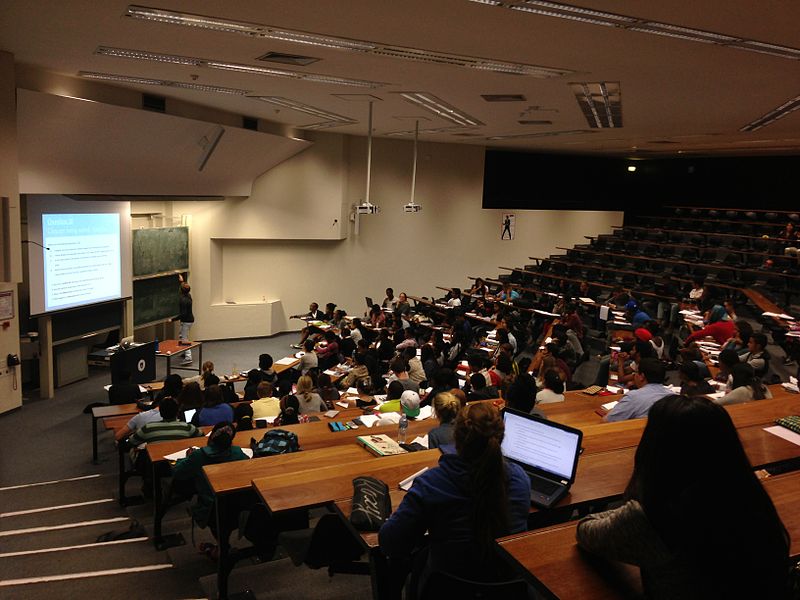 enables private companies to award degrees and add further metrics to the practice of teaching. This progressively turns teaching into a proscriptive exercise rather than a learning experience. The arrival of private companies, it is argued, will provide choice in the ‘education market’ (as if there are not enough universities to provide choice) and innovate.
My take is this. With respect to the railway disputes, this is a Government that wants to impose new working conditions on railway workers that have the potential to make travel less safe. We have seen this before at privatisation, It can be deadly.
With regard to universities, the advent of 9000 pound fees per year changed the relationship between teaching staff and students. The fees effectively commodified learning and universities have been complicit in this. Private companies such as the large publishing houses want to control content and merge their content production with delivery. This will squeeze out any critical thinking.
 As we have seen with Brexit, all is not what it seems. The Conservatives, with hindsight, were always Eurosceptic. They never embraced membership or tried to change it from within. The incoming Prime Minister, Theresa May, simply sees it as an opportunity. The opportunity to leave the jurisdiction of the European Court of Justice and to control border (something that she failed to achieve as home minister in the Cameron Government). The mandate from the referendum is there, even if the damage done to the economy is significant. This is not about the economy, it is about nationalism.
And not unrelated is the situation with the National Health Service. It is the ultimate outcome of a postwar rejection of conservatism. A majority Labour Government in 1948 enacted legislation to enable healthcare to be provided free at the point of use. The UK conservatives see now their opportunity to end this once and for all. They have pr ogressively been privatising it with many familiar private-sector firms cherry picking services (leaving the public sector with the difficult stuff like geriatric care and chronic illness). Now, the crisis that has erupted in recent weeks with Accident and Emergency services struggling, the blame has been put on General Practitioners who are opposing 7-day working. It is reported today that some are indicating their intention to leave the National Health Service. On the one hand, this looks like something that the Government cannot ignore. On the other hand, maybe it is just what they are looking for in order to introduce an insurance system?
Pictures: A lecture in progress in Leslie Soc-Sci building in theatre 2A.
Privatising schools by stealth
 Here we go again. George Osborne (left), the UK Chancellor of the Exchequer – otherwise known as the finance minister – took it upon himself to announce in his budget last week that all Schools will be forced to become academies. This is to rid them of fiendish local bureaucracy and hand them over to private-sector “trusts” where no such bureaucracy can get in the way of delivering first class education to children across the country.
First of all, I was a little confused as to why the finance minister rather than the education minister would make the announcement. Even the Prime Minister is a more likely bearer of such policy news. Who is making policy here? Oh, and while we are at it, let us abolish the right of parents to be governors on school boards. They seem to be part of that unnecessary bureaucracy that gets in the way…
Let us look at the rationale. First, Osborne links local bureaucracy and poor global performance of schools (on very limited instrumental metrics). Simply not demonstrated. Not only are local authority-run schools high performers in some cases but academies also fail – take AET, as just one example. Second, centralisation is an attempt to micromanage education. The national curriculum does not hold in academies, but the testing regimes do. And less-than-exemplar exam companies such as EdExcel (a subsidiary of Pearson) run the show. A far cry from my own secondary education certificate from the Joint Matriculation Board, a lofty university accredited outfit.
The local authority monitoring – sorry, bureaucracy – will be replaced by a highly efficient and non-bureaucratic schools commission. Conveniently accountable to some oblique central authority, not locally-elected representatives or accountable local civil servants.
More pertinent, it seems, is money. There is money to be made for academies not possible under local authority control. So, Knight of the Realm Sir Greg Martin – boss of Durand academy chain, apparently notched up a tidy salary of £390k and management fees of £508k while also running a dating website, a health club and an accommodation business (as if running schools was a part-time business opportunity).
Then there is the land. Oh yes, now we are getting to the nub of the matter. Local authority schools occupy public land. Academy schools’ assets are handed over to a “trust” (if ever the word trust was misused it is here, surely?). Wait and see the terms of use of land held in “trust” change.
Then there are the children who have learning difficulties or behavioural problems. Academies have to be target driven and non-conforming children are removed and ultimately become the responsibility of local authorities, those democratically-controlled entities that bureaucratically hinder educational achievement.
And then there are the teachers. Academies are not bound by national terms and conditions. The current Education Secretary’s predecessor, Michael Gove, already freed up academies to employ non-qualified staff and to replace them with software programs. Really. Now there will be no national negotiations over pay. That is another attack on organised labour and another good reason for conversion.
Talking of which, The BBC reported recently that to date conversion has cost local taxpayers £32.5m. According to Michael Rosen writing in the Guardian, 2,075 out of 3,381 secondary schools and 2,440 out of 16,766 primary schools are academies. That is a lot of conversion money still to be found.
The rationale now makes sense!
Should I admire Jacob Rees-Mogg?
Filed under: Housing, Journalism and News Reportage, Politics, Privatisation, Railways, Transport | Tags: BBC, Channel 4, Jacob Rees-Mogg, Mhairi Black
Leave a comment  Last week I was driving to work listening to BBC Radio 4’s Woman’s Hour. Jenny Murray, the programme’s avuncular anchor, was interviewing the 21 year old Scottish MP, Mhairi Black (left). It was a general discussion about policy, life, MPing, etc. She made her maiden speech in parliament on 14 July 2015 and was roundly lauded for it, despite having broken the protocol that maiden speeches should be largely apolitical.
It transpires, however, that Ms Black is an admirer of Jacob Rees-Mogg, Conservative MP for North East Somerset. This is not someone that is at the top of one’s list for admiration. I find him extremely divisive and not a little annoying. But listening to the interview a seed of doubt was implanted in my brain. Ms Black said that although she fundamentally disagreed with him he was a) very polite to her and b) articulate such that he would always give a reason for his position (something which I would have thought was true of all MPs, but seemingly not).
Oh dear! Should I now reconsider my feelings towards Mr Rees-Mogg (below right)? Fortunately, to the rescue, came today’s edition of the Radio 4 Sunday morning magazine programme, Broadcasting House, for which he was a guest newspaper reviewer (along with former Business Secretary, Vince Cable and  Shelagh Fogerty, a radio presenter in London). They were discussing privatisation, and in particular the privatisation of Channel 4 Television. Cable argued that privatisation would undermine its public service ethos, particularly its flagship news programme, Channel 4 News.
And so Mr Rees-Mogg did what he does best, plausibly lie. First, he said that there are many private-sector news outlets that have high journalistic integrity. Hence Cable’s argument was not valid. He must have been thinking about Sky News and the integrity of Rupert Murdoch’s unimpeachable global news empire. He then went on to say that there should be a management buy-out; seemingly the best of both worlds, a privatised broadcaster with the existing management’s public service broadcasting ethos.
Now I have spent a good part of my life studying privatisation (UK bus and rail industry). In both of these cases, management buy-outs were seen as good options. Many of the former national bus company regional operators were transferred to the private sector by means of management buy-outs. The same is true of railway franchises. But where are they now? The bus and rail industries in the UK are dominated by large – increasingly international – conglomerates. One of the exemplar management buy-outs in the rail industry, Chiltern Railways (operating trains out of London’s Marylebone Station) held out for 6 years before finally succumbing to corporate ownership. It is currently owned by Deutsche Bahn, the German national railway operator. A few bus companies still hold out. In my home town of Hull, East Yorkshire Motor Services remains stubbornly independent. I cannot think of many more.
The point is Mr Rees-Mogg, management buy-outs are simply a means for corporations to access strategic assets at probably a little more than they were originally purchased by incumbent managements. The best way to protect strategic assets from corporations – if this is a desirable objective – is to keep them publicly owned. In this I include housing (wholesale transfer of public housing and right to buy). Mr Rees-Mogg is deliberately specious. He needed to be challenged on his plausibility. He was unfortunately deemed to be presenting a plausible argument. Speciousness is a deeply unadmirable trait.
Pics: Mhairi Black – SNP (through Wikipedia)
Jacob Rees-Mogg –
 Be informed