Archive for the ‘Transport’ Category
Sustainable Aviation Fuel (SAF) and airport expansion
Filed under: Environment, Transport, Travel, UK | Tags: Airbus, Airport Expansion, aviation, Hydrogen aeroplanes, Logan Air, SAF, sustainability, Sustainable Aviation Fuel
 Leave a comment
Decarbonising aviation is very difficult. It is a good example of why oil-based fuels have been so important in the development of modern society. Nothing quite matches the energy intensity of oil, with the exception of nuclear. Sustainable Aviation Fuels (SAF) are trumpeted as the solution to aviation’s sustainability problem.
I am grateful here to Ben Purvis, Research Associate, Sustainability Assessment, University of Sheffield, for his contribution to the The Conversation for the content here. Purvis notes that there are so-called pathways for creating sustainable aviation fuel. These are:
- Oils or fats, including used cooking oil or tallow.
- Municipal solid waste, agricultural residues and sewage
- Hydrogen and captured carbon using renewable electricity.
It might seem that used cooking oil processing into aviation fuel is a win-win. But with the best will in the world, there is just not enough to go round. At the moment it is around 2 per cent of all aviation fuel. There is a UK mandate to increase this to 7 per cent by 2030 and 22 per cent by 2040. That is still only 1/5 or there about. To meet the current demand the UK imports 92 per cent of its used cooking oil from China and Malaysia (with its own carbon footprint). Currently the UK has one facility converting used-cooking oil to aviation fuel. That is the Phillips 66 Humber Refinery.
A recent report from the Royal Society notes that the 12.3 million tonnes of jet fuel per year needs 42.4 million tonnes of rapeseed biomass per year. In land terms, that is 68% of the UK’s agricultural land or 6.2 to 10.3 million hectares (see Innovate UK). The aviation industry’s own sustainability roadmap, CORSIA, precludes use of agricultural land for “fuel” crops.
The UK Chancellor of the Exchequer said on the 30 January 2025 (BBC radio 4, Today, c0815) that SAF could reduce aviation’s GHG emissions by 70 per cent. “Engines have become much more efficient. And, just at the beginning of this year, this government introduced the mandate for sustainable aviation fuel, which can reduce carbon emissions from flying by 70%. And of course, there’s going to be much more progress on that in the years to come.” (Quotes taken from the Guardian)
Equally there is global competition from both the EU and the USA (the latter now depends on the airlines rather than the state as burning fossil fuels now seems to be a US citizen imperative). Whilst it is clear that production could be increased with more investment, there is little confidence that it would be profitable; moreover, there is the small problem of cost – whichever pathway is taken, SAF costs more to manufacture than does aviation fuel (kerosene). That is £s on each ticket.
Surely there is enough municipal solid waste and sewage to go round? Well maybe, but the technology is in its infancy or not yet approved (see below) and no commercial facilities are producing it as yet. As for hydrogen, first it is packed with carbon if fossil fuels are the source of energy for the electrolysis necessary to produce it. Electrolysis by electricity from renewables remains distant. There is a long way to go before the UK grid is totally decarbonised. And now the British Government has added data centers to the mix, which means electricity supplies more generally are under pressure. Hence the Government’s latest endorsement of nuclear power and another un-tested technology, Small Modular Reactors (SMRs).

Not only manufacturing is a challenge, but the infrastructure to store hydrogen at airports or other facilities is just not in place. Hydrogen is also explosive and there are examples of denial of licences for users to store it, for example bus companies. It would require a major change to planning laws for widespread storage.
One UK company is undeterred: Logan Air. Logan Air has announced (12 February 2025) a plan to launch the world’s first hydrogen-fuelled commercial service by 2030. The company does not reveal the identity of the manufacturer of the aircraft that they will use for their point-to-point service (also as yet not stated). This against the backdrop of Airports Council International backtracking on its hydrogen ambitions in favour of scaling SAF, better air traffic management and improving aircraft engine efficiency.

There remains, therefore, the central question of actual aeroplanes. There was some succour in that Airbus was developing hydrogen planes (the A380 Airframer). This aeroplane was going to be a 100-seat 1850km range aircraft (right). But as recent as 6 February 2025 the Force Ouvriere trade union was informed that the launch date has been put off by between 5 and 10 years with an additional budget cut of 25 per cent. The company has identified the lack of available green hydrogen as one of the reasons for the delay. Another, less explicit but particularly troubling reason, is the company’s intention to replace its popular A320neo with a newer and more efficient conventionally-fuelled aircraft. The end of fossil-fuelled aircraft is nowhere in sight. The only option then, for sustainable aviation, is SAF from vegetable oils, tallow or waste.

There is a need, therefore, to clarify whether SAF is actually sustainable. In theory, because the things that it is made of already exist or are grown, burning it does not add to overall CO₂ levels. (Hydrogen, even more so, because it is derived from water and the emissions are just water.) So, aeroplanes still emit CO₂ when we really need to be capturing it and locking it into plants such as trees to generate negative emissions. Equally, it assumes that the crops and the waste had it not been for SAF would have degraded and decomposed releasing greenhouse gases in any case. The reality is that the area being used to cultivate crops to be turned into SAF would in actual fact be used either for food consumption or some form of rewilding. Essentially growing crops to fly planes (at least part of the way to their destinations) would displace food production. This would be a major distortion of land use.
The reason that SAF is so topical is because the British Government seeks to make the case that not only can we continue to fly at current levels, but that airport expansion is possible because the emission reductions from SAF rollout will offset increased flights (all in the name of growth). The above argument challenges that proposition. The calculation also needs to factor in the carbon emissions generated by constructing new runways. It is not trivial.
Gran Canaria – over land and sea, November 2024
Filed under: Easyjet, Environment, Transport, Travel | Tags: Cadiz, europe, European ferries, Eurostar, ferry, Gran Canaria, low-carbon travel, Madrid, Paris, Refre, SNCF, spain, Travel
Leave a comment OK, here we go. Low carbon travel. Train and ferry. Some facts.

Cost
Journey starts Saturday 17 November 2024. To fly from Gatwick Airport on that day would have come in at £45.00 (no luggage) – probably double that with the luggage I have taken that would need to go in the hold. Such pricing in the age of a climate emergency is obscene. By train:
London-Paris – £69.00 (standard class – average of return fare in November/December, considerably more in the summer or ahead of public holidays)
Hotel Paris – I was too late booking this for a Saturday evening. Overall cost £135. Hotel was Ibis Styles, Bercy. Breakfast included, and it was not bad. The room was tight but comfortable.
Paris – Madrid – £175.00 (standard class) – TGV to Barcelona and then Renfe to Madrid. The double-decker TGV is not particularly generous in terms of space, but not uncomfortable. The single-deck Renfe train was much more spacious but with no table (drop down rests were adequate for a laptop). We could not use the wifi because we could not see our ticket number (needed to register).
Hotel Madrid (Ibis Ventas) – £96.33 (incl. breakfast)
Madrid – Cádiz – £80 (standard class)
Hotel Cadiz (Soho Boutique Cadiz) £80 (incl. breakfast)
Cádiz – Gran Canaria – £91.10 (ferry – no cabin)
Taxi – Las Palmas de Gran Canaria – San Augustin – (£75.71) – Why taxi you ask? See below
Being in my sixties, I am not up for hostels, although I know that some budget travellers do so. Good for them, but I think I have reached a milestone. That said, in not selecting a cabin for the journey, we effectively slummed it, but the cost so far have been significant.
There are two of us so we need to double transport costs and share the hotel costs.
First leg
I’m pretty familiar with Eurostar. I travelled standard class on 16 November 2024 on the 1758 (retimed from 1801). I was able to work (the new drop down rests for stuff are now a bit wider). There are power sockets – UK and European. I have my own modem/internet for security reasons. The signal was pretty good throughout, including in the tunnel. In the past when I have connected to the Eurostar wifi, it has been pretty unreliable.

It cost me €2.15 to use the Paris Metro/RER to get from Gare du Nord to Gare de Lyon/Bercy. One can buy a card to load and reuse. Ticket machines take cash and cards.
Second leg
The next day (17 November 2024) we walked for 10 minutes from the hotel to Gare de Lyon and went to Hall 2 from where the trains depart. The QR codes on our phones or paper did not read. There was someone at the barrier to scan using their own reading machine. All good. We had two seats on the upper deck with a collapsible table usable only for the people sat closest to the window. There is a socket and wifi (below left).

The route taken by the train is pretty much rural France, but on reaching the Mediterranean, the scenery changes to on of salt marsh as it precariously meanders through the Parc Naturel Regional de la Narbonnaise (below right). The train is probably the best vantage point for seeing it as the train runs over what seems to be a causeway.
Warning, however, whilst writing this blog entry my case located by the entrance to the carriage was stolen. My advice is either to chain it to the bars or locate your case inside the carriage – there are some internal luggage racks.

The RENFE train to Madrid was directly opposite the arrival platform of the incoming TGV. It was that simple. Though there are a few challenges. We bought our tickets on RailEurope.com. The pdf that is made available on the app is unreadable by anyone with less-than x-ray sight. The train manager had a record of the ticket, so we were fine. It seems also possible to print tickets from ticket machines providing one has a PNR number that was clearly stated on the itinerary confirmation.
We then looked to buy tickets for the next leg, Madrid – Cádiz. We tried the machines – ticket buying by non-Spanish citizens is not so easy. Each traveller needs to insert their passport number. We got so far in the process (give yourself 10 minutes) before we were thrown out of the system whilst trying to pay. We did then find the staffed Renfe ticket office on the first floor and bought them in the traditional way, but passports are still needed. And the ticket office sales person found the system equally cumbersome. Our passport details had to be put in twice!
Then on to the Metro. Two lines, first 1 (blue) to Sol and then 2 (red) to Ventas. Buying tickets is easy, but you have to buy a card and load it with as many journeys as you need. In our case one centre ticket. Each centre area ticket cost €2.50 with the card. For the first charge, I think the card costs €2 (extra). On the way back to the station the following day, 18 November, we just loaded the cards. Note the machines are cashless. We ate in a nearby Lebanese restaurant. Portions were huge – salad, falafel, spicey patata and vegetal mousaka.

The hotel is next to the bull ring (left) – a constant reminder that there are some residual bloodthirsty passions in Europe. (The British as much as the Spanish – though not in such grand areas.)
Third leg
Monday 18 November is another train journey – about 4 1/2 hours to Cádiz. There is a fast and direct service roughly every 3 hours. It think it can also be done in two legs if needed: one to Seville and then Seville – Cádiz. The trains are spacious (standard class). Each seat has a socket (though mine did not work). There is room for a laptop to be opened and used. The wifi on the train is not working. Though my modem is fine. Similar to Paris, Madrid has distinct boarding gates. Passengers are advised to get there 30 minutes before departure – all baggage is scanned (unlike Paris). It takes about 10 minutes to pass through.
Incidentally, I bought a new case at the station, a t-shirt, shirt, a pair of socks and a sweater to keep me going. I discovered that I did have some underwear in my rucksack.
For a change we arrived at our destination in daylight. We checked into our hotel – probably one of the best we have ever enjoyed – the Soho Boutique Hotel. We had a suite. It was sensational. The breakfast was additional, but worth it. The spread was varied ranging from breads, pastries, cereals, cheeses, meats and fruit.
We bought a few more items in the town:
- food to take onboard – correctly assuming that the onboard catering might be a little unapetising
- Some eye protection (my prescription sunglasses were in the stolen case)
- some trousers and a gilet from a male clothing retailer and shorts, leggings, t-shirts and underwear at an unexpected-to-find branch of Decathlon.
We ate in a Latin-inspired restaurant in the town. The restaurant – Más Que La Cresta – is not exclusively vegan, but the options are good. We took a selection of starters as tapas; though the vegan burgers were certainly enticing, burgers are not quite our thing.
Fourth leg
The ferry terminal is about a 15 minute walk from the entrance to the port. Foot passenger enter the office through which they pass security control and then enter a taxi to drive to- and then in-to the ferry. We did not take a cabin – trying to keep down the costs somewhere – so slept in the reclining seat area on deck 7. For the first part of the journey we sat on the deck in the sunshine. The ferry crosses the shipping route from the Mediterranean west. I trust they have some communication and understanding that ferries operate against the dominant shipping route. It is a reminder that the seas are equally colonised by humans. And on the deck, the exhaust from the ferry reminds us that there are still greenhouse gases being expelled into the environment.
The ferry has a small shop that sells the basics – cigarettes and soap. There is a bar/café and then the self- service restaurant. Not much more. It is unlike the ferry to Rotterdam from Hull which has cinemas and a casino (not that a casino is of much interest to us).

Sleeping – without a cabin, there are rows (2-3-2) of reclinable seats on decks 5 and 7 (right). Deck 7 is the quiet level. What we have realised is that this ferry carries some very seasoned travellers, many of them young, who bring mattresses, airbeds, sleeping bags and food to microwave (the restaurant has a public microwave for use). There is no washing up area, though. So the seasoned travellers often sleep horizontally on any available floor (there are signs all around forbidding this, of course). It is, I think, also the case that this is not a party ship. People are here to sleep, not to party (that is probably saved for the islands).
Did I sleep…yes. It was quiet. People slept. Though in the summer it might get more chaotic with so many floor sleeepers. The reclinables are least comfortable, I found, when reclined (they do not recline too much). I reverted to normal position. A pillow of some kind is needed. That doesn’t mean that I am not looking forward to a bed on arrival.

For the day, I was on deck for much of the time (left). The sun was warm and I had a book. Working is not so easy as the ship is really not geared up for business. The sockets are few – and in demand for mobile recharging. There is a small cordoned-off area in the restaurant that could act as a business space. It does have sockets, but I only counted four, and they were not well spaced around the room either. In the end I went to work in the restaurant in-between sittings (breakfast, lunch and dinner). Talking of which, we did take breakfast. It was not bad actually. And not expensive. For €12.50 we had cereal, bread, egg, yoghurt, tortilla and coffee. We are not sure whether it was accurately calculated. But hey.

We were scheduled to dock at midnight…in the end it was 0130 GMT. We were out by about 0200. But what then? Cadiz is easy, the port is adjacent to the town and walkable. Las Palmas de Gran Canaria port is quite large, not walkable and relatively deserted at 0200. There was no shuttle bus, no taxi rank. My beloved was armed with a taxi phone number but more than once – without perfect Spanish – they just put the phone down on us. I walked back to the ferry to ask one of the personnel if they could speak for us. We had a volunteer whose intervention magically summoned a taxi that arrived after about 10 minutes. Uber is on the island – download the app before you travel. Anyway, the drive was approximately 45 minutes – fast because there was little on the roads (which are superior to anything in the UK – not a pothole to be seen). The fare was €90 to San Augustin – 55km. Journey end.
Reflections
I wanted to test the feasibility of getting to the island by land and sea and be productive in the process. Whilst I may be on holiday, I still want to engage in some academic work – I am an academic after all. All travel raises questions that warrant answers. I have never regarded travel time as a waste. I do think my efforts here were thwarted by the transport operators – notwithstanding the theft of a bag. Here are the key challenges:
- Cost – it is significantly more expensive to travel overland than by air. The journey cost overall was £802.14. That is at least eight times what it would cost to fly. We could cut out the hotels – do Paris to Cadiz in a single day starting very early in the morning. That is a tough day and all the connections need to work.
- Time – I wanted to be productive and connected. It was ideal for reading books and academic papers, not so good for writing. Observations:
- I could not connect to the internet on Renfe between Barcelona and Madrid because users need their ticket number. This was unreadable on my ticket from RailEurope. That said, for security, I use my own dongle with European roaming, which worked fine. I did use about 21/2 Gb.
- The (un)complementary internet on the ferry was very poor. And because we were sailing, there was no mobile signal (I feared, too, that if there was, it would be Moroccan, and therefore elicit extra roaming costs). I could have bought a better internet package from the operator, though. I did not because I had lost my credit card in the bag theft.
- As noted, there is no dedicated workspace onboard.
- Foot passengers on ferries are poorly served. The situation at the port of Las Palmas de Gran Canaria was a problem. There was absolutely no provision for us at the port. And being so late, it leaves stranded passengers vulnerable. This is not universal. Other ferry journeys that we have taken have been better served. Hoek van Holland has its own railway station! Europoort had coaches to take passengers to Rotterdam (or used to).
What needs to be done
- Sort out ticketing…
- Buying European train tickets is way too complicated, especially across borders. We used Rail Europe, but the tickets issued were unreadable by station and train staff.
- Adding to that, buying tickets in Spain either by machine or at a staffed ticket office is slow and cumbersome. Passports are needed for non-Spanish travellers and it can take an inordinate amount of time to get issued with a ticket. On the machines, we twice got ejected and had to start again.
- Wifi…
- I am happy to use my dongle for security reasons, but the ferry wifi was poor by any standard. Even basic searching was difficult or impossible. The wifi would shut off in any case after 30 minutes or so and it was necessary to log in again, including reading the terms and conditions.
- Make provision for work – dedicated space, sockets, reliable wifi. I know the argument – there is no demand. But there is no demand because there is no provision, arguably. Equally, the ferry would be an ideal place for a conference, workshop, briefings, etc.
- Treat foot passengers with respect. Ensure that they can embark and disembark safely. And do not leave them stranded at a port in the middle of the night. That is truly shocking.
Getting back
We flew back! It was not the original intention, for sure. I made the decision when we got on the ferry from Cádiz. I am not advocating flying – my overland and sea days are not over, far from it. Indeed, the flight was long, cramped, hot and involved airports. However, three key things swung it for me (a further two factors made me feel slightly more sanguine).
- The timings of ferries back relative to my need to be at my desk on 9 December meant that the time on the island would be much shorter. In order safely to get back by 9 December, I would need to leave the island on 1 December 2024. That ferry is scheduled to be 43 hours. Having taken 5 days to get to the island, to leave after just over a week seemed rather punitive (bearing in mind I am working throughout the period January to August inclusive and this is my summer holiday).
- The experience getting here was not the best – from having my bag stolen to the facilities on the ferry and the restaurant menus.
- Cost – I had to spend quite a bit of money replacing some of the things I had lost particularly my clothes.
- Carbon – I am trying to be a good citizen, but I am not perfect. Though I am reminded by some pioneers of low carbon working of studies relating to carbon generated by flying, in particular the contrast between short haul and long haul. That is not to say that I am going suddenly to start flying again as I had done prior to Covid (i.e. every week). Here is a quote based on work by Frédéric Dobruszkes, Giulo Mattioli and Enzo Gozzoli “flights of less than 500km account for 26.7% of flights, but only 5.2% of fuel burnt; while flights of 4000km or more account for just 5.1% of flights, but 39% of fuel burnt. This tallies with AEF’s (The Aviation Environment Federation) findings that shows that in terms of carbon emitted from flights from the UK to destinations around the world, the worst offenders are indeed long-haul – in top place is the US with 23.6% of the UK’s international flight emissions (10.6Mt), and Dubai with 6.7%.” You can read the summary article, “The Elephant in the Middle Aisle” here.
- Finally, I picked up an injury in the final week on the island (see later entry) that would have made overland very difficult, painful and dangerous. On that basis, too, I can safely say that disabled travellers are much better served by airlines (though there are some horror stories) than overland across borders and modes.
Decarbonisation milestone
Filed under: Environment, Transport, Travel, Vehicles | Tags: decarbonisation, diesel van, Mercedes Vito
Leave a comment It has taken three years to get there, but I have reached a decarbonisation milestone. It started with six photovoltaic cells on my roof and 6kW of battery storage. I then invested in an induction hob. Then, the big one, the heat pump. Which is now doing an amazing job at keeping the house warm and supplying hot water. It is a different experience to my gas boiler and super hot radiators. The radiators stay ambient.

Anyway, finally, today I said goodbye to my diesel van (why did I have a diesel van in the first place you might ask?). I have sold it, so it will still be burning fossil fuels and emitting greenhouse gases. But I felt that in selling it I may be tempering demand for new vehicles. Even this old van has embedded carbon from its manufacture.
Where to next? What more can I do? Well, there remains plenty of scope. First, I need to do a full audit of my life and then create for myself a carbon reduction plan! I will report further here in due course.
Electrifying UK railways and climate change
Filed under: Politics, Railways, Transport, Travel | Tags: Battery train, Great Western Railway, GWR
Leave a comment I use the case of the electrification of the railways as an example of climate mitigation. Diesel trains are hugely polluting, particularly in the context of carbon dioxide; electric trains much less so. Seemingly a switch from car to diesel train can cut an individual’s carbon emissions by 70 per cent and a whopping 90 per cent if the train is electric.

The electrification of the network has always been rather piecemeal. The East Coast Mainline was electrified in the 80s, but missed out key towns and cities such as my home town, Hull. Diesel trains still run under the wires from London to the city. More startling, but not surprising is the account given by Aneurin Redman-White, a railway design consultant, of the mess that is Brunel’s original railway Paddington to Bristol/Cardiff and Penzance. The Penzance bit was abandoned by Chris Grayling, the former secretary of state for transport, even though it had been used as a reason for price increases! It’s like watching a mini-series on TV but not watching the concluding episode. But, actually, it is not like that at all.
Unfortunately, the current British Government, like many before it, believes that private mobility – cars – are still the future and perennially electorally popular. Notwithstanding the fact that governments should always lead rather than follow, especially on global challenges such as climate change, the decision not to electrify the railways on cost grounds, whilst continuing to build roads, is short sighted and wrong.

There is another option, instead of electrifying the infrastructure – at least for short or middle distance routes – battery trains are becoming an option. Great Western Railway in England has now publicly trialled such a train (right – with Mark Hopwood, MD). This train is giving 86 miles (138km) per charge. And charging takes – wait for it – 31/2 minutes.
There are hybrid electric trains, too. Hitachi Rail runs 20 so-called tribrid trains across Italy. The battery is charged when the train decelerates by braking or when it is collecting charge from an overhead wire. There is only 10 miles manageable per full battery, however.
Network Rail, the owner of the UK infrastructure such as track and signalling, has a net zero carbon target for 2050. To meet that target about 500kms of new electrified railway is needed each year. At the moment, a mere 38 per cent of the UK rail network is electrified. The German railways, by contrast, are reported to be 90 per cent electric operation (slightly different terms, I appreciate, but even then, a significant difference).
The argument that the UK railways contribute only about 2 per cent of greenhouse gases across all sectors is a classic response. What is 2 per cent? For that amount, it is not cost-effective. Investment in public infrastructure can be cost-effective, especially if we consider wider social returns in terms of employment and mobility more generally (just look at what CrossRail/Elizabeth Line has done for the Capital). Moreover, maintaining the capability to design, build and maintain infrastructure is, arguably, a requirement of a post-carbon (aka civilised) world.
Travelling in Europe at the height of a pandemic
Filed under: Covid-19, Railways, Terminals, Transport | Tags: Deutsche Bahn
Leave a comment 
Omicron is remarkable. A month ago we were unaware of it, now it threatens – single handedly – to “cancel” Christmas; for some reason, the politicians’ worst fear. It has thrown up a problem for me. At 2300 on 19 December 2021, Germany closed its border with the UK because – yet again – the UK is a considerable source of infection and has to be controlled. A mere 8 hours after the closure of the border, I was to set off on a journey to cross the border.
I am vaccine boosted (but that is no longer enough). I needed a negative PCR test. Bearing in mind it was only 24 hours earlier that the German Government announced the new restrictions, my journey got a whole lot more difficult. I had to search for a PCR test that could be delivered in super-quick time. The recommended testers by Eurostar had no appointments, and even if they did, they had to be done before 1300 for delivery by midnight. That was pushing my itinerary a bit.
I did actually find a company in London with appointments – Concepto Clinic. They have various locations in the UK. I went to the facility in the Hilton Hotel at Canary Wharf on the understanding that the day’s test result would be delivered overnight. It was. On that basis alone, I recommend the experience, despite the expense (all equivalents are similarly priced).
It was necessary. A negative test was required to board the Eurostar in London. Also necessary was a passenger locator form for Belgium (Eurostar terminus is Brussels). The form is online and is validated with a code either sent to the traveller’s email address or mobile phone. The locator form was checked again at Brussels by border police.
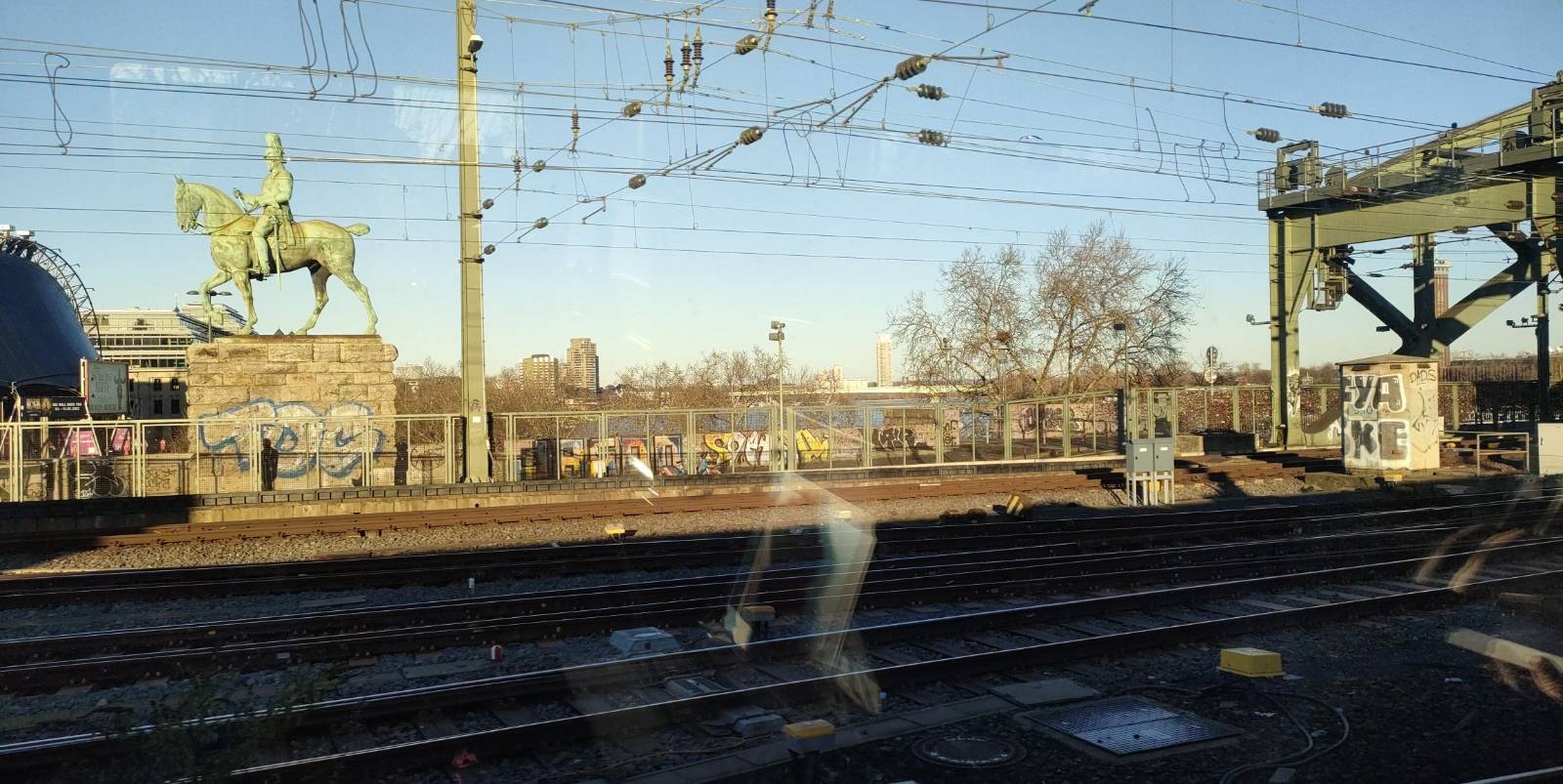
I have additionally filled out a locator form for Germany. This form, for the new regulations, asks for a reason for travel. Visiting close relatives is a valid reason to travel. There is also a section on vaccine status, and being able to prove it. It is not entirely clear at the moment whether two jabs constitutes being vaccinated, or whether a booster is required. The form is online and is also validated with a code. My form was accepted by the system, though not checked despite border police being on the train.
One more thing about travelling with Deutsche Bahn, if a connection is missed (which in my experience is pretty common), the train managers do not seem to care that one is on an unscheduled train. There is no explaining to do, they point their machines at the QR code and move on.
The DB Navigator app is a bit of a curiosity. I travel paperless, so the ticket and itinerary are stored within and read by the train managers’ devices. The app informs you whether you are likely to meet your connections. If not, it offers alternative suggestions. I have found these to be not so wise to take up. Today, for example, I was offered a train from Köln involving some regional services as well as intercity. I think that unless one is terribly stuck, regional services point you in the right direction, but not much else. When booking, however, some of the real bargains on offer involve regional services, but when the booking is exclusively intercity, as mine was, they can extend journey times significantly.
Climate Watch: Ireland exports calves by air!
Filed under: International, Politics, Transport, Environment | Tags: Veal, Irish Government
Leave a comment Amongst greenhouse gases, methane is probably the worst with carbon dioxide caused by burning fossil fuels being the most prevalent. Aviation fuel is still a fossil fuel last time I looked. The Irish Government clearly did some climate-denial overtime to come up with the following: in order to improve the welfare of unweaned calves, instead of packing them in lorries and sending them to the Netherlands, they’ll pack them in transporter planes instead (Guardian, 6 March 2021).

Notwithstanding the fact that veal is a low-welfare meat, transporting any food commodity by air is to be avoided. Transporting a sack of methane, doubly so. If our politicians cannot get their heads around the kind of changes needed to tackle the climate change emergency, what hope for everyone else?
Pic: By David Monniaux – Own work, CC BY-SA 3.0, https://commons.wikimedia.org/w/index.php?curid=234720
Travelling during a pandemic
Filed under: Easyjet, Hotels, Terminals, Transport, Travel |
Leave a comment Hopefully most readers are not travelling at the moment. Staying put is safer and, frankly, much less stressful. I am a frequent traveller to Europe for family reasons and have experienced most things – delayed trains and planes due to failed infrastructure, sick or unregistered passengers and luggage, unruly passengers, theft of my possessions, dodgy hotels, the lot. And then there is Brexit – my passport no longer seems to get me through eGates in Germany (we’ll see if that is a one-off or permanent) and, of course, as a non-EU citizen, I can only be a country for 90 days in every 180 and am barred from working.
Now before I get ripped to shreds on my hypocrisy flying as I do but also constantly banging on about climate change, let me state the following. Travelling is for family reasons, and whilst 15 years’ ago when I first established family connections in Germany, my ignorance – despite friends warning me about my carbon footprint – meant that flying was a viable option. Clearly things have changed, but my family has not. I need to travel to be with them. During the pandemic, I have been travelling less for three reasons. First, it is quite difficult; second, it is dangerous and inappropriate (lockdowns are lockdowns after all); third, I have the privileged of being able to work from home. With regard to flying, I am an advocate of a frequent-flier levy – the more one flies, the more you pay. And exponentially. That would hit me hard financially, and rightly so. I am also hopeful now of structural changes that will enable me to travel more often – or always – by train. The pandemic has demonstrated that we can work remotely. I am healthier and less stressed because of it. We will see how committed employers are to the permanent change in the future. I am hopeful, but not convinced. There is also talk of a new Trans-Europe Express to help people to move across Europe without planes.
What follows is an account of my experience to help others. Having travelled for many years, there are many like me who have family on the continent.
 I passed through Heathrow airport on Sunday evening (14 February). I travelled with British Airways – currently offering 2 flights per week Munich – London. Originally I was scheduled to come back the previous day with easyJet, but that plane was cancelled, with the next scheduled option being sometime in March. On 18 January, the British Government imposed a requirement of a negative Covid test on all arrivals. That was fine, but an extra task to fulfil prior to travelling. Travelling on a Sunday meant that I took the test on the previous Thursday giving enough time for the result to be notified assuming that weekend lab work is not likely. Sunday was, hence, the last day of validity for the test. If the plane did not go on Sunday, I’d have to take another test (€130).
The plane arrived at its stand an hour before departure. The plane was fully boarded (busy but not full) at the scheduled departure time, 1745. But we were 45 minutes late pushing back from the stand due to an administrative error at the gate. Munich Airport would not allow the plane to go until everything was in order. Fair enough, I suppose. After being pushed back we waited motionless for about 10 minutes before the pilot announced that the plane had been damaged in the pushback. Engineers were called. 2 hours later, authorisation was given to fly.
I do not live anywhere near Heathrow Airport, and it being Sunday, the UK railway network enjoyed its usual scattering of engineering works, including on my routes home. If I was able to catch the last train/bus home, I expected to be back about 0300 – not a great prospect. But UK borders are never straightforward, and particularly with the need to demonstrate a negative Covid test and a valid passenger locator form (which includes payment of £210 for two Variant tests to be delivered to one’s home 2 and 5 days after arrival). Even though the arrivals are few, the border area was full and a long queue that snaked its way back and forth was created. Familiar image. Mingle, mingle, mingle.
The eGates were open as additional security staff were checking the documentation. My passport was rejected by the eGates and I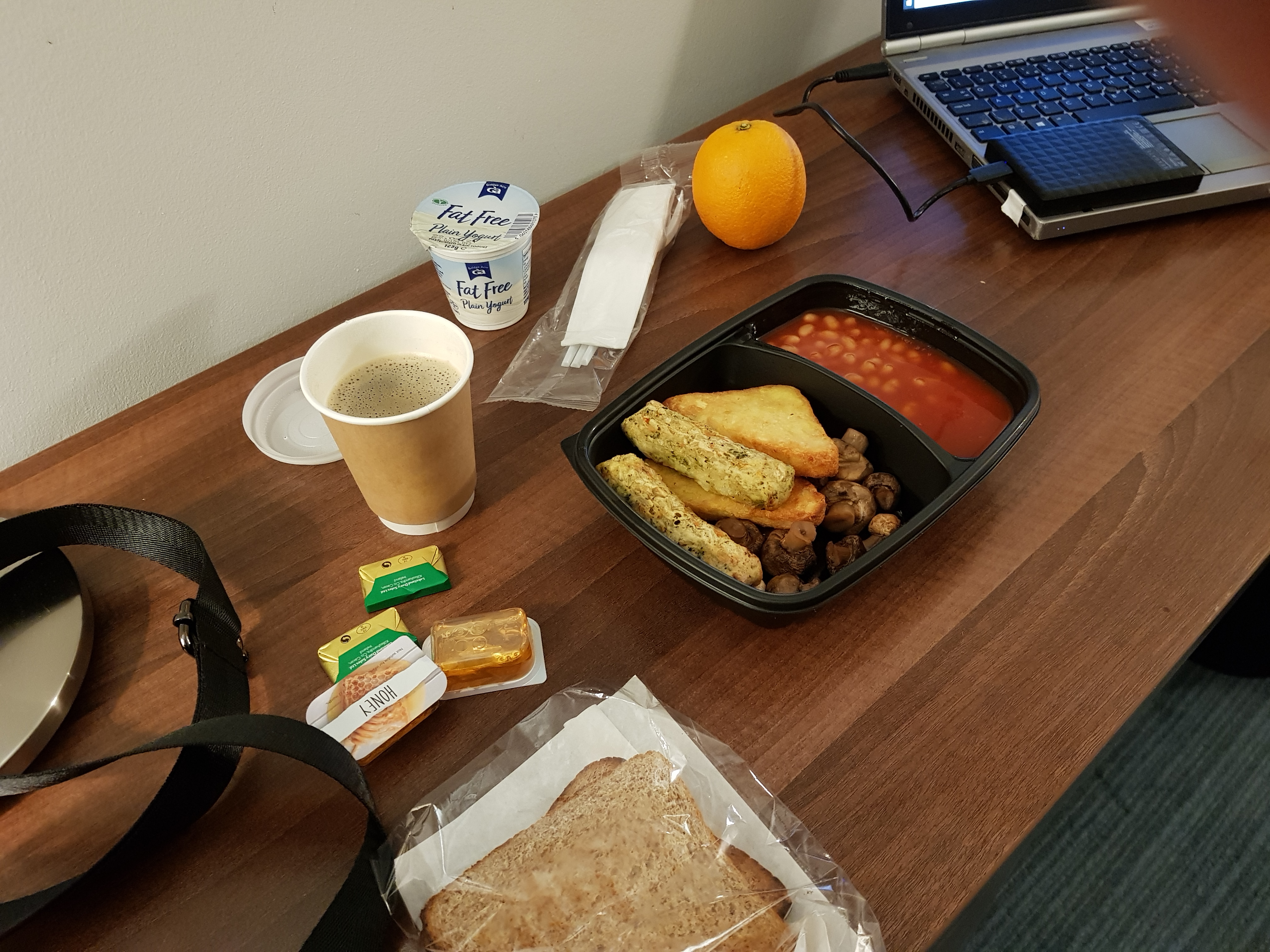 had to stand in another queue to be approved by a border official – there was only one on duty. In total, I was about 1 hour getting across the border. I decided to take a hotel rather than attempt the journey home. I stayed at the Hilton Garden Inn Hotel at Hatton Cross (close to the Tube Station). Hotel prices are half of what one would normally pay, so that was not too onerous, though still a cost. The view (above left) was a shade dystopian, however. But I recommend the hotel if readers are ever in the same position. I bought breakfast – one retrieves it from the kitchen and consume it in one’s room. It was fine (right).
On Monday (15 February 2021) I was able to travel to the South Coast of England. The Tube and overland trains were largely quiet. I am now observing an obligatory 10 days’ quarantine. I stocked up on non-perishables before I departed, so I have most of what I need for the duration. Safe travels.
Posh hotels
We’ve been revisiting the television recently. We’ve done the ten episodes of The Great British Sewing Bee. I finally got round to watching the extraordinary story of the Shah of Iran’s extravagant and delusional party in the desert back in 1971. But the other night we fancied something extremely light and un-challenging. So we went for the BBC’s Amazing Hotels: Life Beyond the Lobby featuring Schloss Elmau in the Bavarian Alps. Unfortunately, this was challenging. I am writing this now because the impact is still festering.
 The concept of the programme is that two presenters go to posh hotels all around the world and muck-in, as it were, whilst giving the hotel a priceless chunk of advertising. The presenters (left) are Monica Galetti – a real-life chef, and Giles Coren – a sometimes controversial columnist with, by his own admission, an opinion “on just about everything”. This mucking-in, or as the publicity for the series has it, “rolling up their sleeves” is excruciating. Coren, in this episode, trying to learn towel flapping in a sauna is a case in point.
I tried to book a room at the hotel. The off-peak prices were about 3000 Euros for a couple of nights for two. But for that you get fed twice a day, access to a spa and a series of temperate pools inside and outside, accessible all year round, libraries and a bookshop (that is a nice touch), lounges and generously-sized rooms with views. Stunning views. It is also unique in that it is a music venue. Some of the world’s most eminent classical musicians play there (and have done so since 1959) on a “stay and play” basis. So the owner, Dietmar Mueller-Elmau, when asked what is the core theme of the hotel, he took them to the music room. It is extraordinary. Oh, and the G7 met there in 2015.
Summary – culture and well-being. At a price. What is my gripe, then?
Notwithstanding the extraordinary publicity granted a private business on a public broadcaster, and the format of the programme – mucking-in – there is an elephant in the room. It is probably true of all in the series and not exclusive to Schloss Elmau. And that elephant is sustainability.
At no point was there any discussion about the carbon footprint of this place. I cannot begin to imagine just how much carbon it generates from heating, the spa, the kitchens and, of course, getting people there. Whilst there is a train 7km away, I doubt it is the primary mode for visitors, especially in the winter. We had a look at the menus for the five restaurants. It all looked rather meaty. Just adding, of course, to the carbon footprint. Now bearing in mind the hotel had a devastating fire in 2005 and was largely rebuilt to meet the vision of Mueller-Elmau, one might have thought that there was a potential sustainability story to be told. Maybe there was, and the BBC just edited it out. I sense the producers and editors just loved Muller-Elmau’s declaration of delight when the hotel burned down and the opportunity it presented. I have no idea to what standard of sustainability the hotel was rebuilt.
That leads to the BBC and any other broad or narrow caster. Sustainability needs to be central to the theme of these programmes. OK, I can be a voyeuristic as the next person on how the “other half” lives, but at least put a carbon price on it. Or maybe the next series is about hotels that are sustainable, have been built or rebuilt to be sustainable – carbon neutral. Maybe it is time to promote them. Or if Schloss Elmau is sustainable, tell that story. Amazing hotels, I fear, come at a price much higher than what comes out of my bank account to visit.
Photo: BBC
Pillar boxes and buses
On 21 March I uploaded my first pictures from my new project, Pillar Boxes and Buses. So, the challenge is, photograph UK pillar boxes with the added challenge of getting a bus, preferably one that is moving, in the frame, too. My latest reel of film came back today with mixed results. First is a curious box – it is actually embedded into a gatepost of one of the large houses on Marina, in St Leonard’s on Sea, Sussex. Currently there is one bus per hour in each direction on the 99 route. The shot has the added complication of lots of parked cars and scaffolding. The results are not great (right) but I’ll be back with a faster film that should help with the depth of view (50mm lens, 200asa film and shutter speed of 250th sec f11; 2 April 2020 at 1830). The bus is a ADL Enviro200. The Stagecoach Hastings fleet can be found here.
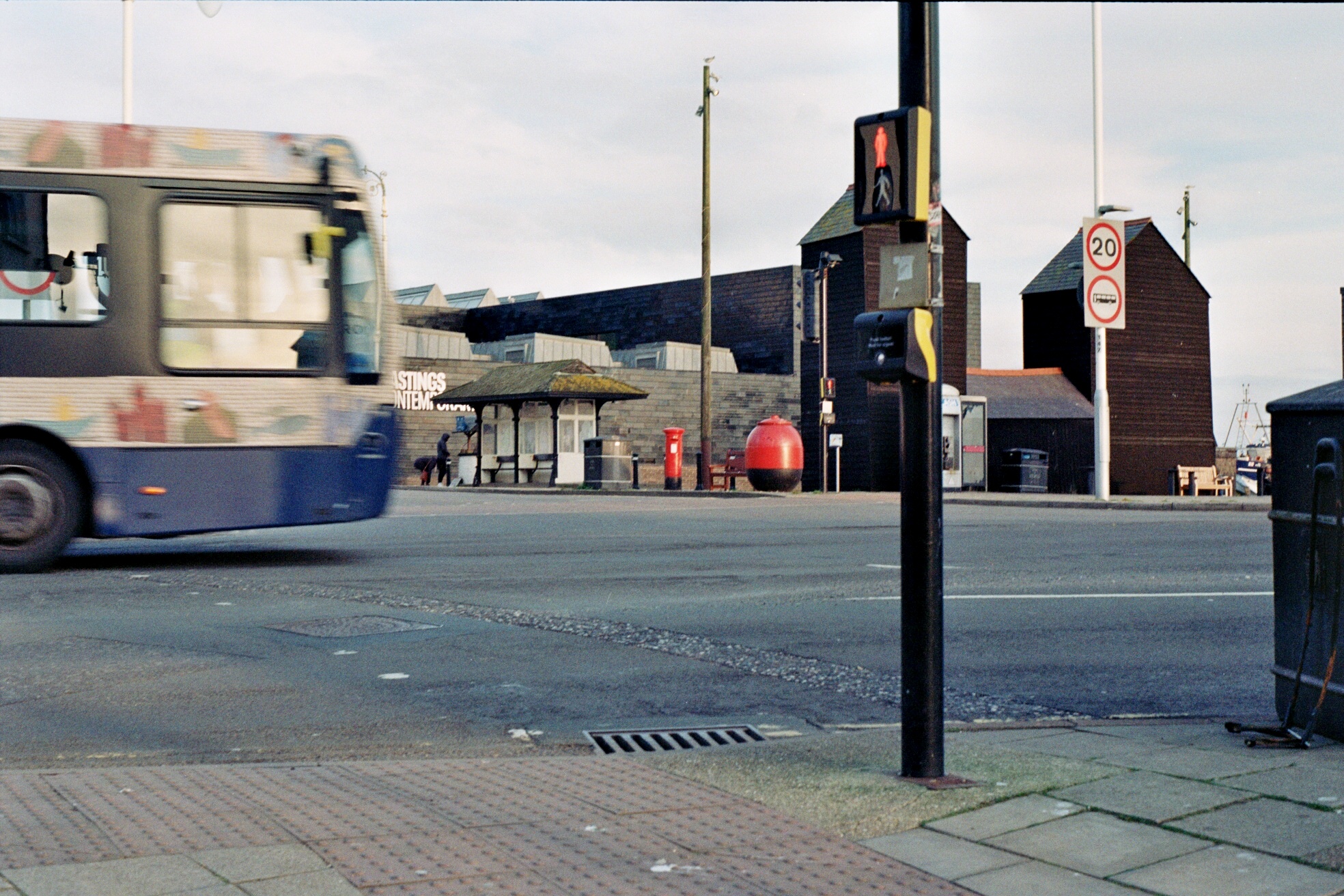 Moving on to Rock-a-nore in Hastings. This one (left) is a free standing GR VI box taken on 21 March in the early evening. There was just not enough light to get the shutter speed fast enough to catch the bus, but actually the motion is quite good. The bus in question was a ADL Enviro200 (Hastings Arrows livery).
| Then on to a box that has been intriguing me for a few days. It is located on Hastings Road in Bexhill close to the Ravensdale trading estate. What is so wonderful about this box is that at a certain time in the day, the sun illuminates it like a spotlight on a performer in a theatre. So, to do it justice I needed a sunny evening and no one really in the way (it is popular with joggers, though I am not sure why. This effort (top right) dates from 24 April at 1845, again with a shutter speed of 250th second, f11, film speed 200 asa. The two additional shots are taken at the same time on the two subsequent evenings. | 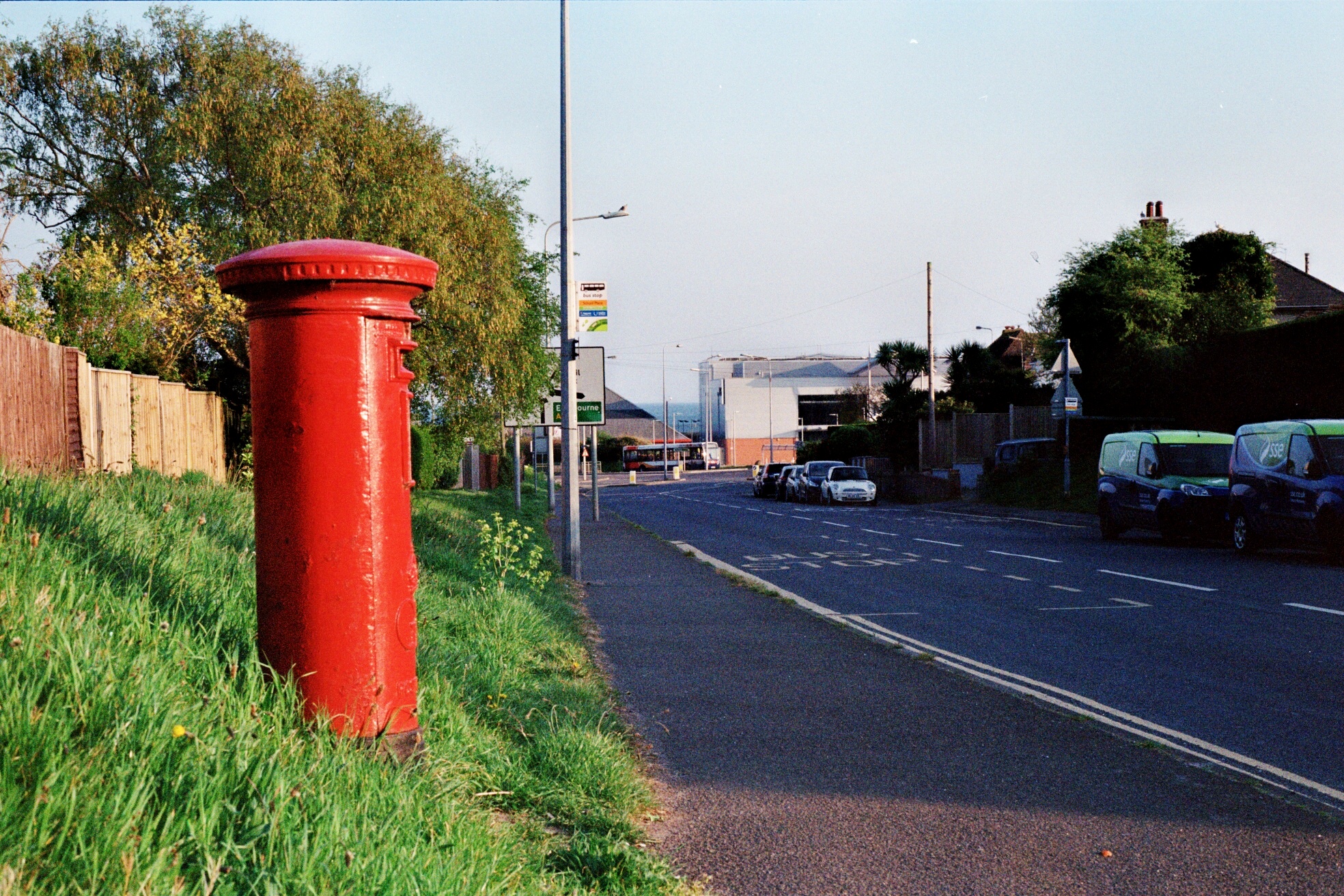 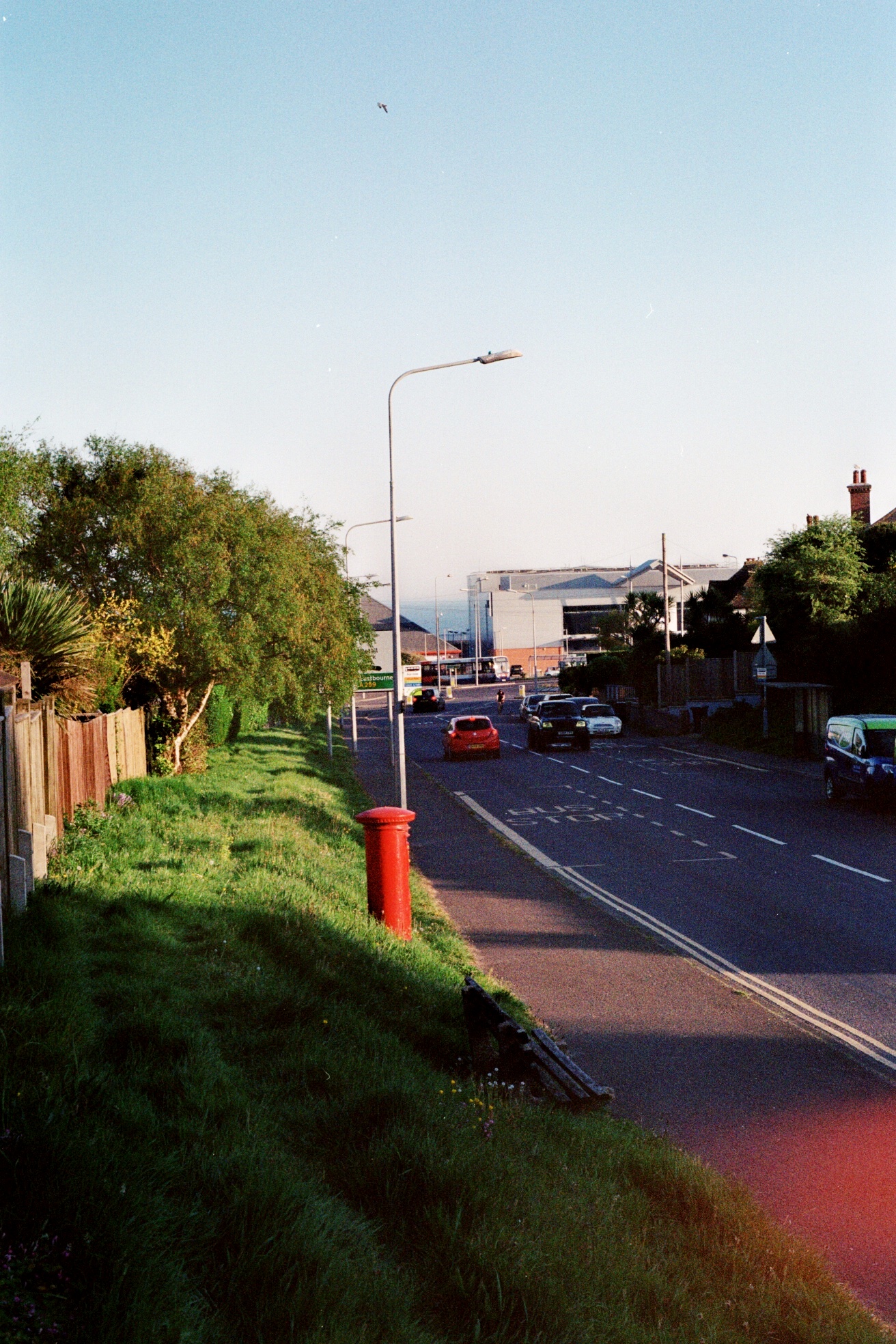  |
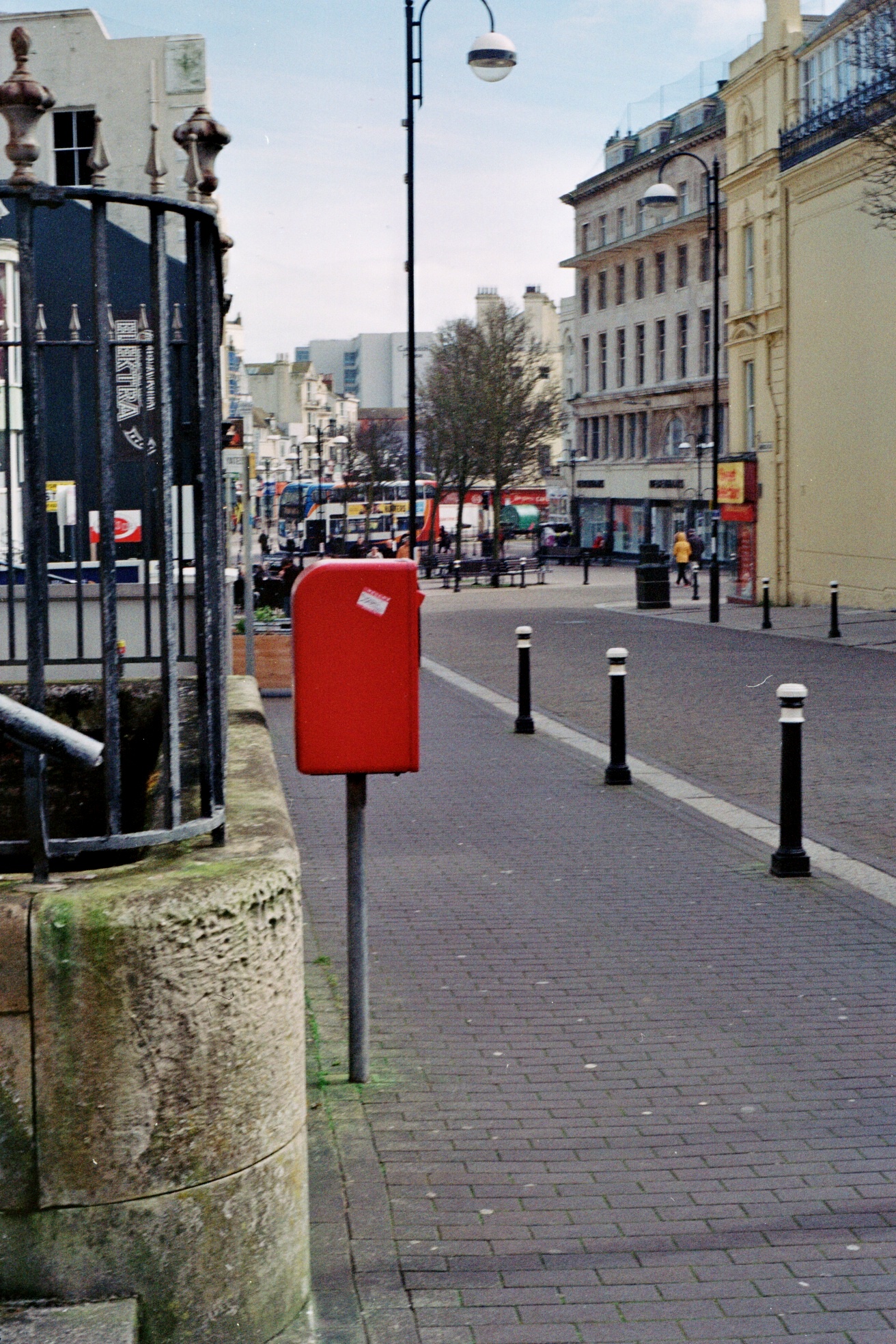 |
Next is me revisiting the relatively small free-standing box outside the now dis-used post office on Cambridge Road in Hastings As noted in my earlier entry in November, it serves as a reminder of how post offices are being assimilated into more traditional retail outlets – for better or worse. Anyway, here it is with a bus in the background which I take to be a Scania N230UD ADL Enviro400! |
| Still in Hastings, this is Queen’s Road, a central loading area opposite Priory Meadow Mall. The box is classic ER Type B. The buses, Scania N230UD ADL Enviro400 (double decker) and ADL Enviro200 (Hastings Arrows livery). | 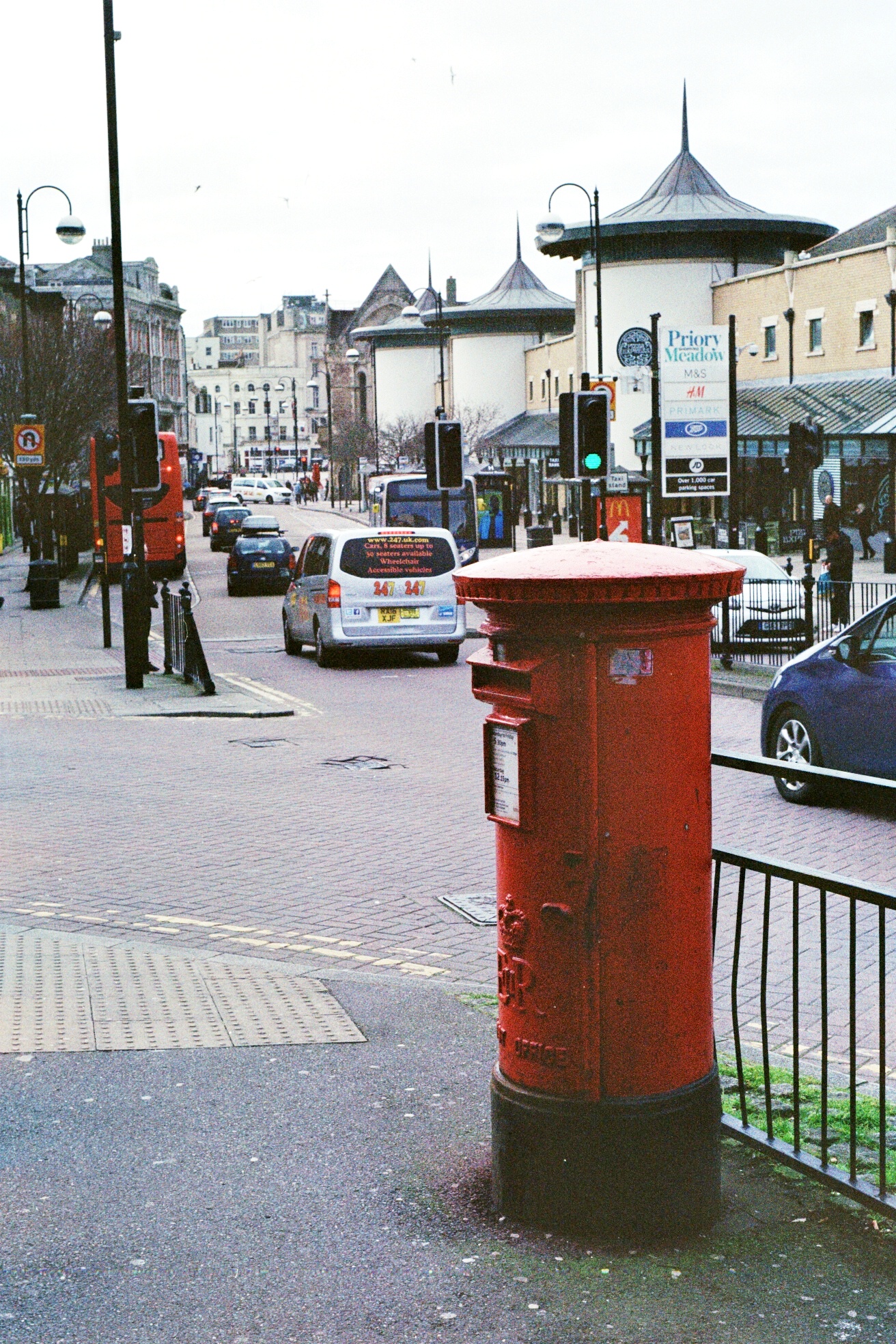 |
 |
I work in Brighton, and the bus-pillar box opportunities there are substantial. This is the Avenue off Lewes Road in the North East of the town. The box is a classic GR example. The bus is a Volvo Wright Gemini B9TL DP43/28F Built 2013. Anyone interested in the B&H fleet should go here. |
I have a bit of research to do on my pillar boxes now. Some have design names, others seem not to. If I am going to do this right, I need to be adequately informed.
Climate watch: watch the airlines wriggle
 The airline industry thought it was being clever. Its pledge on climate change engineered by ICAO (International Civil Aviation Organization) – bizarrely a specialized agency of the UN – was to commit to not breaching carbon emissions above the averages for 2019 and 2020. Any increases would be paid for in carbon offsets by the offending airline. But of course the current year, had it gone according to plan, would have been a record year for aviation. Now with most planes on the ground indefinitely, the committed target will be really really low. So, yes, let’s embrace it.
 Be informed