Archive for the ‘UK’ Category
Why banks do not invest in renewables
Filed under: Environment, Privatisation, UK | Tags: climate change, Electricity markets, energy, environment, Feed-in-tariffs, investment in renewables, renewable-energy, renewables, spot prices, sustainability
 Leave a comment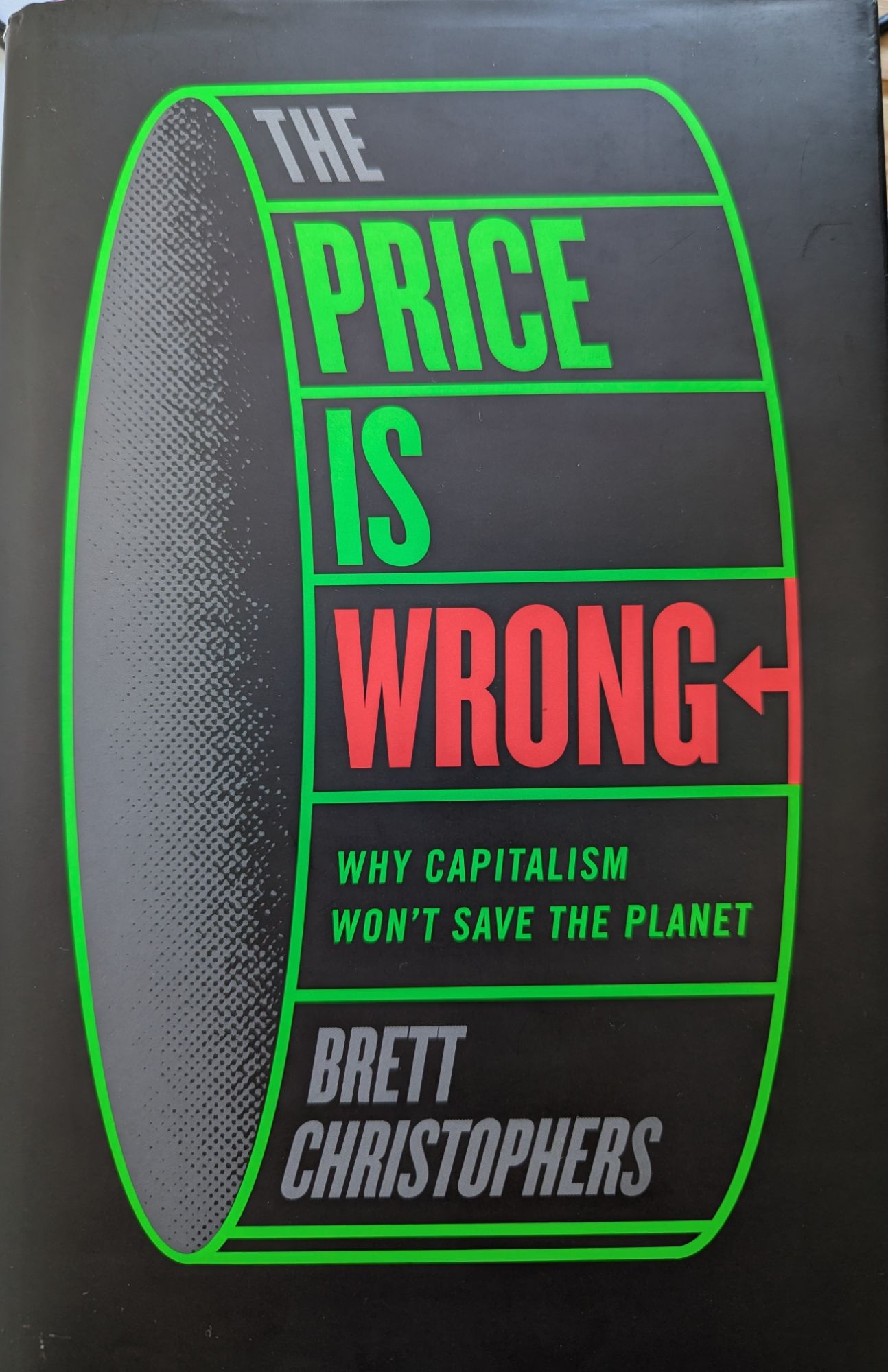
I wrote last month on Andreas Malm and Wim Carton’s book, Overshoot. Like all arguments – and their book is full of them – there are weaknesses. Or in my case, a failure fully to understand. In pursuit of that understanding, I have turned to an extraordinary book by Brett Christophers, the Price is Wrong – Why capitalism won’t save the planet (right).
Christophers waits until chapter 6 – appropriately entitled, The Wild West, to broach the point of why. It is not because the previous chapters were superfluous – far from it. Rather it is because electricity is complex, and despite out belief that all electricity is the same, Christophers has to make the case that not all electricity is the same.
First, we have to look at the structure of the liberalised (i.e. non-vertically integrated markets), of which the UK is a prime example after privatisation in the 1980s. Let me break down some of the stakeholders in the system:
- Generators – owners of power plants (some located outside of the country)
- renewables
- wind
- solar
- hydro
- non-renewables
- gas
- coal
- biomass
- nuclear
- renewables
- Last-mile suppliers.
- Buyers of wholesale electricity for supply to end users (domestic and businesses)
- Electricity System Operators (ESOs)
Markets
Increasingly the industry’s liberalisation has led to regulated markets being constructed by policy makers. In the UK there two distinct routes to market by generators.
- spot markets (electricity for immediate use)
- corporate – Power Purchase Agreements (PPAs) – generator contracts directly with corporate entity which is often a large user of electricity. There can also be PPAs between generators and utilities (retailers).
Spot markets trade in blocks of time, 30 minutes in the UK, for example. There is a base load, usually supplied by renewables and then a top-up, usually coming from the most flexible of supplies; namely, gas. In the UK the last coal-fired power station closed in September 2024.
Spot markets and volatility – why renewables are unattractive to investors and fossil-fuelled plant is attractive
The prices of electricity on spot markets are volatile. They are volatile over each day – demand can vary widely from the peak of the early evening to the overnight lull. But volitivity over a month…that seems to be more scary to investors. For example (p 170) in February 2022, spot market prices in Germany ranged from under €50 per MWh (day 19, Saturday) to just under €250 per MWh (day 25, Saturday). Demand is difficult to predict; indeed, we might ask, are there any other (commodity) markets with such pronounced volatility?
If you are an investor – a bank, for example – such volatility instils a sense of unease. It does not make investment impossible, but it makes it more expensive. Christophers’ research suggests that interest rates for renewable energy projects can be as much as 3x that of non-renewables.
We should then ask, why would a gas-fired power station – that sells into the same volatile market – not also be high risk? There are two things to be aware of here. First, banks have been investing successfully in fossil fuel projects for many years. Successfully. It is a known and tangible entity that has largely been low risk. Bankers, however, when making investment/loan decisions ask one simple question, will the client be able to pay back the loan on any terms agreed? The banker wants to know how much income the project will be generating to service the debt. The project owners will, of course, not be able to answer that question because of the volatility. It seems to be insufficiently adequate for the loanee to say that they are 100 per cent certain that all electricity they generate will be bought by suppliers because what they generate will always be cheaper than electricity generated by gas. The spot markets always include the lowest-priced electricity in a merit hierarchy.
There seems to be other issues here for investors. The returns on renewables is lower than that for fossil-fuelled plant. Typically, noted by Christophers (pp 211-221), fossil-based investments can generate returns of up to 20 per cent. Renewables come in at between 4 and 9 per cent. If we consider oil company shareholders, they are offered by the executive investments that will bring in double-digit returns, or equivalents that will deliver at best half of that. What will they choose? And what if the executive takes the decision to go with the renewables, knowing that their returns will be lower? Most will be out on the ears at the next shareholders’ meeting. These are so-called opportunity costs. Investing in renewables means that the investment will not be made elsewhere; i.e. something that brings in a higher return. But, argues Christophers, the shareholder concerns are minimal in comparison to that of the banks. Banks are looking for double-digit returns. It is also the case that many investments in renewables are made by companies that are not fossil-fuel based. They specialise in renewables. They will only deliver across their portfolio single digit returns to a market that is volatile, that exhibits the so-called merchant risk. Added to that, renewable plant is part of a “transition” – an energy transition. That transition, argues Christophers, has two elements. The first adds to the uncertainty. Transitions by definition are uncertain. The second is transition has no history. Generators are asked to project into the future with no historical data on which to make the calculations.
We might then ask, what about owners of plant fired by fossil fuels, how do they make the case to investors if they sell into the same volatile electricity market (because new gas-fired power stations are still being built)? Well, it seems quite simple, a traditional fossil-fuelled power plant is not part of a transition. It is proven technology and can demonstrate historical returns on investment. It is eminently bankable.
And here is another scenario. If the spot price of electricity (say in the UK) falls, so does the price of gas. The spot price is determined by the gas price (or the highest bid price in the bidding round, usually 30 or 60 minutes in each 24 hour period). In that scenario, the price of gas falls and the bid posted for electricity generated by a gas-fired power station is at a lower price because the primary cost of the power station is its fuel. If the gas price falls, so does the cost base of the plant. There is a hedge at work in the eyes of the bankers (p180).

The same is not true of wind-based renewables plant. The fuel – wind – is a gift of nature. It is free. The cost base of the plant, in the event of the spot price decreasing, does not decrease. That seems to indicate to bankers that there is a point where there is no return, and hence the ability of the plant owner to service the debt. In other words, finance cannot be secured because the fuel is renewable, meaning that even if the turbine is turned by the wind it can still be used by another wind turbine. But non-renewables once used are used. It is counter-intuitive that this is a positive and hence a challenge to bankers. In essence, then, there is a significant merchant risk; namely, “the risk associated with selling renewably generated electricity exclusively or predominantly at volatile merchant (wholesale) prices.” p174
Work arounds – how renewable plant owners can hedge the risk
Christophers offers three ways around this problem.
- Option 1: the futures contract. This is a situation whereby the electricity will be bought and sold at a predetermined price. The fear/danger is that the spot price falls such that revenue is flat and threatens not to cover liabilities. This is a balancing act where an option to sell (short) on the electricity futures contracts means that if the spot price does fall, the negative outcomes in terms of income “earned” in the spot market are compensated for by a gain in the futures market. Essentially, the trading value of the contract enables the sale to be transacted at a fixed future price which typically rises as the spot price declines. This is a common mechanism for hedging in liberalised electricity markets.
- Option 2 – swaps. These are more common in North America and Texas in particular. Swaps act as substitutes for futures contracts. The principle is that a party averse to risk relating to falling electricity prices can offset the risk by entering into a swap that pays out even if electricity prices fall.
Hedging, though, is complex. Only the largest producers have the so-called competence to hedge at scale. There are at the very least significant cash flow challenges. For example, if the spot market does decline, one party has to put up considerable cash to cover the decline. There is even a bigger challenge to contemplate. Christophers asks fairly, what happens if the renewable electricity supplier cannot supply the amount of power it is contracted to supply to the futures or swap markets? The above relate to Christophers’ arguments on pages 178-183.
- Option 3 – PPAs – these reassure banks that there will be a return sufficient for loan repayments.
- Option 4 – government subsidy/support. Such support has its own hazards.
- investment grants do not help in pricing
- Investment Tax Credits can help reduce the level of break-even spot price
- Price controls/Feed-in Tariffs (FiTs) – compensating generators when the spot market “reference” price drops below the contract “strike” price; though when the strike price climbs above the reference price, generators pay back into the pool. The net price is always the strike price.
Price controls stabilise markets and satisfy investors. But then introduces yet another source of uncertainty. Will governments – especially when they are fiscally stressed – honour or extend FiTs rates? Unless they do, renewable generators are back to spot price volatility. Christophers offers examples of state withdrawal in China and India (pp.
Notwithstanding problems with subsidies (option 4), markets can bankrupt renewables generators. In Texas in February 2021, a bolt of cold air caused a number of generators to cease as their equipment, not used to such extreme conditions, seized up. This was not just renewables generators. Fossil-fuel plant also seized up. As a result of the limited supply, electricity spot prises went up considerably. Renewables generators were supplying into a market with spot prices below $100 per MWh (as low as $50). During the crisis, prices were $9000 per MWh. Now if renewables generators were selling into that market, then there was money to be made (assuming the turbines were working, of which many were). But if the generators had PPAs at fixed prices, if they were unable to supply they had to go into the spot market to meet the terms of their PPA. That was enough to bankrupt generators (p310).
Why renewables will not supplant fossil fuel investments
Filed under: Environment, UK | Tags: Andreas Malm, climate, climate change, energy, Overshoot, PV cells, renewable-energy, sustainability
Leave a comment Overshoot
For us non-economists there seems to be a logic that should prevail. If renewables are significantly cheaper than non-renewable fossil fuels, then why do banks and financial institutions continue to provide capital to the fossil fuel industry to extract more oil and gas, despite climate change?

For an answer, I return to the work of Andreas Malm and a recent book (2024), Overshoot (co-authored with Wim Carton). We experience overshoot when policy makers conclude that we can afford to spend our carbon budget in the (mistaken) belief that we can bring back 1.5 degrees by carbon capture and storage. Or even more problematically, reduce the surface temperature of the Earth through geoengineering. It is propagated by fossil-fuel industry lobbyists in order to maintain business-as-usual. Business-as-usual is important because sunk assets of the industry are long-lived and the value of the oil over which they have extraction rights is high.
Commodification
For Malm and Carton (pp209-218) an answer is the inability to commodify sun and wind. We can commodify the equipment that converts the sun’s energy into electricity. We can commodify wind turbines. But because the sun and the wind are renewable – i.e. tomorrow’s sunshine is independent of the sunshine from the previous day – it has not been used up. Moreover, using Marxist theory, Malm and Carton argue that value can only be ascribed to products if human labour is required in its exploitation. Even in the most efficient mining operations, humans are still directing the operation. Wind, sun and water are labourless. That makes them valueless in the eyes of economists. There is no “surplus value”.
By contrast fossil fuels are commodities. They are traded, stored and consumed. The sunshine cannot be traded. There is no world market. There is no OPEC equivalent in renewables. It has no economic value in the capitalist mindset. It is costless. But costlessness may be valuable to consumers, it really is not to capitalists because they are unable to maximise profit – or indeed generate profit at all. Consequently there is only so much renewable energy that any national energy system can support – Malm and Carton suggest about one-quarter to one-third. Above that, costless electricity is so abundant that the price drops to zero or below. It is in Marxist terms, a “labourless void”.

This phenomenon can be illustrated indirectly by asking, name and ascribe a capitalisation to the world’s biggest manufacturer of PV cells or wind turbines. Likewise the owners of the world’s largest PV farms. We can all name the top 10 oil majors and easily find a capitalisation. For those who think Tesla may be a candidate – notwithstanding the current crisis within the company – it is an automobile manufacturer, not a renewable energy company. Essentially, renewable energy technologies (of the flow) have “no talent for providing the accumulation of capital”. (Malm and Carton, 2024: 215).
Competition
Other explanations are available, of course. Is it that there is perfect competition in solar, wind, etc. Barrier to entry are not high and hence there are too many players in the industry (a very Porterian approach). As Malm and Carton argue, if that was the case, then the whole industrial revolution would not have happened as the textile industry was just that, highly competitive.

What is particularly interesting in these technologies is their disruptive potential that could be led by consumers. No amount of consumer demand for fossil-fuel-free electricity, as we have seen, will see off the producers of electricity from fossil fuels. The profit motive blocks this. But it is possible for consumers to become their own generators. And whilst the majority of citizens own little in the way of land, homeowners do have roofs – house, sheds, etc., And in those houses they have space for storage – batteries. Most consumers remain indifferent to this. Even better would be whole neighbourhoods pooling their roofs and generating electricity for collective consumption. The question here is just about the design of the delivery system. For the time being at least, the grid is optimised for national distribution, and as such does not accommodate collective consumption.
Why then has there been any investment in renewables. Malm and Carton offer five reasons.
- Government subsidies – paying someone to do it
- End consumers not needing to make a profit (whilst reducing their own bills)
- Early profit – first movers, for example
- Low rates of profit can still be justified up to a point
- Fossil fuel companies have invested in renewables to fuel their own plants because, like all end users, it is valuable to them
Ultimately market capitalism cannot deliver transition, a mixed economy can.
Sustainable Aviation Fuel (SAF) and airport expansion
Filed under: Environment, Transport, Travel, UK | Tags: Airbus, Airport Expansion, aviation, Hydrogen aeroplanes, Logan Air, SAF, sustainability, Sustainable Aviation Fuel
Leave a comment 
Decarbonising aviation is very difficult. It is a good example of why oil-based fuels have been so important in the development of modern society. Nothing quite matches the energy intensity of oil, with the exception of nuclear. Sustainable Aviation Fuels (SAF) are trumpeted as the solution to aviation’s sustainability problem.
I am grateful here to Ben Purvis, Research Associate, Sustainability Assessment, University of Sheffield, for his contribution to the The Conversation for the content here. Purvis notes that there are so-called pathways for creating sustainable aviation fuel. These are:
- Oils or fats, including used cooking oil or tallow.
- Municipal solid waste, agricultural residues and sewage
- Hydrogen and captured carbon using renewable electricity.
It might seem that used cooking oil processing into aviation fuel is a win-win. But with the best will in the world, there is just not enough to go round. At the moment it is around 2 per cent of all aviation fuel. There is a UK mandate to increase this to 7 per cent by 2030 and 22 per cent by 2040. That is still only 1/5 or there about. To meet the current demand the UK imports 92 per cent of its used cooking oil from China and Malaysia (with its own carbon footprint). Currently the UK has one facility converting used-cooking oil to aviation fuel. That is the Phillips 66 Humber Refinery.
A recent report from the Royal Society notes that the 12.3 million tonnes of jet fuel per year needs 42.4 million tonnes of rapeseed biomass per year. In land terms, that is 68% of the UK’s agricultural land or 6.2 to 10.3 million hectares (see Innovate UK). The aviation industry’s own sustainability roadmap, CORSIA, precludes use of agricultural land for “fuel” crops.
The UK Chancellor of the Exchequer said on the 30 January 2025 (BBC radio 4, Today, c0815) that SAF could reduce aviation’s GHG emissions by 70 per cent. “Engines have become much more efficient. And, just at the beginning of this year, this government introduced the mandate for sustainable aviation fuel, which can reduce carbon emissions from flying by 70%. And of course, there’s going to be much more progress on that in the years to come.” (Quotes taken from the Guardian)
Equally there is global competition from both the EU and the USA (the latter now depends on the airlines rather than the state as burning fossil fuels now seems to be a US citizen imperative). Whilst it is clear that production could be increased with more investment, there is little confidence that it would be profitable; moreover, there is the small problem of cost – whichever pathway is taken, SAF costs more to manufacture than does aviation fuel (kerosene). That is £s on each ticket.
Surely there is enough municipal solid waste and sewage to go round? Well maybe, but the technology is in its infancy or not yet approved (see below) and no commercial facilities are producing it as yet. As for hydrogen, first it is packed with carbon if fossil fuels are the source of energy for the electrolysis necessary to produce it. Electrolysis by electricity from renewables remains distant. There is a long way to go before the UK grid is totally decarbonised. And now the British Government has added data centers to the mix, which means electricity supplies more generally are under pressure. Hence the Government’s latest endorsement of nuclear power and another un-tested technology, Small Modular Reactors (SMRs).

Not only manufacturing is a challenge, but the infrastructure to store hydrogen at airports or other facilities is just not in place. Hydrogen is also explosive and there are examples of denial of licences for users to store it, for example bus companies. It would require a major change to planning laws for widespread storage.
One UK company is undeterred: Logan Air. Logan Air has announced (12 February 2025) a plan to launch the world’s first hydrogen-fuelled commercial service by 2030. The company does not reveal the identity of the manufacturer of the aircraft that they will use for their point-to-point service (also as yet not stated). This against the backdrop of Airports Council International backtracking on its hydrogen ambitions in favour of scaling SAF, better air traffic management and improving aircraft engine efficiency.

There remains, therefore, the central question of actual aeroplanes. There was some succour in that Airbus was developing hydrogen planes (the A380 Airframer). This aeroplane was going to be a 100-seat 1850km range aircraft (right). But as recent as 6 February 2025 the Force Ouvriere trade union was informed that the launch date has been put off by between 5 and 10 years with an additional budget cut of 25 per cent. The company has identified the lack of available green hydrogen as one of the reasons for the delay. Another, less explicit but particularly troubling reason, is the company’s intention to replace its popular A320neo with a newer and more efficient conventionally-fuelled aircraft. The end of fossil-fuelled aircraft is nowhere in sight. The only option then, for sustainable aviation, is SAF from vegetable oils, tallow or waste.

There is a need, therefore, to clarify whether SAF is actually sustainable. In theory, because the things that it is made of already exist or are grown, burning it does not add to overall CO₂ levels. (Hydrogen, even more so, because it is derived from water and the emissions are just water.) So, aeroplanes still emit CO₂ when we really need to be capturing it and locking it into plants such as trees to generate negative emissions. Equally, it assumes that the crops and the waste had it not been for SAF would have degraded and decomposed releasing greenhouse gases in any case. The reality is that the area being used to cultivate crops to be turned into SAF would in actual fact be used either for food consumption or some form of rewilding. Essentially growing crops to fly planes (at least part of the way to their destinations) would displace food production. This would be a major distortion of land use.
The reason that SAF is so topical is because the British Government seeks to make the case that not only can we continue to fly at current levels, but that airport expansion is possible because the emission reductions from SAF rollout will offset increased flights (all in the name of growth). The above argument challenges that proposition. The calculation also needs to factor in the carbon emissions generated by constructing new runways. It is not trivial.
5 Years
The result of the UK General Election was deflating (to put it mildly). Managing the feeling of deflation is not easy and sometimes a distraction can help. Football often works for me. Distraction this time came from some cabaret at the Brighton Fringe Festival (Spiegeltent).
 So, we tried the show by Bourgeois and Maurice (left), a self-declared neo-cabaret act, whatever that is. They are flamboyant, camp, funny and entertaining. Clearly they did not have too much time to put this show together after the election, so naturally they incorporated material from their repertoire as well as new songs and sketches. They started with what seemed to be a new and funny song called ‘move to the right’ capturing the dynamic of the election – people who look to keep what they have ‘move to the right’ and those who swallow the anti-immigration bile ‘move to the right’. We were treated to their ‘depressing poem’. Oddly funny. It was just what was needed.
The conclusion of the show was genius. They did a rendition of David Bowie’s apocalyptic vision of the future, 5 Years. As we inappropriately say, never has a song seemed more appropriate.
The Government’s priorities say it all
The sense of deja vu associated with early reporting of the UK election results early on Friday morning was surreal. Back in 1992 when Labour under Neil Kinnock was expected to oust John Major’s Conservative government, assembled friends reeled as the results came in. Clear that it was not going to be a good night. Sleep does not come easily, either.
Major’s great contribution to human welfare was to privatise the railways; a legacy that stays with those of us who rely on the railway and know something about how it works. This new Tory Government will prioritise the abolition of the Human Rights Act and withdrawal from the European Convention on Human  Rights (ECHR). What kind of people abolish an act written, albeit imperfectly, to protect the interests of vulnerable citizens? And withdrawal from the ECHR has many implications, not least being in breach of one or more European treaties, the foundation of the UK’s very membership of the EU. It is also written into the Good Friday agreement with the Irish Government. Any change would need to be ratified by the Scottish Parliament. That might be challenging.
David Cameron announces that his party in government will be the true party of working people. So much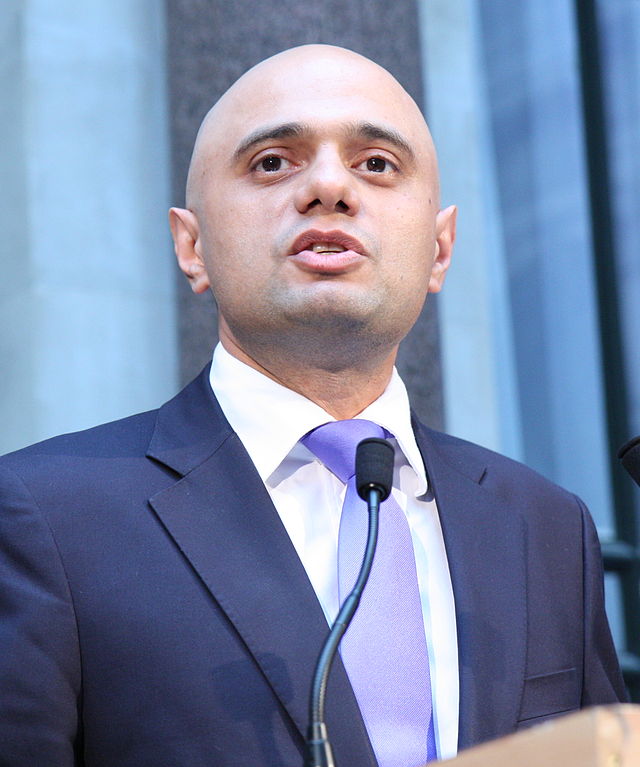 so that the new Business Secretary, Sajid Javid (right), will look to make it very difficult for employees to withdraw their labour by raising the threshold of participation in ballots. Therefore, for some classes of employees, for example, public sector workers, it is proposed that 50 per cent of members will have to participate for it to be valid. However reasonable that may seem, ballots already have to be postal and cannot be held in the workplace. Postal ballots are well known to have lower response rates than workplace ballots. Getting 50 per cent participation is unrealistic and constitutes an effective banning of strikes. The new party of working people seeks to give employers absolute power over employees.
Picture: European Court of Human Rights:
Picture: Sajid Javid through Wikipedia
Avoiding tax avoiders
 The UK Labour Party is under pressure, apparently, because big business is not endorsing tax policies. The most recent criticism has come from Stefano Pessina (left) the boss of Boots, the iconic British pharmacy-cum-drug store. Boots was founded in Nottingham, England, in 1849. It is now privately owned and has its headquarters is in Zug, Switzerland, to avoid UK corporation tax.
Now out of the woodwork are the fickle Simon Woodroffe, he of Yo! Sushi fame, who has funded both Labour and the Conservatives simultaneously just to hedge his bets, and Charles Dunstone, founder of Carphone Warehouse, now part of the Dixons empire. Both of these supported Labour under Blair. Arguably, Labour under Blair was conservative, and hence not a risk. Actually it would have been a risk not to support them in the run up to the 1997 election. Even Murdoch did that.
Labour under Miliband has targeted inequality as a key economic factor much to the chagrin of so-called ‘business leaders’ who took us in to recession and are unwilling to contribute to the state infrastructure that enables them to trade in the country safely and predictably.
Enter Price Waterhouse Coopers (PwC) the accountancy firm has been chastised by the UK Parliament’s Public Accounts Committee, Chaired by Margaret Hodge, for its speciality in advising firms on tax avoidance strategies on an ‘industrial scale’. Denied, of course.
Which other firms offend? We know well about Starbucks, Facebook, Top Shop, Amazon, Google, Apple and Virgin. That said, it is ok for Richard Branson because he is a philanthropist. Maybe we can define a philanthropist as someone who gives away part of their fortune to rectify the ills caused by their own business practices?
Other tax avoiding firms include: Dyson and Wolseley UK, owners of Plumb, Pipe, etc, Centers.
Celebrities have always moaned about tax. Michael Caine went off to the US, albeit when tax rates were somewhat higher than they are today (but even then, the high rate was a marginal rate). Unfortunately, Paul Daniels did not go when he threatened to back in the 1990s, let us hope that the likes of Griff Rhys Jones and Ray Winstone do leave as they threaten. Gary Barlow, Anne Robinson, the Arctic Monkeys, Katie Melula, George Michael and comedian, Jimmy Carr (I could go on) have all been exposed as intentional tax avoiders.
Picture: Stefano Pessina – Alliance Boots, available through Wikipedia
Industrial action, Quarks and Gravity
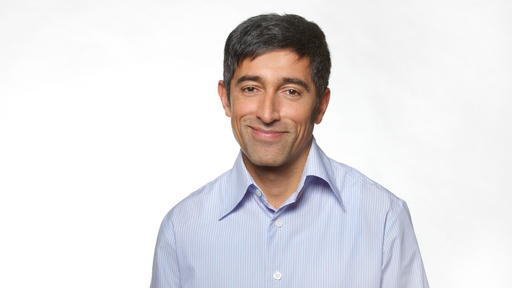 I’ve just been watching an edition of Quarks and Co., a German-language science magazine programme on WDR with the ever-compelling musician turned astro physicist, Ranga Yogeshwar (http://www.wdr.de/tv/quarks/). Yogeswar (left) is a true polymath with considerable charm. I watch this when I can as part of my German learning programme. The Edition on 3 September was all about time. Why does it feel different, depending on what we are doing? And what do we do with time saved as a result of taking a fast train, plane, etc.? The answer to the latter question it seems is that we work more. However, being on strike, as I have today over the erosion of pay in the higher education sector in the UK, frees up time – after first doing the picket line duties – to go to the cinema for the first time in what may be two years.
Spoiler alert!
Was it worth it? No.
Gravity, directed by Alfonso Cuarón, according to the Guardian’s three reviewers, Xan Brooks, the ever unreliable Peter Bradshaw and Catherine Shoad, is amazing. Sandra Bullock stars as the sole survivor of a disastrous US mission on the space shuttle after the Russians detonate a satellite that generates considerable debris that destroys the shuttle, the International Space Station and a mysterious Chinese craft that we did not know existed. All are in the same unfortunate orbit around the Earth.
George Clooney’s character makes an unexpected – though not real – return to the capsule in order to stop  her suffocating herself out of sheer desperation. There is a lot going wrong and the Earth seems a long long way away. Bullock’s character comes back to life after a word with God – seemingly never needed before – and memories of her lost child.
I could go on. Others intelligently have: http://thepoliticsofexperience.net/tpoehome/?p=143
At least I did not squeeze this film into my normal free time. Had I done, I would have felt cheated. And lunch beforehand was most agreeable. Such is the nature of industrial action.
David Cameron’s speech on Europe
 Long anticipated and it did not disappoint. It takes a lot to be criticised by former Prime Minister, Tony Blair, but Cameron has elicited a damning response.
“I think it’s a huge worry in circumstances where you put on the agenda the prospect of Britain leaving. Why would we do that? We don’t yet know what we are proposing, or what we can get negotiated. We don’t yet know what the rest of Europe is going to propose. This referendum will happen in four or five years time, if the Conservatives were re-elected. Why not wait and see what we actually get out of this, play our part in shaping the new Europe, but why be in the situation where now you are putting on the table the prospect, four or five years time, of Britain leaving so that we can no longer answer the question, when we are negotiating, is Britain going to stay a member of the European Union or not? We can’t answer that question any more.” (drawn from Andrew Sparrow’s Guardian blog).
Let us unpick that. We – and anyone who trades with us or invests in the country – no longer know if the UK will stay in the European Union. Should the Conservatives win the next election, that will represent at least 5 years or so of uncertainty. It will precipitate the end of the Union between England and Scotland, putting back on track the campaign north of the border to break free, even though an independent Scotland would need to reapply for membership to the EU (until now a disincentive to break free).
Why is David Cameron such a poor strategist? Even though many in his party – and many outside – loathe the EU, the EU remains the largest trading bloc for the UK. That is strategically significant.It is also the case, that a lot of what these people dislike are good things like the working time directive; 48 hours per day is long enough for anyone to work per week. There is a lot that is wrong, but Cameron has now dug in even deeper and diminished the UK’s influence over what is wrong. Not only will the UK not support efforts in Europe to support the Euro (see post: https://weiterzugehen.net/2011/12/10/26-to-1/), but now we are effectively leaving. On that basis, why negotiate with the UK? Moreover, as Blair said in his response, threaten to leave and someone will say “go on then”.
I had to laugh (though it was a painful speech to listen to) when he said that transport metaphors should be dispensed with – cast into some waste bin, only to serve up a platter full of them himself as he ‘progressed’. Astonishing.
You’ve been Trumped
 I’ve just watched this documentary in amazement. The corruption story is contemptible. Trump is building a golf resort on the East Coast of Scotland south of Aberdeen. Planning permission was originally rejected by the council – not least because the plan involved the destruction of a unique habitat with SSI (site of special scientific interest) status. The decision was called in by the Scottish Government, led by Alex Salmond, and overturned.
However, there are good people in Trump’s way. Local people whose houses, for Trump, are unwelcome features in the landscape. It is the story of how they have resisted and how the forces of the state have facilitated Trump against the locals. There is an extraordinary scene where the police manhandle the amiable journalist, handcuff him, and bundle him off to the police station in Aberdeen. But that is nothing against the despicable acts being perpetrated against the locals. Their water was cut off and not restored. There is footage of the electricity supply being cut by a digger; and the locals being billed for fences that they did not ask for or need.
Please watch.
Bigot of the year
 Stonewall, the gay rights campaigning group, it seems, risks losing valuable sponsorship from Barclays and Coutts banks. The two banks have threated to withdraw support if Stonewall runs its bigot of the year award again in 2013. Both banks are concerned about being associated with the award after it was given to Cardinal Keith O’Brien, the head of the Roman Catholic Church in Scotland at its annual ceremony last week. A deserved winner. Notwithstanding the bigotry, any award that two ethically-challenged banks struggle with must be hitting the mark.
O’Brien won decisively, reported the Guardian newspaper, “after describing gay marriage as a ‘grotesque subversion’ of the traditions of marriage and likened it to slavery. The cardinal called it an ‘aberration’ and claimed it might clear the way for polygamous marriages and would cause ‘further degeneration of society into immorality’.
That strikes me as being spoken by a true bigot. Pure folly as well.
http://www.guardian.co.uk/world/2012/nov/02/stonewall-unrepentant-cardinal-bigot-award?INTCMP=SRCH
 Be informed