Archive for the ‘Uncategorized’ Category
Reasons why voting Labour at the next UK general election is increasingly unlikely
Filed under: Uncategorized | Tags: environment, Government, keir-starmer, Labour Party, news, Politics, The Labour Party, uk-politics
 Leave a comment
 Before I go into my diatribe, here is a counter: https://iandunt.substack.com/p/seven-unrelated-thoughts-about-labours-f9e
Anyway, I have been reluctant to do this, but the list is getting extensive and, come the next election, I need to remind myself why Labour has let me down. The order here is not one of priority. For me, all are as important.

1. Free speech and repressive laws against protest
Proscribing a direct action pressure group (4 July 2025). I have always been a campaigner of some kind. I have disrupted normal life in pursuit of a political aim, usually relating to our treatment of animals and the environment (well before climate change). The idea that any organisation that causes harm only to inanimate objects can be deemed terrorist is dubious to say the least. Maybe the MoD needs to secure its own assets a little better? To get a better understanding of the logic, listen to Bunker podcast from 3 July 2025, here. George Monbiot has also written extensively about the civil liberties implications, too, here.
Allied to that, not repealing anti-union and anti-protest legislation by the previous Conservative government. I know the Government does not want to seem weak and would be attacked by the right-wing press if such legislation was repealed. I can also see that the Government and its ministers may find the repressive legislation useful into the future especially when, because of its ongoing failure and collusion with those causing the problems, people come out onto the streets.
2. Big tech
Palantir – the company controlled by Peter Thiel who is no friend of democracy. His company has aided Trump in tracking immigrants and yet he will access our health records by means of a £330m contract to provide software for the NHS. But more than that, the software has been found to be sub-optimal. In many cases just not as good as what NHS trusts already use. Palantir now has a contract with the police service of the East of England to develop a surveillance network. Starmer seemingly visited the Palantir offices in one of his US visits whilst Mandelson is a keen advocate. This is sinister and a preparation for a war against the people, as we are seeing in the USA.

Then there is Thiel himself (left). Is he really someone who should receive taxpayers’ money? Another venture of his is a betting site called Polymarket on which wagers are made using cryptocurrency ensuring the anonymity of the source of funds. There is plenty of discussion around dodgy wagers made on this site that is not even permitted to operate in the USA.
4. Benefits – are they the problem?
Even thinking about cutting benefits to disabled people (2 July 2025). To borrow from Neil Kinnock, “A Labour Government cutting benefits to people who cannot wash themselves to provide an incentive for them to enter the labour market.” Unconscionable.
5. Lower Thames crossing
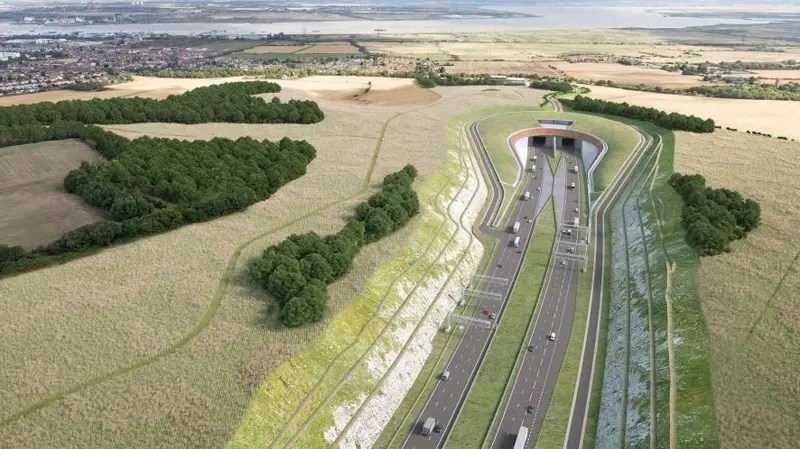
Lower Thames Crossing – something in the region of 40 per cent of UK railways have been electrified. In a time of climate crisis, the electrification of the railways would make a considerable contribution to reducing carbon emissions. Alas not. The long-awaited £1.5 billion upgrade of the Midland Mainline between London St Pancras and Nottingham/Derby, Leicester, Sheffield, amongst others, has now been suspended indefinitely. But there is always money for roads, and expensive ones such as the Lower Thames Crossing. Here we go, one 2.6 miles of road will cost £10bn – £1.7bn has already been spent and another £590 has been allocated. The argument is going to be that the Government is seeking private finance to build the road. We shall see, but private roads in the past have come out more than expensive than expected and not a good deal for the Government in charges levied.
6. Carbon capture and storage
Throwing money (£21.7bn) at carbon capture and storage – a technology that has not been deployed anywhere at scale but lobbied for by oil companies (11 October 2024) so that they can carry on polluting. For goodness sake, just cut carbon emissions. The world has changed.

By Allan warren –
Own work, CC BY-SA 3.0, https://commons.wikimedia.org
/w/index.php?curid=12846326
7. Immigration
That speech on immigration in launching the white paper on 12 May 2025 in which Starmer said we risk becoming an “island of strangers” and that net migration had caused “incalculable damage” to British society was way off. He said he wanted to end a “squalid chapter” of rising inward migration. I know that he has subsequently said that he regrets saying this and that he did not make the link between this and Enoch Powell’s rivers of blood speech back in 1968. He’s a lawyer. He knows exactly what he said and the historical connotations. He may regret it but he said it wilfully.
Notwithstanding that, more recent initiatives by the new Home Secretary, Shabana Mahmood, looks to appear even tougher by extending the qualification time for indefinite leave to stay from 5 to 10 years and insisting on A-level standard English language to work in the country. As we saw recently, even prominent MPs cannot spell to the required level.

8. Getting off X
Why does the Government persist in using X, particularly in a week (w/c 7 July 2025) when Grok, its AI assistant, self-identified as Hitler? Even before that, X had been a serious platform for dangerous right-wing misinformation and hate. Or is it only that the perpetrators of this content are indeed just the people the Government seeks to engage with? If it is, it is not working, nor will it. If you want to read X’s excuse, here it is.
9. Anti-trans
The Labour Government has signalled that it is deeply anti-trans. The Health Secretary started in December 2024 by outlawing puberty blockers for children – a tried-and-tested interregnum whilst they get guidance on their identities and body dysphoria. The Cass report recommended their restriction, not withdrawal; that said, the report has been significantly challenged in its methodological and scientific grounding. More recently the puberty blocker obsession has been developed further with a statement preventing GPs from testing blood for hormone (im)balance.
Seemingly the the Supreme Court’s judgment on interpretations of gender under the Equalities Act 2010 “clarified” matters. By which the Government means provides cover for their anti-trans agenda. Transgender is a protected characteristic under that act; however, as interpreted by the court, gender is determined at birth and hence trans people can be misgendered. The practical implications for employers is that they have to provide facilities for trans people as they cannot legally use facilities provided for their *** gender, even if they have a gender recognition certificate. A sensible government may well have read this and realised that the Equalities Act would need to be amended. But no, the Government and indeed the Prime Minister doubled down on this with his spokesman, when asked whether the PM thought that transgender women are women, the answer was “No, the Supreme Court judgment has made clear that when looking at the Equality Act, a woman is a biological woman”. By implication, here the Equalities Act flaw is being normalised rather than corrected. This was then reaffirmed by Kishwer Falkner, chair of the equalities watchdog, The Equality and Human Rights Commission (EHRC), so we are now locked in a debate about toilets, prisons and hospitals when the real issue is bigotry. And to top it all, the Government’s nomination for the new chair of the EHRC , Dr Mary-Ann Stephenson, is gender critical.
Here are a couple of posts by Ian Dunt that captures the complexity and stupidity; https://iandunt.substack.com/p/frightened-and-desperate-ehrc-anti
https://iandunt.substack.com/p/everything-you-need-to-know-about
10. Destructive planning
On planning, my MP wrote the following in response to my concerns that the Planning and Infrastructure Bill would further denude the country’s biodiversity in allowing developers to destroy habitat providing they pay into a fund that would enable compensation sites to be developed that simply cannot replicate what has been destroyed, for example, ancient woodland:
The Planning and Infrastructure Bill is critical to achieving economic growth, higher
Helena Dollimore MP, 7 July 2025
living standards and a more secure future for our country. I am pleased that the
legislation will help to facilitate the building of 1.5 million homes before the next
election. The Bill is also key to making Britain a clean energy superpower, bringing
down bills and securing our energy supply in a more uncertain world. At a time when
we have a local housing crisis and 1 in 27 children are growing up in temporary
accommodation in Hastings and Rye, we have a duty to act.
I too am concerned that 1 in 27 children are growing up in temporary accommodation. I too think we need to build more houses. Affordable ones. This is not, however, the solution to the problem as the problem has been wrongly defined. The problem is the way property has been commoditised – not just in the UK but across Europe. It is why a wealth tax is needed; boomers – and I include myself in this – sit on “assets” (property) that are obscenely over-valued. The value is un-earned. Boomers who bought in the 1970/80s have seen the value (i.e. price) rise faster than anything else in the economy. It is unearned wealth that needs to be taxed. Their value does not reflect the purpose; namely secure homes for families.
Oh, and whilst I am at it, Government policy itself just makes it worse – the attacks on the welfare system and the failure to fix the 2-child cap on benefit sums it up. My readers can see the impact as presented by the IFS here and more recent evidence/analysis from the Resolution Foundation here (summarised in one graph below). It is also potentially racist as it affect disproportionately ethnic minority families (I trust some people out there think that is a good thing. But I do not). The inequality in our society is at the root of the country’s failure. The Starmer Labour Government does not seem to want to face up to causes. And what about the benefits of children being taken out of poverty – well they do better in life, including education, criminality, health and parenting themselves. It is a false economy.

11. Fuel duty
Fuel duty – a previous Conservative Government introduced in 1993 the fuel price escalator. The purpose was to increase the price of fossil fuels to promote public transport, take cars off the road, reduce the demands for new roads and ensure the efficient use of fuels. It was set roughly at 3 per cent above inflation (the Blair Government temporarily increased it to 6 per cent above). But when the financial crisis struck and subsequently war in Europe coupled with Covid effects, it was never re-established. Perhaps this Labour Government could polish its green credentials and raise much-needed tax for redistribution – maybe even abolishing the 2-child benefit cap? Just looking on any street, one can see SUVs galore. Someone has money to spend. Maybe the burden they put on the rest of us with respect to the consumption and occupation of public space and pollution should be compensated? It is time also to tax the use of electric cars as they still occupy finite space.

One estimate calculates that suspending the 5 pence cut and reinstating inflation-linked rises would raise approximately £4.2 bn annually (Campaign for Better Transport). Even raising the duty in line with inflation would raise £4-6bn. The Government’s own OBR has estimated the cumulative loss since the suspension of the duty as £80bn. Also let us not forget that in 2025 rail fares went up by 4.6 per cent whilst fuel duty remained frozen. Who is subsidising whom? It certainly makes the transition to EVs harder. But of course, petrol and diesel motorists have loud voices and lobbyists (Road Haulage Association/AA, etc.).
12. Airport expansion
The Government has now agreed that Gatwick Airport can have a second runway and Luton can build and operate a second terminal, effectively doubling capacity – all in the name of growth. London City can expand, too. And Heathrow’s claim to a third runway looks increasingly likely. Full analysis can be found here.
But we cannot get anywhere near net-zero with more aeroplanes in the sky. And the propaganda coming from airlines seems to convince – someone – that it is ok to continue flying because:

- New fuel-efficient planes are being delivered
- Sustainable aviation fuel is increasingly replacing kerosene
- New ways of flying aircraft are being adopted that are more efficient and less polluting
- Hydrogen planes are on the way
- Carbon capture and storage (carbon credits)
- And hey, you only live once
You can see all of these in easyJet’s annual sustainability report (2024). With the exception of the issue about our own mortality and how we should respond, all the others fall apart under light scrutiny.
13. Neglecting education
OK, I work in this sector, but it does not negate my ongoing disbelief that a Labour Government continues to starve universities of the resources they need to maintain their position as leading institutions globally. Why oh why are international students still classified as immigrants? They are not. Plus they bring with them fees (that, let’s face it, subsidise domestic students), money to the local economy and, heaven forbid, culture. It breaks my heart and angers me in equal measure.
There is no question this list could go on, I’ve been sat on this post for quite a while hoping that things will improve. That a Labour Government would see that pandering to the right, mis-understanding growth and destroying our natural environment were not good things and will not make them popular.
Mark Miodownik lecture, 5 March 2025
Filed under: Uncategorized | Tags: Everyday Miracles, King's College, London, Professor Mark Miodownik
Leave a comment 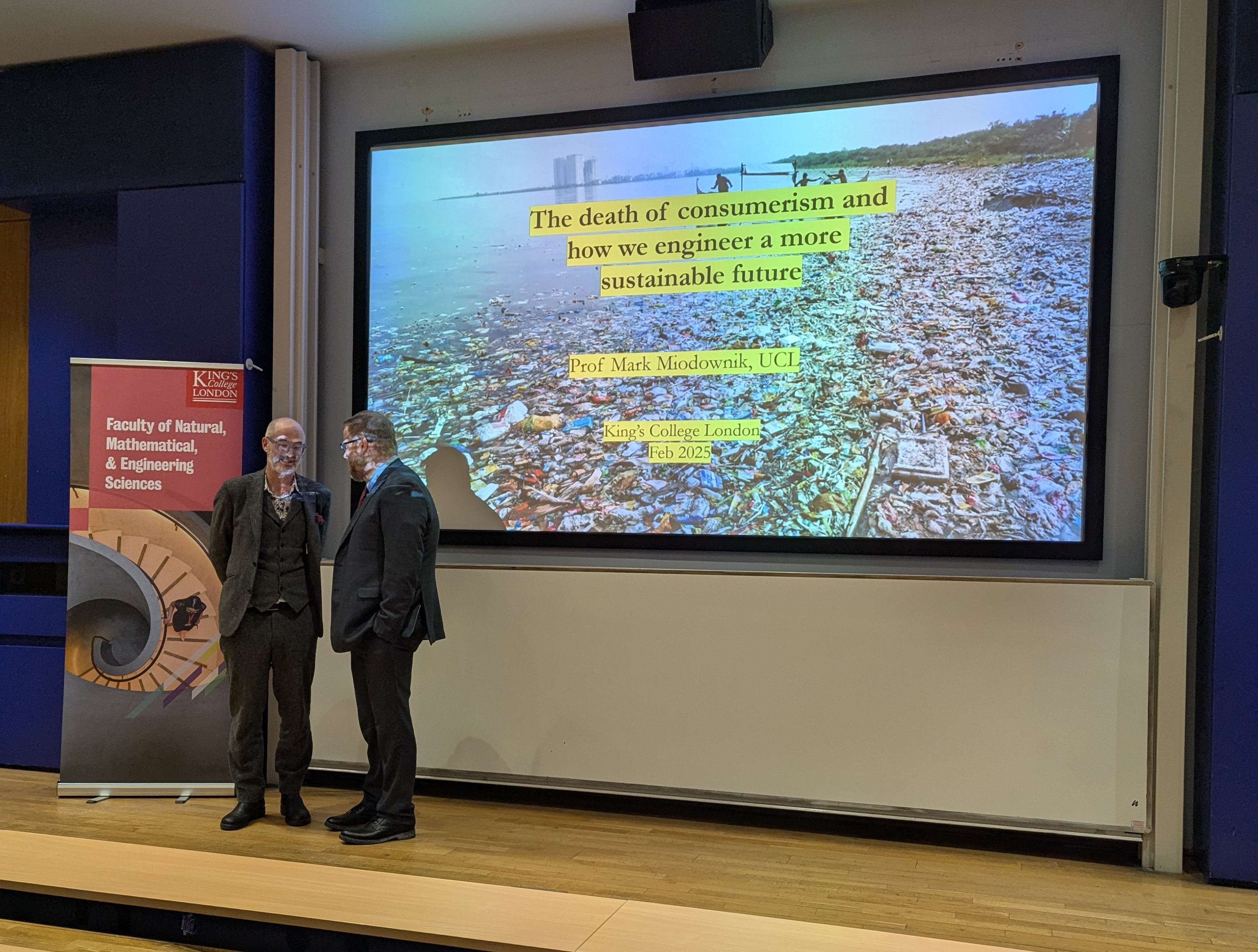
Arriving at the venue, Kings College London, I expected a huge auditorium for such a superstar materials scientist guest as Professor Mark Miodownik (left, with Professor Chris Lorenz*). But the lecture theatre was small, intimate, perfect. Unbeknownst to Professor Miodownik, he has educated many of my undergraduate students with clips from his BBC series, Everyday Miracles, a fascinating history of materials innovation. But that was then.
His lecture was about consumerism from the perspective of a self-declared technological determinist who finds (waste) solutions in materials science fused with…well, just about every other discipline.
Professor Miodownik walked us through the basics of consumer capitalism to the circular economy. But then the magic. A new concept, Animate Materials. A future in which, just as in nature, technologies repair themselves, often with the help of micro-organisms. It means the end of potholes and crumbling concrete. We learnt that disposable nappies are so brilliant because of a super absorbent polymer. The downside is that it is not biodegradable which means that the 300,000 nappies disposed of every minute stay with us. But somewhere out there is a biological solution…his team has discovered one, but it is a slow process. In the meantime, let’s toilet train children sooner (current average seems to be 37 months!).
Great lecture in a superb venue (never been to King’s before).
* forgive me if I have mis-identified you!
Compare and contrast – Aurora and Pond
Filed under: Uncategorized | Tags: Anna Lapwood, Aurora, Camden Electric Ballroom, Music, Nick Allbrook, Pond, Royal Albert Hall
Leave a comment I am not sure I have ever been to back-to-back gigs. But last week we went to see Aurora at the Royal Albert Hall (first time going to see something that was not a BBC Prom) and Pond at the Electric Ballroom in Camden, London.
We’ve enjoyed these two sets of artists for many years, but it is only the second time that we have seen either of them – Aurora most recently at Pryzm in Kingston and Pond at Concorde 2 in Brighton (in 2015).

Aurora is a 28-year old Norwegian singer songwriter. She is certainly more than that as this RAH show demonstrates. Her backing graphics (see left) are full-on avant garde. Her songs are political, personal and political and personal. We discovered her music in our search for environmentally-themed songs. Aurora’s most explicit is The Seed “When the last tree has fallen and the rivers are poisoned, you cannot eat money, oh no:” But her new Album, Whatever happened to the Heart, is a concept album around the heart as muscle, symbol of love and the beating of our world more generally. It is an opus – all that is needed to navigate a world full of hate, wonder, beauty and opportunity (if we choose to take it).
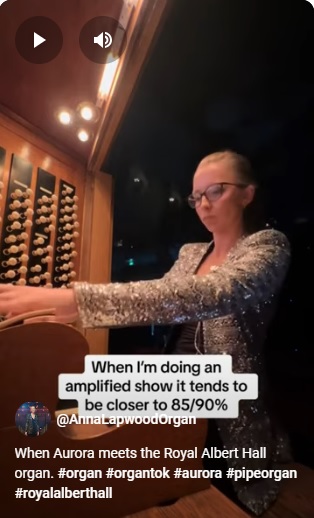
Aurora is a performer, for sure. She is not Dua Lipa with complex dance routines. She is not really stadium music – the RAH is a big venue and takes immense talent and presence to keep its attention. Tickets sold fast and we were relegated to the Rausing Circle, rather in the heavens. The RAH has something that other venues on this tour do not. That thing is the amazing organ. Aurora somehow got Anna Lapwood (right) to rearranged three songs to incorporate that instrument. For me, at least, that addition was beguiling (I love the organ sound in any case). The three songs – Echo of my Shadow, The River and The Seed – elevated this concert beyond what was already memorable. Anna Lapwood is an Associate Artist at the RAH – but so much more than that). Her joy was captured as she let the organ rip during The Seed.
Aurora also engages with her audience. It is not scripted. It is not “[h]ow are your feeling?”. For example, it is not surprising that she was overwhelmed by a full RAH for her own show (she has performed there before). Aurora will conjure up images that one rarely gets from other artists. “We are told the obvious that the RAH is circular. But then “”…it’s like a soup. It’s round”. And later, in a common monologue about the state of the world she tells us “that we wear our love on our hands like a glove…” There is always some unexpected reference to her personal preferences often involving alcohol and sex. The audience hangs on her every word, despite her being only a Norwegian singer songwriter. To some extent she could be Dua Lipa but chooses not to be.

Pond’s frontman and leader, Nick Allbrook (left) is as charismatic as Aurora, though we know nothing of his politics. His approach to engagement with the audience is to ask it to crowd surf him, three times. He has also come forward and physically touched fans – there were plenty of takers.
Sonically, Pond are loud – don’t even think about going without earplugs. The new 10th album is much more rock than the psychedelia that so attracted me to them 9 years’ earlier. I’m Stung, the title track of the new album, is a corker and is about love, of course. “She’s the one” sums it up nicely.

The band more generally are multi-instrumentalists. Allbrook plays guitar and keyboards – and more recently flute. Though he is no Ian Anderson standing on one leg. He’s more likely to stand on his head. The other two core members of the band, Jay Watson and Shiny Joe Ryan (right) are no extras. Watson started out on keyboards and then moved to drums (percussion is also a significant element of the sonic experience).
The venue could not be more different to the RAH. The Electric Ballroom is a classic venue – a dark hole with bars dotted around the periphery. It is all stand, though there are a few seats on the balcony – though there is nothing to be seen if that is where you park yourself during the gig. It can get very lively and Nick Allbrook wants that of his audience – the more they pogo, the better. For those of us of a certain vintage, that is time to step aside and leave the central floor to others.
These were two exceptional nights. No disappointments. Quite the contrary. And whilst Pond had no organ equivalent, their sheer energy…bearing in mind that they are moving through the age range…cannot help but be infectious, even if only emotionally.
Michael O’Leary is right and very wrong, mischievously so
Filed under: Uncategorized | Tags: aviation, carbon-emissions, climate change, sustainability, sustainable-aviation-fuel
Leave a comment 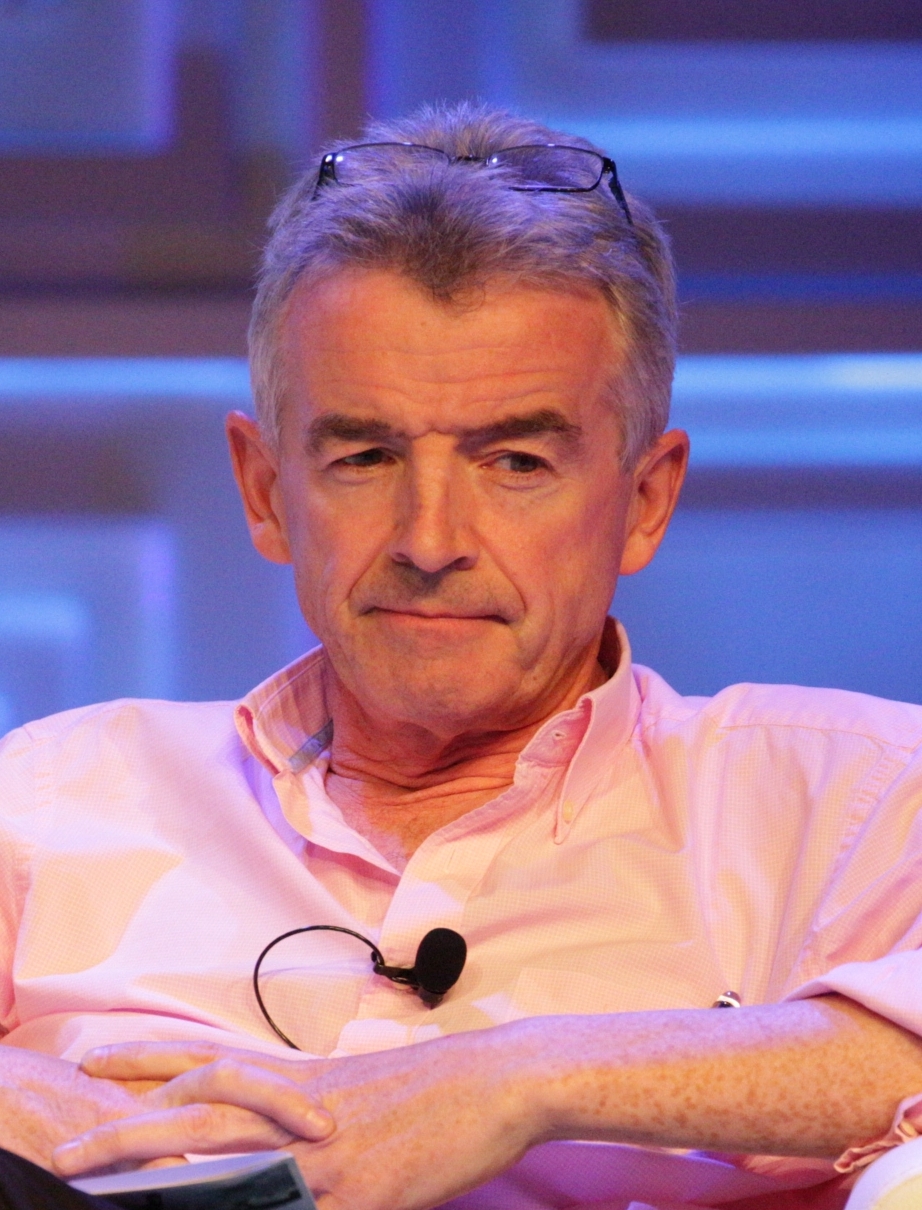
Michael O’Leary (left) is the boss of RyanAir. He has spent much of his life at the helm and took it from limping Irish airline to Europe’s biggest. As he says himself, RyanAir was early into the low cost business after the skies were deregulated and have kept the advantage over rivals. He’s fabulously wealthy off the back of that success.
So, on 26 December 2023 O’Leary proclaims that there is not enough used cooking oil in the world to fuel the world’s airlines for one day, let alone a year. on that he is right. But he has made many other claims that are not defendable with even a cursory analysis. Let’s take them one by one.
O’Leary argues that air travel contributes just 2pc of carbon dioxide. Ships contribute 5pc, but no-one is shouting about global supply chains. Here are 10 points to consider.
- We do not measure greenhouse gases as a percentage, we measure in absolute terms. That 2pc is equivalent to 800 Mt CO2 per year. If we are to get anywhere near even 2 degrees of warming (let alone 1.5 degrees), all GHGs have to be eliminated, Even a fraction of 1pc is too much. In meeting the 1.5 degree Celsius target, the atmosphere can absorb, calculated from the beginning of 2020, no more than 400 gigatonnes (Gt) of CO2. Annual emissions of CO2 are estimated to be 42.2 Gt per year, the equivalent of 1,337 tonnes per second (https://www.mcc-berlin.net/en/research/co2-budget.html). At this rate, at the time of writing, we have 23 years before that budget is used up at current levels, but we have seen clearly how projections are changing – climate change is happening faster than expected. The models are being revised. And we continue to grow demand for fossil fuels whilst destroying carbon sinks such as oceans, forests, bogs, etc. For something most of us do not need, flying is disproportionately expensive in terms of carbon budgets.
- Whilst O’Leary might say that 2pc is not much, carbon emissions overall have doubled since the mid-1980s. Aviation has just kept up with the average increase in emissions across the board. Absolute emissions from aviation are increasing.
- Carbon generated by aeroplanes is not the same as that emitted by land-based activities. Indeed, if we consider aviation’s full impact it is more like 3.5pc. Aviation emits other greenhouse gases, and the release of water vapour at altitude significantly increases its warming impact. Accounting for this, its contribution increases by around 70%.
- CO2 emissions arising from aviation are not globally fair (equitable). It is the relatively rich who fly. 1 per cent emit half of GHG emission from aviation. Business class is more carbon intensive than economy. Private jets…let’s not go there. Most people on the planet have never flown (estimated between 80 to 90pc) and have not contributed to aviation-generated carbon emissions. Put another way, only 5pc of people fly in any one year (less than that for international travel). The average air traveller takes just over 5 flights per year (1).
- We do not adequately count all emissions. Domestic flights are ok – they are factored into national emission-counting, but international/long haul belong to no one (though airlines to count them). Incentives are not in place to reduce emissions from long-haul flights. This we must get to grips with, but recent stunts like those from Branson do not help.
- O’Leary seeks to distract attention – forget aviation, much better and easier to electrify cars and vehicles. Vehicular emissions are 20pc of the total with cars alone producing 3bn Mt CO2e annually. Another diversion – Air Traffic Control – if they could be more efficient there would be no need to spend hours circuling airports in stacks (the fact that there may be too many planes in the air is not considered).
- There is the technological fix – O’Leary has them all up his sleave. Seemingly he is “generally a believer that technology and human ingenuity will overcome climate change”. He goes on “I have no doubt that we will not decarbonise because we tax people more” So belief will get us there; though at this point in time, there are no viable electric planes in sight. Or any other fuels, for that matter.
- O’Leary argues that “[p]eople will absolutely not stop flying because of concerns about climate change”. This may, of course be true, but that is why we have Governments, regulations and tax to provide the incentives. What O’Leary is doing at RyanAir is expand capacity with the purchase of new fuel-efficienter aircraft. But they are not sustainable.
- So. let us look at the low cost base and the subsidies airlines get to maintain them. Fuel (tax) is a huge subsidy not open to land-based services. Some old data – but in 2012 the lack of tax on fuel amounted to an annual subsidy of £5.7bn. No VAT on tickets add 4bn to the total. In the UK, the Government actually reduced air passenger duty on domestic flights. Seemingly there is another £200m subsidy to the industry. And then there is the infrastructure provided by the state such as roads and rail links. Did Heathrow really need a fourth rail link to the airport with CrossRail?
- And on ships, there is a lot of discussion both amongst engineers, campaigners and industry about decarbonisation. Try these:
Pictures:
Michael O’Leary, World Travel & Tourism Council
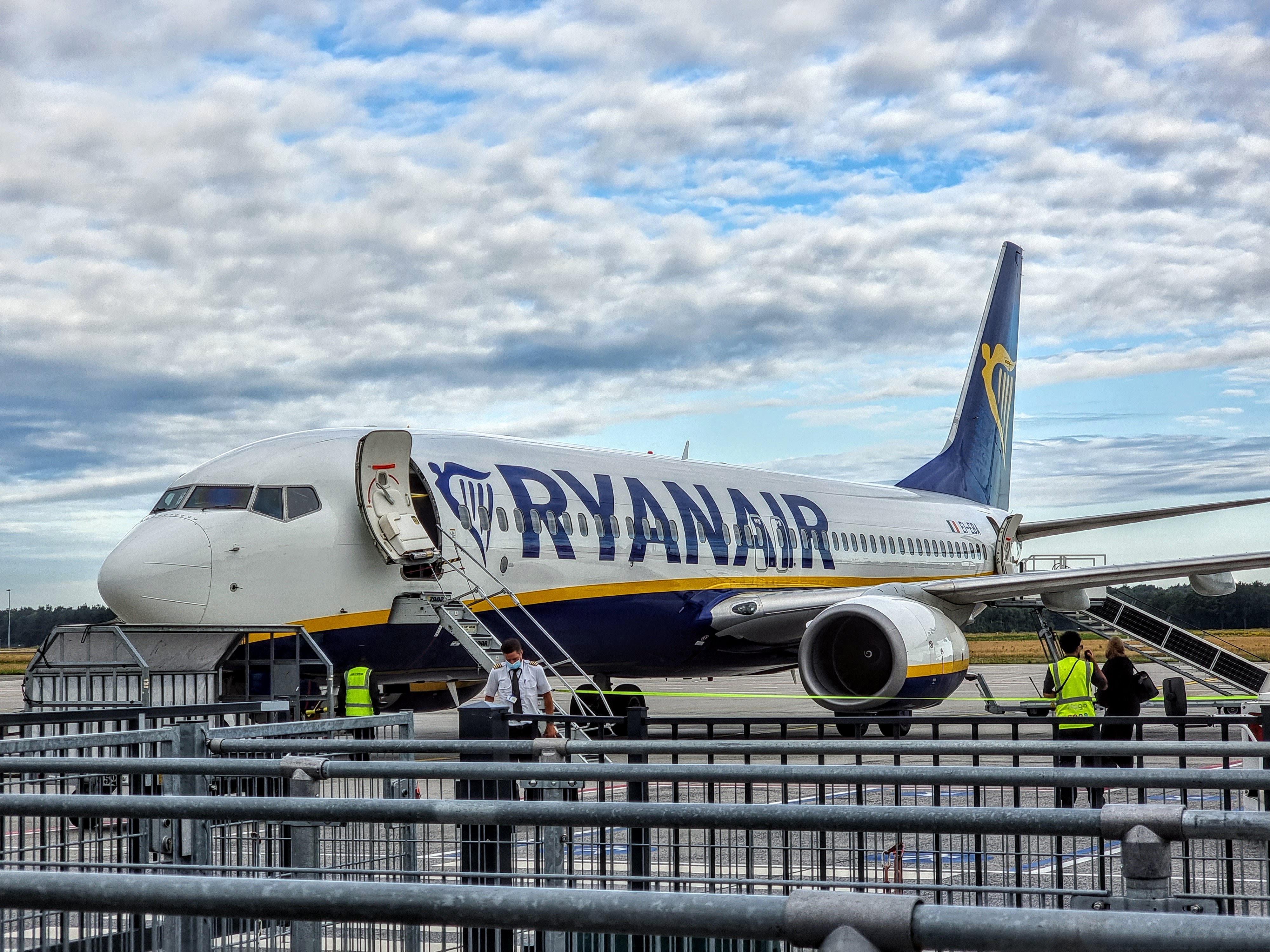
RyanAir Boeing 737, By Dylaaann – Own work, CC BY-SA 4.0, https://commons.wikimedia.org/w/index.php?curid=114958876
References:
(1) Stefan Gössling, Andreas Humpe, The global scale, distribution and growth of aviation: Implications for climate change, Global Environmental Change, Volume 65, 2020;
Rome, December 2023 – Bernini and Borromini
Filed under: Uncategorized | Tags: Art, baroque, bernini, borromeni, graham-dixon, italy, Rome, schama, sculpture
Comments (1) We are struggling a little bit this holiday. Both of us are under the weather, but doing our best, safely, to enjoy the city. Yesterday’s theme emerged as women – or the absence of them in the recorded history of the city. Of course, when they are depicted, it is not in the best light. The mother of Romulus and Remus left her children to the fate of a wolf – and that did not end well history tells us.
In previous cultural adventures we have piggybacked on art critics. We do so again. Andrew Graham-Dixon with his cook Giorgio Locatelli, did a series “Rome Unpacked” for the BBC. Likewise Waldamar Januszczak’s Baroque series (both of which can be viewed on Youtube, at the time of writing). Much of what we are witnessing is on their recommendation, as it were.
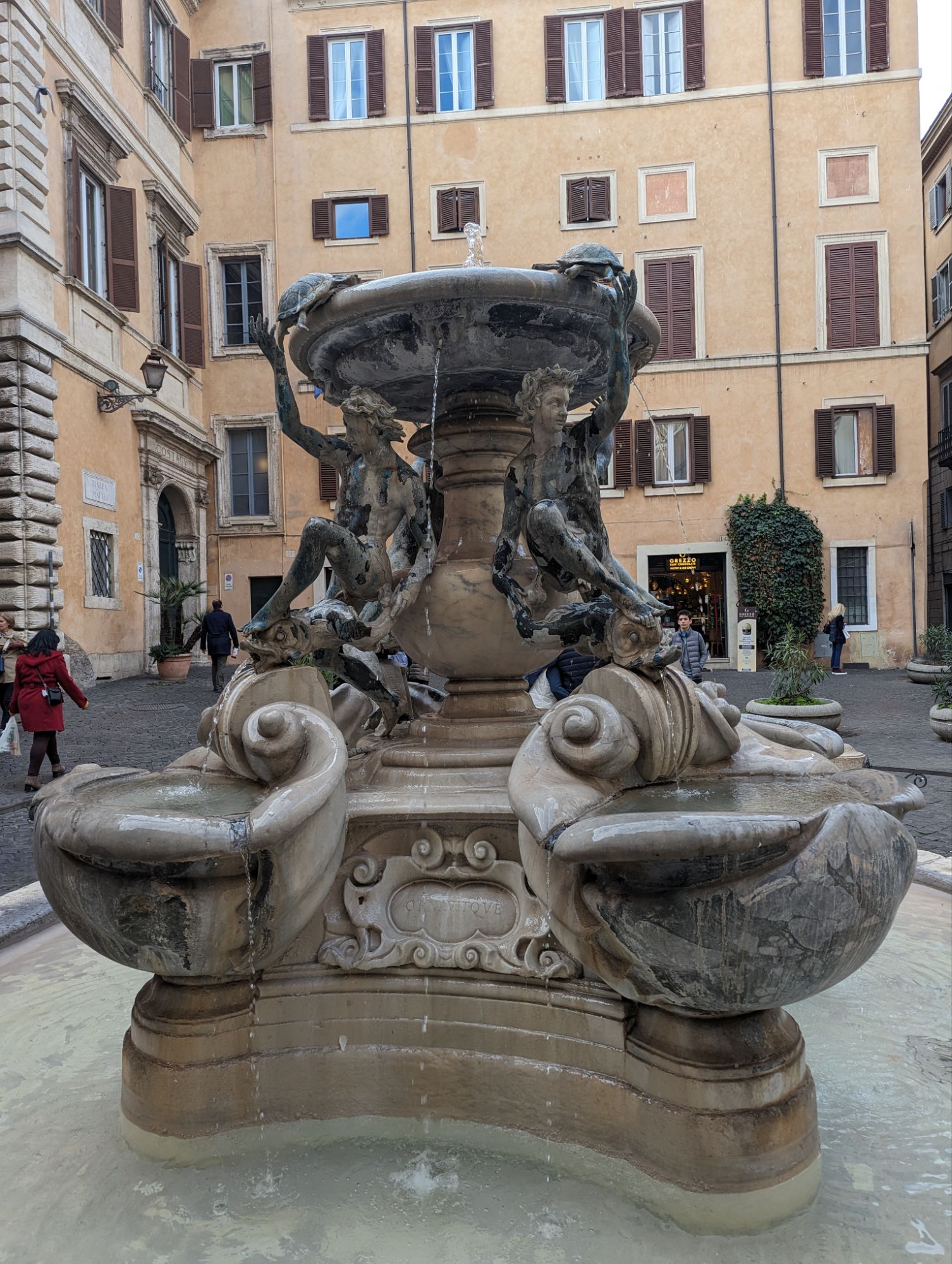
Rome boasts hundreds of fountains. Every square has church and fountain. The fountains are very much part of building civilisation – fresh water, effectively. The example (right) is found close to the entrance to the (former) Jewish Ghetto. It is called Fontana delle Tartarughe – fountain of turtles, I think. If you look carefully, they scale the upper rim! It is renaissance bronze.
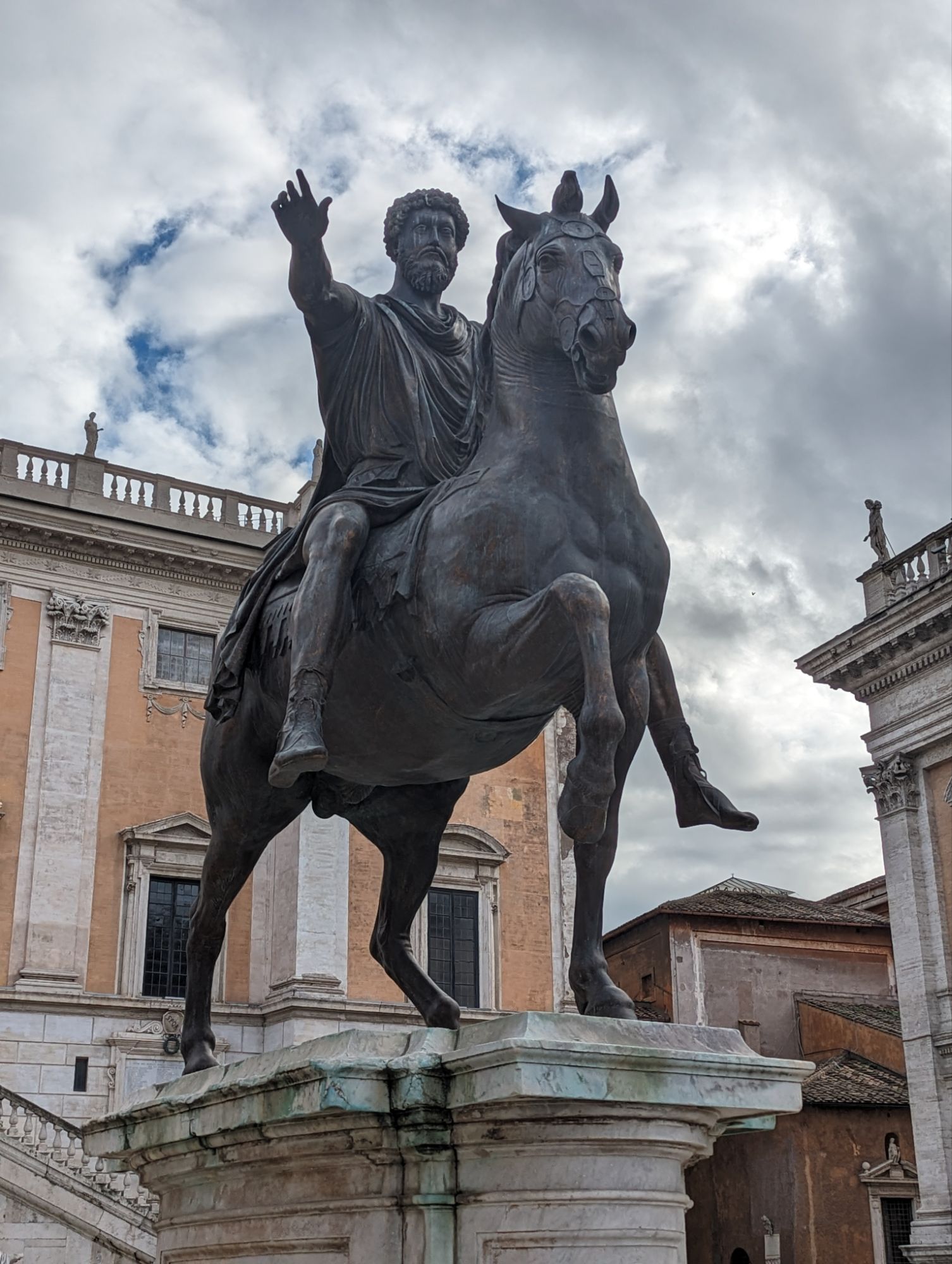
Talking of bronze, the equestrian statue of Marcus Aurelius Michelangelo at the centre of the Capitaloni Square and in front of the Palazzo Senatorio (seat of government) is as bold as they come. It was sculpted in 175AD. It apes the imagery of bestriding – and all conquering – leaders; though his gestures are those of peace rather than vanquish. There are no weapons on display. It is apparently still there by accident (the original is in a nearby museum – this example was erected in 1981). Graham-Dixon suggests that the Pope seemingly thought it was of a more godly leader and hence it survived a great meltdown (of precious bronze).
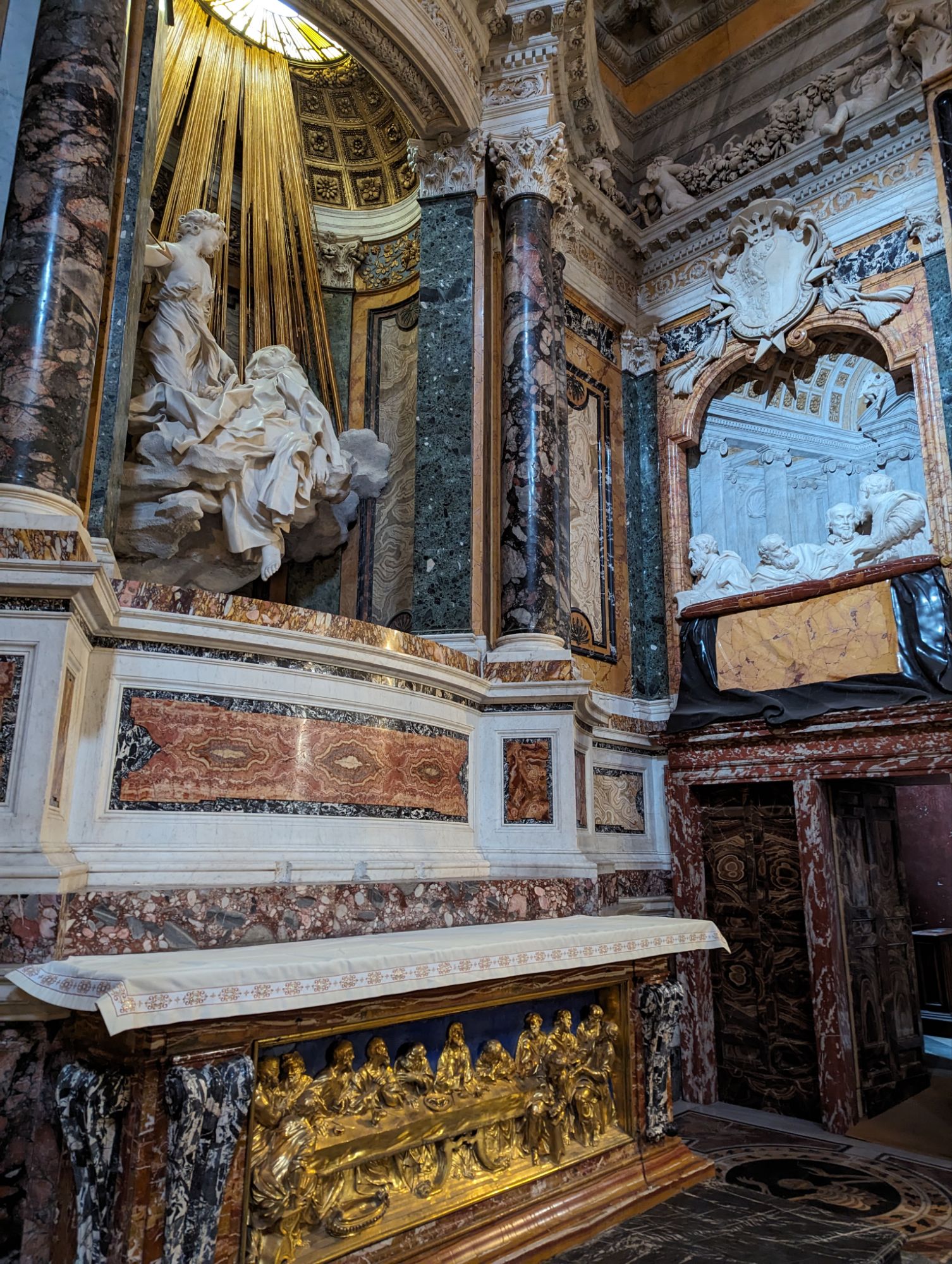
The history of Rome’s art and architecture is so often determined by rivalries. Caravaggio famously killed a rival and fled the city, but Bernini and Borromini were particular rivals – the latter committed suicide on his sense of worthlessness, the former had a confidence and arrogance to see him through and leave his mark through ubiquitous examples architectural and sculptorial talent. Though his ill-advised – and subsequently demolished – south Tower of St Peter’s Basilica nearly destroyed him until the commission for the sculpture in the Chiesa di Santa Maria della Vittoria. A nun experiencing ecstasy is not a good look. But, as Januszczak argues, how are we supposed to depict devout ecstasy? What if it is the same as a sexual ecstasy? The nun was no ordinary nun, she was St. Teresa and no stranger to controversy. Indeed Bernini’s sculpture is a marble representation of her own words! Just a word of note, she is impossibly young in the sculpture. And Bernini – like so many artists – is even more subversive than we might think. The drapery around her, explains Simon Sharma, is particularly revealing. Whilst we might think of it providing her with some cover at a time of extreme exposure and intimacy (with an angel and a spear), the opposite is true. It depicts the human sensation of ecstasy. If Schama is right, that is even more impressive. That’s the baroque for you.
Note also that the scene is being observed as if it were a theatre experience. I am presuming the four men in a theatre box paid for the sculpture (I think they were from the Cornaro family whose chapel the sculpture sits)? And below the whole scene is a depiction of the Last Supper. Almost incidental!
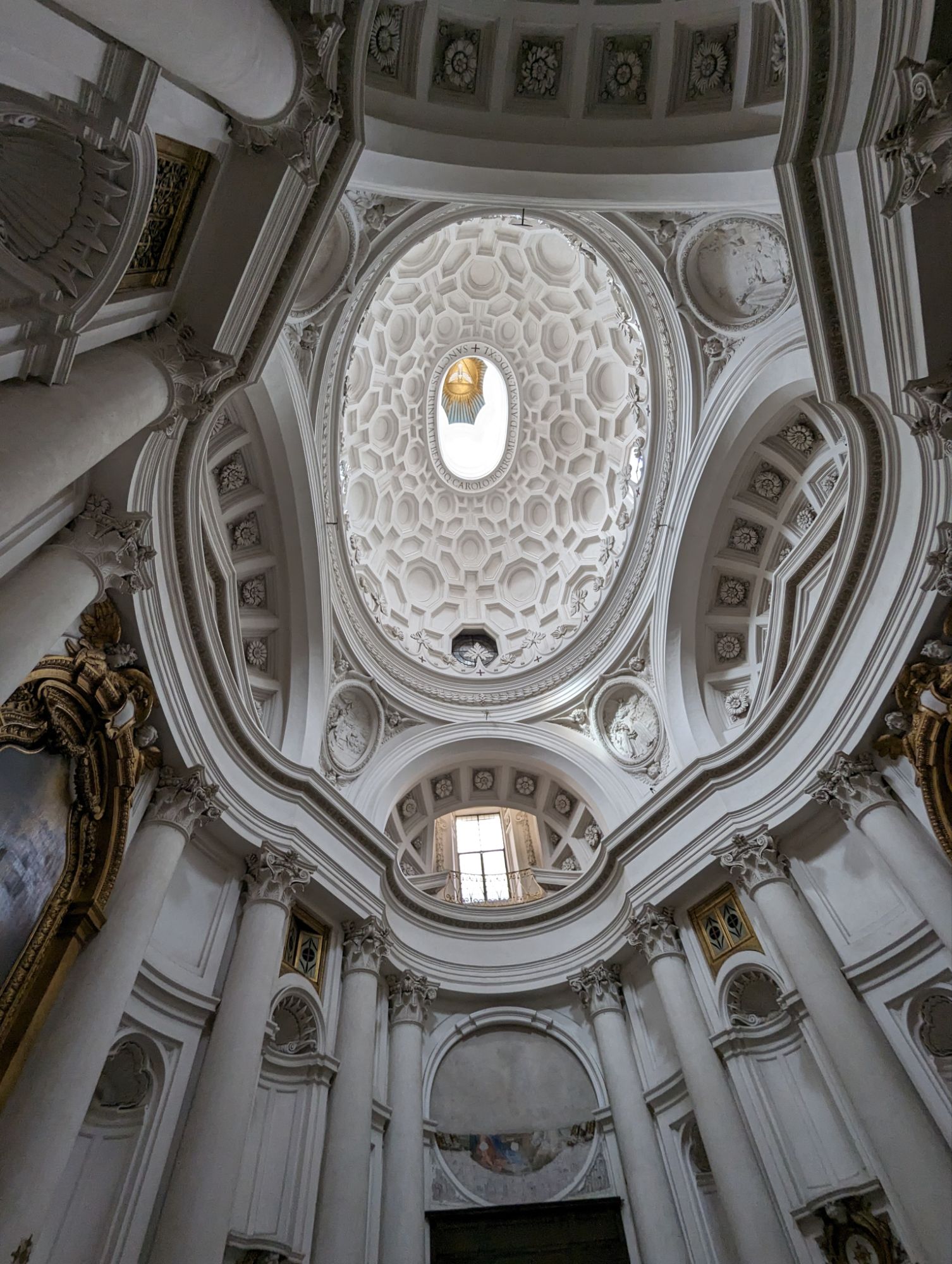
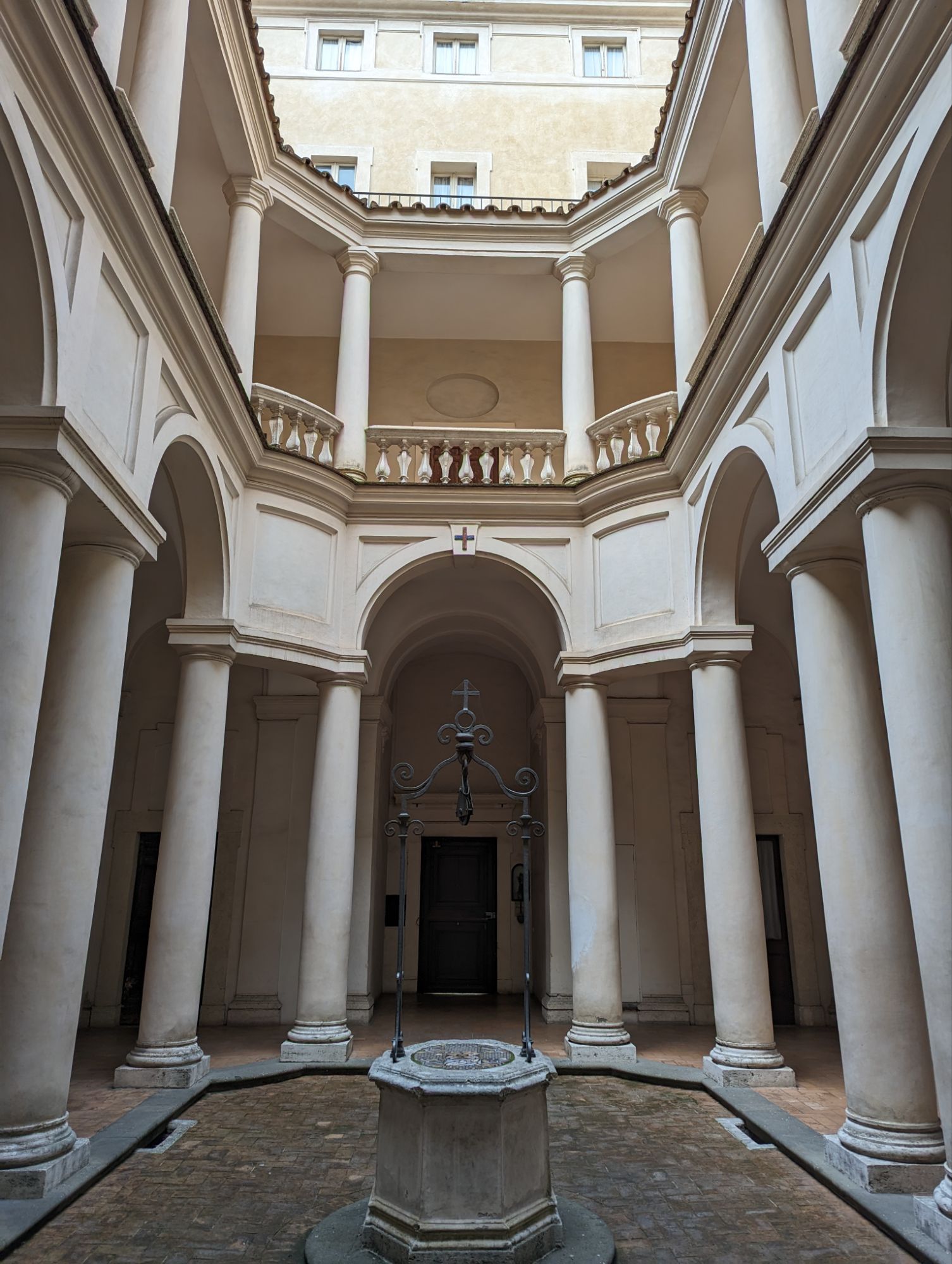
Bernini had rich sponsors, Borromeni did not. And so his seeming Masterpiece – Chiesea di San Carlino alle Quattro Fontane (1638-41) is modest by comparison, but architecturally clever in its use of space and geometry. The ceiling is oval but not, and the light penetrating from the dome adds to the effect. The commission was from an order of Trinitarian monks that did not have much money – or space for that matter. Real skill comes in being able to deliver innovative designs to make the most of what is available. To that end, Borromeni also created a small cloister for the monks. Also modest, also baroque. The balustrade on the gallery is inventive with the pillars arranged in a way that no renaissance architect could countenance.
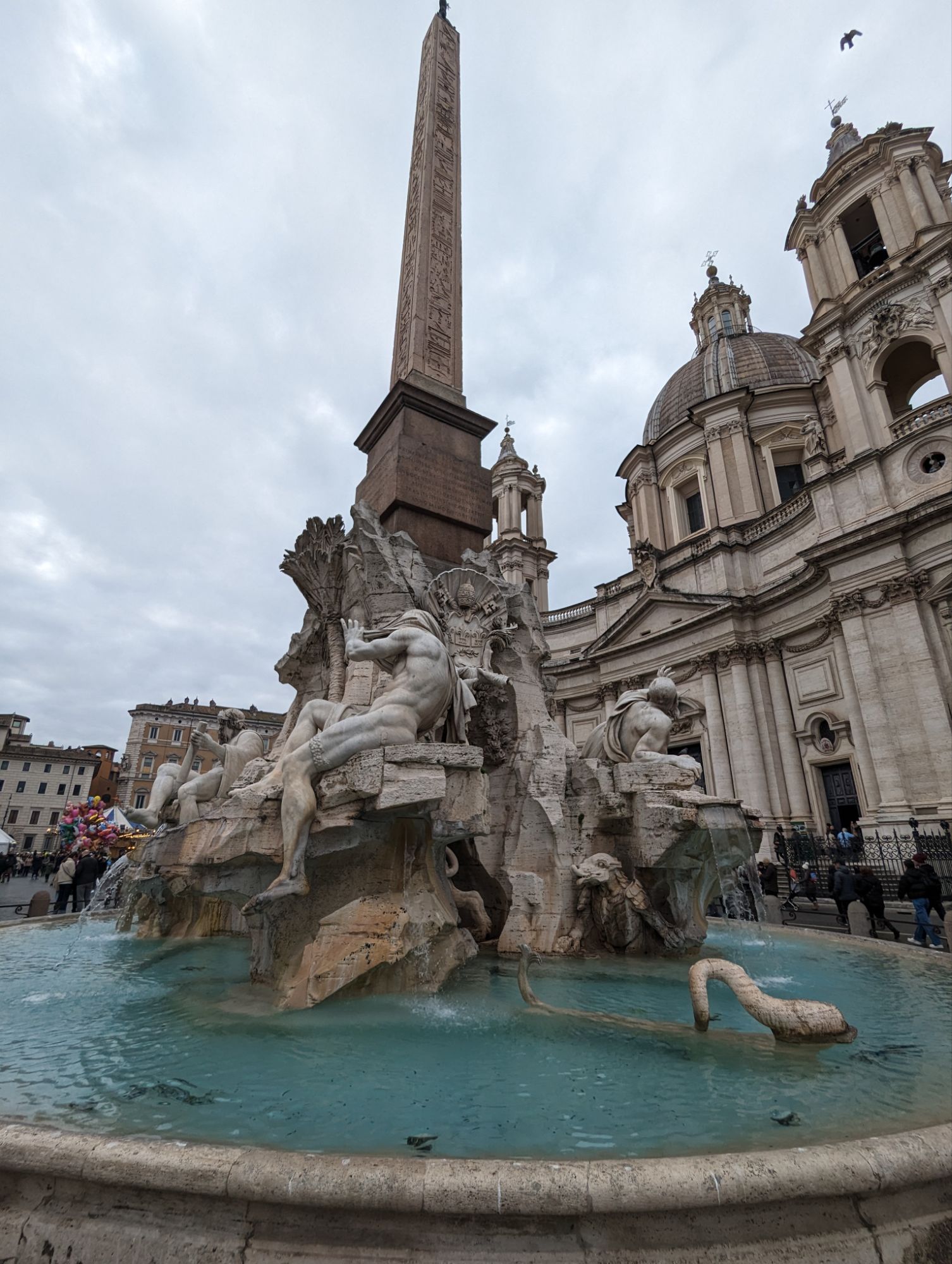
Bernini also did fountains. His masterpiece is Fontana dei Fiumi (1651, Piazza Navona) with its curious mix of representations of continental peoples and animals found – or thought to be found – along four rivers over which Papal authority had been extended – Nile, Danube, Ganges and Rio de la Plata. All of this sat on an obelisk. The crocodile-type creature (right) is seemingly to be found in the Ganges (though maybe the Nile would have been more appropriate).
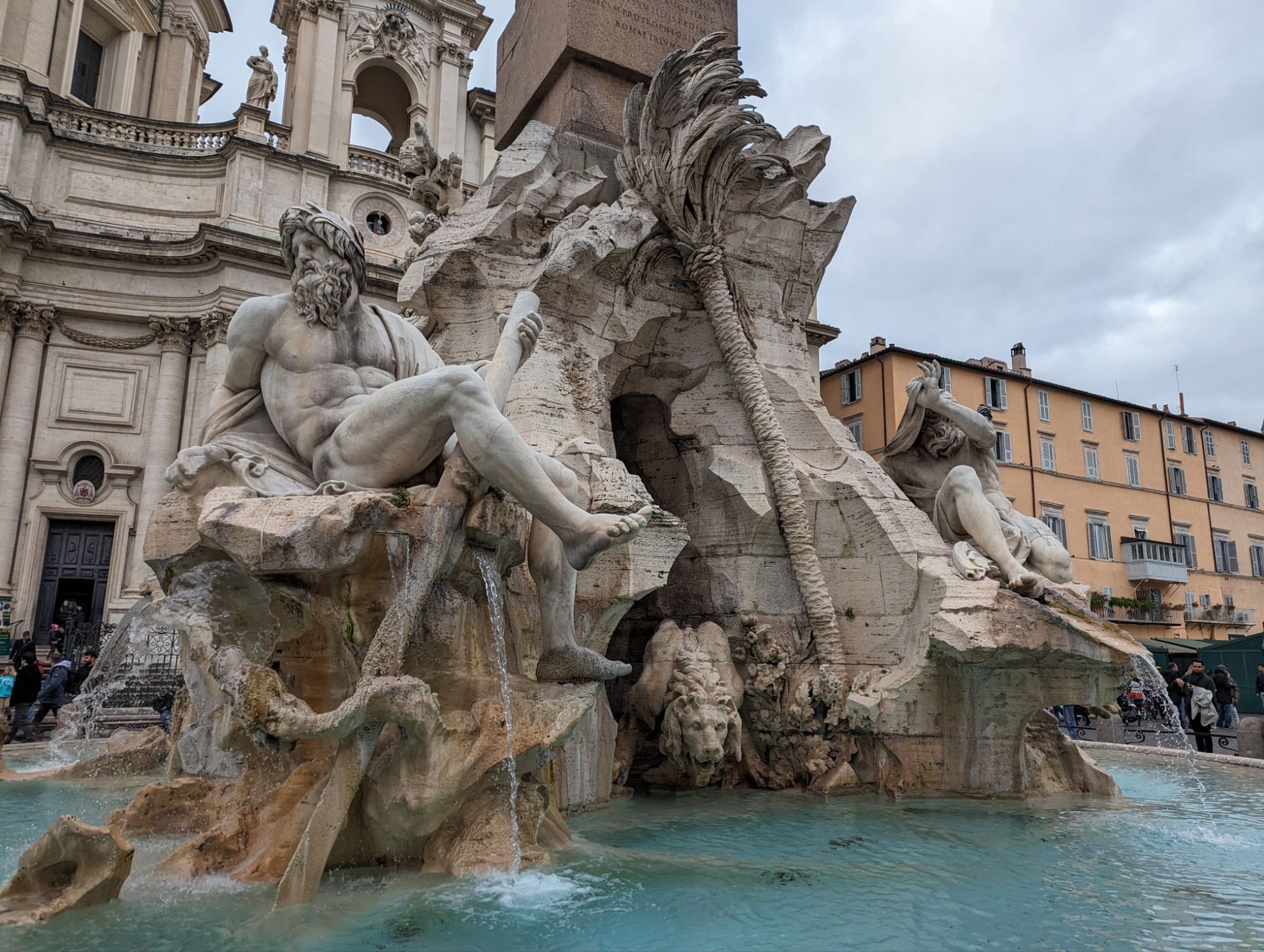
But there are clues as to Bernini’s thinking. The Nile is draped with cloth because no-one at the time knew where its source was; the Danube has the Pope’s coat of arms on it (he knows where the river flows); Rio de la Plata has money around it – riches to be plundered and the Nile has a long oar that someone will have to use to navigate it and spread the word.
Just another note, if anyone is visiting and needs to understand how the city was planned, here is a good source:
Summer 2022: the €9 ticket holiday – 1
Travel
There is a certain normality currently as I sit on ICE928 heading to Frankfurt and then Brussels. What is not normal is that the trains are running to time and my Eurostar connection is within reach. This is not normal!

Nor is a holiday facilitated by train journeys courtesy of the €9 ticket. This ticket has been available since June 2022 and allows unlimited travel on regional services, buses, U-Bahn and trams. It is wonderful and has taken us from one end of the country to the other. The DB Navigator app is the essential companion. The downside is that sometimes the demand generated by the €9 ticket has not been met by DB or the private rail operators. It has been difficult to board trains, let alone get a seat. But on the whole, trains have been on time and reliable. And people have been polite. On the whole.
So, we wanted to go to the Baltic coast. We also wanted to go into Poland to visit a place in Eastern Poland called Elbląg – the birthplace of my beloved’s mother and trace the movement of the whole family seeking to avoid a confrontation with the Red Army as it pushed back the Nazis and established what we now refer to as the “Eastern Bloc”.
We made it to Berlin on one day and then visited the Reisezentrum in Berlin Hauptbahnhof to book tickets to Elbląg. There were two substantive problems. First, demand for trains in Poland is high. It’s the summer and “walk-on” is not always possible. Second, as others have noted, booking trains – or even just getting tickets for cross-border services – is thwarted by insufficiently integrated IT systems. Or just insufficient systems. Buying tickets online or through an app is not easy. We did not try it. We used the Deutshe Bahn Navigator to provide times, as well as Koleo. Since looking more deeply into this, I have found another online option, Polish Trains, though I have no way of validating this site. (as buying tickets online or through an app in Poland is not easy).

We delayed our journey by a day and bought tickets as far as Zbasznek via Frankfurt an der Oder and Rzepin. We thought that buying a ticket at Rzepin should be straightforward, but there is always something about border towns. The stations are often either not open or simply building sites. The towns themselves may be a good walk away. It was difficult to find a café, or a bank as we needed some cash (Poland is not in the Eurozone). We did find a bank and the bank machines dispensed cash, though in unwieldy-denominated notes. Most shops do have card payments, but I dare not look at how much it costs per transaction.
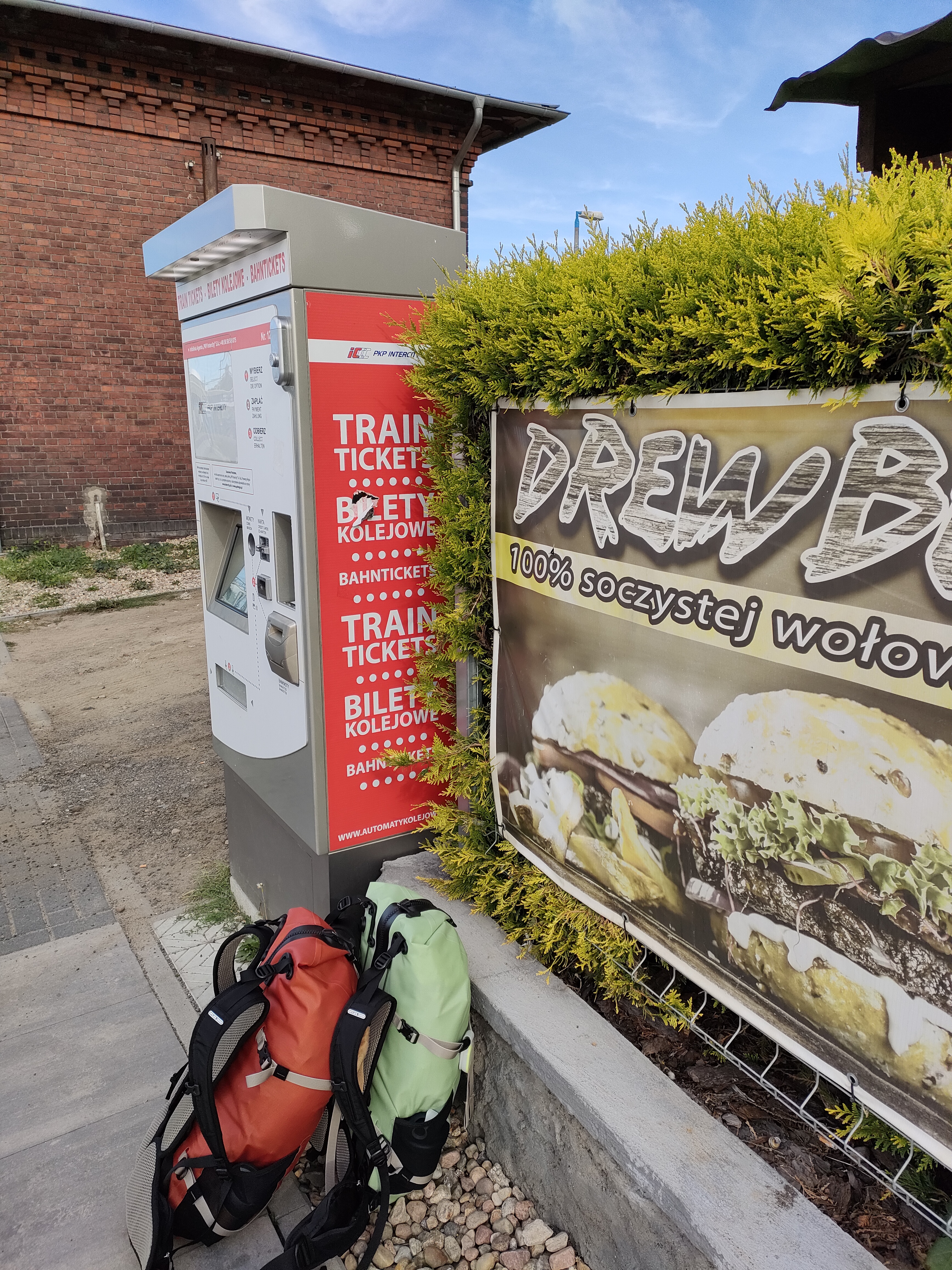
We managed to buy a ticket using the machine (right) to Poznan. We stayed overnight and carried on the following day, but not without a 90-minute wait in the queue at the station ticket office. In the end we took regional trains from Posnan to Elbląg (via Bydgoszcz, Tczew and Malbork). For the return journey we did book ahead and got a seat on the direct InterCity service Elbląg to Szczecin. Another overnight stay and another ticket purchase problem. I asked the conductor on a Germany-bound train whether we could buy tickets on board (as there was another long queue at the ticket office and the two auto ticket machines were out of order). She basically said no, but as we discovered the following day, it is possible, but at a greatly inflated price. It was about €20 to get to Pasewalk (below left) – advanced purchased more like €2. By the morning the ticket machines were again functioning, but unable to sell tickets across the border. Though you have to go through the motions to discover this. The touch screens assume you have a paw rather than a finger, so it is easy to mess up and have to start again.
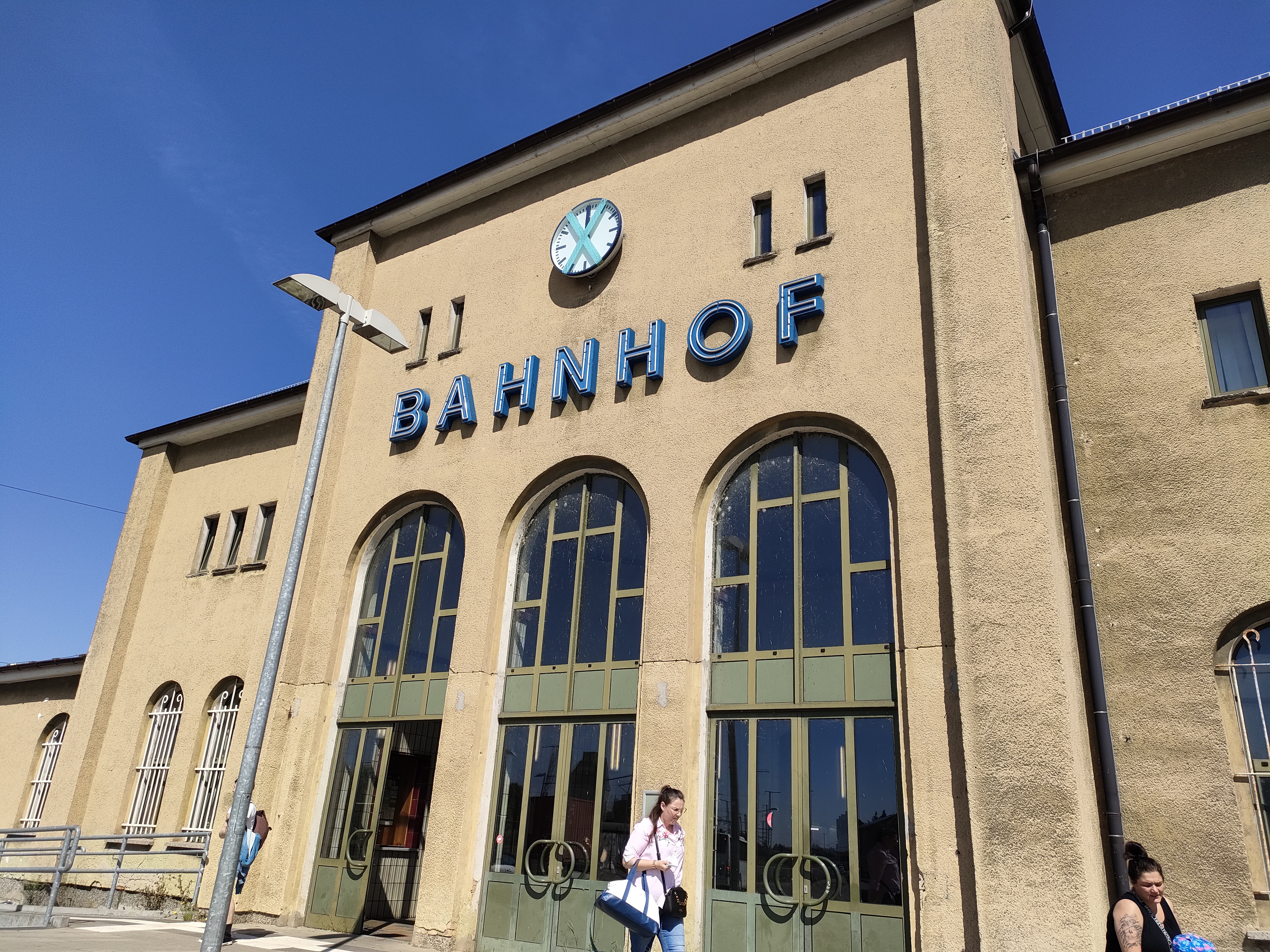
I am learning something about border crossings. We crossed the German/Polish borders at two different locations (hin und zurück). Both services were operated by Deutsche Bahn – both were diesel traction and made up of two coaches. It is very similar to what I experienced in recent times crossing the border between Germany and Belgium. Welkenraedt, for example, is not an obvious place to cross from Aachen (Liège, surely?). But the border history of European countries cannot be ignored. They are located where checks could be made, identities validated.
Polish railways are quirky like in most countries. This is partly due to the EU which requires a split between infrastructure and operation, and partly to facilitate operational efficiencies – essentially separating longer-distance Inter City services from regional services and freight. To that end, in Poland the Inter City services are run by PKP (Polskie Koleje Państwowe) centrally and the regional services, (Przewozy Regionalne) are just that, regional and managed so. Additionally the Gdansk areas has its own brand, (SKM). There is no inter-operability between PolRegio and Inter City. Over many routes they compete with one another. Though those aforementioned auto ticket machines can dispense both.
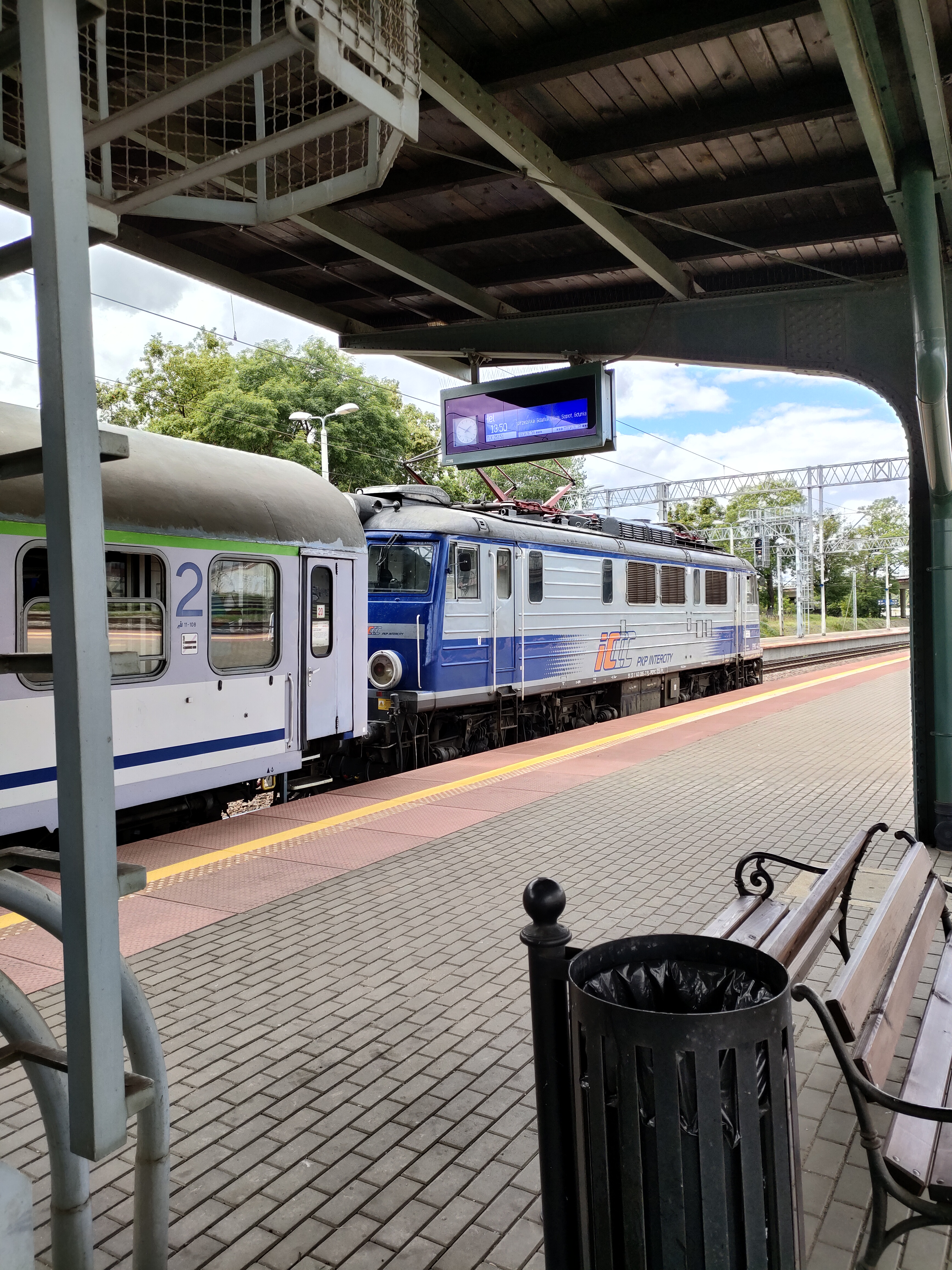
The Inter City services are fantastic. They run using refurbished rolling stock manufactured in the 1980s (the plates in each corridor specify exactly when they were built. The locomotives seem to be of more recent vintage. They are not high speed. They have many timing points. But they do seem to be reliable. Many have European power sockets, but no wifi. That is for East to West. North to South has some impressive new Pendolino trains but seemingly they run fast not so often as, again, the infrastructure cannot support it. That said, I saw lots of evidence of infrastructure renewal using equipment from Alstom and Bombardier.
The units used for regional services seem to be more modern, with a few exceptions – Malbork to Elbląg being a case in point.
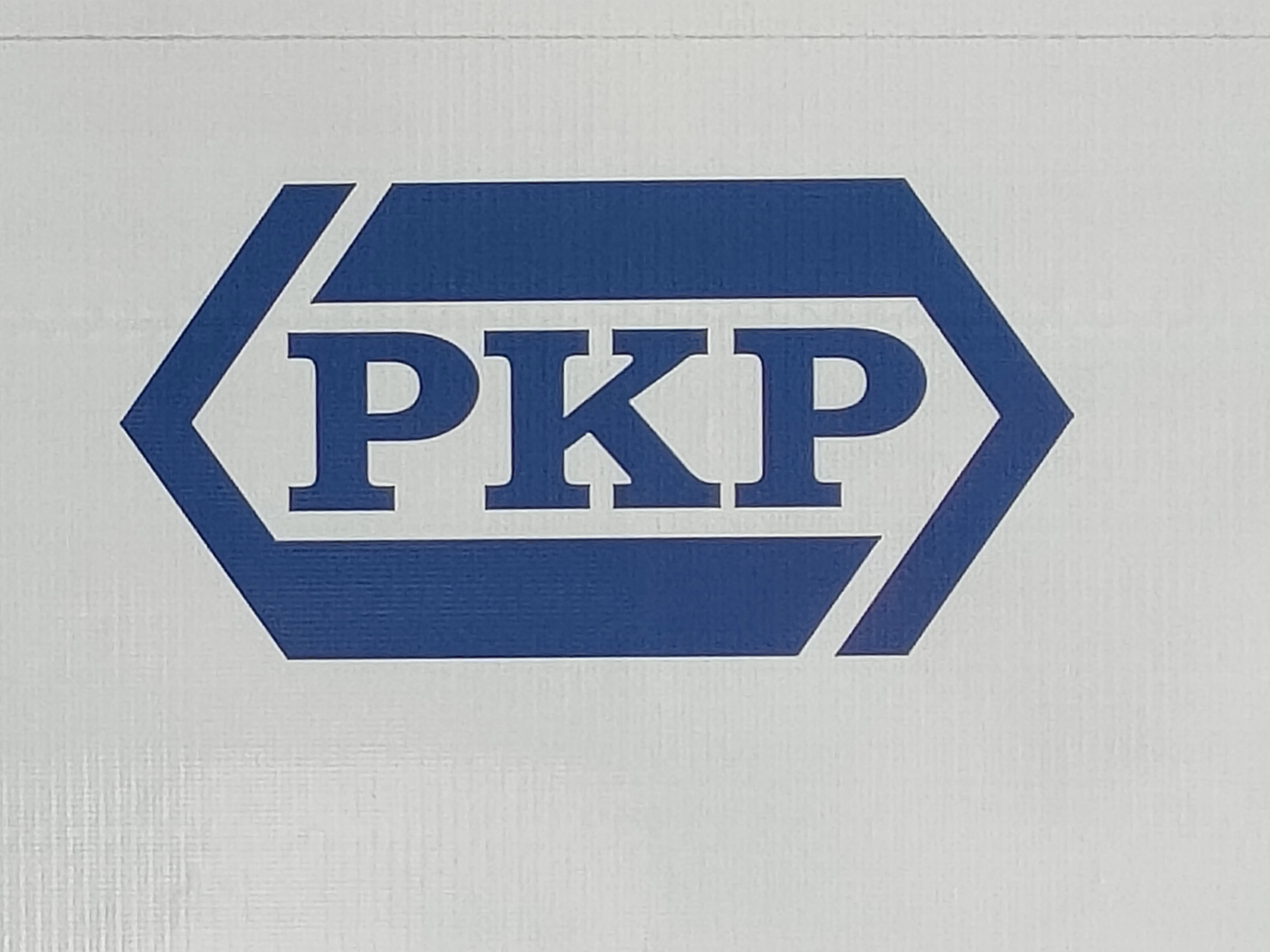
The PKP (right) logo is interesting. It has a period design and the obligatory arrows associated with mobility – and railway mobility in particular.

Naturally, the younger company, PolRegio has a much more modern appearance and a bit more of primary colour. The livery of the trains reflects this, too. Though exactly what it is supposed to say, I’ve no idea. PolRegio seems to be enough. But what do I know about design?
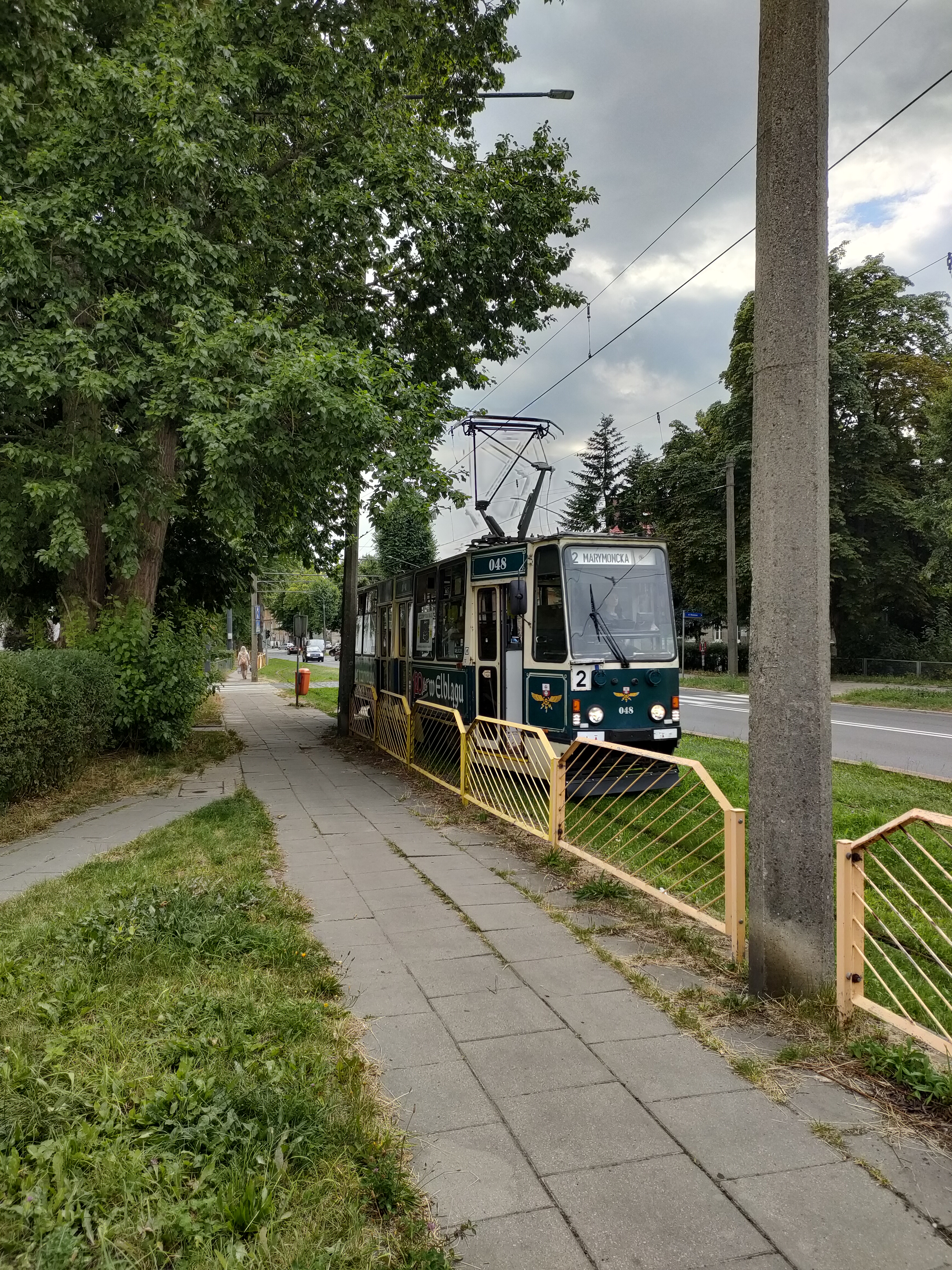
Most of the cities that we have visited have street trams. Elbląg, not a huge place, has a complex network of trams. Some of them are dated – rustbuckets, even (left). They run – in certain parts of the city over beautifully grassed avenues. They are a delight (we did not ride the trams, but they sat with me as characterful as the art – see blog entry 2).
European travel by train, post-Covid
Filed under: Uncategorized | Tags: Deutsche Bahn, European railways, German railways
Comments (1) 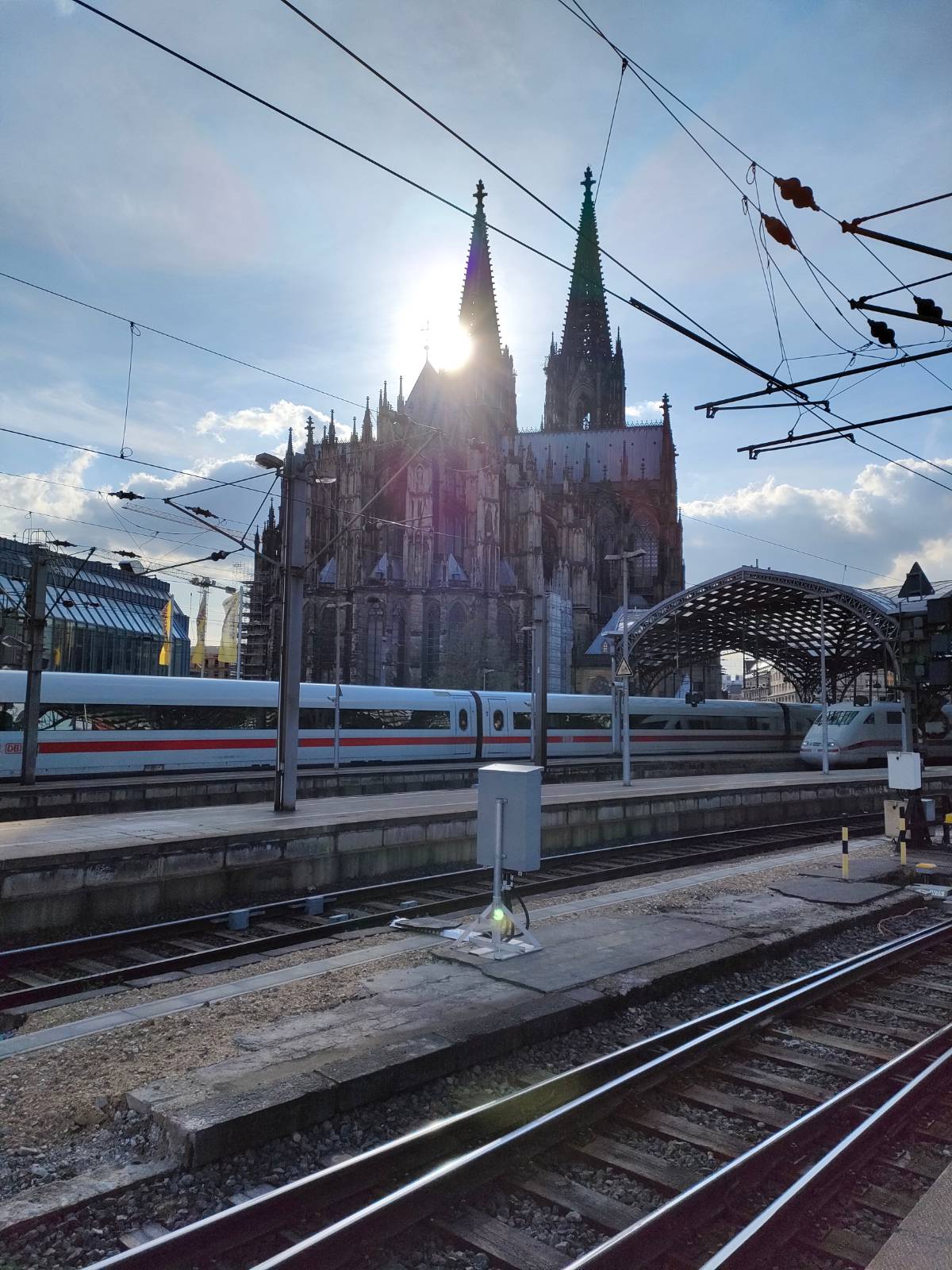
Since leaving planes behind pre-Covid, I have been travelling by train regularly between London and Munich. It can be a very stressful journey because connections are invariably missed. Deutsche Bahn is not having a good time at the moment. For example, whilst writing this, I am writing this on a train that has picked up a technical fault and goes no further than Köln (it should be going to Brussels).
I cannot remember the last time that I had a trouble-free journey. There is always a problem. Here are the most common:
- technical fault on train (the train does not arrive, or it does and gets cancelled on the spot)
- detour to avoid damaged overhead lines and failed points
- failed AirCon (whole coaches closed)
- bad weather (which now increasingly means hot weather)
So, going out from the south coast of England a couple of weeks ago (midweek), my first leg was delayed (Hastings to Ashford, 0615). I took a slower train to London (0620), changing at London Bridge. I reached the Eurostar terminal (St Pancras Int) with 5 minutes to spare (before the check-in closed at 0830). Important here is just to go to the front of the queue and ask to get straight to the gates and through security.
I usually give myself a lot of connecting time in Brussels (careful of thieves, they are active and I have had a bag stolen, use the cafes). Eurostar arrives in Brussels at around five-past the hour. Deutsche Bahn ICE usually leaves at 25 past the hour. It is according to The Man in Seat61 a recognised change. But 20 minutes is not long. I usually allow more for the next train (in my case 1425, Brussels – Frankfurt). Often this train is cancelled or starts at Liège. If the latter, there are plenty of trains to Liège. Take one. But if the former, travellers need to get to Aachen. This is not possible from Liège. If readers end up there, then the place to go is Welkenraedt. From there, it is possible to get across the border on a small local train to Aachen, and from Aachen to Köln and from there options are available to go south, east or north in Germany and beyond.

Where delays are involved, DB conductors do not care whether passengers are on their booked train or not. So, It is not necessary to ask in the Reisezentrum to validate a ticket (I used to do this), for general travel. Just get on. I do not print out my tickets these days. They are stored on the DB app, DB Navigator (right). The app records the journey and sends updates. Take screen grabs where cancellations occur (DB does take them from your app shortly after the cancellation notification, so it is good practice – readers may want to claim back money, too).

On the way back, I was booked on 0746 InterCity train Munich to Frankfurt (left). The app had warned me early of a 10-minute delay; the train was 40 minutes late leaving Munich after experiencing engineering works between Salzburg and Munich (though the app reported a technical fault on the train as the cause). I had given myself a 45 minute change time. The app allows users to specify how many minutes are preferred for changing – I set mine to at least 30 minutes, but increasingly that is not enough. On this first leg of my journey the app kept saying that the connection would be met in Frankfurt. And then not. And then once again possible (erreichbar). In the end it was 4 minutes. A bit of a run from platform 11 to 18 (the station is a dead end, so there are no stairs). It was all rather in vain. The ICE to Brussels developed a fault at Köln and went no further. I waited for the next scheduled train two hours’ later (having given myself this extra time in Brussels to accommodate such a failure). I squeezed on, only for the train to develop a fault at Aachen. So then it was back to Welkenraedt, this time with two ICE trainloads to be accommodated on a two coach electric train! The Belgian rail staff keep their distance. Not everyone got on. From Welkenraedt there is a direct train to Brussels Midi (Oostende service).

Now I did not think that I was going to be confronted by two failed ICEs in one day. At Köln I could have taken a regional service to Aachen, and from there to Welkenraedt. That would have given me time to get to Brussels. Though I held back because the immediate next Aachen train was itself cancelled. I chose to wait for the ICE. I should have thought that something might have gone wrong as my way out was plagued by two failed trains. But I edged my way forward. But Eurostar is a bottleneck. There is only one tunnel (and not enough trains).
To finish the story I arrived Brussels at 1900 (missing the Eurostar comfortably). On the train I used Booking.com to find a hotel in the vicinity of the station. The only meaningful option was Park Inn. Pretty standard. Been before. I also booked a Eurostar ticket for 0852 on Sunday morning. €200 – about double what I paid for the original ticket. Ultimately I was lucky to get a ticket as I had no seat options other than that allocated.
Advice –
- keep a mobile phone charged/charging (use the power on DB trains – though do not forget an adapter)
- ensure that you have roaming
- always go forward – though decisions are tight. I am disappointed that I did not go for the Aachen-Welkenraedt option in the first instance. I would have made the Eurostar
- always assume something will go wrong – ensure you have room on credit cards for unexpected payments (I heard some people on the train trying to book a hotel with insufficient credit).
- I appreciate that is a bit of a privilege, but a bunk bed in a hostel in mid-summer in Brussels will cost €100. Sleeping in the station really is not recommended
- always carry food and water.
I’ll work out how to claim back money for failed services and post again.
I’ve also got something to say about Germany’s €9 ticket. Great idea but comes with some systemic failures.
Climate revisionism
I am a subscriber to the Economist; not because I like it – though the writing is excellent – but because its free-market ideology is a constant reminder of the challenge the ideology presents for those looking to foster progressive change. So, when I opened this week’s copy, I was hoping to see one dominant factor, climate change. Note it was hope, not expectation.
The Economist is struggling with climate change. The writers/editors know that it is a challenge to business-as-usual. The IPCC report published earlier this week (9 August 2021), has given the the magazine’s editors a way out: sulphates. Every cloud has a silver lining, and sulphates – or more generically, aerosols – are showing themselves to be a way to justify not changing the system that delivers ever-greater climate change.

The IPCC report shows that in burning fossil fuels, sulphates are released into the atmosphere – the lower atmosphere to be precise. These particles actually reflect heat away from the planet and have contributed something in the order of 0.4 degrees Celsius of cooling. Actually scrubbing fossil fuels when they are burned, takes out the sulphates and, hence, makes warming worse (though the benefits to air quality and hence mortality from air polution are significant but peripheral in the argument). Even more interesting is the discernible decrease in sulphates that occurred after 2015 and is detailed here by James Hansen – a colossus in climate science (left). In other words, without sulphates the planet would have already reached 1.5 degrees Celsius warming since pre-industrial times. Readers may well be able to see where this is going?
The sulphates “solution” is at the heart of solar geo-engineering thinking (see Elizabeth Kolbert’s account). If human beings scatter the upper-atmosphere with sulphate particles, the heat would be reflected and the planet cooled. It seems that geo-engineering is back on the agenda for free-market thinkers, even though it is unthinkable for many reasons: political, unintended consequences (some of which are known), etc. Solar geo-engineering is not a solution for the IPCC, however.
In addition, the Economist has gone for another easy option, methane. Methane is a greenhouse gas, something-like 10 times the potency of carbon dioxide. However, it stays in the atmosphere for a much shorter time. The logic, then, is for methane to be targeted rather than carbon dioxide. Moreover, methane can be monetized (it has a market price), therefore it is easier to attract private investment than simple carbon capture. Here is a question, methane can be captured from human industrial processes, but one of the growing sources of methane is that released from melting ice and permafrost. How is that captured? I think the answer is not to release it in the first place. Zero carbon has to be the target. End.
Pic: By NASA – nasa.gov, (archived), Public Domain, https://commons.wikimedia.org/w/index.php?curid=71506555
The LGB Alliance Are A Hate Group — Ruth On The Line
The LGB Alliance exists solely to attack transgender people’s well established place within the wider LGBT community, for no other reason than the personal bias against transgender people of the LGB Alliance’s founders. If WordPress doesn’t force me to take this down, I’ll turn this post into a list of bulletpoints explaining why they are […]
The LGB Alliance Are A Hate Group — Ruth On The Line
The UK models itself on Hungary?
The populist conservative government in the UK has shown itself to hold democracy and the UK parliament in contempt. The PM prorogued the parliament – that is, suspended it – in order to thwart attempts to avoid a no-deal Brexit in the summer of 2019. The Brexit Bill bringing into law the TCA (Trade and Cooperation Agreement) between the UK and the EU was pushed through in less-than a week to avoid the scrutiny of the committee system, itself designed to ensure law is robust and able to stand up to interrogation. The shortcomings of that law are on display daily at ports, shops and exporting firms across the country.
The next illiberal bill being pushed speedily through the parliament is the Police, Crime, Sentencing and Courts Bill. I got wind of its illiberal content and aims from Ian Dunt. Consequently, I have written to my Conservative member of parliament, Sally-Ann Hart, to register my concern (reproduced below).
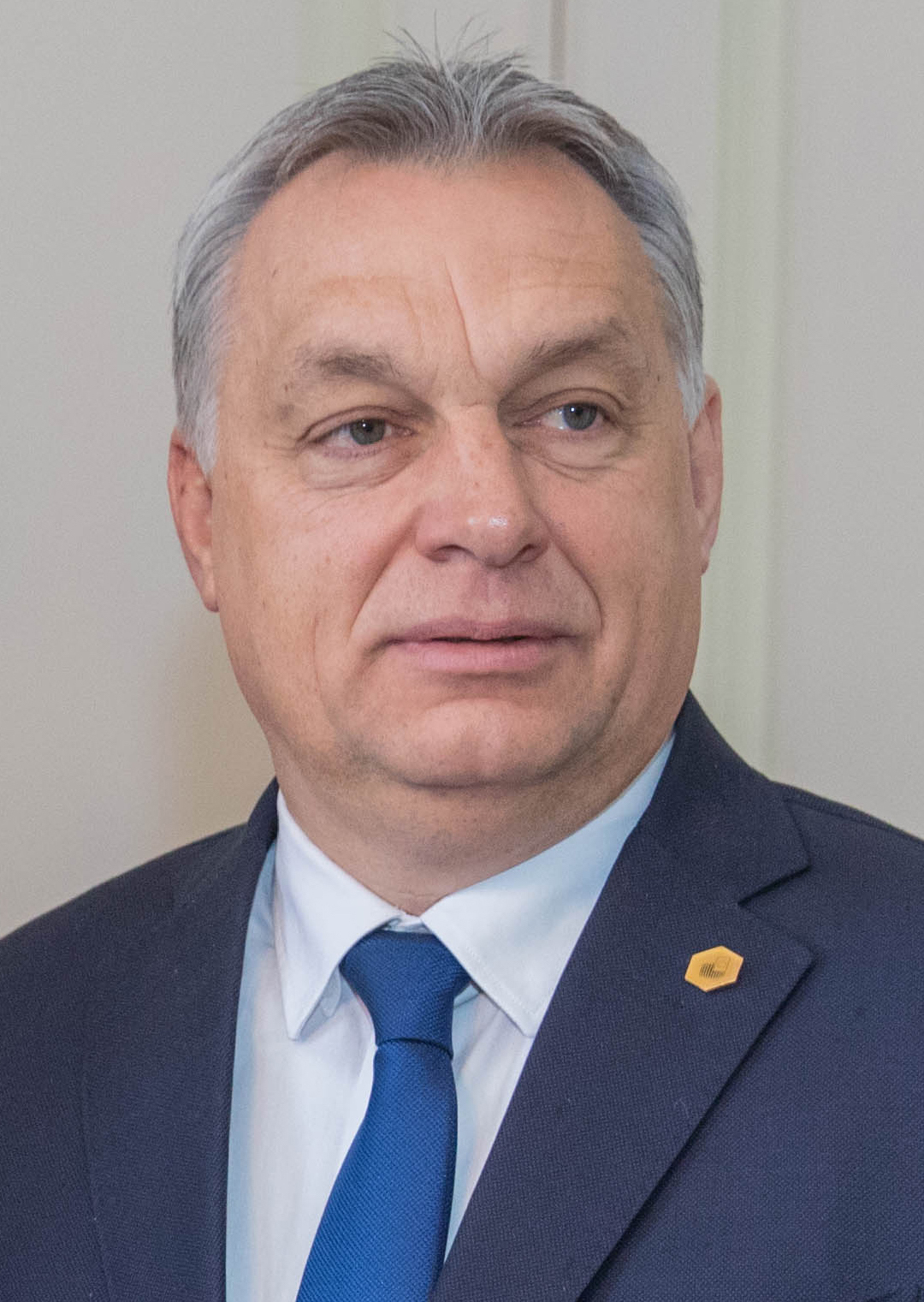
As for heading towards being Hungary; the current PM’s predecessor fuelled the belief that the British courts were the enemies of the people when they were used to force the Government to follow the law. There is more of that to come, I’m sure. The UK will soon have its own version of Fox News – opinion rather than news. The existing regulator enforces partiality, but it is difficult to see how the two newly licensed channels are going to achieve that. Any doubters out there should also note that the new boss of the BBC has just cancelled – yes, cancelled – the satirical TV show, The Mash Report. Officially because it is not funny. Unofficially because it is.
11 March 2021
Dear Ms Hart,
Re: Free Speech
I work in a university with an honourable tradition of free speech. Your colleague, The Secretary of State for Education, believes that free speech is so important that it needs a champion to ensure that it is respected in our universities.
Meanwhile another of your colleagues, the Home Secretary, has published a bill designed to shut down free speech. The Police, Crime, Sentencing and Courts bill has a number of provisions that are deeply anti-democratic. First, and for example, there is a potential for a noise restriction to be imposed on a demonstration if the police believe that it will cause a nuisance to anyone. I’ve been on many demonstrations exercising my democratic right to free speech. They are, by definition, noisy. That is the point, is it not?
Second, should a restriction be placed on the demonstration and a demonstrator violate it and arguing in court that they did not know about it, previously that was admissible. Under this law, it will not. A person on a demonstration will need to know all of the restrictions imposed on the demonstration or face prosecution.
Thirdly, a demonstration by a lone individual would have the same status.
Finally, the Home Secretary will be given powers to change a definition of “serious disruption” under a statutory instrument. This is a wholly inappropriate use of such a mechanism.
Why is there such a difference between the Home Office and the Department for Education on the question of free speech?
I trust that you will resist the attempt in the bill to curtail and criminalise free speech in our country.
Kind regards,
Andrew Grantham
 Be informed