Cigarette advertising – it has been a long time
Filed under: Cigarette advertising | Tags: Cigarette advertising, This Plus Cigarettes
 Leave a Comment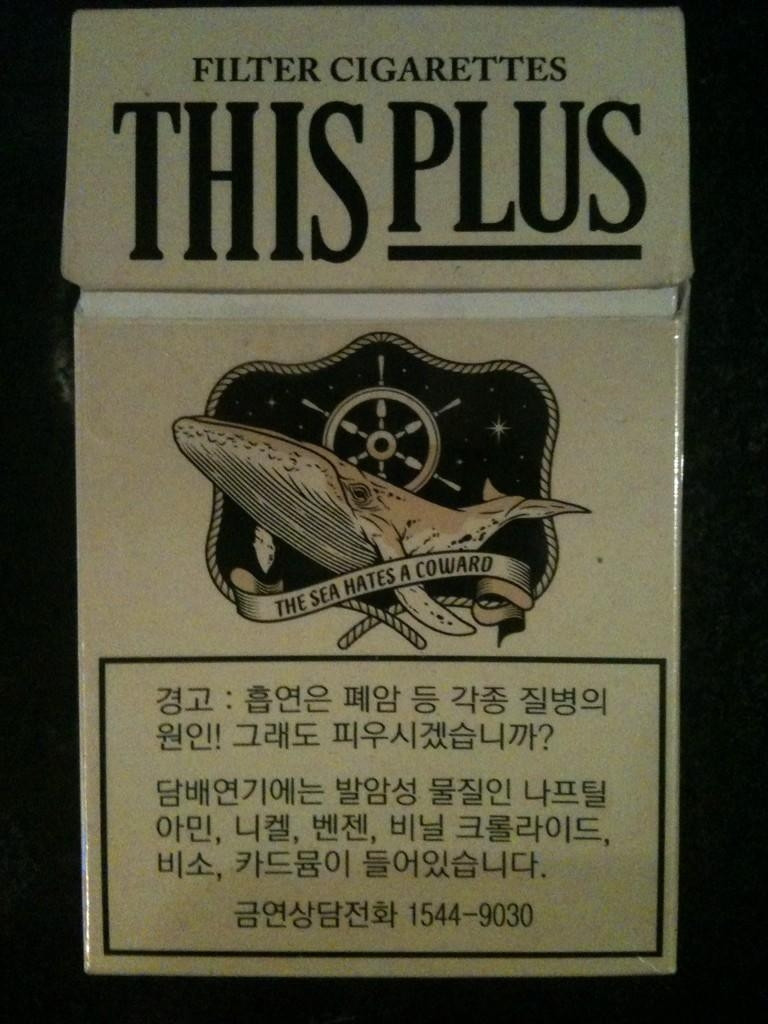
I have not posted on cigarette advertising recently because…there isn’t any. All advertising in Germany concentrates on e-cigarettes, few of which are in any way as creative as those produced by the tobacco industry.
Anyway, just scrolling down in Bluesky, I came across this posted by Garth Mahrengi’s Catbus (@catbus.bsky.social). It is quite special and, well, wrong? The sea cannot like or dislike. Though it is true that those who do not treat the sea with respect, may find themselves in trouble. The fact there is a whale in the graphic suggests that these cigarettes were for men who hunted them, or fishers more generally?
Decarbonisation milestone
Filed under: Environment, Transport, Travel, Vehicles | Tags: decarbonisation, diesel van, Mercedes Vito
Leave a Comment It has taken three years to get there, but I have reached a decarbonisation milestone. It started with six photovoltaic cells on my roof and 6kW of battery storage. I then invested in an induction hob. Then, the big one, the heat pump. Which is now doing an amazing job at keeping the house warm and supplying hot water. It is a different experience to my gas boiler and super hot radiators. The radiators stay ambient.

Anyway, finally, today I said goodbye to my diesel van (why did I have a diesel van in the first place you might ask?). I have sold it, so it will still be burning fossil fuels and emitting greenhouse gases. But I felt that in selling it I may be tempering demand for new vehicles. Even this old van has embedded carbon from its manufacture.
Where to next? What more can I do? Well, there remains plenty of scope. First, I need to do a full audit of my life and then create for myself a carbon reduction plan! I will report further here in due course.
Compare and contrast – Aurora and Pond
Filed under: Uncategorized | Tags: Anna Lapwood, Aurora, Camden Electric Ballroom, Music, Nick Allbrook, Pond, Royal Albert Hall
Leave a Comment I am not sure I have ever been to back-to-back gigs. But last week we went to see Aurora at the Royal Albert Hall (first time going to see something that was not a BBC Prom) and Pond at the Electric Ballroom in Camden, London.
We’ve enjoyed these two sets of artists for many years, but it is only the second time that we have seen either of them – Aurora most recently at Pryzm in Kingston and Pond at Concorde 2 in Brighton (in 2015).

Aurora is a 28-year old Norwegian singer songwriter. She is certainly more than that as this RAH show demonstrates. Her backing graphics (see left) are full-on avant garde. Her songs are political, personal and political and personal. We discovered her music in our search for environmentally-themed songs. Aurora’s most explicit is The Seed “When the last tree has fallen and the rivers are poisoned, you cannot eat money, oh no:” But her new Album, Whatever happened to the Heart, is a concept album around the heart as muscle, symbol of love and the beating of our world more generally. It is an opus – all that is needed to navigate a world full of hate, wonder, beauty and opportunity (if we choose to take it).

Aurora is a performer, for sure. She is not Dua Lipa with complex dance routines. She is not really stadium music – the RAH is a big venue and takes immense talent and presence to keep its attention. Tickets sold fast and we were relegated to the Rausing Circle, rather in the heavens. The RAH has something that other venues on this tour do not. That thing is the amazing organ. Aurora somehow got Anna Lapwood (right) to rearranged three songs to incorporate that instrument. For me, at least, that addition was beguiling (I love the organ sound in any case). The three songs – Echo of my Shadow, The River and The Seed – elevated this concert beyond what was already memorable. Anna Lapwood is an Associate Artist at the RAH – but so much more than that). Her joy was captured as she let the organ rip during The Seed.
Aurora also engages with her audience. It is not scripted. It is not “[h]ow are your feeling?”. For example, it is not surprising that she was overwhelmed by a full RAH for her own show (she has performed there before). Aurora will conjure up images that one rarely gets from other artists. “We are told the obvious that the RAH is circular. But then “”…it’s like a soup. It’s round”. And later, in a common monologue about the state of the world she tells us “that we wear our love on our hands like a glove…” There is always some unexpected reference to her personal preferences often involving alcohol and sex. The audience hangs on her every word, despite her being only a Norwegian singer songwriter. To some extent she could be Dua Lipa but chooses not to be.

Pond’s frontman and leader, Nick Allbrook (left) is as charismatic as Aurora, though we know nothing of his politics. His approach to engagement with the audience is to ask it to crowd surf him, three times. He has also come forward and physically touched fans – there were plenty of takers.
Sonically, Pond are loud – don’t even think about going without earplugs. The new 10th album is much more rock than the psychedelia that so attracted me to them 9 years’ earlier. I’m Stung, the title track of the new album, is a corker and is about love, of course. “She’s the one” sums it up nicely.

The band more generally are multi-instrumentalists. Allbrook plays guitar and keyboards – and more recently flute. Though he is no Ian Anderson standing on one leg. He’s more likely to stand on his head. The other two core members of the band, Jay Watson and Shiny Joe Ryan (right) are no extras. Watson started out on keyboards and then moved to drums (percussion is also a significant element of the sonic experience).
The venue could not be more different to the RAH. The Electric Ballroom is a classic venue – a dark hole with bars dotted around the periphery. It is all stand, though there are a few seats on the balcony – though there is nothing to be seen if that is where you park yourself during the gig. It can get very lively and Nick Allbrook wants that of his audience – the more they pogo, the better. For those of us of a certain vintage, that is time to step aside and leave the central floor to others.
These were two exceptional nights. No disappointments. Quite the contrary. And whilst Pond had no organ equivalent, their sheer energy…bearing in mind that they are moving through the age range…cannot help but be infectious, even if only emotionally.
Summer Festivals – can they survive climate change?
Filed under: Environment, Finance and Economics | Tags: Festivals, Festivals and climate change, Leeds Festival
Leave a Comment Late summer bank holiday weekend, 2024. The Leeds and Reading festivals are scheduled as normal. But normal does not really exist any more. It used to be possible to put on such a festival in August with some confidence that, whilst it may rain, festival goers will at worst be wet. But no longer.

On 23 August 2024, the Leeds part of the festival reported that it had “lost” two stages. The BBC stage and the Chevron stage were withdrawn from the festival programme. The Aux stage was reopened. Wind was a particular problem making camping really challenging (as if camping is not challenging enough already, see above after the storm).
The cause? English weather? Well, weather, probably. In the autumn and winter we had an unprecedented number of so-called named storms – storms that will cause disruption, however defined. This bank holiday weekend “welcomed” (Storm) Lilian to the Leeds festival. Named storms have only been with us since 2015. But I do not recall life-threatening situations at British music festivals in the past from storms (I cannot find evidence – though famously the Woodstock Festival in 1969 offered up a dangerous electrical storm on its third day). The cause, according to the UK Met Office is the behaviour of the Jet Stream – column of fast-moving air that usually sits to the North of the UK in the summer but has shifted frequently in recent years to sit directly above the UK, and particularly the North West of England and Scotland. The consequence is that the particularly moist air above the Atlantic is directed to the UK and is deposited over the country when it meets the land. To make matters worse – and to illustrate the interconnectedness of our weather and climate – unusual weather patterns over North America (sinking cold air) have given additional energy to the Jet Stream.
OK, let us talk about climate change. As expected, there is some reluctance on the part of climate scientist and meteorologists to ascribe causality – a warming planet equals more storms. Named storms are an irrelevance – they are merely a media mechanism to raise awareness that citizens need to be careful in what they do in the face of a named storm. For example, don’t go to outdoor music festivals or hike in the mountains. If you can avoid it. There are data relating to rainfall (certainly increasing) and wind leading to tidal surges and flooding. The UK’s positioning in the north west of Europe leaves the land mass open to exposure to Atlantic weather and the effects of small changes in the positioning of the Jet Stream.
The business implications are immense. Festival organisers (and owners of the brands), now need to consider more carefully how to host such events safely. It is not clear yet, in the Leeds case this year, as to why two stages were withdrawn completely. Were the stages irreparably damaged? Were they merely discovered to be unsafe after the wind (in which case a rethink is needed on stage design)? And what about insurance? What if festivals become uninsurable?
Nye – National Theatre, Spring 2024
Filed under: Privatisation, Reviews | Tags: Michael Sheen, National Theatre, NHS, Nye, Tim Price
Leave a Comment I hit sixty this year. A milestone for anyone, but especially for those of us who never thought we’d get that far – not that we would die prematurely, rather that 60 years seems an impossible number of years ever to reach (despite the evidence of its absolute possibility). So what is to do to celebrate the milestone? Well, obviously, do something that I have not done before. For me, then, it was to go to the National Theatre in London with my beloved. Neither of us have been there before, it turns out. So what is on on the special day? Well, magically, it is Nye by Tim Price. It is the story of the founding of the National Health Service (NHS) told through the life of the man who made it happen, Aneurin Bevan, played by Michael Sheen. Expensive, but you only live once and it is down hill from 60.
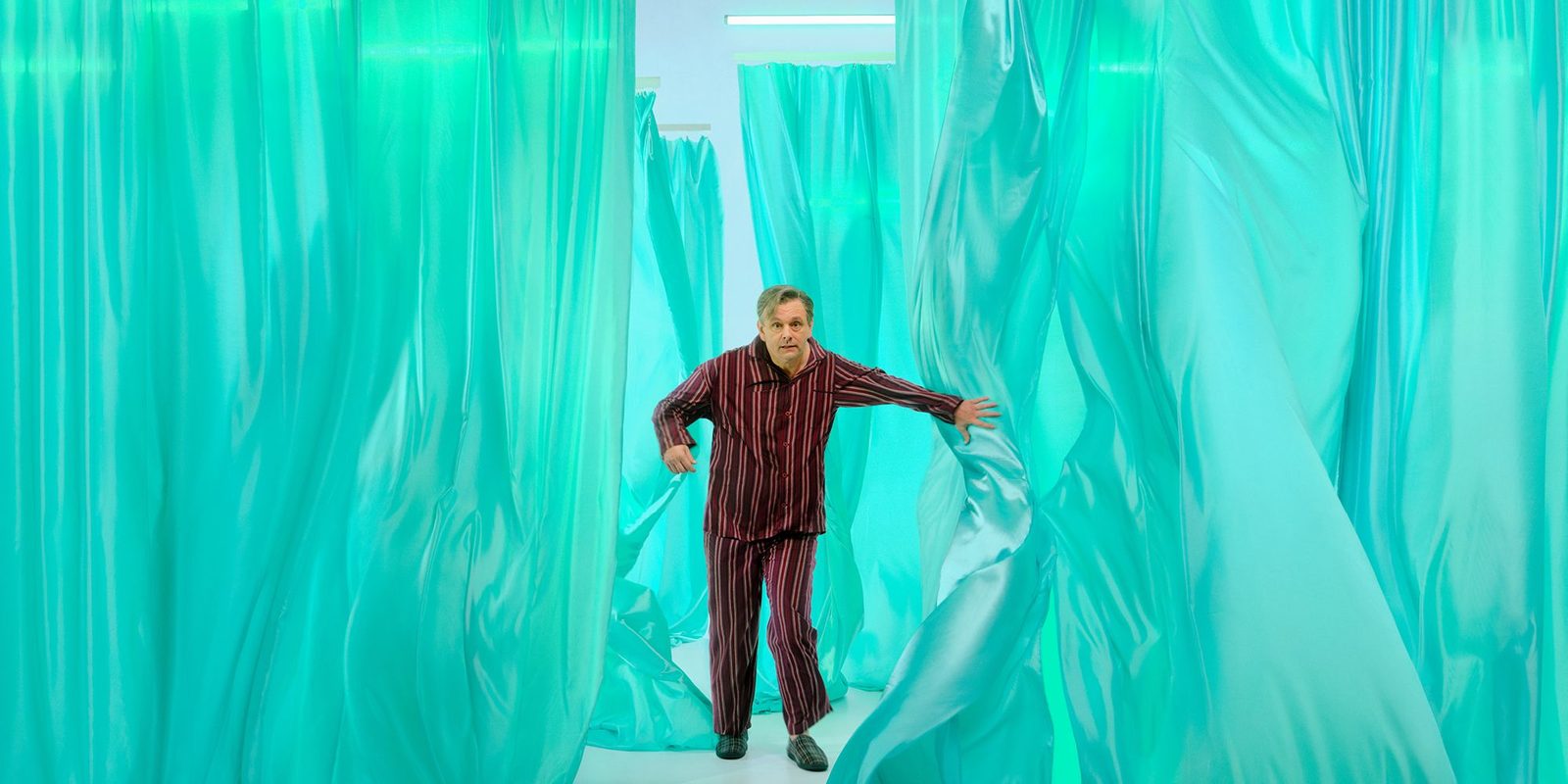
I’m not a fan of theatre as some of my friends know. It is all a bit too representational for me. I’ve understood the purpose of theatre. I think. But here I was attracted to the combination of my own history (the NHS), Michael Sheen (left) and the National. Michael Sheen I have seen in films. The National – I always remember many BBC programmes ending with the statement that x and y were both National Theatre players. I did not really know what that meant. But it must have been important. 50 years on, I have an answer.
Not being a fan of theatre, I was additionally anxious that the performance took the best part of 3 hours. But in the end, I need not have worried. There was not a moment of boredom or anxiety. Nye Bevan is depicted honestly by Sheen. Sheen is in every scene wearing pyjamas even when making a speech in Parliament. See what I mean about being representational?
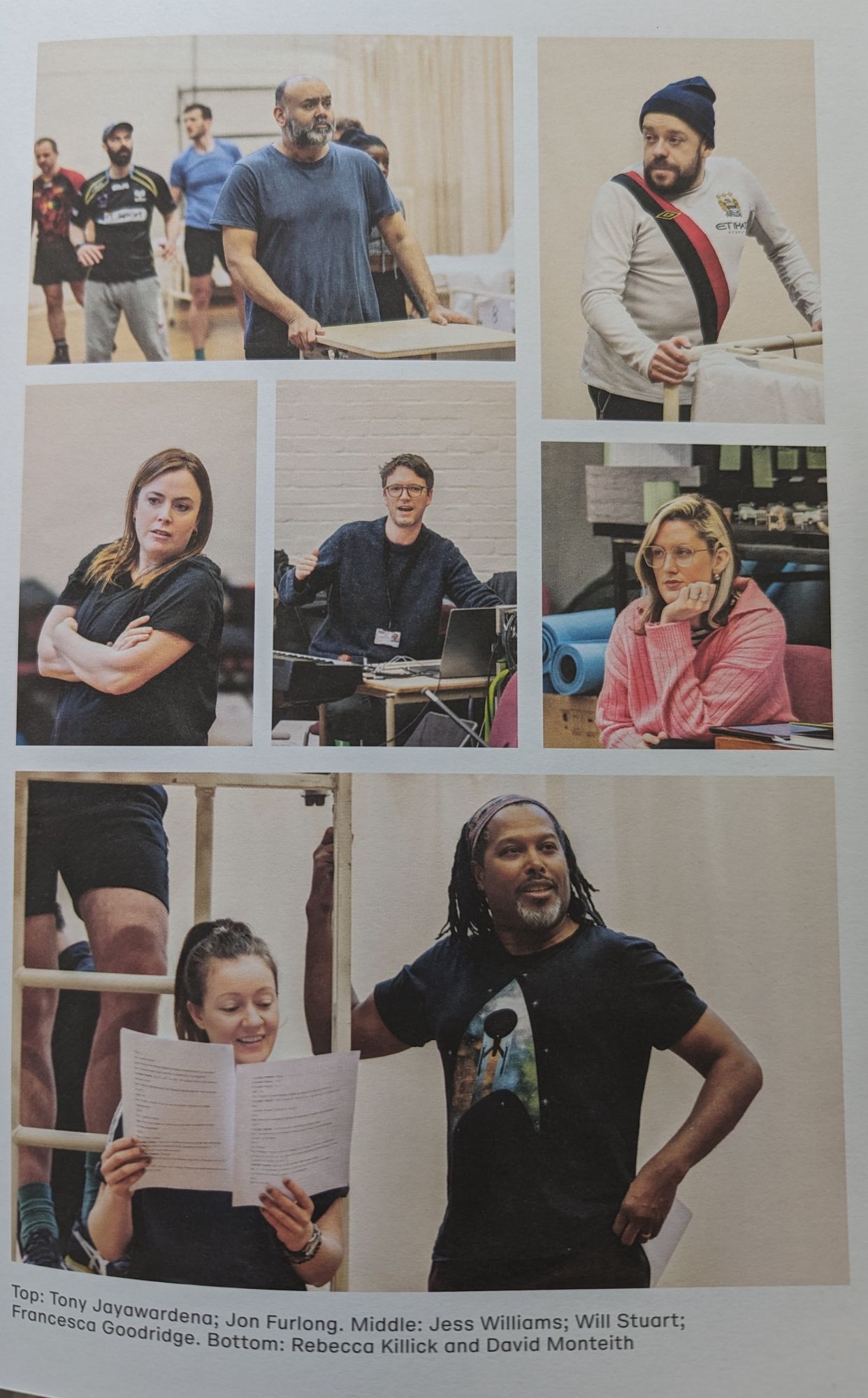
The play traces Bevan’s journey from being bullied by teachers in school because of his stammer – Sheen handles the stammer brilliantly – to the local council, to Parliament, to the Health Ministry and death. In hospital. There were for me three standout scenes. Getting over the stammer was facilitated by access to libraries – and books. There’s the realisation that if some words are unpronounceable, others with the same meaning are perhaps not. Focus on what is possible rather than what is not possible. The library scene is uplifting (literally). Those National Theatre Players show why all of those years ago they got an additional mention. The second scene was an exchange with Churchill, his parliamentary nemesis. Churchill taught him that compromise was sometimes needed to get what you want. Sometimes MPs have to go through government or opposition lobbies against their better judgment. And finally the scene where he takes on the doctors (supported by Tories in the Parliament, including Churchill) that are vehemently against the nationalisation of their profession. He wins them over through compromise. The NHS is founded. We now reflect on the extent to which the Tories of the 2020s have systematically undermined the service because of their seeming hatred of public provision of services that make our society and define civilisation.
There is a much more to this play than these three scenes, of course. My sixtieth birthday present from the NHS was a letter inviting me to provide them with some “poo” to test for bowel cancer. Bevan died of stomach cancer at the age of 62.
Burtynsky – Extraction/Abstraction (Saatchi Gallery, April 2024)
Filed under: Environment, Photography | Tags: Burtynsky, Saatchi Gallery
Comments (1) I am not a little impressed by photographers that work at scale. I have been the subject of one such photographer, Spencer Tunick, in London. His subjects were always without clothes. It was late April 2003. There were thousands of us. It was quite an experience. And for the exhibitionists amongst us, it was possible to visit the adjacent Saatchi Gallery (then in the old County Hall building) before re-robing.
Then there is the wife-and-husband couple of Hilla and Bernd Becher who spent their careers taking black and white photographs of industrial sites and machinery such as mines, steel plants, water towers, etc. I suppose what really impressed me was the fact that they hit on recording something that I, as a child, thought would be there forever and they, not being children, knew they would not. Hence I regret not taking more photographs of buses, trains and shops in my home town when I was growing up. But there you go.
And then there is American photographer, Edward Burtynsky. His father worked in a steel plant. Burtynsky himself funded his studies by working in that very same plant for a sufficiently long time for him to latch on to the idea that such plants may provide a subject for his photographic career. As it turned out, his most influential work is not the plant itself, rather the extraction of the raw materials that ended up in those plants – iron ore, copper, coal, etc. For that reason, this exhibition was a must (subject to my busy schedule).
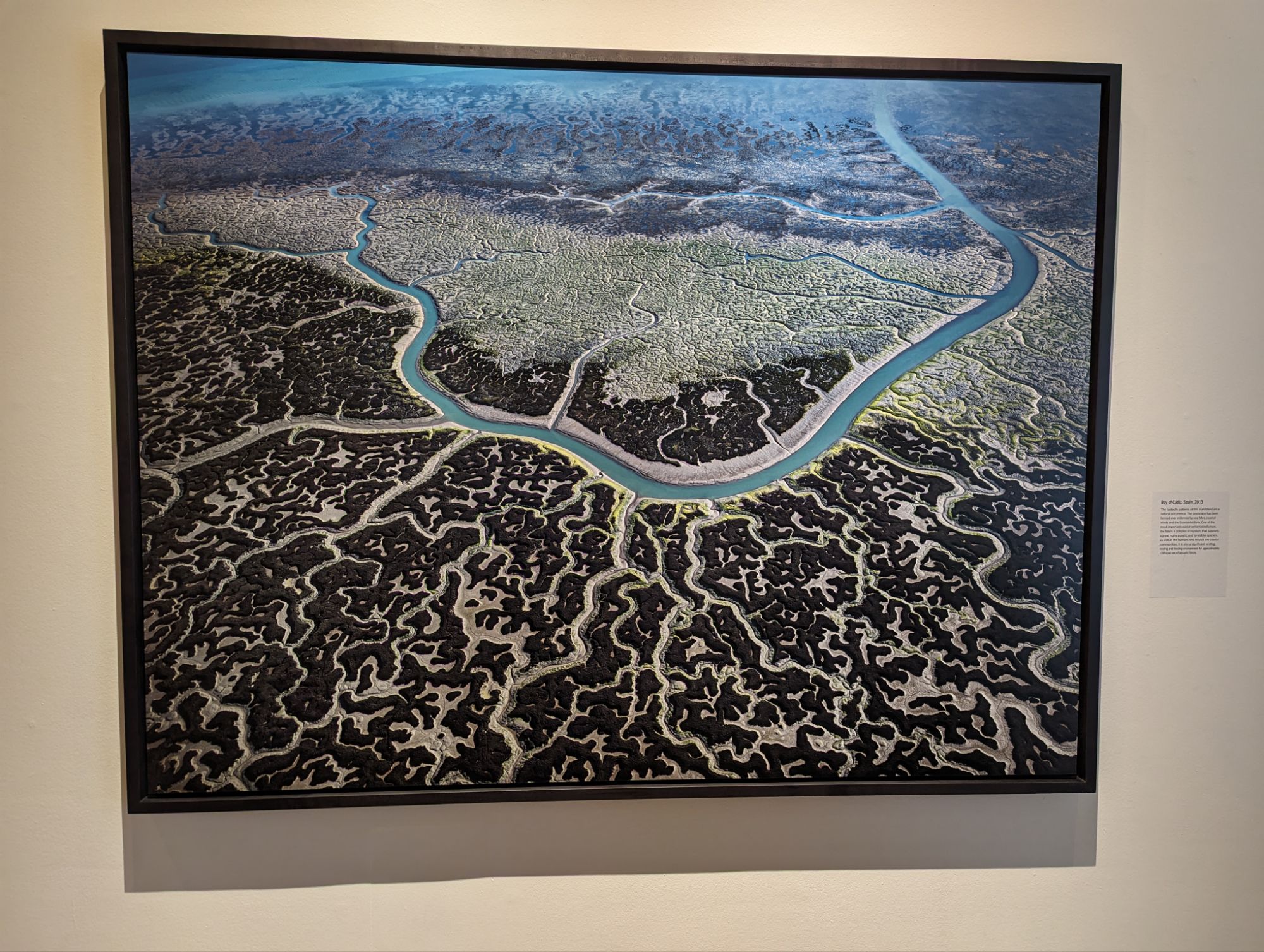
I’ve now been and the images are extraordinary. They are presented in very large format and, mostly, as aerial shots, look nothing like what they depict. They come across as abstract art – hence the title of the exhibition. On the whole, however, they are not art, they are a record of environmental destruction. There are a few exceptions where the extraordinary patterns actually record profuse wildlife habits such as the landscape around Cadiz in Southern Spain (above left).
Like most artists Burtynsky has a team working for him. The drone technology he uses relies on an expert to make them fit-for-purpose. For example, high altitude photography creates a challenge to get sufficient lift to get the drone in the air (there is a part of the upstairs gallery that reveal his methods, equipment and projects).

By far the most interesting galleries show the scale of the impacts on the landscape of mining – whether it be the scars of the opencast mines themselves, or the spoil heaps or tailing ponds. With the possible exception of coal, the ores and minerals are not neatly packaged by nature for extraction. They require significant refining, often with toxic chemicals that tend to be dispersed into the natural environment. At scale.
So, anyone with a diamond may well have contributed to the large deposits of “waste” displaced to find diamonds. The picture (above right) is of the Wesselton Diamond Mine, Kimberley, Northern Cape, South Africa (2018). If readers look closely a conveyor belt can be seen on which the tailings are transferred to the pond.

A metal that we hear so much about for the necessary electrification of our world is lithium. There are a number of extraction methods for lithium; however, one mine in the Atacama Desert in Chile (left) pumps up a liquid from beneath a salt flat into ponds. The ponds are exposed to the sun, the liquid evaporates and the lithium carbonate is then harvested, before being processed. And then there’s agriculture.

Do readers ever go to the supermarket and see that broccoli or some other vegetable is from Spain and think, “ah, that’s fine”? Well, maybe it is not fine. Burtynsky shows the true scale of such operations and their impact on the environment (right). The greenhouses on the Almeria Peninsular harvest between 2.5 and 3.5 million tons of fruits and vegetables annually, including “out-of-season”. These greenhouses require huge amounts of precious water along with a heavy use of chemicals. Climate change is making the water situation more difficult.
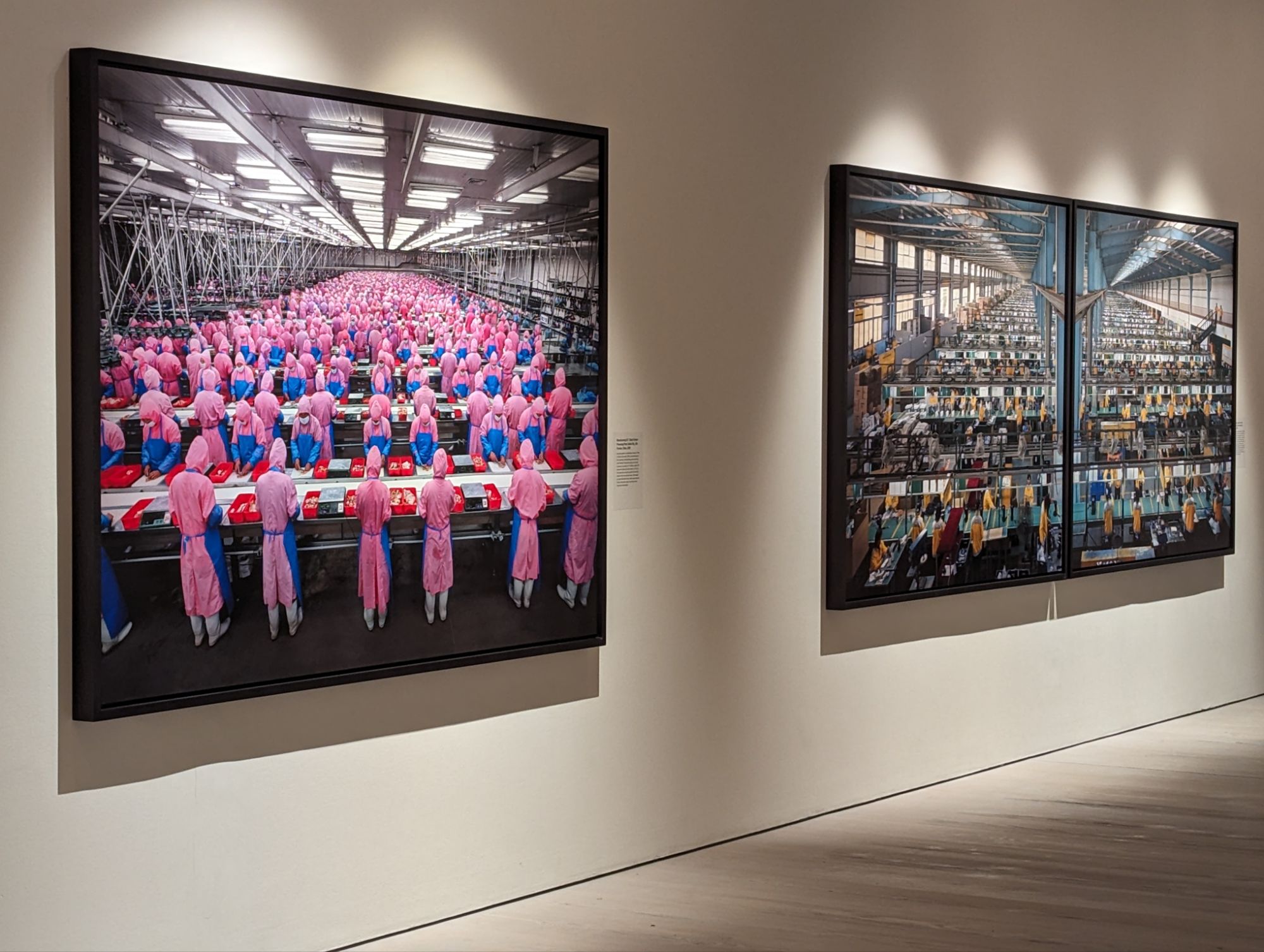
I could go on. I have one last thought. Scale is a problem for us as humans. Burtynsky has taken some revealing pictures of people at work (left) of particular alarm is a picture showing people working in a chicken processing factory in China (everyone wears pink, left). The scale here is twofold really. First, the people. The thought of 8/10 hours per day chopping up chickens is hard to comprehend. We try to present work as something that offers meaning to humans and the opportunity to work with others and exchange ideas, thoughts and stories. There is not much of that going on in this factory. And then there is the chickens. The sheer scale of this one factory tells of the huge number of chickens slaughtered daily to keep these people employed (and presumably fed).
This is an exhibition at scale. Bigger than I thought it would be. It took about 21/2 hours to get through and that included a 30 minute film at scale (worth the visit, for sure). It is thought provoking. There’s a big chalk board to write one’s thoughts – mostly about human stupidity. And then there is a shop in which visitors can contribute to the further exhaustion of finite resources. I had a poster in my hand. And then I put it down and left.
Nothing in this exhibition is human scale. Arguably the Bechers’ work in the 1960s was a little more human scale. Spencer Tunick’s work is by definition human scale.
If readers want to know more about extraction, I suggest Ed Conway’s book, The Material World.
Electrifying UK railways and climate change
Filed under: Politics, Railways, Transport, Travel | Tags: Battery train, Great Western Railway, GWR
Leave a Comment I use the case of the electrification of the railways as an example of climate mitigation. Diesel trains are hugely polluting, particularly in the context of carbon dioxide; electric trains much less so. Seemingly a switch from car to diesel train can cut an individual’s carbon emissions by 70 per cent and a whopping 90 per cent if the train is electric.

The electrification of the network has always been rather piecemeal. The East Coast Mainline was electrified in the 80s, but missed out key towns and cities such as my home town, Hull. Diesel trains still run under the wires from London to the city. More startling, but not surprising is the account given by Aneurin Redman-White, a railway design consultant, of the mess that is Brunel’s original railway Paddington to Bristol/Cardiff and Penzance. The Penzance bit was abandoned by Chris Grayling, the former secretary of state for transport, even though it had been used as a reason for price increases! It’s like watching a mini-series on TV but not watching the concluding episode. But, actually, it is not like that at all.
Unfortunately, the current British Government, like many before it, believes that private mobility – cars – are still the future and perennially electorally popular. Notwithstanding the fact that governments should always lead rather than follow, especially on global challenges such as climate change, the decision not to electrify the railways on cost grounds, whilst continuing to build roads, is short sighted and wrong.

There is another option, instead of electrifying the infrastructure – at least for short or middle distance routes – battery trains are becoming an option. Great Western Railway in England has now publicly trialled such a train (right – with Mark Hopwood, MD). This train is giving 86 miles (138km) per charge. And charging takes – wait for it – 31/2 minutes.
There are hybrid electric trains, too. Hitachi Rail runs 20 so-called tribrid trains across Italy. The battery is charged when the train decelerates by braking or when it is collecting charge from an overhead wire. There is only 10 miles manageable per full battery, however.
Network Rail, the owner of the UK infrastructure such as track and signalling, has a net zero carbon target for 2050. To meet that target about 500kms of new electrified railway is needed each year. At the moment, a mere 38 per cent of the UK rail network is electrified. The German railways, by contrast, are reported to be 90 per cent electric operation (slightly different terms, I appreciate, but even then, a significant difference).
The argument that the UK railways contribute only about 2 per cent of greenhouse gases across all sectors is a classic response. What is 2 per cent? For that amount, it is not cost-effective. Investment in public infrastructure can be cost-effective, especially if we consider wider social returns in terms of employment and mobility more generally (just look at what CrossRail/Elizabeth Line has done for the Capital). Moreover, maintaining the capability to design, build and maintain infrastructure is, arguably, a requirement of a post-carbon (aka civilised) world.
Banksy’s artworks
Filed under: Art, Environment, Politics | Tags: art and climate, Banksy, Islington
Leave a Comment Gio Iozzi asks, why does it take an artist to expose the assault on our urban trees? This in light of Banksy’s latest addition to his portfolio recently found in Finsbury Park, London. It is an interesting work, and slightly different from his usual work, as it requires a significant prop. A tree. The tree is special because it has been “pollarded” – severely pruned in normal parlance. It has been pollarded because, according to the Council (the owners of the land on which the tree stands) it was diseased. It is a cherry tree, and they do not, it seems, respond well to radical pruning. There is also a question of whether diseased trees need to be pruned or felled. Many of us are a little diseased, but we do not lob off all of our limbs to deal with it. Or at least not as the first option.
It seems that Banksy, whoever he is, saw the opportunity to provide this sad tree with leaves by painting them – or spray painting them – onto an adjacent side wall. Viewed from one angle, the tree looks healthy and with full plumage. And like all Banksy artwork, there’s a message.
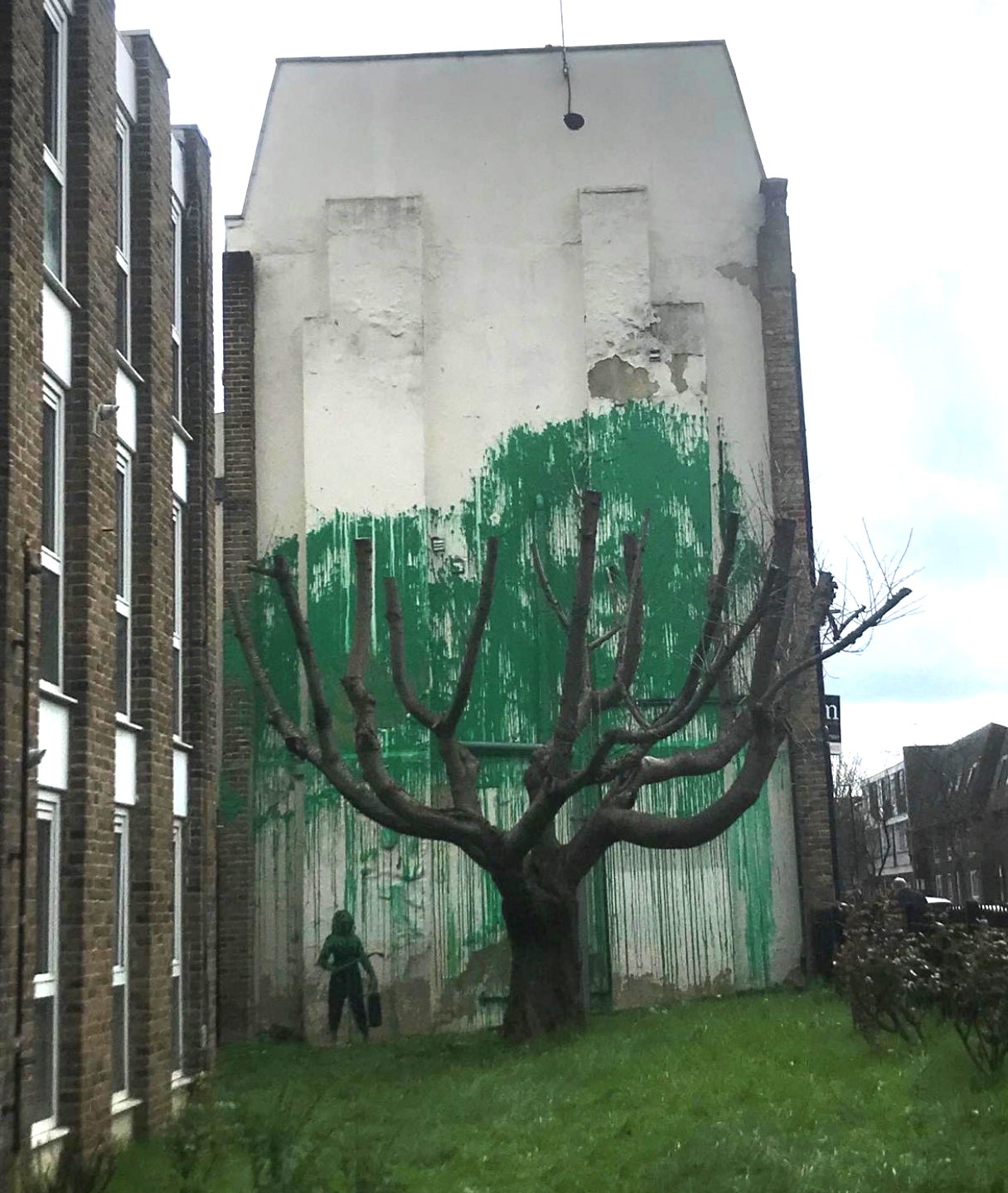
Art is there for the receiver to interpret, even if the artist provides the artwork with their own meaning. So we take liberties – rightly – with interpretations. So let us interpret this widely. This is a dual statement about the state of our urban trees and about climate change. Urban trees are under threat, just at a the time when we need them most. Our cities are getting hotter. Trees provide shade, for sure. But they also cool the air. Even diseased ones. So much urban landscape is devoid of trees. Devoid of ways of cooling and, increasingly, draining.
More broadly the onslaught against the planet’s forest ecosystems is relentless. The cutting and burning of the Amazon has slowed, but not stopped. Forests elsewhere in Indonesia and Africa are also in retreat. In Brazil particularly to provide land and feed for cattle. So not only do we lose carbon-capturing trees, we also increase our emissions through bovines, notorious methane producers. All because we want to eat large quantities of beef.
In response to Iozzi’s opening question about artists, I respond simply by saying, it is what artists do. It is why they are an essential part of the democratic process. Throughout history artists (not all, for sure) have made statements about society, power and morals. Degenerate art in Nazi Germany was degenerate for a reason. Artists have been subtle sometimes in their representations. Messages that eluded the censors because they were unable adequately to understand what they were actually looking at. Even Picasso, not known for his political statements, produced his masterpiece, Guernica, to say something to the perpetrators of the destruction of the Spanish town in 1937. Famously when asked by a Nazi Officer at his Paris studio whether he had “done” this painting, his reply was “no, you did this”.
To add value to the picture and to the metaphor, Islington Council put a protective fence around the work, but within 48 hours it had been defaced. I am pretty sure that Banksky was smiling. I rest my case.
Original picture source: https://twitter.com/IslingtonBC/status/1769722470355828821/photo/1
The Garrick Club
The Guardian’s recent exposé on the Garrick Club in London is troubling. It took a data breach for us to know who the club’s members are.

Not only is this a “gentlemen’s” club, it is also an elite club where state/government policies are discussed and made. As a man I do not have the resources to join and even if I did, I think it is unlikely that existing members would nominate me. I could at least try; but if I was female, it would be harder despite David Pannick KC’s best efforts to justify its existence. There is, argues Pannick, nothing in the language that bars women – even the word “gentleman” seemingly has a defence. Here is Pannick quoted in the Guardian article: “[t]he term ‘gentlemanly’ is plainly being used here in the sense of the meaning ‘[o]f a pastime, behaviour or thing’ that is ‘of high quality; excellent’”. I’m not about to buy that. It is not surprising that lawyers can offer such a defence as we discover that a large tranche of senior [read influential] figures in the profession are members. Many environmental campaigners, for example, have found themselves judged by them. And that raises bigger questions about the profession itself.
Picture: By Cambridge Law Faculty – https://www.youtube.com/watch?v=fxB59qEi6i0, CC BY 3.0, https://commons.wikimedia.org/w/index.php?curid=104993515
Fossil fascism
Filed under: Environment | Tags: Andreas Malm, climate change, climate change ad nationalism, Climate change denial, climate scepticism, Fossil Capital
Comments (1) 
When I came to write my textbook on business strategy in the age of climate change, it was not until I had read Andreas Malm’s book, Fossil Capital that I felt I had a proper foundation. Malm’s thesis was relatively simple: the mechanisation underpinning the industrial revolution did not need to be a fossil-driven revolution. Water would have done (I understand why that is contested). But, the capital owners saw a number of benefits (to them) of steam power (fuelled by coal). Many of the early mills in the North of England and Scotland required the owners not only to build factories, but also villages for employees (one example, Saltaire, West Yorkshire (right). Villages with schools, sports, places of worship, etc. These were expensive, they also promoted labour power. The steam engine was not geographically hidebound. The fuel could come to the factory rather than the other way around. More expensive, maybe, but the plutocrats no longer needed to provide housing and labour power was neutralised.
This realisation enabled me to frame my book in terms of the continued burning of fossil fuels as a choice. It did not need to be that way in the past, and it does not need to be that way in the future. We can have a zero carbon economy. We choose not to.

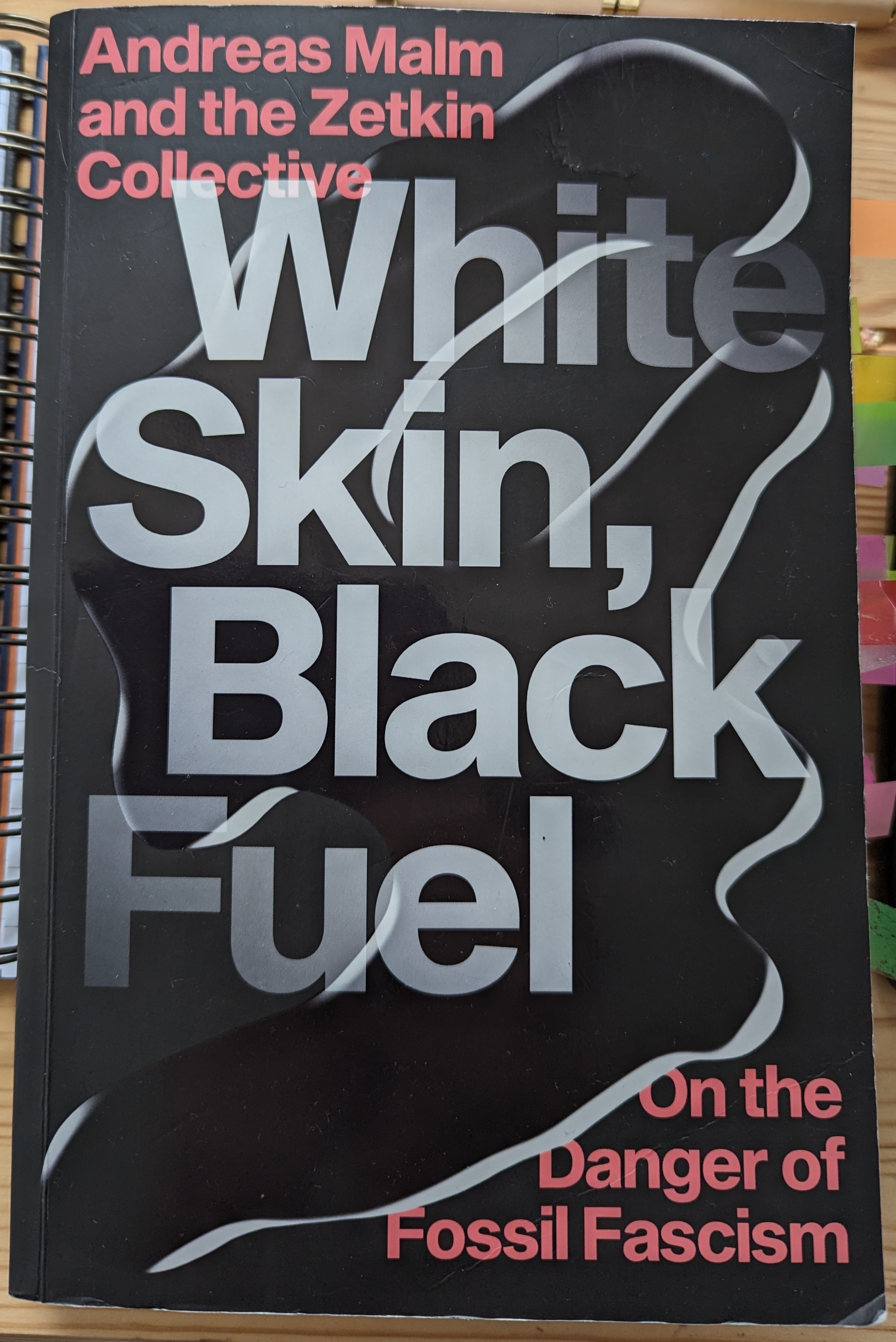
Many writers and thinkers may have stopped there, but Malm is driven. He followed that up with a book about climate and Covid and, controversially, enlightened us on how to blow up a pipeline. In between all of that, Malm, along with the Zetkin Collective, wrote an extraordinary book entitled White Skin, Black Fuel about the relationship between climate change denial/scepticism and fascism. It is like his earlier book, Fossil Capital rather sprawling. Readers need to persevere, it is easy to say that it is too difficult. Malm takes us through time and space locating as he does the origins of fascism, its contemporary manifestations (Europe, North America and South America) and, crucially, why fascism and climate scepticism/denialism are aligned.
Consider this (which I had not done before), why has no far-right party ever endorsed renewable energy? Indeed, why do far-right parties commit to dismantling renewable energy installations, particularly wind? Now this is only a small part of the book, but for me it is the most intriguing and the one that augments my own understanding of the challenges ahead – maybe not absolutely for my generation, but certainly for anyone under 50.
Malm’s plausible hypothesis rests on an understanding of ultra-nationalism (he takes close to 260 pages to tell us what that is). Let me stick with nationalism, the sense that the homeland and its authentic peoples should be prioritised over so-called invaders, immigrants, alien faiths and, basically, anyone with a dark skin. Not only prioritised, but cleansed. We see it in today’s politics. Fossil fuels, argues Malm, fit a nationalist narrative. The is “our” oil. It is independent and we use it for our own development and wellbeing. Of course, oil usually belongs to oil majors that trade it in global markets, so that argument is flawed, but it is surprisingly potent when it comes to electioneering/power grabbing. The sun and the wind cannot be appropriated in the same way even though it provides energy security that no fossil fuel can match (in terms of availability and price). I hear readers now asking, what about countries that do not have a store of fossil fuels in their territory, why are nationalists in those countries so opposed to renewables?
Malm is clear. Colonialism and whiteness! Particularly rich whiteness. For it is the rich off the back of colonial exploitation that have so much to lose from decarbonisation. Their assets are sunk – literally – in the ground. Their lifestyles are high carbon. They fly so much more than most of us, and often in their own planes. Carbon is so much a part of who they are that to decarbonise is to lose their very identity. And what is more, decarbonisation (for them, a Marxist plot) is to enforce an unfair (to them) equality. How else do we explain a global carbon budget that is shared between countries representing some element of fairness? For example, the USA and Europe (particularly the UK) have a tendency to deny historic emissions, and cannot countenance coming down to the level of developing countries. How fair is that?
Malm argues that such an approach by the right (not even the far-right) can be traced back to the fall of the Berlin Wall and the loss of a tangible enemy – communism – that imposed equality in places where it was the dominant ideology. (Arguably not, as the Soviet Leadership and acolytes seemed not to be too constrained in their consumption.) To prove the point, Earth Day (22 April) is the the birthday of Lenin – no coincidence. So, those proclaiming a climate crisis and the need for action became the new targets of the right. Denialism and then a rejection of mitigation (cutting carbon emissions) in favour of a West-friendly adaptation (the West/North is better able to cope with temperatures of 2, 3 and even 6 degrees of warming so much better than other less-developed regions). Malm is thinking about people like Jordan Peterson and William S Lind. The attacks on Greta Thunberg feature in the analysis, too. The picture of her wearing an antifascist “Allstars” t-shirt, for critics, was proof that she was both Antifa and in the pocket of George Soros.
There are some other interesting elements to this approach. Denialists do not present counter evidence (largely because there is none), rather they present their narrative over and over again. The more it is repeated, the more it is liked and re-tweeted, the truer it becomes. Repetition is key. Our media tend to allow them to repeat their lies at will and without challenge. With this in mind, argues Malm, if one can lie about climate change, anything can be successfully lied about. Despite the evidence to the contrary, the lies carry more currency. That is partly because white people, increasingly turning their territories into fortresses, will survive it longer than people of colour in vulnerable countries.
This is not the end of the book at all. The race discussion occupies the subsequent chapters. But just like Fossil Capital, perseverance pays off. The reader is rewarded with insights (you do not have to agree totally with them). Malm has plenty of critics. By goodness, though, he does a lot of heavy lifting for us.
 Be informed