Maybe in Australia
 Leave a Comment
So, it is now not possible in Australia to brand cigarettes. From today, cigarettes can only be sold in packs that are olive 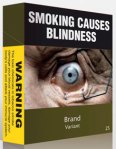 green in colour and depict images of the consequences of smoking; for example, blindness (see right). The industry has, of course, objected to this – even at one point claiming that it was an infringement of trading law. Essentially the argument goes that states cannot restrict firms from using their brands. The role of the state is to maintain fairness in trading, not restrict it.
In going to law, the tobacco industry lost the case. In response the industry then claimed that the new rules would draw in counterfeiters, particularly from Asia. This is a nice but flawed relativist argument. By definition, counterfeited products are potentially more dangerous – brand owners, even cigarette brand owners – do not try to poison consumers in any acute sense (over time, they knowingly do so). But there is no safe level of cigarette consumption. And the explicit aim of the Australian government is to stop people from smoking. One has to assume that the Australian government does have a contingency for the counterfeiters.
Good on the Australian government.
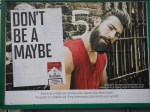 By way of contrast, cigarette advertising – brand promotion – goes on in every German high street. Today I shot the latest in the ongoing Marlboro ‘Don’t be a Maybe’ campaign (left). The campaign requires some insider knowledge fully to understand. The notion of being a ‘maybe’ is not clear from any one poster, but I have seen the associated video in shops; chilling in their association with glamour and success. Indeed, the campaign has been criticised and deemed to be in breach of the law. Cigarette companies cannot target young people in advertising. Frankly, most of the brands glamorise smoking for young people (see elsewhere in this blog copious examples, particularly Pall Mall). I think it needs to be turned around. ‘Don’t be a maybe cancer sufferer’?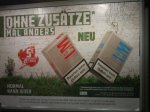
L&M have a new poster for the run up to Christmas (right). There is no glamorisation of smoking as the brand pursues its additive free nature. Different and a standard, if my translation is correct.
Women Bishops
 So, the Church of England has voted against the ordination of women bishops at its General Synod on 21 November 2012. How progressive is that? What is particularly troubling is the number of women in the laity who have argued for their own subservience on this issue. It turns out that half of those voting against were women associated with the conservative evangelical group Reform or the traditional Anglo-Catholic movement, Forward in Faith (surely wrongly named?).
I am inclined, however, to call for the expedition of the removal of bishops from the House of Lords on the grounds that they represent an organisation with strict discriminatory policies; namely, that women cannot actually get to the top on the basis of some bizarre reading of stories that may or may not be true and of dubious authenticity. Equally – and for not dissimilar reasons – it is time to disestablish.
Or maybe on the grounds that a belief in the supernatural should not be rewarded with a seat in Parliament.
The Rhine Route by tandem – the experience (5)
 Worms is one of Germany’s most historic towns. It claims to be the country’s oldest city. But it is mostly associated with Martin Luther’s hereticism through the Edict of Worms. BBC Radio 4 had Worms as the topic of In Our Time in 2006. The podcast is still available http://www.bbc.co.uk/programmes/p0038x8z
The Cathedral dates from the 12th Century. It has four round towers (see left) and is dark inside due to the red sandstone. It has to compete, however, with both Koeln and nearby Speyer (right) over grandeur.
The ride by this time was becoming a little harder. We had had no rest days; though Worms provided us with our first hotel of the tour – and a bed. We decided that we would have a day off and visit Strasbourg. A campsite 20 km north of the city was our target. Gambsheim in France had a large municipal campsite with a railway station convenient for getting into Strasbourg. So we thought. In total the day was 100 km. The ride is not the prettiest at this point as the river is significantly banked and the cycle track is behind the bank. Hence there is no view.
We stopped at a small restaurant nestling in a wood 100m or so from the cycle track. The owners had no german or english, but we did negotiate some food and beer suitable for supplying the energy for the final 20 or so kilometers to Gambsheim. A bit spooky, and goodness knows what the business model is, but welcome nonetheless.
Arriving at Gambsheim in the twilight was not the best. The campsite reception was well and truly closed and all facilities locked, but there was an event going on involving some French-German goodwill with games and music. And beer. Albeit 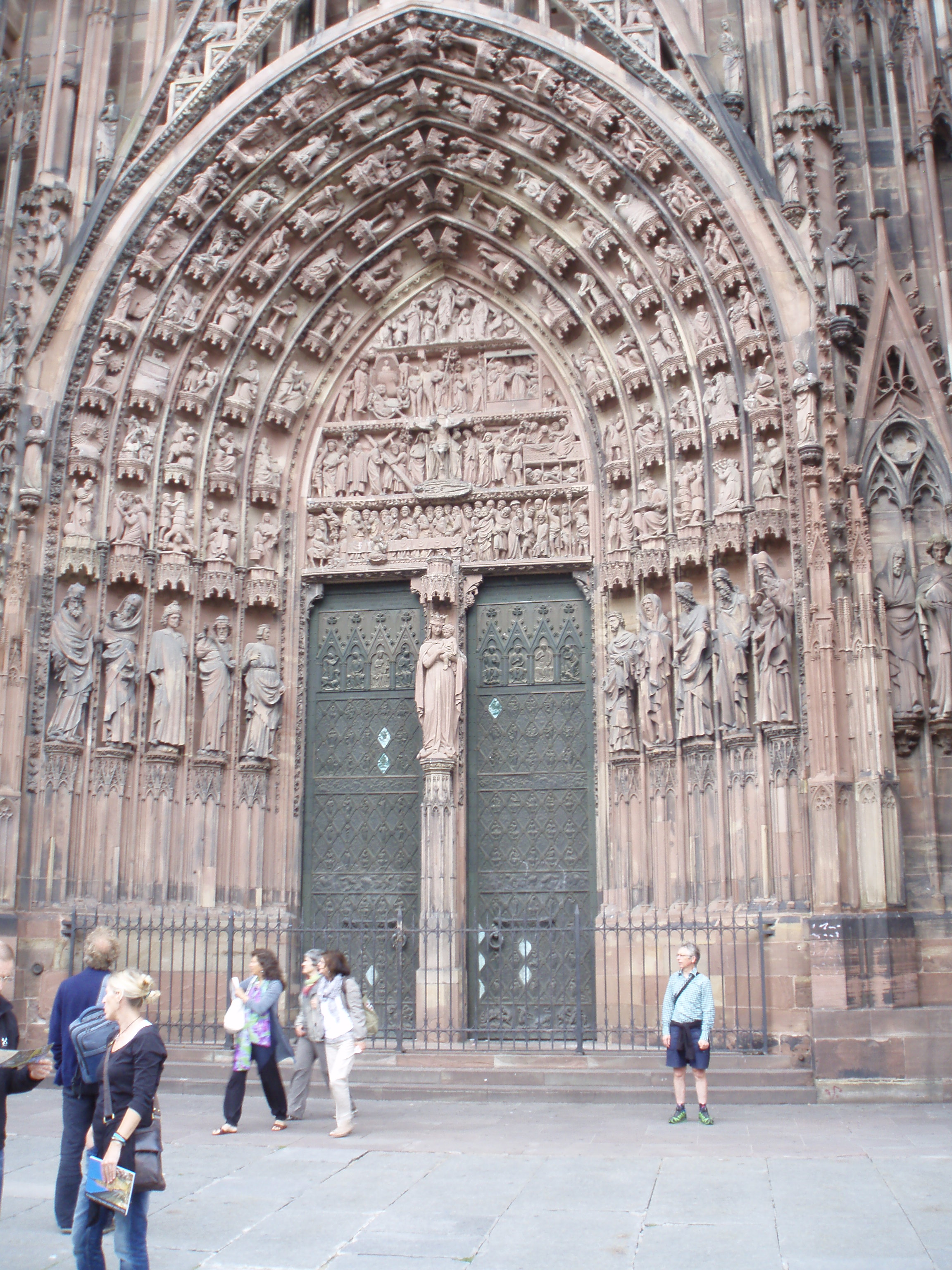 sweet. The night presented a most spectacular lightening storm that was to introduce much wetter and cooler weather for the final push to Basel. The tent held out.
Trains to Strasbourg were roughly hourly, but sometimes buses. The French – even when they are located so close to the border – do not concede to other languages, particularly English. The ticket machine needed some knowledge of French in order to negotiate its system; and one needs to be able to anticipate the bus rather than the train. Suffice to say, we missed the bus necessistating another 70-minute wait.
Strasbourg’s cathedral is most impressive – the door (above, left) is representative. Inside there are many treasures and some anomolies. For example, an atomic clock that would be more suited to a museum. The hourly performance does keep people hanging around in anticipation. 
Strasbourg is more than its cathedral, however. It is a fine city in which just to wander and explore. The architecture is stunning. The small streets are a treat. We treated ourselves to one museum – the Tomi Ungerer museum. Ungerer is a famous – infamous even – illustrator of children’s books and advertising materials as well as a satirist.
The Rhine Route by tandem – the experience (4)
 Remagen in the direction of Koblenz travelling south is one of those notorious places – the bridge across the Rhine was destroyed in the war and never replaced. The pillars remain with the flags of theUSA, Germany and the European Union. It is a chilling place.
It is also an excellent part of the route – the surface is concrete and flat. It is shared with pedestrians and can be a shade busy at the weekend. But good progress can be made. And so it was that we made it to Koblenz for an overnight stay. The junction of the Mosel and the Rhine is busy with shipping and a shade restricting (no accessible bridges). The statue at the Deutsches Eck is that of Emperor Wilhelm I dating from 1897. It is  imposing and celebrates the (re)unification of Germany after three wars. The picture (right, sourced from the US Library of Congress through Wikipedia) dates back to 1900. Though it was destroyed in 1945, it has always represented a desire and a will for unification. After the fall of the Berlin Wall the names of the Laender making up the federal republic were again inscribed.
 Onward south we headed to Loreley (Sankt Goar), a picturesque section of the river. And uniquely dangerous for shipping due to its limited width and currents. There is an inscrutable traffic light system allowing only one way movement. According to myth, Loreley used to sing hauntingly from the rock bewitching sailors to their deaths.
The weather had changed since Koeln, the day before. No longer did we have to contend with heat and sun. Summer rain forces the compromise between waterproofs (getting too hot and by definition wet from the inside) and just getting wet and letting the cycling clothes do their ‘wicking’ duties. It is as it is – imperfect. It is partly why we do the outdoors.
We took another ferry across the river from Bingen to Rhuedesheim am Rhein largely to be on the correct side of the river for the campsite in Wiesbaden. But these are two places that seem to face off to one another. From a tourist’s perspective, they both do the same thing – provide food, drink, hotels and promenades. There is a lot of facing off on this river. Castles do the same along this stretch. Where there is one castle, you can be sure that there is another. Each with their dynastic and family histories.
The river is very tempting for a swim. There are many secluded spots with beaches – particularly in the section Mainz to Worms. Care is needed, however. This river claims many lives each year. The currents are serious. There is one further hazard. Whilst one may feel in a secluded spot viewed from the bank, that may not be the case from the river. Barges are one thing, but very large cruisers are quite another especially when one has travelled without a swimming costume.
You’ve been Trumped
 I’ve just watched this documentary in amazement. The corruption story is contemptible. Trump is building a golf resort on the East Coast of Scotland south of Aberdeen. Planning permission was originally rejected by the council – not least because the plan involved the destruction of a unique habitat with SSI (site of special scientific interest) status. The decision was called in by the Scottish Government, led by Alex Salmond, and overturned.
However, there are good people in Trump’s way. Local people whose houses, for Trump, are unwelcome features in the landscape. It is the story of how they have resisted and how the forces of the state have facilitated Trump against the locals. There is an extraordinary scene where the police manhandle the amiable journalist, handcuff him, and bundle him off to the police station in Aberdeen. But that is nothing against the despicable acts being perpetrated against the locals. Their water was cut off and not restored. There is footage of the electricity supply being cut by a digger; and the locals being billed for fences that they did not ask for or need.
Please watch.
Bigot of the year
 Stonewall, the gay rights campaigning group, it seems, risks losing valuable sponsorship from Barclays and Coutts banks. The two banks have threated to withdraw support if Stonewall runs its bigot of the year award again in 2013. Both banks are concerned about being associated with the award after it was given to Cardinal Keith O’Brien, the head of the Roman Catholic Church in Scotland at its annual ceremony last week. A deserved winner. Notwithstanding the bigotry, any award that two ethically-challenged banks struggle with must be hitting the mark.
O’Brien won decisively, reported the Guardian newspaper, “after describing gay marriage as a ‘grotesque subversion’ of the traditions of marriage and likened it to slavery. The cardinal called it an ‘aberration’ and claimed it might clear the way for polygamous marriages and would cause ‘further degeneration of society into immorality’.
That strikes me as being spoken by a true bigot. Pure folly as well.
http://www.guardian.co.uk/world/2012/nov/02/stonewall-unrepentant-cardinal-bigot-award?INTCMP=SRCH
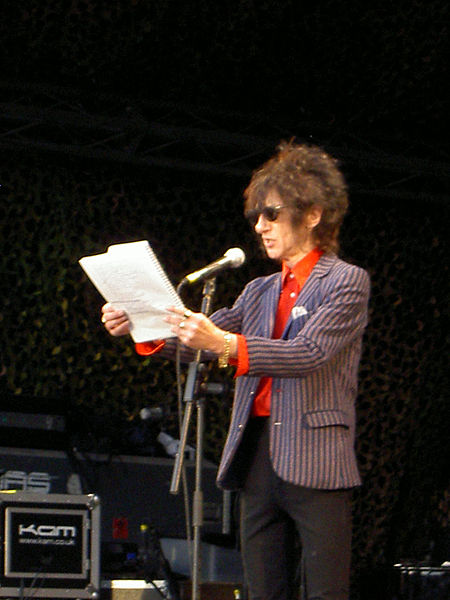
John Cooper Clarke plays Brighton Dome, Review
 Thursday 1 November, 2012, some 34 years since my first exposure to the Bard of Salford through his album Disguise in Love, there he was in front of me. The Dome really is not the place to see him, but my countless previous attempts at seeing him at smaller venues always ended in disappointment. I was never quick enough to get tickets.
If you want to hear his poems, this is not the tour for that. The poems support a programme of observation on modern life, politics, sex and, particularly, mortality. His reflections on Alzheimer’s Disease are acute. There are at least two good things about it. First, suffers just keep on meeting new people. Second, they forget what comes next. His apparent dislike of Terry Pratchett – or at least position on assisted suicide – pervades the whole show. “I did a gig recently in Switzerland but made sure I had a return ticket”. Terry Pratchett wants to be able to die before he becomes a “bumbling vegetable”, apparently. For JCC, that is the present state, far too premature.
We had ten minutes on why he endorsed Domino’s Pizzas (normally he only endorses products that he can get right behind like yacht makers). Skillfully he linked the concept of pizza to the another disease, Swine Flu. “It’s the only nourishing meal that can be slipped under the door”.
Source: flickr_newbie, Wikipedia
Another ten minutes were devoted to the rebranding of venereal disease (as it used to be). He told how VD was rebranded as sexually transmitted disease after a jolly by stakeholders in a sunny climate only to realise when they got home and had replaced all of the stationery that it is the ‘D’ that is the problem. Disease. Another jolly was organised, this time on the Isle of Man (no man in an island, goes the quote, but the Isle of Man shows this to be untrue), to come up with STIs – sexually transmitted infections.
So which poems did we get? Beasley Street, of course, with its 30 year revision, Beasley Boulevard. Also from the back catalogue his favourite poem – though it is so only because it is connected to his swear box which is the source of his pension – Evidently Chickentown. He made a poem out of an imaginery guest list. We got I fell in Love with my Wife as an encore – one of those wonderfully romantic pieces that never fail to warm.
JCC is a consummate performer. So engaging. He gives the impression that he is chaotic – shambolic even – but this is a slick programme. Certainly he could have gone on beyond the 90 minutes that he was allocated. He had to deal effectively with a lone heckler.
Just brilliant.
The Rhine Route by tandem – the experience (3)
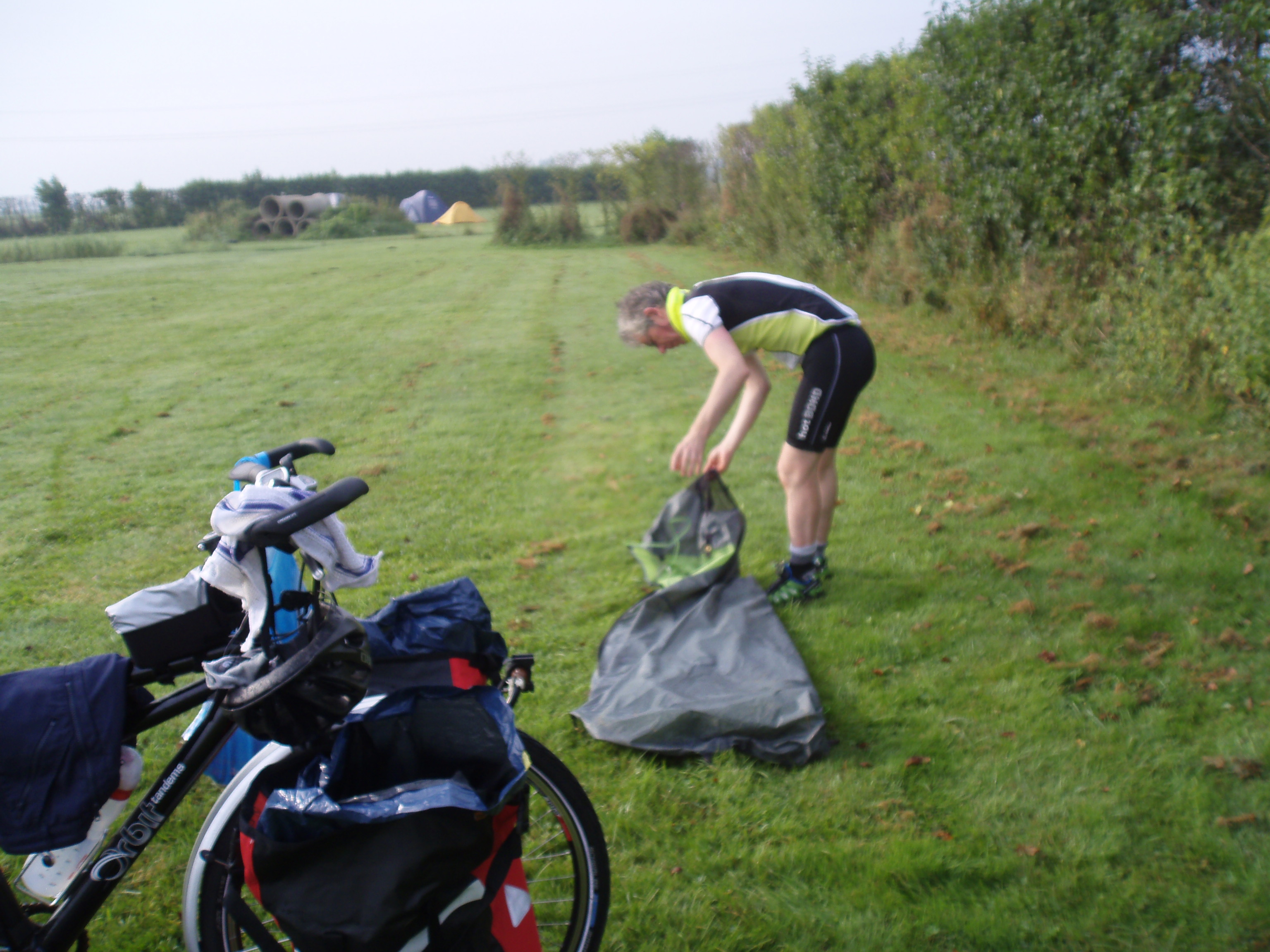 Through Utrecht, the landscape becomes a shade lonely. We stopped at Bunnik, a small town to the east of Utrecht; the campsite (left) was a good metaphor for the area. Getting to the campsite involved scaling a daunting bridge over the railway with the loaded tandem (see below right). Although there is a ridge for the bicycle’s wheels, the weight and length of the tandem made it a challenge.
A very pleasant 20 kilometers further one encounters Rhenen where the river becomes more familiar – it is navigable and the barges ply their trade. We bought some food at a nearby deli and took it to the river to eat – it was also an opportunity to dry the tent (which can be seen in the foreground of the picture, left).  The Rhine path, however, remains sporadic, with frequent detours that, in some cases, take cyclists some distance away from the banks.
The Rhine features are sometimes other-worldly, or at least other timely (see below right). The features that facilitate the management of the river, its flows and direction, are many and interesting subjects. The feature below right is to the west of Arnhem approached here on the south bank  which we selected in order to avoid the centre of Arnhem at peak time (a bit of learning from our experience in Utrecht – albeit with the consequence of not seeing the city itself). It is a lonely approach and is the precursor to a lot of loneliness punctuated by many seemingly lost villages.
The long night of museums, Munich
Each year – for one Saturday evening – the museums in Munich stay open late. For 15 Euros one can purchase a ticket that gets access to the majority of museums and galleries in the city and ‘free’ travel on the buses that visit the museums split into four groups – Central, West, Schwarbing and East.
 This year – 2012 – we decided to join in. There is a certain serendipity as to where one ends up. Having tried the Max Planck Institute, we opted for the Schwarbing bus and the BMW museum. My first time.
This museum is pure marketing – or propaganda. With that in mind it can be enjoyed. The building clearly borrows from the Guggenheim in New York in its bulbous appearance and interior walkways. The artefacts inside are immaculate. These range from cars, motorbikes, engines, film footage and marketing/advertising materials.
Whilst the museum says little about the company’s history in terms of its Nazi affiliations, some of the film footage of racing success in the 1930s cooly displays the Nazi symbols and sentiments of the time.
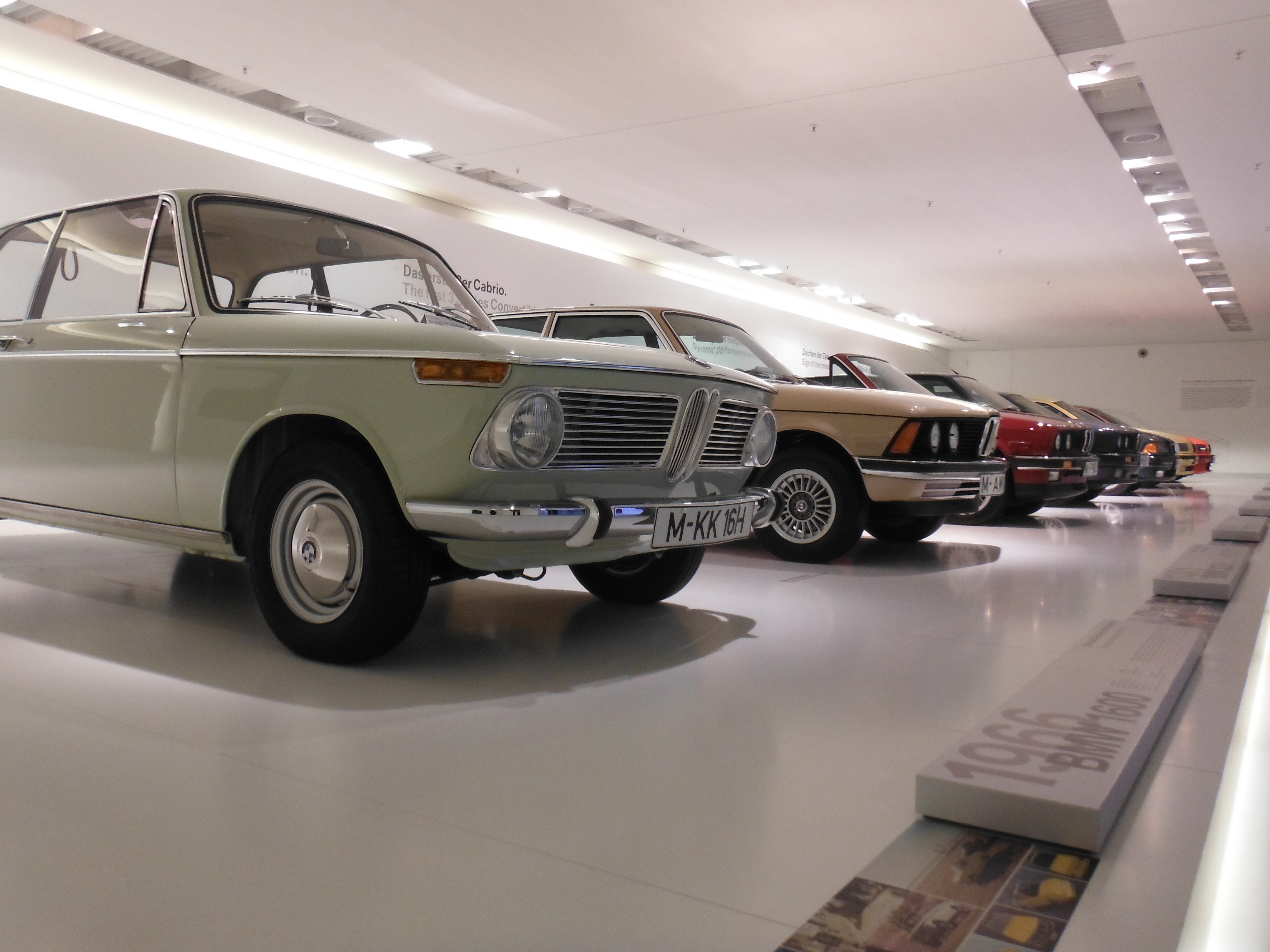
Modern era
The museum does not try to over display. There are some fine examples of vehicles, but the displays are not exhaustive. The room on the left is a good example of the museum’s approach. It is almost a case of the designers believing – probably rightly – that the exhibits speak for themselves. They are instantly recognisable – distinctive. Unmistakably BMW.
However, some of the vehicles seem out of line – though a BMW narrative is wrapped around their 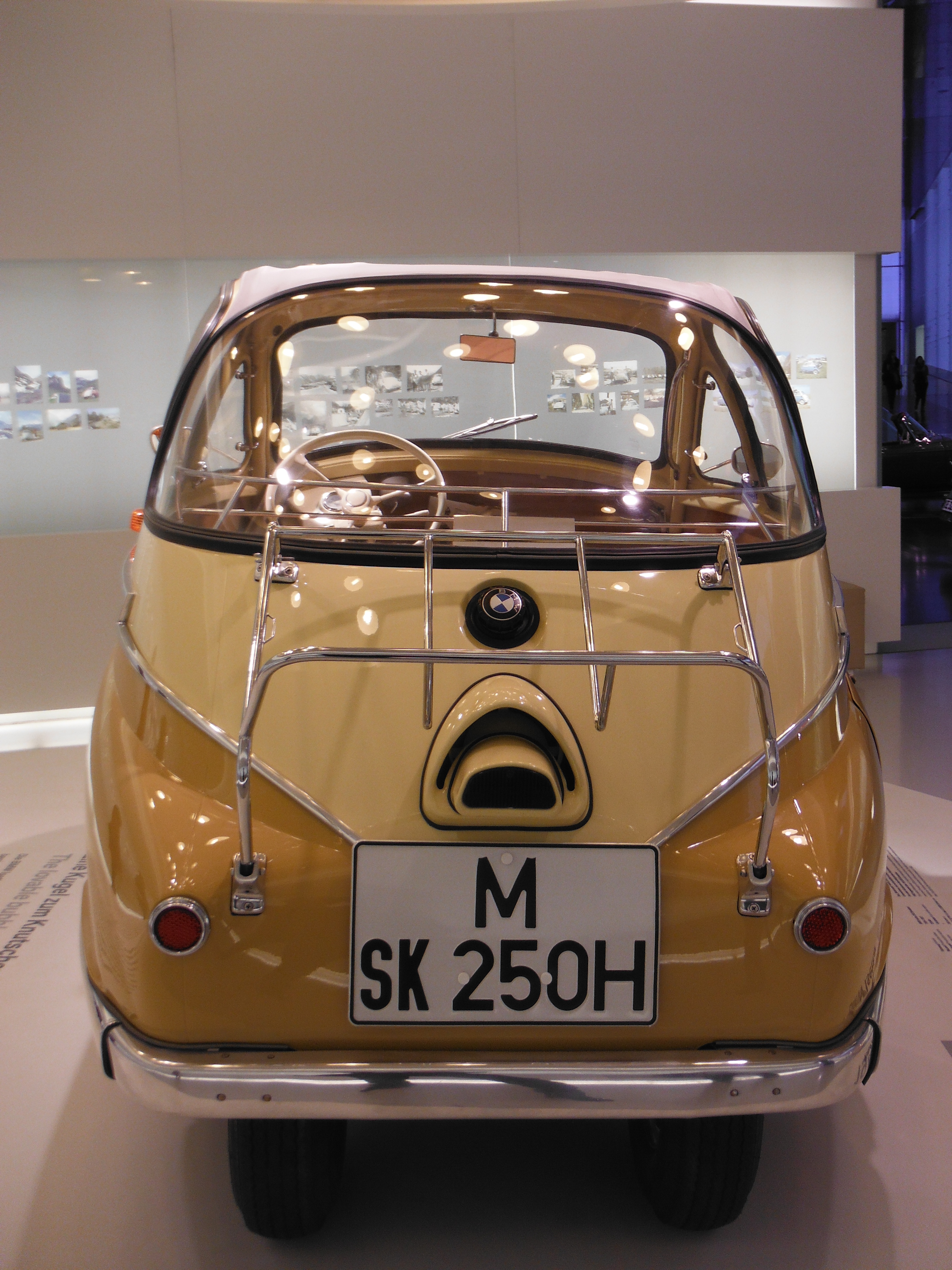 inclusion. For example, the Isetta bubble car. Far away is this vehicle from the high performance BMW products that preceded and succeeded it. Manufactured under licence from the Italian firm, Iso, which also designed and manufacturered refridgerators (see http://en.wikipedia.org/wiki/Isetta), the Isetta apparently buffered the company against hard times in the 1950s. The gallery’s walls are decorated with splendid period photographs of the German public taking their Isettas to places they presumably were not designed for; for example, the Alps. Television advertising footage is also to be seen.
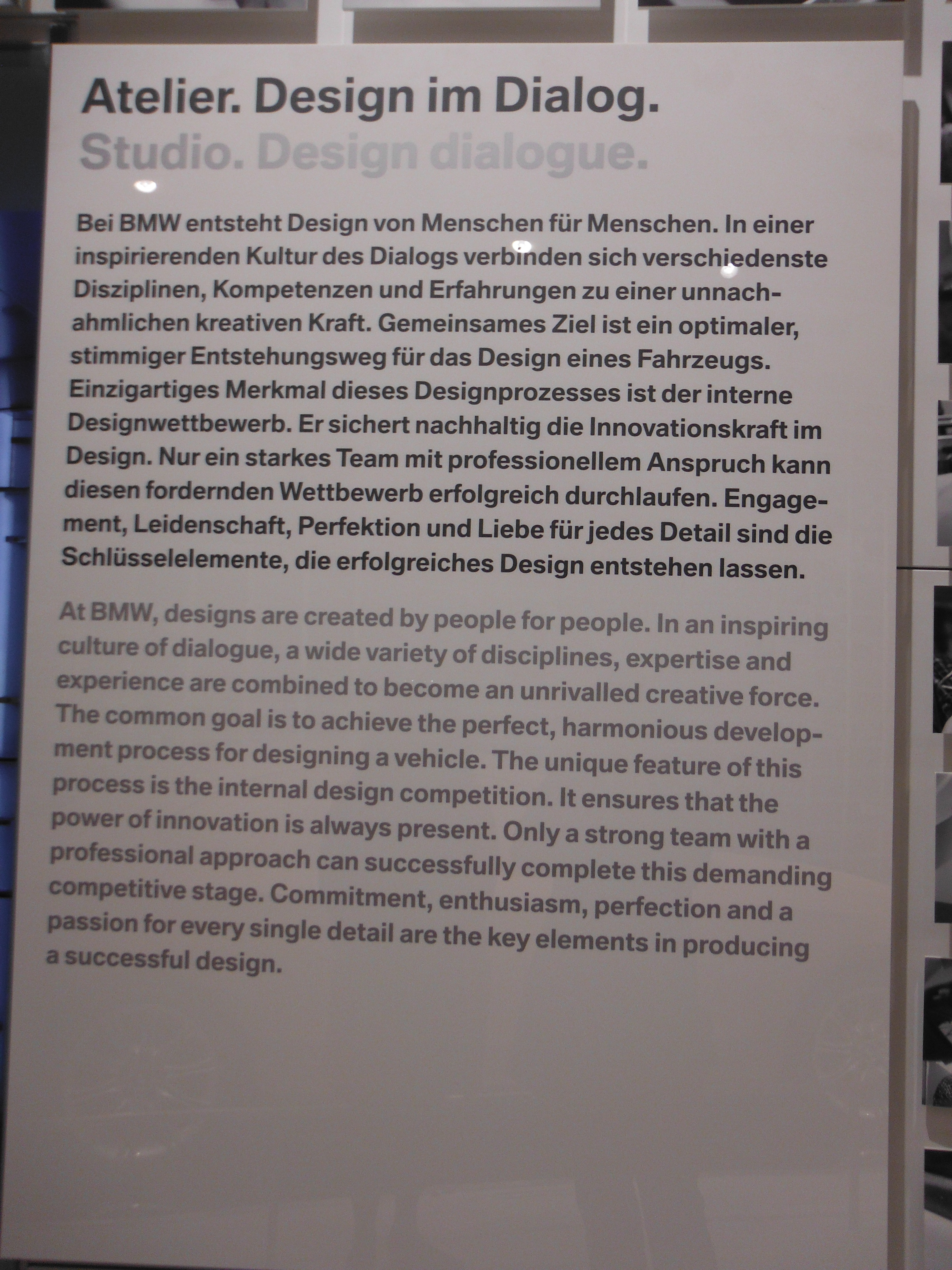 The museum goes to great lengths, however, to spell out its design philosophy. They heap it on, just in case it was missed. The panel on the left is typical – written in German and English, the design philosophy is spelled out – ‘power of innovation’; ‘strong team’, ‘professional approach’ and ‘perfection’ are used to capture its essence. There are also many references to emotion engendered by careful selection and use of materials and colour in the interior.
The museum is only one part of the complex that constitutes what one might call the BMW quarter of the city. Opposite is BMW Welt – housed in a post-modern building that successfully conveys power, influence and intent.
The bendy Daimler bus took us swiftly back into the city. BMW never got into buses, oddly. The S-Bahn had a signal failure. Being stuck in a crammed stationary train for 30 minutes in the early morning brought us back to reality.
Using the B word
Bigots. Nick Clegg nearly used the word – but pulled back when he was challenged by the former Arch Bishop of Canterbury, George Carey, amongst others. Now I use it in connection with the case of Michael Black and John Morgan who won their case against the bigotted Christian Bed and Breakfast owner, Susanne Wilkinson, who refused them a room.
Backed by the Christian Legal Centre, Susanne Wilkinson spuriously defended her bigotry. But now we learn that it was not their homosexuality that was the issue, but rather that they were not married. Jonathan Overrend on Radio 5 Live on Thursday evening (18 October) failed to follow through on that. It is laughable to suggest that any hotel – even her unwelcoming microbusiness – would contemplate turning away a heterosexual couple in a similar situation. And what’s more, if such is true and Susanne Wilkinson’s wish, she really does have to ask if she is in the right business.
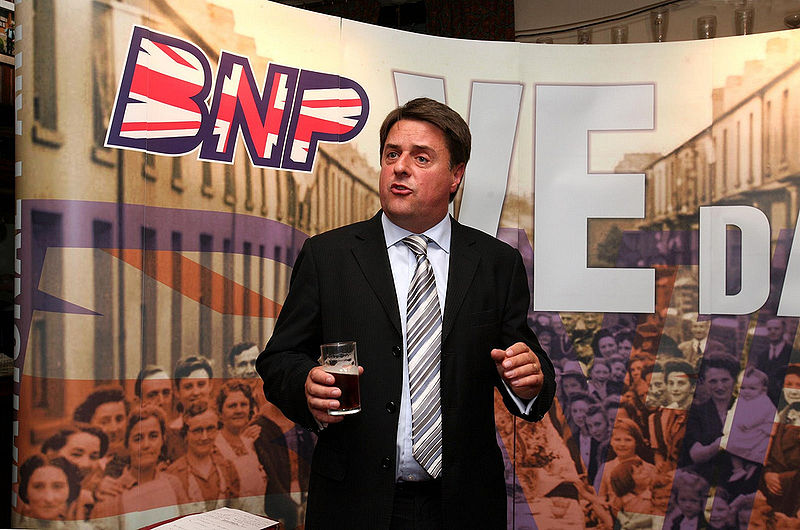
I trust she has a reservation taken for Nick Griffin?
 Be informed