Banana case
 Leave a Comment
Originally posted 2 August 2010: Here’s a little innovation for you from Sainsbury’s. Those of you li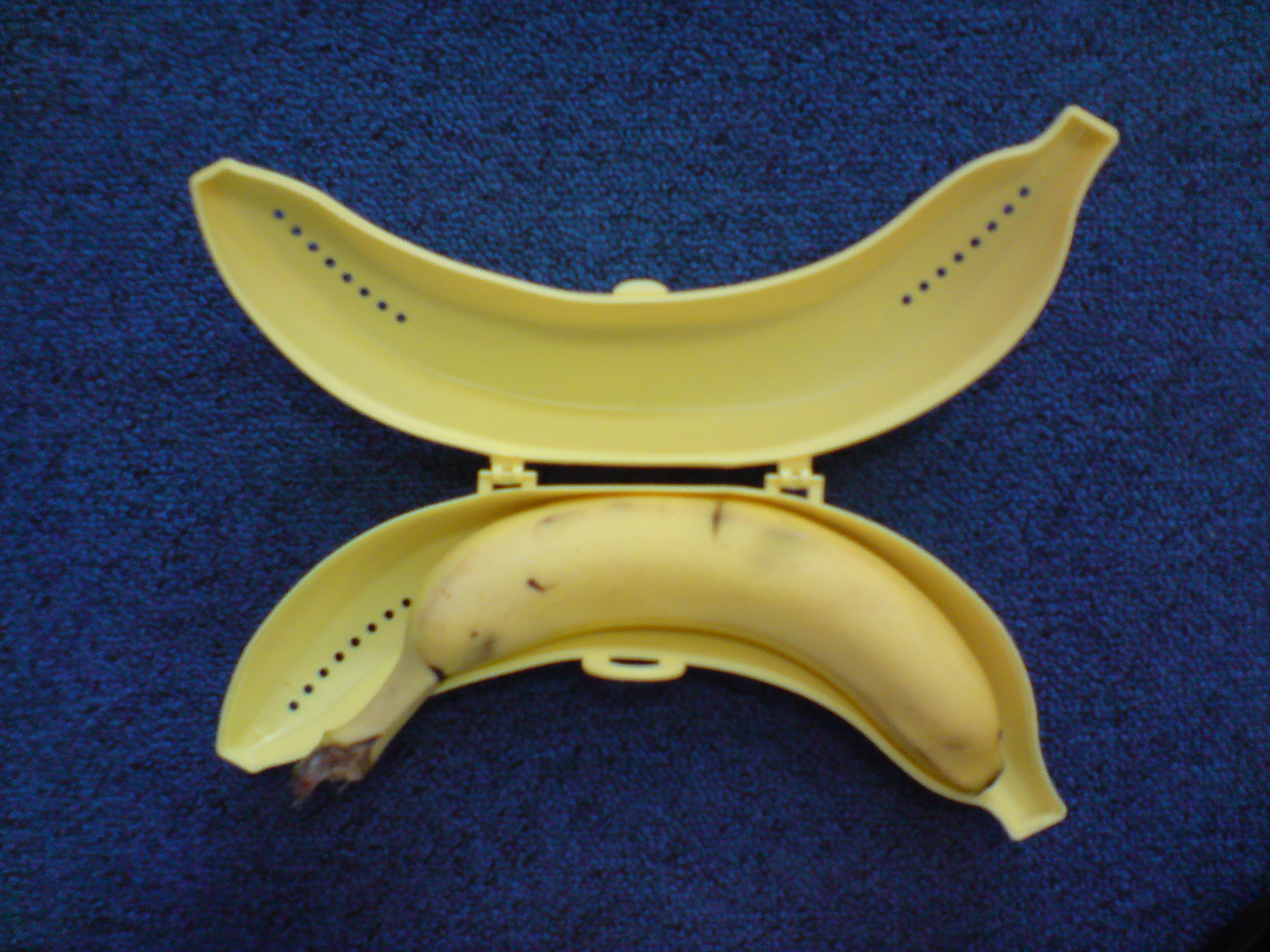 ke me who carry bananas around know only too well that they are prone to damage in one’s bag. The solution, a protective case in the shape of a banana!
However, the designers may not quite have got the curvature right. For my organic banana this morning, I found the curvature insufficient. This meant that I had to squeeze it in to the case. Consequently, when I retrieved it this morning after a typically strong cup of coffee, it was as bruised as if I had carried it uprotected in my pannier bag. On what basis did the designers decide on their average curvature?
Time now for a bit of a rant: easyJet! The route between Gatwick and Munich is troublesome. It is never on time, but now even worse it is prone to cancellation. Now there is another little trick. Instead of cancelling the flight, they ‘postpone’ it to the following morning. Actually, they put on a completely new plane – unscheduled – which one has to take even if it is no longer convenient. Normally, if they cancel the flight, one can make a no-cost transfer to a flight of choice that reflects one’s changed circumstances. What’s more, because the flight is not on the system, they force passengers to check in manually. I waited 2 hours to check in earlier this week, even though I only had cabin baggage. What was Michael O’Leary saying about easyJet’s performance recently? Suffice to say, easyJet, my next journey will by by rail.
Workbench
I’ve been doing quite a bit of DIY in the last few days in Germ any. In executing my tasks, I have been to a number of Baumärkte to buy materials and tools. What I found particularly interesting is the origin of many of the tools on sale. In my experience, in the UK, many tools and materials are sourced from far-away places. For example, I recently purchased a workbench that was made in China. I expected the same to be true of German retail. In fact, the domestic sourcing in the German Baumärkte is extraordinary. This bench is a German brand made in Germany. The price was comparable; it was easier to assemble than my UK equivalent.
The extent to which this is a phenomenon of building materials and tools I am unsure. Further research is required. For example, kitchen equipment (I know that there are some high-end UK manufacturers making toasters, for example).
Mailbox
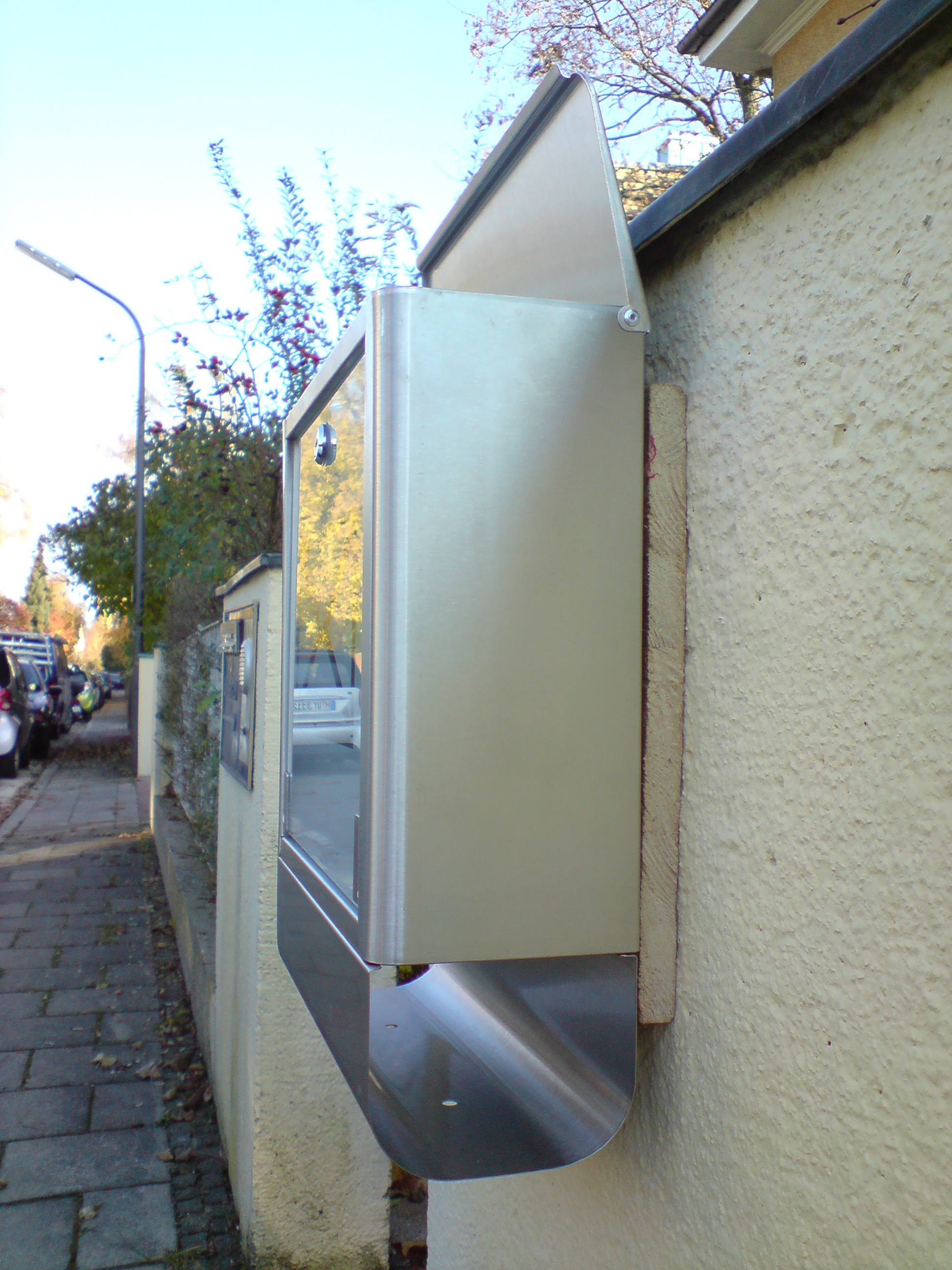 This is my latest handiwork – a mailbox attached to a wall (designed by Portferm of Mannheim, Germany). It may look simple, but it has a serious design flaw for which I have no explanation. It is designed, from what I can see, to sit flat against a wall. Do so, and the top cannot be opened, something that is required for the post person to insert the mail.
The solution, of course, is to mount it on wood. A little less elegant, I feel. But it works.
Berlin: Railway station and airport

The building of Hauptbahnhof in Berlin was a real prestige project. The glass building over four floors that emerged is impressive to say the least. But it suffers from that most irritating of modern construction diseases, shopping mallism. Instead of left luggage, there are places to buy stuff. Actually, the shortage of left luggage space is excused on the grounds of security as the station is in the proximity to the Bundestag and the Kanzlerresidenz. (There are a few lockers located adjaceent to the parking area, and a staffed facility on the main concourse – but when I visited, the queue was very long). Contrast with Köln Hauptbahnhof, posted 6 November 2011.
Travel advice: if you have cases that you want to leave, go somewhere else. I’m not sure if the other stations – Ostbahnhof, Friedrichstrasse or Alexanderplatz – have left luggage facilities. Watch this space.
As for Shoenefeld Airport, it is a real disaster. Very few seats, plenty of shops, though few places to buy a drink and sit down and relax prior to departure. If you are travelling easyJet, the ground staff are very strict with the one bag policy. Expect to be surcharged if you can’t get your manbag inside your case and it still fit into the measuring frame that they have.
The entry to the gates is appalling. Dank corridors take passengers to passport control causing confusion and long queues. Maybe worth taking Lufthansa from Tegel.
Bob Dylan and the O2 World, Berlin
 It cost 90 Euros for what looked like a good seat in the O2 World in Berlin (29 October 2011). Okay, I didn’t expect too much of a view, but I did expect a large screen to help me to see the man on stage. Actually, he and his band arrived on stage all dressed alike. It took us two songs finally to identify him. Not once did he address us as an audience; nor did we get an encore.
Okay, I’m not a great fan of Bob Dylan, but I was prepared to try. His band were excellent. However, was it a state of the art venue with pristine sound quality? No. Wretched. I couldn’t hear a thing from Bob Dylan or his support act, Mark Knopfler. Great venue if if you want to get mugged; in addition to the ticket, a bottle of Becks will set you back 4 Euros. Dreadful place. Dreadful gig.
Not all agree with me, of course. Here is a link to a review of an earlier concert with this set that may be fairer than mine: http://rockandrollmojo.blogspot.com/2011/04/bob-dylan-concert-review.html
Richard Dawkins and the empty chair
Richard Dawkins has declined an invitation (25 October 2011) to debate his book, The God Delusion, with William Lane Craig, 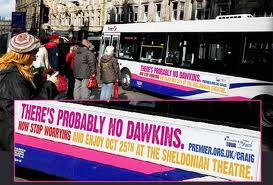 despite the abuse that has come his way in recent weeks. At the top of this abuse list is bus advertising in Oxford (see left). This is, of course, a play on his own advertising claiming ‘There probably is no God. Now stop worrying and enjoy your life’, that got the God botherers particularly worked up.
As Dawkins point out in in a riposte in the Guardian newspaper on Friday (here) the issue is not about debating the book but more to do with Craig’s literal translation of the Old Testament that commits him to defend genocide (of the Canannites in Deuteronomy 20: 15-17) and the goodness associated with the death of children (God is doing them a favour). The latter potentially leads us in a recent example, to be thankful that two vehicles ran over the little girl in China as she has most certainly gone to a better place and it was God’s will (see, for example, Huffingtonpost).
There are plenty of Dawkins provocations on the internet and in the press. Another Oxford Don, Daniel Came (who appears at the debate), writing in the Guardian, has accused Dawkins of cynicism and anti-intellectualism. Let’s get this clear, Dawkins is a scientist. This God bit is not his life’s raison d’etre; despite that, nobody advocates atheism better. Life really is too short to debate with Craig. Just look at the review to see how true that is: see oxfordstudent
Brighton and HA v Hull City at the Amex Stadium
It is a while since I last went to a football match. Getting to Hull is not that convenient, but BHA’s promotion to the Championship presented an opportunity to see Hull City away. Tickets £24 and a scarf for a tenner, we were in business as bona fide away supporters (there is no point in being in the opposition’s side – it is just not possible truly to ‘support’ as I have found out to my peril).
Bearing in mind this is the Championship and not Premier League, it was a bit scappy. Fortunately, it was BHA that provided the majority of the scappiness, particularly in the first half. We contributed to the scrappiness in the second half, but only after countless attempts on goal thwarted either by the goalkeeper or the woodwork. The shots off target shouldn’t have been. 0-0.
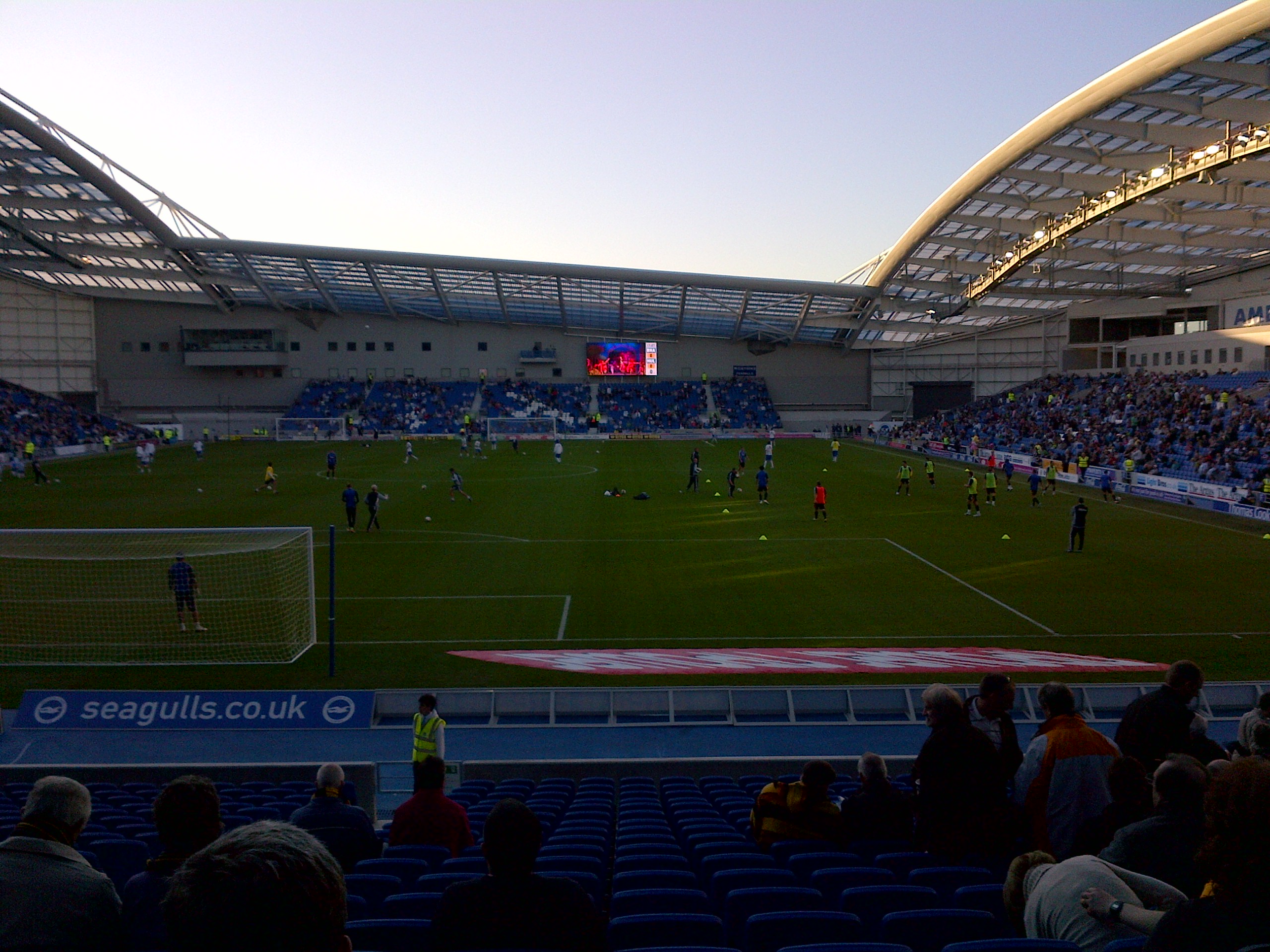 The experience was great. The Amex is modern and confortable (the seats are actually padded). But more importantly, witnessing a match demonstrates in my mind just how futile and silly is the game. Mostly I consume football on the radio or on big screens in pubs and bars. There, commentators and summarisers take it all so seriously. One forgets that it is really only 22 men kicking a ball around for 90 minutes. It is a hoot of a game. A great afternoon out. Would recommend.
Housing and rents
A shelter report reveals that rents are now too dear for ordinary families. What does too dear mean and why is it so? The Guardian newspaper reported that: “The Shelter Rent Watch found that average private rents were unaffordable for  ordinary working families in 55% of local authorities in England. Typical rents charged by private landlords were more than a third of median take-home pay, the widely accepted measure of affordability.” A key indicator of this in the Shelter report is that households are now cutting down on food in order to transfer money to rents.
http://england.shelter.org.uk/news/october_2011/rental_market_in_crisis
Presumably demand is high because people are unable to afford to buy and/or cannot get affordable social housing? Demand causes price escalation for ‘customers’ who cannot afford the price but pay because housing is an essential. This is made worse by controls on housing benefit recently introduced, a fact which unscrupulous landlords appear not to be responding to. Ironically families are being forced to uproot AWAY from work and family in order to afford housing.
Making money out of exploiting others through rents is obscene. Rent caps – or fair rent controls are surely appropriate?
The Government’s intention to launch another round of ‘right to buy’ for Council or Housing Association tenants is nonsense. This was recently announced by David Willets on the Today Programme. Though I note that even Ed Miliband admitted in his conference speech that the ‘right to buy’ under Thatcher was a good idea. Blue Labour as it is now called.
Marie Jahoda Lecture, 2011
This annual keynote lecture is usually in my diary. This year the speaker was Professor Luc Soete of the United Nations University- Maastricht. In a previous life, Professor Soete had worked extensively with colleagues at SPRU, University of Sussex (with which my research group shares a building).

Professor Luc Soete
It was an extremely interesting lecture; indeed, I was not expecting it to be so. Professor Soete is an economist. His thesis was unexpected. Essentially he turned on its head Schumpeter’s notion of Creative Destruction whereby economies and humanity move forward, sometimes by the destruction of the old – whether it be products or modes of production. Professor Soete posited the idea that perhaps not all innovation was good (a bizarrely accepted phenomenon). So what we were presented with, alternatively, was Destructive Creation. Professor Soete focussed on the financial crisis, but equally, this destruction is taking place in the public sector with any number of services being destroyed by cherry picking private sector companies being invited in to leave the state with rump services all in the name of innovation, entrepreneurialism and economic development.
In terms of policy responses, Professor Soete offered a number of familiar initiatives; notably rearming the regulators so that they can tackle the abuses by private sector utilities in particular. These are old hat. States are not particularly interested in rearming regulators in our interests. We’ve all seen how regulators are routinely disarmed by policy makers (all readers of this blog should see Inside Job by Charles H. Ferguson). There was no suggestion that perhaps the system was broke and needs replacing (not fixing).
Professor Soete had one interesting policy suggestion. Because children are going to bear the brunt of this Destructive Creation, perhaps they should have proxy votes in elections. What form these proxy votes should take was not clear. But I think it is a good idea providing the proxy is not the very same people who have brought us to this nadir.
Latest publication
It is almost four years since my last journal publication. There have been and are many in the pipeline, but the printed version has been elusive. So, finally, my name is back in print. Writing with colleagues, the first instalment of An Innovation Perspective on Design has just been published in Design Issues (Volume 27, Issue 4 – Autumn 2011). The second instalment is due before the end of the year.
Even better is the fact that we share an edition with Per Galle, a fabulous design theorist (as well as architect and computer scientist amongst other things). Reputation by association suits me.

