Archive for the ‘Andreas Malm’ Tag
Why renewables will not supplant fossil fuel investments
Filed under: Environment, UK | Tags: Andreas Malm, climate, climate change, energy, Overshoot, PV cells, renewable-energy, sustainability
 Leave a comment
 Overshoot
For us non-economists there seems to be a logic that should prevail. If renewables are significantly cheaper than non-renewable fossil fuels, then why do banks and financial institutions continue to provide capital to the fossil fuel industry to extract more oil and gas, despite climate change?

For an answer, I return to the work of Andreas Malm and a recent book (2024), Overshoot (co-authored with Wim Carton). We experience overshoot when policy makers conclude that we can afford to spend our carbon budget in the (mistaken) belief that we can bring back 1.5 degrees by carbon capture and storage. Or even more problematically, reduce the surface temperature of the Earth through geoengineering. It is propagated by fossil-fuel industry lobbyists in order to maintain business-as-usual. Business-as-usual is important because sunk assets of the industry are long-lived and the value of the oil over which they have extraction rights is high.
Commodification
For Malm and Carton (pp209-218) an answer is the inability to commodify sun and wind. We can commodify the equipment that converts the sun’s energy into electricity. We can commodify wind turbines. But because the sun and the wind are renewable – i.e. tomorrow’s sunshine is independent of the sunshine from the previous day – it has not been used up. Moreover, using Marxist theory, Malm and Carton argue that value can only be ascribed to products if human labour is required in its exploitation. Even in the most efficient mining operations, humans are still directing the operation. Wind, sun and water are labourless. That makes them valueless in the eyes of economists. There is no “surplus value”.
By contrast fossil fuels are commodities. They are traded, stored and consumed. The sunshine cannot be traded. There is no world market. There is no OPEC equivalent in renewables. It has no economic value in the capitalist mindset. It is costless. But costlessness may be valuable to consumers, it really is not to capitalists because they are unable to maximise profit – or indeed generate profit at all. Consequently there is only so much renewable energy that any national energy system can support – Malm and Carton suggest about one-quarter to one-third. Above that, costless electricity is so abundant that the price drops to zero or below. It is in Marxist terms, a “labourless void”.

This phenomenon can be illustrated indirectly by asking, name and ascribe a capitalisation to the world’s biggest manufacturer of PV cells or wind turbines. Likewise the owners of the world’s largest PV farms. We can all name the top 10 oil majors and easily find a capitalisation. For those who think Tesla may be a candidate – notwithstanding the current crisis within the company – it is an automobile manufacturer, not a renewable energy company. Essentially, renewable energy technologies (of the flow) have “no talent for providing the accumulation of capital”. (Malm and Carton, 2024: 215).
Competition
Other explanations are available, of course. Is it that there is perfect competition in solar, wind, etc. Barrier to entry are not high and hence there are too many players in the industry (a very Porterian approach). As Malm and Carton argue, if that was the case, then the whole industrial revolution would not have happened as the textile industry was just that, highly competitive.

What is particularly interesting in these technologies is their disruptive potential that could be led by consumers. No amount of consumer demand for fossil-fuel-free electricity, as we have seen, will see off the producers of electricity from fossil fuels. The profit motive blocks this. But it is possible for consumers to become their own generators. And whilst the majority of citizens own little in the way of land, homeowners do have roofs – house, sheds, etc., And in those houses they have space for storage – batteries. Most consumers remain indifferent to this. Even better would be whole neighbourhoods pooling their roofs and generating electricity for collective consumption. The question here is just about the design of the delivery system. For the time being at least, the grid is optimised for national distribution, and as such does not accommodate collective consumption.
Why then has there been any investment in renewables. Malm and Carton offer five reasons.
- Government subsidies – paying someone to do it
- End consumers not needing to make a profit (whilst reducing their own bills)
- Early profit – first movers, for example
- Low rates of profit can still be justified up to a point
- Fossil fuel companies have invested in renewables to fuel their own plants because, like all end users, it is valuable to them
Ultimately market capitalism cannot deliver transition, a mixed economy can.
Fossil fascism
Filed under: Environment | Tags: Andreas Malm, climate change, climate change ad nationalism, Climate change denial, climate scepticism, Fossil Capital
Comments (1) 
When I came to write my textbook on business strategy in the age of climate change, it was not until I had read Andreas Malm’s book, Fossil Capital that I felt I had a proper foundation. Malm’s thesis was relatively simple: the mechanisation underpinning the industrial revolution did not need to be a fossil-driven revolution. Water would have done (I understand why that is contested). But, the capital owners saw a number of benefits (to them) of steam power (fuelled by coal). Many of the early mills in the North of England and Scotland required the owners not only to build factories, but also villages for employees (one example, Saltaire, West Yorkshire (right). Villages with schools, sports, places of worship, etc. These were expensive, they also promoted labour power. The steam engine was not geographically hidebound. The fuel could come to the factory rather than the other way around. More expensive, maybe, but the plutocrats no longer needed to provide housing and labour power was neutralised.
This realisation enabled me to frame my book in terms of the continued burning of fossil fuels as a choice. It did not need to be that way in the past, and it does not need to be that way in the future. We can have a zero carbon economy. We choose not to.

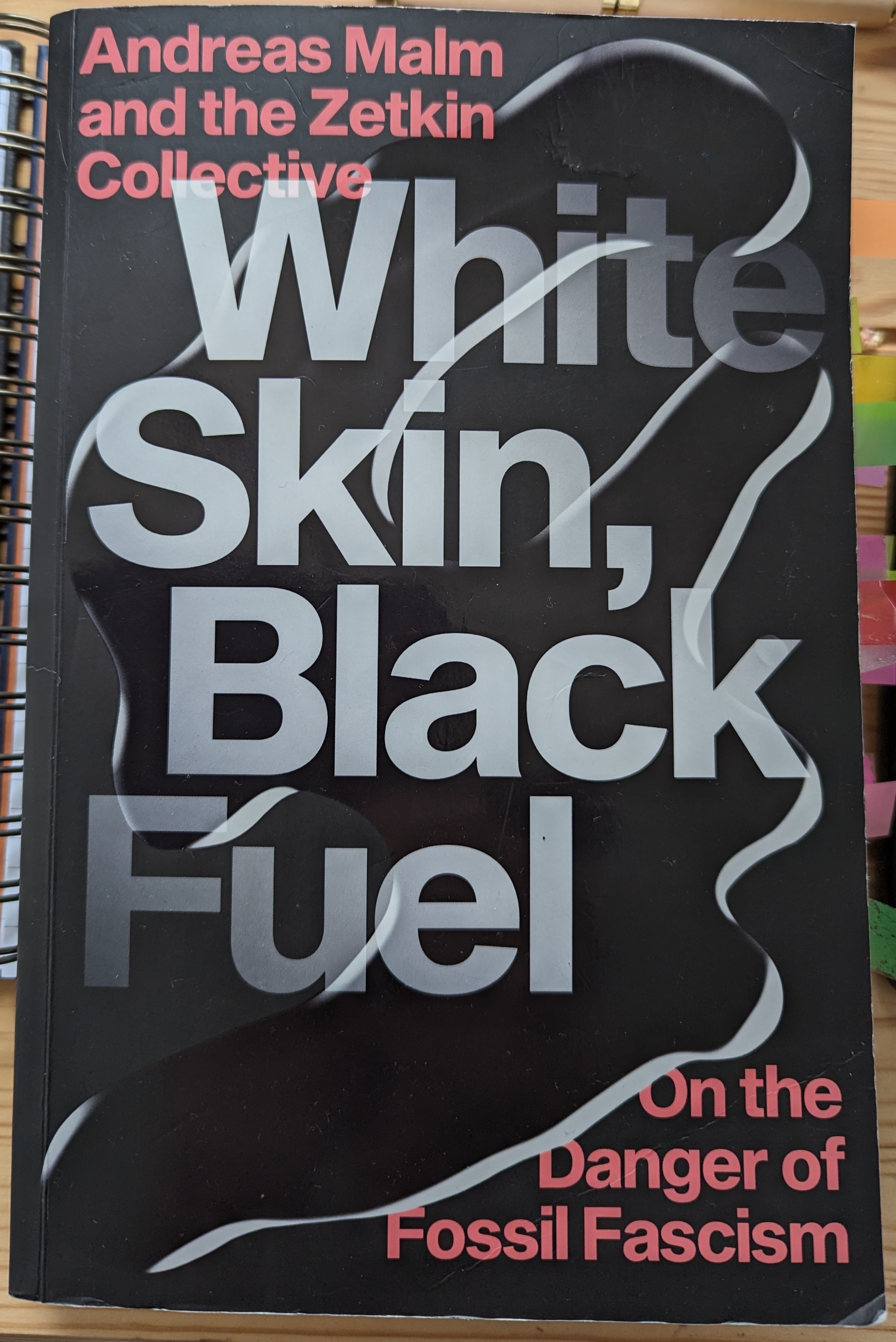
Many writers and thinkers may have stopped there, but Malm is driven. He followed that up with a book about climate and Covid and, controversially, enlightened us on how to blow up a pipeline. In between all of that, Malm, along with the Zetkin Collective, wrote an extraordinary book entitled White Skin, Black Fuel about the relationship between climate change denial/scepticism and fascism. It is like his earlier book, Fossil Capital rather sprawling. Readers need to persevere, it is easy to say that it is too difficult. Malm takes us through time and space locating as he does the origins of fascism, its contemporary manifestations (Europe, North America and South America) and, crucially, why fascism and climate scepticism/denialism are aligned.
Consider this (which I had not done before), why has no far-right party ever endorsed renewable energy? Indeed, why do far-right parties commit to dismantling renewable energy installations, particularly wind? Now this is only a small part of the book, but for me it is the most intriguing and the one that augments my own understanding of the challenges ahead – maybe not absolutely for my generation, but certainly for anyone under 50.
Malm’s plausible hypothesis rests on an understanding of ultra-nationalism (he takes close to 260 pages to tell us what that is). Let me stick with nationalism, the sense that the homeland and its authentic peoples should be prioritised over so-called invaders, immigrants, alien faiths and, basically, anyone with a dark skin. Not only prioritised, but cleansed. We see it in today’s politics. Fossil fuels, argues Malm, fit a nationalist narrative. The is “our” oil. It is independent and we use it for our own development and wellbeing. Of course, oil usually belongs to oil majors that trade it in global markets, so that argument is flawed, but it is surprisingly potent when it comes to electioneering/power grabbing. The sun and the wind cannot be appropriated in the same way even though it provides energy security that no fossil fuel can match (in terms of availability and price). I hear readers now asking, what about countries that do not have a store of fossil fuels in their territory, why are nationalists in those countries so opposed to renewables?
Malm is clear. Colonialism and whiteness! Particularly rich whiteness. For it is the rich off the back of colonial exploitation that have so much to lose from decarbonisation. Their assets are sunk – literally – in the ground. Their lifestyles are high carbon. They fly so much more than most of us, and often in their own planes. Carbon is so much a part of who they are that to decarbonise is to lose their very identity. And what is more, decarbonisation (for them, a Marxist plot) is to enforce an unfair (to them) equality. How else do we explain a global carbon budget that is shared between countries representing some element of fairness? For example, the USA and Europe (particularly the UK) have a tendency to deny historic emissions, and cannot countenance coming down to the level of developing countries. How fair is that?
Malm argues that such an approach by the right (not even the far-right) can be traced back to the fall of the Berlin Wall and the loss of a tangible enemy – communism – that imposed equality in places where it was the dominant ideology. (Arguably not, as the Soviet Leadership and acolytes seemed not to be too constrained in their consumption.) To prove the point, Earth Day (22 April) is the the birthday of Lenin – no coincidence. So, those proclaiming a climate crisis and the need for action became the new targets of the right. Denialism and then a rejection of mitigation (cutting carbon emissions) in favour of a West-friendly adaptation (the West/North is better able to cope with temperatures of 2, 3 and even 6 degrees of warming so much better than other less-developed regions). Malm is thinking about people like Jordan Peterson and William S Lind. The attacks on Greta Thunberg feature in the analysis, too. The picture of her wearing an antifascist “Allstars” t-shirt, for critics, was proof that she was both Antifa and in the pocket of George Soros.
There are some other interesting elements to this approach. Denialists do not present counter evidence (largely because there is none), rather they present their narrative over and over again. The more it is repeated, the more it is liked and re-tweeted, the truer it becomes. Repetition is key. Our media tend to allow them to repeat their lies at will and without challenge. With this in mind, argues Malm, if one can lie about climate change, anything can be successfully lied about. Despite the evidence to the contrary, the lies carry more currency. That is partly because white people, increasingly turning their territories into fortresses, will survive it longer than people of colour in vulnerable countries.
This is not the end of the book at all. The race discussion occupies the subsequent chapters. But just like Fossil Capital, perseverance pays off. The reader is rewarded with insights (you do not have to agree totally with them). Malm has plenty of critics. By goodness, though, he does a lot of heavy lifting for us.
 Be informed