Archive for the ‘Art’ Tag
David Hockney, Paris, August 2025
Filed under: Art, Museums, Travel | Tags: Art, David Hockney, exhibition, exhibitions, Luis Vuitton Fondation, painting, Paris
 Comments (1)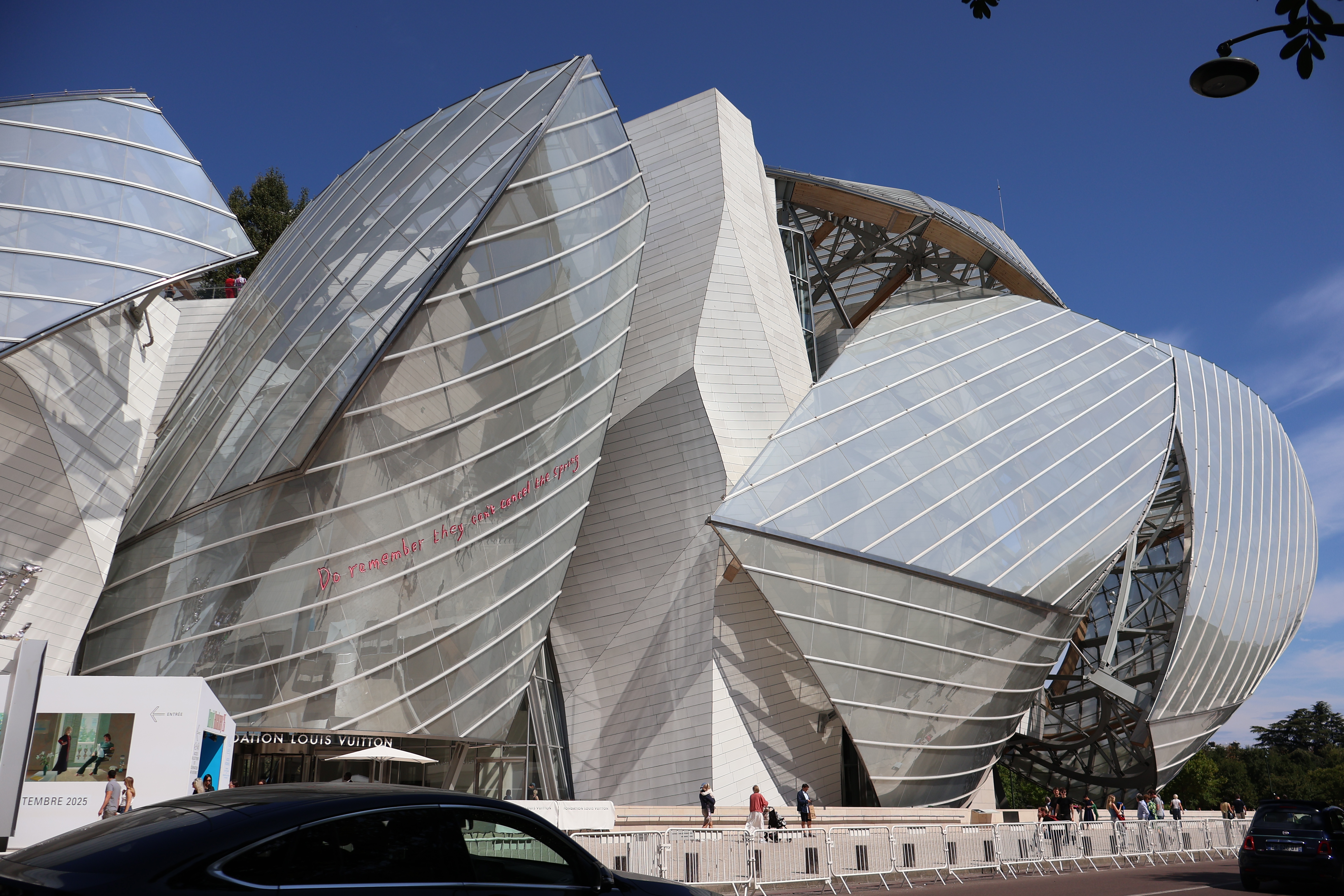
Eurostar from London, dinner, nearby hotel, sleep and then work out how to get to the Fondation Louis Vuitton building that, due to my lack of preparation, turns out to be a Frank Gehry building (left). It sits in a bizarre park that is home to a retro amusement park, amongst other things. Over breakfast we decided to walk – Google maps advised nearly 2 hours, but such is Paris, walking is a delight. By chance we ended up meeting up with an electric bus shuttle from Arc de Triumph to the building – further than we thought. Anyway, the marketing for the exhibition is here.

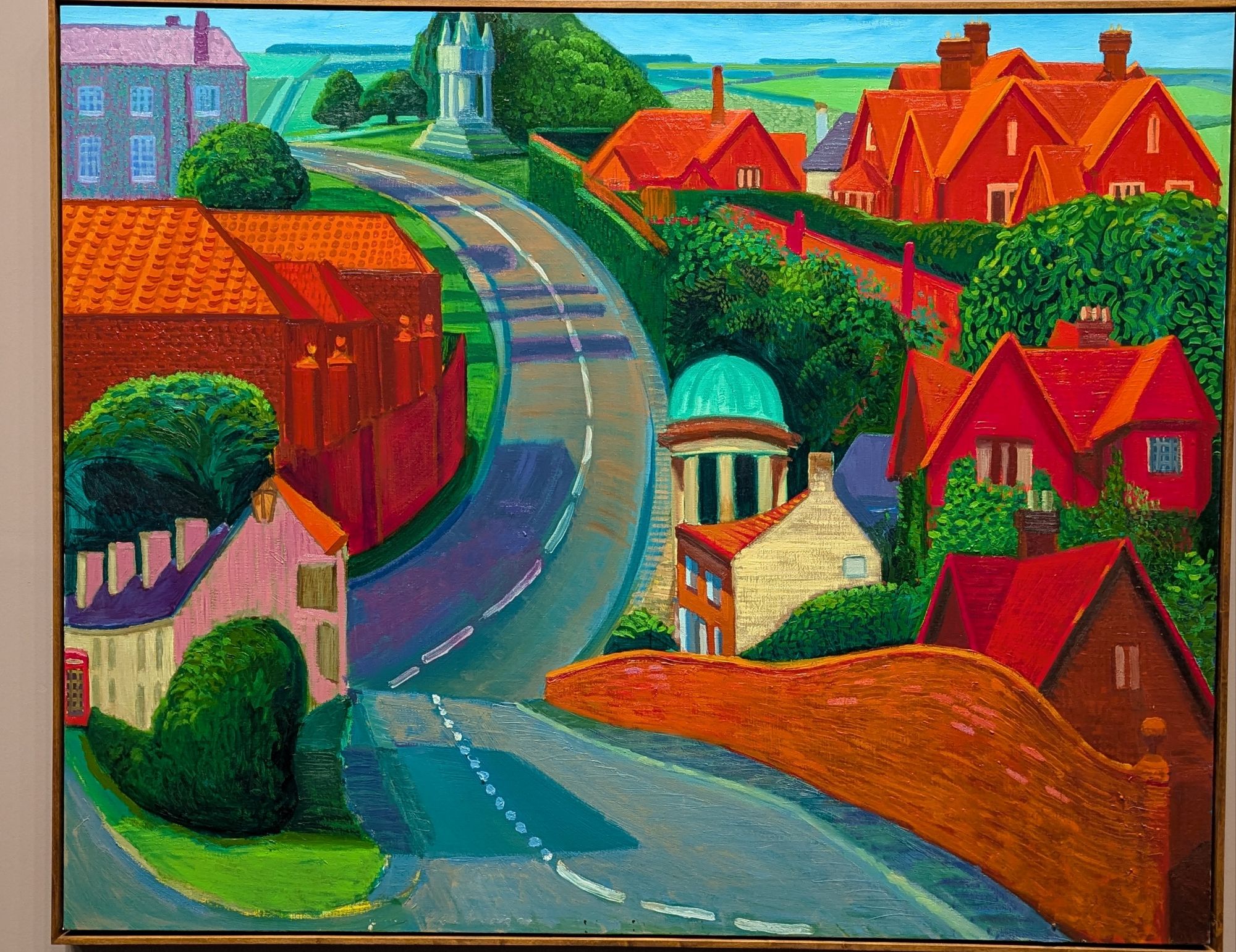
Once into the building we did as we were told and started in the first gallery. It was an exhibition that was organised chronologically by date. So Hockney’s earliest works can be found in that gallery, including the portrait of his father, life in what is now Greater Manchester (right) and series of abstract paintings exploring his early understanding of his sexuality. Then in 1964 he heads off to California. This period delivered some of his most famous images, for example, the Bigger Splash and a series of other poolside paintings that are now beyond my price bracket. But I have to say, I found this rather boring, egotistical, even narcissistic.
Portraits

I like to think that artists have something to say (about the world) beyond themselves. Maybe the next gallery of portraits might reveal something, after all, the sitters were others, often pairs of others. There were lots of admirers of these portraits, but I felt that most lacked emotion. In fact, the only picture (actually a set of four) that showed emotion were a man towards his dog. All others seemed inert. I found one image that summed up this whole gallery (below right).

East Yorkshire
Onwards – Hockney came back to the UK and moved into his deceased grandmother’s house in Bridlington, Yorkshire. In this period he produced a significant number of landscapes depicting changing seasons; for example, a spot on a farm track. Man, easel, paints, brushes. Some of the pictures are huge, made up of 40 or so panels that oddly do not quite match or line up with one another. And they all seem to be without people or, indeed, animals. I can cope without people in the countryside. But not an absence of animals.
That was enough, time for coffee. We left the building in order to find refreshments – the gallery itself has an expensive restaurant but no coffee shop from what we could see. The park has a number of delightful outlets, so no problem.
The full artist

We were back within the hour to a gallery on the second floor which, frankly, we should have started in. This gallery showed what a consummate artist Hockney is and what he could have been had he wanted to be – but that is me being arrogant. I say this because Hockney himself writes on the entry panels that we might think that he has limited styles on which he can draw for his “periods” – all long-lived artists have those, I have come to realise. In this gallery were examples of Hockney aping the styles of other famous artists. There is always a nod to van Gogh, but we did not realise he was a fine cubist artist in the style of Picasso. I particularly enjoyed his take on Hogarth and the illusions generated in his picture, Kerby (After Hogarth) Useful Knowledge, 1975 (above left).
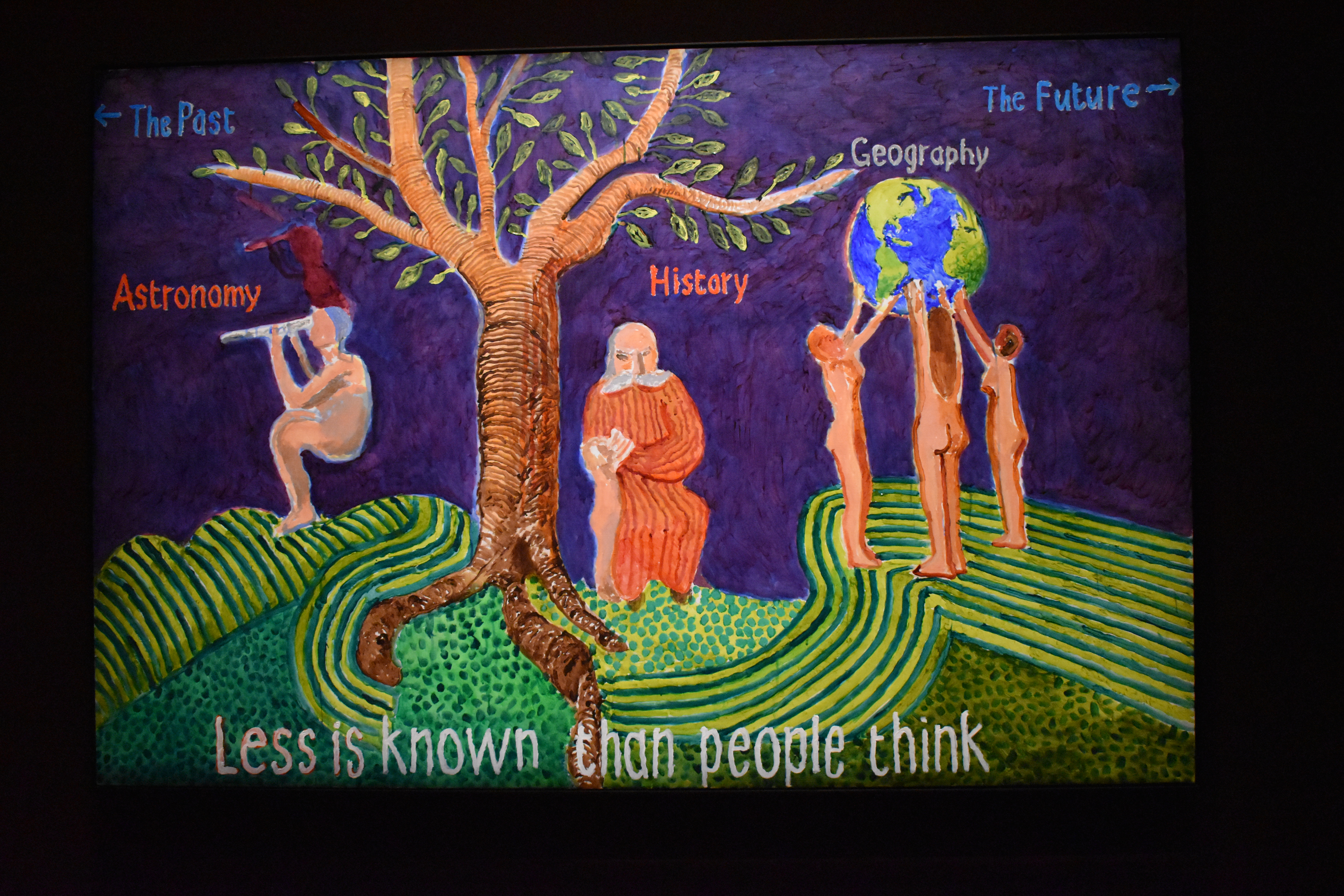
Then on to Munch and Blake (After Blake: Less is Known than People Think, 2023, left). This is the only image that alludes in any way to the welfare of the natural environment (the landscape gallery does not address any of our environmental challenges, indeed reproduces them with straightforward depictions of modern lowland farming). Blake’s painting was a representation of Dante’s Divine Comedy which, admittedly, I have never read. But here we have a holistic view of our human world – a dependence on the natural environment, the awe and fear of the galaxy and universe beyond, human history and a vulnerability (unclothed women holding up the globe) to the planetary system more generally. As we know, we have moved from the Holocene to the Anthropocene – our fate is in our hands, and we ignore the signals at our peril (increasingly decreasing temporality).
Theatre set drawing
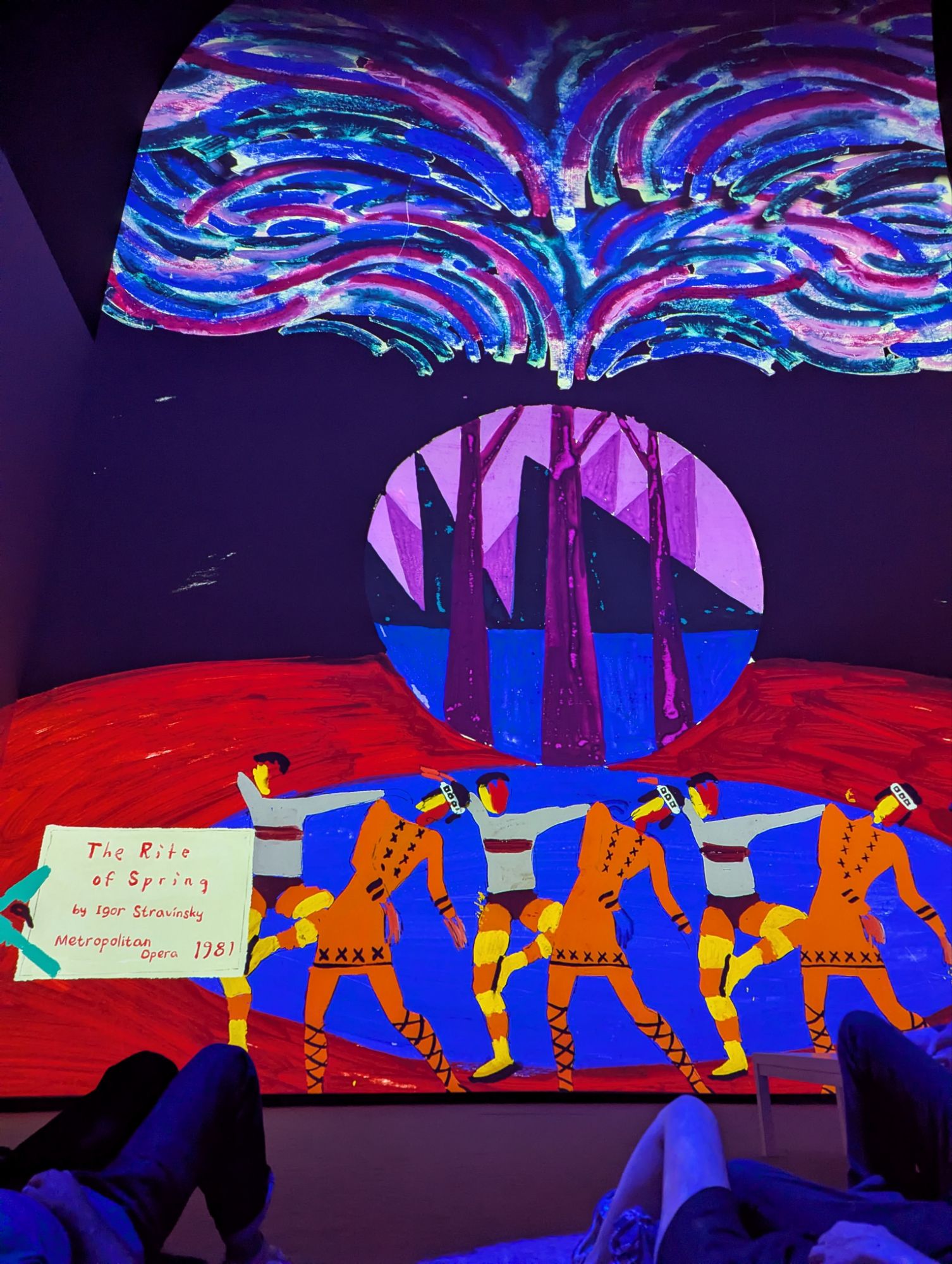
And then there is the theatre work. Hockney was a great fan of opera and throughout his career he has been painting backdrops for some of the great opera houses worldwide. For this exhibition his work is immersive. One enters a large gallery to observe the paintings projected onto walls, with some being animated and involving motion. They are terrific. Another important aspect is Hockney’s experimentation. For example, he has created intriguing electronic pictures that track his method for drawing and painting, particularly landscapes. All credit to him for this. I spent quite a bit of time over these images.
Photo drawing

More recently Hockney has explored “photo drawing” (right – one of a series depicting the same “event from different angles). Equally in this almost recursiveness is his image of himself looking at his own pictures with subtle references to his own brilliance, such as the edition of “die Welt” underneath the small table (below left). And these, for me, sum it all up. Whilst I concede that Hockney is a versatile artist, able to work in most styles and genres and has a body of work that can fill the Fondation Louis Vuitton building in Paris. He is also just a shade too narcissistic for me really to embrace.
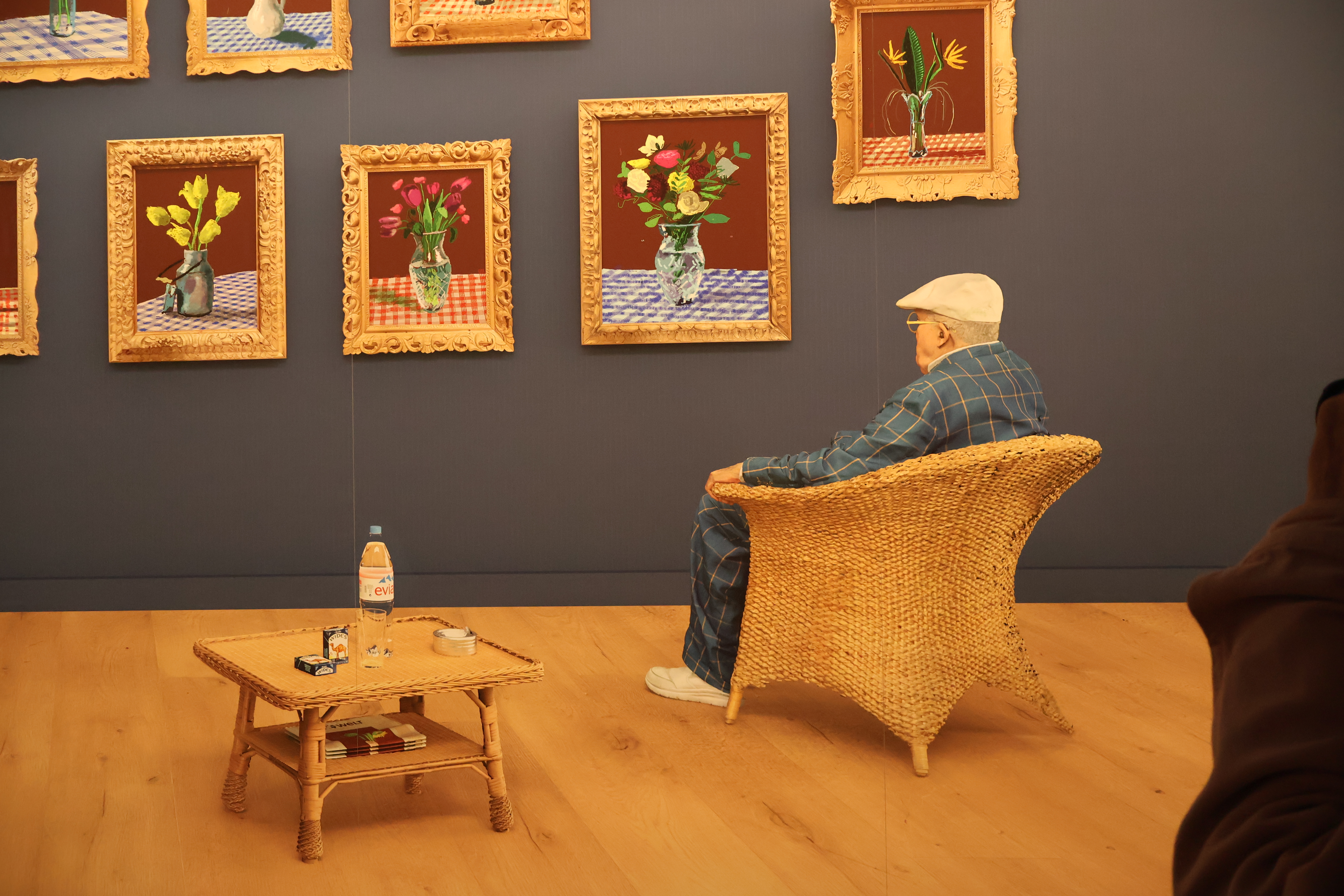
Exhibition ran from 9 April – 1 September 2025
Warhol and Haring together at the Brandhorst Museum, Munich, December 2024
Filed under: Art, Museums, Travel | Tags: Andy Wahol, Art, Brandhorst Museum, graffiti, Keith Haring, Munich, street-art
Leave a comment I had not realised it earlier – or not paid attention – that Keith Haring and Andy Warhol were artistic compatriots. There is a generational difference, for sure. Stylistically, too. But this superbly well curated exhibition (on until the end of January 2025) brings the two artists together – their lives, loves and work.

Haring is this curious subway graffiti artist (Haring would prefer me to drop the graffiti adjective) who became the artist he wanted to be, commercially and critically successful. In 1986 he opened Pop Shop in New York (292 Lafayette Street) to sell his designs on all sorts of artefacts – from textiles to skateboards (left).
For both of these artists I found plenty of contradictions. Haring, particularly so. Whilst both were so-called pop artists, that did not mean they were not looking to be commercially successful. Neither were bohemian in that sense. Whilst Warhol famously bought a factory in which to live, work and socialise, that came at a (financial) price. Haring wanted his work to be as accessible to as many people as possible which explains to some extent the subway art. He was often arrested for this, but seemingly his whiteness protected him from serious prosecution. Many of the works were removed (stolen evening – though whether graffiti can be stolen, I am not sure) and sold at auction as he became increasingly marketable. He moved on to free work for charities and hospitals where, presumably, his work would be a little more protected. His work was also printed onto dresses worn by Grace Jones and Madonna both of whom he met through Warhol.

But the affection the two men had for one another was the focus of my approach to the exhibition. I am not sure for myself if a friend caricatured me as Mikey Mouse (right) that I would be too chuffed. But Warhol was delighted with Haring’s effort which captured the essence of the man (for sure it is Warhol), one of his styles (repetition) and critique (Disney and dollars).

Warhol died in 1987 after some disastrous surgery. Haring was devastated and did what most artists would do, remember them through art whether it be visual, aural, written, whatever. Haring went for a curious depiction that takes some explanation. Warhol is naked. (Warhol had taken naked photographs of Haring in the past.) Warhol is sucking a banana which was a common Warhol motif. He is holding an apple that is somewhat sorf and juicy. This perhaps has a number of meanings – by this time Haring himself was ill with Aids and had a prescribed diet which included a lot of fruit. Equally, it could mean something else entirely.

Both Haring and Wahol were social activists as well. Haring’s social commentary ranged from Aids awareness to anti-apartheid statements (right). There is also an endorsement of the German Green Party.
In the true spirit of Haring’s accessibility, we visited on a Sunday when the entry fee is just 1 Euro. We had dinner in a nearby Vietnamese diner. The front-of-house was dominated by a woman who had an amazing ability to take multiple orders without writing anything down and then remembering who ordered what. Very Warhol.
Gran Canaria: museums, galleries and colonialism
Filed under: History, Museums, Travel | Tags: Art, CAAM - Centro Atlántico de Arte Moderno, canary-islands, Casa-Museo de Colón, Gran Canaria Museums, Museo Canario, Travel
Leave a comment Museums and galleries
Las Palmas – the capital of Gran Canaria – is home to at least four museums, three of which we visited.

Naturally there is a Columbus Museum (Casa-Museo de Colón – https://www.casadecolon.com/) that chronicles the significance of the islands for Columbus’s so-called discoveries. What we learned from the museum was how strategic the islands were for transatlantic crossings, particularly to the Caribbean. Columbus made four such crossings as captain and for each, the Canary Islands provided resources – food, water and labour. For example, for his first tour he needed, essentially, to refit his ships and fix a rudder.

The museum basically presents maps and artefacts in a reproduction of ship environments; for example, the Captain’s quarters showing a bed, desk (right). There is lots to learn about cartography – the evolution of maps is part of the story, of course. Visitors trace through the centuries how humanity moved from a flat earth to a globe and eventually got the shape of the continents right. I suppose cartography is the discovery that we can celebrate if not the conquering aspect of the voyages.
I give them credit for being focused and not getting distracted – Columbus is a big story. It is a lovely small but informative museum close to the cathedral in the historic centre of the city.

The top floor of the museum is an art gallery with time-limited exhibitions. At the time of our visit (29 November 2024) was a celebration of the work of a Canarian artist, Juan de Miranda. There is, as one might expect for a painter of his era, a lot of religion and aristocracy. But also some quirks. For example, I was intrigued by the portrait of St Lucia dated from around 1785. St Lucia is often depicted with eyes on plate. The meaning is not entirely clear but it is thought to reflect her lack of desire to marry. To be blind and eyeless – or to have one’s eyes literally disembodied – may well help her to avoid what she did not want!
CAAM – Centro Atlántico de Arte Moderno
As one might expect, this is gallery of modern art (free entry). Over three floors there are three exhibitions dedicated to particular artists and themes. On our visit (4 December 2024) the artists were: British artist, Zak Ové; Canarian artist, Juan Hidalgo Codorniú and Teresa Arozena. Arozona’s work featured large prints of photographs showing the impact of tourism on the natural environment of the islands of the archipelagos (largely negative). Whilst they are recognisable for anyone who opens their eyes as they wander around the tourist spots (and possibly beyond), they are not particularly standout or framed in an interesting way. For example, shots of the dunes of Maspalomas fail to capture their scale (always difficult with photographs) and show engagingly the threat posed to it. I sense that we as tourists may have some better shots to take home with us.

Juan Hidalgo Codorniú had a lot to say about himself. A long career (he died in 2018) as a conceptual artist presented some interesting artefacts. Like for all conceptual artists, there are good, interesting and not-so-interesting pieces. Bizarrely in one of the galleries is a large area of simple pornography, and another a series of pictures of the artist with nude models. Let me put it this way, they are of their time (the latter the 70s), but unworthy of the exhibition more generally. One piece stood out, though. The depiction of the Earth in a condom (right) resonated. Though I suspect his meaning was different to mine – rather more sexual. It gave me a sense of the earth being emasculated/suffocated, particularly by men. But all we need is a little tear!

Finally, Zak Ové, whose collection here was streets ahead and eclectic. Ové’s father was also an artist and this work seemed like an extension across generations. Both men had a deep commitment to black rights. Seemingly the family lived adjacent to Michael X (aka Michael de Freitas) – there are some atmospheric photographs of him – one particular in Paddington Station, London. (He was eventually convicted of murder and executed in Port of Spain in 1975.) Images of the Notting Hill Carnival in the 60s also feature. Striking images include Evil is White (left) – though for me it could also include the adjective, male.
Ové is also a big user of re-used materials. One gallery demonstrates the fun and creativity associated with his approach. For example, for Fish (2009) he used brass instruments, rubber gloves and dolls. There is a series of masks made from old leather jackets dating form a 2024 collection.


Ultimately, this is a fascinating exhibition in an unlikely location. All the better for it.
Museo Canario
This museum is charming. It is made up of a private collection that was donated along with the building that charts the pre-history of the indigenous people of the island up to the point they were conquered by the Spanish. So it does not deal with the conquest. I bought a book to take up that story – it is complex, see later.

Charm comes in many forms – the building (left, the gift shop is housed in the collector’s library); the collection is disproportionately comprised of lots of bones and skulls; the staff (guaranteed not to leave without having visited the gift shop and bought something) and a curious but welcome adoption of technology (QR codes enable visitors to have an audio guide for each gallery in a selection of languages).

The story is one of arrival (by boat with a few animals and seeds); shelter (in caves and huts); clothing (tanning animal skins and weaving); food (agriculture, preparation/grinding of grains particularly barley); pottery (technology and types) and death (causes and funerals). There are representations of life dotted around the galleries. For example, pottery making (right).
The are other museums and galleries on the island. In Las Palmas, for example, there is El Museo Néstor, dedicated the work of the Gran Canarian artist Néstor Martín-Fernández de la Torre. Moreover, Gran Canaria is more than Las Palmas. There are important other towns in the north of the island such as Galdar.
Colonialism
The colonial history of the islands seems to be something few museums want to address. The conquest of of the islands is not told in any depth. I had to do my own research and, so far, have relied on a single source, Carlos Alvarez’s book, Chronicle of the Conquest of the Canary Islands (left).
Alverez notes that there are a number of different accounts of this period (17th Century), none of which, of course, take account of the indigenous populations’ experiences. Alvarez has done a lot heavy lifting for us in checking the facts; for example, when false dates are presented, he make it explicit to us that it is false and why (if possible). In reading the book I conclude a number of things.

- The islands were not homogenous – geology, culture, natural resources. I sense this is still the case today.
- Colonialisation requires the cooperation of an indigenous population – on Lanzarote, the population surrendered rather quickly realising that they could not defeat the invaders. They agreed to be converted to Christianity as confirmation of their surrender.
- Of all of the islands, Gran Canaria was the most difficult to conquer (eventually in 1478). The final conquest was brutal – but conquistadors suffered high losses until Captain Don Juan Rejón arrived armed and prepared for his success attempt at conquest.
- The islands became property of the Spanish nobility (though the Portuguese had a go at wresting control by miliary force). They were traded between Spanish nobles. The owners and nobles were paranoid (fearful of losing their claims) and vindictive. This actually led to the “accidental” death of Captain Rejón an (unwelcome) unscheduled landing on La Gomera en route to La Palma (yet to be conquered). Consequently, the story of the conquest is told in the voice of the nobles – and their squabbles – rather than the voices of the indigenous people.
Rome, December 2023 – Bernini and Borromini
Filed under: Uncategorized | Tags: Art, baroque, bernini, borromeni, graham-dixon, italy, Rome, schama, sculpture
Comments (1) We are struggling a little bit this holiday. Both of us are under the weather, but doing our best, safely, to enjoy the city. Yesterday’s theme emerged as women – or the absence of them in the recorded history of the city. Of course, when they are depicted, it is not in the best light. The mother of Romulus and Remus left her children to the fate of a wolf – and that did not end well history tells us.
In previous cultural adventures we have piggybacked on art critics. We do so again. Andrew Graham-Dixon with his cook Giorgio Locatelli, did a series “Rome Unpacked” for the BBC. Likewise Waldamar Januszczak’s Baroque series (both of which can be viewed on Youtube, at the time of writing). Much of what we are witnessing is on their recommendation, as it were.
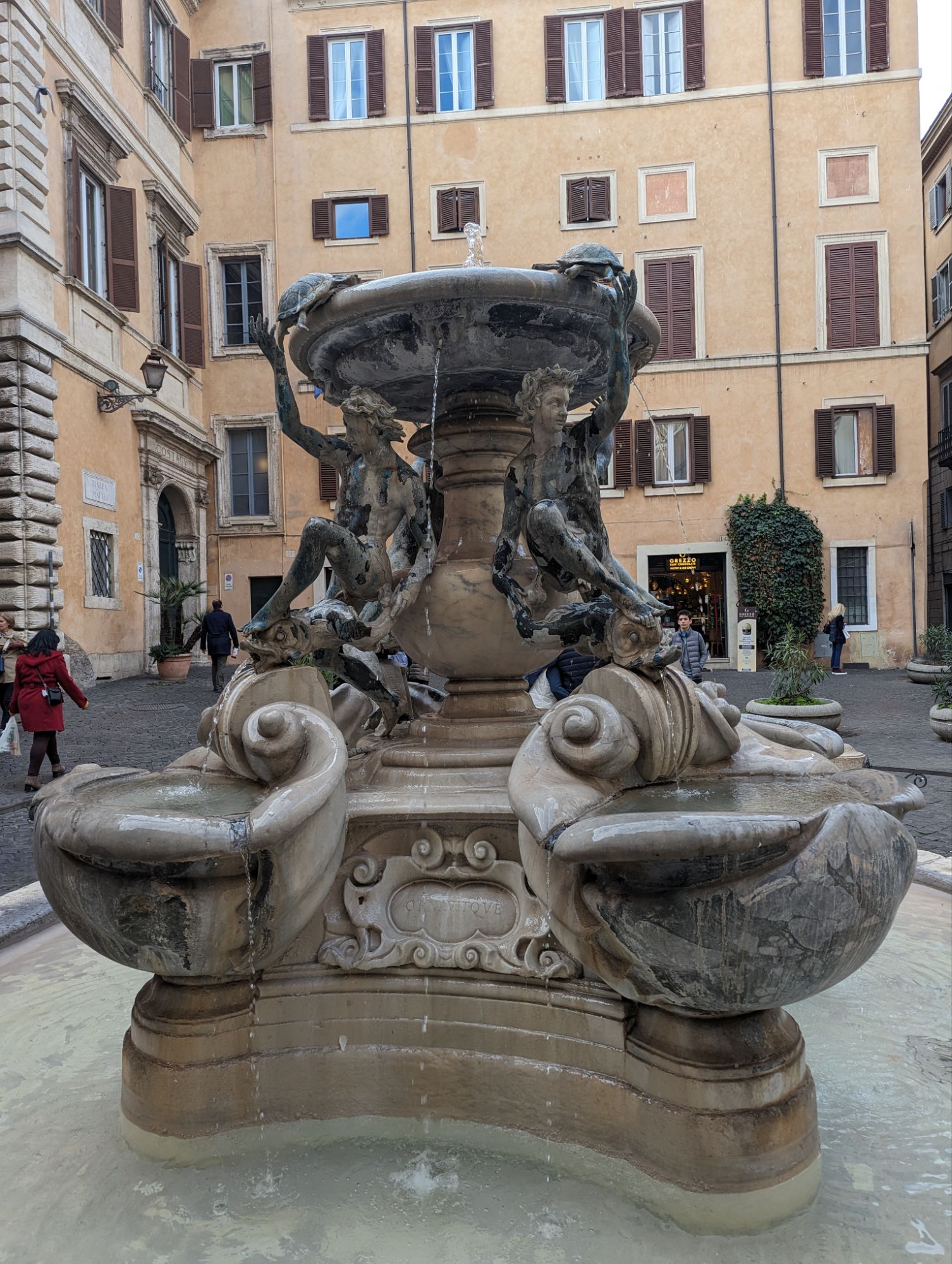
Rome boasts hundreds of fountains. Every square has church and fountain. The fountains are very much part of building civilisation – fresh water, effectively. The example (right) is found close to the entrance to the (former) Jewish Ghetto. It is called Fontana delle Tartarughe – fountain of turtles, I think. If you look carefully, they scale the upper rim! It is renaissance bronze.
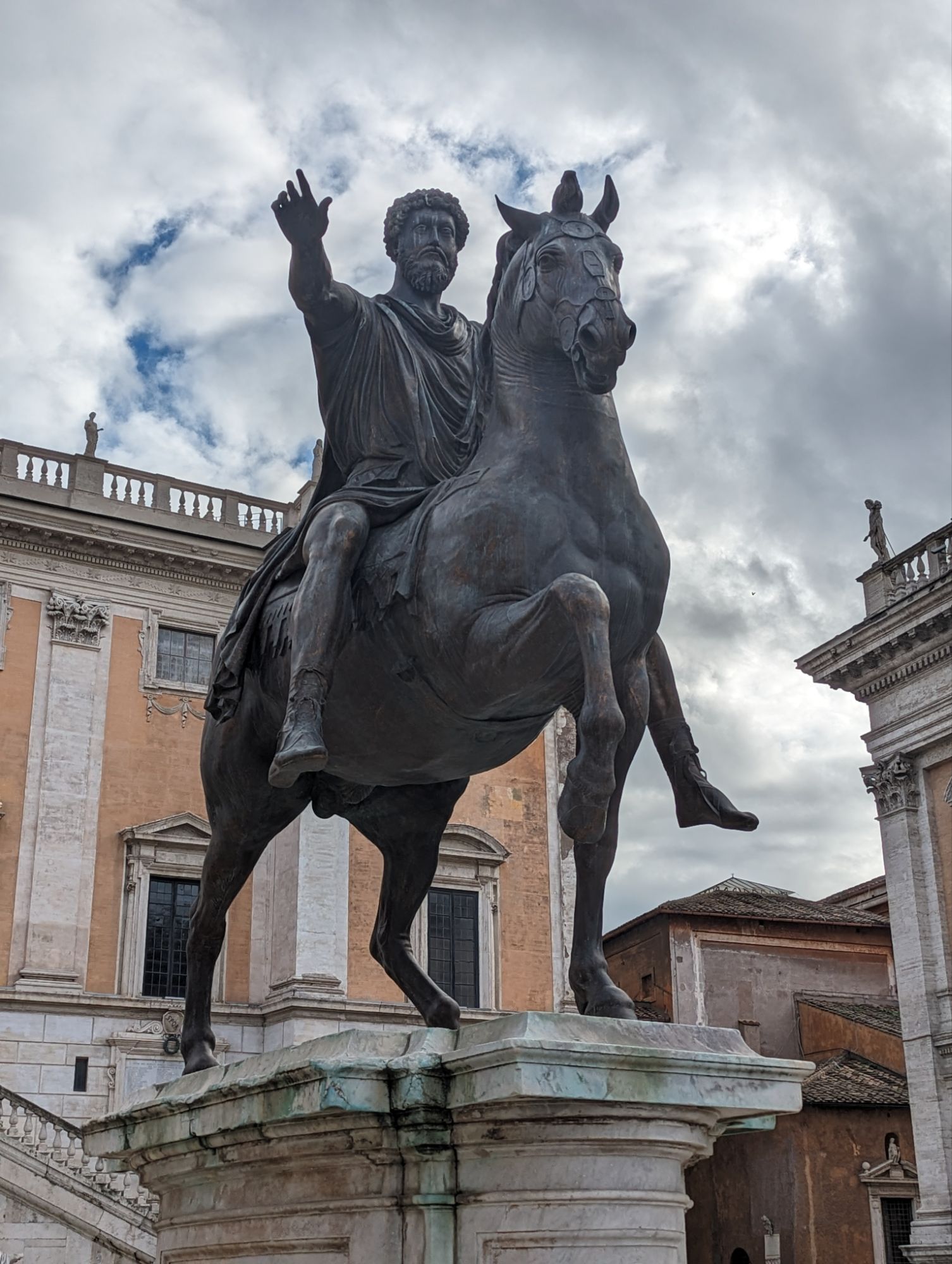
Talking of bronze, the equestrian statue of Marcus Aurelius Michelangelo at the centre of the Capitaloni Square and in front of the Palazzo Senatorio (seat of government) is as bold as they come. It was sculpted in 175AD. It apes the imagery of bestriding – and all conquering – leaders; though his gestures are those of peace rather than vanquish. There are no weapons on display. It is apparently still there by accident (the original is in a nearby museum – this example was erected in 1981). Graham-Dixon suggests that the Pope seemingly thought it was of a more godly leader and hence it survived a great meltdown (of precious bronze).
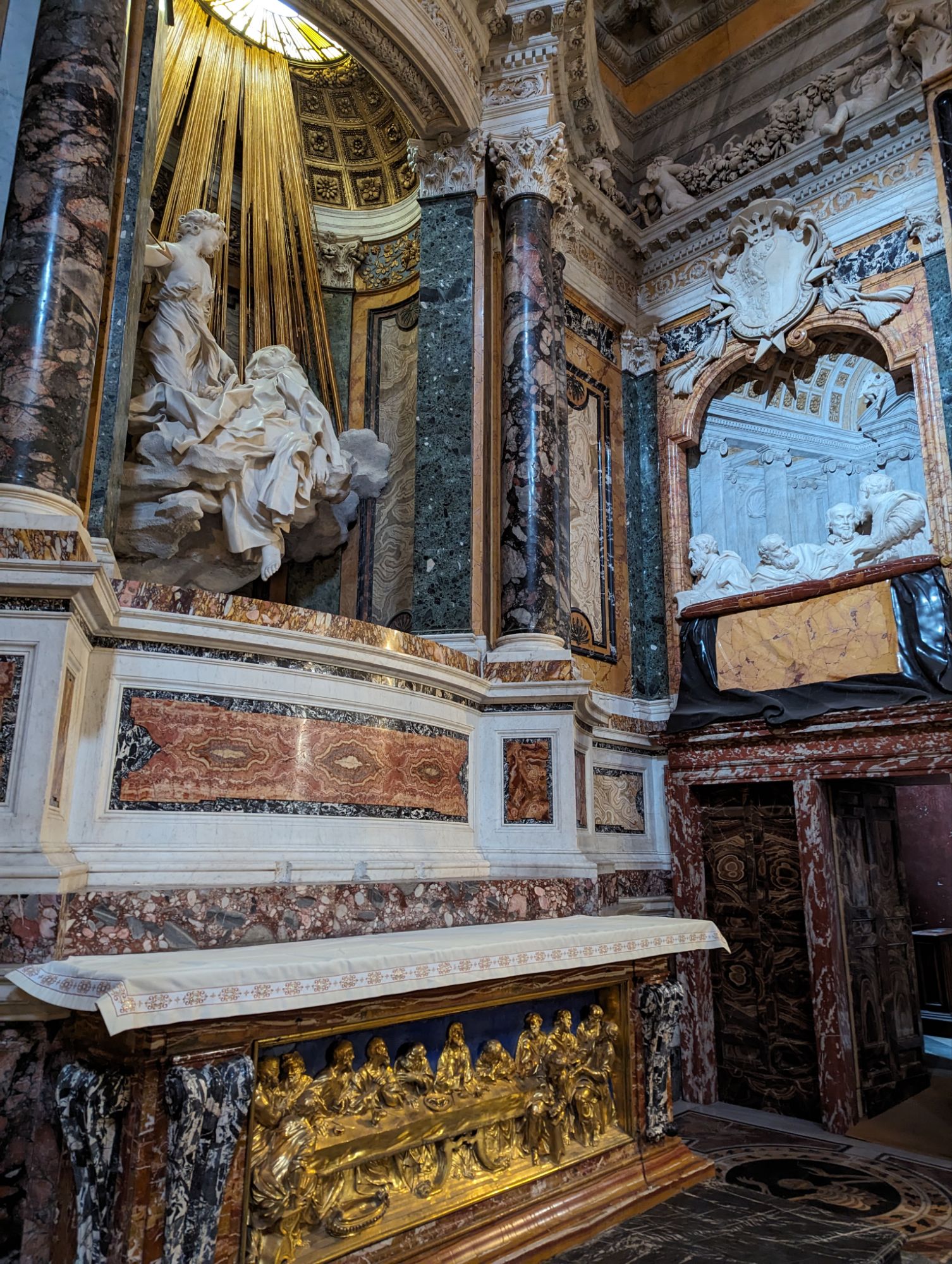
The history of Rome’s art and architecture is so often determined by rivalries. Caravaggio famously killed a rival and fled the city, but Bernini and Borromini were particular rivals – the latter committed suicide on his sense of worthlessness, the former had a confidence and arrogance to see him through and leave his mark through ubiquitous examples architectural and sculptorial talent. Though his ill-advised – and subsequently demolished – south Tower of St Peter’s Basilica nearly destroyed him until the commission for the sculpture in the Chiesa di Santa Maria della Vittoria. A nun experiencing ecstasy is not a good look. But, as Januszczak argues, how are we supposed to depict devout ecstasy? What if it is the same as a sexual ecstasy? The nun was no ordinary nun, she was St. Teresa and no stranger to controversy. Indeed Bernini’s sculpture is a marble representation of her own words! Just a word of note, she is impossibly young in the sculpture. And Bernini – like so many artists – is even more subversive than we might think. The drapery around her, explains Simon Sharma, is particularly revealing. Whilst we might think of it providing her with some cover at a time of extreme exposure and intimacy (with an angel and a spear), the opposite is true. It depicts the human sensation of ecstasy. If Schama is right, that is even more impressive. That’s the baroque for you.
Note also that the scene is being observed as if it were a theatre experience. I am presuming the four men in a theatre box paid for the sculpture (I think they were from the Cornaro family whose chapel the sculpture sits)? And below the whole scene is a depiction of the Last Supper. Almost incidental!
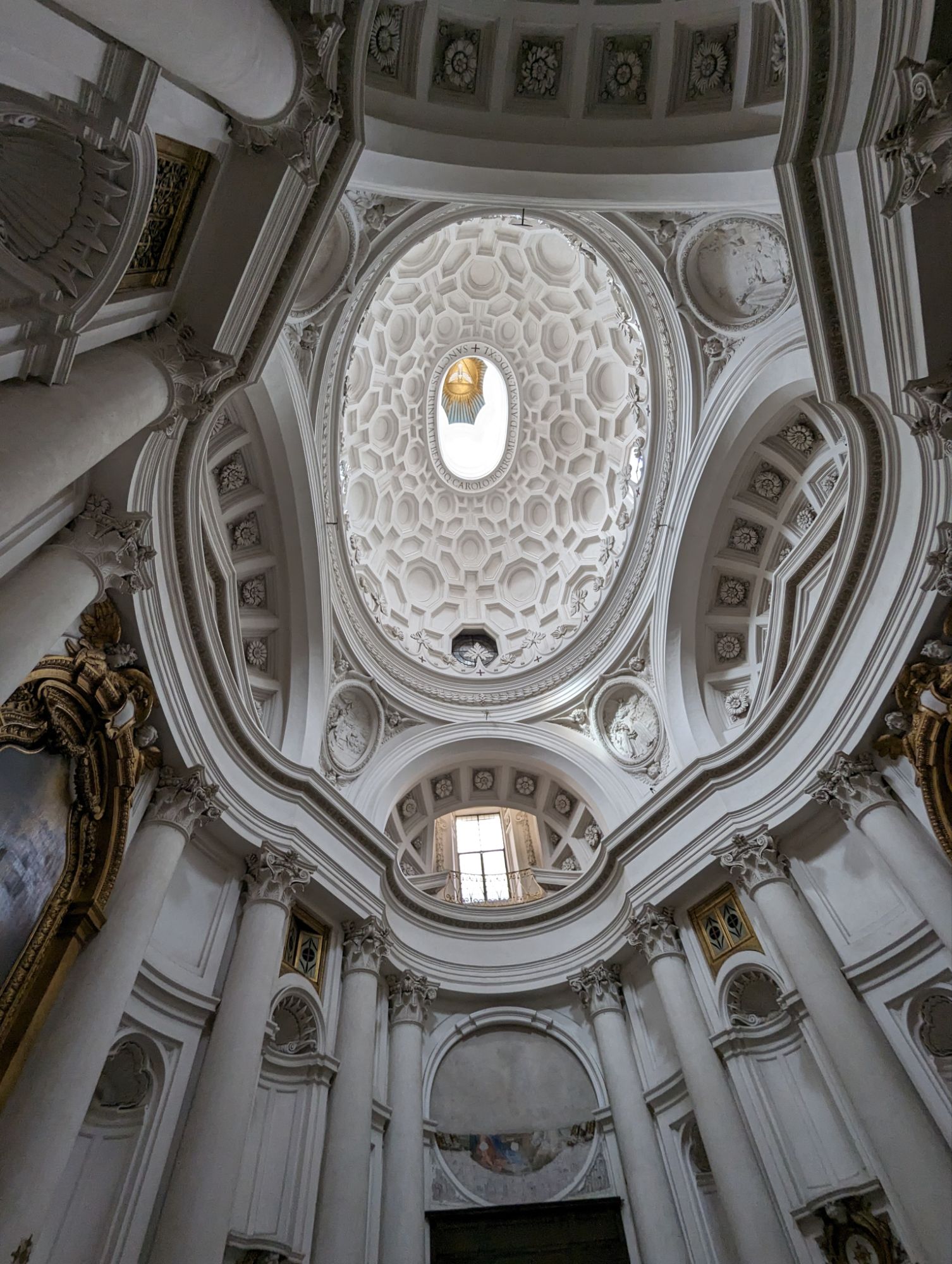
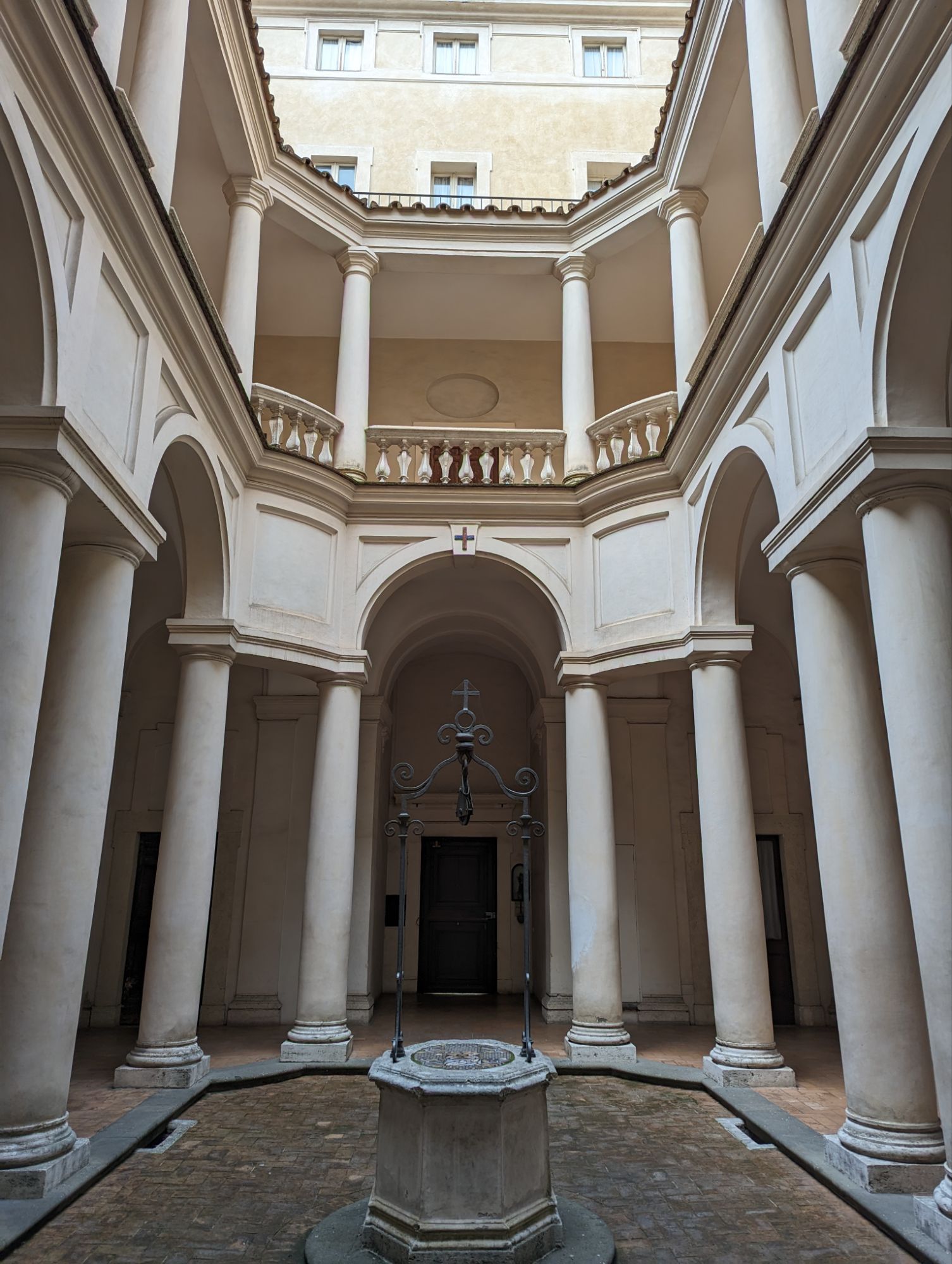
Bernini had rich sponsors, Borromeni did not. And so his seeming Masterpiece – Chiesea di San Carlino alle Quattro Fontane (1638-41) is modest by comparison, but architecturally clever in its use of space and geometry. The ceiling is oval but not, and the light penetrating from the dome adds to the effect. The commission was from an order of Trinitarian monks that did not have much money – or space for that matter. Real skill comes in being able to deliver innovative designs to make the most of what is available. To that end, Borromeni also created a small cloister for the monks. Also modest, also baroque. The balustrade on the gallery is inventive with the pillars arranged in a way that no renaissance architect could countenance.
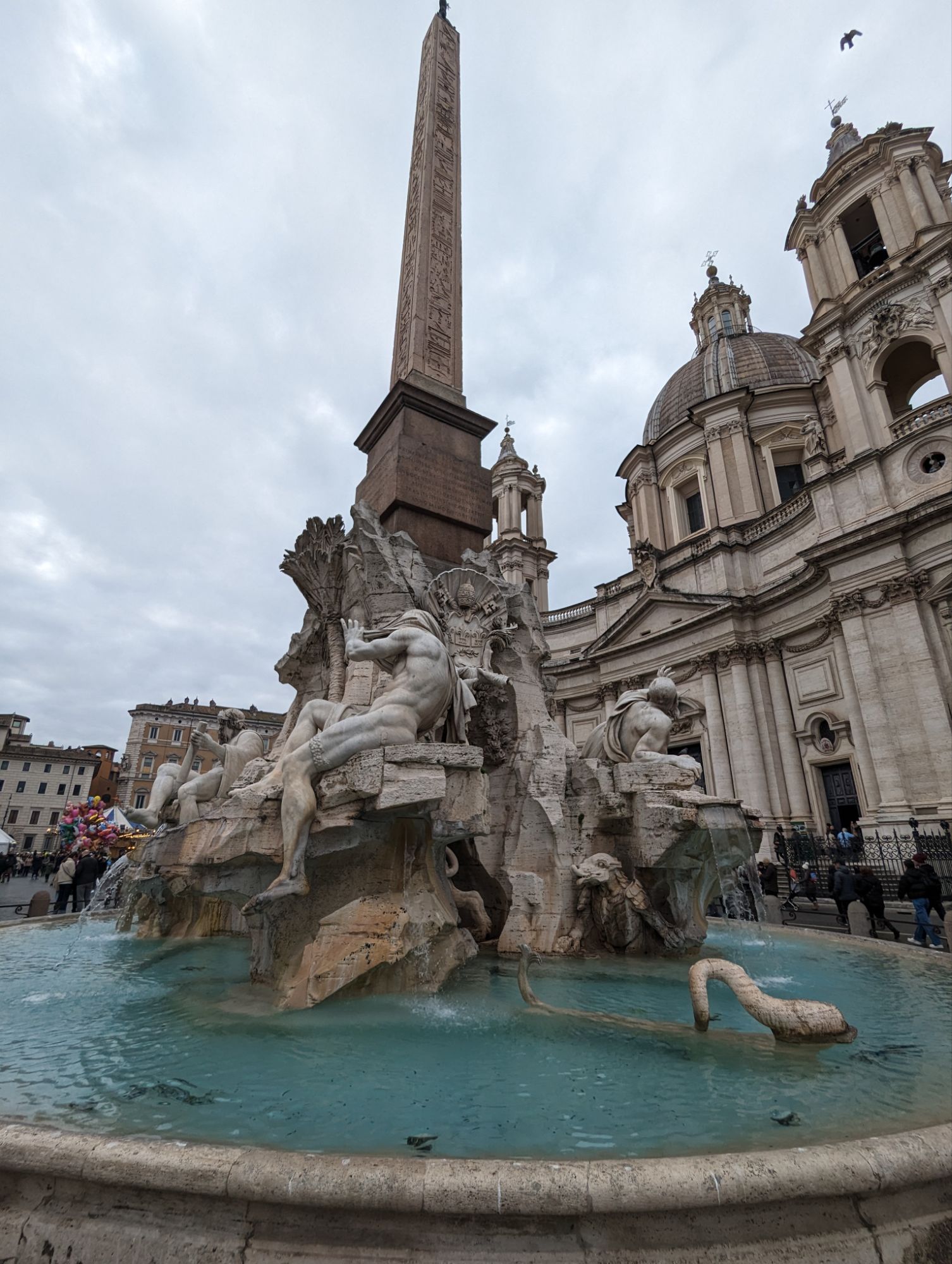
Bernini also did fountains. His masterpiece is Fontana dei Fiumi (1651, Piazza Navona) with its curious mix of representations of continental peoples and animals found – or thought to be found – along four rivers over which Papal authority had been extended – Nile, Danube, Ganges and Rio de la Plata. All of this sat on an obelisk. The crocodile-type creature (right) is seemingly to be found in the Ganges (though maybe the Nile would have been more appropriate).
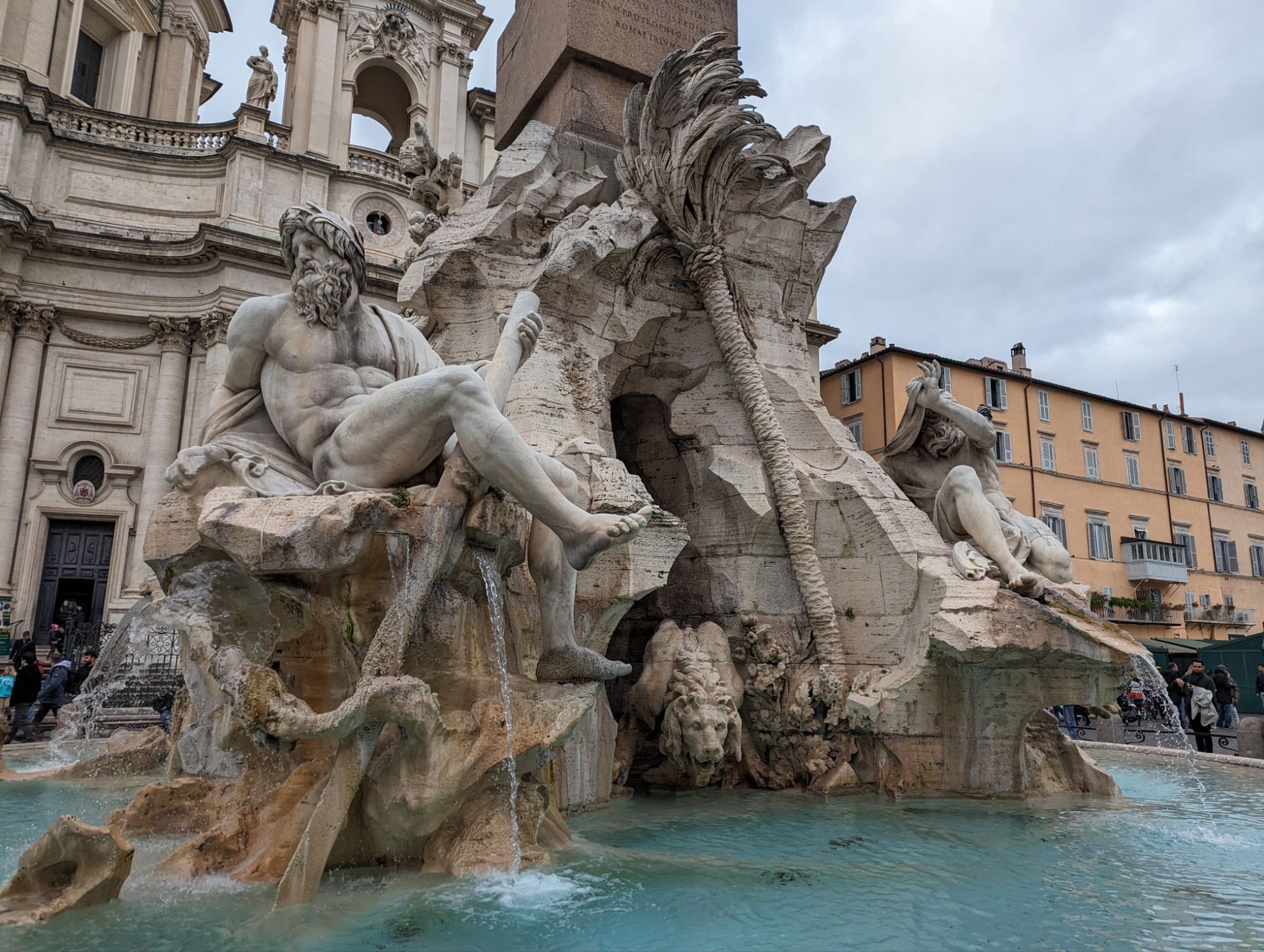
But there are clues as to Bernini’s thinking. The Nile is draped with cloth because no-one at the time knew where its source was; the Danube has the Pope’s coat of arms on it (he knows where the river flows); Rio de la Plata has money around it – riches to be plundered and the Nile has a long oar that someone will have to use to navigate it and spread the word.
Just another note, if anyone is visiting and needs to understand how the city was planned, here is a good source:
 Be informed