Archive for the ‘energy’ Tag
Capitalism is the problem
Filed under: Environment, Politics, Privatisation | Tags: Capitalism, Circularity, climate, climate change, Decoupling, Dutch East India Company, energy, environment, Erald Kolasi, GDP, renewable-energy, sustainability
 Leave a comment
 I have been reading some excellent books recently. You know the ones that you wish you had written? I have written a book, and I have just read The Physics of Capitalism by Erald Kolasi. It is brilliant and takes no prisoners. It also a book that I will need to incorporate into the next edition of my textbook if the publisher ever gets round to inviting an update. I know my book needs revision, not least because we’ve all been on generative AI catch-up. My bio needs an update, too.

Back to Kolasi. He’s a physicist. A physicist taking on economists in a way that economists should have been taking on economics in the 21st Century. Back to me. My book starts with a statement about the finite planet and argues that business strategy has to be devised and executed so as not to breach the planetary boundaries, of which there are nine. Kolasi’s genius (at least for me) is to use his knowledge of physics to critique arguments by economists (and others to be fair) about technological “solutions” in the context of climate change. It is hugely effective and it tells it bluntly and with humour (though totally unfunny if you are an economist).
At its bluntest, Kolasi likens economists to people who simply cannot accept that we cannot make light go faster than the speed of light (3×10⁸ m/s) or go below absolute zero (currently -273.15oC). More realistically, in terms of the efficiency of the stuff we use and rely on, internal combustion engines struggle to be more efficient than 35 per cent (conversion of liquid fuel into kinetic energy/Carnot cycle). 70 per cent is a theoretical maximum, but such an engine is unlikely to be put into a car; photovoltaics, 15 per cent (though theoretically possible, but never achieved, 90 per cent). And so it goes. As Kolasi notes, too, even if we could get 90 per cent conversion of solar energy to electrical energy we would still struggle to meet demand for panels and electrical energy as they need an energy source to extract raw materials and manufacture. There are limits (that neo-classical economists will not accept).
GDP and decoupling

The likes of Hannah Ritchie have been making a strong case for decoupling as a sign that capitalism can survive a climate crisis. We can grow economies (as defined by GDP) and reduce carbon emissions simultaneously and absolutely. It’s a dangerous myth.
Some definitions first: relative decoupling is simple reduction in carbon emissions whilst experiencing an increase in GDP. Absolute decoupling is a kind of safe zone where decline in carbon emissions outstrip growth and head towards zero. From what I can see, and have read, there is no absolute decoupling even using current measures of GDP. For Kolasi, the current measure is the problem as it does accurately measure change in the biophysical scale; namely, the use of natural resources in production and reproduction.
Then there is the question of permanence, assuming GDP is a fair measure of output. Kolasi tells us that with this perspective, economic growth and life expectancy have decoupled as Americans die earlier than previously. Where we thought there was a positive relationship between growth and life expectancy, that seems not to be the case. But no one is saying there has been a decoupling.
Then we can consider the data on emissions. They are to some extent estimates. We might have a handle on carbon dioxide, but we certainly do not have measures of methane, nitrous oxide, synthetic and fluorinated gases, all of which are more potent greenhouse gases than carbon dioxide. Even before the Trump administration, the Environmental Protection Agency in the USA relied on self reporting by corporations! Now it is unlikely that any degree of self-reporting will be needed.
Finance
Talking of changes in direction, up to 2021, banks had been reducing (not eliminating) lending for fossil-fuel projects. That has now changed. The Guardian newspaper has reported that “Two-thirds of the world’s largest 65 banks increased their fossil fuel financing by $162bn from 2023 to 2024.” The US Treasury has withdrawn from the Network of Central Banks and Supervisors for Greening the Financial System, essentially giving a green light to private banks to start lending again. Indeed, JP Morgan, Citigroup, Bank of America, Morgan Stanley, Wells Fargo and Goldman Sachs all withdrew from the net zero banking alliance. Here is a table of the worst offenders (apologies for the poor resolution, but if you download it, it is fine):

Be rest assured, banks have not changed.
The steam engine
A book that opened my eyes to the non-inevitability of industrial fossil economies was Andreas Malm’s, Fossil Capital. The argument was threefold: first, capitalists were not prepared to share resources such as flowing water. Second, flowing water was located in areas that required investment by capitalists in infrastructure such as housing, schools, medical. Thirdly, where this infrastructure existed, labour militancy was difficult to manage – wages were going down and work rates increasing. Capital is best optimised if it is mobile. The steam engine enabled capital mobility despite being less efficient than water, at least until major improvements were made to the design of steam engines (to stop them from exploding if nothing else). All this being true, it is not the whole story. Kolasi has helped me to refine this argument.
Let us compare changes over time (Kolasi 2025: 290):
| Year | Steam HP | Water HP | Wind HP |
| 1800 | 35,000 | 120000 | 15000 |
| 1830 | 160,000 | 160,000 | 20,000 |
| 1870 | 2,060,000 | 230,000 | 10,000 |
That brings us to two additional concepts that I did not get from Malm: exergy and spectralization. Exergy is a thermodynamic system’s maximum capacity for useful work (p290); spectralization is the “diversification and variation in the conversional methods of existing technologies in response to changing social and ecological conditions” (p222). And so…
“…Boosting the spectralization of conversional technologies was the main causal vector for the corresponding improvement in the efficiency of industrial devices. The Industrial Revolution in England and virtually everywhere else as well, followed a path of exergy-driven efficiency gains that spurred additional gains and butterfly effects in economic productivity. The English achieved this incredible growth through a huge increase in the aggregate output of mechanical work a process spearheaded by the spectralization of high-pressure steam engines, and eventually the spectralization of other types of engines as well.”
Kolasi, 2025: 290-1
Let me unpick that, probably imperfectly. Efficiency per se is not the point. It is exergy efficiency. And curiously, Kolasi demonstrates that steam engines had a negative impact on aggregate efficiency across the English economy as a whole. Indeed in their early days they were highly inefficient relative to water and wind. The more steam engines that were installed – at least until 1770 – the lower the efficiency of the economy in aggregate. My head hurts trying to get it around this idea.

In the 19th Century it is a different story. But steam’s impact is not that it could be used to power textile factories. Rather it is this spectralization whereby if became a significant component of the economy as a whole, not least in transportation (shifting coal to factories and shifting product to markets). And if we think that steam power is a thing of the past, we must remember that it is steam power that generates most of the world’s electricity.
Steam power does something else, too, which I had not considered. Steam enables capital to be used harder. By which we mean, it enables us to hit things harder – in a foundry, for example, that is useful.
That leaves a question as to why coal? Well here’s a thing, the answer lies is that great British phenomenon of the enclosures. Back in the sixteenth and seventeenth centuries, the aristocracy displaced many people from their traditional lands by enclosing it – fencing it off and turning it into private property. This displacement led to a rapid urbanisation. People were concentrated in towns and cities and used wood to heat their homes. More rapacious, though, was the state’s need for timber for warships. The nation’s forests disappeared. Coal was a suitable substitute and, as Kolasi writes, “…the northern parts of England were full of it”. Full of it for sure, but it was under ground. The mines were established but they needed pumping. That was first significant industrial use of steam power – to pump mines.
The steam engines then went through spectralization – the addition of condensers to improve thermodynamic efficiency; new gear configurations that allowed the engines to generate rotary motion and to power machines in factories; and the transition from low- to high-pressure machines as the driving motive force. Kolasi (p281) argues this was the “breakthrough moment of the entire industrial revolution”.
Colonialism

The English enclosures displaced many and created a work-hungry proletariat. International colonialism resulted in mass slaughter, disease and slavery. Kolasi (pp300303) goes into great detail about the activities of the Dutch East India Company (VOC). Most brutally, the company slaughtered the majority of the people of the Banda Islands (modern day Indonesia) because they had a monopoly in nutmeg growing. On discovering exactly where the fabled trees grew in 1621, 15,000 people lost their lives through brutal acts of beheading and being pushed over cliffs. These people were substituted for by slaves. The VOC set the stage for the Amsterdam Stock Exchange becoming the first publicly-traded company; but as is ever, the company declined as the secret of nutmeg was demystified and grown in other regions with suitable climates. The Dutch Government nationalised the assets in 1799.
The Circular Economy
We hear a lot about the circular economy…it is essentially another attempt at saving capitalism from itself. In its purist form, the waste from one cycle of production becomes the raw materials for the next. A weakness here is the issue of recycling. Many of us are asked to recycle our waste – my weekly doorstep collection is a case in point. I separate out my plastic, card, glass and metals to be collected. Notwithstanding the fact that turning glass and metals into reworked materials requires energy. Plastic…to much cannot be recycled, and even if it can, the capacity is rarely there to enable it. So, recycling is not realistically part of the circular economy – energy is lost in the circularity.

For circularity to be meaningful, materials have to be reusable or re-purposable. A glass bottle needs to be reused as a glass bottle (energy is required for transportation and cleaning. Textiles need to be re-tradable, up-cyclable and volumes need to come down, drastically. A recent story in the Guardian newspaper illustrates once again just how much textile materials find their way dumped in habitat and wilderness because we cannot absorb the volumes being disposed of.
Sources: Decoupling Chart – Hannah Ritchie (2021) – “Many countries have decoupled economic growth from CO2 emissions, even if we take offshored production into account” Published online at OurWorldinData.org. Retrieved from: ‘https://ourworldindata.org/co2-gdp-decoupling’ [Online Resource]
Bank investment table – Banking on Climate Chaos: Fossil Fuel Finance Report, 2025: https://www.bankingonclimatechaos.org/?bank=JPMorgan%20Chase#fulldata-panel (accessed 21 June 2025)
Steam Engine: Chris Allen / Steam engine, Nortonthorpe Mills, Scissett
VOC Plaque: By Stephencdickson – Own work, CC BY-SA 4.0, https://commons.wikimedia.org/w/index.php?curid=72939415
Ghana Wetlands – source unknown. Taken from Guardian story.
Why banks do not invest in renewables
Filed under: Environment, Privatisation, UK | Tags: climate change, Electricity markets, energy, environment, Feed-in-tariffs, investment in renewables, renewable-energy, renewables, spot prices, sustainability
Leave a comment 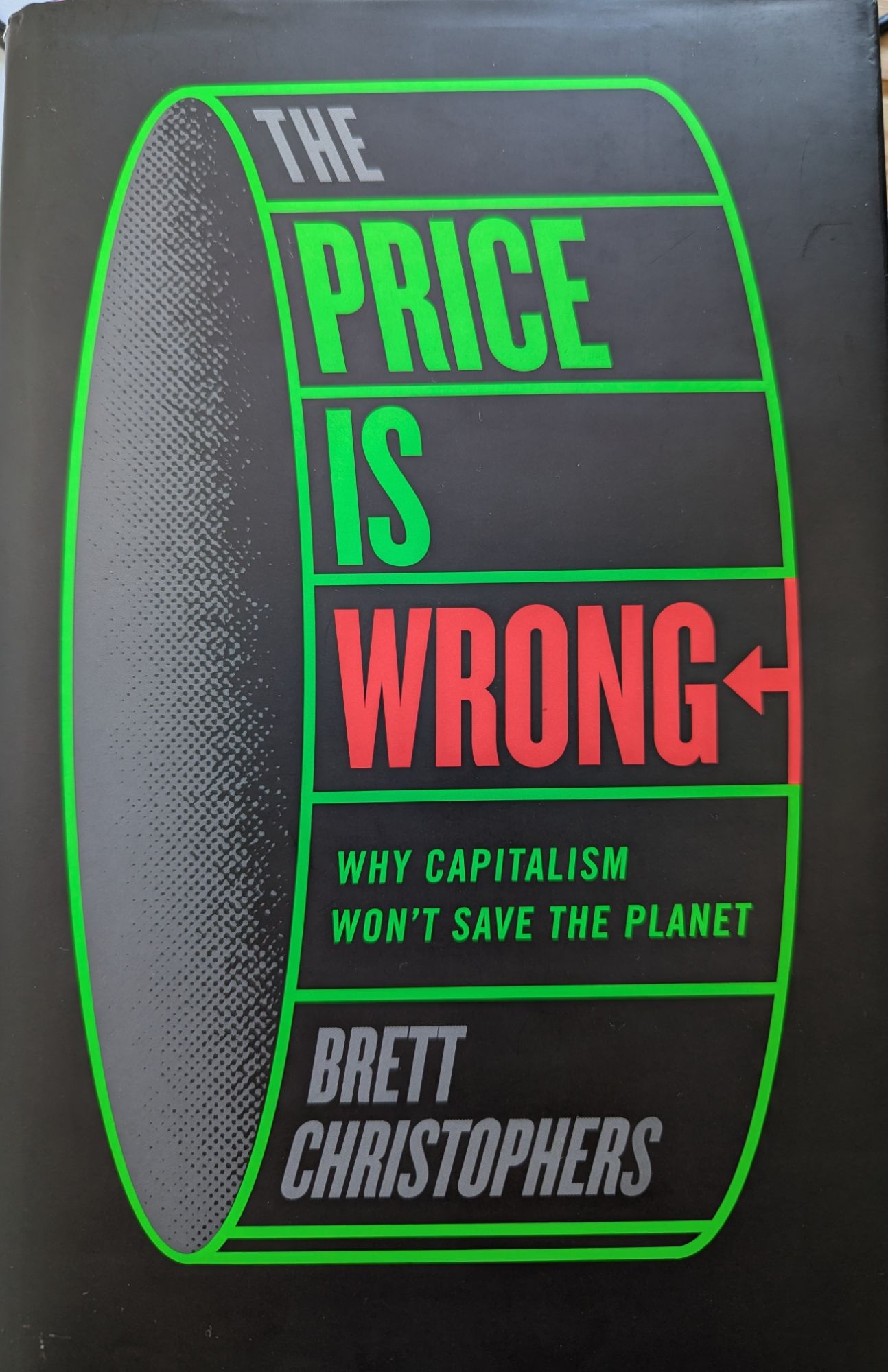
I wrote last month on Andreas Malm and Wim Carton’s book, Overshoot. Like all arguments – and their book is full of them – there are weaknesses. Or in my case, a failure fully to understand. In pursuit of that understanding, I have turned to an extraordinary book by Brett Christophers, the Price is Wrong – Why capitalism won’t save the planet (right).
Christophers waits until chapter 6 – appropriately entitled, The Wild West, to broach the point of why. It is not because the previous chapters were superfluous – far from it. Rather it is because electricity is complex, and despite out belief that all electricity is the same, Christophers has to make the case that not all electricity is the same.
First, we have to look at the structure of the liberalised (i.e. non-vertically integrated markets), of which the UK is a prime example after privatisation in the 1980s. Let me break down some of the stakeholders in the system:
- Generators – owners of power plants (some located outside of the country)
- renewables
- wind
- solar
- hydro
- non-renewables
- gas
- coal
- biomass
- nuclear
- renewables
- Last-mile suppliers.
- Buyers of wholesale electricity for supply to end users (domestic and businesses)
- Electricity System Operators (ESOs)
Markets
Increasingly the industry’s liberalisation has led to regulated markets being constructed by policy makers. In the UK there two distinct routes to market by generators.
- spot markets (electricity for immediate use)
- corporate – Power Purchase Agreements (PPAs) – generator contracts directly with corporate entity which is often a large user of electricity. There can also be PPAs between generators and utilities (retailers).
Spot markets trade in blocks of time, 30 minutes in the UK, for example. There is a base load, usually supplied by renewables and then a top-up, usually coming from the most flexible of supplies; namely, gas. In the UK the last coal-fired power station closed in September 2024.
Spot markets and volatility – why renewables are unattractive to investors and fossil-fuelled plant is attractive
The prices of electricity on spot markets are volatile. They are volatile over each day – demand can vary widely from the peak of the early evening to the overnight lull. But volitivity over a month…that seems to be more scary to investors. For example (p 170) in February 2022, spot market prices in Germany ranged from under €50 per MWh (day 19, Saturday) to just under €250 per MWh (day 25, Saturday). Demand is difficult to predict; indeed, we might ask, are there any other (commodity) markets with such pronounced volatility?
If you are an investor – a bank, for example – such volatility instils a sense of unease. It does not make investment impossible, but it makes it more expensive. Christophers’ research suggests that interest rates for renewable energy projects can be as much as 3x that of non-renewables.
We should then ask, why would a gas-fired power station – that sells into the same volatile market – not also be high risk? There are two things to be aware of here. First, banks have been investing successfully in fossil fuel projects for many years. Successfully. It is a known and tangible entity that has largely been low risk. Bankers, however, when making investment/loan decisions ask one simple question, will the client be able to pay back the loan on any terms agreed? The banker wants to know how much income the project will be generating to service the debt. The project owners will, of course, not be able to answer that question because of the volatility. It seems to be insufficiently adequate for the loanee to say that they are 100 per cent certain that all electricity they generate will be bought by suppliers because what they generate will always be cheaper than electricity generated by gas. The spot markets always include the lowest-priced electricity in a merit hierarchy.
There seems to be other issues here for investors. The returns on renewables is lower than that for fossil-fuelled plant. Typically, noted by Christophers (pp 211-221), fossil-based investments can generate returns of up to 20 per cent. Renewables come in at between 4 and 9 per cent. If we consider oil company shareholders, they are offered by the executive investments that will bring in double-digit returns, or equivalents that will deliver at best half of that. What will they choose? And what if the executive takes the decision to go with the renewables, knowing that their returns will be lower? Most will be out on the ears at the next shareholders’ meeting. These are so-called opportunity costs. Investing in renewables means that the investment will not be made elsewhere; i.e. something that brings in a higher return. But, argues Christophers, the shareholder concerns are minimal in comparison to that of the banks. Banks are looking for double-digit returns. It is also the case that many investments in renewables are made by companies that are not fossil-fuel based. They specialise in renewables. They will only deliver across their portfolio single digit returns to a market that is volatile, that exhibits the so-called merchant risk. Added to that, renewable plant is part of a “transition” – an energy transition. That transition, argues Christophers, has two elements. The first adds to the uncertainty. Transitions by definition are uncertain. The second is transition has no history. Generators are asked to project into the future with no historical data on which to make the calculations.
We might then ask, what about owners of plant fired by fossil fuels, how do they make the case to investors if they sell into the same volatile electricity market (because new gas-fired power stations are still being built)? Well, it seems quite simple, a traditional fossil-fuelled power plant is not part of a transition. It is proven technology and can demonstrate historical returns on investment. It is eminently bankable.
And here is another scenario. If the spot price of electricity (say in the UK) falls, so does the price of gas. The spot price is determined by the gas price (or the highest bid price in the bidding round, usually 30 or 60 minutes in each 24 hour period). In that scenario, the price of gas falls and the bid posted for electricity generated by a gas-fired power station is at a lower price because the primary cost of the power station is its fuel. If the gas price falls, so does the cost base of the plant. There is a hedge at work in the eyes of the bankers (p180).

The same is not true of wind-based renewables plant. The fuel – wind – is a gift of nature. It is free. The cost base of the plant, in the event of the spot price decreasing, does not decrease. That seems to indicate to bankers that there is a point where there is no return, and hence the ability of the plant owner to service the debt. In other words, finance cannot be secured because the fuel is renewable, meaning that even if the turbine is turned by the wind it can still be used by another wind turbine. But non-renewables once used are used. It is counter-intuitive that this is a positive and hence a challenge to bankers. In essence, then, there is a significant merchant risk; namely, “the risk associated with selling renewably generated electricity exclusively or predominantly at volatile merchant (wholesale) prices.” p174
Work arounds – how renewable plant owners can hedge the risk
Christophers offers three ways around this problem.
- Option 1: the futures contract. This is a situation whereby the electricity will be bought and sold at a predetermined price. The fear/danger is that the spot price falls such that revenue is flat and threatens not to cover liabilities. This is a balancing act where an option to sell (short) on the electricity futures contracts means that if the spot price does fall, the negative outcomes in terms of income “earned” in the spot market are compensated for by a gain in the futures market. Essentially, the trading value of the contract enables the sale to be transacted at a fixed future price which typically rises as the spot price declines. This is a common mechanism for hedging in liberalised electricity markets.
- Option 2 – swaps. These are more common in North America and Texas in particular. Swaps act as substitutes for futures contracts. The principle is that a party averse to risk relating to falling electricity prices can offset the risk by entering into a swap that pays out even if electricity prices fall.
Hedging, though, is complex. Only the largest producers have the so-called competence to hedge at scale. There are at the very least significant cash flow challenges. For example, if the spot market does decline, one party has to put up considerable cash to cover the decline. There is even a bigger challenge to contemplate. Christophers asks fairly, what happens if the renewable electricity supplier cannot supply the amount of power it is contracted to supply to the futures or swap markets? The above relate to Christophers’ arguments on pages 178-183.
- Option 3 – PPAs – these reassure banks that there will be a return sufficient for loan repayments.
- Option 4 – government subsidy/support. Such support has its own hazards.
- investment grants do not help in pricing
- Investment Tax Credits can help reduce the level of break-even spot price
- Price controls/Feed-in Tariffs (FiTs) – compensating generators when the spot market “reference” price drops below the contract “strike” price; though when the strike price climbs above the reference price, generators pay back into the pool. The net price is always the strike price.
Price controls stabilise markets and satisfy investors. But then introduces yet another source of uncertainty. Will governments – especially when they are fiscally stressed – honour or extend FiTs rates? Unless they do, renewable generators are back to spot price volatility. Christophers offers examples of state withdrawal in China and India (pp.
Notwithstanding problems with subsidies (option 4), markets can bankrupt renewables generators. In Texas in February 2021, a bolt of cold air caused a number of generators to cease as their equipment, not used to such extreme conditions, seized up. This was not just renewables generators. Fossil-fuel plant also seized up. As a result of the limited supply, electricity spot prises went up considerably. Renewables generators were supplying into a market with spot prices below $100 per MWh (as low as $50). During the crisis, prices were $9000 per MWh. Now if renewables generators were selling into that market, then there was money to be made (assuming the turbines were working, of which many were). But if the generators had PPAs at fixed prices, if they were unable to supply they had to go into the spot market to meet the terms of their PPA. That was enough to bankrupt generators (p310).
Why renewables will not supplant fossil fuel investments
Filed under: Environment, UK | Tags: Andreas Malm, climate, climate change, energy, Overshoot, PV cells, renewable-energy, sustainability
Leave a comment Overshoot
For us non-economists there seems to be a logic that should prevail. If renewables are significantly cheaper than non-renewable fossil fuels, then why do banks and financial institutions continue to provide capital to the fossil fuel industry to extract more oil and gas, despite climate change?

For an answer, I return to the work of Andreas Malm and a recent book (2024), Overshoot (co-authored with Wim Carton). We experience overshoot when policy makers conclude that we can afford to spend our carbon budget in the (mistaken) belief that we can bring back 1.5 degrees by carbon capture and storage. Or even more problematically, reduce the surface temperature of the Earth through geoengineering. It is propagated by fossil-fuel industry lobbyists in order to maintain business-as-usual. Business-as-usual is important because sunk assets of the industry are long-lived and the value of the oil over which they have extraction rights is high.
Commodification
For Malm and Carton (pp209-218) an answer is the inability to commodify sun and wind. We can commodify the equipment that converts the sun’s energy into electricity. We can commodify wind turbines. But because the sun and the wind are renewable – i.e. tomorrow’s sunshine is independent of the sunshine from the previous day – it has not been used up. Moreover, using Marxist theory, Malm and Carton argue that value can only be ascribed to products if human labour is required in its exploitation. Even in the most efficient mining operations, humans are still directing the operation. Wind, sun and water are labourless. That makes them valueless in the eyes of economists. There is no “surplus value”.
By contrast fossil fuels are commodities. They are traded, stored and consumed. The sunshine cannot be traded. There is no world market. There is no OPEC equivalent in renewables. It has no economic value in the capitalist mindset. It is costless. But costlessness may be valuable to consumers, it really is not to capitalists because they are unable to maximise profit – or indeed generate profit at all. Consequently there is only so much renewable energy that any national energy system can support – Malm and Carton suggest about one-quarter to one-third. Above that, costless electricity is so abundant that the price drops to zero or below. It is in Marxist terms, a “labourless void”.

This phenomenon can be illustrated indirectly by asking, name and ascribe a capitalisation to the world’s biggest manufacturer of PV cells or wind turbines. Likewise the owners of the world’s largest PV farms. We can all name the top 10 oil majors and easily find a capitalisation. For those who think Tesla may be a candidate – notwithstanding the current crisis within the company – it is an automobile manufacturer, not a renewable energy company. Essentially, renewable energy technologies (of the flow) have “no talent for providing the accumulation of capital”. (Malm and Carton, 2024: 215).
Competition
Other explanations are available, of course. Is it that there is perfect competition in solar, wind, etc. Barrier to entry are not high and hence there are too many players in the industry (a very Porterian approach). As Malm and Carton argue, if that was the case, then the whole industrial revolution would not have happened as the textile industry was just that, highly competitive.

What is particularly interesting in these technologies is their disruptive potential that could be led by consumers. No amount of consumer demand for fossil-fuel-free electricity, as we have seen, will see off the producers of electricity from fossil fuels. The profit motive blocks this. But it is possible for consumers to become their own generators. And whilst the majority of citizens own little in the way of land, homeowners do have roofs – house, sheds, etc., And in those houses they have space for storage – batteries. Most consumers remain indifferent to this. Even better would be whole neighbourhoods pooling their roofs and generating electricity for collective consumption. The question here is just about the design of the delivery system. For the time being at least, the grid is optimised for national distribution, and as such does not accommodate collective consumption.
Why then has there been any investment in renewables. Malm and Carton offer five reasons.
- Government subsidies – paying someone to do it
- End consumers not needing to make a profit (whilst reducing their own bills)
- Early profit – first movers, for example
- Low rates of profit can still be justified up to a point
- Fossil fuel companies have invested in renewables to fuel their own plants because, like all end users, it is valuable to them
Ultimately market capitalism cannot deliver transition, a mixed economy can.
 Be informed