Archive for the ‘exhibition’ Tag
David Hockney, Paris, August 2025
Filed under: Art, Museums, Travel | Tags: Art, David Hockney, exhibition, exhibitions, Luis Vuitton Fondation, painting, Paris
 Comments (1)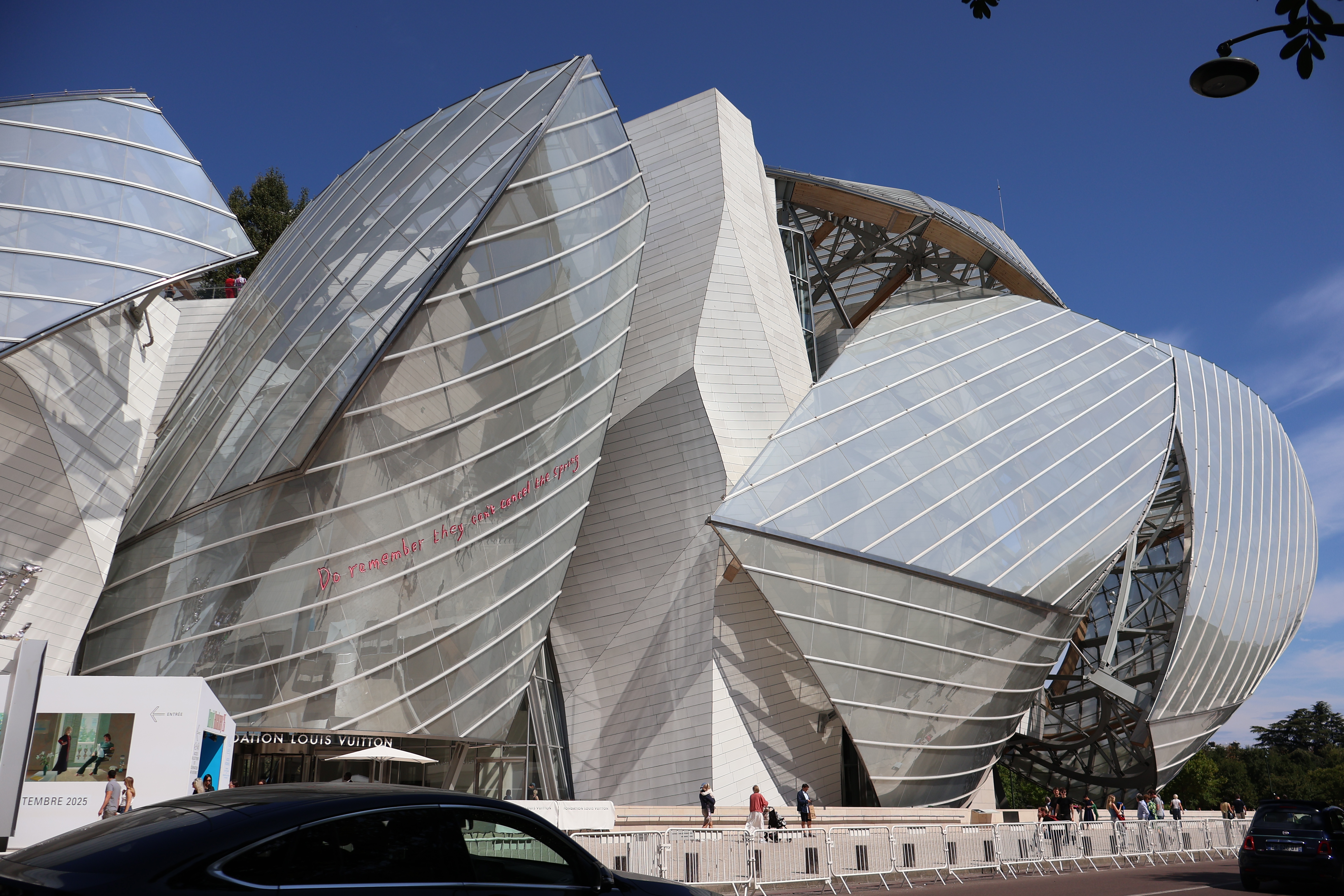
Eurostar from London, dinner, nearby hotel, sleep and then work out how to get to the Fondation Louis Vuitton building that, due to my lack of preparation, turns out to be a Frank Gehry building (left). It sits in a bizarre park that is home to a retro amusement park, amongst other things. Over breakfast we decided to walk – Google maps advised nearly 2 hours, but such is Paris, walking is a delight. By chance we ended up meeting up with an electric bus shuttle from Arc de Triumph to the building – further than we thought. Anyway, the marketing for the exhibition is here.

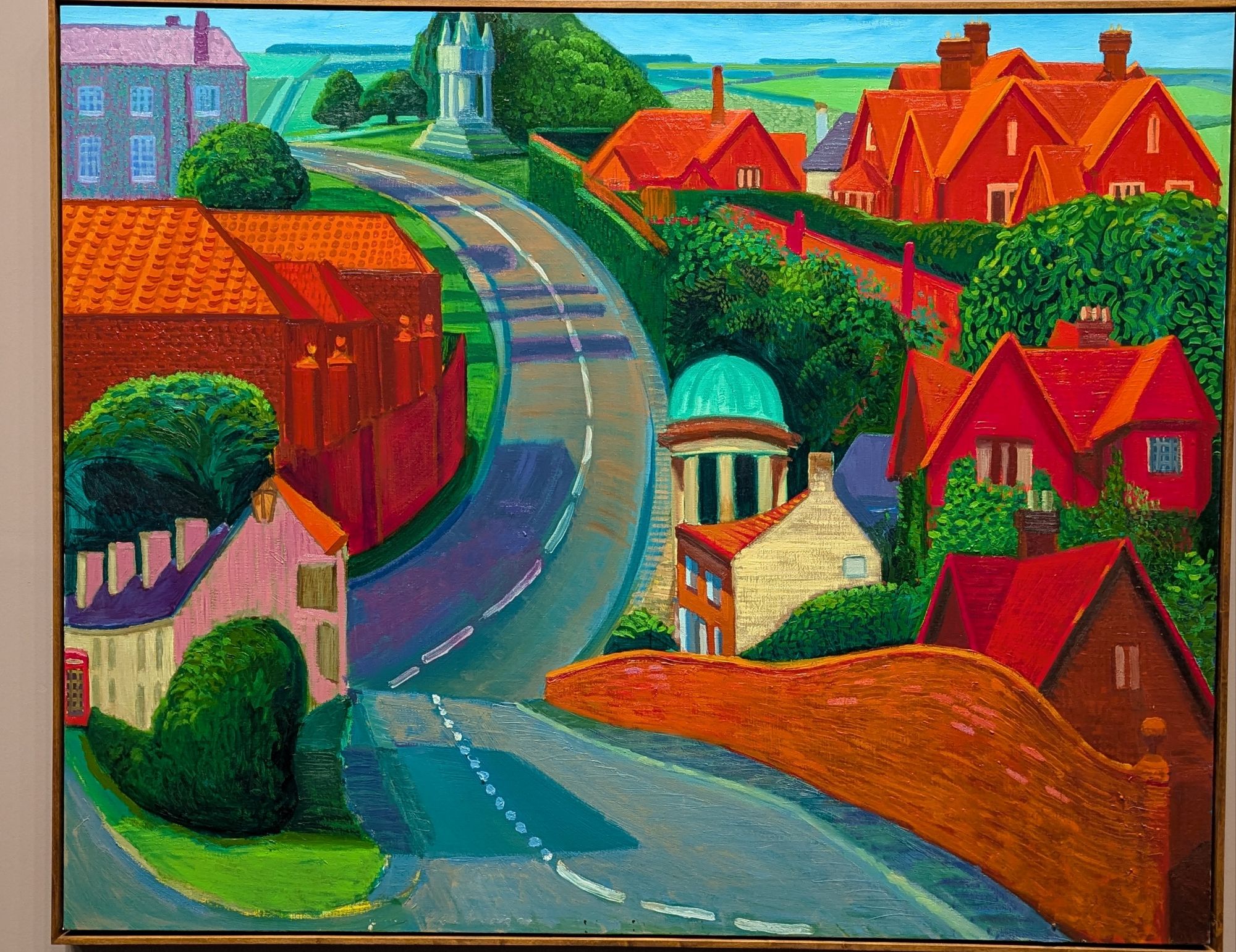
Once into the building we did as we were told and started in the first gallery. It was an exhibition that was organised chronologically by date. So Hockney’s earliest works can be found in that gallery, including the portrait of his father, life in what is now Greater Manchester (right) and series of abstract paintings exploring his early understanding of his sexuality. Then in 1964 he heads off to California. This period delivered some of his most famous images, for example, the Bigger Splash and a series of other poolside paintings that are now beyond my price bracket. But I have to say, I found this rather boring, egotistical, even narcissistic.
Portraits

I like to think that artists have something to say (about the world) beyond themselves. Maybe the next gallery of portraits might reveal something, after all, the sitters were others, often pairs of others. There were lots of admirers of these portraits, but I felt that most lacked emotion. In fact, the only picture (actually a set of four) that showed emotion were a man towards his dog. All others seemed inert. I found one image that summed up this whole gallery (below right).

East Yorkshire
Onwards – Hockney came back to the UK and moved into his deceased grandmother’s house in Bridlington, Yorkshire. In this period he produced a significant number of landscapes depicting changing seasons; for example, a spot on a farm track. Man, easel, paints, brushes. Some of the pictures are huge, made up of 40 or so panels that oddly do not quite match or line up with one another. And they all seem to be without people or, indeed, animals. I can cope without people in the countryside. But not an absence of animals.
That was enough, time for coffee. We left the building in order to find refreshments – the gallery itself has an expensive restaurant but no coffee shop from what we could see. The park has a number of delightful outlets, so no problem.
The full artist

We were back within the hour to a gallery on the second floor which, frankly, we should have started in. This gallery showed what a consummate artist Hockney is and what he could have been had he wanted to be – but that is me being arrogant. I say this because Hockney himself writes on the entry panels that we might think that he has limited styles on which he can draw for his “periods” – all long-lived artists have those, I have come to realise. In this gallery were examples of Hockney aping the styles of other famous artists. There is always a nod to van Gogh, but we did not realise he was a fine cubist artist in the style of Picasso. I particularly enjoyed his take on Hogarth and the illusions generated in his picture, Kerby (After Hogarth) Useful Knowledge, 1975 (above left).
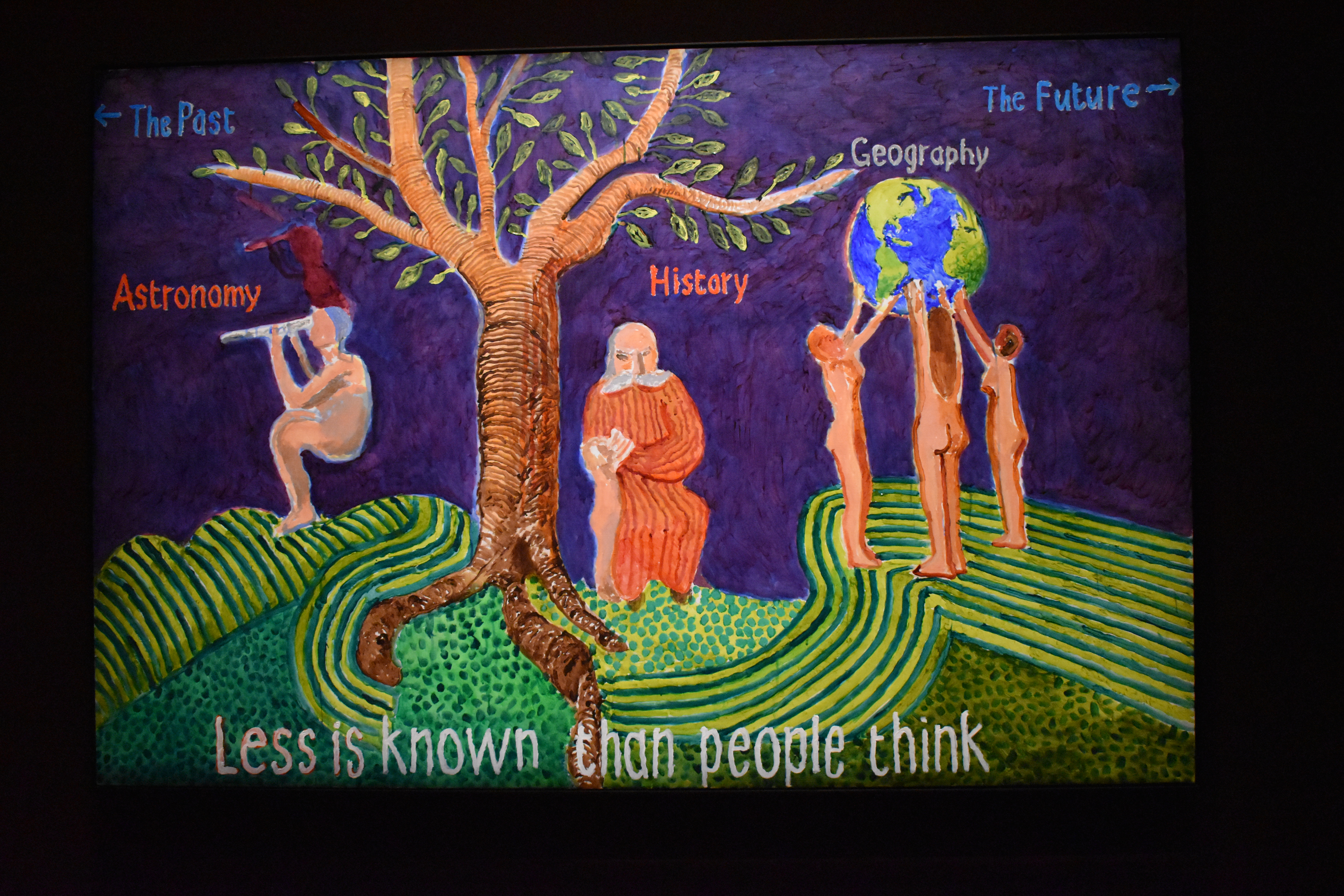
Then on to Munch and Blake (After Blake: Less is Known than People Think, 2023, left). This is the only image that alludes in any way to the welfare of the natural environment (the landscape gallery does not address any of our environmental challenges, indeed reproduces them with straightforward depictions of modern lowland farming). Blake’s painting was a representation of Dante’s Divine Comedy which, admittedly, I have never read. But here we have a holistic view of our human world – a dependence on the natural environment, the awe and fear of the galaxy and universe beyond, human history and a vulnerability (unclothed women holding up the globe) to the planetary system more generally. As we know, we have moved from the Holocene to the Anthropocene – our fate is in our hands, and we ignore the signals at our peril (increasingly decreasing temporality).
Theatre set drawing
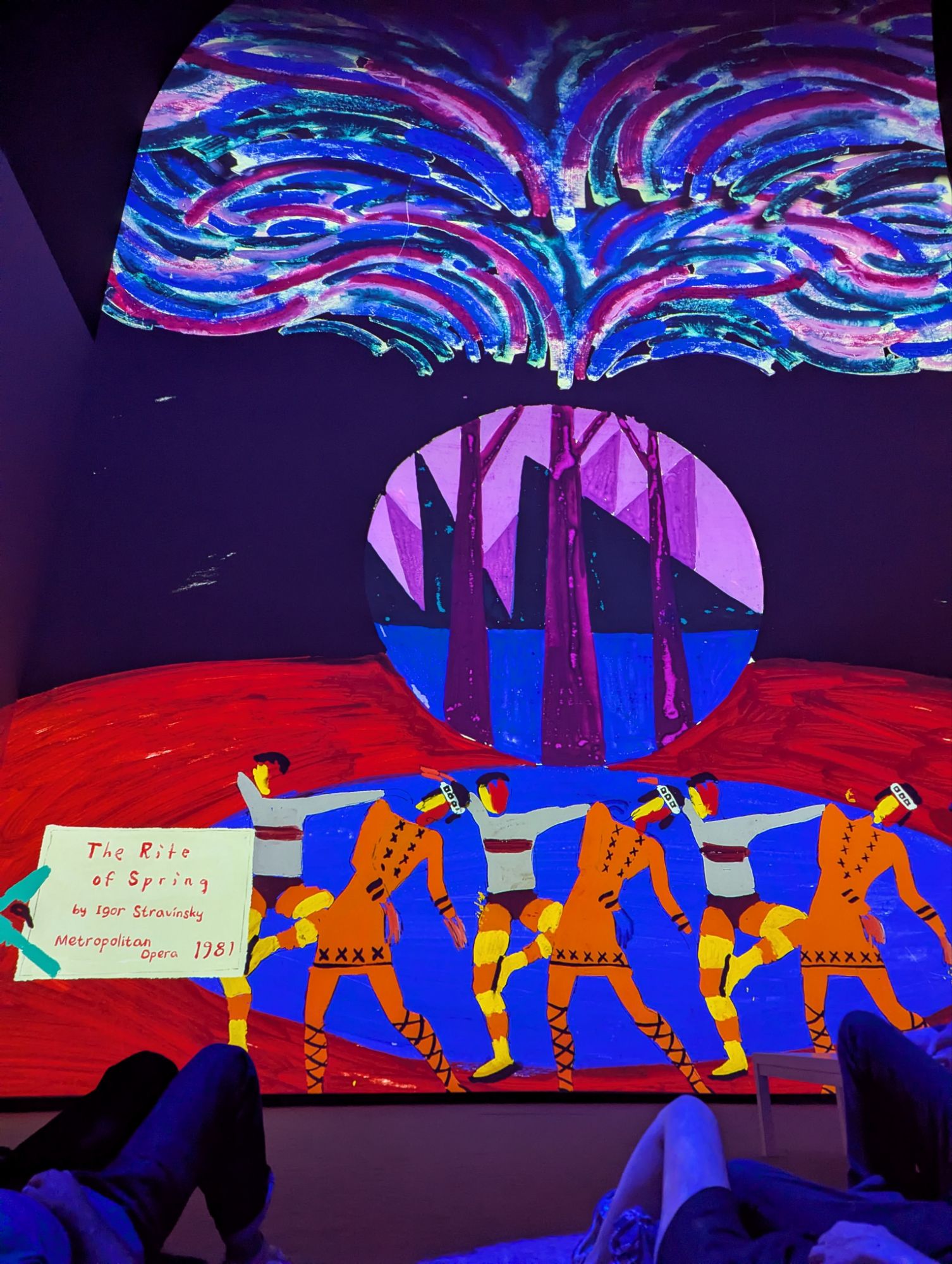
And then there is the theatre work. Hockney was a great fan of opera and throughout his career he has been painting backdrops for some of the great opera houses worldwide. For this exhibition his work is immersive. One enters a large gallery to observe the paintings projected onto walls, with some being animated and involving motion. They are terrific. Another important aspect is Hockney’s experimentation. For example, he has created intriguing electronic pictures that track his method for drawing and painting, particularly landscapes. All credit to him for this. I spent quite a bit of time over these images.
Photo drawing

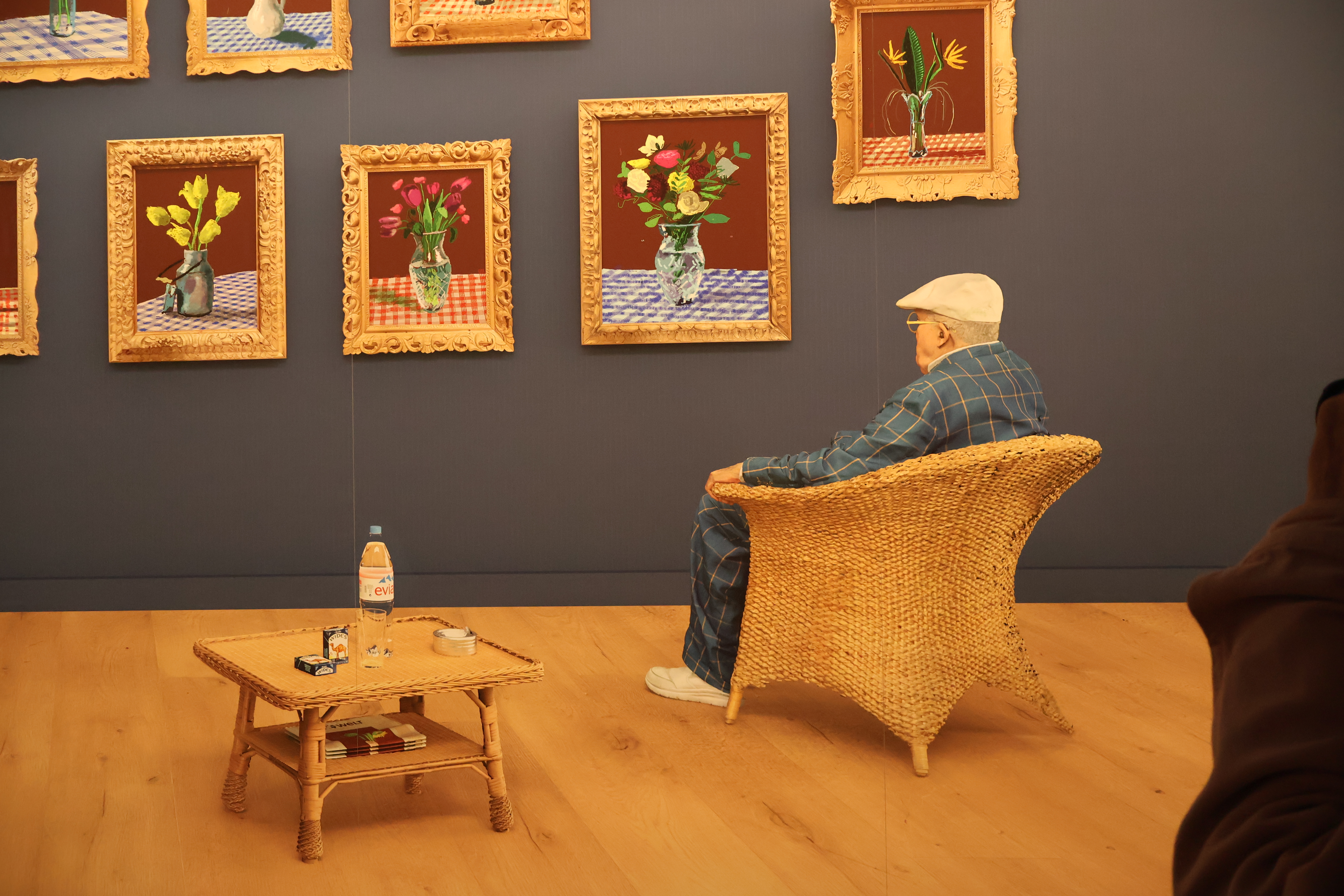
More recently Hockney has explored “photo drawing” (right – one of a series depicting the same “event from different angles). Equally in this almost recursiveness is his image of himself looking at his own pictures with subtle references to his own brilliance, such as the edition of “die Welt” underneath the small table (below left). And these, for me, sum it all up. Whilst I concede that Hockney is a versatile artist, able to work in most styles and genres and has a body of work that can fill the Fondation Louis Vuitton building in Paris. He is also just a shade too narcissistic for me really to embrace.
Exhibition ran from 9 April – 1 September 2025
 Be informed