Archive for the ‘Gran Canaria buses’ Tag
Being on the Island of Gran Canaria
Filed under: Travel | Tags: canary-islands, Gran Canaria, Gran Canaria buses, Maspalomas, nature, Travel
 Leave a comment
 Architecture
I think this is the first time that I have stayed at a place that is one big resort. And I was not quite prepared for what constitutes mass tourism based around sand, sea, eating and drinking. We are not staying in one of the resort hotels, we have a small apartment that we are renting from friends. So, we can cook our own food and observe.
The architecture of the island is split into two very distinct groups – tourism and colonialism.
The tourism architecture is, I presume, functional, but does not even have the merits of brutalist architecture that some of the post-war buildings in the UK herald (or suffered, as some see it). Here are a couple of examples from Maspalomas:


The building on the right really does emulate so many examples of telecom exchange buildings in England. It is breath-taking in its lack of sympathy. That on the left is a gap in the generic shops in one of the town’s shopping centers. I could go on with this, but will not. It is a cheap shot at functional architecture that serves its purpose and makes available tens of thousands of beds that simply are the local economy of the south of the island.

Good examples of the colonial architecture can be found in the capital, Las Palmas. I’m not impressed with my phone camera shot here, but this fine example is now a posh restaurant. Make of it what you will regarding style and period.
Public transport
Of course there are no trains on Gran Canaria. There seemingly once was a plan to build a tramway south along the coast from Las Palmas to Maspalomas (reminiscent of the tramway in Belgium between De Panne and Ostend), but there is insufficient money to invest. That said, the island boasts an extraordinary bus service. Las Palmas has its own yellow bus network, the rest of the island has the benefit of Globalbus services. The buses are largely single deck, 3 axel vehicles, a combination of Volvo, MAN, IVECO and Scania chassis (right). Their frequency is excellent – though the real-time information at bus shelters leaves a lot to be desired. Buses can be 5 minutes away for 15 minutes, never actually getting any closer. I’m not sure if I am confident about the published timetable either. From where we stayed in St Augustin east and west, there were plenty of buses during the day. Fewer in the evening (the last bus back from Las Palmas is currently 2115, which is a bit early if we had wanted to attend an evening football match or a concert). Plus, if one arrived at 2115 it would already have departed. Pretty sure about this by experience.
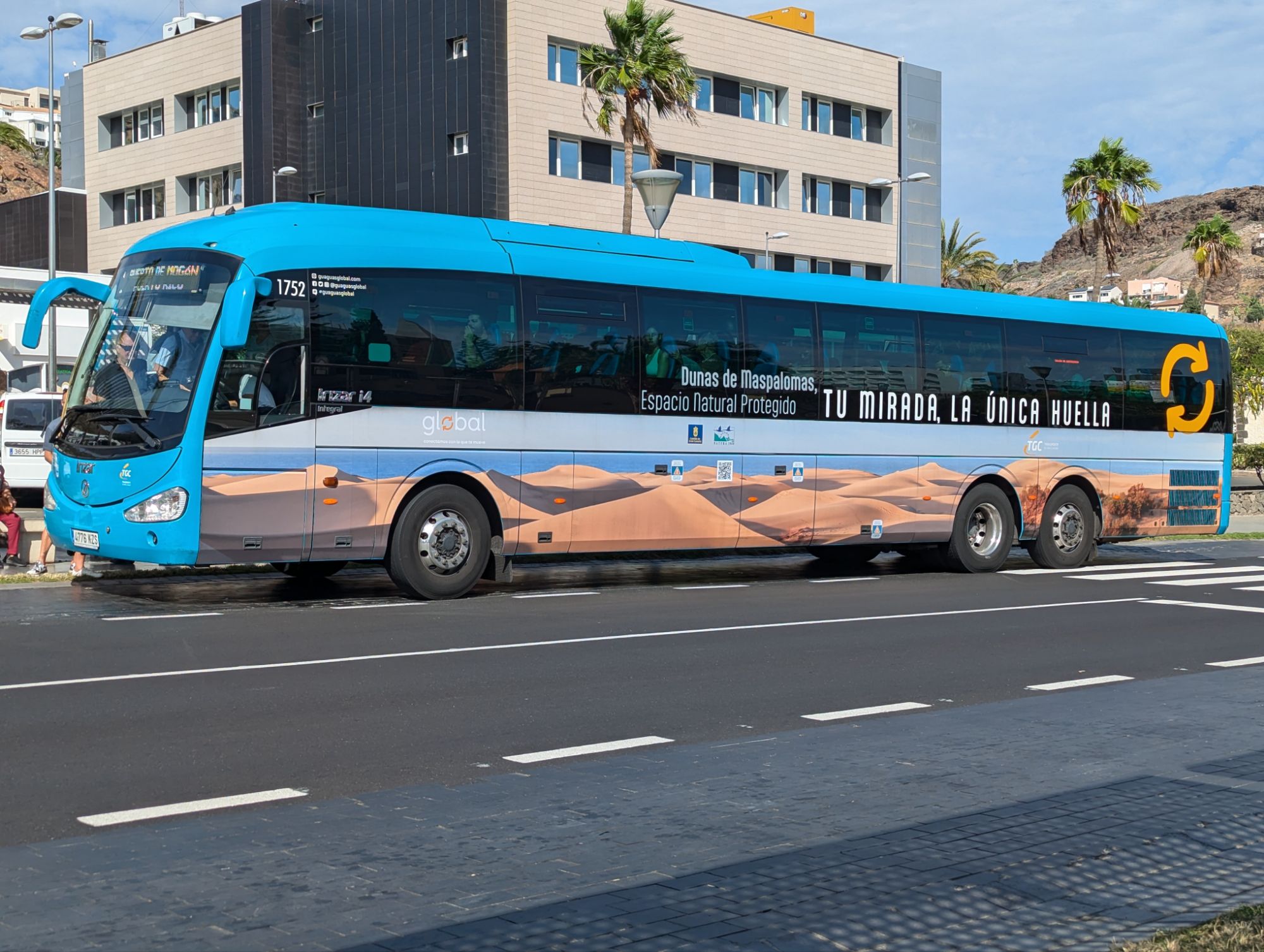
Each bus shelter has a list of destinations, the buses that serve that destination and the price. These range from €1.40 to €5.60 to various locations on the coastal routes. The drivers are amazing. They take no prisoners, for sure. Some of the routes are a bit like the Amalfi coast route in Italy – a bit, the architecture doesn’t compare – and the drivers work the roads with great skill.

We have also used the bus to get inland – into the interior mountains. These buses are fewer, of course, with last buses making it necessary to travel early. For example, to get to Tedeja, one really needs to be on the 0800 from Maspalomas to have enough time in the town and be able to return on the last bus at 1700. Once on, it is perfectly reasonable to regret it. The drivers know the roads and drive the hairpin bends like F1 drivers.
Public works
The roads along the coast are pretty good. I have seen a few rougher streets in the tourist areas, but the motorway along the coast – GC-1 is excellent. Though just like British roads, there are countless roundabouts (traffic lights are few). Inland, whilst the quality is good, they are narrow, bendy and cut into the side of the mountain (GC-550, above right).

I am always on the lookout for how the daily stuff is done. So, along the coast are very large rubbish bins. The are the same colour as the sand which is odd, because for people with eyesight like mine, I could do with them to be fluorescent pink rather than brown. I did wonder how they were emptied. And then I found out (left).
The trees are largely palms. I did just think they got on with it, but no, they are managed by the local authority (right).

Wildlife
The coastal area is pretty much bereft of wildlife.
Birds: I have seen a few small waders on the beach (Sanderlings and possibly Common Sandpipers), but nothing like the numbers I would encounter on a similar beach on the south coast of England. There are a few egrets on the island. Alien parakeets are everywhere, as well as collared doves. I’ve seen what I think my poor identification skills might claim to be Whimbrel. Gulls are not present in numbers. I trust I have seen a few black-backed gulls. On the lagoon near to the dunes of Maspalomas, there were three what appeared to be Glossy Ibises (they were rather dark-feathered, though). It has been a delight to see Common Hoopoes. Birders have classified the birds that one can expect to find here.
Reptiles: Of course, there are reptiles on the island. Again, on the southern coastal area, there are a few geckoes clinging to walls and scurrying into crevices. I was not expecting to find giant lizards in the tourist areas and I am sure that at night or early morning the dunes are busy with reptilian life (the rocks do retain their heat). I may need to revisit the hinterland and be patient.

And then there are crabs. Red-rock crabs to be precise (Red Rock Crab, Grapsus adscensionis).
. They are found on the rocks, particularly those inaccessible rocky areas where humans rarely go (it is quite dangerous). They are distinctive, mobile, potentially aggressive with one another, but a delight to watch if one cares to look. And I think that kind of sums up the island generally. It is not the most beautiful, but there is beauty if visitors want to find it, even in the architecture.
 Be informed