Archive for the ‘The Revenant’ Tag
The Revenant and The Road back-to-back
Filed under: Art, Reviews | Tags: Film review, Leonardo DiCaprio, The Revenant, The Road, Viggo Mortensen
 Leave a comment
 It is fair to say that I am deeply in my dystopia reading period, but it cannot all be about books. With a few hours “free” I accidentally started watching Alejandro González Iñárritu’s The Revenant instead of John Hillcoat’s, The Road. Easy mistake? But I am glad I did because the contrast is fascinating.
The Revenant stars Leonardo DiCaprio as the leader of a group of fur trappers in the literal Wild West (1820s, Dakota) – not the one I grew up with with John Wayne taking on “Indians”. The trappers are guilty of colonising both land and people. In fact the daughter of a chief was kidnapped and, if I understand correctly, ended up being the wife of Glass, DiCaprio’s character, and giving him a son who is, essentially, a trapping apprentice.
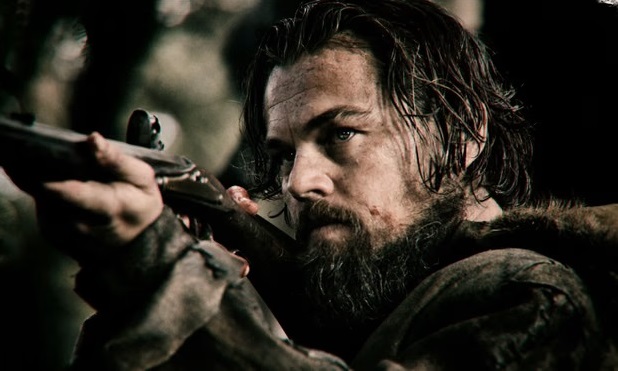
The film opens with an Arikara ambush on the trappers. There is gore. A few of them escape on a boat and then trek for quite some time back to the base trading post, Fort Kiowa. But on the way Glass found himself at the end of a grizzly bear’s temper (he is tracking her babies). She mauls him in a graphic 5 minutes of CGI realism. The injured Glass slows the progress of the trekking. It is agreed that one member of the team, John Fitzgerald, stays behind (along with the son, Hawk, and one other young trapper, Jim Bridger) to give him a Christian burial when he eventually dies. And to get paid for it. Fitzgerald is not patient and tries to speed up Glass’ passing. When caught trying to Euthanise him by Hawk, Fitzgerald kills him. He then partially buries Glass and takes the other boy with him.
Glass, however, not only remarkably and improbably survives, but witnessed the murder of his son. The will to survive, then, is driven by revenge. It becomes a classic Western with a familiar denouement. The improbability comes from scenes of self-surgery, extreme cold and wet. Some scenes resemble Bond movies with extended fight scenes. It is immersive, though. One feels the cold oneself. And the dirt is ground in. Notwithstanding the Western theme, this is a story, too, about nature. White humans exploiting it (in contrast to the native Americans). Certainly in that period, nature was to be tamed. A concept that is so familiar to us in the 21st Century. The problem with the movie – and one of the reasons I stopped watching them – is that the underlying narrative is that with enough will, nature can be tamed and overcome. It is fantasy.
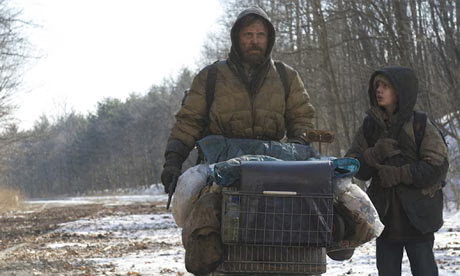
Whilst the backdrop to The Revenant is white colonialism, The Road is white decolonialism caused by some environmental catastrophe that ends civilisation. We never get to know what it is, but whatever it is it blocks out the sun so nothing grows. The whole point of existence becomes survival. The road in question is one followed by a man and boy (neither have names) to the coast on the assumption that there is a better life there. Though with no certainty. The passage is hazardous as one route to survival is cannibalism. I was not prepared for this, but I am constantly reminded that food security has been compromised by globalisation and the outsourcing of production to strangers in far away places. We are closer to “cannibalism” than we care to imagine. The Road reminds us that when hungry, people will do anything to survive, even eat one another. At least in the Revenant, food can be scavenged after the wild dogs have taken down a buffalo. In The Road, there are no animals to be scavenged, and by the time Man and Boy are on the road, all the shops and houses have been completely stripped.
In The Road, nature has taken back control. There are no blue skies. It rains relentlessly. The sea is grey. Man in pursuit of protecting his own son is prepared to kill – or bring on the death of strangers. The only compassion comes from the boy. Only the boy wants to share the food they have (accidentally found) with strangers who are equally hungry. The boy can see the transition from being the good guys – defined in terms of not eating others – and the bad guys who do. We are given few signs of hope. The discovery of a live beetle is but one.
After watching the films, I then read the reviews. Peter Bradshaw in the Guardian went as far to say that films like The Revenant are the reason he is a film critic. This was balanced by Carol Cadwalladr’s description of it as “meaningless pain porn“. Maybe that is why she no longer is employed by the Guardian/Observer and Bradshaw is? Bradshaw was less impressed by The Road, saying “I can’t fully share the critical enthusiasm it has widely gained elsewhere because of what seemed to me its fractional reluctance to confront the nightmare fully, though what Joe Penhall’s adaptation arguably does is import into the body of the movie a premonition of the unexpectedly redemptive and gentle tone in McCarthy’s final pages.” I have not read McCarthy’s book and it is not currently on my reading list. But frankly, another scene of cannibalism was not going to make this a “better” film. And like in The Revenant, women remain particular victims. It is they that try to protect the children and in so doing fall victim to hungry men who are, in all probability, responsible for whatever catastrophe caused the fall of civilisation in the first place.
What unites these two movies is the will of men to survive. Glass wants to survive only to avenge the death of his son. Man wants to survive because…we do not give up. There is a better world somewhere. All we have to do is find it. This is also a bit of a strange idea. I implore my students to leave the university and make the world a better place. I don’t say, go on a journey and find a “better” place. For a reason.
 Be informed