Author Archive
How capital took on labour and gave us climate change in 400 pages
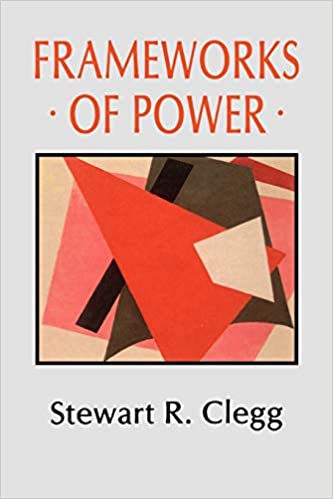 Back in 1989 when I was a student, I took a “course”, as they were called then, entitled Political Sociology. I took it because the other options were over-subscribed. I don’t know whether it was because I was not favoured that particular year and simply did not make the cut for other courses, or whether someone unbeknownst to me, concluded that Political Sociology was just what I needed. If the latter is correct, whoever it was, thank you. Without it I would not/never have read Stuart Clegg’s phenomenal book, Framworks of Power (left). There were 10 weeks of seminars (no lectures) and, each week, I or one of my peers would lead a chapter. Under normal circumstances, this would have been quite straightforward, but this book is tough going. Really tough going. Each chapter, I recall, took about 7 or 8 hours to get anywhere near understanding. Clegg was mischievous, he knew how difficult he had written it. He knew that students like myself would be required to read it. It is that requirement that meant that one had to persevere. The seminar leader was uncompromising on that, thankfully. The rewards for completion and assimilation were immense.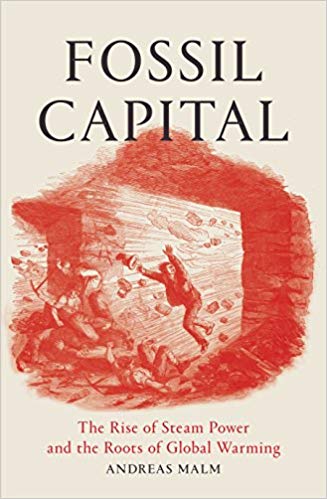
And so it is with Andreas Malm’s, Fossil Capital (right). This book takes no hostages. Its 400 pages are some of the most uncompromising prose. Malm is not in a hurry; and the reader is not invited to be in a hurry either. To be so would result in a less-than satisfactory outcome. It lends itself to being the subject of a “course” with 10 weeks of study. I am not sure that happens anymore. Malm’s book is basically in three parts. The first section is a history of the machinery that delivered the industrial revolution in Britain. The machinery was powered by coal (steam generation) – the reasons for that “prime mover” makes up 250 of the 400 pages. The second section is philosophical – Malm applies an essentially Marxist analysis (about 80 pages) to get to the nub of the cause. The third section is Malm conceding a certain pessimism about the future; about humanity’s ability to get out of this mess. Verso, the publisher, was, apparently, committed to the project. They must have because had they not been, an editor would have cut by a third, if not more. That would have been a shame because the detail, often repeated, assists with the final analysis.
Prime Movers in the industrial revolution – water or steam
The detail is awesome. Malm’s account of the work of Robert Thom’s water projects, the pinnacle of which was

Greenock Cut sluice building
the Greenock Reservoir and its 6-mile long acqueduct (the Cut). Much space is given over to Thom and his projects in order to demonstrate how water as a “prime mover” – with imaginative and skilled civil engineers at the helm – could have provided all of the power needed by the textile industry. That was not the purpose of the Greenock reservoir, but the engineering that delivered water to the town could also deliver water to mills, turning wheels to power spinners inside factories. In fact, the Greenock project offered 1666hp as a basis for a “vibrant” – probably sustainable – cotton industry around the town. (It was calculated that mills could share this power, each with 50hp – the average from steam at that time was 29hp.) The potential was never realised and the reasons clear.
First, flowing water was a shared resource. It was a commons – it could not be owned, only managed. The mill owners simply could not co-operate to provide the necessary investment and also self-regulate. Some sites were better than others; the less-well served sites would require other users to regulate their own consumption to maximise the utility of the resource on a daily, monthly and yearly basis. Plans for developing the River Irwell in Lancashire ultimately foundered here. Other schemes were unable to get parliamentary approval not least because cotton industrialists were well represented in the House of Commons.

Quarry Bank Mill, Styal, Cheshire
Second, labour militancy and mobility. On the latter, water mills were located along river courses outside of main towns and cities, such as Manchester. In order fully to attract and maintain a workforce, mill owners had to provide additional resources such as housing, education, leisure and places of worship. There are exemplars – Richard Arkwright’s so-called colony in Cromford, Derbyshire and Finlay’s in Catrine, Ayrshire, for example. Colonies had their issues, but they provided sanitary conditions for employees and their families. The benevolence was not always appreciated and workers often “absented” themselves which resulted in owners taking on “unfree” workers – nothing short of slave labour, that was dispensed with after 10 years’ of indentured service. The apprentices were recruited from the age of 12 and often came from workhouses. The colonies also bred labour militancy – wages were going down and work rates increasing. In March 1830 there was a definitive and violent strike in Arkwright’s New Eagely Mill.

The Apprentice House, Quarry Bank Mill
Where capital is not mobile, it is not optimised. Whilst coal needed for the steam engines that drove the spinning machines was expensive relative to water, it was mobile. It could be deployed in major towns and cities relinquishing the need for additional “colony” investment. It could be controlled and managed by individuals – the owners themselves. Labour was also eminently more controllable. With no colony commitments, costs were managed. Coal was expensive to transport so mills and mines were often co-located (e.g. Wigan, Oldham, Ashton).

Steam engine,_Nortonthorpe Mills, Scissett
Come the legal curtailment of the the working day in the Factory Acts of 1833 and 1844, whilst consistently violated by mill owners, eventually capital substituted machines for labour and intensified the work of those remaining (easier to do with steam than water). Though this new intensity often led to steam engines exploding! Resistance was inevitable and the targets were the steam engines (whose plugs were pulled releasing the water) and the coal mines. The resistance movement is usually remembered as that of the Chartists seeking representation (of men) in the Parliament. From 7 August 1842 increasing numbers marched through the mill towns pulling the plugs on steam engines (seemingly more damage than that was done to mills). There was little resistance.
The ability of strikers to maintain their action was, however, tempered by two factors: hunger and the intervention of the state. The army was deployed on 14 August in the mill towns enabling the mill owners to re-insert the plugs and restart their engines. Malm notes that some 15000 “[S]trike leaders and Chartist agitators were nabbed in batches” (p235). Perpetrators were imprisoned, some were transported (to foreign colonies); meanwhile, damaging or sabotaging coal mines was made a capital offence leading to the execution of textile workers.
Explaining why steam

Andreas Malm
Malm’s logic circuits are never opaque. When one finally reaches (p255) his analysis chapters, there are no great surprises. What is a surprise – though I have no idea why I am surprised – is the lengths that he goes to to eliminate independent variables as causes of steam/fossil over water as industry’s prime mover. It is clear already that Malm points the finger at capital’s control over labour. Malm, however, has to deal with the arguments from others such that coal was a means for humans to realise the natural inclination towards growth and overcoming a dependence on nature for life. He refers to this as the Rickardian-Malthusian explanation. Growth using fossil fuels was always latent, it just needed the right moment to flourish, goes the argument. He concludes that this is rather circular: “The shift to fossil fuels is explained by the impossibility of self-sustaining growth without them, the onset of self-sustaining growth by the shift to fossil fuels.” (p259) Step-by-step Malm takes away competing theories leaving one only: capital. At the heart of capital is ownership – property rights, rentierism. The crown privatised land and minerals below it in the 1570s – the so-called Elizabethen leap – leading to further enclosure of the commons. Granting of mineral rights lead to the commodification of coal.
Comparative advantage – globalisation of capital

Environmental Kuznets Curve
The Kuznets Curve (right) posits that as populations get richer, pollution – and greenhouse gas emissions – declines. Whilst the initial growth is dirty when incomes are low, the environment is cleaned up as incomes grow. Malm points out, however, that the Kuznets curve is only “true” if capital is static. The rising incomes are geographically specific. However, capital moves usually as Foreign Direct Investment. Generally it moves to where incomes are low (drawing on comparative advantage). An element of the comparative advantage, argues Malm, is carbon emissions. Firms relocate their dirtiest activities to countries with low incomes in order to externalise their emissions. Those emissions are then not counted against emissions for the firm’s host country or the consumer’s. Significantly, Malm writes: “In 2001, China entered the WTO, dismantled the remaining barriers to investment, abolished restrictions on foreign ownership, relaxed requirements on local cooperation and, in general, flung the gates wide open: then the real explosion began.” (p331). The western world externalised CO2 emissions to China in exchange for unimaginable growth in GDP. The Kuznets Curve is reversed. Rising incomes lead to fresh waves of capital mobility and more environmental degradation geographically dispersed.
Fossil fuels always win out against renewables
 In 2006 Shell sold its solar subsidiary. By 2013 BP had exited the solar business, too. The margins were insignificant and the electrical energy generated were too cheap to make the necessary profits. For as long as oil had a market price, company boards look to focus on maximising earnings, not contributing to climate change mitigation – which is perhaps what the solar industry had become. Oil and coal still have healthy market prices for a number of reasons: when countries like China are looking to industrialise fast, they turn to coal to produce the electricity for the factories. Not to renewables. Coal and oil are commodities. They are tradable and they themselves have an exchange value in the chain or flow of production. They are commodity inputs that add value and require considerable capital deployed on which numerous other stakeholders benefit – from banks, pension funds and other industrialists. Moreover, the assets are long-lived. Coal-fired power stations coming on line now will produce electricity for 50 years or so; and for some of that time, they will produce electricity at high margins once the debt has been serviced.
Those with vested interests in fossil fuels do not necessarily deny human-induced climate change, rather they advocate a technical solution rather than a social and structural one. Bill Gates (right), notes Malm, is one of  the biggest global investors in geoengineering research. He owns shares in a venture that seeks to put sulphates into the higher atmosphere to reflect away the sun and cool the planet. This technology has dramatic side-effects and has to be administered yearly. Sulphates “deplete the ozone layer, upset precipitation patterns, possibly shut down the Asian monsoon, disrupt photosynthetic productivity, whiten the sky, tinker with the balance between day and night as well as winter and summer, contribute to thousands of air pollution deaths per year…lower the efficiency of solar panels by diluting the sunlight”. (p387) Other geoengineering options include carbon capture and something to do with mirrors!
That leads to a further challenge – and it is the same problem that besets attempts at carbon mitigation; namely, global coordination. Humanity simply cannot do it. The current incumbent of the Whitehouse sees the world in zero-sum terms: winner takes all. No politician is willing or able to countenance the structural changes necessary to bring about the scale of change needed. I write this whilst in the middle of the Covid-19 pandemic shutdown in the UK. The UK Government was not even willing to join with EU member states to procure PPE for health service workers, let alone coordinate global climate mitigation. Indeed, the pandemic has shown us only too well how incapable the international community is to work for some kind of global good that does not confer advantage, and that facilitates a transfer of wealth from the rich to poorer, even if such a transfer is it own interests (rich countries, that is). Consumers, too, are complicit, especially those of us in those rich countries. Are we prepared to consume less, or are we, too, looking for the technological fix that enables business-as-usual? We seem to be prepared to wait and see what Bill Gates comes up with. There’s a 10-week course in there somewhere.
Pictures:
Greenock Cut:
Quarry Bank Mill: Mike Peel (www.mikepeel.net)
Apprentice House: Peter Fuller
Steam Engine: Chris Allen / Steam engine, Nortonthorpe Mills, Scissett
Andreas Malm: https://www.goodreads.com/author/show/292496.Andreas_Malm
Environmental Kuznets Curve:
Bill Gates:
Climate Watch: update on airlines
Filed under: Easyjet, Environment | Tags: Easyjet, ICAO, Stelios Haji-Ioannou
 Leave a comment
 As predicted, the airline industry is now trying to wriggle out of its commitments on carbon emissions and climate change. Only last month, the industry agreed a protocol whereby airlines would pay to increase  carbon emissions (through offsetting) based on some sort of average for 2019 and 2020. As we now know, 2020 will be a record low carbon year, and the airlines, many of which have all planes grounded because of Covid-19, are now saying that committing to this new level would make them bankrupt, notwithstanding that many of them are already.
To be fair, the industry body, ICAO, has not yet shifted, but it is being lobbied hard – understandably – by airlines to re-evaluate the threshold. Seemingly, it was already going to cost the industry between £4bn and £18bn (not much of a difference there, is there?) – which just goes to show how much more carbon they intended to put into the environment on growth projections (now, of course, unlikely).
And th en there is easyJet. Readers may already have been following the story of how founder and major shareholder, Stelios Haji-Ioannou, wants the firm to cancel its order for 107 Airbus A320 Neos, planes that are necessary if easyJet is to meet its targets for carbon reduction. However, for Haji-Ioannou, that is no longer viable. By which he means under the current easyJet and industry business model and not under an ICAO – or other – environmental commitment. At what point does he smell the coffee?
Pic: Adrian Pingstone
Climate watch: watch the airlines wriggle
The airline industry thought it was being clever. Its pledge on climate change engineered by ICAO (International Civil Aviation Organization) – bizarrely a specialized agency of the UN – was to commit to not breaching carbon emissions above the averages for 2019 and 2020. Any increases would be paid for in carbon offsets by the offending airline. But of course the current year, had it gone according to plan, would have been a record year for aviation. Now with most planes on the ground indefinitely, the committed target will be really really low. So, yes, let’s embrace it.
Shareholders against the planet – knowingly or unknowingly
Filed under: Covid-19, Easyjet, Environment, Politics | Tags: Easyjet, Stelios Haji-Ioannou
Leave a comment  Stelios Haji-Ioannou (right) is founder and major shareholder (about 34 per cent) in easyJet, the budget airline. When he established the airline that challenged incumbent “full-service” airlines back in 1995, climate change was not well understood in business circles (though as we know, the science was maturing and the Earth summit had taken place 3 years’ earlier in Rio). Easyjet is now a very large airline with over 300 aircraft and a market capitalisation of £4bn.
In recent times airlines have become environmental villains responsible for almost 3 per cent of all carbon emissions (and about 12 per cent of all emissions from transport). The low-cost model of easyJet and others has encouraged travel and made it possible to commute over long distances. This has been regarded as a good thing economically. A global pandemic, however, sees airlines at the forefront of a new battle against another invisible enemy, Covid-19. That market capitalisation has collapsed, and the 300 aircraft grounded indefinitely. Easyjet – along with other airlines – may well seek state aid to support the business through the crisis.
The question of state aid for airlines – major contributors to climate emissions and hence climate change – puts the Government in a difficult position. Neo-Liberal Governments like that in the UK are generally opposed to state support. Indeed they do not even protect strategic industries and businesses from foreign buyers. So any support eventually given to scheduled airlines serving a free market (I accept that some airlines serve niche, fragile and social markets such as Logan Air) will challenge neo-liberal ideology and raise questions about ministers’ proximity to business leaders in the industry. Cash transfers to easyJet would lead to Richard Branson’s Virgin Atlantic receiving similar. That would be difficult to countenance.
The management at easyJet now has an added problem. Knowing full well that their industry is a problem in the carbon economy, there are two – what one calls – mitigating policies. One is more effective that the other, but neither are a solution. The first is offsetting; in the easyJet case, that involves committing to planting trees, though there are many offset schemes that involve investing in developing countries’ own mitigation policies. The second is buying a fleet of more efficient aeroplanes. Easyjet has opted for a fleet of Airbus A320 Neos and they are arriving in batches.
Stelios Haji-Ioannou is not, seemingly, very happy with this. He is now calling for the whole order to be cancelled. He believes, with some justification, seemingly, that the order threatens the solvency of the company. Moreover, as Nils Pratley in the Guardian writes, the company may need to be recapitalised: “Haji-Ioannou says he would support a rights issue – as he should given that his family has collected £620m in dividends since 2011, including £60m this month – but he is vowing to make his backing dependent on an Airbus cancellation. Given the size of his shareholding, he has some clout.”
So here is the conflict of capitalism laid bare. Without the new planes the company will see carbon emissions increase and probably be subject to some regulation or tax (or both). The company will also lose considerable customer credibility on anything it says in the future about caring for the environment. But with the planes, at best shareholders will have to recapitalise, at worst, the company goes under. Plus, very rich man determines the future of the planet. Which side are you on?
Picture: Audiopedia
Nudged into not wasting
 It can take a serious nudge to get people to do things that modern living has sanctioned as not necessary, such as not wasting anything. Covid-19 and impending climate change have been nudging me. I’ve also been nudged – or prodded – by experiencing a self-inflicted reduced income. Over the years, I’ve been pretty good at not wasting, but a few things have found their way into my bins.
I am a big fan of brocolli. I do not recall it actually existing when I was growing up, but it is ubiquitous now. That stalk has always been a bit of a problem. In to the bin, out of sight, has been its normal fate. In recent weeks, I’ve been eating it. Largely in soups. This one on the left has a couple of stalks in it, plus a load of celery that was beyond crunch, put perfectly nutrious. Also in there is pepper, onion, silken tofu and, of course, water. It looks a bit anaemic, but it does the job. I think a good pot adds to it. This one from a ceramacist working out of Beverley in East Yorkshire. Her name currently escapes me. I’m a bit of a sucker for ceramics.
If you want to know more about not wasting food, this is Alex Andreou talking sense.
My new photographic project
 I got out my Minolta X-300 (left) the other day. There was a film in it; about 10 frames left. Having been on strike for part of the previous month, a bit of photography, I thought, would be cathartic. I took a few pictures of fellow strikers, but pictures of marches are not really very interesting. On this blog I have managed to get quite a following around my photographs of cigarette posters over the last 8 years. One aspect of that is how ephemeral they are. A campaign poster can be up for as little as a fortnight, and then it is gone. So I have captured a record of something that is no more; though the original plan was simply to ridicule the concept of cigarette advertising, not to create a repository of advertising posters. But there you go.
It made me think about other ephemeral things in society. I wish, probably like many others, that I had captured more images of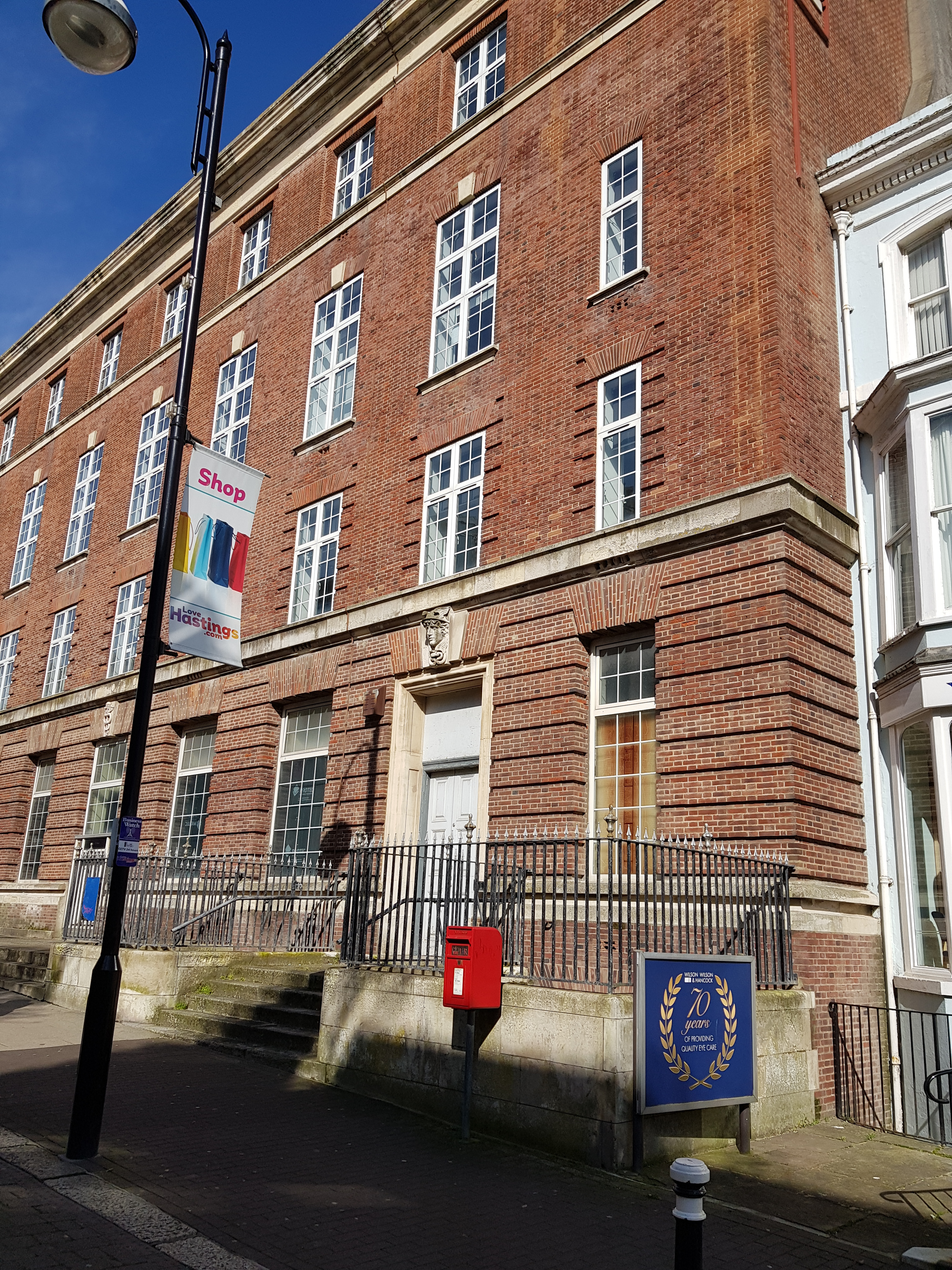 normal life throughout my time (I’m now 55) living in the UK; many of the things that we thought were permanent were not. And things are still changing. I gave some thought to the ephemerality around me. What have I taken for granted and may disappear in the not too distant future? The answer, pillar boxes! So, I began photographing pillar boxes. For those of you reading from abroad, a pillar box is a place to post letters – essentially, hand them over to the post office to deliver to whoever. A service very much in decline.

ER Pillar box, Marina, Hastings, 13 March, 2020
I discovered that many of the very solid steel ones are being replaced. There is an old grand post office building here in Hastings, UK (right) where the boxes have been replaced by much smaller versions reflecting less traffic but also the relocation of the main post- office counter. So, I think, perhaps, that it is about time that I captured the variety of pillar boxes with my camera. However, that does not seem enough. Then I came up with the idea that I should try to combine pillar boxes and another passion of mine – and something else that is ephemeral – buses. I’ve started with the shot (left). With a film camera, it is tougher than it looks. The bus passes a pace, the light has to be sufficient and in the right place. But as a first effort, I’m quite pleased with the result.
Climate Watch: the EU’s Climate Law
 The new EU Commission president, Ursula von der Leyan, and her deputy, Frans Timmermans (left), are championing climate change. There is a Green Deal for Europe which will facilitate the creation of a sustainable new growth model. The Deal’s critics range from activists like Greta Thunberg and climate scientists Jean-Pascal van Ypersele, a former vice-chair of the UN Intergovernmental Panel on Climate Change (IPCC). Van Ypersele argues that the deal does not seek to keep temperatures below the 1.5 degrees agreed at Paris in 2015. Indeed, he argued, that the EU should be pushing for carbon neutrality by 2040 rather than 2050.
With that in mind, how do we explain the EU’s lack of ambition, for want of a better term? Could it be the fossil-fuel lobby? Aude Massiot, writing in the Guardian, has identified the lobbyists and their targets, and they are uncomfortably close to one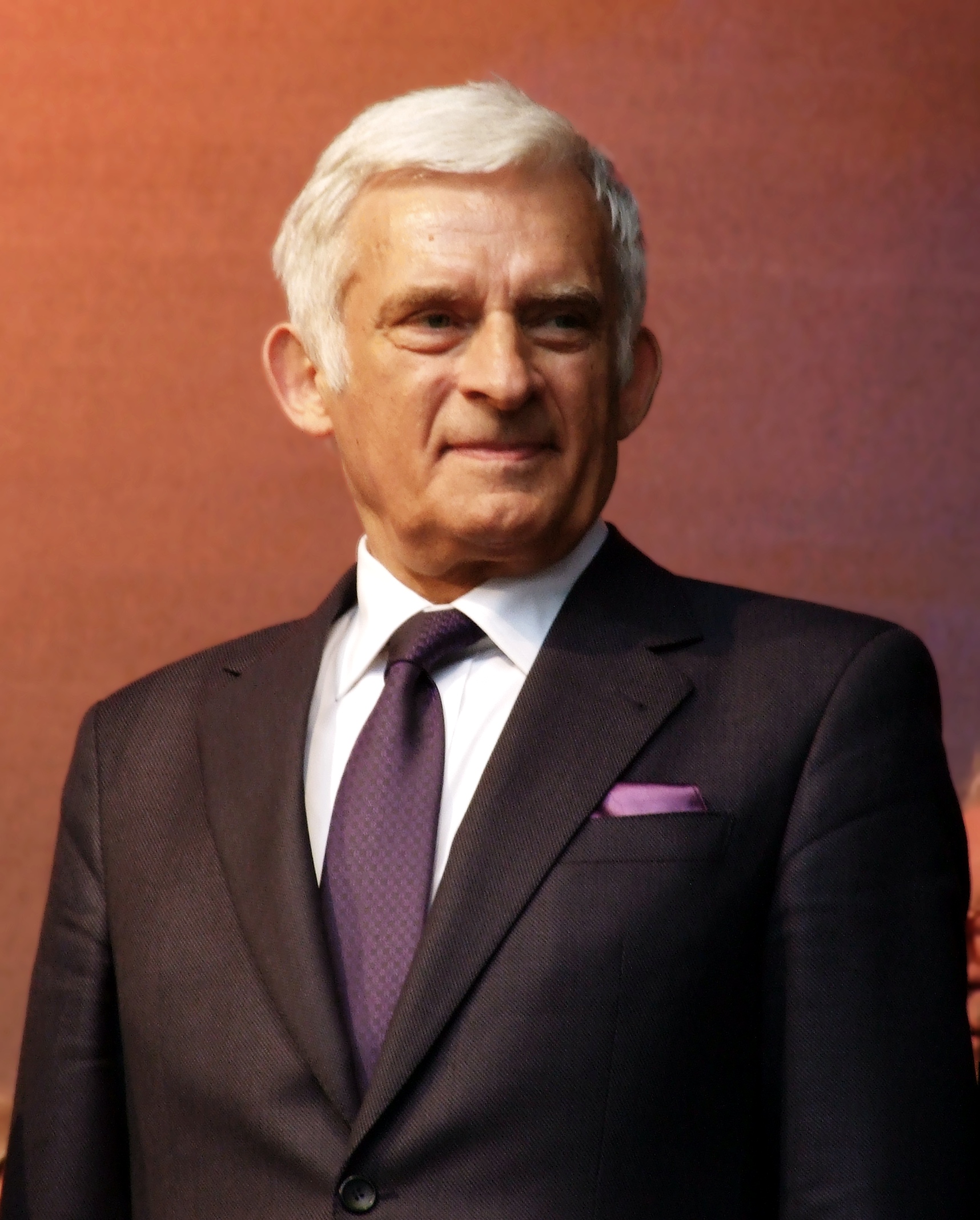 another. Guido Bortoni, Croatia’s environment minister, current holder of the EU presidency, goes to his mailbox and finds a dinner invitation from MEPs part of the European Energy Forum (EEF), headed by Jerzy Buzek (right), a MEP for the European People’s party (EPP). He’s a former prime minister of Poland, a former president of the European parliament and chairs the industry research and energy committee. The forum has associate membership – with a €7,000 a year in membership fee. There are 82 of these all from the oil and gas sector. And dinner is sponsored by the International Association of Oil and Gas Producers (IOGP). No journalists, no NGOs. The IOGP’s access is seamless. On 17 December it met Ditte Juul Jorgensen, the head of DG Energy; though seemingly other EU directorates are equally accessible.
 Prior to this dinner IOGP spent €350,160 in 2018 lobbying in Brussels. The real lobby costs are much higher, perhaps as much as €250m. Thinktanks are common vehicles for influencing legislation. In this case the favoured thinktank was the Centre for European Policy Studies (CEPS). Lobby breakfasts have been attended by key policy makers such as Timmermans who is directly responsible for the composition of the law. Moreover, the lobbyists often have accreditation to the European Parliament building. Also watch out for this year’s Eurogas conference on 19 March in Brussels; the keynote speaker will be Kadri Simson (above left), the energy commissioner. It will be interesting to see what she has to say about the industry.
Massiot calls this “revolving doors”. Former officials of the EU becoming lobbyists and vice-versa; for example, Jean-Arnold Vinois (below right) is energy policy adviser at the Jacques Delors Institute. Delors, for course, was a former EC president and so the thinktank that bears his name seems to be respectable enough. However, 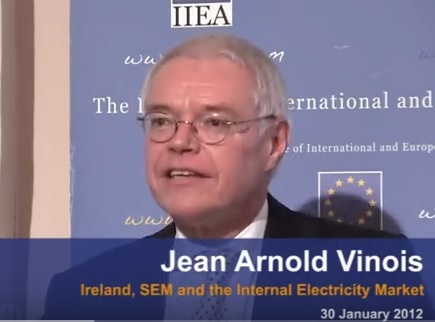 Vinois is also an honorary director for energy at the commission and a consultant at FleishmanHillard, another Brussels-based lobby organisation. FeeishmanHillard has an interesting customer portfolio; including, the European Chemical Industry Council (Cefic), Gas Naturally and Fuels Europe all rather interested in keeping things just as they are.
For readers looking for indicators of scepticism and keeping things as they are, any firm or lobbyist suggesting the carbon capture and storage (CCS) is a solution, should be a clue. CCS has potential, no doubt. But it is only potential and has insufficient capacity and scalability to make much of an impression in carbon emission totals towards 2030. Eurogas is, notes Massiot, working closely with the Global CCS Institute to promote the technology and conceivably divert resources away from reducing carbon emissions toward an unproven and unrealisable technological fix. The fix is simple: reduce carbon emissions, keep fossil fuels in the ground, consume less and stop deforestation and promote reforestation.
Pictures: Timmermans, European Parliament from EU
Jerzy Buzek, – Own work
Kadri Simson – subject’s own work, Wikipedia – https://en.wikipedia.org/wiki/Kadri_Simson#/media/File:Kadri_Simson_2017-05-25_(cropped).jpg
Jean-Arnold Vinois – screen grab from youtube: https://www.youtube.com/watch?v=tu3S7FW-2iw
Onshore wind turbines again supported by the British Government
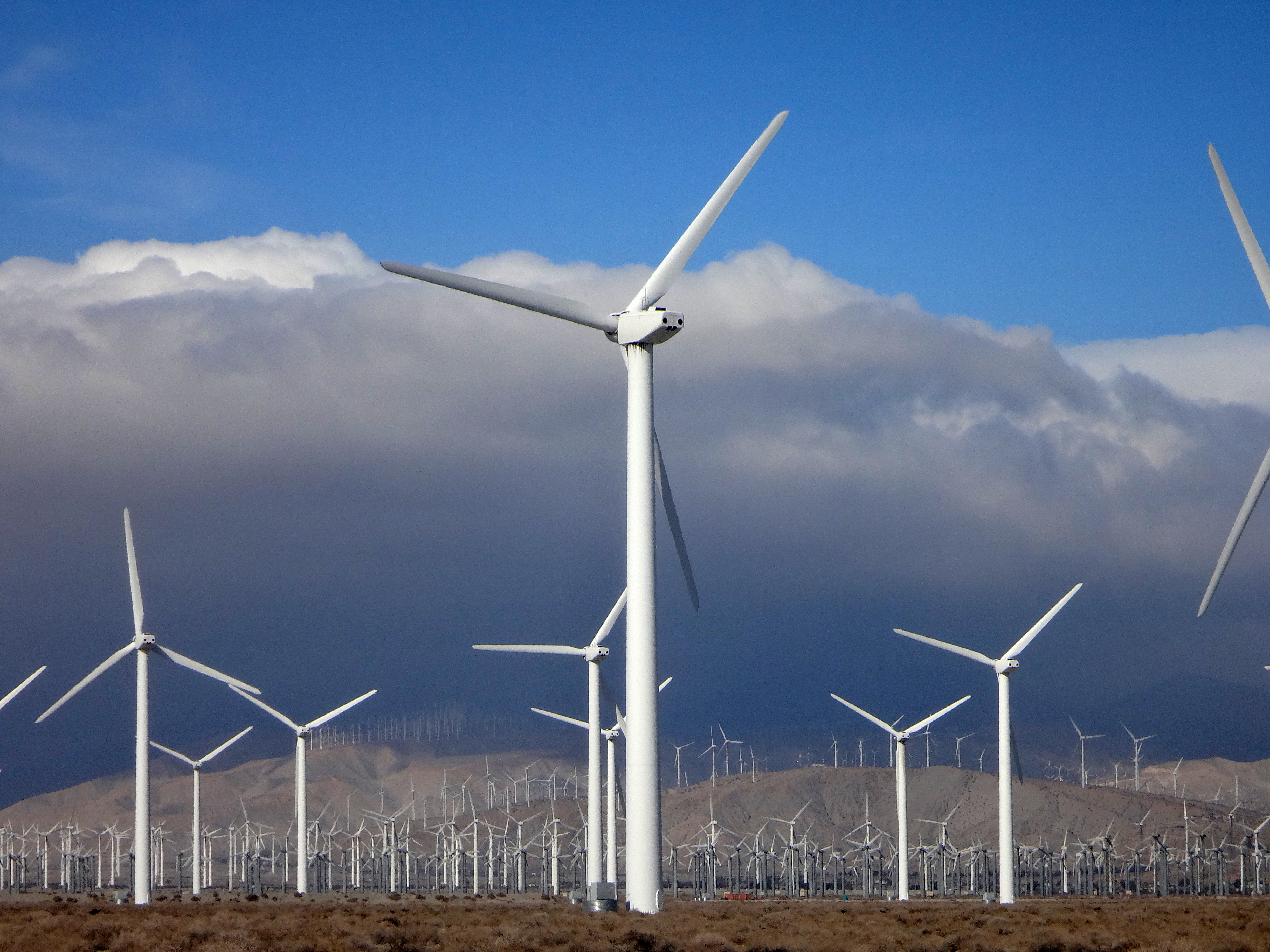 Out of the blue – at least for me – comes the news that the British Government is lifting its opposition to subsidising onshore wind turbines in support of meeting carbon emission targets. In order to meet those targets, it is estimated that onshore wind turbines will need to triple in number in the next 15 years. Wind turbines are unloved by Conservatives but are the cheapest and cleanest source of renewable energy. Whilst projects can now compete for funding against other renewable sources, it is not clear how the planning system will accommodate the change.
Picture: – harvesting wind
Built-in obsolescence
 Here’s my Russel Hobbs iron (left). The cable is wearing and exposing the live wires within. The fix should be to rewire it. But it is well-and-truly sealed. No way in. I know they would say it is a safety feature, but I cannot even take it to an electrician to fix it. It is, essentially, waste.
Darning socks
 When I was growing up, my grandmother used to knit my socks. I did think it was very uncool to wear knitted socks. Even worse, when a hole appeared, my mother darned the hole. My feet were always warm. And as a child, sartoriality was not much of a factor.
Today I have darned my own socks. Two motivations; first, the environment. It the past, holes such as those (left) would have warranted disposal. Against the backdrop of climate change, darning them is now just another one of those Sunday tasks. Second, I am on strike. This is knocking quite a hole in my finances. Repairing saves money. And quite a bit. It is not just about buying another pair of socks. I do not think I ever go to the shop and buy only what I intended to buy. The solution is not to go to the shops at all!
 Be informed
.jpg)