Archive for the ‘Environment’ Category
Brenda says…
Filed under: Brexit, education, Environment, Housing, Politics |
 Leave a comment
 Brenda is just an ordinary woman in Bristol. She was questioned on the street by a BBC journalist and she said that she was fed up with politics – there is too much of it about at the moment – and she just wanted to live her life in peace. That is a bit of a paraphrase, but only a bit.
Let me be clear, I do not want an election. What is the point in a fixed-term parliament if an insecure Prime Minister decides that she needs a personal mandate for her mendacity and push for majoritarianism and the limited state? However, if we are going to have one – precipitated to some extent by the EU’s interregnum over exit terms – then so be it. But this is no ordinary election. I’m 53 and I believe this is the most important election in my lifetime. We can let the Conservative Party for the foreseable future dominate the executive and legislature (not to say judiciary if recent experience is anything to go by) or we can stand up for something bigger.
This is not a party-political election in the normal sense. Notwithstanding Brexit, this is an election to stand up for public services, the NHS, education, housing, social care, the environment, liberty and decency. All of these things the Conservative Party seem to be willing to denude or abolish in pursuit of power. Not the public good.
This will be an ugly island if May achieves her aim. All opposition parties have to work together on this one. This is not about Labour, LibDems, SNP, Green. This is about a future. Brenda needs to engage, vote and learn.
End.
Will the EU let the destruction happen?
For reasons that I cannot explain, I have been affected by the so-called Islamic State’s destruction of UNESCO World Heritage Sites such as Palmyra in Syria (below right). The destruction of ancient artefacts for religious reasons somehow seems personal, and that is not diminishing IS’s penchant for killing that seems part of their ideology. But why should the destruction of ancient temples which I have not visited bother me?

Yesterday the Guardian newspaper ran a story about the impending destruction of another World Heritage Site, this time in Europe and by a member state of the EU. The site in question is the Białowieża forest (left). It covers an area of 150,000 hectares in Poland. It straddles the border with Belarus, where it is entirely protected as a nature park. It is home to 20,000 animal species, including 250 types of bird and 62 species of mammals – among them Europe’s largest, the bison (left).
The government has passed a law allowing 188,000 cubic metres of trees to be felled by 2021. It is argued that some of the trees – maybe even 1 million spruce trees – are infested with bark beetle and are dying. The felling, however, seems to go way beyond what is necessary to contain the infestation – assuming it needs dealing with at all. Nature is pretty good at regeneration.
The Polish government seems to have put a price on the forest. The logging in Białowieża is expected to raise about 700m złotys (£124m); however, some see it as the thin edge of the wedge. Undermine the viability and diversity of the forest and that might pave the way for extensive and lucrative tree clearances (as if what is proposed is not damaging enough).
So, what is the link to the so-called Islamic State? Well IS was not a member of the EU, or even the UN, so negotiation over the Palmyra site were difficult to arrange. There was not much sanction at that point in time. They willingly filmed the destruction for posterity, keen as they are to share their violence with us. Poland is an EU member state. Sanction is there if it chooses to exercise it. We shall see.
But the story did help me with the question of why it might bother me. Both sites are ancient. The trees or the relics – if they could speak to us – could tell us much about ourselves, our history and origins. I know they cannot. Both are irreplaceable. Take them away and they cannot be replaced. With forest, the whole eco-system is lost. The flora and fauna will die. That is also an issue. With the ancient relics, we erase our link to history, ancestors and the humbling that often comes with huge ancient buildings erected without, at the very least, lifting technology. Wonderment, that is the connection.
In the comments accompanying the article in the Guardian newspaper (link above), one comment suggested that countries with elected governments can do what they like with their land. And there lies the problem. Human beings believe the land and its content to be theirs. They are resources to be exploited. They are very rarely viewed as there to be protected, even though protecting the forest sustains the environment on which we depend. Humanity often struggles to see itself as made up of organic life forms. Rather humanity locates itself as some superior entity removed from its place in nature.
Will the EU act?
Pictures:
Bison in forest: Herr stahlhoefer, Wikipedia
Temple of Bel, Palmyra, Syria, Bernard Gagnon, Wikipedia
Belawege
University of Brighton degree show 2015 pt 1
Filed under: Art, Environment | Tags: University of Brighton degree show 2015
Leave a comment Here is my annual review of the best (in my humble opinion) of the degree show. In light of the recent election result and my passion for students and young people more generally to engage with the political process, I highlight in the first instance the work that prompts thought about change and the environment.
First, let us start with the graphic designers whose task is surely to help us navigate the complex environment in which we live and to alert us to dangers both real and imaginable. There were seven exceptional examples in this year’s show starting with Hannah Jeffery (right). It never ceases to shock to learn just how few examples of these extraordinary animals there are left; largely because of poaching and game hunting.
 Next, Amy Fullalove who asks, how do we alert future generations to the dangers associated with a huge nuclear waste repository in Finland (Onkalo)? I think these symbols (left) will do the trick!
Sasha George (below right) has another approach. Now this is my interpretation, and hence it might be entirely wrong. The artist seems to have presented a series of six extraordinary pictures depicting  nature reclaiming human despoliation. There is a toppled Statue of Liberty (somehow on land); trees growing through houses and abandoned vehicles. The array of animals – tigers, bears, birds and fauna is fantastic. And to me at least, it shocks.
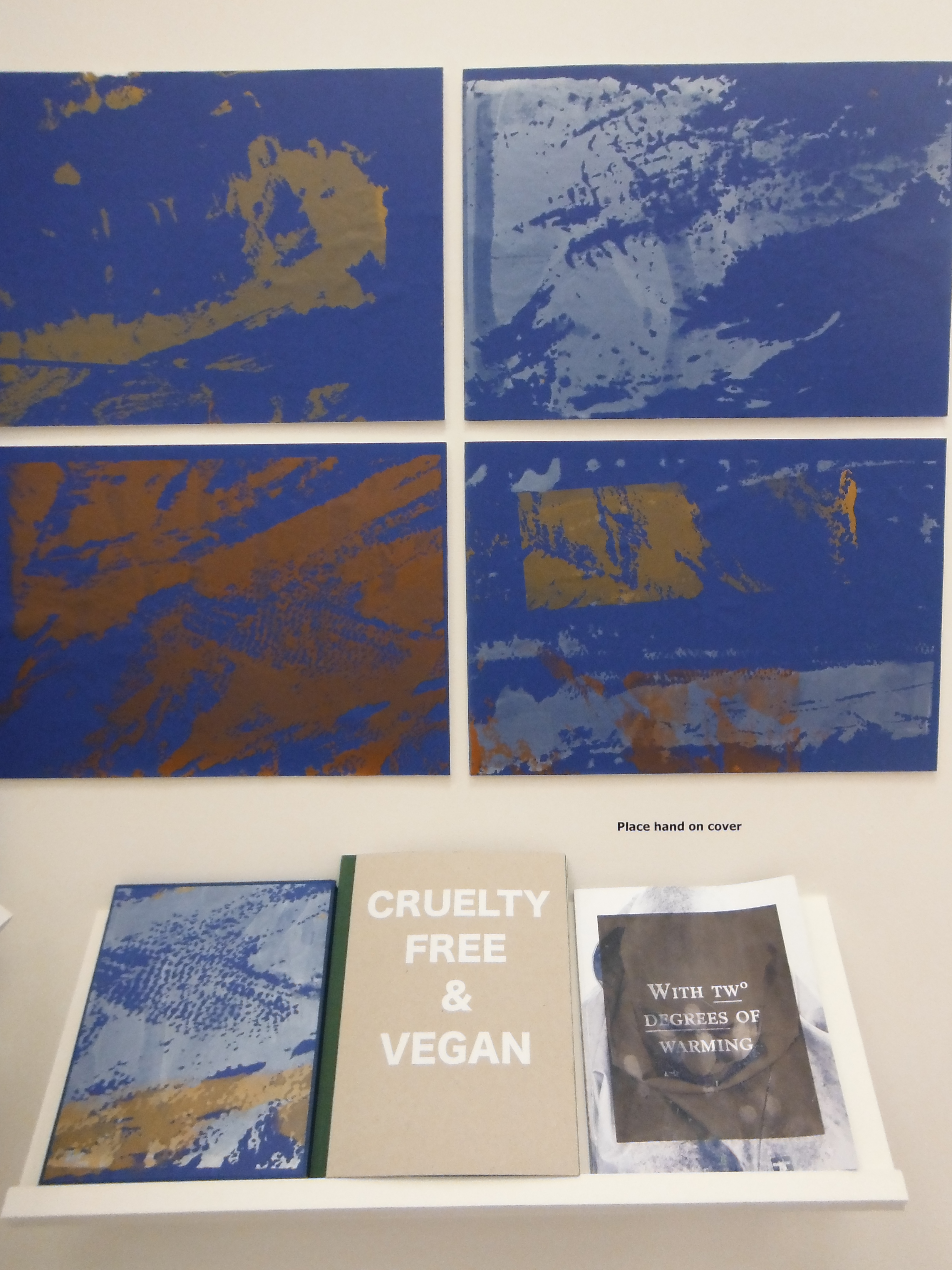 Next Lossie Ng Lei (left) takes on global warming with a challenge to feel the difference that 2 degrees makes with a set of oceanic images and a push towards veganism (as a solution).
Next, Beth Ducket (below right) who is in fact a print maker rather than graphic design. It is not clear exactly how explicit the artist is about the impact on the environment of consumption, but even by accident the reproduction of so many receipts makes a clear point. Her accompanying script could even be Marxist with references to alienation (meaninglessness) and mass production/consumption. Perversely the artist has reproduced by hand the receipts on the one hand claiming artisanal value but also this wonderful ability to see art in the mundane and a deep commitment to classification.
My penultimate choice goes to an artist whose work seems not to have been labelled. I do not know  whether this work is a critique of modern communication technology or a celebration of it (left). Every individual in the series of six pictures is completely consumed by a mobile phone. If it is a critique, well done. If it is a celebration, we really are doomed.
Finally in this section (fine art and sculpture to follow), Holly MacDonald is going to go far with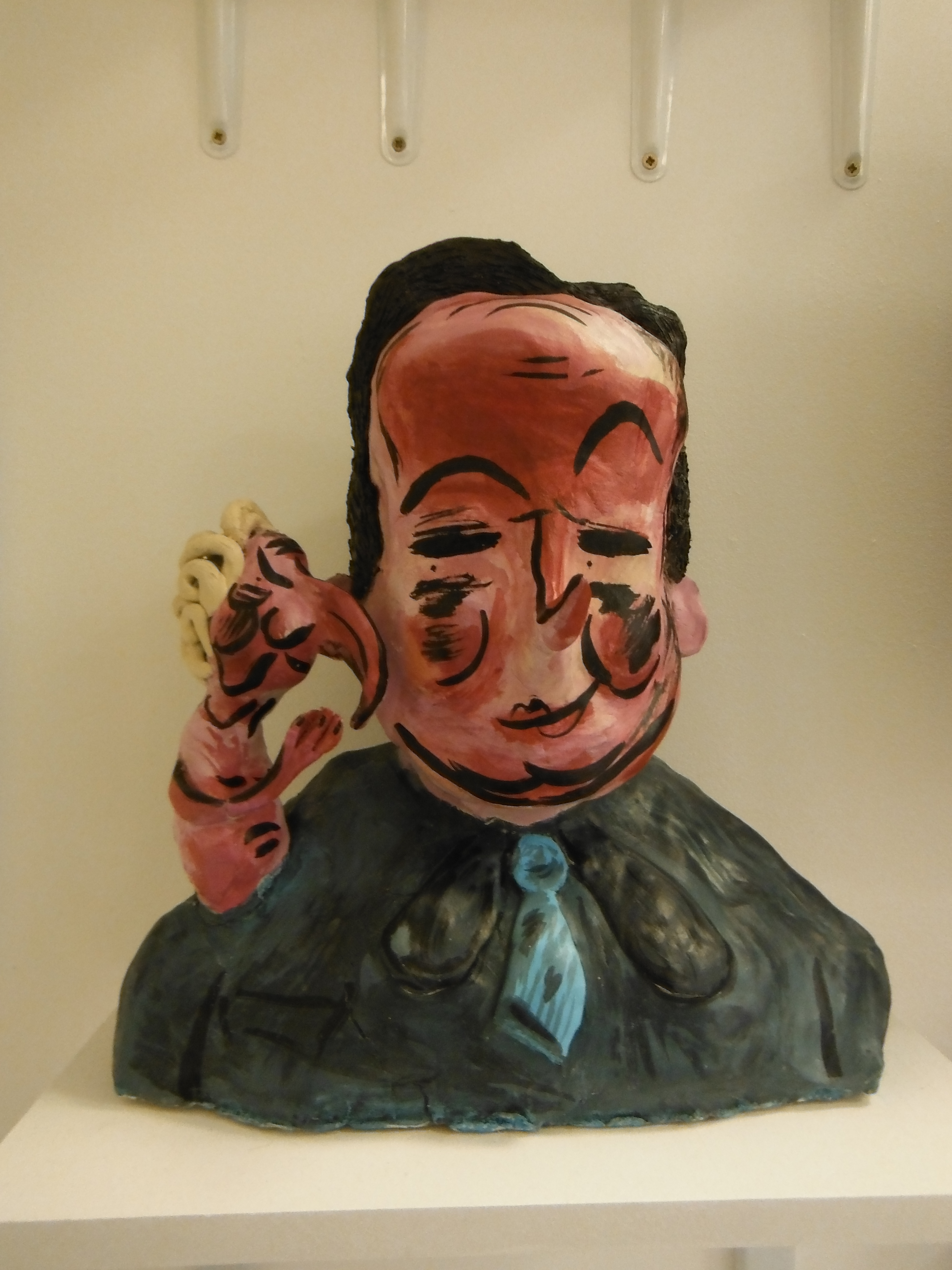 her caricatures of British politicians. There are two in this example (right). And they are brilliant and correct.
Das Gewitter
 35 degrees heat has been imposing itself on central Europeans over the past few days. It is not to my liking as a English bloke from the north used to fog in the middle of summer. I do, however, love a good electrical storm. From a safe distance.
The weatherman on the TV on Friday night promised some activity on this front. First the clouds came over, then a breeze got up. Finally the flashes and thunder. Not a classic, but I did manage to capture a lit-up sky on my phone. It required a little patience.
Actually tonight, I got some real lightening!
Here’s the next challenge to our liberties
Filed under: Environment, International, Politics, Privatisation |
Leave a comment 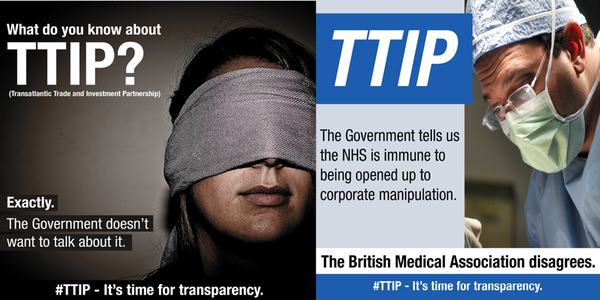 So here is the next outrage – the inappropriately named Transatlantic Trade and Investment Policy, coming to a court not near you very soon. It is inappropriate because it is not really a trade and investment policy. Such a policy would, on the whole, be benign. This one, by my understanding, gives large corporations the opportunity to challenge nation states/governments on issues that they view as restrictions on trade. So, a nationalised health service is conceivably a restriction on trade of US healthcare providers. Under this argument, US corporations would be able to make the case that they should be able to compete for contracts in the NHS – the whole of the NHS, not just the bit that the UK Conservatives have so far transferred to their private sector firms. Equally, all environmental policy could be viewed in this way. Restricting carbon emissions, for example, imposes costs on firms, that is a restriction on trade. Surely corporations should be able to pollute as much as they like?
Magazine subscriptions
Filed under: Environment, International, Journalism and News Reportage |
Comments (1) I subscribe to two weekly magazines – the New Statesman and The Economist. The former for twelve years, the latter perhaps four years. The Economist is an essential read for my work. The New Statesman feeds my interest in political debate. I took up reading it when I ended my daily subscription to the Guardian newspaper.
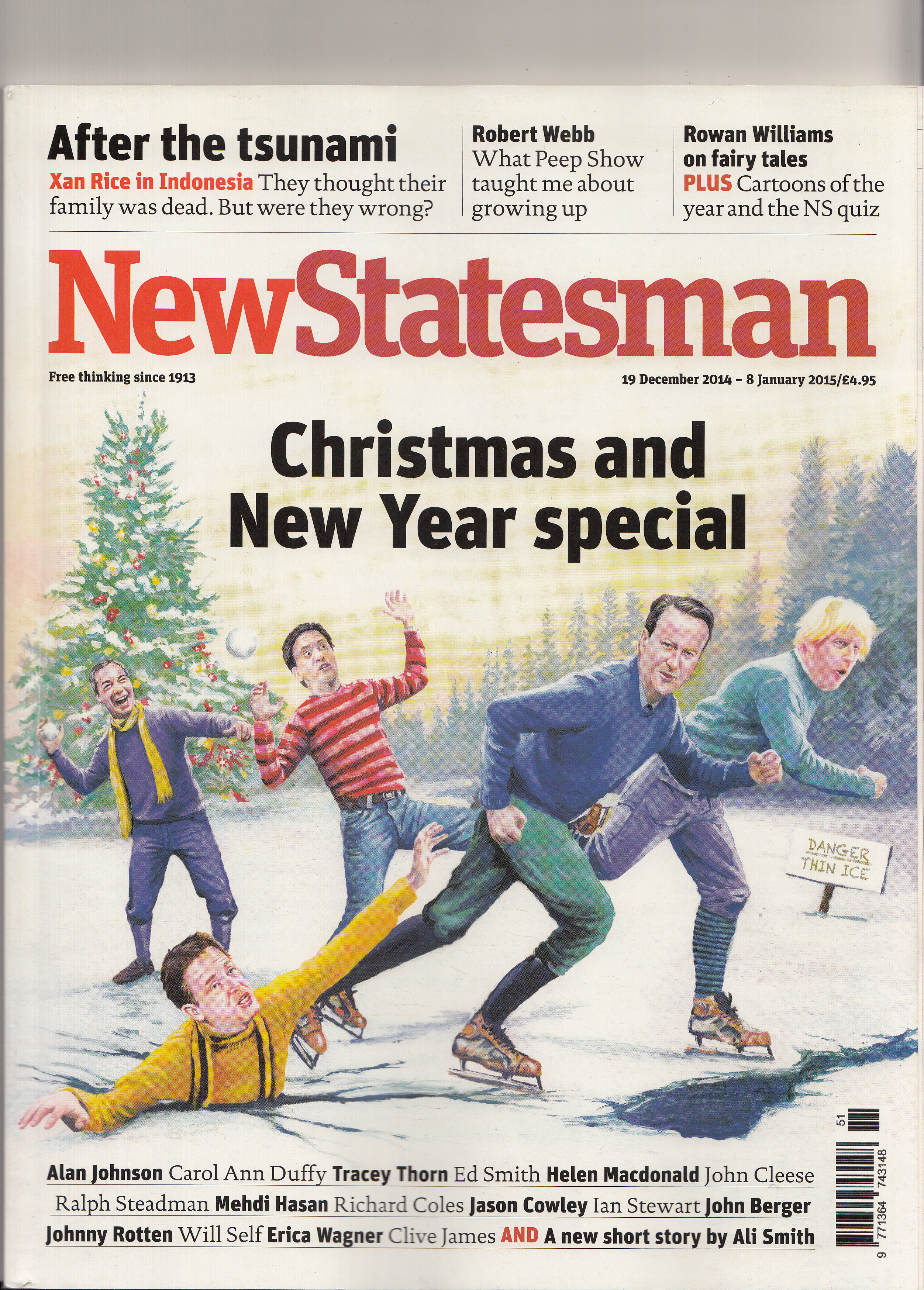 When big public holidays arrive, both magazines publish bumper editions – sufficient to keep readers satiated for the two weeks that the magazines are on holiday, as it were. The New Statesman’s bumper edition is, generally, full of pap and even some of my favourite columnists let the side down. This year, for example, Will Self has taken to writing about another columnist in the same magazine! And to make matters worse, when that columnist started a few years ago, I only managed a couple of weeks before I lost the will to read any more, life being too short and all that. Holding the fort are the veterans Peter Wilby and Hunter Davies.
The Economist, however, fills out its pages with features on history, culture and science. Although it is unashamedly 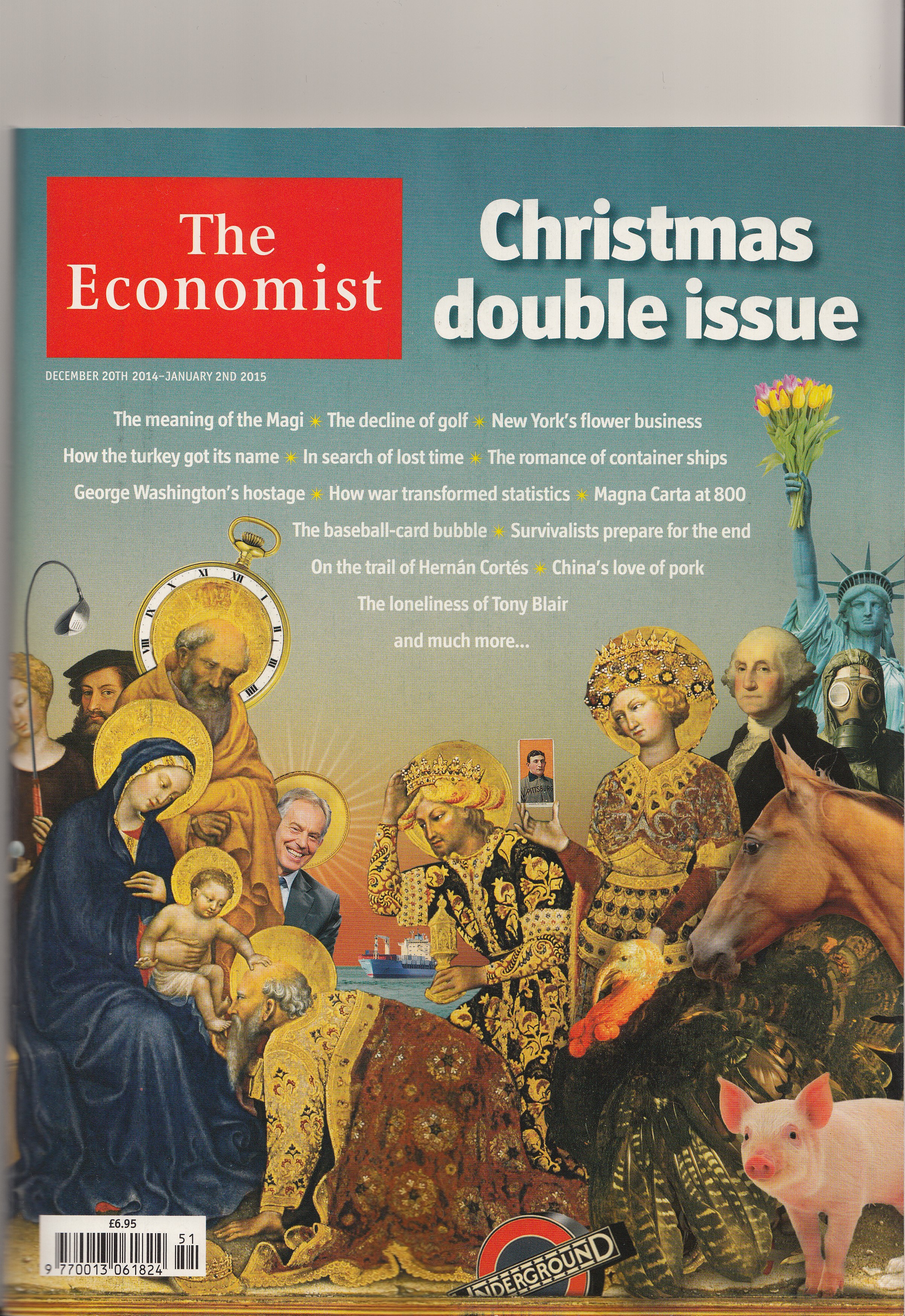 conservative, neo-liberal, it is at least well written and thoughtful. Hence I’m prompted to relay one of those features to readers (20 December 2014, pp82-84). It tells the story of the rise of pork as a symbol of affluence in China. It is a favourite food. Seemingly, Chinese citizens eat the equivalent of half a pig each per year (that is 500 million pigs annually). Such is its importance for the Chinese government seeking social stability, it is subsidised to the tune of $22bn per year. However, this leads to environmental and resource challenges.
Most are factory reared. Consequently they are routinely fed antibiotics to stave off disease that could decimate what is increasingly an in-bred, non native pig population. They are mainly fed on cash crops, particularly imported soy beans. These are grown predominantly in South America on land much of which has been cleared of rain forest. Moreover, the Chinese pork industry is responsible for 50 per cent of the total global soy market. Each kilo of pork requires 6kg of feed.
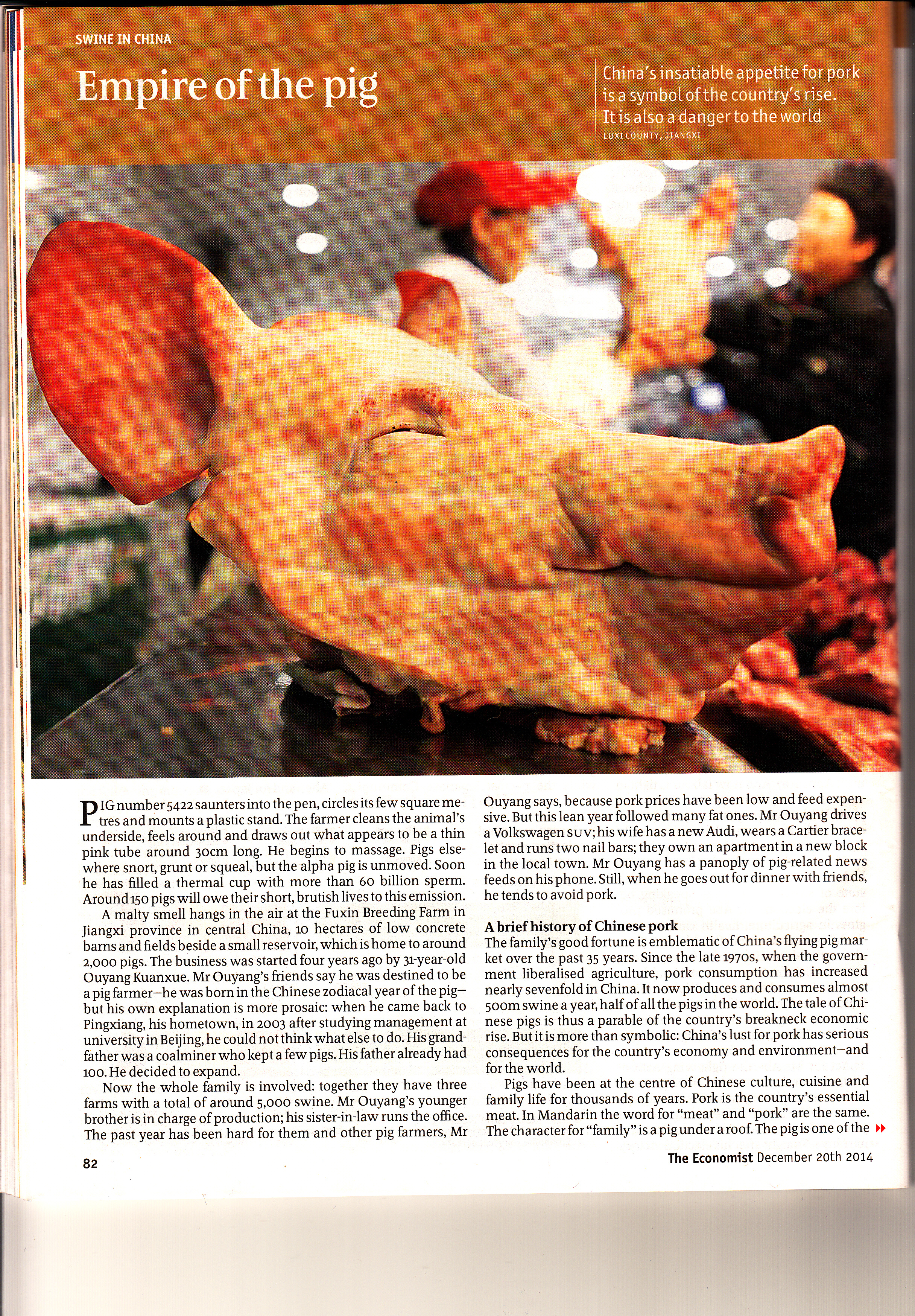 Then there is the waste. Each pig produces, apparently, 5kg of waste per day. Traditionally, pig excrement was highly valued as a fertiliser; however, mass produced pigs generate contaminated waste – antibiotics, hormones, pesticides, etc., not suitable to spreading. There is also too much of it. Pigs and pig waste have become increasing sources of water and soil pollution.
Moreover, the pigs themselves produce methane and nitrous oxide. These are potent greenhouse gases somewhat more damaging than carbon dioxide (300 times more so, it is argued).
I gave up meat 35 years ago. I may give up the New Statesman in 2015.
The oil price is a problem
Filed under: Environment, Finance and Economics, International | Tags: environment, fracking, oil price
Leave a comment  Whilst I am delighted to see that I can fill the tank of my ever-so reliable van for a fraction of what it cost this time last year and fly until my heart is discontent in the knowledge that the value of the airlines (share price) is increasing, they having done nothing more than survive three months since the oil price started to plummet, it is bad news. Why?
First, burning hydrocarbon fuels is bad for the environment and price is a key regulator of consumption. Second, many oil producing countries – some of them not the richest – have set their budgets at anticipated levels; for example, $100. The shortfall of $35 (reflecting today’s price-per-barrel) can make the difference between life-and-death. High oil prices, then, can be good transfer payments between rich and poorer countries.
Third, oil company shares are down sharply. With these stocks being some of the key investments made by pension funds, meeting obligations becomes more difficult. Fourth, investment in renewables will be hit. Suddenly it is only cost-effective to burn oil. Fifth, geopolitics. When demand goes down, price is often regulated by cutting supply. This is not happening for reasons which are currently unclear. However, there are some suggestions that it is a power battle between oil producing countries particularly in the middle-east rendering the region even more unstable than it already is. That is also not to mention the situation in Russia. Very much an oil economy that is suffering also from ludicrous EU sanctions. There is unrest ahead.
What about the positives? Well, I can think of one key positive. The glut in demand is, in part, caused by shale oil production in the USA and tar sands in Canada. These two practices are very damaging to the environment. $65 a barrel is not sufficient to warrant such production. Whether the firms will cease their activities remains to be seen, but what is clear is that where fracking has not yet started, it is unlikely to do so.
Picture: Flcelloguy/Wikipedia
It breaks my heart
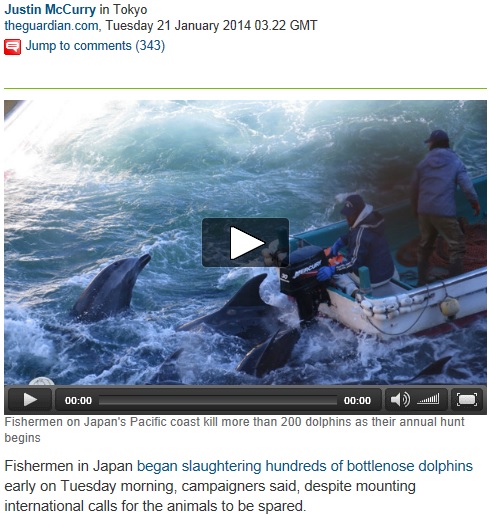 This blog has been a shade quiet since Christmas. I really did not want to reawaken with this post, but the image on the left has been haunting me since I saw it yesterday. My earlier years were dominated by my campaigning against animal abuse. Large aquatic mammals, especially. I even bought a Praktica SLR camera rather than support the Japanese optics industry back in the 1980s when the Japanese persistently blocked a moratorium against whale hunting; particularly humpbacks that were endangered at the time.
I knew that the Japanese had an annual barbaric killing of pilot whales, but this slaughter of dolphins had escaped me. It is the dolphin on the left that haunts me. It will soon be speared by the ‘fisherman’. It will drown. At the risk of anthropomorphism, I ask myself what is going through its head. On the one hand, it knows what its fate will be. But as a higher mammal with quite developed communication, not only is it trying to communicate with its rapidly diminishing peers, it is saying to humanity, ‘why are you doing this to us?’
The process is not random, it seems. The dolphins are rounded up and herded into coves. They are left for four days and then released. In the video, men in wetsuits are seen in the water securing the animals by their tails before they are speared. And so orchestrated is this slaughter, the ‘fishermen’ have built a very large screen to keep away the cameras.
This is not to feed people who are hungry. It is not even fishing. This is a crime against nature. And it breaks my heart.
Picture: The Guardian – http://www.theguardian.com/world/2014/jan/21/japanese-fishermen-begin-annual-slaughter-of-hundreds-of-dolphins
Cutting energy use
 Readers of this blog know that I fly quite a bit. My beloved lives in Munich and I live on the South Coast of England. That is about 500 miles/800 kms complicated by a stretch of water. Last week I did take the train all the way. It took 14 hours, though it was extremely civilised, particularly the first-class travel between Brussels and Cologne. In the short-term, I will continue to fly. But the effect on climate change makes it very difficult to reconcile. Energy use is unsustainable. So, here are some ideas for cutting energy use in the short-term. Low hanging fruit. Any additional suggestions welcome.
I do think about ‘unnecessary’ flying. Top of my list is sport. Tournaments are international these days and sports players – individuals and teams – fly all over the globe in pursuit of titles. Mostly unsuccessfully. One thinks about the Olympics last year. The amount of unnecessary carbon generated by moving sportspeople and their equipment really cannot be justified. Not to mention all of the building, electrical power, etc. Essentially, there needs to be less international and elite sport, not more. The Olympics should be every 5 or 10 years with intermediary events held regionally. Ditto for football’s world cup. Cricketers should play the Ashes between England and Australia less often (it pains me to say that as a cricket fan). Golf is already split into two ‘tours’ – the American and the European. This should be consolidated and playing in both tours should be frowned upon rather than celebrated. Playing in the Gulf should not be counternanced because of the energy required to maintain golf courses in deserts and the air miles needed to get the top golfers and their entourages there. The same is true of tennis.
And putting horses in aeroplanes so that they can compete in horse races across the planet is neither good for the planet nor fair for the animals concerned.
I appreciate that whole national economies are now based on exporting perishable produce to supermarkets. Particular culprits – asparagus from Peru (even when it is in season in the UK and Europe – note Tesco); sugar snaps, sweetcorn, fresh herbs, etc. Be careful as shoppers, just because it is there, does not mean that it should be bought. We need to be more creative with our cooking to render more locally-produced foods attractive and enjoyable. Some may say that Peru and Kenya, for example, enjoy comparative advantage in terms of climate and land. Be that as it may, but the transportation costs are just too high. At the very least these products can be tinned, jarred, dried, etc.
Here is another one. Turning off soft-drinks vending machines. In fact, all chilling cabinets for soft drinks and chocolate. Chocolate, indeed. We chill chocolate. The vending machine in the building I work in now serves at best 10 people. Nonsense. Soft drinks are unnecessary, chilled in December, particularly so.
Picture: (asparagus) Evan-Amos (wikipedia)
Climate change denial in school
 The ongoing cold weather reminds us that something is afoot in global climate change. The list of concerns is growing. The pictures of the sea ice cracking over the Beaufort Sea north of Alaska and Canada (left) may be extraordinary, but the causes and consequences remain distant for policy makers. Compare global climate change with efforts to save the Euro.
The UK Government now seeks to take climate change off the agenda in schools for under 15 year olds. It is not totally clear why. It may just be because of pressure on the curriculum, but it may be because policy makers do not think that this age group should be taught about climate change. But let us just reflect, in the words of John Ashton (Director of E3G and a fellow of the Grantham Institute for Climate Change at Imperial College) writing in the Guardian newspaper (19 March 2013), “[t]here are two paths now available: one leads towards a world in which by mid-century the basic needs of 9 billion people can be met by co-ordinating a successful response to climate change. The other looks increasingly like descent into competition, fragmentation and conflict, as the interconnected stresses of food, water, and energy insecurity become unmanageable.” The children who will inherit the legacy of previoius generations at least have the right to know what has been done to them.
Picture: taken from http://econnexus.org/; but originating from the European Space Agencies CryoSat-2 satelite and mission to examine the arctic ice caps.
 Be informed