Archive for the ‘International’ Category
Post holiday blues in record time – European Convention on Human Rights
Filed under: International, Politics | Tags: Chris Grayling, European Convention on Human Rights, Theresa May
 Leave a comment
 It does not take long for an awful reality to reassert itself after the summer tandem riding holiday, even if it was un-summerly and not everyone’s idea of a holiday. For example, what on earth happened in Scotland? Why did the Scots vote to stay dependent on the English elite establishment, fronted by David Cameron. One wonders whether the result would have been different had the Tory Party conference occurred before the vote rather than after it.
 It was, of course, at that conference that Chris Grayling, the UK (in)Justice Secretary, announced that should the Tories win outright the next UK election, they will knowingly take us out of the European Convention on Human Rights so as to free the country from those pesky European judges who so often tell us to do things that we do not want to do, such as give votes to prisoners, allow foreign criminals into the country, prevent the extradition of undesirables (especially those with hooks as substitutes for hands) and a ban whole-life sentences for grave crimes. It does, of course, none of these things; the Strasbourg Court merely highlights incompatibilities between UK law and the Convention. See: http://www.tinyurl.com/pszhdky
But instead, we will have a UK Bill of Rights, subject to the whim of the Tory elite to decide whether any citizen’s claims of a breach of human rights is valid or not. Not independent judges, but the likes of Grayling himself. Moreover, this elite used their conference to inform us that we have to allow ourselves to be subjugated, monitored and pacified to maintain security against the threat of terrorists that the elite has created for us through innumerable foreign wars, murder, incarceration and expropriation. The Home Secretary, Theresa May (right), told the conference that the ‘snoopers’ charter’ will be reintroduced to Parliament and passed when there is a Tory majority; but of course one has nothing to fear if one has nothing to hide.
The European Convention is not an EU institution, however. The Convention was scripted by European human rights lawyers, many of them British, in the early 1950s in the aftermath of WWII. To withdraw is to align ourselves with some of the least liberal states in the world; for example, Belarus.
 Such a move will precipitate a response from the Council of Europe – which is an EU institution. Ultimately, adherence to the Convention is a reasonable condition for membership of the European Union, if not the United Nations. Of course, getting out of the EU is precisely what Tories want and these arguments play well with their illiberal supporters. It is always gratifying to hear that the Prime Minister is generously giving our European partners one more chance to see sense and allow the UK to contravene the founding treaties that enshrine the concept of the free movement of people across European borders. A right that millions of UK citizens have exploited over the years.
Pictures:
Theresa May: ,Wikipedia
European Court Strasbourg: CherryX, Wikipedia
Wasted time
Filed under: International, Journalism and News Reportage, Uncategorized |
Comments (1) I regret the time that I have wasted in my life. Time that I could have used productively. But did not. Sitting on the train yesterday, as I often do, heading to my workplace (one hour), I glanced around and saw maybe two-thirds of the people on the train engaged in no activity other than looking around or out of the window. Immediately opposite me was a boy about 12 years’ old, I presumed with his mother. Both were, how I would describe, under-stimulated. I remember being that boy.
 Each Class 171 train has 124 seats. The train was full for the whole journey. For sections of the journey, there were people standing. So let us say there were 150 people on the train. If two-thirds were under-stimulated, that means 100 people. That is 6000 minutes going spare, 100 hours.
What could I do with 100 hours? I know that they are not mine to claim. I also realise that it is not for me to tell people what is good for them. However, I wonder whether this issue is not what is good for the individual, but rather society. Not using time productively, arguably, is anti-social?
The obvious activity for this sort of available time is reading. The boy in front of me had no visible reading material with him. He sat there patiently, commenting periodically to his mother about something that he had seen out of the window. I remember being that boy.
When I talk about society benefitting from those lost hours, I do so against the backdrop of what seems to be an almost global breakdown in human reason. The situation in Gaza, for example. It troubles me not least because the mis-information is so completely assimilated by our news organisations. It takes a bit of decoding when one is aware of it, let alone when reporting seems ‘balanced’. We are many of us under-informed (I include myself very much in this). Rectifying that would strike me as a good use for those 100 hours.
Picture of Class171: Mackensen
Gaza situation
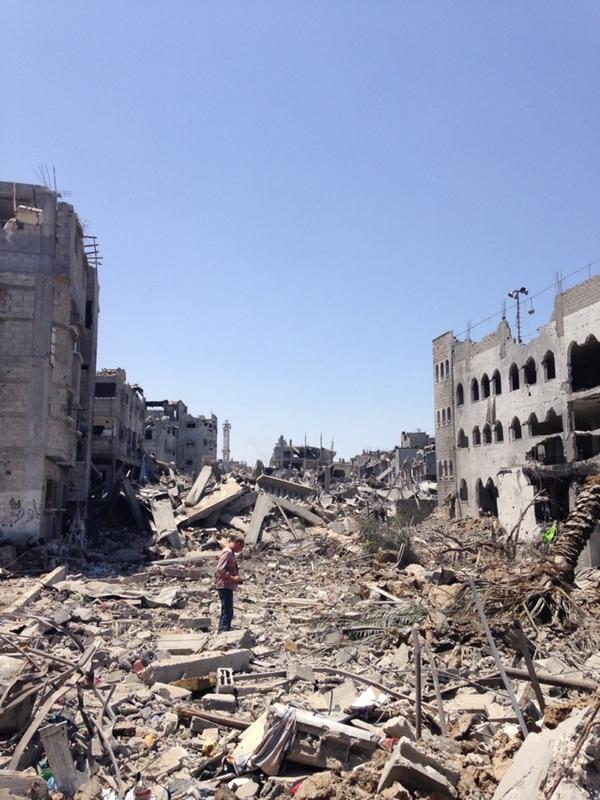 Today there is a 12 hour ceasefire in Gaza. It is safe, briefly, to enter outside, survey the damage to the infrastructure, reclaim a few possessions, whilst the Israel Offence Force watches over.
The scene on the left is the devastation meted out to the Gazan neighbourhood of Shijaiyah (picture sourced from Media Lens) in the name of ‘right of self-defence’. Proportionate? By contrast, the image, right (from the Israel Defence Force). This was the damage to an apartment block in the Israeli town of Ashkelon from a Palestinian rocket. Proportionate? Proportionality is a bit of a red herring. The issue is the siege of Gaza and Israeli settlements.
It is time for Obama to get on his plane and tell Netanyahu that he is on his way to the to the ICC in the Hague.
It is also time that the media get their reporting proportionate. Too much sourcing from  official Israeli authorities. Too many platforms given to the likes of Mark Regev (http://t.co/mNkP57gpKf). Too easy. Lazy. If you do have the mis-fortune to sit through Israeli propaganda, decode with this guide: http://www.independent.co.uk/voices/comment/israelgaza-conflict-the-secret-report-that-helps-israelis-to-hide-facts-9630765.html
European election results
 There is an uncanny resemblance between this graphic and opinions that I have been listening to on the radio this morning after the release of the European Election results in the UK.
Unemployment – get out of Europe. Housing – get out of Europe. Stop immigration. Recession – get out of Europe. Stop immigration. Etc.
Europe as an entity and a ‘project’ is a mess, for sure. It is expensive. There is a lot of free riding. It is dangerously expansionist, as the crisis in the Ukraine demonstrates. And it does fuel some of the economic excesses of globalisation. However, the opinions that I have been listening to are bigoted, ill-informed and dangerous.
Some basic knowledge about economics might help. And a look at the expenditures made by the Swiss and Norwegians in complying with European legislation in order to trade in the EU, indicate that leaving the EU is not an answer. Most of our trade is with Europe. I trust that in the event of a vote to leave the EU, the hundreds of thousands of ex-pats living and working in Europe will be asked to return to the Isle?
Moreover, as ex-commodities trader, Nigel Farage, leader of the UK Independence Party, ought to know the recession is not the fault of the people, it is his class that caused it. And the mainstream ‘professional’ politicians that allowed them to do it. So, I can understand the need for change and some honest talking over a beer. But surely the future should come from the left, not the fascist right?
Picture: http://www.hopenothate.org.uk/blog/nick/archive/1/2014
Cigarette industry – grim prospects?
For a number of years this blog has reported, as irreverently as possible, cigarette advertising in Germany. Germany is one of the few places in Europe where it is still possible to advertise cigarettes. The contrasting campaigns are a source of endless fascination as the brands pit themselves against one another.
However, cigarette advertising is one thing, the continuation of the industry more generally is now in some doubt. I say this after reading an article in the Economist magazine (link below). Apparently, it is fifty years since the US Surgeon General declared smoking to be a ‘health hazard’ requiring appropriate ‘remedial action’. This remedial action led to a decrease in cigarette consumption from 43 to 18 per cent in the American adult population. Still, 20 million Americans have died from smoking-related diseases since then. The current Surgeon General has declared smoking deadlier than previously thought and has promised ‘end game strategies’.
 What does this mean for the tobacco companies? Traditionally, they have found new markets, particularly in Asia. But here, also, the regulatory environment is becoming hostile. Arguably, too, the firms have not seen the e-Cigarette phenomenon coming – dominated at the moment by new firms, a selection of which are represented on the panel (left). Perhaps they have failed to understand fully what is their business? The customer craves nicotine, not tar: e-cigarettes seem to be efficient deliverers of nicotine, and less riskily. Though this may well be scrutinised closer in coming months and years.
Another approach seems to be cigarettes that do not actually burn the tobacco. Rather they heat it to deliver their nicotine payload.
Picture: http://www.eciguserguide.com/promising-e-cigarette-brands-2014/
What is this about?
 In my search for cigarette advertising today in Munich, I had the mis-fortune to come across this explicit piece of advertising for a local radio station. Just in case any readers are wondering what it is, it is a naked woman with her breast covered by the hand of some disembodied man. The strapline, I think, translates as ‘close-up on the hearing’.
I do not know this radio station. A quick visit to the website suggests it is a subsidiary of a group of stations with the same name in various cities pumping out pop music – old and new – and news. This photo was taken at a busy transport interchange in Munich! It is difficult to explain to adults what this is about. I’d be hard pressed to say much to a child who might notice it.
It breaks my heart
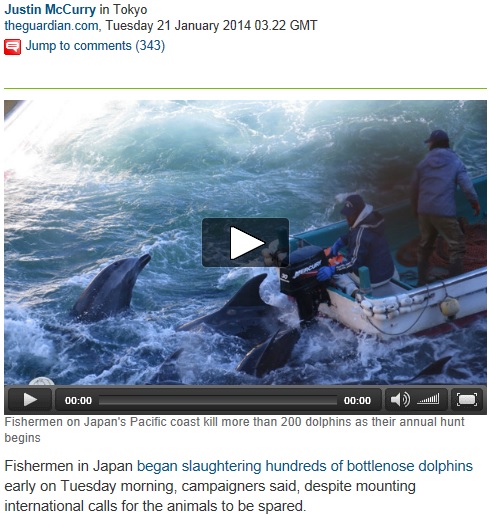 This blog has been a shade quiet since Christmas. I really did not want to reawaken with this post, but the image on the left has been haunting me since I saw it yesterday. My earlier years were dominated by my campaigning against animal abuse. Large aquatic mammals, especially. I even bought a Praktica SLR camera rather than support the Japanese optics industry back in the 1980s when the Japanese persistently blocked a moratorium against whale hunting; particularly humpbacks that were endangered at the time.
I knew that the Japanese had an annual barbaric killing of pilot whales, but this slaughter of dolphins had escaped me. It is the dolphin on the left that haunts me. It will soon be speared by the ‘fisherman’. It will drown. At the risk of anthropomorphism, I ask myself what is going through its head. On the one hand, it knows what its fate will be. But as a higher mammal with quite developed communication, not only is it trying to communicate with its rapidly diminishing peers, it is saying to humanity, ‘why are you doing this to us?’
The process is not random, it seems. The dolphins are rounded up and herded into coves. They are left for four days and then released. In the video, men in wetsuits are seen in the water securing the animals by their tails before they are speared. And so orchestrated is this slaughter, the ‘fishermen’ have built a very large screen to keep away the cameras.
This is not to feed people who are hungry. It is not even fishing. This is a crime against nature. And it breaks my heart.
Picture: The Guardian – http://www.theguardian.com/world/2014/jan/21/japanese-fishermen-begin-annual-slaughter-of-hundreds-of-dolphins
Making the case for leniency for marines who murder
Filed under: International, Journalism and News Reportage |
Leave a comment What is the normally thoughtful Michael White, assistant editor of the Guardian newspaper in the UK, doing calling for leniency for the marine who executed an Afghan man? The Guardian itself (8 November) reported the details of the story thus: “In the graphic footage, Marine A leans over and  fires into the chest of the bloodied and moaning insurgent with a pistol. He then tells him: “There you are, shuffle off this mortal coil, you c***. It’s nothing you wouldn’t do to us.” A few moments later Marine A is picked up telling colleagues: “Obviously this doesn’t go anywhere fellas. I’ve just broken the Geneva convention.””
The marine is unnamed to protect him. The Afghan man is unnamed because his name is not important.
The call for leniency is not restricted to Michael White. The Daily Mail, a notoriously partisan and reactionary newspaper, had a couple of days earlier made clear its position by making the quote of Major General Julian Thompson, a veteran of 3 Commando Brigade in the Falklands War, a front page banner headline: “I won’t condemn him…”
We can all think of many cases where similar arguments could be used in the case of civilians. Would Michael White and others advocate taking evidence of victims of child abuse as mitigating circumstances when as adults they go on to do similar things, or worse, themselves? I think not.
Photograph: MoD
Speechless over Zimmerman
 This picture is scanned from the Südeutsche Zeitung (Monday, 15 July 2013). It is copyrighted RTR, but it one of the most chilling pictures I’ve seen in recent times. On the right is George Zimmerman, acquitted of murder in a Florida court on Saturday. The smiles demonstrate the ‘success’ of the defence in evading justice. Knowingly. Even if it is a job well done – which it is not – the smiles seem to demonstrate some perverted sense of ‘citizenship’. Zimmerman shot and killed an unarmed 17 year old black man, Trayvon Martin, in what can only been seen as vigilante justice defending a gated ‘community’ against the threat of robbery. ‘Stand your ground’ laws permit lethal force in Florida and other states. Using such force against an unarmed teenager brandishing sweets from a local shop has been demonstrated in a court to be legitimate. It is also seen to be a cause for celebration. Shameful.
There are many who are more eloquent and informed than I am on this case and the implications. The Südeutsche Zeitung (below right), for example, pulls no punches. There is no attempt to ‘explain’ the Jury’s decision, only to describe what happened (black man shot) as a mixed race white man ‘feared’ for his life after having stalked the young man and been told by the police to stop following him. Zimmerman’s 911 call can be heard here
Gary Younge’s first paragraph in the Guardian newspaper on 15 July says enough: “Let it be noted that on this day, Saturday 13 July 2013, it was still deemed legal in the US to chase and then shoot dead an unarmed young black man on his way home from the store because you didn’t like the look of him.” http://www.guardian.co.uk/commentisfree/2013/jul/14/open-season-black-boys-verdict
The President – increasingly becoming illiberal and reactionary – could only say: “The death of Trayvon Martin was a tragedy. Not just for his family, or for any one community, but for America. I know this case has elicited strong passions. And in the wake of the verdict, I know those passions may be running even higher.”
“But we are a nation of laws, and a jury has spoken. I now ask every American to respect the call for calm reflection from two parents who lost their young son.”
“And as we do, we should ask ourselves if we’re doing all we can to widen the circle of compassion and understanding in our own communities. We should ask ourselves if we’re doing all we can to stem the tide of gun violence that claims too many lives across this country on a daily basis. We should ask ourselves, as individuals and as a society, how we can prevent future tragedies like this.”
The short answer surely is, convict racist killers. Guns, compassion, understanding and the other apparent platitudes are red herrings.
Edward Snowden and Prism
 The treatment of Edward Snowden and those who might give him asylum, tells us as much as we need to know about in whose interests states act and where the current balance of power lays. In the name of anti-terrorism, we are all being monitored. They say that they are only collecting “meta data”; i.e. data about who ‘citizens’ contact rather the content of that contact. The usual guff comes from politicians – ‘if you have done nothing wrong, then there is nothing to fear’.
The vilification of Edward Snowden – the whistleblower – is clear. The US state brands him as a traitor, a fugitive from justice guilty of treason and much of the media is aligned with this position. The latest post from Medialens gives Snowden their usual treatment: http://www.medialens.org/index.php/alerts/alert-archive/alerts-2013/737-snowden-surveillance-and-the-secret-state.html
And then there is the Latin America situation. The denial of Evo Morales’s plane access to key parts of European airspace on 2 July is extraordinary. Morales, let us not forget, is President of Bolivia and was attending a legitimate energy conference in Moscow. Clearly pressure had been put on European states from the US. But it is interesting that ‘they’ – whoever they are – thought that Snowden was on the plane; he may well have been stupid with respect to whistleblowing and his own safety, but he is not, surely, going to do the obvious (as he demonstrated by not being on the plane to Cuba a couple of weeks earlier)?

