Archive for July, 2026|Monthly archive page
Book Review – Ecotopia by Ernest Callenbach
Filed under: Book reviews, Environment | Tags: book review, books, Callenbach, dystopia, Ecotopia, fiction, writing
 Leave a comment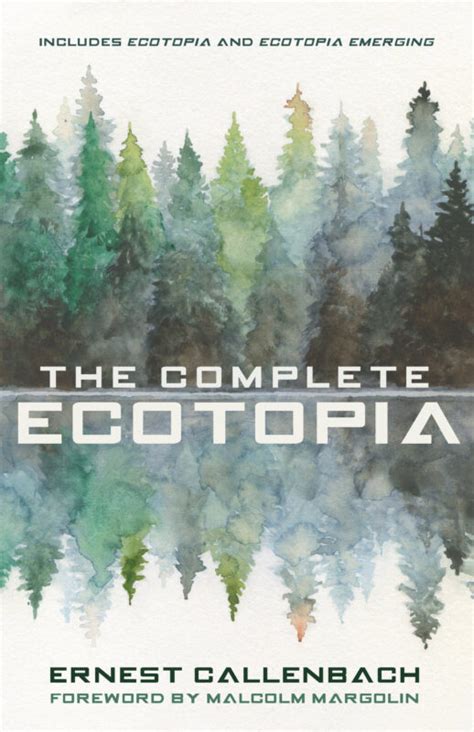
This book has been sat on my bookshelf for two or three months. It is a shiney new edition that features an informative foreword by Malcolm Margolin (his publisher) and the prequel, Ecotopia Emerging (which is not being reviewed here). If you are planning on reading this book, read this entry no further. There are many spoilers.
The book was first published in 1975 – that is significant because many of the technologies that were clearly aspirant at the time are now at the forefront of the transition; for example, heat pumps and videophones (albeit wired). There is no plot as such. Everything revolves around the unlikely scenario that two-and-a-half states in North America split from the USA to create Ecotopia. These were Washington State, Oregon and the northern part of California (including San Francisco but not Los Angeles).
It is a closed and protected society such that only now is a New York journalist, William Weston allowed to enter to experience life in Ecotopia. He is, however, much more than a journalist. He is an agent looking for intelligence on how to re-unite the states.
There is a lot of hippie nonsense in the prose and the conceptualisation of Ecotopia. That said it is a more faithful manifestation of hippie-dom than what perhaps transpired. The eco-utopianism in the novel arguably could have been realised, but instead the utopianism transmogrified into libertarian silicon valley technological determinism. Callenbach obviously saw the opportunity, but as is so often the case, humanity chose a different direction when confronted with an inadequately signposted fork in the road.
Economics
So what does Ecotopia look like? The economic model is not easy to define exactly. It is still capitalist but it is mixed. There is much regulation, particularly about fuels, materials, housing, etc. There are no cars – though bicycles and electrified public transport including, remarkably, high speed trains, are abundant. There are some diesel trucks used for logging that simply have no substitute at this point in time.
Food and land are very important in this economy. Forests were – are being – reforested, though wood has become, once again, the main and favoured building material. Forests are managed sustainably, there is no clear cutting for lumber. It is not a vegetarian world, but the meat is not intensively reared. Some of it is hunted; deer, for example. What is true is that there is no shortage of food. There is a universal basic income, but most Ecotopians regard it too meagre to exist on. In the employed economy, the working week is 20 hours. That is generous, even by modern thinking on the relationship between work, leisure and volunteering. There is more functionality in this world – all consumer gadgets are mendable, and the people are taught – starting in school – to do the mending themselves. Universities are run by academics, but students can determine who gets employed as it is their fees that pay salaries. University education is often seen as an end in itself. It is a life experience worthy of investment. This may explain why many Ecotopians are experts in arguing esoteric concepts!
Ecotopia has a sophisticated science-base, so much so that scientists have discovered and businesses have commercialised bio-degradable plastic. This can be used for both packaging and for modular housing. Now there is a thought. There are factories extruding plastic for building purposes. Though not all Ecotopians are in favour, it is still plastic, after all. Much research is done in small research institutes located near universities. There is innovative work taking place that probably would not be funded in the USA; for example tapping electrical energy from algae (the inventors won a Nobel prize for their work). Research, however, is focused on practical/scientific disciplines. There is no room for the social sciences – political science, sociology and psychology. Though there is, interestingly, room for philosophy. History also survives much of it focused on pre-independence research (maybe to justify the independence rationale).
After independence, there was a flight of capital. The state had to nationalise farms, factories and retail. They ultimately brecame cooperatives, owned by the workers. Inheritance of property was abolished. The core tax is corporation tax – the state claims a percentage of output and invests the proceeds in public goods. There is also a land tax (p95). Imports attract very high tariffs to ward off competition from Asia. This does facilitate the circular economy; for example, people wear home-made clothes rather than buy low-price, low quality garments from abroad.
So, the circular economy exists in this world, and seems to work such that it is accepted and embraced. Ecotopians consume much less than their US counterparts. It is also degrowth which includes a falling population. In order to limit pressure on resources, the Ecotopian government initiated a fertility programme largely focused on women, birth control and access to abortion clinics. More economically, Ecotopia evolved a less-consumptive economy through decentralisation of power, taxation, health, education, agriculture and appropriate-scale food production more generally.
People live in mini-cities. It reminds me very much of the modern concept of the 15-minute city. Everything is within reach geographically. Though there are other Ecotopians who live in communes/forest camps on the land (p53). A family could be as many as 20 related and unrelated people who share space, domestic tasks and childcare.
Energy and law

There are no coal-fired power stations. There remain a few fission nuclear power stations, but these are increasingly seen as unsustainable because of the inability to deal safely with radioactive waste. There is geothermal, hydro, solar, “earth heat”, tides and wind. The sea thermal plant in Punta Gorda takes heat from the ocean passes it through heat exchangers to extract the heat that can be used for heating and presumably electricity generation.
The criminal justice system (pp89-90) is also noteworthy. Penal institutions exist and sentences are long – though there does not seem to be capital punishment. Inmates work (forced labour as described by some). There is a different hierarchy of crimes in Ecotopia. There are no laws against prostitution, drug use and gambling (these are seemingly “victimless crimes”. White collar crimes such as embezzlement, fraud, collusion, and similar, are treated as severely as assault and robbery. Likewise for deliberate pollution of air and water.
There is a pro-USA underground movement (p50-52). Weston meets a couple of representatives in his hotel. But nothing comes of this encounter, though the Ecotopian (counter)intelligence service is aware of that meeting (p63). In the end, Weston does not file his story relating to this encounter.
Race
Prior to independence, the three states that now constitute Ecotopia were racially mixed. Since independence, there is segregation after the black population sought to gain their own independence. Areas of San Francisco and Oakland (known as Soul City), have become city states with their own currencies, postage stamps and language (Swahili is increasingly spoken). Only international affairs are managed by the central Ecotopian government/state. More disturbing has been a proposal to move black populations, for example in Monterey Bay and Salinas Valley, into the black city states to free up valuable agricultural land. It is noted that people in the black city states earn more money largely because they work longer than the 20 hours than people in Ecotopia.
Media and communications
Ecotopia, on independence, broke up media conglomerates. Ultimately, ownership was limited to one media outlet per city. If a corporation retained the TV station, then it could not operate parallel newspapers and magazines (there is no social media in 1975 Ecotopia). Newspapers and magazines thrive despite the divestment.
TV was transformed. Rather than channels for entertainment, they became news and information outlets hosting debates, hearings and committee meetings! This approach perhaps influenced the C-Span model? For news there are no correspondents based in the USA, so the focus is domestic and other foreign affairs (Brazil is a favourite, especially after US air attacks).
Specialist books are printed at kiosks as they are not in print and sellable through book stores.
Sex
There is a lot of it. Especially during four (statutory) holidays, solstices and equinoxes, obviously! By way of a possible explanation, this is a post-1960s free love California influencing Callenbach’s thinking. Largely because women control their own fertility they also seem liberally to have sex with multiple partners. Weston, on being introduced to one of the forest camps, is initiated by being given a bath and having sex with Marissa, his host. Marissa becomes the chief protagonist in Weston’s ecotopianisation, for want of a better word. Sex is also, potentially, fundamental to the healthcare system. As noted, hospital patients are allocated a nurse who stays for the duration. Sex is so connected to wellbeing, it seems to be written into a recovery plan.
All women choose the father of their children. Incidentally, Callenbach is an awful writer of sex and even less good in writing about love (making).
Schools and education
In schools, children are taught to make things. Children also work the land as much as they learn in the classroom; they understand growing cycles, land fertility, harvesting and develop a deep knowledge about flora and fauna. It is a very practical education; they even learn how to operate printing presses! They learn to trap animals, build shelters, make weapons (bows and arrows). Schools are not free of charge (there is a grant system for poorer households). They are private enterprises, though largely owned by the teachers. Children undertake national examinations at 12 and 18 years of age.
Despite the absence of some subjects from curricula, most young people can play an instrument, are artists, dancers, actors, sculptors, film makers, etc. There are no big-name architects because, essentially, everyone is an architect, even if it is only designing a rudimentary shelter. Most communities have their own groups playing music mirroring their ethnicities. They all seem to have a dance beat. Subject captured musically are not too different from other countries – love, loss, etc.
Ritual war games and health
Most societies seem to have some outlet for simulated violence. Sport is the obvious channel for this, particularly between men. In Ecotopia, they have ritual war games which involve two bands of (young) men – maybe 25 on each side – with spears trying to kill one another. It seems a bit like hunting and ends when one man from one of the sides is isolated and then speared, more often than not, non-fatally (it is estimated that there are only 50 fatalities each year – p78, but certainly requiring surgery and hospital recuperation). Callenbach contrasts this number with fatalities on roads annually in the USA by way of justification. With the exception of the victim who is ritually whisked off to the hospital, after period of lamentation by the losing side, everyone feasts at the invitation and provision of the winning side.
The book has two entries involving war games. In the first, Weston is an observer. In the second, he is a participant. It should not surprise readers that he is speared which provides a segue for him to experience the healthcare system first hand.
The health system is, however, free at the point of use. It really is utopian. Each patient is allocated a full-time nurse. It is one-to-one care. There is less need for healthcare because Ecotopia’s air is clean, its water is uncontaminated and food is not sprayed with pesticides (I am pretty sure that Callenbach had read Rachel Carson’s Silent Spring). Doctors are generalists rather than consultant specialists. They are all trained in psychiatry which helps deal with mental health as well as physical health. They are well paid. Intensive care is not well developed.
Defence
There is a sophisticated decentralised armaments industry as well as a successful militia army that is difficult for the enemy to defeat.
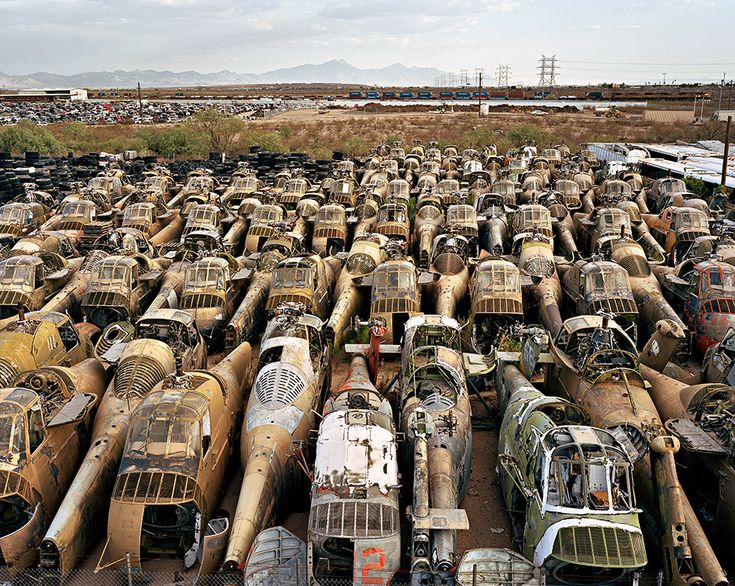
The evidence of that success in defending the independent state is found in a scrapyard in southern San Francisco where over 7000 wrecked US helicopters can be seen (p125). The peace is kept, additionally, by the belief that secret weapons – mines – have been left in US cities and can be detonated should the USA once again seek to invade (New York and Washington DC are named specifically, p4).
Areas of concern
The president is female; the governing paradigm is female. That is not reflected in how women are regarded by Callenbach – who is, of course, the architect of Ecotopia. Weston’s attempt to control Marissa, for example, look familiar. Equally, the nurse performing sexual therapy is surreal to say the least. The male part of the population needs, moreover, ritual violence through its war games. Why is sport not enough? It reminds me of the film, Rollerball, which was also from 1975. Whilst Rollerball’s premise is that the world has reached a corporate utopia, a violent gladiatorial entertainment is needed to keep order and reward compliance. Ecotopia is not a corporate utopia, but it premises the human male “need” for violence.
Then there is the segregation of races. Callenbach sees it not as segregation but as political economy. It is seemingly the case that the black citizens could not realistically embrace a radical Ecotopia, preferring instead to retain more of the trappings of regular capitalism similar to that of the United States.
I am also perplexed and disturbed by Callenbach’s thinking on degrowth, particularly degrowth in the population. And whilst eugenics is not a feature of Callenbach’s Ecotopia, the segregation, closed borders and selective breeding does raise alarm bells. Eco utopias are not necessarily progressive. To be fair, the borders are closed because the USA is hostile neighbour. Ecotopians celebrate victory in their early years over the USA’s invasion attempt (perhaps thinking here about Cuba?).
Towards the end of the book, Weston is kept hostage essentially until he concedes the superiority of Ecotopia over its neighbour (he is a New Yorker with a family and mistress/girl friend there). There is a final twist which is flagged up earlier on when Weston asks Marissa whether she wants to create a family and who she would choose as a father. To paraphrase, she responds by suggesting that he might already know the answer. Weston was always destined to stay in Ecotopia.
(1) The helicopter scrapyard is a picture from Edward Burtynsky and taken from https://uk.pinterest.com/pin/454300681161318244/
Book Review – Elemental by Arthur Snell
Filed under: Environment | Tags: Antarctica, Arctic, Arthur Snell, book review, climate change, Elemental, environment, greenland, Politics
Leave a comment 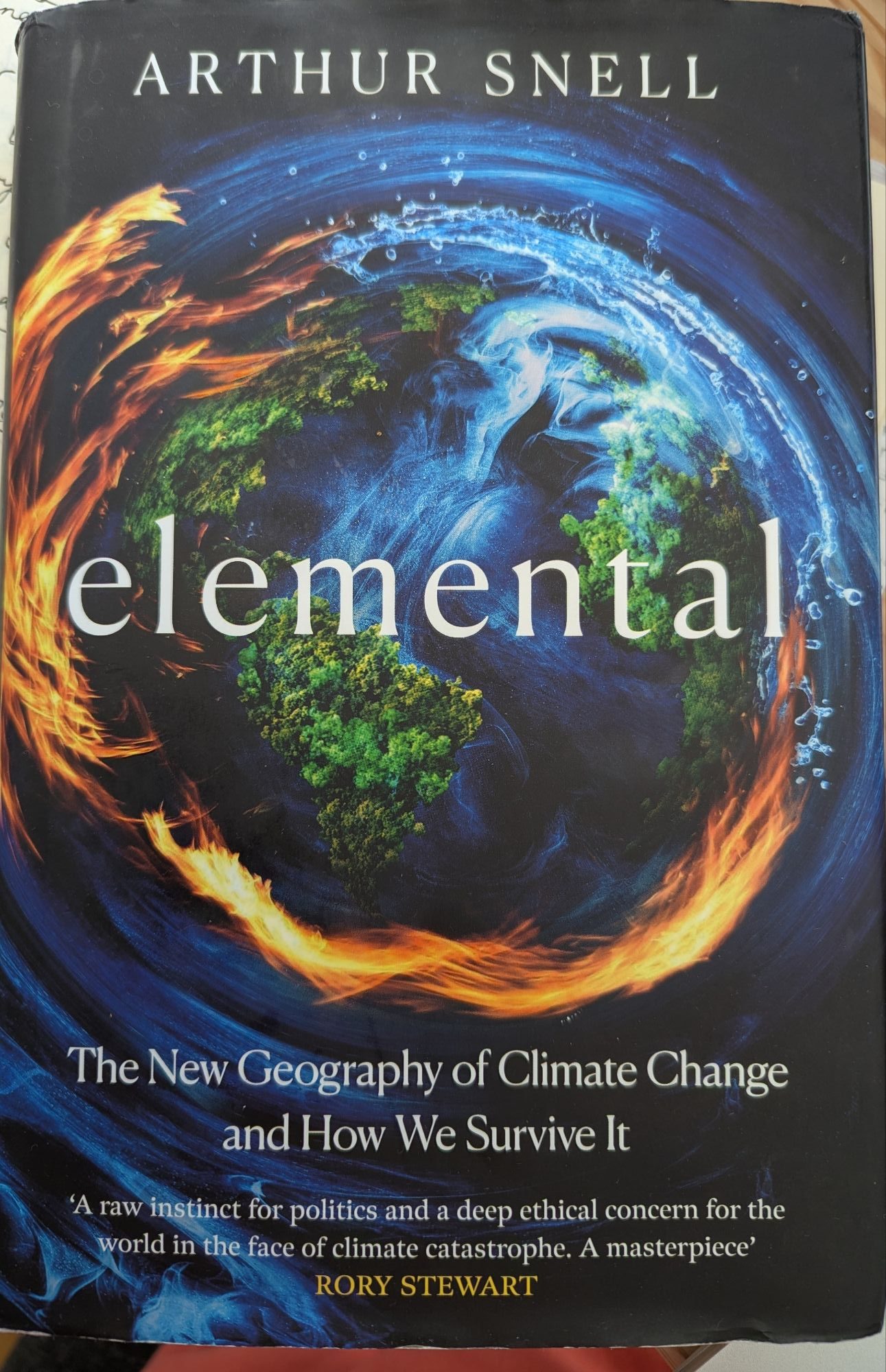
Much of the climate change literature, quite rightly, is based on the planetary sciences – weather, oceans, gases, etc. Arthur Snell, here, provides and important additional perspective, that of geo-politics. Ultimately, if we thought the science was tough enough to comprehend, the geo-politics can only complicate matters. Of course we are talking climate migration, food and fuel security, water (fresh for drinking and agriculture, saline oceans for weather stability and free trade routes).
The book is organised, as the title suggests – around the elements of fire, water, air and earth. This is as good scaffolding as any, I think; it gives Snell the opportunity to share insights from his own diplomatic experiences and new travels and discoveries (revelations, probably).
Readers of this blog may already be well aware of the mechanics of climate change, the IPCC’s periodic reporting and the target of 1.5 degrees Celsius by 2050 achieved only by eliminating the burning of fossil fuels and, unfortunately, some unlikely carbon capture and storage. At one end of the spectrum are poor, low lying countries such as Bangladesh, particularly vulnerable to sea-level rises, erosion, salination of agricultural land, amongst others. At the other end of the spectrum is Trump’s USA in denial about human-caused climate change (I write this section on 4 July on the 250th anniversary of the USA when a good number of events have been cancelled because of extreme heat) and the promotion of fossil fuel exploitation and consumption and the active suppression of renewables, wind, solar and batteries. And then there is the rest of us pulling back from commitments because of a far-right false narrative about cost and impacts on electricity bills and lifestyle.
Worrying highlights
Let’s take Russia. Russia is under stress having opted for an all-out invasion of Ukraine, it has few allies in the West (it is difficult to know whether the USA is an ally, it has to be said). Say what we will about Russia, it does seem to have a more forward thinking approach than many Western countries. For example, The Russian state is watching closely the opportunities for opening up and controlling a strategic arctic sea route. The natural resources currently locked under the Arctic ice become accessible as the permafrost melts. And that secretive and provocative settlement on Svalbard, Barentsburg (Norwegian sovereignty, and a NATO member). Readers wanting to see this, Simon Reeves went there on his Scandinavian adventure. Snell describes it on pages 297-301. The main town on the archipelago is Longyearbyen which serves primarily as a summer tourism base.
For the time being, Svalbard is a demilitarised zone under a treaty dating back to 1925. There may not be weapons on the archipelego, but there seems to be plenty of NATO intelligence equipment linked to the mainland (800km south) by an undersea cable that has already been damaged by, very likely, a Russian “trawler” (page 300). Such cables are also being cut in the Baltic.
China is another actor in this area. Whilst it has no coastline in the Arctic, it is very active in the region. It has observer status in the Arctic Council. It has also built a fleet of icebreakers (the USA has one, apparently). China’s interest in an Arctic passage come out of the insecurity of existing sea/trade routes controlled by hostile powers including Malaysia, Singapore and Indonesia (p308). It is potentially a “polar silk road” to add to the Belt and Road Initiative, amongst others. Clearly Trump’s claim on Canada and Greenland is part of this strategic game (though one wonders whether Trump understands it quite like Xi and Putin).
Since the invasion of Ukraine, Russia looks to the East to sell its oil and gas – China is now the key recipient of these resources. Russia also stays close to China because of arms procurement and the Arctic passage. But there is an even more intriguing reason for the alliance, and that is migration and food security. Snell offers a very interesting insight into how Russian land opened up by the melting of permafrost can become highly productive agricultural land that is particularly attractive to Chinese migrants and for which Russia has too few ethnic citizens to work (p118-9). Crucially, however, there are tensions that go back a long way. In a nutshell, Vladivostok and its hinterland used to be part of China. The port city was Haishenwai before being renamed. Arguably, China wants this territory back.
Just back to international treaties for a moment, Snell signals how jeopardised international treaties are becoming. For example, Antarctica belongs to no one (under a treaty dated 1959), though claims are being staked, as it were, again, as the ice melts and the resources become accessible. It is also a demilitarised region (or unmilitarised). China has four research stations on the island each with military capabilities and functions. The 1991 Madrid Protocol that bans mineral extraction is being challenged. It is up for renegotiation in 2048, let us see if it is not opened up before then. Finally two treaties between China and Russian (Aigun and Beijing) which formalised China’s ceding of territory to Russian may also become life expired.
Obviously I could summarise the whole book at length. It is not the purpose of a review, and I recommend the book to anyone with the slightest interest in geopolitics let alone the geopolitics of climate change. But here are a few more quick highlights:
- Why rice is so difficult to genetically modify (page 40)
- China’s dominance in EVs and the materials that drive them (p67-9)
- Weather control and geoengineering (chapter 10)
- importing PV electricity from Morocco (p169)
- Middle-East oil empires (183-191)
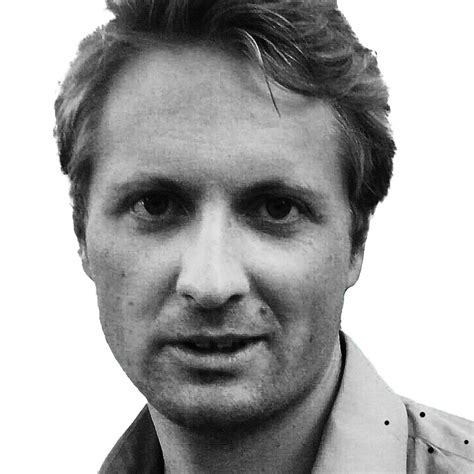
Photo: Arthur Snell from https://tinyurl.com/3y6mrusm

