Archive for the ‘Arctic’ Tag
Book Review – Elemental by Arthur Snell
Filed under: Environment | Tags: Antarctica, Arctic, Arthur Snell, book review, climate change, Elemental, environment, greenland, Politics
 Leave a comment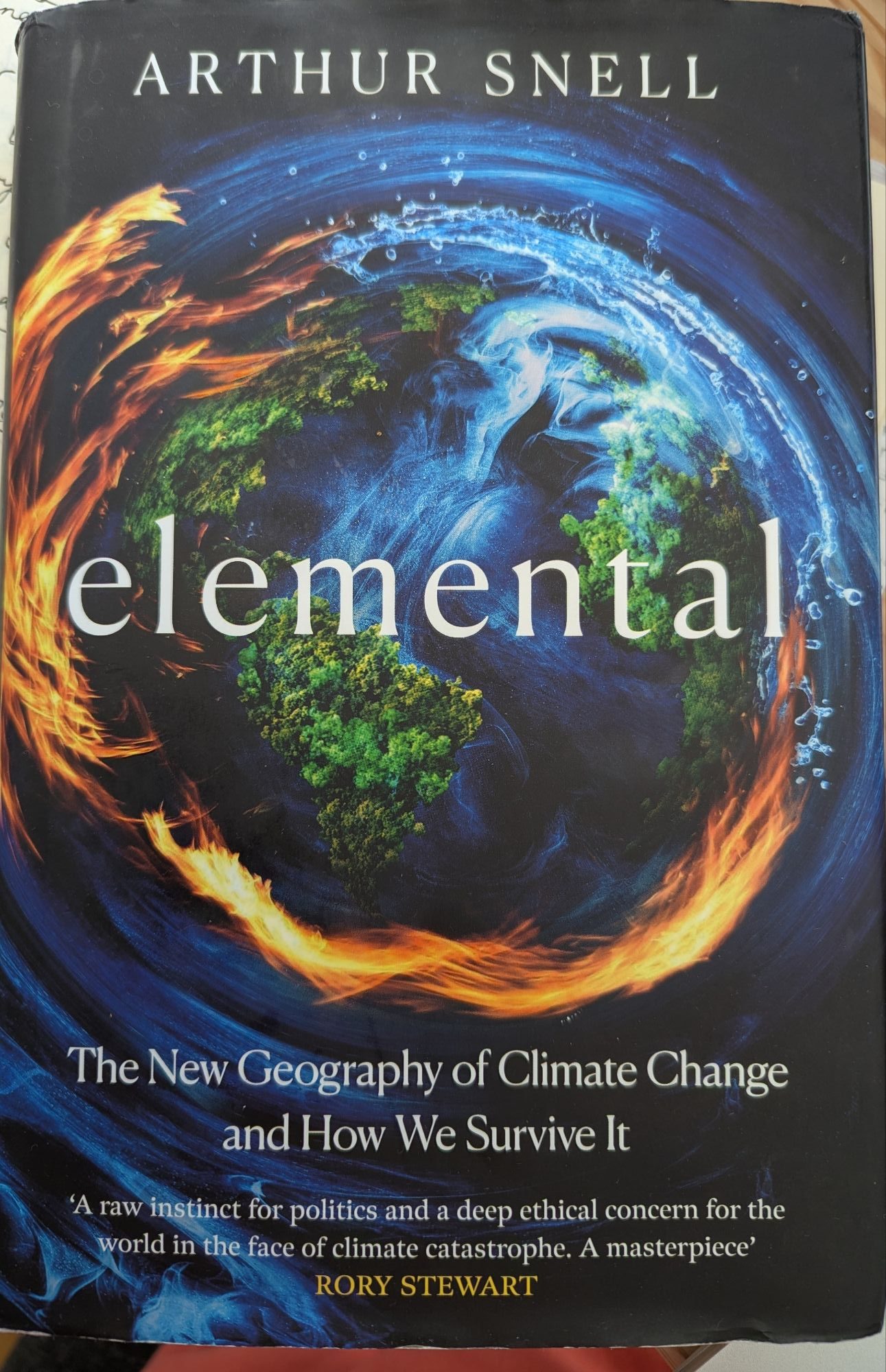
Much of the climate change literature, quite rightly, is based on the planetary sciences – weather, oceans, gases, etc. Arthur Snell, here, provides and important additional perspective, that of geo-politics. Ultimately, if we thought the science was tough enough to comprehend, the geo-politics can only complicate matters. Of course we are talking climate migration, food and fuel security, water (fresh for drinking and agriculture, saline oceans for weather stability and free trade routes).
The book is organised, as the title suggests – around the elements of fire, water, air and earth. This is as good scaffolding as any, I think; it gives Snell the opportunity to share insights from his own diplomatic experiences and new travels and discoveries (revelations, probably).
Readers of this blog may already be well aware of the mechanics of climate change, the IPCC’s periodic reporting and the target of 1.5 degrees Celsius by 2050 achieved only by eliminating the burning of fossil fuels and, unfortunately, some unlikely carbon capture and storage. At one end of the spectrum are poor, low lying countries such as Bangladesh, particularly vulnerable to sea-level rises, erosion, salination of agricultural land, amongst others. At the other end of the spectrum is Trump’s USA in denial about human-caused climate change (I write this section on 4 July on the 250th anniversary of the USA when a good number of events have been cancelled because of extreme heat) and the promotion of fossil fuel exploitation and consumption and the active suppression of renewables, wind, solar and batteries. And then there is the rest of us pulling back from commitments because of a far-right false narrative about cost and impacts on electricity bills and lifestyle.
Worrying highlights
Let’s take Russia. Russia is under stress having opted for an all-out invasion of Ukraine, it has few allies in the West (it is difficult to know whether the USA is an ally, it has to be said). Say what we will about Russia, it does seem to have a more forward thinking approach than many Western countries. For example, The Russian state is watching closely the opportunities for opening up and controlling a strategic arctic sea route. The natural resources currently locked under the Arctic ice become accessible as the permafrost melts. And that secretive and provocative settlement on Svalbard, Barentsburg (Norwegian sovereignty, and a NATO member). Readers wanting to see this, Simon Reeves went there on his Scandinavian adventure. Snell describes it on pages 297-301. The main town on the archipelago is Longyearbyen which serves primarily as a summer tourism base.
For the time being, Svalbard is a demilitarised zone under a treaty dating back to 1925. There may not be weapons on the archipelego, but there seems to be plenty of NATO intelligence equipment linked to the mainland (800km south) by an undersea cable that has already been damaged by, very likely, a Russian “trawler” (page 300). Such cables are also being cut in the Baltic.
China is another actor in this area. Whilst it has no coastline in the Arctic, it is very active in the region. It has observer status in the Arctic Council. It has also built a fleet of icebreakers (the USA has one, apparently). China’s interest in an Arctic passage come out of the insecurity of existing sea/trade routes controlled by hostile powers including Malaysia, Singapore and Indonesia (p308). It is potentially a “polar silk road” to add to the Belt and Road Initiative, amongst others. Clearly Trump’s claim on Canada and Greenland is part of this strategic game (though one wonders whether Trump understands it quite like Xi and Putin).

Since the invasion of Ukraine, Russia looks to the East to sell its oil and gas – China is now the key recipient of these resources. Russia also stays close to China because of arms procurement and the Arctic passage. But there is an even more intriguing reason for the alliance, and that is migration and food security. Snell offers a very interesting insight into how Russian land opened up by the melting of permafrost can become highly productive agricultural land that is particularly attractive to Chinese migrants and for which Russia has too few ethnic citizens to work (p118-9). Crucially, however, there are tensions that go back a long way. In a nutshell, Vladivostok and its hinterland used to be part of China. The port city was Haishenwai before being renamed. Arguably, China wants this territory back.
Just back to international treaties for a moment, Snell signals how jeopardised international treaties are becoming. For example, Antarctica belongs to no one (under a treaty dated 1959), though claims are being staked, as it were, again, as the ice melts and the resources become accessible. It is also a demilitarised region (or unmilitarised). China has four research stations on the island each with military capabilities and functions. The 1991 Madrid Protocol that bans mineral extraction is being challenged. It is up for renegotiation in 2048, let us see if it is not opened up before then. Finally two treaties between China and Russian (Aigun and Beijing) which formalised China’s ceding of territory to Russian may also become life expired.
Obviously I could summarise the whole book at length. It is not the purpose of a review, and I recommend the book to anyone with the slightest interest in geopolitics let alone the geopolitics of climate change. But here are a few more quick highlights:
- Why rice is so difficult to genetically modify (page 40)
- China’s dominance in EVs and the materials that drive them (p67-9)
- Weather control and geoengineering (chapter 10)
- importing PV electricity from Morocco (p169)
- Middle-East oil empires (183-191)
Photo: Arthur Snell from https://tinyurl.com/3y6mrusm

