Archive for the ‘book review’ Tag
Juice by Tim Winton, book review
Filed under: Book reviews, Environment | Tags: book review, books, fiction
 Leave a comment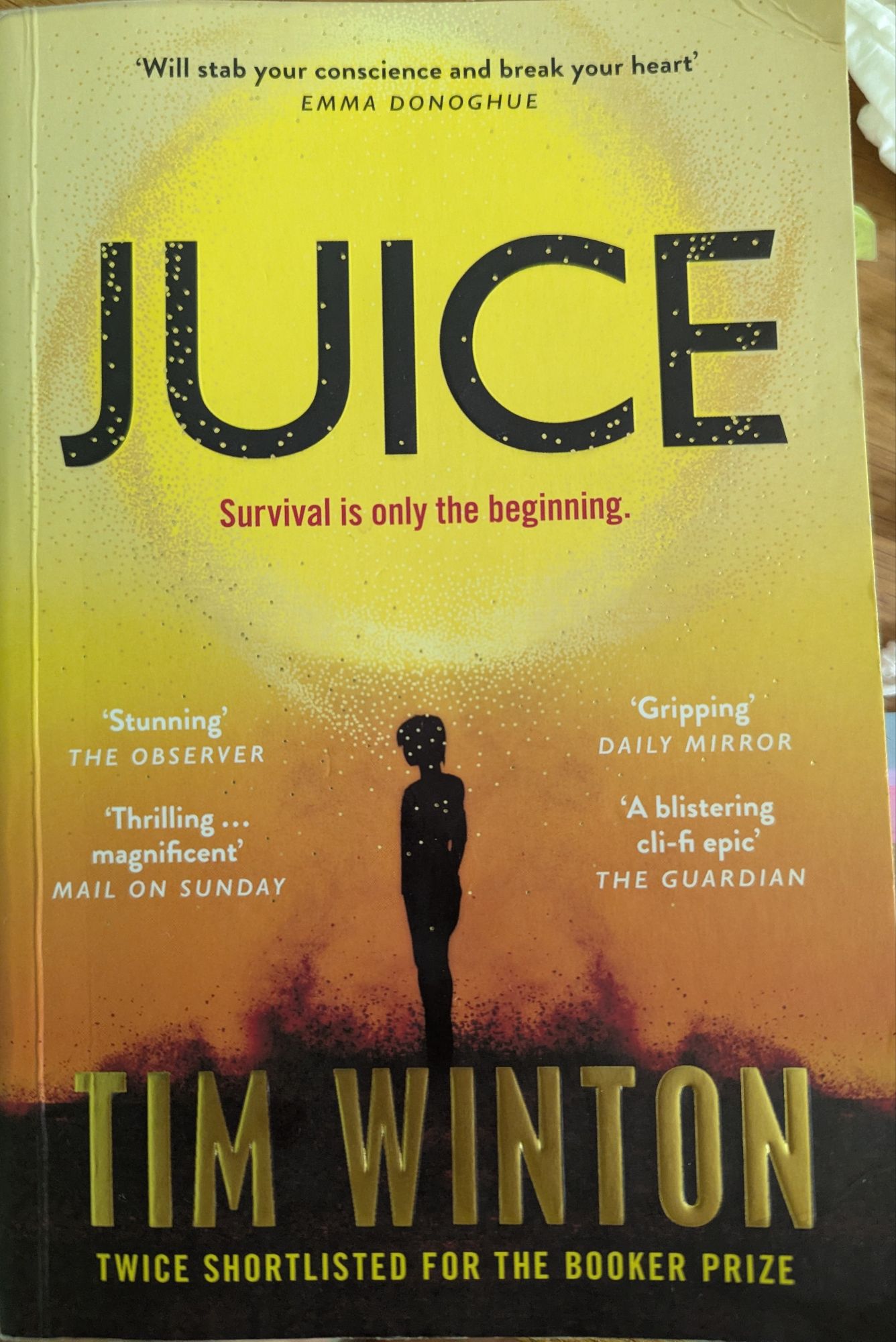
This is an epic – over 500 pages for the Picador paperback edition published in 2024. Of all of the cli-fi novels I have so far read (scroll in this blog to see the others), it is probably the most chilling. It is chilling because this is a novel informed by the scientific consensus about global warming: it is happening, life will become increasingly difficult in our lifetimes (and I am heading out of this world more than I am heading into it), civilisation will break down, though not universally (more on this below), and there will be violence. Oh, and there is a little sub-plot about machines that can either help us if we let them or kill us.
This review is full of spoilers – read no further if this book is on your reading list.
It is written in the first person, which is not my favourite style. Most of the characters are nameless; there are a few exceptions including the lead character’s wife, Sun, and their daughter, Ester. It is set on an Australian homestead run and worked by the lead character and his mother. Sun joins later. They are successful in growing food, raising fowl and harvesting water. They live underground for half of the year as the heat – over 55 degrees Celsius – is too much on the surface. The lead character is big into salvage and has a whopping great solar-powered truck (rig) to repatriate his finds. The economy is one of barter. People trade in the nearby hamlet through a co-op known as The Association.
One day, the lead character goes to the hamlet to trade for parts to repair a warped central axle on their barrel turbine caused by a recent storm. He encounters the Filmlayer, a trader with one eye and broken teeth. The Filmlayer was known to visit his mother. He grabbed the young man and frog-marched him to a shelter where he encounters a nameless woman whose payment for the new axle is his attention. He consents and is confronted by a visual display of the realities of the world transformed by the warming (wildfires, for example) along with fast moving images of houses, people, vehicles, “kit”, etc. He was being recruited to a highly secret organisation known as the The Service. A mixture of fear and curiosity led to his agreement to undertake the “Basic” training under the tutelage of a woman known as Awe.
The book starts somewhat close to the end (of the lead character’s story). Our character is in his rig along with a child searching for that one place to settle. He drives up to, what appears to be, a deserted mine, only to find it is occupied with a rather aggressive man, the Bowman, who takes them prisoner underground. It is in the course of one evening/night that our lead character tells the Bowman his story. It is an incredible one at that. We know that the oath to secrecy about the Service has gone, but we do not know why. The Bowman also claims to be a veteran and is equally scarred and disenchanted.
The Service
During the basic training, volunteers are inculcated with the purpose of the Service; namely to rid the world of networks and bloodlines of the people who caused the warming – largely the fossil fuel company bosses and their helpers. Because of their vast wealth from extraction, these people live in protected, remote and secret citadels. It is clear that a lot of intelligence work goes into finding the citadels and drawing up the plans to attack them in elaborate and complex operations involving planes, helicopters, ships and sophisticated weaponry.
Our lead character is a decorated veteran having been part of, or leader in, some of the most high profile raids. He played a leading role in the operation that saw off the so-called Exxons, for example, commonly referred to as the Utah operation. The Bowman claimed to be part of that operation, too. The story of that raid takes us into the bowels of the citadel revealing the privileged lifestyle of its residents, relative to homesteaders, city dwellers and itinerants.
In between these secret operations, the lead character maintains his life as homesteader. Sun enters as an apprentice vet who comes to the homestead to assess the health of the fowl. He is immediately smitten. When she finds out that she is no longer required by the vet she agrees to join the homestead and make a new life away from the city. They build their own house from salvage and the largesse that is a reward for service. And eventually they have a child whom they name Ester because of the association with the smell of sweet fruit and for the “warrior queen of the sagas” (p294)
By virtue of the fact that the lead character is no longer with Sun and Ester or his mother, we know that something happened along the way. Ultimately, there are two causes. Sun and Ester leave the homestead whilst the lead character is on an operation. The cause is a rumour that when he is away he is actually with another family in the South. His mother pleads with him not to go looking for them. The lead character convinces himself that they will be back. The second reason is the growing harshness of the climate. Storms not only flood homesteads but huge hailstones destroy everything – homes, growing houses, vehicles. Notwithstanding the increasing temperatures in which nothing grows. The homesteads’ self-sufficiency evaporates. The people become refugees heading south seeking cooling and new lives. After the death of his mother, our lead character continues alone for a few more seasons punctuated by one final mission: to get the Aramcos!
The Sims
The Aramco mission is like no other. Normal protocols are broken but defended by the leaders as necessary to destroy this critical citadel. They will use a proscribed weapon, fire. They travel by sea and are acclimatised to the extreme conditions on board wearing full combat gear and being forced to stand for long periods. Volunteers die during the voyage and are committed to the sea. Those that remain are tough, ready to do their service.
It does not go well. Whilst many enemy defenders are killed, it is impossible to penetrate the citadel not least because so many Service members are themselves killed. Our character is injured but is picked up and protected by 11 sims (p420) who seemingly were “slaves” of the Aramcos. Sims are human in form, seemingly partly organic, but most certainly electronic as witnessed when they are destroyed by fighters or others. Our character will have a later encounter with a sim after fleeing the homestead.
This group of sims are looking for liberation and they want to be taken to Australia and away from the desert. Our character reassures them that he will honour that wish in exchange for safe passage to the coast where the support ship is waiting for the escaping Service people. They take him through the searing desert under an insulation blanket as well as plying him with food and water. The personnel on the support ship do not wait for explanations and summarily destroy the sims. Another question is raised. And it is a significant one. Who is running all of this? A drone delivered ordinance, was it directed by human or is it autonomous? The sims only shrug at this question (p419).
As noted, our lead character has another encounter with a sim. On his search for sanctuary in the South he encounters a sim who has taken responsibility for an orphan child. He agrees to take them with him, despite being one extra mouth to feed (the sim is recharged by sunbathing). One evening they are confronted by three men who take her prisoner, sexually abuse her and then destroy her. Our lead character in turn kills them leaving him alone with the child. These are not the only people he uses violence against – a man caught trying to steel his water maker (clearly a valuable piece of kit) is beaten and has his wrist broken. Another has his rig burned and is left by the roadside bound and gagged.
The big questions
This final mission raises many questions that have not been asked earlier. Among them, who runs the Service? How does the intelligence work? How is the killing ultimately justified? Where does all of the kit come from? Should the current clan members be held responsible for the actions of their predecessors, even though they are living off the proceeds? Indeed, the Service volunteers have no history with the people who caused the warming. Indeed, our central character during basic training says “The dirty world is long gone. These people are dust now.” (p121) We may ask what kind of justice is being meted out and at what cost to Service volunteers (at best, diminished mental health at worst, death)? One final concern seems to be the secrecy and whose interests it serves. Whilst our lead character thinks that he is the only person in the Association who has been recruited, we learn later that that is not the case. Everyone is lying to everyone else all of the time. This is a society of zero trust. And for what? The World heats up relentlessly. The tipping points have been reached. No amount of killing is going to bring back the Holocene. “Maybe it was a mistake, I say. Trying to purify the world one dead body at a time.” (p461)
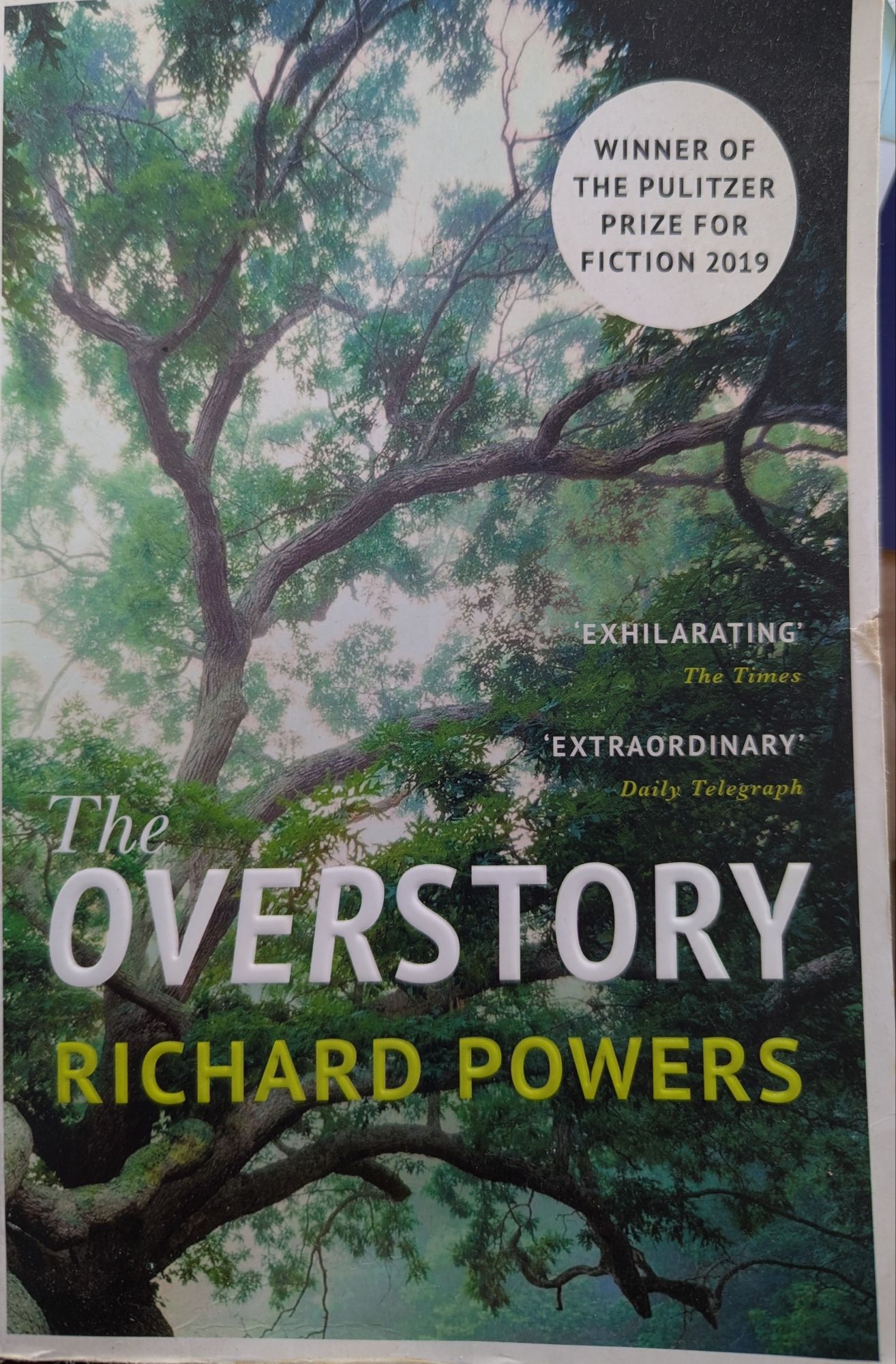
This reminds me very much of Richard Powers’ book, The Overstory, in which the protagonists’ direct action to protect a forest and its trees inadvertently leads to the death of loggers. A number of years pass and the group disperses with no accountability for their actions. That is until, for one of them, the guilt boils over and he implicates others leading to arrests and jail. In Juice, the lead character, in his big reveal, exposes his own culpability for the deaths. Through his exchange with the Bowman, he confronts his doubts. It is catharsis. It is the first time he has been able to tell the whole story. Reluctantly, if I read it correctly, the Bowman can no longer doubt him. Living the lie is over.
There’s another comparator that springs to mind, too. As I write this the BBC is airing its next series of Traitors – the celebrity version. This year featuring the likes of Hannah Fry, Michael Sheen, Richard E Grant, James Blunt and Joe Lycett (these are some of the ones I recognise). I have never watched Traitors because of the concept; namely deceit. I trust in the analysis by Rupert Read on the mechanics, but instead of it being a show for problem solving by collaboration, it is one that deliberately pits people against one another – in some cases, siblings and professional collaborators. Trust no one. They are out to kill you (or at least oust you from the show). That is how civilisation ends.
Here is the Guardian’s review by Rachel Seiffert of October 2024.
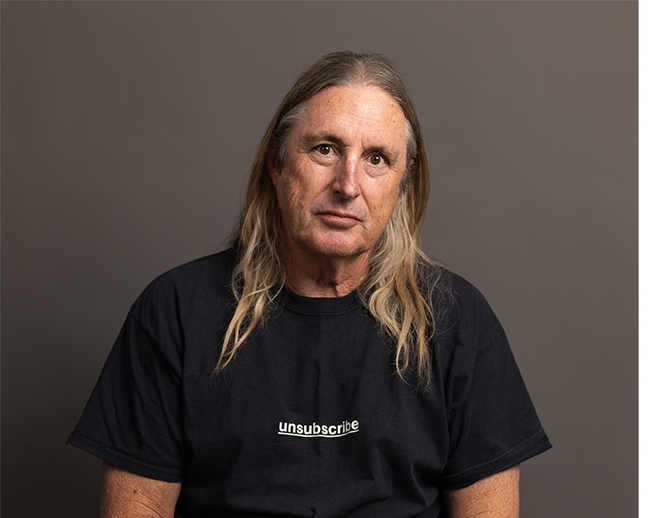
Picture, Tim Winton https://www.greenbelt.org.uk/artists/tim-winton/
Flight Behaviour by Barbara Kingsolver, book review
Filed under: Book reviews, Environment | Tags: Barbara Kingsolver, book review, climate change
Leave a comment This is my review of Barbara Kingsolver’s novel, Flight Behaviour. It has plenty of spoilers so read on only if you have already read the book or do not intend to.
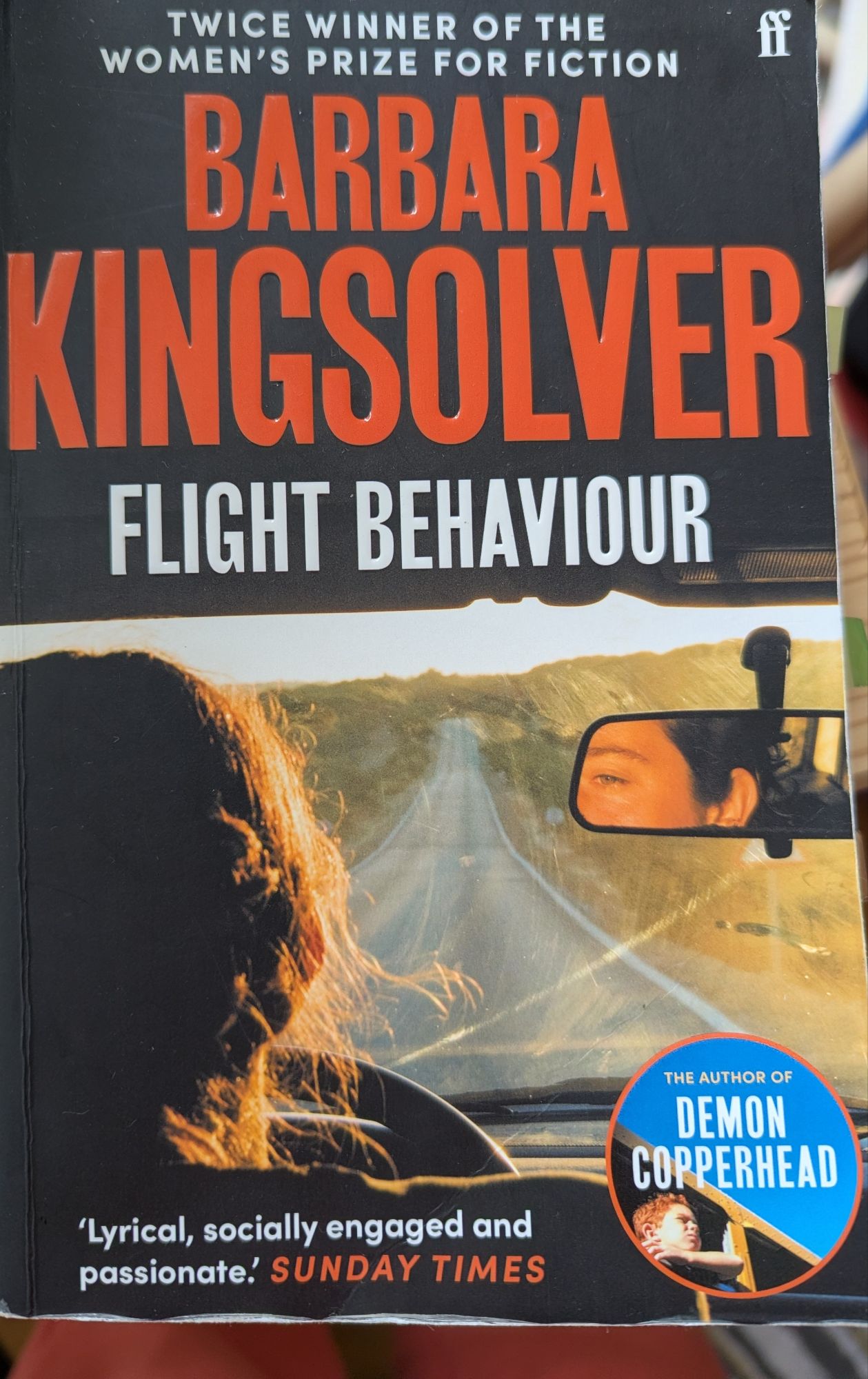
I was a little apprehensive about this book, it did not look like anything I would want to read and 600 pages of something that one does not want to read is beyond the call of duty. My conclusion is simple, although I am unlikely to claim this as a favourite to join me in my tomb, for a book published in 2012 it shows remarkable perceptiveness. It also addresses climate change from the perspective of farming families in rural Tennessee. The family of Dellarobia Turnbow, her husband Cub, their two children, Preston and Cordie, and the dog, Roy, who live near to the fictional Feathertown – a place that we can all imagine. Nearby live Cub’s parents Hester and Bear who own much of the forested land as well as property.
New arrivals, new thinking, new opportunities
Times are really hard on the farm, not least because of the relentless rain. Unusual but increasingly common because of climate change. Our protagonists are not wholly aware of the causes, only the effects. Bear decides to cash in on the wood in his forests after a lumber company offers him money to clear it. He agrees to wait until the butterflies have migrated before the felling starts.
Central to the exploration of the changing lives of of the characters is the unexpected arrival and discovery of a huge population of Monarch butterflies (below right) in the forest. On seeing them for the first time by accident, Dellarobia has somewhat of an epiphany as she and her son become obsessed with the lives and survival of the butterflies that are normally expected to over-winter in Mexico. We learn that the habitat in Mexico has been destroyed, hence the unexpected migration.
Dellarobia becomes somewhat of a local celebrity and the spectacle becomes an attraction which Hester and Bear try to monetise unsuccessfully. The television media (News Nine) take a particular interest (pp274-288) and journalist Tina Ultna exploits a naïve Dellarobia through an interview in which she reveals that she went into the forest to kill herself (not true, it was to start an affair in the old hunting hut, but the cause was the same, alienation). On seeing the butterflies she realised that she was too focused on herself and not on the wider world including her children. Some weeks later Tina and different cameraman, Everett, came back for a follow up that is much more revealing but less reportable (see below).
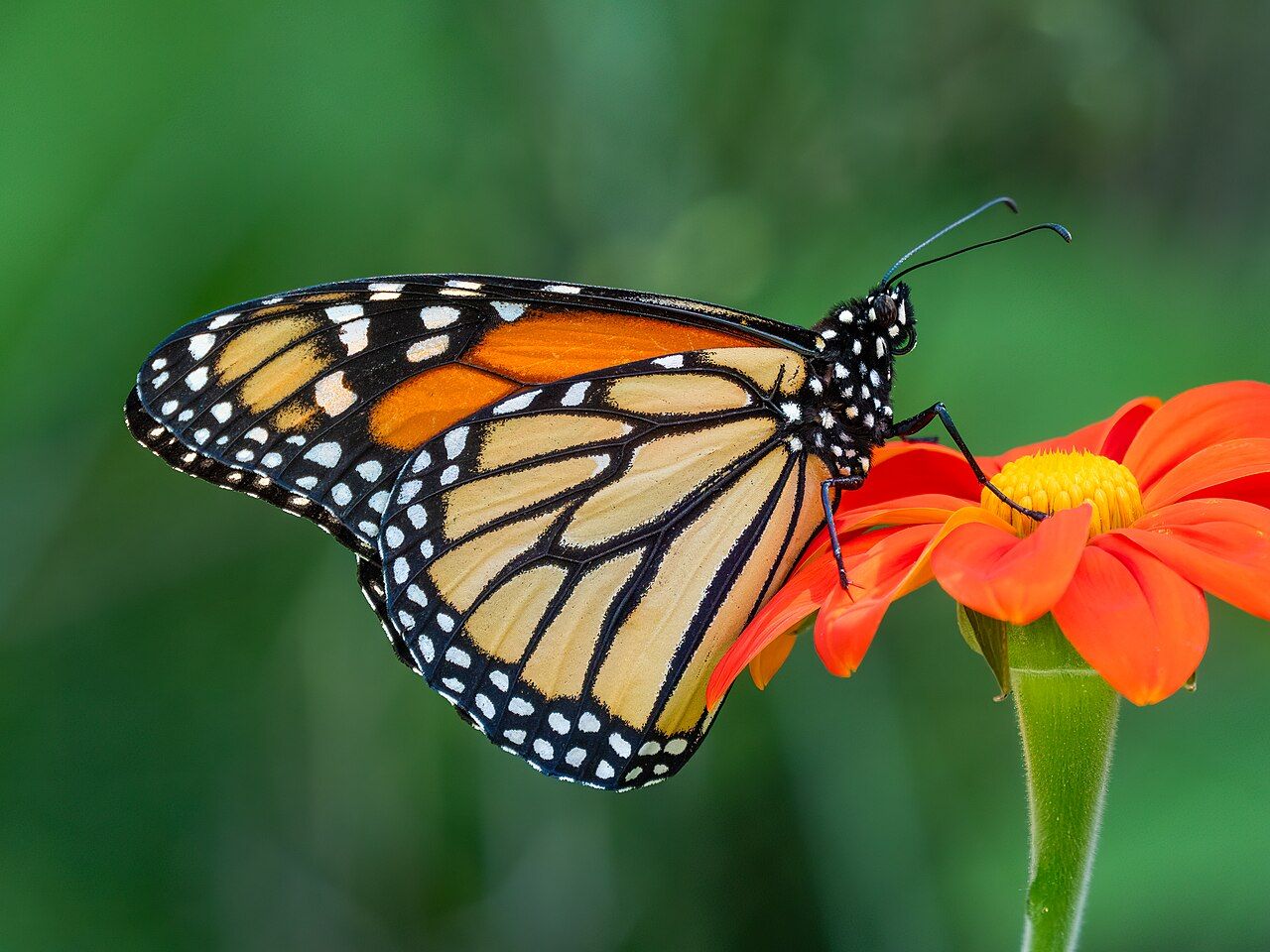
A series of visitors begin to change everything. First a Mexican family call on them (pp132-142). The child, Josefina, is in Preston’s class at school. The parents Lupe and Reynaldo are not so proficient in English. They come and request to see the butterflies. They do, of course, have a parallel experience of being displaced from Michoacán (Angangueo) like the butterflies (it is a bit of a crude rhetorical device, but there are quite a few of these in the book). Indeed, they used to be guides in the forest for visitors coming to see the butterflies, such a spectacle they are/were. But then came the flood. All was gone. Be under no illusions on this point as the novel progresses.
The most significant visitor is a scientist called Dr Ovid Byron (pp143-174) who changes everything for the family. He is a 40 something tall and handsome black man and drives a rented orange VW Beetle. In an exchange with her closest friend, we get the following:
“Wait a sec,” Dovey said. “He flew across the whole damn country and drove to your place to see butterflies?”
“That is correct”
“Did he seem, I don’t know, insane?”
“How would I know? I spend my whole life with people that want to eat thumbtacks off the floor.”
Without hesitation she invites him for supper with the family after coming back from the mountain to look at the butterflies. Dellarobia likened him to Sidney Poitier because of the movie plot. At supper he charmed both Dellarobia and Preston. Dellarobia was amazed to find that scientists exist that specialise not only in butterflies, but to these butterflies. So much so that she progressively learns from Byron not only about Monarch butterflies but natural history more widely and the impact of climate change, a subject that was something they were living through but where the trust, ultimately, was in the hands of God. Preston, equally becomes beguiled by this stranger whose knowledge he can aspire to in a way that his mother, and particularly his father, cannot.
From this moment on, Dellarobia and Preston are different people. Cub is different because of the impact of Byron on his family. For a matter of weeks, Dellarobia is employed by Byron along with a research team of Mako, Bonnie and Pete (who lodged nearby) plus local and not-so-local volunteers, many of whom are hardy souls living rough in the forest throughout the winter – albeit a mild one. Byron himself lives in a mobile home parked on the farm and an outbuilding is converted into a laboratory, for a rent of course. Dellarobia’s employment on her own terms provides her with a small income that enables a degree of autonomy and the ability to provide a few of the presents that she has wanted to buy her children but couldn’t. But more important is Dellarobia’s education – learning by doing. Everything from counting, sexing, measuring, looking out for food sources and signs of flight. She realises that human life is intertwined with that of the natural world and humans’ impacts not only lead to extinctions (Byron believes that they are watching a species extinction) but hardship for human beings as well. Farming becomes uncertain; security, too, and migration becomes necessary for those whose habitats have changed so much that their lives cannot be sustained there.
Ephemera
Perhaps one of the most telling chapters, Chapter 11, is the visit to a very large second hand store in the nearby town of Clearly visited by Dellarobia, Dovey and the children. The shop is a magical place full of useful stuff ranging from bedding to toys, homeware to clothes, bicycles to books, aquariums to wigs, and so on. All at exceedingly affordable prices. The merchandise largely comes from house clearances, but the symbolism of this extended chapter speaks volumes. It tells us that:
- There are a lot of poor people, (even) in modern America
- Used stuff has value
- We are reflected in all of the things we own; we reveal our identities often after death
- It lays bare the possessions that humans acquire through life
- [resale] is a metaphor for genetic mutation (p439)
- There is such a thing as society (even in highly individualised societies, or maybe particularly in such societies)
- People come together to trade, exchange, commune and replenish.
Media culpability
And so to the second encounter with Tina Ultna and cameraman, Everett (pp498-510). Again, arriving without warning, Dellarobia (with Dovey) takes her to meet Byron, a man who is not keen on talking to the media about his work. After some goading he lets Tina have copy, but not of the kind she wants or expects. This is a long exchange, but here is the critique of media coverage of the climate crisis:
“…What is your name again?”
“Tina Ultna,” she said in a different, off-camera voice.
“To see only beauty here is very superficial. Certainly in terms of news coverage. I would say it’s off message.”
“You’re saying there’s a message here? And what is that?”
“…After a long pause, Tina tried again. “Dr Byron, something new is happening here. Most of us are struck by the beauty of this phenomenon. But” she cocked her head theatrically as if burdened by a keen insight – “do you think it might possibly be a sign of some deeper problem with the ecology?”
“Yes!” Ovid cried. “A problem with the environment is what you are trying to say. Pervasive environmental damage. This is a biological system falling apart along its seems. Yes. Very good, Tina Ultna.”
“And briefly, Dr Byron, tell us the nature of the problem.”
“Briefly? Unseasonable temperature shifts, droughts, a loss of synchronization between foragers and their host plants. Everything hinges on the climate.”
She blinked a couple of times. “Are we talking about global warming?”
“Yes, we are.”
Tina made a downward wave at Everett to stop the camera, and bizarrely her own animation clicked off too, her face slack as she walked across the lab, maybe starting to feel homesick for her average flaming interstate wreck. Tina checked something on the camera, then walked back to her interview spot and spoke in a subdued voice. “The station has gotten about 500 e-mails about these butterflies, almost all favourable. Is this really where you want to go with this segment? Because I think you’re going to lose your audience.
Ovid looked genuinely startled. “I am a scientist. Are you suggesting I change my answer to improve your ratings?”
Byron gets angrier as the dialogue progresses. It ends with Byron telling Tina that humanity has been drifting for decades but now we are at Niagara Falls in a canoe. Tina responds by saying that at least if this was Niagara Falls “I’d have a decent background.” On they go. Byron tells Tina that she is part of the problem, dancing to the tune of her sponsors and not doing real inquiry.
All the while, Dovey was recording with her phone. She had an unedited version of the exchange and very quickly it was on the internet.
Religion
Religion, of course, plays its part in the story. This is a religious community. Though there is a lot of doubt. Hester gave up after a miscarriage (not her own but she had given up a baby for adoption) and labelled Dellarobia a 9/11 Christian, “in the event of an emergency, call the Lord” (p82). The local pastor, Bobby Ogle, was an attraction beyond Feathertown and is more than a cleric. He set up his own “no heller” church. He could look past petty things. “[H]e was not into things of this world. Just love.” He also takes a role of mediating the change for and amongst those in his congregation. So much so that he has a significant influence over the fate of the trees once the butterflies have gone.
After church (chapter 13) the family meet Pastor Ogle in his office to discuss the logging contract. Not before, however, having sung “Oh this earth is a garden, the garden of my Lord, and He walks in His garden in the cool of the day.” amongst other references in a distinctly organic sermon. Surprisingly it was Cub who started the bidding pointing out the potential for mudslides and contamination of the well water. Pastor Ogle offered Bear alternatives, including selling equipment (back to the secondhand theme) and how community can help to send work his way (keeping the machine shop open). Bear stayed firm. Then the insults: “Bear apparently at the end of his argument rope, responded by calling Bobby [the Pastor] a tree hugger.” (p556). The Pastor responded with “…what have you got against the Lord’s trees?”
That is not the end of the story, suffice to say Dellarobia and Cub come to an arrangement over their marriage and the duties to their children, but not before a climate-related natural event occurs that parallels the experience of the Lupe, Reynaldo and Josefina. We observe the events with little real surprise. Kingsolver is not the subtlest of writers. It does leave us with a few questions but they are overridden by the change to all brought about by the butterflies as symbols of our own fragilities, vulnerabilities and detachment from the natural world that supports us.
Pictures: Monarch butterfly (Brooklyn Botanic Garden, CCBY-SA 4.0)
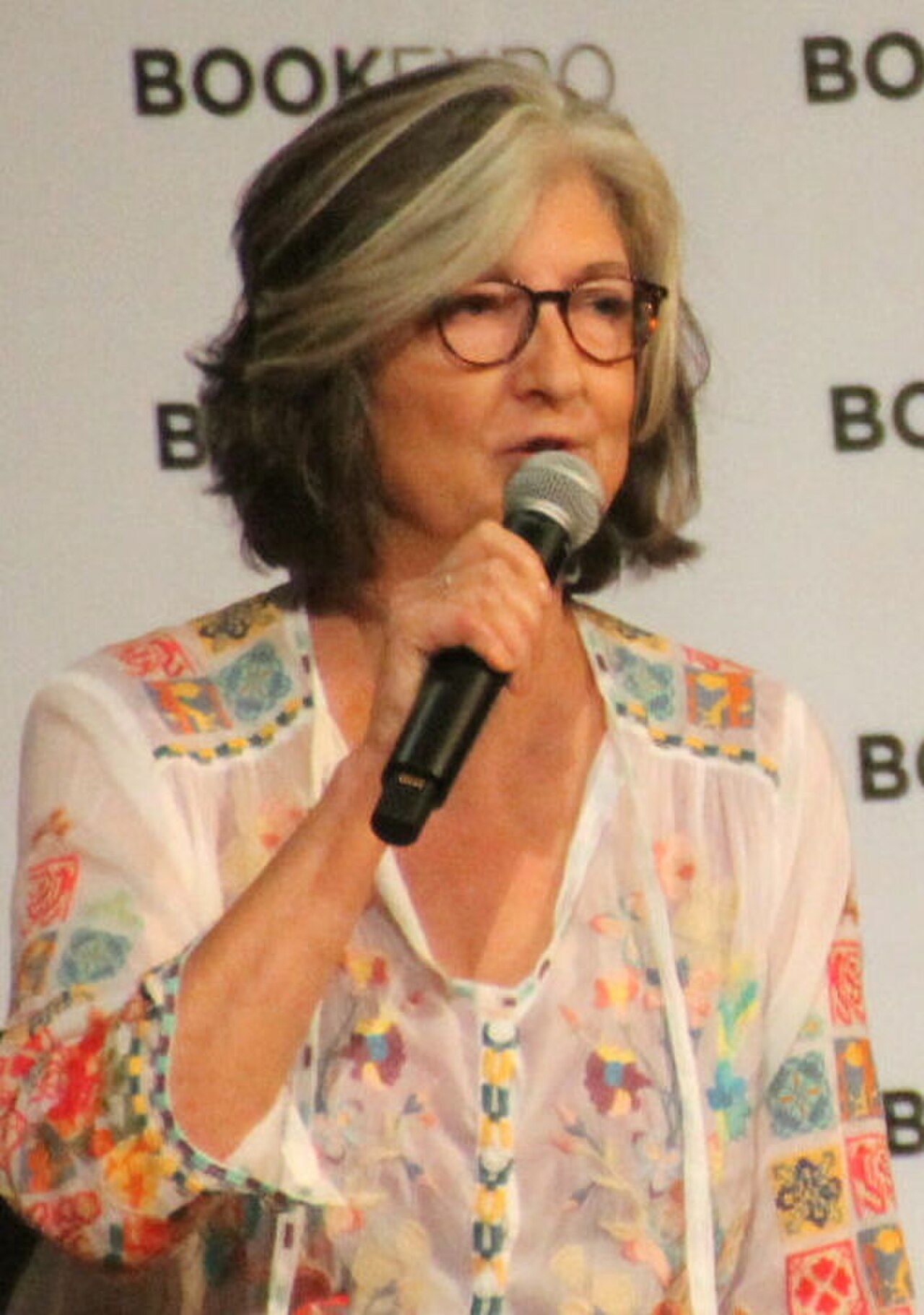
Barbara Kingsolver: Terry Ballard – https://www.flickr.com/photos/terryballard/40684622480/
Book Review – Ecotopia by Ernest Callenbach
Filed under: Book reviews, Environment | Tags: book review, books, Callenbach, dystopia, Ecotopia, fiction, writing
Leave a comment 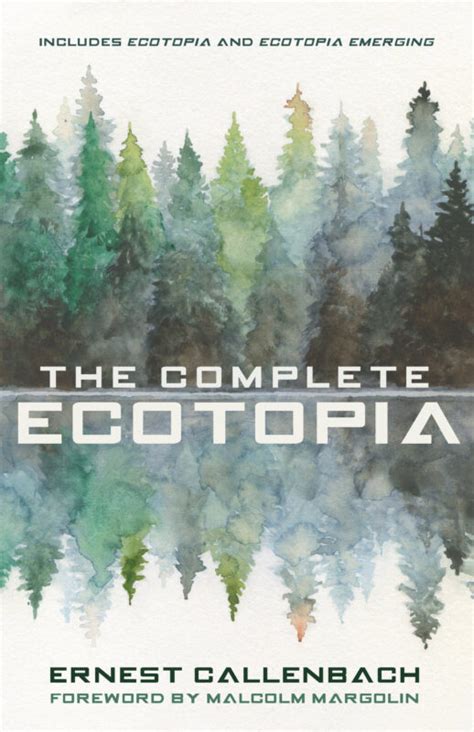
This book has been sat on my bookshelf for two or three months. It is a shiney new edition that features an informative foreword by Malcolm Margolin (his publisher) and the prequel, Ecotopia Emerging (which is not being reviewed here). If you are planning on reading this book, read this entry no further. There are many spoilers.
The book was first published in 1975 – that is significant because many of the technologies that were clearly aspirant at the time are now at the forefront of the transition; for example, heat pumps and videophones (albeit wired). There is no plot as such. Everything revolves around the unlikely scenario that two-and-a-half states in North America split from the USA to create Ecotopia. These were Washington State, Oregon and the northern part of California (including San Francisco but not Los Angeles).
It is a closed and protected society such that only now is a New York journalist, William Weston allowed to enter to experience life in Ecotopia. He is, however, much more than a journalist. He is an agent looking for intelligence on how to re-unite the states.
There is a lot of hippie nonsense in the prose and the conceptualisation of Ecotopia. That said it is a more faithful manifestation of hippie-dom than what perhaps transpired. The eco-utopianism in the novel arguably could have been realised, but instead the utopianism transmogrified into libertarian silicon valley technological determinism. Callenbach obviously saw the opportunity, but as is so often the case, humanity chose a different direction when confronted with an inadequately signposted fork in the road.
Economics
So what does Ecotopia look like? The economic model is not easy to define exactly. It is still capitalist but it is mixed. There is much regulation, particularly about fuels, materials, housing, etc. There are no cars – though bicycles and electrified public transport including, remarkably, high speed trains, are abundant. There are some diesel trucks used for logging that simply have no substitute at this point in time.
Food and land are very important in this economy. Forests were – are being – reforested, though wood has become, once again, the main and favoured building material. Forests are managed sustainably, there is no clear cutting for lumber. It is not a vegetarian world, but the meat is not intensively reared. Some of it is hunted; deer, for example. What is true is that there is no shortage of food. There is a universal basic income, but most Ecotopians regard it too meagre to exist on. In the employed economy, the working week is 20 hours. That is generous, even by modern thinking on the relationship between work, leisure and volunteering. There is more functionality in this world – all consumer gadgets are mendable, and the people are taught – starting in school – to do the mending themselves. Universities are run by academics, but students can determine who gets employed as it is their fees that pay salaries. University education is often seen as an end in itself. It is a life experience worthy of investment. This may explain why many Ecotopians are experts in arguing esoteric concepts!
Ecotopia has a sophisticated science-base, so much so that scientists have discovered and businesses have commercialised bio-degradable plastic. This can be used for both packaging and for modular housing. Now there is a thought. There are factories extruding plastic for building purposes. Though not all Ecotopians are in favour, it is still plastic, after all. Much research is done in small research institutes located near universities. There is innovative work taking place that probably would not be funded in the USA; for example tapping electrical energy from algae (the inventors won a Nobel prize for their work). Research, however, is focused on practical/scientific disciplines. There is no room for the social sciences – political science, sociology and psychology. Though there is, interestingly, room for philosophy. History also survives much of it focused on pre-independence research (maybe to justify the independence rationale).
After independence, there was a flight of capital. The state had to nationalise farms, factories and retail. They ultimately brecame cooperatives, owned by the workers. Inheritance of property was abolished. The core tax is corporation tax – the state claims a percentage of output and invests the proceeds in public goods. There is also a land tax (p95). Imports attract very high tariffs to ward off competition from Asia. This does facilitate the circular economy; for example, people wear home-made clothes rather than buy low-price, low quality garments from abroad.
So, the circular economy exists in this world, and seems to work such that it is accepted and embraced. Ecotopians consume much less than their US counterparts. It is also degrowth which includes a falling population. In order to limit pressure on resources, the Ecotopian government initiated a fertility programme largely focused on women, birth control and access to abortion clinics. More economically, Ecotopia evolved a less-consumptive economy through decentralisation of power, taxation, health, education, agriculture and appropriate-scale food production more generally.
People live in mini-cities. It reminds me very much of the modern concept of the 15-minute city. Everything is within reach geographically. Though there are other Ecotopians who live in communes/forest camps on the land (p53). A family could be as many as 20 related and unrelated people who share space, domestic tasks and childcare.
Energy and law

There are no coal-fired power stations. There remain a few fission nuclear power stations, but these are increasingly seen as unsustainable because of the inability to deal safely with radioactive waste. There is geothermal, hydro, solar, “earth heat”, tides and wind. The sea thermal plant in Punta Gorda takes heat from the ocean passes it through heat exchangers to extract the heat that can be used for heating and presumably electricity generation.
The criminal justice system (pp89-90) is also noteworthy. Penal institutions exist and sentences are long – though there does not seem to be capital punishment. Inmates work (forced labour as described by some). There is a different hierarchy of crimes in Ecotopia. There are no laws against prostitution, drug use and gambling (these are seemingly “victimless crimes”. White collar crimes such as embezzlement, fraud, collusion, and similar, are treated as severely as assault and robbery. Likewise for deliberate pollution of air and water.
There is a pro-USA underground movement (p50-52). Weston meets a couple of representatives in his hotel. But nothing comes of this encounter, though the Ecotopian (counter)intelligence service is aware of that meeting (p63). In the end, Weston does not file his story relating to this encounter.
Race
Prior to independence, the three states that now constitute Ecotopia were racially mixed. Since independence, there is segregation after the black population sought to gain their own independence. Areas of San Francisco and Oakland (known as Soul City), have become city states with their own currencies, postage stamps and language (Swahili is increasingly spoken). Only international affairs are managed by the central Ecotopian government/state. More disturbing has been a proposal to move black populations, for example in Monterey Bay and Salinas Valley, into the black city states to free up valuable agricultural land. It is noted that people in the black city states earn more money largely because they work longer than the 20 hours than people in Ecotopia.
Media and communications
Ecotopia, on independence, broke up media conglomerates. Ultimately, ownership was limited to one media outlet per city. If a corporation retained the TV station, then it could not operate parallel newspapers and magazines (there is no social media in 1975 Ecotopia). Newspapers and magazines thrive despite the divestment.
TV was transformed. Rather than channels for entertainment, they became news and information outlets hosting debates, hearings and committee meetings! This approach perhaps influenced the C-Span model? For news there are no correspondents based in the USA, so the focus is domestic and other foreign affairs (Brazil is a favourite, especially after US air attacks).
Specialist books are printed at kiosks as they are not in print and sellable through book stores.
Sex
There is a lot of it. Especially during four (statutory) holidays, solstices and equinoxes, obviously! By way of a possible explanation, this is a post-1960s free love California influencing Callenbach’s thinking. Largely because women control their own fertility they also seem liberally to have sex with multiple partners. Weston, on being introduced to one of the forest camps, is initiated by being given a bath and having sex with Marissa, his host. Marissa becomes the chief protagonist in Weston’s ecotopianisation, for want of a better word. Sex is also, potentially, fundamental to the healthcare system. As noted, hospital patients are allocated a nurse who stays for the duration. Sex is so connected to wellbeing, it seems to be written into a recovery plan.
All women choose the father of their children. Incidentally, Callenbach is an awful writer of sex and even less good in writing about love (making).
Schools and education
In schools, children are taught to make things. Children also work the land as much as they learn in the classroom; they understand growing cycles, land fertility, harvesting and develop a deep knowledge about flora and fauna. It is a very practical education; they even learn how to operate printing presses! They learn to trap animals, build shelters, make weapons (bows and arrows). Schools are not free of charge (there is a grant system for poorer households). They are private enterprises, though largely owned by the teachers. Children undertake national examinations at 12 and 18 years of age.
Despite the absence of some subjects from curricula, most young people can play an instrument, are artists, dancers, actors, sculptors, film makers, etc. There are no big-name architects because, essentially, everyone is an architect, even if it is only designing a rudimentary shelter. Most communities have their own groups playing music mirroring their ethnicities. They all seem to have a dance beat. Subject captured musically are not too different from other countries – love, loss, etc.
Ritual war games and health
Most societies seem to have some outlet for simulated violence. Sport is the obvious channel for this, particularly between men. In Ecotopia, they have ritual war games which involve two bands of (young) men – maybe 25 on each side – with spears trying to kill one another. It seems a bit like hunting and ends when one man from one of the sides is isolated and then speared, more often than not, non-fatally (it is estimated that there are only 50 fatalities each year – p78, but certainly requiring surgery and hospital recuperation). Callenbach contrasts this number with fatalities on roads annually in the USA by way of justification. With the exception of the victim who is ritually whisked off to the hospital, after period of lamentation by the losing side, everyone feasts at the invitation and provision of the winning side.
The book has two entries involving war games. In the first, Weston is an observer. In the second, he is a participant. It should not surprise readers that he is speared which provides a segue for him to experience the healthcare system first hand.
The health system is, however, free at the point of use. It really is utopian. Each patient is allocated a full-time nurse. It is one-to-one care. There is less need for healthcare because Ecotopia’s air is clean, its water is uncontaminated and food is not sprayed with pesticides (I am pretty sure that Callenbach had read Rachel Carson’s Silent Spring). Doctors are generalists rather than consultant specialists. They are all trained in psychiatry which helps deal with mental health as well as physical health. They are well paid. Intensive care is not well developed.
Defence
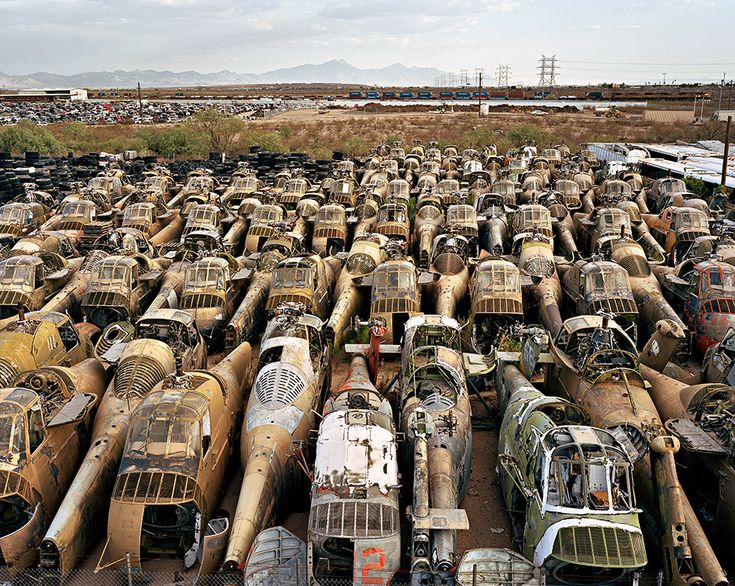
There is a sophisticated decentralised armaments industry as well as a successful militia army that is difficult for the enemy to defeat.
The evidence of that success in defending the independent state is found in a scrapyard in southern San Francisco where over 7000 wrecked US helicopters can be seen (p125). The peace is kept, additionally, by the belief that secret weapons – mines – have been left in US cities and can be detonated should the USA once again seek to invade (New York and Washington DC are named specifically, p4).
Areas of concern
The president is female; the governing paradigm is female. That is not reflected in how women are regarded by Callenbach – who is, of course, the architect of Ecotopia. Weston’s attempt to control Marissa, for example, look familiar. Equally, the nurse performing sexual therapy is surreal to say the least. The male part of the population needs, moreover, ritual violence through its war games. Why is sport not enough? It reminds me of the film, Rollerball, which was also from 1975. Whilst Rollerball’s premise is that the world has reached a corporate utopia, a violent gladiatorial entertainment is needed to keep order and reward compliance. Ecotopia is not a corporate utopia, but it premises the human male “need” for violence.
Then there is the segregation of races. Callenbach sees it not as segregation but as political economy. It is seemingly the case that the black citizens could not realistically embrace a radical Ecotopia, preferring instead to retain more of the trappings of regular capitalism similar to that of the United States.
I am also perplexed and disturbed by Callenbach’s thinking on degrowth, particularly degrowth in the population. And whilst eugenics is not a feature of Callenbach’s Ecotopia, the segregation, closed borders and selective breeding does raise alarm bells. Eco utopias are not necessarily progressive. To be fair, the borders are closed because the USA is hostile neighbour. Ecotopians celebrate victory in their early years over the USA’s invasion attempt (perhaps thinking here about Cuba?).
Towards the end of the book, Weston is kept hostage essentially until he concedes the superiority of Ecotopia over its neighbour (he is a New Yorker with a family and mistress/girl friend there). There is a final twist which is flagged up earlier on when Weston asks Marissa whether she wants to create a family and who she would choose as a father. To paraphrase, she responds by suggesting that he might already know the answer. Weston was always destined to stay in Ecotopia.
(1) The helicopter scrapyard is a picture from Edward Burtynsky and taken from https://uk.pinterest.com/pin/454300681161318244/
Book Review – Elemental by Arthur Snell
Filed under: Environment | Tags: Antarctica, Arctic, Arthur Snell, book review, climate change, Elemental, environment, greenland, Politics
Leave a comment 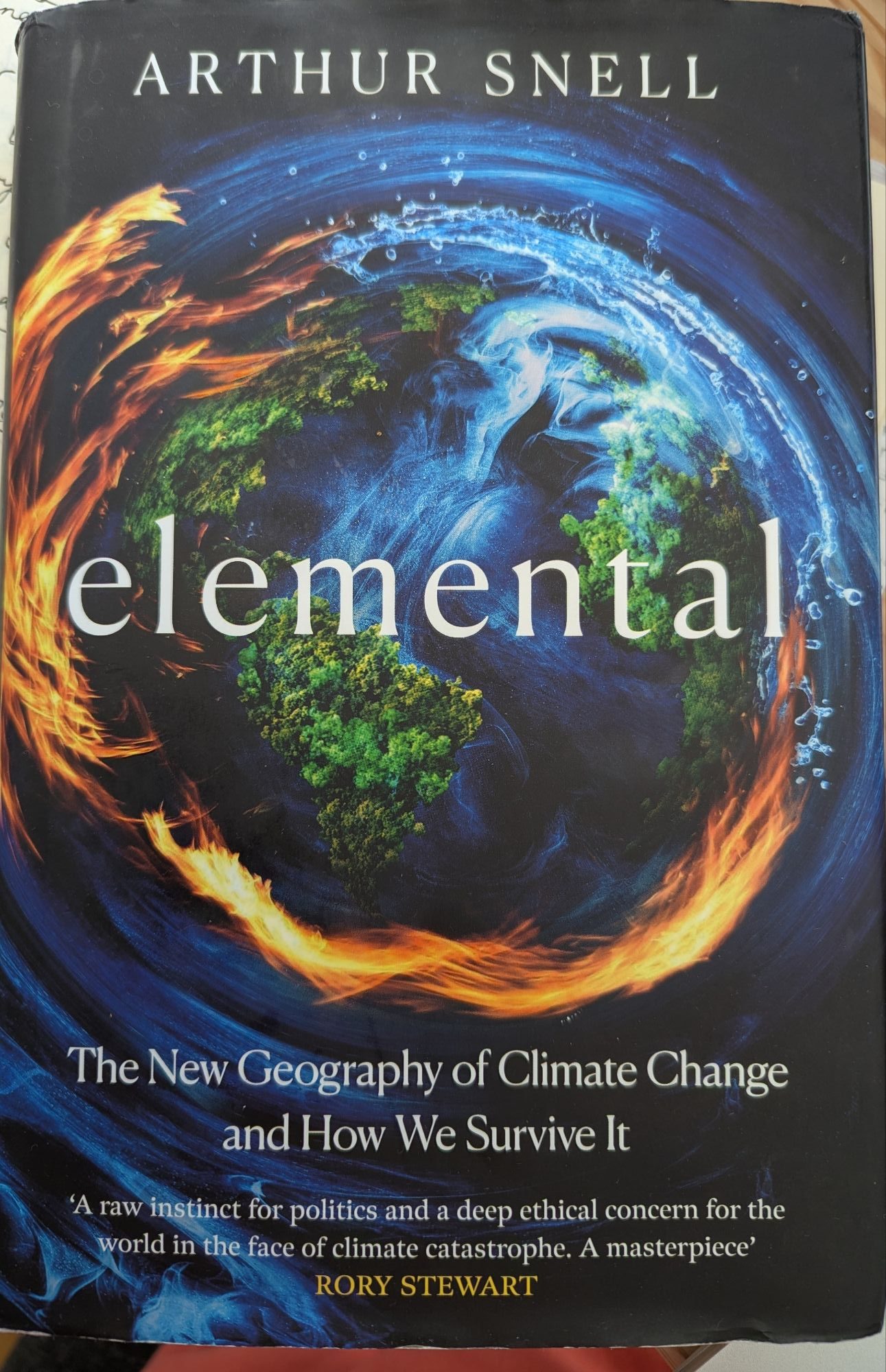
Much of the climate change literature, quite rightly, is based on the planetary sciences – weather, oceans, gases, etc. Arthur Snell, here, provides and important additional perspective, that of geo-politics. Ultimately, if we thought the science was tough enough to comprehend, the geo-politics can only complicate matters. Of course we are talking climate migration, food and fuel security, water (fresh for drinking and agriculture, saline oceans for weather stability and free trade routes).
The book is organised, as the title suggests – around the elements of fire, water, air and earth. This is as good scaffolding as any, I think; it gives Snell the opportunity to share insights from his own diplomatic experiences and new travels and discoveries (revelations, probably).
Readers of this blog may already be well aware of the mechanics of climate change, the IPCC’s periodic reporting and the target of 1.5 degrees Celsius by 2050 achieved only by eliminating the burning of fossil fuels and, unfortunately, some unlikely carbon capture and storage. At one end of the spectrum are poor, low lying countries such as Bangladesh, particularly vulnerable to sea-level rises, erosion, salination of agricultural land, amongst others. At the other end of the spectrum is Trump’s USA in denial about human-caused climate change (I write this section on 4 July on the 250th anniversary of the USA when a good number of events have been cancelled because of extreme heat) and the promotion of fossil fuel exploitation and consumption and the active suppression of renewables, wind, solar and batteries. And then there is the rest of us pulling back from commitments because of a far-right false narrative about cost and impacts on electricity bills and lifestyle.
Worrying highlights
Let’s take Russia. Russia is under stress having opted for an all-out invasion of Ukraine, it has few allies in the West (it is difficult to know whether the USA is an ally, it has to be said). Say what we will about Russia, it does seem to have a more forward thinking approach than many Western countries. For example, The Russian state is watching closely the opportunities for opening up and controlling a strategic arctic sea route. The natural resources currently locked under the Arctic ice become accessible as the permafrost melts. And that secretive and provocative settlement on Svalbard, Barentsburg (Norwegian sovereignty, and a NATO member). Readers wanting to see this, Simon Reeves went there on his Scandinavian adventure. Snell describes it on pages 297-301. The main town on the archipelago is Longyearbyen which serves primarily as a summer tourism base.
For the time being, Svalbard is a demilitarised zone under a treaty dating back to 1925. There may not be weapons on the archipelego, but there seems to be plenty of NATO intelligence equipment linked to the mainland (800km south) by an undersea cable that has already been damaged by, very likely, a Russian “trawler” (page 300). Such cables are also being cut in the Baltic.
China is another actor in this area. Whilst it has no coastline in the Arctic, it is very active in the region. It has observer status in the Arctic Council. It has also built a fleet of icebreakers (the USA has one, apparently). China’s interest in an Arctic passage come out of the insecurity of existing sea/trade routes controlled by hostile powers including Malaysia, Singapore and Indonesia (p308). It is potentially a “polar silk road” to add to the Belt and Road Initiative, amongst others. Clearly Trump’s claim on Canada and Greenland is part of this strategic game (though one wonders whether Trump understands it quite like Xi and Putin).
Since the invasion of Ukraine, Russia looks to the East to sell its oil and gas – China is now the key recipient of these resources. Russia also stays close to China because of arms procurement and the Arctic passage. But there is an even more intriguing reason for the alliance, and that is migration and food security. Snell offers a very interesting insight into how Russian land opened up by the melting of permafrost can become highly productive agricultural land that is particularly attractive to Chinese migrants and for which Russia has too few ethnic citizens to work (p118-9). Crucially, however, there are tensions that go back a long way. In a nutshell, Vladivostok and its hinterland used to be part of China. The port city was Haishenwai before being renamed. Arguably, China wants this territory back.
Just back to international treaties for a moment, Snell signals how jeopardised international treaties are becoming. For example, Antarctica belongs to no one (under a treaty dated 1959), though claims are being staked, as it were, again, as the ice melts and the resources become accessible. It is also a demilitarised region (or unmilitarised). China has four research stations on the island each with military capabilities and functions. The 1991 Madrid Protocol that bans mineral extraction is being challenged. It is up for renegotiation in 2048, let us see if it is not opened up before then. Finally two treaties between China and Russian (Aigun and Beijing) which formalised China’s ceding of territory to Russian may also become life expired.
Obviously I could summarise the whole book at length. It is not the purpose of a review, and I recommend the book to anyone with the slightest interest in geopolitics let alone the geopolitics of climate change. But here are a few more quick highlights:
- Why rice is so difficult to genetically modify (page 40)
- China’s dominance in EVs and the materials that drive them (p67-9)
- Weather control and geoengineering (chapter 10)
- importing PV electricity from Morocco (p169)
- Middle-East oil empires (183-191)
Photo: Arthur Snell from https://tinyurl.com/3y6mrusm
The Sheep Look Up by John Brunner, book review
Filed under: Book reviews, Environment | Tags: book review, Book reviews, books, dystopia, Ecocide, John Brunner, science-fiction, The Sheep Look Up
Leave a comment Background
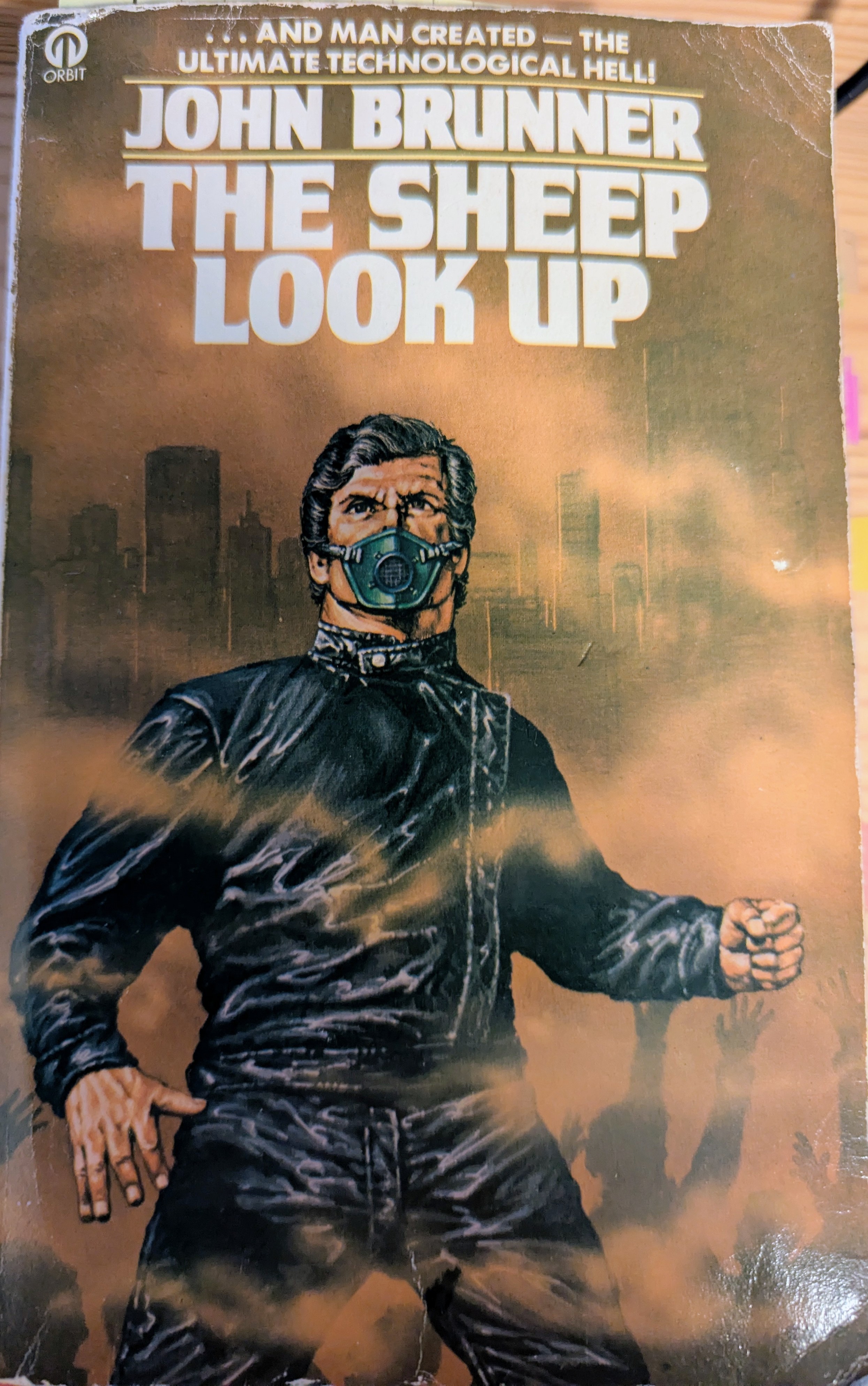
This book dates from 1972 and my copy is the paperback published in 1974 (left). It is just short of 500 pages and has 12 substantive chapters, each one focusing on one month in the not-too-distant future (from 1972 – now probably the past). The first two or three chapters are difficult to get into. There are a lot of characters, too many really, and each chapter flits between characters, places and events. Notes may be needed to keep abreast of characters and their fates.
The setting is the USA and some of the main action takes place in Denver (Colorado). It is worth considering what might have influenced Brunner (originally from Cheltenham, UK). The Vietnam War, for example, where both deadly defoliants were use and there was a draft. Both of these feature in this book. Moreover, on the defoliants issue, Rachel Carson’s book, Silent Spring, from 1962 clearly was within Brunner’s purview. Brunner does miss a trick on considering future communication technologies. There is no internet, for example. And no mobile phones. There is, however, problematic technology. A microwave oven cooks a baby in its mother’s womb arising from poor manufacturing and safety (unlikely, but in 1972 microwaves were not widespread).
Corporatism
The main import into the USA is oxygen. The key technology is owned by a conglomerate called Bamberley Trust and its core product is Nutripon. Nutripon was exported to “Africa” (a town called Noshri) to avert a famine. Instead of liberating inhabitants from famine it caused madness and mass killings arising from a mysterious contamination by a hallucinogen, Ergot, with a similar molecular structure to LSD. It had also been sent to Honduras. In later chapters, Ergot contaminates Denver’s water supply and violence ensues.
Bamberley Trust is headed up by the Bamberley family whose final patriarch, Roland, won’t even negotiate with the captors of his youngest son, Hector, for fear of profit loss despite being a proto-not-for-profit. It is technological determinism: “I don’t see why we shouldn’t improve on nature” Bamberley proclaims (p33). Nutripon is a hydroponically-grown, high protein cassava and is handled by Globe Relief, the world’s largest aid agency. Under the cover of Bamberley Oil, the company also makes napalm which is dumped on US citizens for no discernible reason. However, Bamberley Trust is a company that holds the population ransom. Very soon, Nutripon will be needed by American citizens as food shortages start to bite (p227). Incidentally, the president is a captured figure, familiarly known as Prexy. When the going gets tough, he declares martial law.
We learn also that insurance is a problem when the world moves from stability to insecurity/uncertainty (just as we are moving from the stable Holocene to the unstable Anthropocene). A major player in the insurance industry, Angel City Interstate Mutual, whose key character is Philip Mason, is sold after a series of environmental disasters, an enteritis epidemic as well as an avalanche caused by a sonic boom, overstretch its resources. Or maybe an earthquake. Mason failed to re-insure the Apennine Lodge (p79) and other buildings in Towerhill, exposing the company to $50m in costs – quite a sum at that time. Mason gets away with being fired for his incompetence. But this is America, fail in one thing and start again is the norm. He is approached by Alan Prosser, a water, sewerage and plumbing man looking for another business partner after the former had gone to Puritan, a food retailer selling pure foods (or at least uncontaminated ones, it is difficult to tell). Puritan is a Syndicate operation (p177). Mason may have been incompetent in reinsurance, but he was always a good salesman, a skill that Prosser does not have. If one can sell insurance, water filters should be a cinch. There is one supplier, in particular, Mitsuyama, a Japanese company. Everyone wants a franchise. But the filters fail and the franchisees struggle.
Typhus, measles, polio, gonorrhoea and enteritis are endemic not because of a reluctance to vaccinate as in the current scenario, but rather because antibiotics no longer work due to their exploitation, particularly in agriculture. People suffer lice, too. There is plenty of scratching going on. Phillip Mason visits the VD clinic for treatment for gonorrhoea only to discover that traces of antibiotic from his meat diet have rendered his strain resistant (p122). Vegetarians eating organic foods fare better. Care is needed not to cut oneself shaving; they can fester. The city rains are acidic. Notwithstanding gonorrhoea, everyone is sick which leads to labour shortages and limited public services.
Internationally, other continents do no better. The Mediterranean is close to collapse. As is the Baltic. There is bottom trawling to catch the deepest sea creatures that might still be fit to eat (p177) – though the trawlers bring up barrels of toxic chemicals as well, just add a few more to the death toll (p180).
There is also an imminent food crisis. A pest known as a jigra is blighting key crops such as potatoes. They too are resistant to known pesticides. It is not clear whether their resistance is evolutionary or the product of some genetic manipulation. Worms are bought in for soil conditioning. One supplier is Plant Fertility. Suspicion is rife about the jigras’ origins. In any case, it is difficult enough growing things when the sun does not shine.
The resistance
Fred Smith is the alias of Austin Train, the notional leader of an environmental movement – the Trainites – fighting the corporate poisoning of the USA. Their calling card is a scull-and-crossbones. He is the author of Handbook for 3000 AD. Some Trainites live in communes known as Wats. They also enjoy khat, a recreational drug that also acts as a natural bacteriacide (p152). It also has constipation as a side-effect. Good for dealing with the symptoms of enteritis, though (p198). Train goes to ground playing dead in LA living as a garbage collector (pp96/7), though 200 other people take on his name, not least Ossie, the brains behind the kidnap of Bamberley’s son and various bombings, one of which actually kills the real Train in a courtroom where he is being tried for the kidnapping! And the motive for the kidnap? In this world, clean water is the most highly desired and valuable of resources. Certain companies hold a near monopoly over water dispensing machines and filters. Bamberley is one of them and the kidnappers want him to install 20 thousand water machines with filters (presumably in places accessible to all). Bamberley is also rumoured to be behind a bombing of the Denver wat (p343)
Another flank of resistance comes from the Tupas, described as US black militants (p228). It seems ok to poison black Africans, less to black Americans.
The lessons to take
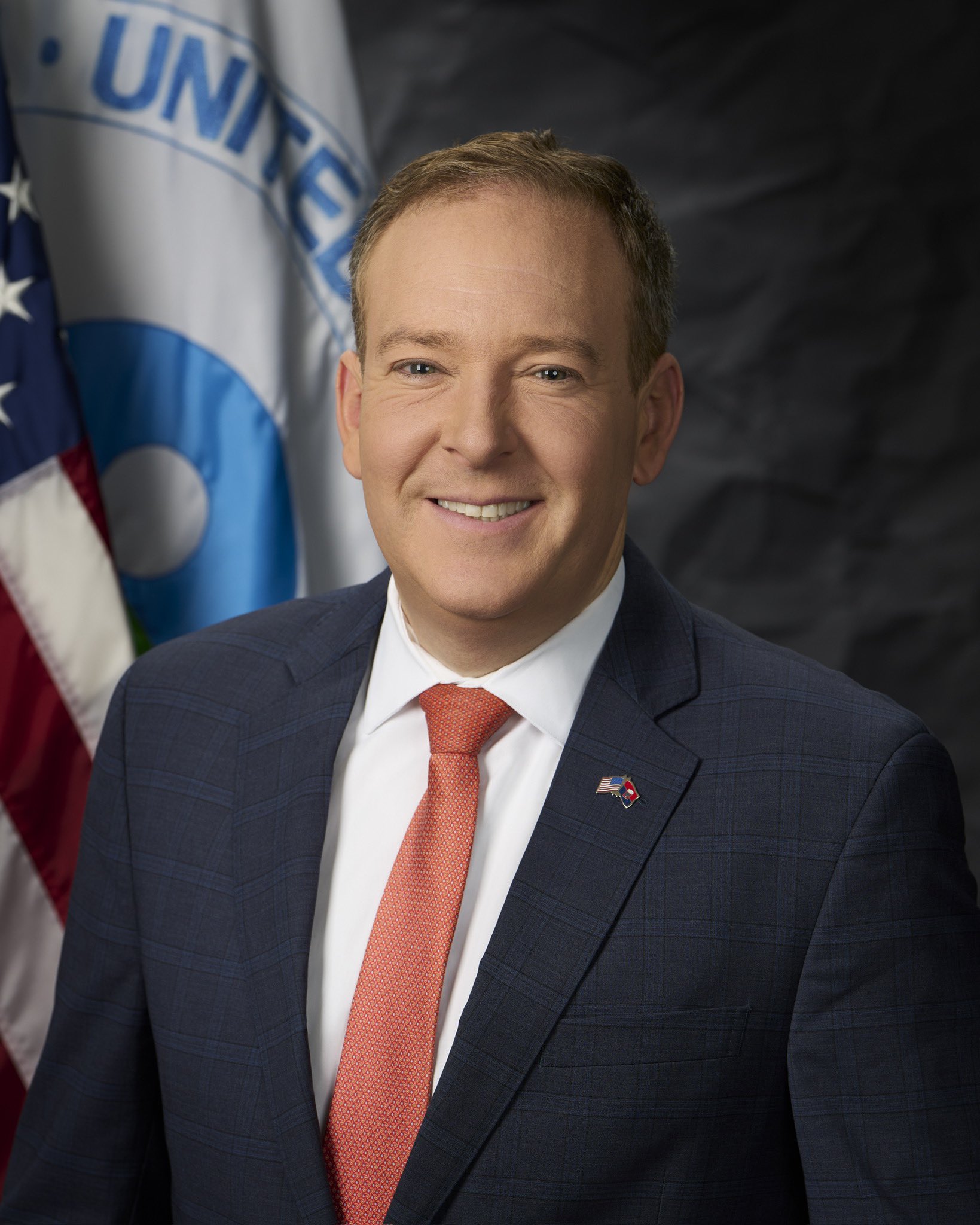
I am writing this the day after the current US Prexy, with his zealous head of the now-misnamed Environmental Protection Agency, Lee Zeldin (right), rolled back the Endangerment Finding that enabled the US Congress to legislate to tackle climate change. The Endangerment Finding is based on the scientific determination that carbon dioxide and greenhouse gases are a danger to human health. It dates from 2009.
In Brunner’s USA there is no Endangerment Finding, but there has been little regulation at all when it comes to air and water pollution. There are EVs and “steam” cars; on the latter we are not quite sure how they work, but they do represent alternatives to petrol/gas powered vehicles.
Brunner warns us against the abuse of antibiotics, particularly in factory farming. Bacteria become resistant because of the pervasiveness of antibiotics in common, largely meat-based, foods. Humans’ ability to fight common disease, including sexually-transmitted ones (good to see that infidelity remains a feature of the future). There is no discussion in the book about vaccines and so-called “antivax” sentiment. But the inability to fight common, particularly childhood diseases, should worry us all (at the time of writing, London is now suffering an outbreak of measles due to low vaccination rates). There is actually a point in the book, where it becomes clear that there is perhaps a children problem. It is not about a shortage of them necessarily, but the child mortality rate is increasing. This will become an issue going into whatever future remains.
Brunner’s modern-day billionaires, represented in the book by the male members of the Bamberley family, appear to be philanthropists, but behind their charitable ventures (Nutripon Hydroponics) is the real money makers, oil and war (napalm). Protecting those interests is paramount. There is also “the Syndicate”, characterised as a mafia-type operation that owns Puritan, the organic – or at least uncontaminated – food retailer. Increasingly we learn that what it says on the label is not what is inside, despite paying a premium for the product. There are also some death squads. Men turning up with guns and killing key characters in cold blood. There does not seem to be too much law and order, or maybe just law, in this USA. The billionaires themselves, however, are not protected. The bad air affects all, it is just that they live in airconditioned gated communities. The majority, as Hector found out during his captivity, live in squalor.
The book has three instances of carnage: Noshri, Honduras and Denver. All three have the same source. The contaminant is a thing called “Ergot”. It is a nerve gas that drives people crazy. It is enough to get a boy to murder his sister. Ergot is stored in an abandoned silver mine, but the drums have become rotten and leak. The leakage seeped into the nearby watercourses used for Nutripon production, hence the contamination. The effects are then exported with the product. The Denver riot is caused by the contamination of the drinking water supply. We can extrapolate from this our own predicament. Our water courses are contaminated with PFAs, so-called forever chemicals (they do not degrade when released to the natural environment). UK water courses are also contaminated with both human and animal waste. The human and animal waste both contain antibiotics. The routine use of antibiotics on farm animals and humans undermines the effectiveness of these wonder drugs when we need them.
Food security is another thread throughout the book. Nutripon itself is a famine-busting product specifically designed to feed people facing starvation, or at least malnutrition. In the end it will provide nutrition for millions of Americans as the jigras spread and humanity’s ability to feed itself declines. Fanciful it may seem, but it is not so. Any reader wanting to investigate further can read the work of Tim Lang (left), and in particular his book, Feeding Britain (2020). Lang has long warned of a food crisis, but policymakers do not seem to listen or care. They will, of course, when hunger sets in. But it will be too late by then. A new report from a consortium of academics including those from York and Anglia Ruskin universities have run scenarios on food security. They confirm that social unrest is a very real possibility arising from climate change, war, cyber attacks and supply chain disruption.
The Sheep Look Up does not end on a happy note. The one man thought to be able to challenge the corporate and political powers is dead, murdered by a man who takes his name. The Prexy goes on and presumably also the Bamerberley Trust albeit without the patriarch and his son. Train, before his death, was about to proclaim a solution to the planetary challenges. But before he was able to, the cameraman focused on Train for the live TV transmission was ordered to stop by Prexy. It is rather like Douglas Adams in the Hitch Hiker’s Guide to the Galaxy where a young woman had the answer to humanity’s problems but before she could announce it, the planet was “unexpectedly” demolished to make way for a hyperspace bypass. By the Vogons.
It is difficult not to see Brunner’s book as a prescient warning to humanity, way back. A crazy American president in hoc to powerful corporate interests making money out of suffering and planetary collapse. It is in this sense breath-taking. There are few characters worthy of admiration. Peg Mankiewicz, the investigative journalist, perhaps (though she too dies from the courtroom bomb). Maybe policeman Pete Goddard, the rescuer of the children from the Towerhill avalanche, achieves credit. He seriously injures himself in the rescue. Maybe that is the point, everyone is complicit by virtue of consumption and a failure to act collectively in the interests of a future potential for life on the planet. Maybe the Nutripon madness is what comes to all when society breaks down and food becomes scarce as seen in The Road.
I leave this review with an extract from Prexy’s speech (pp409-411):
…Friends and fellow Americans, no president of the United States has ever had a more melancholy task that I have at this moment. It is my sad duty to inform you that our country is in a state of war. A war that is none of our choosing. And, moreover, not a war with bombs and tanks and missiles, not a war that is fought by soldiers gallant on the field of battle, sailors daring the hostile sea, airmen streaking valiant through the skies – but a war that must be fought by you, the people of the United States.
We’ve been attacked with the most cowardly, the most monstrous, the most evil weapons ever devised by wicked men.We are the victims of a combined chemical and biological attack. You are all aware that our crops have failed disastrously last summer. We, them members of my cabinet and I delayed the release of the truth behind that story in the vain hope that we may contain the threat of the jigras. We can no longer do so. It is known that they were deliberately introduced into this country. They are the same pest which ruined the entire agriculture of Central America and led to the sad and unwished for conflict in Honduras.
That by itself we could endure. We are resilient, brave, long suffering people, we Americans. What is necessary, we will do. But alas there are some among us that bear the name ‘American’ and are traitors, determined to overthrow the legitimate government, freely elected, to make the work of the police impossible, to denigrate and decry the country we love. Some of them adhere to alien creeds, the communism of Marx and Mao; some detestably adhere to a creed equally alien yet spawned within our own borders – that of the Trainites, whose leader, thank God, is safely in jail awaiting his just punishment for kidnapping an innocent boy and imprisoning him and infecting him with foul diseases that endangered his life.
We are fighting an enemy already in our midst. He must be recognised by his words as well as his deeds. Ome of the great cities of our nation today writhes in agony because of the water supply, the precious diamond stream that nourishes our lives, has been poisoned. You may say: how can we resist an enemy whose weapon is the very faucet at the sink, the very water-cooler we go to for relief in the factory or the office? And I will say this! It is you, the people of our great land, who must provide the answer!
It is not going to be easy. It is going to be very hard. Our enemies have succeeded in reducing our stocks of food to the point where we must share and share alike. Following my speech, you will be informed of the emergency arrangements we are putting in hand for equal and fair distribution of the food we have. You will be informed, too, of the plans we have for silencing known traitors and subversives. But the remainder is up to you. You know who the enemy is – you met him at work, you heard him talking treason at a party, you heard about his attendance at the commie-front meeting, you saw the anti-American books in his library, you refused to laugh at his so-called jokes that dragged the name of the United States in the mud, you shut your ears to his anti-American propaganda, you told your kids to keep away from his kids who are being taught to follow in his traitor’s footsteps, you saw him at a Trainite demonstration, you know how he lied and slandered the loyal Americans who have built our country up until it is the richest and most powerful nation in history.
My friends, you elected me to lead you into the third century of our country’s existence. I know you can be trusted to do what is right. You know who the enemy is. Go get him before he gets you!
John Brunner picture: original source unknown, taken from https://www.goodreads.com/photo/author/23113.John_Brunner
Lee Zeldin picture: By Unknown author – https://www.epa.gov/aboutepa/epa-administrator, Public Domain, https://commons.wikimedia.org/w/index.php?curid=159082104
Tim Lang picture: By The British Library – Food Futures: The Choices Facing Us Now at 2:51 and 4:21, cropped, brightened, CC BY 3.0, https://commons.wikimedia.org/w/index.php?curid=125626647
Book Review: Kim Stanley Robinson, The Ministry for the Future
Filed under: Book reviews, Environment | Tags: book review, Book reviews, books, climate change, fiction, Kim Stanley Robinson, Ministry for the Future, Review, science-fiction, wet bulb
Leave a comment People have different ways of coping with the climate crisis. Quite a few people just ignore it. Others deny it and actively seek to make it worse. Others expect someone or something else to fix it; surely there is a technological fix? I wake up each morning with the challenge in my head. What can I do more to change things?
A response has been to seek solace in art, theatre and music. Indeed, I have a playlist. Every visit to a gallery or exhibition is filtered through the climate lens. And now it is novels – not a medium that I have indulged much. I was never a great reader of novels as a child. When I grew up I immersed myself in non-fiction and newspapers. There is a point to my sudden interest. I have an objective. But first I have to read what are seen as the significant books of fiction that deal with the climate crisis. I also have to learn how to critique literature. This is not a skill that I currently possess. Please bear that in mind when reading. Also note, there are countless spoilers in this text.
My first book to review is Kim Stanley Robinson’s, The Ministry for the Future. It is an epic. The paperback has a small font and has 563 pages. There are two main characters. There is a lot of implicit violence. It is also a book unusual in explaining economic and innovation concepts; for example, discounted cash flow (p 131); the Jevons Paradox (p 165); Gini Coefficient/equality measures (p73); MMT (Ch73); Bretton Woods (Ch50) and the International criminal court (Ch56), etc. There are also free lessons in glaciology and geoengineering amongst other scientific concepts.
The first of the book’s two main characters, Frank May, is an aid worker in Uttar Pradesh. It is 6am and the temperature is already 38 degrees and the humidity 35 per cent. We know that heat and humidity are a lethal combination. And so it proved. When the power failed all life-saving air conditioning shut off. During the course of the next few hours 2 million people died. What we learn from this is that 2 million people is the trigger for action. No state can sit back when 2 million of its citizens die from what is not a natural disaster.
The Indian Government’s near first response was to execute a programme of geoengineering – depositing particulates into the upper atmosphere to deflect the sun and cool the surface. This contravened the Paris Agreement of 2015. No state should unilaterally undertake a programme of geoengineering where the impacts are unknown and cross-border. But they did it.
Frank May improbably survives, but his whole life is haunted by the experience. His post traumatic stress disorder impacts on those around him. His focus is on bringing about change by whatever means. He makes contact with an organisation called The Children of Kali, a direct action grouping that targets the world’s climate villains; namely, those who caused climate change and those who perpetuate it. The bosses of oil companies require 24 hour protection. The owners of private jets do not sleep easy. Diesel ships and aeroplanes will sink or crash on the so-called “accident day”. That, at least, sees an end to mass aviation.
Rejected by the Children of Kali, Frank kidnaps the book’s second main character, Mary Murphy, the head of the recently established UN entity, The Ministry for the Future based in Zurich. He is not very good at kidnapping since he allows the kidnapping to take place in her own apartment, one which is monitored by the local police, she being a target – by the right for threatening their profits or the left for not doing enough to threaten their profits. Before the arrival of the police, Frank confronts her with the “left” position. The Ministry is not doing enough to change things. It is incremental, transparent and easily captured. He tells her about the Children of Kali and the kind of action needed to bring about real change.
On the arrival of the police, Frank disappears through a back window and goes underground until he is eventually apprehended by the police after defending migrants from an attack by local fascists – naturally, immigration is a real flashpoint, and immigrants very much a target. Frank is sent to prison for the kidnapping and his involvement in the death of a man on the beach whom he hit with a large piece of wood.
Scary though the the kidnap experience was, Mary knew that Frank was right. She discussed with her Chief of Staff, Badim Bahadur, whether the Ministry had any black ops, not dissimilar to the Children of Kali. He was not about to disclose any activities of the sort, but the very reticence suggested that the Ministry had such an arm. This, of course, leads to questions about who is responsible for what? Is the Ministry sinking ships or the Children of Kali, or some other radical outfit with little faith in mainstream politics?
A core vehicle for change is the carbon coin. It is discussed extensively in the book. It has key features; for example it has to be supported by central banks, is securitised by the creation of long-term bonds, it is rendered by blockchain technology. It works whereby: “Every ton [sic] of carbon not burned, or sequestered in a way that would be certified to be real for an agreed-upon time, one century being typical…you are given a carbon coin…the central banks would guarantee it at a certain minimum price, they would support a floor so it couldn’t crash. But also it could rise above the floor as people get a sense of its value, in the usual way of currencies in the currency exchange markets.” (p174). It is a form of carbon quantitative easing. And it is a market-driven mechanism.
The carbon coin is based on a paper (actually a series of papers/essays) by Delton Chen (p172 – https://tinyurl.com/4c27dj9a) author of the key paper: Chen, D. B., van der Beek, J., & Cloud, J. (2017). Climate mitigation policy as a system solution: addressing the risk cost of carbon. Journal of Sustainable Finance & Investment, 7(3), 233–274. https://tinyurl.com/5ervkk74
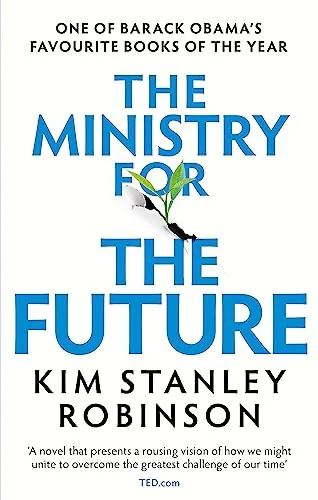
The cover brands the “Ministry…” as “one of Barak Obama’s favourite books of the year”. We all know how important that endorsement has been in recent years. Whilst this may be good for sales, I am not sure if the scenario presented has the legs the author and Obama think and hope for. The first part of the book is apocalyptic, for sure. Lots of bad things happen to people; obviously the heatwave that starts the book results in mass death, but the terrorism/state-sponsored terrorism takes its toll, too. We do not ever get to know who did what. Curiously, the terrorism seems to go without investigation. We do find out who may be behind much of the terror, however; namely, brown people.
The second half of the book simply reassures. Yes, the climate crisis remains present, but the trajectory starts to go in the right direction. Global emissions are cut seriously, not least by the incentive provided by the carbon coin. The scientist innovate in ways that give hope. Though this part is difficult for lay readers like myself to judge relative to the carbon coin initiative (which has at least been subject to peer review). Some of the glacier adaptations do seem fanciful not just scientifically, but also geopolitically. Admittedly, the book was written before the second Trump administration and the current phase of the Ukraine conflict, but even before then, it would have seemed optimistic.
I suppose my biggest misgiving is Robinson’s belief/hope that already-occurring warming can be reversed. Tipping points are recognised, but they do seem to be glossed over. Migration is recognised, of course, but it is still a “problem” to be handled by efficient bureaucracy. There is, equally, not much thought given to food security, biodiversity and shifting global alliances. Without the security of world order, much of what is described in the second half of the book is unlikely to be feasible. And I have no confidence that that world order will be maintained. For example, I worry particularly about food security, centred as it is now around global value chains, limited genetic diversity of core foodstuffs such as grain, rice, bananas, etc. Interested readers should read Tim Lang. Hungry people do not play be the rules. And because of the trajectory, the second half of the book loses its momentum, suspense and mission. For the final few chapters I was waiting for something to happen. But it did not because the author had already determined that the world had been saved and that one of the main characters can actually retire and travel the world in an airship! The book, therefore, has a very long and unrewarding tail.
Anyone needing more – and there is more – should read clever review using an ideal-type approach to criticism, see the work of Solarpunk – Hacker. Worth a good few minutes of your time.
Book Review – Super Charge Me: Net Zero Faster by Eric Lonergan and Corinne Sawers
Filed under: Book reviews, Environment | Tags: book review, climate change, Super Charge Me
Leave a comment 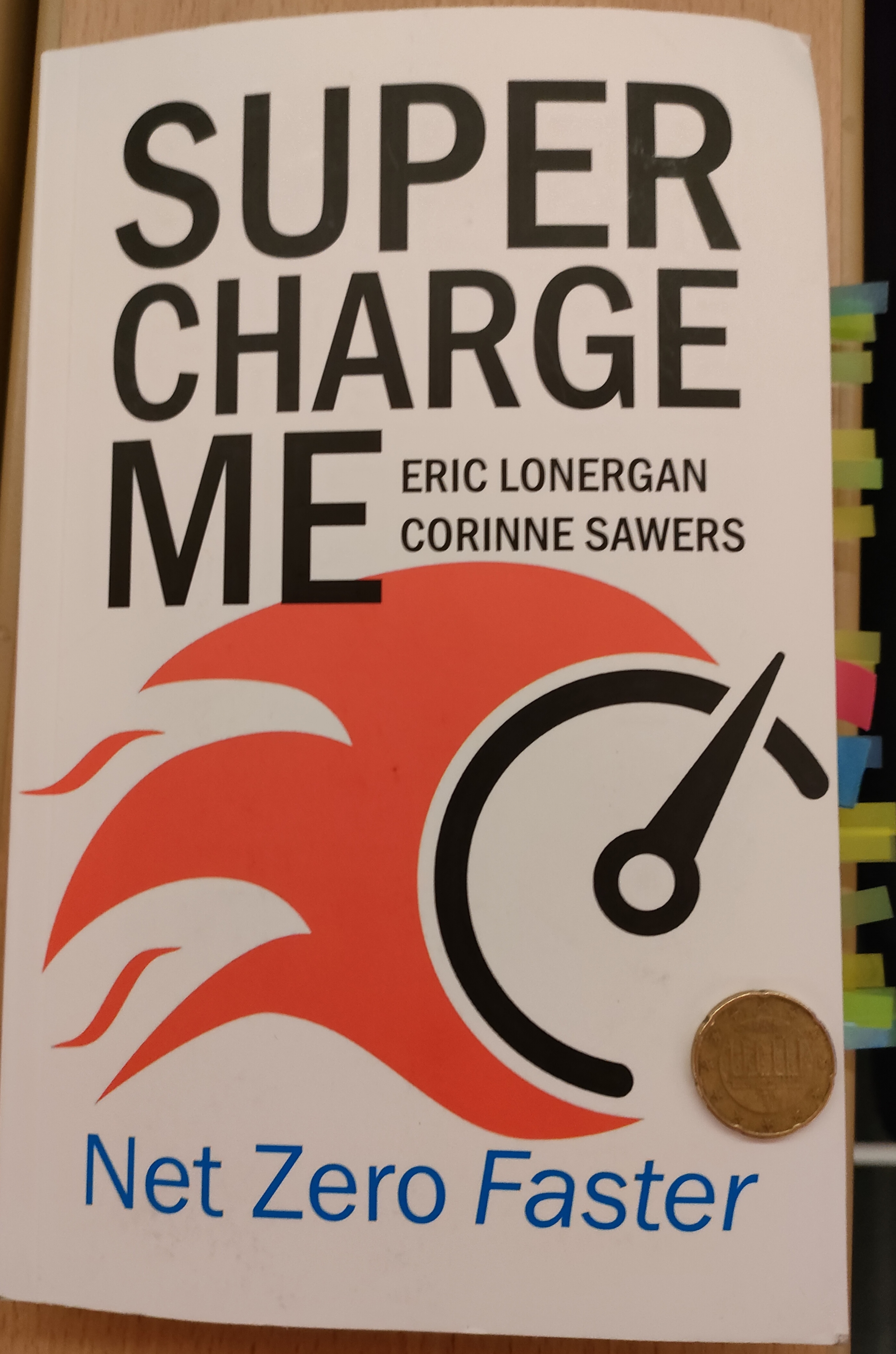
If you have a spare evening, buy this book and join the conversation between two wonderful dinner guests, Eric Lonergan and and Corinne Sawers. That said, I’m not sure that you’d get a word in edgeways, even if you wanted to. I suggest just listening and learning.
In the first instance, the format spooked me. It genuinely is written as a dialogue. The two conversationalists flesh out their arguments – they do not challenge one another, rather they develop one another’s points – or invite further development: “go on…” says Sawers, to avoid a cliff hanger. Unless one is paying absolute attention, it is not clear who is speaking, such is the mutual expertise revealed in the exchanges. The book can be read in one sitting.
This is not, be rest assured, one of those “I’ve read this so that you do not have to” reviews. I have been known to write these. Readers are invited into a conversation that needs full engagement (my copy has plenty of page markers for future reference, top left). In addition, if we are in luck, the shelf life of this book will be short. If we, our governments, and the global community more widely, make the transition, the book will have served its purpose and become a cherished museum exhibit.
I’ve reviewed some other books – Alice Bell’s wonderful, Our Biggest Experiment, for example – that reveal how we got to where we are. What we could have done; how we could have avoided the precipice that humanity has now perched itself upon. Those perspectives inevitably lead to despair and inaction. Lonergan and Sawers are future-oriented. There is little dwelling on the past. They discuss a bright future: one that is fair and safe. Readers do not even have to have that much knowledge about climate change because a couple of to-the-point sentences – to paraphrase Douglas Adams – “avoid all that mucking about in hyperspace” and gets readers up to speed. There is no time to waste. It is just better to start using the language of Super Charge Me straight away: appropriately-named EPICs (extreme positive incentives for change) and Mini Musks (those intractable problems – aviation and cement, for example).
What are EPICs? They are extreme because moderate does not change behaviour. They are positive because the behaviour change cuts carbon emissions. They incentivise (never think about something else when you should be thinking about the power of incentives, says Charlie Munger, Warren Buffett’s long-standing business partner, p172). It is all about change. In particular, change that reduces carbon emissions.
But what are they in reality? I have been led astray, it seems. It has been known for me to advocate carbon taxes. My dirty vehicle is taxed – the vehicle licensing cost is high for that reason and it costs more for my on-street parking than for cleaner vehicles. But I still have it. The incentive to ditch is not sufficiently extreme. I’ve learnt recently, that keeping it is potentially better for the environment than buying a new electric vehicle, thanks to a recent BBC show, Sliced Bread. But this is the wrong thinking. I should not be replacing it, I should be using a substitute. I do not because there is no incentive provided by the relative price of that substitute. For example, to visit my family tomorrow using the train would cost me £153. Even with the high price of fuel, my dirty vehicle could do it for half that cost, and I could take two people and unlimited luggage (it is a van) with me. The substitute, if I read the authors right, needs the EPIC treatment by Government. It is their job to fix the relative price and provide the incentive to switch. More generally, it may need investment in infrastructure to do it (more trains/capacity), a change in work practices allowing slower and shared commutes or fewer and, ultimately, a change in the norms of behaviour – actually it is a bit passé to drive a dirty white van rather than take the train. What, no photovoltaics on your roof?! Etc.
These are obviously EPICs for individuals, but there are EPICs for states. EPICs are responsible for the collapse in the cost of solar/photovoltaics and wind power. My new favourites that are going straight into my curriculum are captured in the Green Bretton Woods and Green Trading Agreements. The institutions of the Bretton Woods post-war agreement include the IMF and the World Bank. In the context of the transition, Lonergan cheekily says that “I am not sure that the World Bank is up to the task” (p144), but credits the designers of the post-war economic system with bestowing upon the IMF a “magic power” that was apparently leveraged in the banking crisis of 2008 and more recently in the global response to Covid-19. This power is manifested in a “special drawing right” (SDR). Readers can discover the magic for themselves, but I would entirely concur with Lonergan that the designers of the Bretton Woods institutions covered all bases insightfully and provided utility well into the future.
Thanks also to the conversation, I now also know about Export Credit Agencies (they’d somehow passed me by). These agencies mitigate credit risk for banks lending to low-income countries. The authors argue that they can be repurposed towards carbon-reducing investments. They have served the fossil-fuel industry well in the past and can serve transition economies well, too, into the future.
The book also provides an strong argument for countering the “stranded assets” challenge. Stranded assets are long-lived assets that, if economies transition to net zero with haste, will lose their value and become redundant before their time. Shareholders will lose money. It is true, they will, but it is not really an argument against stranding them if it makes the difference between a liveable and non-liveable planet. Rather, the losers will be an energy elite who have made lots of money from the carbon economy in the past. Being an elite, they are so few in number and the impact overall is small. There is about $4 trillion locked up in fossil-related assets. A lot to us, but small in relation to overall assets in the global economy.
Be prepared to be (re)educated about how money is created, interest rates, why China is cleaner than it may seem, how to stop free-riding, leveraging state borrowing capability, why inflation is good (within reason), contingent carbon tax, sovereign wealth funds, border taxes and why activism is not futile. And trees.
An evening well spent. And no one noticed the food was vegan.

