Archive for the ‘International’ Category
The Economist and the UK General Election – what a squirm
Filed under: Brexit, education, Environment, Housing, Politics, Privatisation |
 Leave a comment
 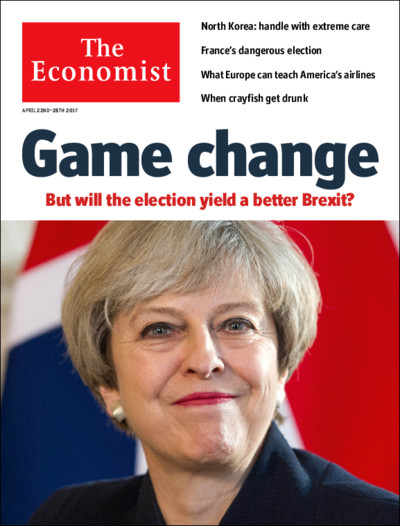 Two years ago I critiqued the Economist’s advocacy of the Conservative Party to form the next UK Government under David Cameron. The magazine, in my opinion, disingenuously dismissed Ed Miliband’s programme in favour of the “stability” offered by more economic-liberal austerity by the Conservatives. The magazine overlooked the commitment to an in-out referendum on Europe despite its avowed support for the European Union, at least in the context of a single market and customs union.
Fast-forward 2 years and here we are with another General Election having been called – we are told by Theresa May – to protect the will of the people translated as her vision of Brexit from those who would oppose it (saboteurs according to the Daily Mail), like parliamentary oppositions are supposed to do under the Country’s usefully unwritten constitution. May, not being a democrat, or not one that I recognise, duly called her General Election after having been on a walking holiday. Though I am minded that she first had a word with the architect of the Conservatives’ last election victory, the benighted Lynton Crosby.
I was waiting to see what stance The Economist would take this time. Let me have a look. First of all, the leader of the opposition is called “ineffectual”. However, that is not the real story. May looks to achieve a landslide victory and increase her majority from the current 17 to something approaching 100. “For the 48% of voters who, like this newspaper, opposed Brexit, this may look ominous” says the Economist, un-reassuringly. However, we have mis-read this. Indeed, argues the newspaper, “[i]nfact, it offers an opportunity for those who believe in a more open, Liberal Britain”. Really? We need to know more.
If I read it correct, if May gets her increased majority, she will fear the Commons less when it comes to the final deal. The House of Commons fought hard to have a say on the final deal and would, if the “deal” was not as good as what the country has at the moment with EU membership, tell her to go back and try harder. One assumes she is particularly fearful of her “hard Brexit” backbenchers. If she has a bigger majority, goes the argument, she can accommodate their wrath as well as that coming from the depleted opposition benches. This means, continues the argument, that she is more likely to be able to make compromises with the EU with this safety net. And that means a softer Brexit. Brilliant!
Dear Economist, that is nonsense. May wants to close the borders. Only a hard version of Brexit will enable that. Plus Guy Verhofstadt, the European Parliament’s Brexit coordinator, has himself described it as a “power grab”. Moreover, she also does not want to be bound by the current manifesto of her party written by her predecessor. So, her Finance Minister, Philip Hammond, who suffered ignominy when his budget tax increase was rejected, can now make this a manifesto commitment. Also, May herself is obsessed with selective education and already has in train a return to grammar schools at the expense of children from less privileged backgrounds. The Economist thinks that Theresa May with a majority can fix the housing shortage and make good the “funding crisis in social care”. Bearing in mind that her party is the cause of these two problems and policies so far pursued seek to make it worse, not better (for example, right-to-buy housing association dwellings).
We should not be surprised by this spin and support for the Conservative Party; but we are where we are because of the Conservative Party (austerity policies and THAT referendum). The solutions and future must lie elsewhere.
Brenda says…
Filed under: Brexit, education, Environment, Housing, Politics |
Leave a comment Brenda is just an ordinary woman in Bristol. She was questioned on the street by a BBC journalist and she said that she was fed up with politics – there is too much of it about at the moment – and she just wanted to live her life in peace. That is a bit of a paraphrase, but only a bit.
Let me be clear, I do not want an election. What is the point in a fixed-term parliament if an insecure Prime Minister decides that she needs a personal mandate for her mendacity and push for majoritarianism and the limited state? However, if we are going to have one – precipitated to some extent by the EU’s interregnum over exit terms – then so be it. But this is no ordinary election. I’m 53 and I believe this is the most important election in my lifetime. We can let the Conservative Party for the foreseable future dominate the executive and legislature (not to say judiciary if recent experience is anything to go by) or we can stand up for something bigger.
This is not a party-political election in the normal sense. Notwithstanding Brexit, this is an election to stand up for public services, the NHS, education, housing, social care, the environment, liberty and decency. All of these things the Conservative Party seem to be willing to denude or abolish in pursuit of power. Not the public good.
This will be an ugly island if May achieves her aim. All opposition parties have to work together on this one. This is not about Labour, LibDems, SNP, Green. This is about a future. Brenda needs to engage, vote and learn.
End.
What insights can I add?
Filed under: International, Politics, Trump | Tags: Brexit, Donald Trump, Jon Snow, Theresa May
Leave a comment I am observing, like most of us, events in the USA. This time last week, I shivered at that image of Theresa May, the UK Prime Minister, holding the hand of Donald Trump, President of the USA. OK, she held his hand to steady him as they walked down some stairs. He’s 70 after all.
I have struggled with Owen Smith, Labour’s leadership challenger and now rebel. But he has gone up in my estimation relating to the last week’s vote in the UK Parliament sanctioning the trigger for Article 50 – starting the process of exit.
Brexit in the context of Trump is a different proposition to the one at the time of the referendum in June 2016. Especially with UK International Trade Secretary, Liam Fox, being linked to Trump’s sinister corporate Dark Money (and notwithstanding Nigel Farage’s recent antics).
More significantly, however, is the realisation that we are all being hoodwinked by the Trump administration. Take, for example, Jon Snow’s tweet this morning where Trump has a go at his successor, Arnold Schwarzenegger, at the Apprentice reality TV show:
Now Jon Snow is a good journalist. Indeed, he will be running next week a series of programmes about fake news (maybe this is why he sent the above tweet). US journalists persist with the White House briefings and are lied to by Sean Spicer, Trump’s media spokesperson. But they persist. It really is the only world they know. But the issue is different: the protagonist has changed. There is plenty of fake news about, for sure. Blatant lies, yes. But these are distractions from what is really happening. The media is being distracted apart from Fox News, the source of news for most Trump’s supporters.
Time to wake up? It seems to me that the EU has woken up. Theresa May’s offer to act as a bridge between the EU and the USA was rejected. I’m undecided whether it was laughable that the British even offered to play this role in light of Brexit, or whether this is a maturing EU. An EU that realises that it will be the bulwark of democracy in the new world. The USA is going to be lost.
Researching Brexit and the effectiveness of dead cats
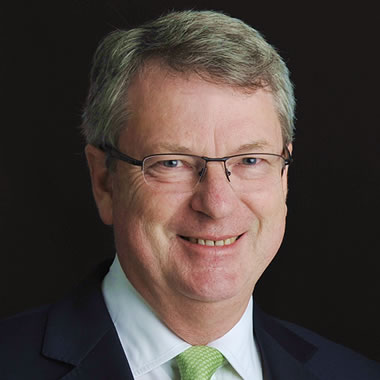 It was in the UK General Election of 2015 that we seemingly encountered the concept of the dead cat. It was a campaign innovation by the Conservative Party’s campaign strategist, Linton Crosby (left). Essentially, throw the dead cat into the arena even if it is not a cat. Or dead. It does not matter. For most observers, it is a dead cat and it is the only thing that people can see. So, for example, linking Labour and the SNP – with Alec Salmond calling the shots. Never on, but enough to worry English voters (and possibly Scottish).
I mention this because this is the year that the implications of all of 2016’s successful dead cats – Brexit and Trump to name but two – will be realised. At least partially. Both fill me with foreboding – the former because of the apparent incompetence of the Government to manage the transition; the latter because…well, anxiety about a Trump presidency is natural, is it not? The bigger questions, however, are about how to counter the dead cat when it is thrown in to the arena and to understand the causes of the Brexit vote. I have short observations o n both of these.
Let me deal with Brexit vote first. Over the Christmas break I read a very interesting academic paper with some poignant empirical observations. The paper is called “The 2016 Referendum, Brexit and the Left Behind: An Aggregate-level Analysis of the Result”. The authors are Matthew J Goodwin and Oliver Heath and is published in the Political Quarterly (Vol 87(3), July September 2016). This is an early peer-reviewed analysis of available data that the authors have interrogated to ascertain who were the key voters. This is a summary of what they found:
- There is a statistically significant positive correlation between (high) levels of education and propensity to vote Remain (excluding London and Scotland).
- The over 65s – particularly in areas where UKIP polled well in the 2014 European Parliament elections – significantly voted Leave. So, 19 of the 20 “oldest” local authority areas voted Leave. By contrast, 16 of the 20 “youngest” local authority areas voted Remain (Oxford and Cambridge are the youngest of these). The exceptions again are London and Scotland.
- Areas with the fewest recent immigrants from the EU that were most likely to vote Leave (for example, South Staffordshire and the West Midlands). Of the 20 local authority areas with the most EU migrants, 18 voted Remain.
- Those local authority areas that have experienced a sudden increase in the number of EU migrants over the last 10 years tended to me more pro-Leave.
What conclusions can be drawn from this analysis? The authors conclude that the Brexit vote was determined by a high turnout by older voters, those with lower educational qualifications and in lower-skilled jobs. Essentially, those “left behind” in terms of economic transformation and whose values are at odds with those of a “liberal elite”. I conclude that these are all political factors that successive UK governments have ignored.
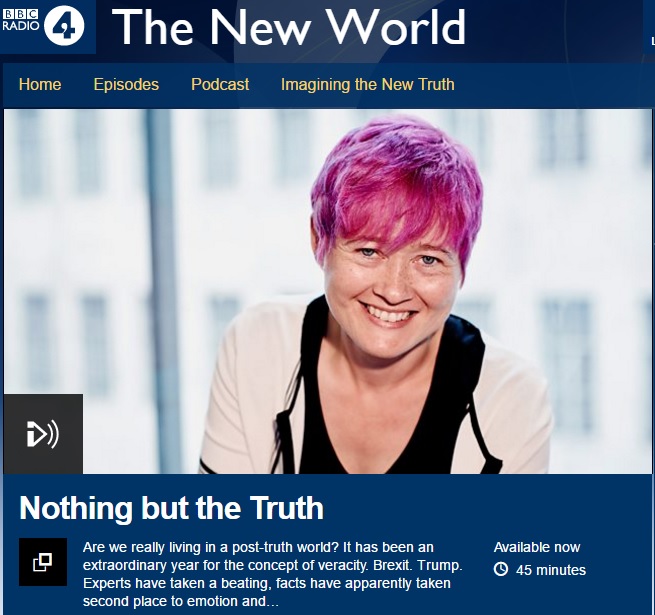 So, what do I have to say about dead cats? I was listening to an excellent suite of programmes on BBC Radio 4 this week under the umbrella title of The New World. In the the first of these, Jo Fidgen examined the concept of post truth. In this programme, there were a few uncomfortable findings. It seems that we are all as likely as each other to disregard the truth particularly if we disagree (with it) and live with others who disagree. Most disturbing is the dead cat syndrome. Fidgen uses the example of a murder inquiry to make the point. An aristocrat has her jewelry stolen. The media report that the gardener had been arrested on suspicion of the theft. However, the gardener was released with no charge; but in a controlled experiment, on his release, a sample of people still believed that he was guilty, despite the no charge report. It was not until the media reported that the butler had then been arrested and charged that the people in the sample were prepared to believe that the dead cat gardener was in fact innocent. Truth is perhaps beyond political.
It’s racism, not the economy
A couple of days ago, I wrote a post flagging up the considered view of Professor John Gray on the potential motivation of voters in the USA and the election of Donald Trump. The underlying point of his “letter” is that economic factors rather than social factors account for the result.
This opinion is not shared by all, and for good reason. The ever-vigilent Mehdi Hasan – has looked at the available data on the demographic that voted for Trump. It may not be as clear cut as we had thought. In actual fact, he argues, those who have been left behind economically – despite the logic – were not those who voted Trump. Rather it was those who have done better than average under neo-liberalism who put him in the White House. And the disturbing conclusion is not that the election was decided on economic issues. It was pure racism.
Reflections on a future
 After the Brexit vote I was grateful to a number of thinkers who had contributed to a week of short talks on BBC radio. I wrote about them here. The BBC revisited this format last week to help us to make sense of the US election. It was – as with Brexit – left to Professor John Gray to present a hard truth. I’ve taken the liberty of uploading it below.
The stark reality, for Gray, and I fear for the rest of us, is that (liberal) progressivism is not the norm in European human history. Autocracy and war are more representative of earlier times over the continent. Moreover, humanity may get into an autocratic and illiberal mindset – indeed, vote for it – because progressivism is itself partial. Essentially, not everyone benefits and progresses. And this comes back to bite society. The question for us is whether what we are experiencing in 2016 – and probably further into 2017 with elections in the Netherlands, France and Germany – a reversible phenomenon. John Gray, I sense, is not so sure.
.
Will the EU let the destruction happen?
For reasons that I cannot explain, I have been affected by the so-called Islamic State’s destruction of UNESCO World Heritage Sites such as Palmyra in Syria (below right). The destruction of ancient artefacts for religious reasons somehow seems personal, and that is not diminishing IS’s penchant for killing that seems part of their ideology. But why should the destruction of ancient temples which I have not visited bother me?

Yesterday the Guardian newspaper ran a story about the impending destruction of another World Heritage Site, this time in Europe and by a member state of the EU. The site in question is the Białowieża forest (left). It covers an area of 150,000 hectares in Poland. It straddles the border with Belarus, where it is entirely protected as a nature park. It is home to 20,000 animal species, including 250 types of bird and 62 species of mammals – among them Europe’s largest, the bison (left).
The government has passed a law allowing 188,000 cubic metres of trees to be felled by 2021. It is argued that some of the trees – maybe even 1 million spruce trees – are infested with bark beetle and are dying. The felling, however, seems to go way beyond what is necessary to contain the infestation – assuming it needs dealing with at all. Nature is pretty good at regeneration.
The Polish government seems to have put a price on the forest. The logging in Białowieża is expected to raise about 700m złotys (£124m); however, some see it as the thin edge of the wedge. Undermine the viability and diversity of the forest and that might pave the way for extensive and lucrative tree clearances (as if what is proposed is not damaging enough).
So, what is the link to the so-called Islamic State? Well IS was not a member of the EU, or even the UN, so negotiation over the Palmyra site were difficult to arrange. There was not much sanction at that point in time. They willingly filmed the destruction for posterity, keen as they are to share their violence with us. Poland is an EU member state. Sanction is there if it chooses to exercise it. We shall see.
But the story did help me with the question of why it might bother me. Both sites are ancient. The trees or the relics – if they could speak to us – could tell us much about ourselves, our history and origins. I know they cannot. Both are irreplaceable. Take them away and they cannot be replaced. With forest, the whole eco-system is lost. The flora and fauna will die. That is also an issue. With the ancient relics, we erase our link to history, ancestors and the humbling that often comes with huge ancient buildings erected without, at the very least, lifting technology. Wonderment, that is the connection.
In the comments accompanying the article in the Guardian newspaper (link above), one comment suggested that countries with elected governments can do what they like with their land. And there lies the problem. Human beings believe the land and its content to be theirs. They are resources to be exploited. They are very rarely viewed as there to be protected, even though protecting the forest sustains the environment on which we depend. Humanity often struggles to see itself as made up of organic life forms. Rather humanity locates itself as some superior entity removed from its place in nature.
Will the EU act?
Pictures:
Bison in forest: Herr stahlhoefer, Wikipedia
Temple of Bel, Palmyra, Syria, Bernard Gagnon, Wikipedia
Belawege
What is to be done?
Filed under: International, Journalism and News Reportage, Politics | Tags: Donald Trump, John Whittingdale
Leave a comment  What a depressing day this is, despite the sunshine. I have been trying to hide from the reality of Donald Trump being on the ballot for the US presidential election in November. But last night’s victory in Indiana and the withdrawal of the two remaining opponents from the Republican nomination guarantees his candidacy. And with it, the very real prospect of power.
Back in the UK, the punitive Trade Union legislation entered the statute book. It is a bare-faced attempt to outlaw strikes (in the public sector) by forcing a minimum of a 50 per cent turnout for strike ballots and a 40 per cent positive vote amongst those eligible to vote. Let me get my head around that. 40 per cent of the eligible voters have to be in favour even if they choose not to vote. Basically, choosing not to vote counts as a “no” in a strike ballot. Put another way, very few of our Members of Parliament meet those criteria for their own election.
What else? Ah yes, another unsavoury character, John Whittingdale (right), the inappropriately appointed Culture Minister, is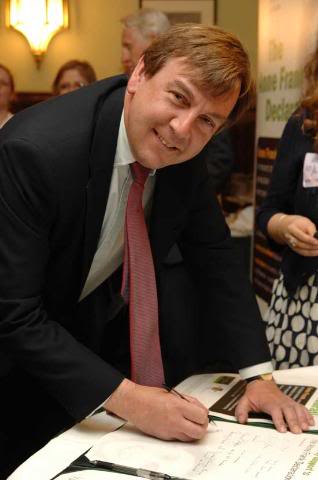 desperate to abolish the BBC. Now I’m no lover of the BBC – with the exception of its factual output, essentially BBC4 – but abolition leaves us to the mercy of commercial media and commercial agendas. Whittingdale has already been kite flying arguing that the BBC should not be able to go head-to-head with commercial rivals; for example, Strictly Come Dancing against the X-Factor on a Saturday evening. He wants to top-slice the BBC licence fee to give to commercial broadcasters in the interests of fairness. The BBC has already had to subsidise pensioners with the free licence and take on the World Service, traditionally the responsibility of the Foreign Office. But last week during a Cambridge Conservative Association speech he described the demise of the BBC as a “tempting prospect”.
Pictures: Donald Trump By Michael Vadon (Wikipedia)
John Whittingdale – johnwhittingdale.org.uk
Bombing Syria
Filed under: Arab Spring, International, Politics | Tags: David Cameron, IS, Syria
Comments (1)  I was sickened by the attacks in Paris. As a regular attender at gigs, I can only imagine the terror of a gunman in a dark confined space, let alone two gunmen. Paris is special.
France’s President Hollande (left), however, is not. I sense that he is using this opportunity to reinvent himself as a statesman, he doing not so well on the being President gig. He seems now to strut around inspecting his troops and embracing photo-opportunities with the scenes of terror as a backdrop. Oh, and bombing Raqqa in Syria, the Capital of the Islamic State, the perpetrator of the atrocity.
Whilst Raqqa may be the Capital, it is also a city full of civilians, many living under occupation. Any attack will have civilian casualties. But for President Hollande it does seem now that they are dispensable in the pursuit of his statesmanship. For goodness sake, the perpetrators of the atrocities were French nationals living in Belgium! Arguably, the attacks should have been prevented as there seems to be plenty of evidence that the perpetrators were known to the authorities. Warnings had been issued. They were not acted upon. That is not to excuse them, but we spend a lot of money on the security services and have – and will continue to – voluntarily concede civil liberties in order for these individuals to be monitored.
IS is of our own making. The US/UK illegitimate invasion of Iraq is one component. Our continued support for Saudi Arabia, arguably the source of the IS-statehood – a variation of Wahabi-ism – where beheadings are legitimate forms of punishment and the subjugation of women institutionalised, is another.
And then there is the ally of the French across the Channel, the UK, with its very own statesman pretender, David Cameron. Now, it seems, it is time for him to push ahead with his much-heralded desire to bomb Syria. He argues that we, the British, are already bombing Iraq and the Syrian border at the moment is a bit nebulous (see chart, right). It is not really respected by IS and Assad is a bit holed up in Damascus to do much about any incursions. That is until the Turks blow out of the sky a Russian fighter and film the pilot being being shot at as he descends with a parachute. Spend 17 seconds over Turkey without an invitation and boom!
I can only hope that the UK Labour Party MPs do not accede to Cameron’s war mongering. I fear that they will. We seem not to learn the lessons of history – both near and far.
Picture of President Hollande: , Wikipedia
Graphic: Guardian newspaper: http://www.theguardian.com/politics/2015/nov/26/david-cameron-persuading-labour-mps-back-syria-airstrikes
Journalists reporting on Greece
Filed under: International, Journalism and News Reportage, Politics | Tags: Grexit, Paul Mason, Simon Nixon
Leave a comment I was relatively late to the world of Twitter as a source of news. Naturally, one needs to follow a few journalists as well as informed individuals and institutions in order fully to appreciate its special immediacy. When it comes economics, I follow, amongst others, Paul Mason from Channel 4 TV in the UK and Simon Nixon from the Wall Street Journal and the Times of London. What these two journalists have in common is a passion for Greece and for reporting on the nature of the current Greek crisis and potential – though unknowable – solutions.
 Mason has taken to vlogging on a daily basis, usually from a cafe with an ATM in view of himself and/or the camera (left). He’s reflective and tries desperately to understand and articulate what is going on and what is needed from both sides to, at least temporarily, avert a potential conflagration across the Eurozone and Europe more generally. It seems to me that his tolerance of the Greek government and its leadership is based on its democratic legitimacy, the flawed logic of austerity as a means to economic growth and, perhaps, the sense that this crisis does have the potential to bring about a change in the global system of sovereign debt relief that, largely, benefits rich countries at the expense of the poor. He is not anti-capitalism.
By contrast, Nixon, is a conservative steeped in the belief in the legitimacy of the global system as it is. The crisis in Greece seems to have brought out worst in him. The tweet below, for example, demonstrates his belief in his own ability to diagnose the problem; namely, Syriza, and Yanis Varoufakis particularly.
So, for Nixon, there seems to be little recognition of any culpability for the previous, seemingly corrupt, Greek governments; the Euro project itself; the EU or monetarism. Only Syriza. My Twitter feed was overwhelmed on Tuesday evening with Nixon’s tweets from the “yes” demonstration in Athens. Whilst it was impressive, it is not surprising that there is a polarisation of opinion and that people take to the streets to express it. It does not make it right or viable. Ultimately we do not know. We cannot know.
Twitter, however, remains the most immediate way of following fast-moving stories.
 Be informed