Archive for the ‘International’ Category
Researching Brexit and the effectiveness of dead cats
 It was in the UK General Election of 2015 that we seemingly encountered the concept of the dead cat. It was a campaign innovation by the Conservative Party’s campaign strategist, Linton Crosby (left). Essentially, throw the dead cat into the arena even if it is not a cat. Or dead. It does not matter. For most observers, it is a dead cat and it is the only thing that people can see. So, for example, linking Labour and the SNP – with Alec Salmond calling the shots. Never on, but enough to worry English voters (and possibly Scottish).
I mention this because this is the year that the implications of all of 2016’s successful dead cats – Brexit and Trump to name but two – will be realised. At least partially. Both fill me with foreboding – the former because of the apparent incompetence of the Government to manage the transition; the latter because…well, anxiety about a Trump presidency is natural, is it not? The bigger questions, however, are about how to counter the dead cat when it is thrown in to the arena and to understand the causes of the Brexit vote. I have short observations o n both of these.
Let me deal with Brexit vote first. Over the Christmas break I read a very interesting academic paper with some poignant empirical observations. The paper is called “The 2016 Referendum, Brexit and the Left Behind: An Aggregate-level Analysis of the Result”. The authors are Matthew J Goodwin and Oliver Heath and is published in the Political Quarterly (Vol 87(3), July September 2016). This is an early peer-reviewed analysis of available data that the authors have interrogated to ascertain who were the key voters. This is a summary of what they found:
- There is a statistically significant positive correlation between (high) levels of education and propensity to vote Remain (excluding London and Scotland).
- The over 65s – particularly in areas where UKIP polled well in the 2014 European Parliament elections – significantly voted Leave. So, 19 of the 20 “oldest” local authority areas voted Leave. By contrast, 16 of the 20 “youngest” local authority areas voted Remain (Oxford and Cambridge are the youngest of these). The exceptions again are London and Scotland.
- Areas with the fewest recent immigrants from the EU that were most likely to vote Leave (for example, South Staffordshire and the West Midlands). Of the 20 local authority areas with the most EU migrants, 18 voted Remain.
- Those local authority areas that have experienced a sudden increase in the number of EU migrants over the last 10 years tended to me more pro-Leave.
What conclusions can be drawn from this analysis? The authors conclude that the Brexit vote was determined by a high turnout by older voters, those with lower educational qualifications and in lower-skilled jobs. Essentially, those “left behind” in terms of economic transformation and whose values are at odds with those of a “liberal elite”. I conclude that these are all political factors that successive UK governments have ignored.
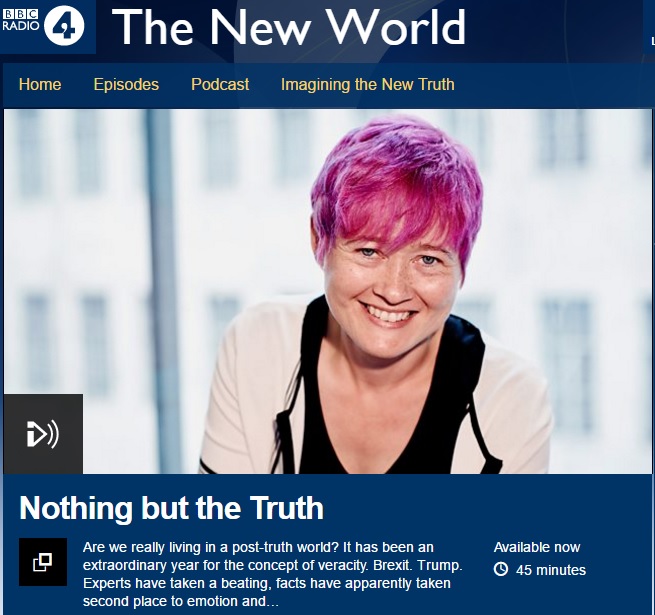 So, what do I have to say about dead cats? I was listening to an excellent suite of programmes on BBC Radio 4 this week under the umbrella title of The New World. In the the first of these, Jo Fidgen examined the concept of post truth. In this programme, there were a few uncomfortable findings. It seems that we are all as likely as each other to disregard the truth particularly if we disagree (with it) and live with others who disagree. Most disturbing is the dead cat syndrome. Fidgen uses the example of a murder inquiry to make the point. An aristocrat has her jewelry stolen. The media report that the gardener had been arrested on suspicion of the theft. However, the gardener was released with no charge; but in a controlled experiment, on his release, a sample of people still believed that he was guilty, despite the no charge report. It was not until the media reported that the butler had then been arrested and charged that the people in the sample were prepared to believe that the dead cat gardener was in fact innocent. Truth is perhaps beyond political.
It’s racism, not the economy
A couple of days ago, I wrote a post flagging up the considered view of Professor John Gray on the potential motivation of voters in the USA and the election of Donald Trump. The underlying point of his “letter” is that economic factors rather than social factors account for the result.
This opinion is not shared by all, and for good reason. The ever-vigilent Mehdi Hasan – has looked at the available data on the demographic that voted for Trump. It may not be as clear cut as we had thought. In actual fact, he argues, those who have been left behind economically – despite the logic – were not those who voted Trump. Rather it was those who have done better than average under neo-liberalism who put him in the White House. And the disturbing conclusion is not that the election was decided on economic issues. It was pure racism.
Reflections on a future
 After the Brexit vote I was grateful to a number of thinkers who had contributed to a week of short talks on BBC radio. I wrote about them here. The BBC revisited this format last week to help us to make sense of the US election. It was – as with Brexit – left to Professor John Gray to present a hard truth. I’ve taken the liberty of uploading it below.
The stark reality, for Gray, and I fear for the rest of us, is that (liberal) progressivism is not the norm in European human history. Autocracy and war are more representative of earlier times over the continent. Moreover, humanity may get into an autocratic and illiberal mindset – indeed, vote for it – because progressivism is itself partial. Essentially, not everyone benefits and progresses. And this comes back to bite society. The question for us is whether what we are experiencing in 2016 – and probably further into 2017 with elections in the Netherlands, France and Germany – a reversible phenomenon. John Gray, I sense, is not so sure.
.
Will the EU let the destruction happen?
For reasons that I cannot explain, I have been affected by the so-called Islamic State’s destruction of UNESCO World Heritage Sites such as Palmyra in Syria (below right). The destruction of ancient artefacts for religious reasons somehow seems personal, and that is not diminishing IS’s penchant for killing that seems part of their ideology. But why should the destruction of ancient temples which I have not visited bother me?

Yesterday the Guardian newspaper ran a story about the impending destruction of another World Heritage Site, this time in Europe and by a member state of the EU. The site in question is the Białowieża forest (left). It covers an area of 150,000 hectares in Poland. It straddles the border with Belarus, where it is entirely protected as a nature park. It is home to 20,000 animal species, including 250 types of bird and 62 species of mammals – among them Europe’s largest, the bison (left).
The government has passed a law allowing 188,000 cubic metres of trees to be felled by 2021. It is argued that some of the trees – maybe even 1 million spruce trees – are infested with bark beetle and are dying. The felling, however, seems to go way beyond what is necessary to contain the infestation – assuming it needs dealing with at all. Nature is pretty good at regeneration.
The Polish government seems to have put a price on the forest. The logging in Białowieża is expected to raise about 700m złotys (£124m); however, some see it as the thin edge of the wedge. Undermine the viability and diversity of the forest and that might pave the way for extensive and lucrative tree clearances (as if what is proposed is not damaging enough).
So, what is the link to the so-called Islamic State? Well IS was not a member of the EU, or even the UN, so negotiation over the Palmyra site were difficult to arrange. There was not much sanction at that point in time. They willingly filmed the destruction for posterity, keen as they are to share their violence with us. Poland is an EU member state. Sanction is there if it chooses to exercise it. We shall see.
But the story did help me with the question of why it might bother me. Both sites are ancient. The trees or the relics – if they could speak to us – could tell us much about ourselves, our history and origins. I know they cannot. Both are irreplaceable. Take them away and they cannot be replaced. With forest, the whole eco-system is lost. The flora and fauna will die. That is also an issue. With the ancient relics, we erase our link to history, ancestors and the humbling that often comes with huge ancient buildings erected without, at the very least, lifting technology. Wonderment, that is the connection.
In the comments accompanying the article in the Guardian newspaper (link above), one comment suggested that countries with elected governments can do what they like with their land. And there lies the problem. Human beings believe the land and its content to be theirs. They are resources to be exploited. They are very rarely viewed as there to be protected, even though protecting the forest sustains the environment on which we depend. Humanity often struggles to see itself as made up of organic life forms. Rather humanity locates itself as some superior entity removed from its place in nature.
Will the EU act?
Pictures:
Bison in forest: Herr stahlhoefer, Wikipedia
Temple of Bel, Palmyra, Syria, Bernard Gagnon, Wikipedia
Belawege
What is to be done?
Filed under: International, Journalism and News Reportage, Politics | Tags: Donald Trump, John Whittingdale
 Leave a comment
  What a depressing day this is, despite the sunshine. I have been trying to hide from the reality of Donald Trump being on the ballot for the US presidential election in November. But last night’s victory in Indiana and the withdrawal of the two remaining opponents from the Republican nomination guarantees his candidacy. And with it, the very real prospect of power.
Back in the UK, the punitive Trade Union legislation entered the statute book. It is a bare-faced attempt to outlaw strikes (in the public sector) by forcing a minimum of a 50 per cent turnout for strike ballots and a 40 per cent positive vote amongst those eligible to vote. Let me get my head around that. 40 per cent of the eligible voters have to be in favour even if they choose not to vote. Basically, choosing not to vote counts as a “no” in a strike ballot. Put another way, very few of our Members of Parliament meet those criteria for their own election.
What else? Ah yes, another unsavoury character, John Whittingdale (right), the inappropriately appointed Culture Minister, is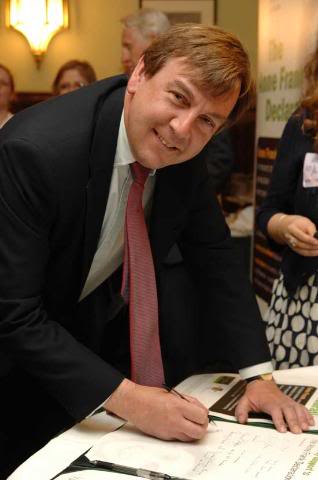 desperate to abolish the BBC. Now I’m no lover of the BBC – with the exception of its factual output, essentially BBC4 – but abolition leaves us to the mercy of commercial media and commercial agendas. Whittingdale has already been kite flying arguing that the BBC should not be able to go head-to-head with commercial rivals; for example, Strictly Come Dancing against the X-Factor on a Saturday evening. He wants to top-slice the BBC licence fee to give to commercial broadcasters in the interests of fairness. The BBC has already had to subsidise pensioners with the free licence and take on the World Service, traditionally the responsibility of the Foreign Office. But last week during a Cambridge Conservative Association speech he described the demise of the BBC as a “tempting prospect”.
Pictures: Donald Trump By Michael Vadon (Wikipedia)
John Whittingdale – johnwhittingdale.org.uk
Bombing Syria
Filed under: Arab Spring, International, Politics | Tags: David Cameron, IS, Syria
Comments (1)  I was sickened by the attacks in Paris. As a regular attender at gigs, I can only imagine the terror of a gunman in a dark confined space, let alone two gunmen. Paris is special.
France’s President Hollande (left), however, is not. I sense that he is using this opportunity to reinvent himself as a statesman, he doing not so well on the being President gig. He seems now to strut around inspecting his troops and embracing photo-opportunities with the scenes of terror as a backdrop. Oh, and bombing Raqqa in Syria, the Capital of the Islamic State, the perpetrator of the atrocity.
Whilst Raqqa may be the Capital, it is also a city full of civilians, many living under occupation. Any attack will have civilian casualties. But for President Hollande it does seem now that they are dispensable in the pursuit of his statesmanship. For goodness sake, the perpetrators of the atrocities were French nationals living in Belgium! Arguably, the attacks should have been prevented as there seems to be plenty of evidence that the perpetrators were known to the authorities. Warnings had been issued. They were not acted upon. That is not to excuse them, but we spend a lot of money on the security services and have – and will continue to – voluntarily concede civil liberties in order for these individuals to be monitored.
IS is of our own making. The US/UK illegitimate invasion of Iraq is one component. Our continued support for Saudi Arabia, arguably the source of the IS-statehood – a variation of Wahabi-ism – where beheadings are legitimate forms of punishment and the subjugation of women institutionalised, is another.
And then there is the ally of the French across the Channel, the UK, with its very own statesman pretender, David Cameron. Now, it seems, it is time for him to push ahead with his much-heralded desire to bomb Syria. He argues that we, the British, are already bombing Iraq and the Syrian border at the moment is a bit nebulous (see chart, right). It is not really respected by IS and Assad is a bit holed up in Damascus to do much about any incursions. That is until the Turks blow out of the sky a Russian fighter and film the pilot being being shot at as he descends with a parachute. Spend 17 seconds over Turkey without an invitation and boom!
I can only hope that the UK Labour Party MPs do not accede to Cameron’s war mongering. I fear that they will. We seem not to learn the lessons of history – both near and far.
Picture of President Hollande: , Wikipedia
Graphic: Guardian newspaper: http://www.theguardian.com/politics/2015/nov/26/david-cameron-persuading-labour-mps-back-syria-airstrikes
Journalists reporting on Greece
Filed under: International, Journalism and News Reportage, Politics | Tags: Grexit, Paul Mason, Simon Nixon
Leave a comment I was relatively late to the world of Twitter as a source of news. Naturally, one needs to follow a few journalists as well as informed individuals and institutions in order fully to appreciate its special immediacy. When it comes economics, I follow, amongst others, Paul Mason from Channel 4 TV in the UK and Simon Nixon from the Wall Street Journal and the Times of London. What these two journalists have in common is a passion for Greece and for reporting on the nature of the current Greek crisis and potential – though unknowable – solutions.
 Mason has taken to vlogging on a daily basis, usually from a cafe with an ATM in view of himself and/or the camera (left). He’s reflective and tries desperately to understand and articulate what is going on and what is needed from both sides to, at least temporarily, avert a potential conflagration across the Eurozone and Europe more generally. It seems to me that his tolerance of the Greek government and its leadership is based on its democratic legitimacy, the flawed logic of austerity as a means to economic growth and, perhaps, the sense that this crisis does have the potential to bring about a change in the global system of sovereign debt relief that, largely, benefits rich countries at the expense of the poor. He is not anti-capitalism.
By contrast, Nixon, is a conservative steeped in the belief in the legitimacy of the global system as it is. The crisis in Greece seems to have brought out worst in him. The tweet below, for example, demonstrates his belief in his own ability to diagnose the problem; namely, Syriza, and Yanis Varoufakis particularly.
So, for Nixon, there seems to be little recognition of any culpability for the previous, seemingly corrupt, Greek governments; the Euro project itself; the EU or monetarism. Only Syriza. My Twitter feed was overwhelmed on Tuesday evening with Nixon’s tweets from the “yes” demonstration in Athens. Whilst it was impressive, it is not surprising that there is a polarisation of opinion and that people take to the streets to express it. It does not make it right or viable. Ultimately we do not know. We cannot know.
Twitter, however, remains the most immediate way of following fast-moving stories.
Grexit
 When I was at university back in the 80s, I took a course entitled Political Sociology. Essentially it was a study of power. The core text was Stewart Clegg’s Frameworks of Power, an extremely difficult text (for an undergraduate), but every week ahead of the seminars, a chapter was consumed and prepared to present.
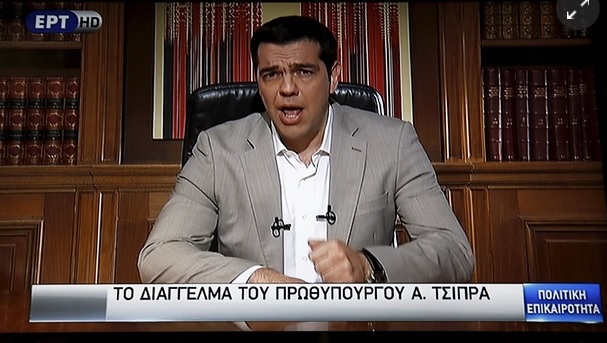
Clegg introduced me to the concept of Organisational Outflanking. This post is a partial celebration of this concept and a very good example of its employment. Say what we might about Alexis Tsipras, the Greek Prime Minister (above left), he is a fine exponent of the art. It does not matter how poor is the hand that one is dealt, it is still possible to outflank opponents by doing something unexpected. Tsipras announcing a referendum in the home of democracy was a master stroke. The creditors (the EU, the IMF and the ECB – the so-called Troika) were not expecting that. It took a little while for a response, the best indicator of a successful outflanking, as it were.
In writing this, I risk the wrath of Greek friends and colleagues who are being hurt by this crisis. Let us not forget that the crisis that we continue to try to deal with was caused by the banking sector, not the people of Greece. Moreover, Greece’s continued membership of the Euro was managed – conceivably fraudulently – by the banking sector for its own ends. That wonderful banking institution Goldman Sachs made a lot of money out of helping the then Greek Government to hide the true extent of the deficit in contravention of the Maastricht Treaty.
Locking poorer members of the European Union into a currency regime managed from the heart of Europe’s strongest economy, Germany, is a nonsense. When the going gets tough, countries devalue their currencies to render products and services cheaper. Without that lever, what other options are available to Governments? Erm…asking the Troika for money to pay back the Troika and the transfer of state assets, healthcare provision, etc.? 50 per cent unemployment of young people is but one unacceptable consequence of this.
I’m glad to see that Nobel Prizewinning economist, Paul Krugman, reported in Business Insider seems to have come out in support of Tsipras. Summed up in a nutshell:
“Over the past seven years, Krugman argues, the financial noose Europe has placed around Greece’s neck has strangled the Greek economy. Each time Europe has loaned Greece money, it has demanded spending cuts in return. And these spending cuts — austerity — have further damaged the Greek economy.
In the past, every time the situation has come to a head, Greece has caved. And, in the process, it has transformed itself into little more than a financial slave state mired in an economic depression.
There is no way Greece will ever be able to cut its way to prosperity, Krugman argues. And history suggests that any argument to the contrary is crazy.
Given that Europe refuses to restructure Greece’s debt in a sustainable way and allow the country to try to grow its way out of its misery, Greece has no choice but to default and withdraw.”
It is going to be tough with the banks closed. It is not just the people at the ATMs, but the economy more generally. The whole point about banks is they deal the means of exchange of value; i.e. money. And when they are shut, this becomes very difficult. In response, we either find other stores of value such as gold (or as happened in Douglas Adams’ Hitch Hikers Guide to the Galaxy, the leaf) or we merely exchange things on the basis of a perceived equivalence.
The outcome – either the Troika gets real and accepts that we are dealing with real people and not inanimate institutions, or Greece goes it alone. It has been done before. But if that happens, Europe has to take a close look at itself.
By contrast:
https://twitter.com/strassenbahn13/status/615422529180704768
The Confederate flag
 Ben Hallman in the Huffington Post notes that “[t]he Confederacy was the most vile and harmful political invention in United States history. It was founded on the explicit principle that slavery is the “natural and normal condition” of black people, and that they should be ruthlessly exploited to the benefit of their white masters. More Americans died in the bloodletting that followed than in World War I, World War II, Korea and Vietnam combined.”
I was bemused to learn that the flag still flies legally on State Government land in Columbia, South Carolina. Even more that the president of the USA cannot intervene and get it down (and outlawed). It like the Berlin Government flying the Swastika over its government buildings.
Ben Hallman’s article can be found at: http://tinyurl.com/pr6yxjg
Flag: William Porcher Miles (1822-1899) – Wikipedia
University of Brighton degree show 2015 pt 1
Filed under: Art, Environment | Tags: University of Brighton degree show 2015
Leave a comment Here is my annual review of the best (in my humble opinion) of the degree show. In light of the recent election result and my passion for students and young people more generally to engage with the political process, I highlight in the first instance the work that prompts thought about change and the environment.
First, let us start with the graphic designers whose task is surely to help us navigate the complex environment in which we live and to alert us to dangers both real and imaginable. There were seven exceptional examples in this year’s show starting with Hannah Jeffery (right). It never ceases to shock to learn just how few examples of these extraordinary animals there are left; largely because of poaching and game hunting.
 Next, Amy Fullalove who asks, how do we alert future generations to the dangers associated with a huge nuclear waste repository in Finland (Onkalo)? I think these symbols (left) will do the trick!
Sasha George (below right) has another approach. Now this is my interpretation, and hence it might be entirely wrong. The artist seems to have presented a series of six extraordinary pictures depicting  nature reclaiming human despoliation. There is a toppled Statue of Liberty (somehow on land); trees growing through houses and abandoned vehicles. The array of animals – tigers, bears, birds and fauna is fantastic. And to me at least, it shocks.
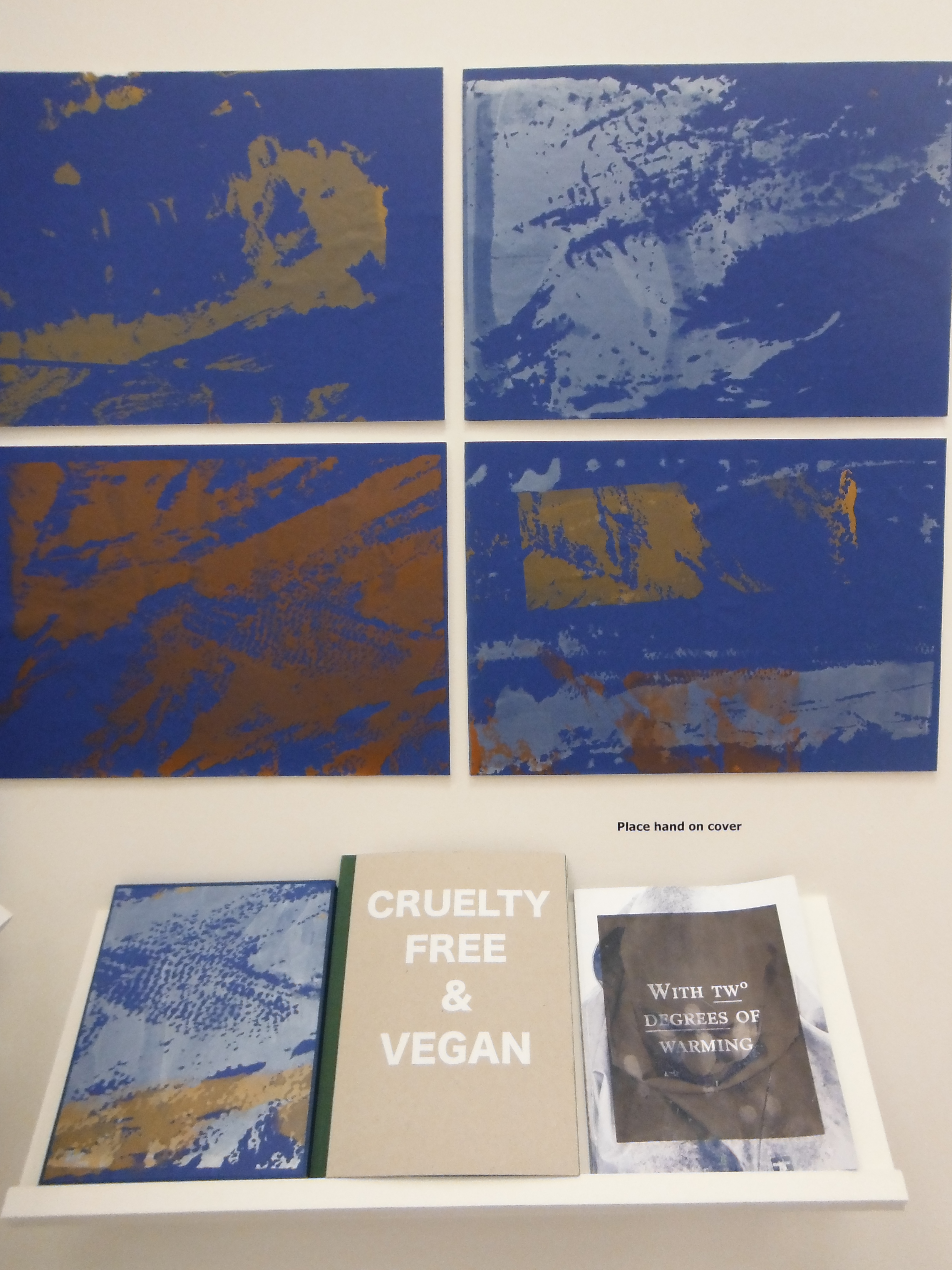 Next Lossie Ng Lei (left) takes on global warming with a challenge to feel the difference that 2 degrees makes with a set of oceanic images and a push towards veganism (as a solution).
Next, Beth Ducket (below right) who is in fact a print maker rather than graphic design. It is not clear exactly how explicit the artist is about the impact on the environment of consumption, but even by accident the reproduction of so many receipts makes a clear point. Her accompanying script could even be Marxist with references to alienation (meaninglessness) and mass production/consumption. Perversely the artist has reproduced by hand the receipts on the one hand claiming artisanal value but also this wonderful ability to see art in the mundane and a deep commitment to classification.
My penultimate choice goes to an artist whose work seems not to have been labelled. I do not know  whether this work is a critique of modern communication technology or a celebration of it (left). Every individual in the series of six pictures is completely consumed by a mobile phone. If it is a critique, well done. If it is a celebration, we really are doomed.
Finally in this section (fine art and sculpture to follow), Holly MacDonald is going to go far with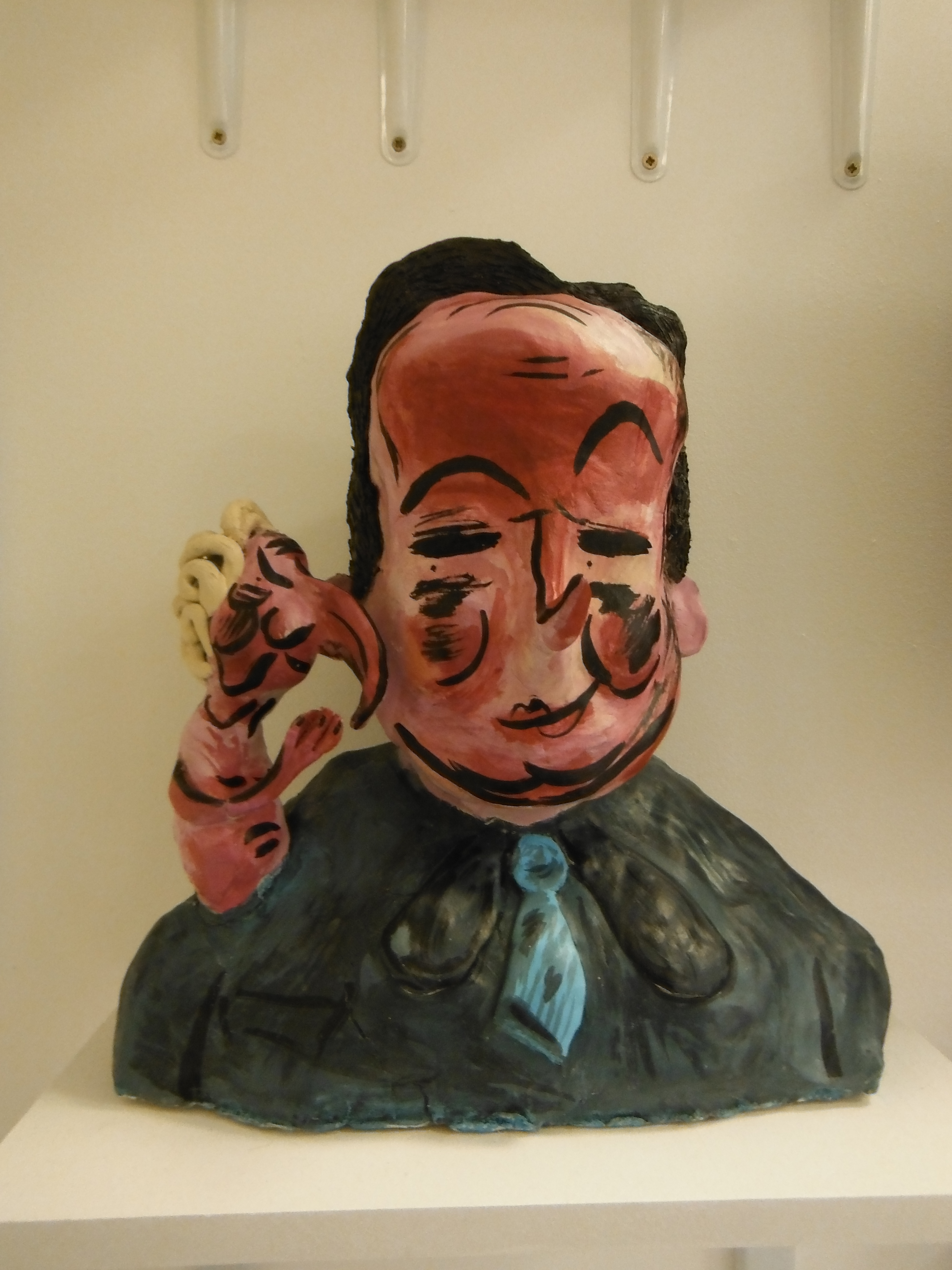 her caricatures of British politicians. There are two in this example (right). And they are brilliant and correct.

