Archive for the ‘International’ Category
The Confederate flag
 Ben Hallman in the Huffington Post notes that “[t]he Confederacy was the most vile and harmful political invention in United States history. It was founded on the explicit principle that slavery is the “natural and normal condition” of black people, and that they should be ruthlessly exploited to the benefit of their white masters. More Americans died in the bloodletting that followed than in World War I, World War II, Korea and Vietnam combined.”
I was bemused to learn that the flag still flies legally on State Government land in Columbia, South Carolina. Even more that the president of the USA cannot intervene and get it down (and outlawed). It like the Berlin Government flying the Swastika over its government buildings.
Ben Hallman’s article can be found at: http://tinyurl.com/pr6yxjg
Flag: William Porcher Miles (1822-1899) – Wikipedia
University of Brighton degree show 2015 pt 1
Filed under: Art, Environment | Tags: University of Brighton degree show 2015
 Leave a comment
 Here is my annual review of the best (in my humble opinion) of the degree show. In light of the recent election result and my passion for students and young people more generally to engage with the political process, I highlight in the first instance the work that prompts thought about change and the environment.
First, let us start with the graphic designers whose task is surely to help us navigate the complex environment in which we live and to alert us to dangers both real and imaginable. There were seven exceptional examples in this year’s show starting with Hannah Jeffery (right). It never ceases to shock to learn just how few examples of these extraordinary animals there are left; largely because of poaching and game hunting.
 Next, Amy Fullalove who asks, how do we alert future generations to the dangers associated with a huge nuclear waste repository in Finland (Onkalo)? I think these symbols (left) will do the trick!
Sasha George (below right) has another approach. Now this is my interpretation, and hence it might be entirely wrong. The artist seems to have presented a series of six extraordinary pictures depicting  nature reclaiming human despoliation. There is a toppled Statue of Liberty (somehow on land); trees growing through houses and abandoned vehicles. The array of animals – tigers, bears, birds and fauna is fantastic. And to me at least, it shocks.
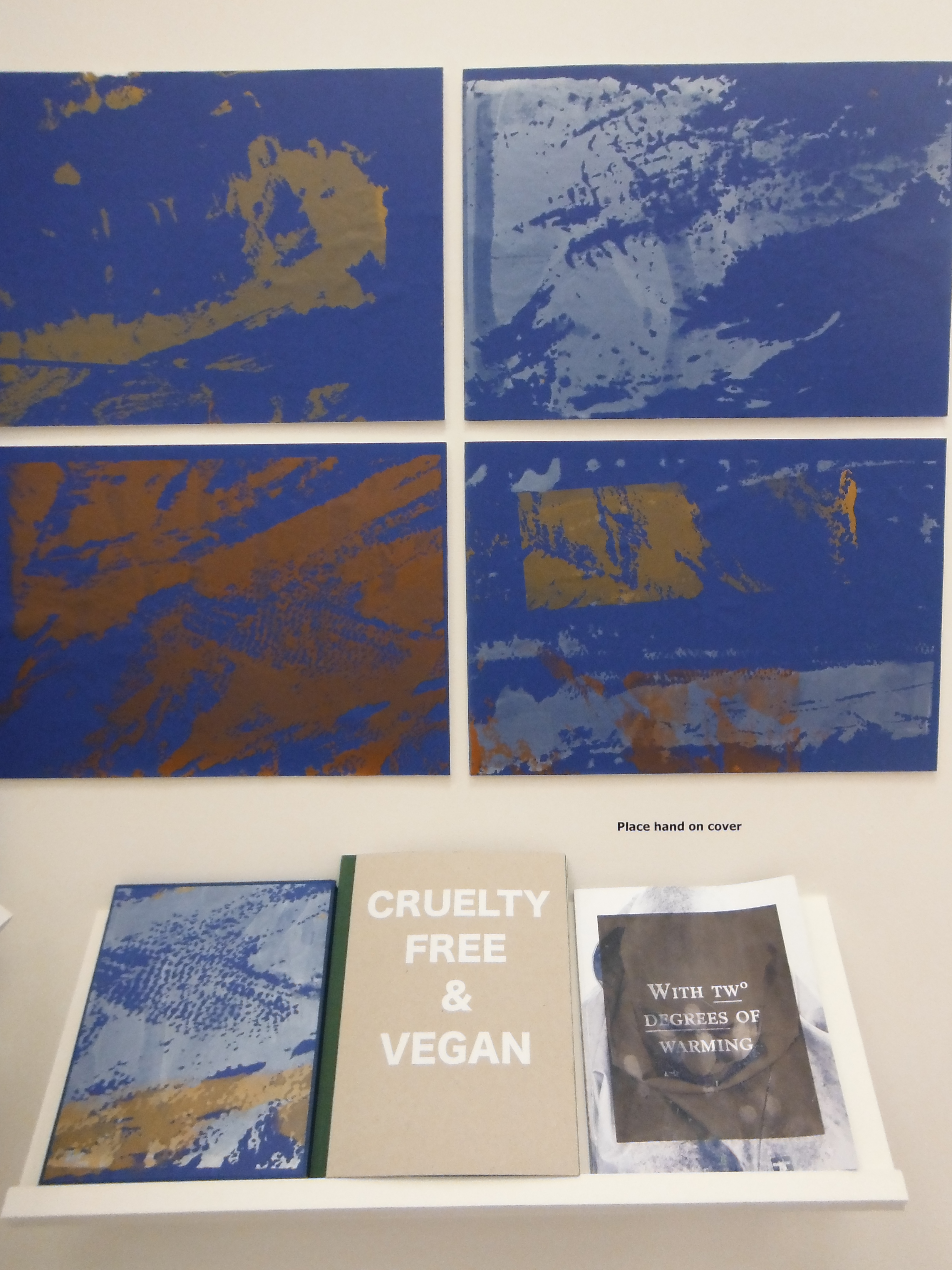 Next Lossie Ng Lei (left) takes on global warming with a challenge to feel the difference that 2 degrees makes with a set of oceanic images and a push towards veganism (as a solution).
Next, Beth Ducket (below right) who is in fact a print maker rather than graphic design. It is not clear exactly how explicit the artist is about the impact on the environment of consumption, but even by accident the reproduction of so many receipts makes a clear point. Her accompanying script could even be Marxist with references to alienation (meaninglessness) and mass production/consumption. Perversely the artist has reproduced by hand the receipts on the one hand claiming artisanal value but also this wonderful ability to see art in the mundane and a deep commitment to classification.
My penultimate choice goes to an artist whose work seems not to have been labelled. I do not know  whether this work is a critique of modern communication technology or a celebration of it (left). Every individual in the series of six pictures is completely consumed by a mobile phone. If it is a critique, well done. If it is a celebration, we really are doomed.
Finally in this section (fine art and sculpture to follow), Holly MacDonald is going to go far with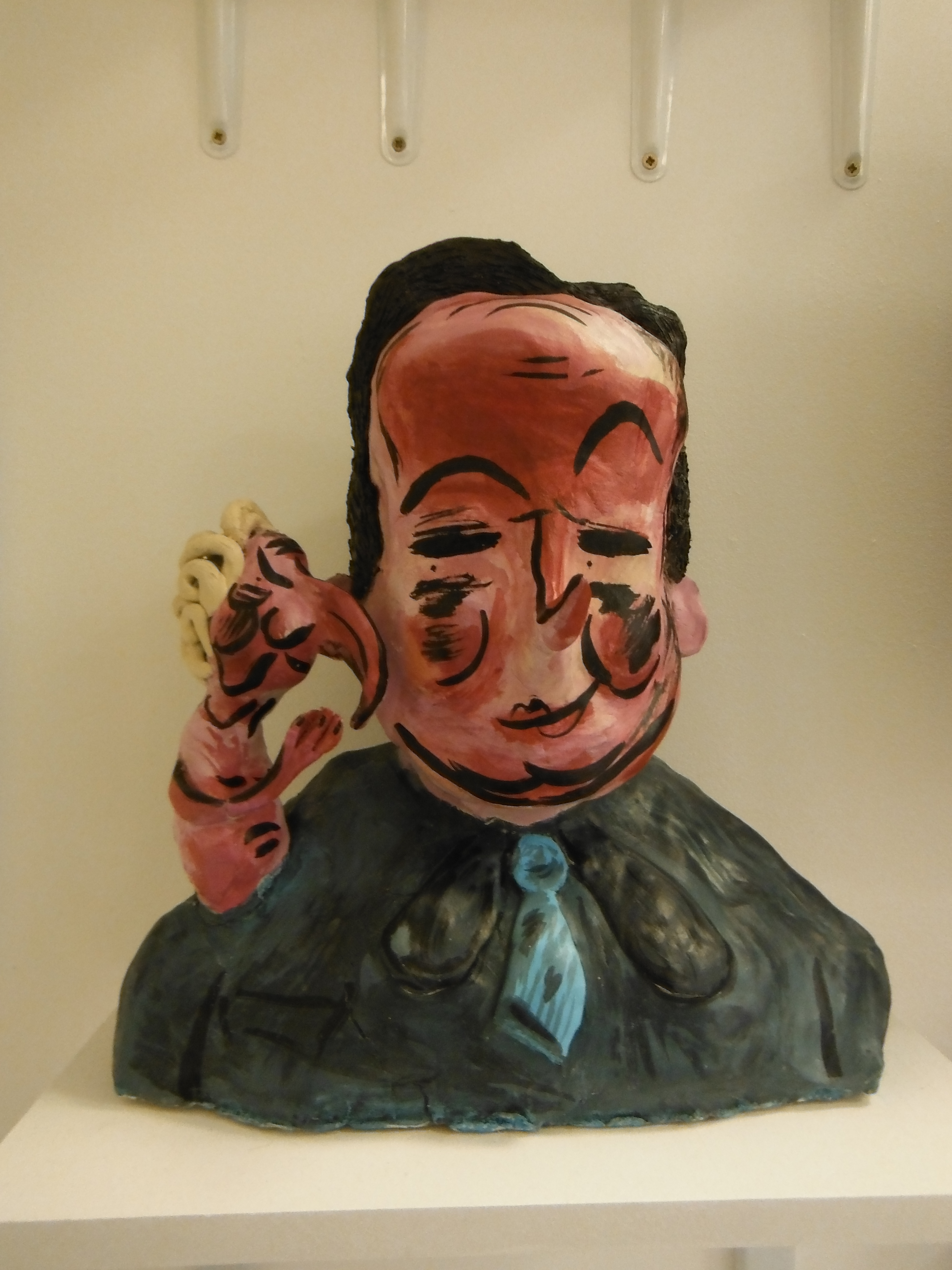 her caricatures of British politicians. There are two in this example (right). And they are brilliant and correct.
Das Gewitter
 35 degrees heat has been imposing itself on central Europeans over the past few days. It is not to my liking as a English bloke from the north used to fog in the middle of summer. I do, however, love a good electrical storm. From a safe distance.
The weatherman on the TV on Friday night promised some activity on this front. First the clouds came over, then a breeze got up. Finally the flashes and thunder. Not a classic, but I did manage to capture a lit-up sky on my phone. It required a little patience.
Actually tonight, I got some real lightening!
Culpability for the desperation of migrants crossing the Mediterranean
Filed under: International, Politics | Tags: Mediterranean Migrants, UK General election 2015
Leave a comment It has finally made it to the top of the political agenda; though the discussions amongst EU ‘leaders’ yesterday (including David Cameron) comes up with a sticking plaster rather than a solution. The suggestion that we should use bombs yet again, this time to destroy the vessels used by the human traffikers, is quite shocking in its stupidity. No doubt it suits arms manufacturers.
 This morning, the Labour Leader, Ed Miliband (left), effectively put his hands up and said that the Western Powers – particularly the UK and France – failed the people of Libya by having “inadequate postwar planning”. He noted that “In Libya, Labour supported military action to avoid the slaughter Gaddafi threatened in Benghazi. But since the action, the failure of post-conflict planning has become obvious. David Cameron was wrong to assume that Libya’s political culture and institutions could be left to evolve and transform on their own.”
I’m not sure that was the ultimate reason for bombing Libya. In response, David Cameron, the Conservative Leader, presented himself as a statesman (and great military strategist) and suggested that the electorate will decide what to make of such criticism in the face of so much death on the seas. Perhaps we need to remind Mr Cameron that it was his Government that withdrew the funding from the EU rescue mission on the grounds that it only made refugees more likely to attempt the crossing.
Okay, if it is post-(post)war planning that we are after, then these so-called leaders should be sat around a table working out how to facilitate the integration of migrants into Europe. Not finding ways of preventing them from coming (some hope on the part of politicians) or repatriating them after weeks or months in internment camps.
Oh, and Mr Farage, your advocacy of some sort of egalitarian Australian quotas approach needs some careful  consideration. There are plenty of refugees trying to enter Australia. They are held in camps run by our good friends Serco (and previously G4S). A number of these camps have witnessed serious human rights abuses, Amnesty International described the extremely offshore Nauru detention centre (right) as “a human rights catastrophe … a toxic mix of uncertainty, unlawful detention and inhumane conditions”. Meeting that challenge is a test for civilising politicians and a civilised society.
Syriza and the Greek response to austerity
Filed under: Finance and Economics, International, Politics |
Leave a comment Increasingly, it is clear that globalisation has globalised wealth in the hands of a number of elites – from  oligarchs in Russia, bankers in the UK and land speculators in Bombay. When the crash came in 2008, the perpetrators – the financial services elites – ‘hoovered’ up the public money pumped into the system to obviate a capitalist meltdown. No one went to jail; but Europe’s people were handed down a dose of austerity in return for their support. What is perplexing is how any sane policy-maker can sustain an argument that austerity helps declining economies. In Greece, for example, something in the order of 70 per cent of the country’s under 25s are unemployed. They are neither economically active nor productive. In the UK, unemployment goes down not because the economy is growing and the demand for labour is increasing; rather because people are taking zero-hour jobs or, indeed, taking jobs for an hour through ‘freelancer’ websites. Or, most disturbingly, if unskilled – at the unconnected end of the labour market – ads in supermarkets and shop windows.
Syriza’s victory in the Greek general election last week represents something positive. It is populist, but from the left rather than the right. The rhetoric is one of alternative, fairness and equality. It is a David and Goliath story in the making. The new Greek Prime minister, Alexis Tsipras (left), takes his secular oath, appoints radicals to his government (such as Yanis Varoufakis as Finance Minister), halts privatisations, reappoints the cleaners who were sacked from their jobs in the finance ministry, initiates tax reform and targets corruption. They have even put up all of the ministerial BMWs up for sale.
https://twitter.com/Oireachtas_RX/status/561578575057666048
We learn that the first port of call is not the IMF, the European Commission or even the German government in Berlin, rather opposition parties in Italy and Spain – next up on Europe’s election merry-go-round. I wait and see what happens, but there is optimism about Europe’s prospects and the rightness of Syriza’s approach to the crippling debt that they have inherited. I trust the elites do not share my optimism.
Flag: Fry1989, Wikipedia
Photo:
Here’s the next challenge to our liberties
Filed under: Environment, International, Politics, Privatisation |
Leave a comment 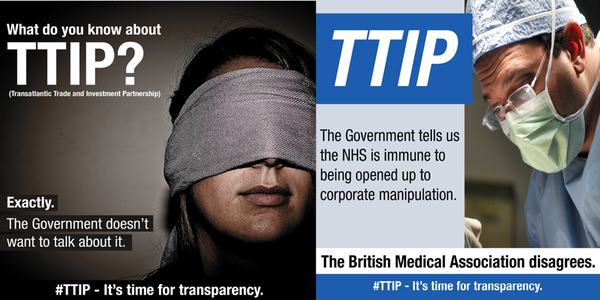 So here is the next outrage – the inappropriately named Transatlantic Trade and Investment Policy, coming to a court not near you very soon. It is inappropriate because it is not really a trade and investment policy. Such a policy would, on the whole, be benign. This one, by my understanding, gives large corporations the opportunity to challenge nation states/governments on issues that they view as restrictions on trade. So, a nationalised health service is conceivably a restriction on trade of US healthcare providers. Under this argument, US corporations would be able to make the case that they should be able to compete for contracts in the NHS – the whole of the NHS, not just the bit that the UK Conservatives have so far transferred to their private sector firms. Equally, all environmental policy could be viewed in this way. Restricting carbon emissions, for example, imposes costs on firms, that is a restriction on trade. Surely corporations should be able to pollute as much as they like?
Magazine subscriptions
Filed under: Environment, International, Journalism and News Reportage |
Comments (1) I subscribe to two weekly magazines – the New Statesman and The Economist. The former for twelve years, the latter perhaps four years. The Economist is an essential read for my work. The New Statesman feeds my interest in political debate. I took up reading it when I ended my daily subscription to the Guardian newspaper.
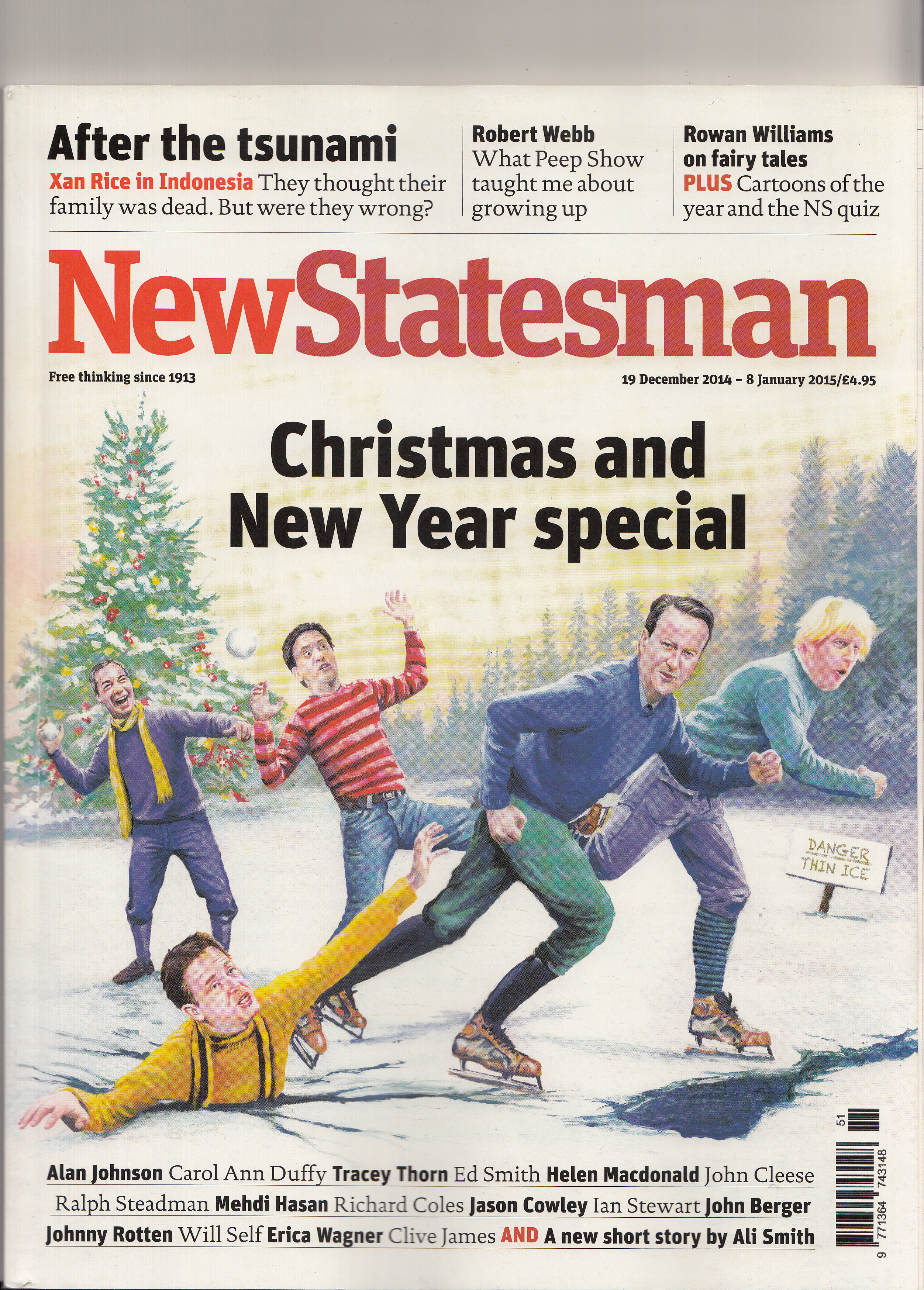 When big public holidays arrive, both magazines publish bumper editions – sufficient to keep readers satiated for the two weeks that the magazines are on holiday, as it were. The New Statesman’s bumper edition is, generally, full of pap and even some of my favourite columnists let the side down. This year, for example, Will Self has taken to writing about another columnist in the same magazine! And to make matters worse, when that columnist started a few years ago, I only managed a couple of weeks before I lost the will to read any more, life being too short and all that. Holding the fort are the veterans Peter Wilby and Hunter Davies.
The Economist, however, fills out its pages with features on history, culture and science. Although it is unashamedly 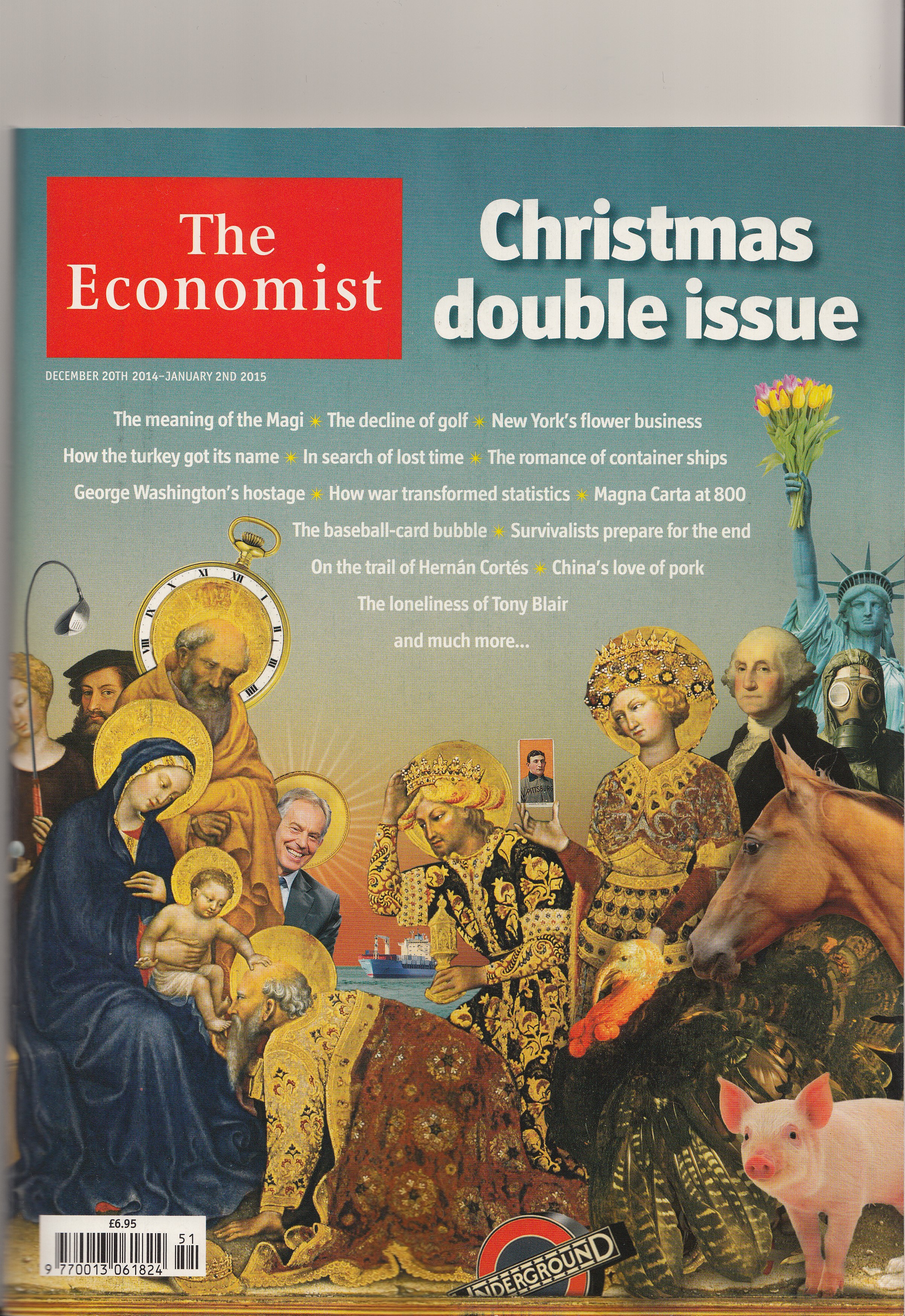 conservative, neo-liberal, it is at least well written and thoughtful. Hence I’m prompted to relay one of those features to readers (20 December 2014, pp82-84). It tells the story of the rise of pork as a symbol of affluence in China. It is a favourite food. Seemingly, Chinese citizens eat the equivalent of half a pig each per year (that is 500 million pigs annually). Such is its importance for the Chinese government seeking social stability, it is subsidised to the tune of $22bn per year. However, this leads to environmental and resource challenges.
Most are factory reared. Consequently they are routinely fed antibiotics to stave off disease that could decimate what is increasingly an in-bred, non native pig population. They are mainly fed on cash crops, particularly imported soy beans. These are grown predominantly in South America on land much of which has been cleared of rain forest. Moreover, the Chinese pork industry is responsible for 50 per cent of the total global soy market. Each kilo of pork requires 6kg of feed.
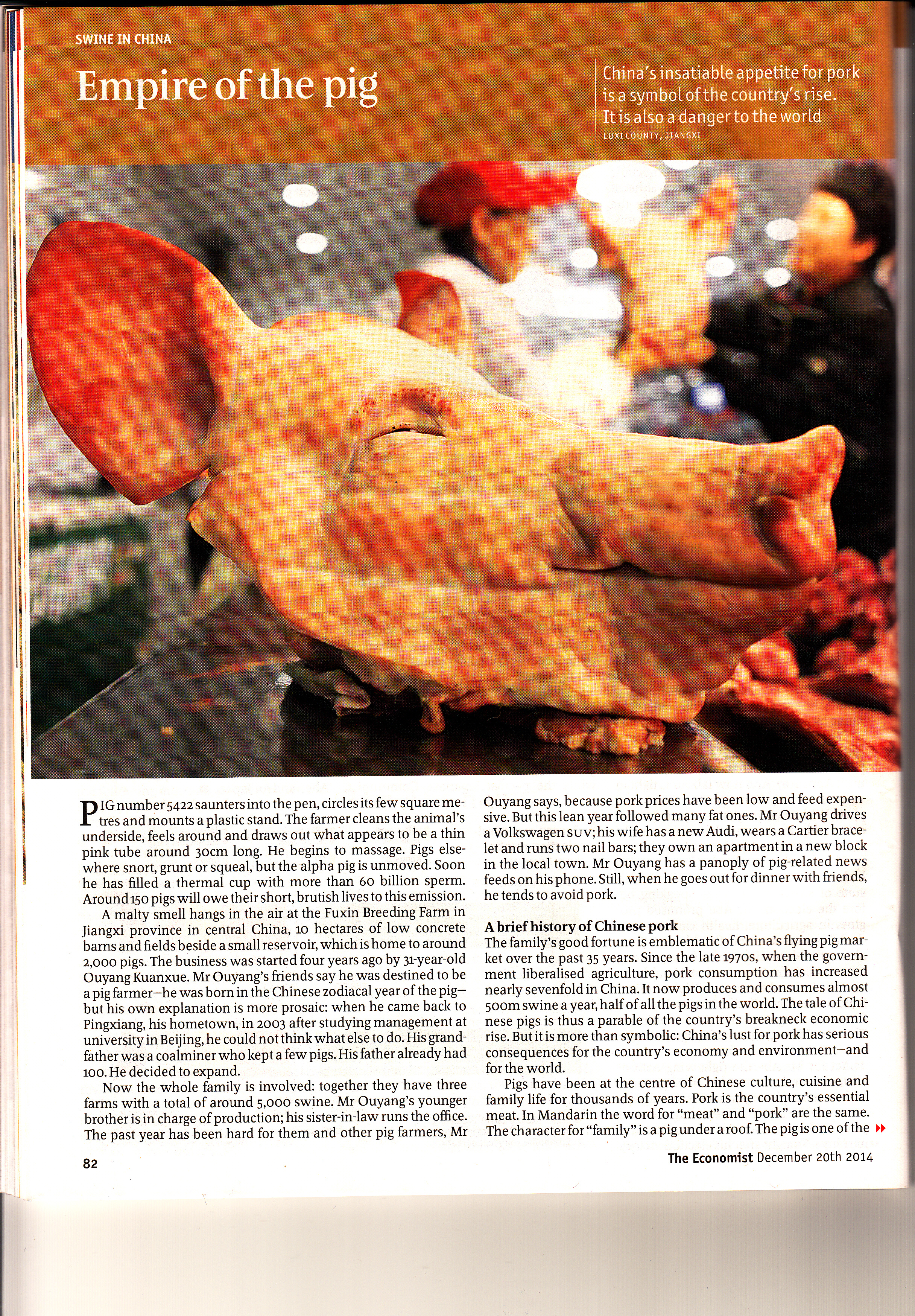 Then there is the waste. Each pig produces, apparently, 5kg of waste per day. Traditionally, pig excrement was highly valued as a fertiliser; however, mass produced pigs generate contaminated waste – antibiotics, hormones, pesticides, etc., not suitable to spreading. There is also too much of it. Pigs and pig waste have become increasing sources of water and soil pollution.
Moreover, the pigs themselves produce methane and nitrous oxide. These are potent greenhouse gases somewhat more damaging than carbon dioxide (300 times more so, it is argued).
I gave up meat 35 years ago. I may give up the New Statesman in 2015.
The oil price is a problem
Filed under: Environment, Finance and Economics, International | Tags: environment, fracking, oil price
Leave a comment  Whilst I am delighted to see that I can fill the tank of my ever-so reliable van for a fraction of what it cost this time last year and fly until my heart is discontent in the knowledge that the value of the airlines (share price) is increasing, they having done nothing more than survive three months since the oil price started to plummet, it is bad news. Why?
First, burning hydrocarbon fuels is bad for the environment and price is a key regulator of consumption. Second, many oil producing countries – some of them not the richest – have set their budgets at anticipated levels; for example, $100. The shortfall of $35 (reflecting today’s price-per-barrel) can make the difference between life-and-death. High oil prices, then, can be good transfer payments between rich and poorer countries.
Third, oil company shares are down sharply. With these stocks being some of the key investments made by pension funds, meeting obligations becomes more difficult. Fourth, investment in renewables will be hit. Suddenly it is only cost-effective to burn oil. Fifth, geopolitics. When demand goes down, price is often regulated by cutting supply. This is not happening for reasons which are currently unclear. However, there are some suggestions that it is a power battle between oil producing countries particularly in the middle-east rendering the region even more unstable than it already is. That is also not to mention the situation in Russia. Very much an oil economy that is suffering also from ludicrous EU sanctions. There is unrest ahead.
What about the positives? Well, I can think of one key positive. The glut in demand is, in part, caused by shale oil production in the USA and tar sands in Canada. These two practices are very damaging to the environment. $65 a barrel is not sufficient to warrant such production. Whether the firms will cease their activities remains to be seen, but what is clear is that where fracking has not yet started, it is unlikely to do so.
Picture: Flcelloguy/Wikipedia
Justifying the unjustifiable
Filed under: Politics, Race | Tags: Mediterranean Migrants, Theresa May
Leave a comment 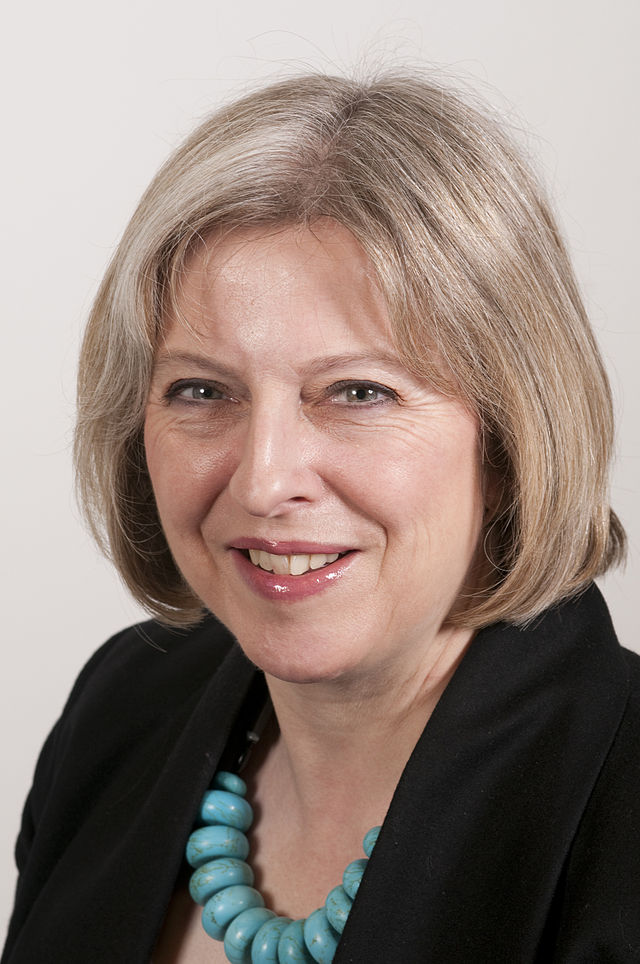 The UK Conservatives now argue that too many people – cast out on to the Mediterranean Sea in unsuitable boats by unscrupulous traffickers – have been saved by benevolent Europeans. So much so that it generates an incentive for more people to try it, safe in the knowledge that they will be rescued when the vessel capsizes.
Even if this were true – and no hard evidence to my knowledge has been presented to back it up – it is immoral. Knowingly ignoring victims of traffickers, fleeing from wars, economic crises and penuary caused largely by us is criminal.
And again, leading the way is the Home Secretary, Theresa May (above left). I used to think that these illiberal and racist policies were a response to UKIP. Now, however, I sense that UKIP is merely an excuse. The Conservatives really do believe in these policies.
Rochester by-election – UKIP and neo fascists, Britain First, stand together
Filed under: Politics, Race | Tags: Britain First, Rochester and Strood, UKIP
Leave a comment  The Rochester and Strood by-election was caused by the resignation of the incumbent Conservative, Mark Reckless, as a result of his defection to UKIP. The by-election is an opportunity for any number of disgruntled people to stand for election. By-elections – particularly towards the end of a parliamentary period – often throw up surprises. Probably not enough to elect Britain First’s candidate, Jayda Fransen. Never mind, she seems quite friendly with UKIPers if this happy photo is anything to go by. Might they have much in common?
Picture: Britain First website
 Be informed