Archive for the ‘Politics’ Category
Sustainable Aviation Fuel (SAF) and airport expansion
Filed under: Environment, Transport, Travel, UK | Tags: Airbus, Airport Expansion, aviation, Hydrogen aeroplanes, Logan Air, SAF, sustainability, Sustainable Aviation Fuel
 Leave a comment
Decarbonising aviation is very difficult. It is a good example of why oil-based fuels have been so important in the development of modern society. Nothing quite matches the energy intensity of oil, with the exception of nuclear. Sustainable Aviation Fuels (SAF) are trumpeted as the solution to aviation’s sustainability problem.
I am grateful here to Ben Purvis, Research Associate, Sustainability Assessment, University of Sheffield, for his contribution to the The Conversation for the content here. Purvis notes that there are so-called pathways for creating sustainable aviation fuel. These are:
- Oils or fats, including used cooking oil or tallow.
- Municipal solid waste, agricultural residues and sewage
- Hydrogen and captured carbon using renewable electricity.
It might seem that used cooking oil processing into aviation fuel is a win-win. But with the best will in the world, there is just not enough to go round. At the moment it is around 2 per cent of all aviation fuel. There is a UK mandate to increase this to 7 per cent by 2030 and 22 per cent by 2040. That is still only 1/5 or there about. To meet the current demand the UK imports 92 per cent of its used cooking oil from China and Malaysia (with its own carbon footprint). Currently the UK has one facility converting used-cooking oil to aviation fuel. That is the Phillips 66 Humber Refinery.
A recent report from the Royal Society notes that the 12.3 million tonnes of jet fuel per year needs 42.4 million tonnes of rapeseed biomass per year. In land terms, that is 68% of the UK’s agricultural land or 6.2 to 10.3 million hectares (see Innovate UK). The aviation industry’s own sustainability roadmap, CORSIA, precludes use of agricultural land for “fuel” crops.
The UK Chancellor of the Exchequer said on the 30 January 2025 (BBC radio 4, Today, c0815) that SAF could reduce aviation’s GHG emissions by 70 per cent. “Engines have become much more efficient. And, just at the beginning of this year, this government introduced the mandate for sustainable aviation fuel, which can reduce carbon emissions from flying by 70%. And of course, there’s going to be much more progress on that in the years to come.” (Quotes taken from the Guardian)
Equally there is global competition from both the EU and the USA (the latter now depends on the airlines rather than the state as burning fossil fuels now seems to be a US citizen imperative). Whilst it is clear that production could be increased with more investment, there is little confidence that it would be profitable; moreover, there is the small problem of cost – whichever pathway is taken, SAF costs more to manufacture than does aviation fuel (kerosene). That is £s on each ticket.
Surely there is enough municipal solid waste and sewage to go round? Well maybe, but the technology is in its infancy or not yet approved (see below) and no commercial facilities are producing it as yet. As for hydrogen, first it is packed with carbon if fossil fuels are the source of energy for the electrolysis necessary to produce it. Electrolysis by electricity from renewables remains distant. There is a long way to go before the UK grid is totally decarbonised. And now the British Government has added data centers to the mix, which means electricity supplies more generally are under pressure. Hence the Government’s latest endorsement of nuclear power and another un-tested technology, Small Modular Reactors (SMRs).

Not only manufacturing is a challenge, but the infrastructure to store hydrogen at airports or other facilities is just not in place. Hydrogen is also explosive and there are examples of denial of licences for users to store it, for example bus companies. It would require a major change to planning laws for widespread storage.
One UK company is undeterred: Logan Air. Logan Air has announced (12 February 2025) a plan to launch the world’s first hydrogen-fuelled commercial service by 2030. The company does not reveal the identity of the manufacturer of the aircraft that they will use for their point-to-point service (also as yet not stated). This against the backdrop of Airports Council International backtracking on its hydrogen ambitions in favour of scaling SAF, better air traffic management and improving aircraft engine efficiency.

There remains, therefore, the central question of actual aeroplanes. There was some succour in that Airbus was developing hydrogen planes (the A380 Airframer). This aeroplane was going to be a 100-seat 1850km range aircraft (right). But as recent as 6 February 2025 the Force Ouvriere trade union was informed that the launch date has been put off by between 5 and 10 years with an additional budget cut of 25 per cent. The company has identified the lack of available green hydrogen as one of the reasons for the delay. Another, less explicit but particularly troubling reason, is the company’s intention to replace its popular A320neo with a newer and more efficient conventionally-fuelled aircraft. The end of fossil-fuelled aircraft is nowhere in sight. The only option then, for sustainable aviation, is SAF from vegetable oils, tallow or waste.

There is a need, therefore, to clarify whether SAF is actually sustainable. In theory, because the things that it is made of already exist or are grown, burning it does not add to overall CO₂ levels. (Hydrogen, even more so, because it is derived from water and the emissions are just water.) So, aeroplanes still emit CO₂ when we really need to be capturing it and locking it into plants such as trees to generate negative emissions. Equally, it assumes that the crops and the waste had it not been for SAF would have degraded and decomposed releasing greenhouse gases in any case. The reality is that the area being used to cultivate crops to be turned into SAF would in actual fact be used either for food consumption or some form of rewilding. Essentially growing crops to fly planes (at least part of the way to their destinations) would displace food production. This would be a major distortion of land use.
The reason that SAF is so topical is because the British Government seeks to make the case that not only can we continue to fly at current levels, but that airport expansion is possible because the emission reductions from SAF rollout will offset increased flights (all in the name of growth). The above argument challenges that proposition. The calculation also needs to factor in the carbon emissions generated by constructing new runways. It is not trivial.
Gran Canaria – over land and sea, November 2024
Filed under: Easyjet, Environment, Transport, Travel | Tags: Cadiz, europe, European ferries, Eurostar, ferry, Gran Canaria, low-carbon travel, Madrid, Paris, Refre, SNCF, spain, Travel
Leave a comment OK, here we go. Low carbon travel. Train and ferry. Some facts.

Cost
Journey starts Saturday 17 November 2024. To fly from Gatwick Airport on that day would have come in at £45.00 (no luggage) – probably double that with the luggage I have taken that would need to go in the hold. Such pricing in the age of a climate emergency is obscene. By train:
London-Paris – £69.00 (standard class – average of return fare in November/December, considerably more in the summer or ahead of public holidays)
Hotel Paris – I was too late booking this for a Saturday evening. Overall cost £135. Hotel was Ibis Styles, Bercy. Breakfast included, and it was not bad. The room was tight but comfortable.
Paris – Madrid – £175.00 (standard class) – TGV to Barcelona and then Renfe to Madrid. The double-decker TGV is not particularly generous in terms of space, but not uncomfortable. The single-deck Renfe train was much more spacious but with no table (drop down rests were adequate for a laptop). We could not use the wifi because we could not see our ticket number (needed to register).
Hotel Madrid (Ibis Ventas) – £96.33 (incl. breakfast)
Madrid – Cádiz – £80 (standard class)
Hotel Cadiz (Soho Boutique Cadiz) £80 (incl. breakfast)
Cádiz – Gran Canaria – £91.10 (ferry – no cabin)
Taxi – Las Palmas de Gran Canaria – San Augustin – (£75.71) – Why taxi you ask? See below
Being in my sixties, I am not up for hostels, although I know that some budget travellers do so. Good for them, but I think I have reached a milestone. That said, in not selecting a cabin for the journey, we effectively slummed it, but the cost so far have been significant.
There are two of us so we need to double transport costs and share the hotel costs.
First leg
I’m pretty familiar with Eurostar. I travelled standard class on 16 November 2024 on the 1758 (retimed from 1801). I was able to work (the new drop down rests for stuff are now a bit wider). There are power sockets – UK and European. I have my own modem/internet for security reasons. The signal was pretty good throughout, including in the tunnel. In the past when I have connected to the Eurostar wifi, it has been pretty unreliable.

It cost me €2.15 to use the Paris Metro/RER to get from Gare du Nord to Gare de Lyon/Bercy. One can buy a card to load and reuse. Ticket machines take cash and cards.
Second leg
The next day (17 November 2024) we walked for 10 minutes from the hotel to Gare de Lyon and went to Hall 2 from where the trains depart. The QR codes on our phones or paper did not read. There was someone at the barrier to scan using their own reading machine. All good. We had two seats on the upper deck with a collapsible table usable only for the people sat closest to the window. There is a socket and wifi (below left).

The route taken by the train is pretty much rural France, but on reaching the Mediterranean, the scenery changes to on of salt marsh as it precariously meanders through the Parc Naturel Regional de la Narbonnaise (below right). The train is probably the best vantage point for seeing it as the train runs over what seems to be a causeway.
Warning, however, whilst writing this blog entry my case located by the entrance to the carriage was stolen. My advice is either to chain it to the bars or locate your case inside the carriage – there are some internal luggage racks.

The RENFE train to Madrid was directly opposite the arrival platform of the incoming TGV. It was that simple. Though there are a few challenges. We bought our tickets on RailEurope.com. The pdf that is made available on the app is unreadable by anyone with less-than x-ray sight. The train manager had a record of the ticket, so we were fine. It seems also possible to print tickets from ticket machines providing one has a PNR number that was clearly stated on the itinerary confirmation.
We then looked to buy tickets for the next leg, Madrid – Cádiz. We tried the machines – ticket buying by non-Spanish citizens is not so easy. Each traveller needs to insert their passport number. We got so far in the process (give yourself 10 minutes) before we were thrown out of the system whilst trying to pay. We did then find the staffed Renfe ticket office on the first floor and bought them in the traditional way, but passports are still needed. And the ticket office sales person found the system equally cumbersome. Our passport details had to be put in twice!
Then on to the Metro. Two lines, first 1 (blue) to Sol and then 2 (red) to Ventas. Buying tickets is easy, but you have to buy a card and load it with as many journeys as you need. In our case one centre ticket. Each centre area ticket cost €2.50 with the card. For the first charge, I think the card costs €2 (extra). On the way back to the station the following day, 18 November, we just loaded the cards. Note the machines are cashless. We ate in a nearby Lebanese restaurant. Portions were huge – salad, falafel, spicey patata and vegetal mousaka.

The hotel is next to the bull ring (left) – a constant reminder that there are some residual bloodthirsty passions in Europe. (The British as much as the Spanish – though not in such grand areas.)
Third leg
Monday 18 November is another train journey – about 4 1/2 hours to Cádiz. There is a fast and direct service roughly every 3 hours. It think it can also be done in two legs if needed: one to Seville and then Seville – Cádiz. The trains are spacious (standard class). Each seat has a socket (though mine did not work). There is room for a laptop to be opened and used. The wifi on the train is not working. Though my modem is fine. Similar to Paris, Madrid has distinct boarding gates. Passengers are advised to get there 30 minutes before departure – all baggage is scanned (unlike Paris). It takes about 10 minutes to pass through.
Incidentally, I bought a new case at the station, a t-shirt, shirt, a pair of socks and a sweater to keep me going. I discovered that I did have some underwear in my rucksack.
For a change we arrived at our destination in daylight. We checked into our hotel – probably one of the best we have ever enjoyed – the Soho Boutique Hotel. We had a suite. It was sensational. The breakfast was additional, but worth it. The spread was varied ranging from breads, pastries, cereals, cheeses, meats and fruit.
We bought a few more items in the town:
- food to take onboard – correctly assuming that the onboard catering might be a little unapetising
- Some eye protection (my prescription sunglasses were in the stolen case)
- some trousers and a gilet from a male clothing retailer and shorts, leggings, t-shirts and underwear at an unexpected-to-find branch of Decathlon.
We ate in a Latin-inspired restaurant in the town. The restaurant – Más Que La Cresta – is not exclusively vegan, but the options are good. We took a selection of starters as tapas; though the vegan burgers were certainly enticing, burgers are not quite our thing.
Fourth leg
The ferry terminal is about a 15 minute walk from the entrance to the port. Foot passenger enter the office through which they pass security control and then enter a taxi to drive to- and then in-to the ferry. We did not take a cabin – trying to keep down the costs somewhere – so slept in the reclining seat area on deck 7. For the first part of the journey we sat on the deck in the sunshine. The ferry crosses the shipping route from the Mediterranean west. I trust they have some communication and understanding that ferries operate against the dominant shipping route. It is a reminder that the seas are equally colonised by humans. And on the deck, the exhaust from the ferry reminds us that there are still greenhouse gases being expelled into the environment.
The ferry has a small shop that sells the basics – cigarettes and soap. There is a bar/café and then the self- service restaurant. Not much more. It is unlike the ferry to Rotterdam from Hull which has cinemas and a casino (not that a casino is of much interest to us).

Sleeping – without a cabin, there are rows (2-3-2) of reclinable seats on decks 5 and 7 (right). Deck 7 is the quiet level. What we have realised is that this ferry carries some very seasoned travellers, many of them young, who bring mattresses, airbeds, sleeping bags and food to microwave (the restaurant has a public microwave for use). There is no washing up area, though. So the seasoned travellers often sleep horizontally on any available floor (there are signs all around forbidding this, of course). It is, I think, also the case that this is not a party ship. People are here to sleep, not to party (that is probably saved for the islands).
Did I sleep…yes. It was quiet. People slept. Though in the summer it might get more chaotic with so many floor sleeepers. The reclinables are least comfortable, I found, when reclined (they do not recline too much). I reverted to normal position. A pillow of some kind is needed. That doesn’t mean that I am not looking forward to a bed on arrival.

For the day, I was on deck for much of the time (left). The sun was warm and I had a book. Working is not so easy as the ship is really not geared up for business. The sockets are few – and in demand for mobile recharging. There is a small cordoned-off area in the restaurant that could act as a business space. It does have sockets, but I only counted four, and they were not well spaced around the room either. In the end I went to work in the restaurant in-between sittings (breakfast, lunch and dinner). Talking of which, we did take breakfast. It was not bad actually. And not expensive. For €12.50 we had cereal, bread, egg, yoghurt, tortilla and coffee. We are not sure whether it was accurately calculated. But hey.

We were scheduled to dock at midnight…in the end it was 0130 GMT. We were out by about 0200. But what then? Cadiz is easy, the port is adjacent to the town and walkable. Las Palmas de Gran Canaria port is quite large, not walkable and relatively deserted at 0200. There was no shuttle bus, no taxi rank. My beloved was armed with a taxi phone number but more than once – without perfect Spanish – they just put the phone down on us. I walked back to the ferry to ask one of the personnel if they could speak for us. We had a volunteer whose intervention magically summoned a taxi that arrived after about 10 minutes. Uber is on the island – download the app before you travel. Anyway, the drive was approximately 45 minutes – fast because there was little on the roads (which are superior to anything in the UK – not a pothole to be seen). The fare was €90 to San Augustin – 55km. Journey end.
Reflections
I wanted to test the feasibility of getting to the island by land and sea and be productive in the process. Whilst I may be on holiday, I still want to engage in some academic work – I am an academic after all. All travel raises questions that warrant answers. I have never regarded travel time as a waste. I do think my efforts here were thwarted by the transport operators – notwithstanding the theft of a bag. Here are the key challenges:
- Cost – it is significantly more expensive to travel overland than by air. The journey cost overall was £802.14. That is at least eight times what it would cost to fly. We could cut out the hotels – do Paris to Cadiz in a single day starting very early in the morning. That is a tough day and all the connections need to work.
- Time – I wanted to be productive and connected. It was ideal for reading books and academic papers, not so good for writing. Observations:
- I could not connect to the internet on Renfe between Barcelona and Madrid because users need their ticket number. This was unreadable on my ticket from RailEurope. That said, for security, I use my own dongle with European roaming, which worked fine. I did use about 21/2 Gb.
- The (un)complementary internet on the ferry was very poor. And because we were sailing, there was no mobile signal (I feared, too, that if there was, it would be Moroccan, and therefore elicit extra roaming costs). I could have bought a better internet package from the operator, though. I did not because I had lost my credit card in the bag theft.
- As noted, there is no dedicated workspace onboard.
- Foot passengers on ferries are poorly served. The situation at the port of Las Palmas de Gran Canaria was a problem. There was absolutely no provision for us at the port. And being so late, it leaves stranded passengers vulnerable. This is not universal. Other ferry journeys that we have taken have been better served. Hoek van Holland has its own railway station! Europoort had coaches to take passengers to Rotterdam (or used to).
What needs to be done
- Sort out ticketing…
- Buying European train tickets is way too complicated, especially across borders. We used Rail Europe, but the tickets issued were unreadable by station and train staff.
- Adding to that, buying tickets in Spain either by machine or at a staffed ticket office is slow and cumbersome. Passports are needed for non-Spanish travellers and it can take an inordinate amount of time to get issued with a ticket. On the machines, we twice got ejected and had to start again.
- Wifi…
- I am happy to use my dongle for security reasons, but the ferry wifi was poor by any standard. Even basic searching was difficult or impossible. The wifi would shut off in any case after 30 minutes or so and it was necessary to log in again, including reading the terms and conditions.
- Make provision for work – dedicated space, sockets, reliable wifi. I know the argument – there is no demand. But there is no demand because there is no provision, arguably. Equally, the ferry would be an ideal place for a conference, workshop, briefings, etc.
- Treat foot passengers with respect. Ensure that they can embark and disembark safely. And do not leave them stranded at a port in the middle of the night. That is truly shocking.
Getting back
We flew back! It was not the original intention, for sure. I made the decision when we got on the ferry from Cádiz. I am not advocating flying – my overland and sea days are not over, far from it. Indeed, the flight was long, cramped, hot and involved airports. However, three key things swung it for me (a further two factors made me feel slightly more sanguine).
- The timings of ferries back relative to my need to be at my desk on 9 December meant that the time on the island would be much shorter. In order safely to get back by 9 December, I would need to leave the island on 1 December 2024. That ferry is scheduled to be 43 hours. Having taken 5 days to get to the island, to leave after just over a week seemed rather punitive (bearing in mind I am working throughout the period January to August inclusive and this is my summer holiday).
- The experience getting here was not the best – from having my bag stolen to the facilities on the ferry and the restaurant menus.
- Cost – I had to spend quite a bit of money replacing some of the things I had lost particularly my clothes.
- Carbon – I am trying to be a good citizen, but I am not perfect. Though I am reminded by some pioneers of low carbon working of studies relating to carbon generated by flying, in particular the contrast between short haul and long haul. That is not to say that I am going suddenly to start flying again as I had done prior to Covid (i.e. every week). Here is a quote based on work by Frédéric Dobruszkes, Giulo Mattioli and Enzo Gozzoli “flights of less than 500km account for 26.7% of flights, but only 5.2% of fuel burnt; while flights of 4000km or more account for just 5.1% of flights, but 39% of fuel burnt. This tallies with AEF’s (The Aviation Environment Federation) findings that shows that in terms of carbon emitted from flights from the UK to destinations around the world, the worst offenders are indeed long-haul – in top place is the US with 23.6% of the UK’s international flight emissions (10.6Mt), and Dubai with 6.7%.” You can read the summary article, “The Elephant in the Middle Aisle” here.
- Finally, I picked up an injury in the final week on the island (see later entry) that would have made overland very difficult, painful and dangerous. On that basis, too, I can safely say that disabled travellers are much better served by airlines (though there are some horror stories) than overland across borders and modes.
Decarbonisation milestone
Filed under: Environment, Transport, Travel, Vehicles | Tags: decarbonisation, diesel van, Mercedes Vito
Leave a comment It has taken three years to get there, but I have reached a decarbonisation milestone. It started with six photovoltaic cells on my roof and 6kW of battery storage. I then invested in an induction hob. Then, the big one, the heat pump. Which is now doing an amazing job at keeping the house warm and supplying hot water. It is a different experience to my gas boiler and super hot radiators. The radiators stay ambient.

Anyway, finally, today I said goodbye to my diesel van (why did I have a diesel van in the first place you might ask?). I have sold it, so it will still be burning fossil fuels and emitting greenhouse gases. But I felt that in selling it I may be tempering demand for new vehicles. Even this old van has embedded carbon from its manufacture.
Where to next? What more can I do? Well, there remains plenty of scope. First, I need to do a full audit of my life and then create for myself a carbon reduction plan! I will report further here in due course.
Summer Festivals – can they survive climate change?
Filed under: Environment, Finance and Economics | Tags: Festivals, Festivals and climate change, Leeds Festival
Leave a comment Late summer bank holiday weekend, 2024. The Leeds and Reading festivals are scheduled as normal. But normal does not really exist any more. It used to be possible to put on such a festival in August with some confidence that, whilst it may rain, festival goers will at worst be wet. But no longer.

On 23 August 2024, the Leeds part of the festival reported that it had “lost” two stages. The BBC stage and the Chevron stage were withdrawn from the festival programme. The Aux stage was reopened. Wind was a particular problem making camping really challenging (as if camping is not challenging enough already, see above after the storm).
The cause? English weather? Well, weather, probably. In the autumn and winter we had an unprecedented number of so-called named storms – storms that will cause disruption, however defined. This bank holiday weekend “welcomed” (Storm) Lilian to the Leeds festival. Named storms have only been with us since 2015. But I do not recall life-threatening situations at British music festivals in the past from storms (I cannot find evidence – though famously the Woodstock Festival in 1969 offered up a dangerous electrical storm on its third day). The cause, according to the UK Met Office is the behaviour of the Jet Stream – column of fast-moving air that usually sits to the North of the UK in the summer but has shifted frequently in recent years to sit directly above the UK, and particularly the North West of England and Scotland. The consequence is that the particularly moist air above the Atlantic is directed to the UK and is deposited over the country when it meets the land. To make matters worse – and to illustrate the interconnectedness of our weather and climate – unusual weather patterns over North America (sinking cold air) have given additional energy to the Jet Stream.
OK, let us talk about climate change. As expected, there is some reluctance on the part of climate scientist and meteorologists to ascribe causality – a warming planet equals more storms. Named storms are an irrelevance – they are merely a media mechanism to raise awareness that citizens need to be careful in what they do in the face of a named storm. For example, don’t go to outdoor music festivals or hike in the mountains. If you can avoid it. There are data relating to rainfall (certainly increasing) and wind leading to tidal surges and flooding. The UK’s positioning in the north west of Europe leaves the land mass open to exposure to Atlantic weather and the effects of small changes in the positioning of the Jet Stream.
The business implications are immense. Festival organisers (and owners of the brands), now need to consider more carefully how to host such events safely. It is not clear yet, in the Leeds case this year, as to why two stages were withdrawn completely. Were the stages irreparably damaged? Were they merely discovered to be unsafe after the wind (in which case a rethink is needed on stage design)? And what about insurance? What if festivals become uninsurable?
Nye – National Theatre, Spring 2024
Filed under: Privatisation, Reviews | Tags: Michael Sheen, National Theatre, NHS, Nye, Tim Price
Leave a comment I hit sixty this year. A milestone for anyone, but especially for those of us who never thought we’d get that far – not that we would die prematurely, rather that 60 years seems an impossible number of years ever to reach (despite the evidence of its absolute possibility). So what is to do to celebrate the milestone? Well, obviously, do something that I have not done before. For me, then, it was to go to the National Theatre in London with my beloved. Neither of us have been there before, it turns out. So what is on on the special day? Well, magically, it is Nye by Tim Price. It is the story of the founding of the National Health Service (NHS) told through the life of the man who made it happen, Aneurin Bevan, played by Michael Sheen. Expensive, but you only live once and it is down hill from 60.
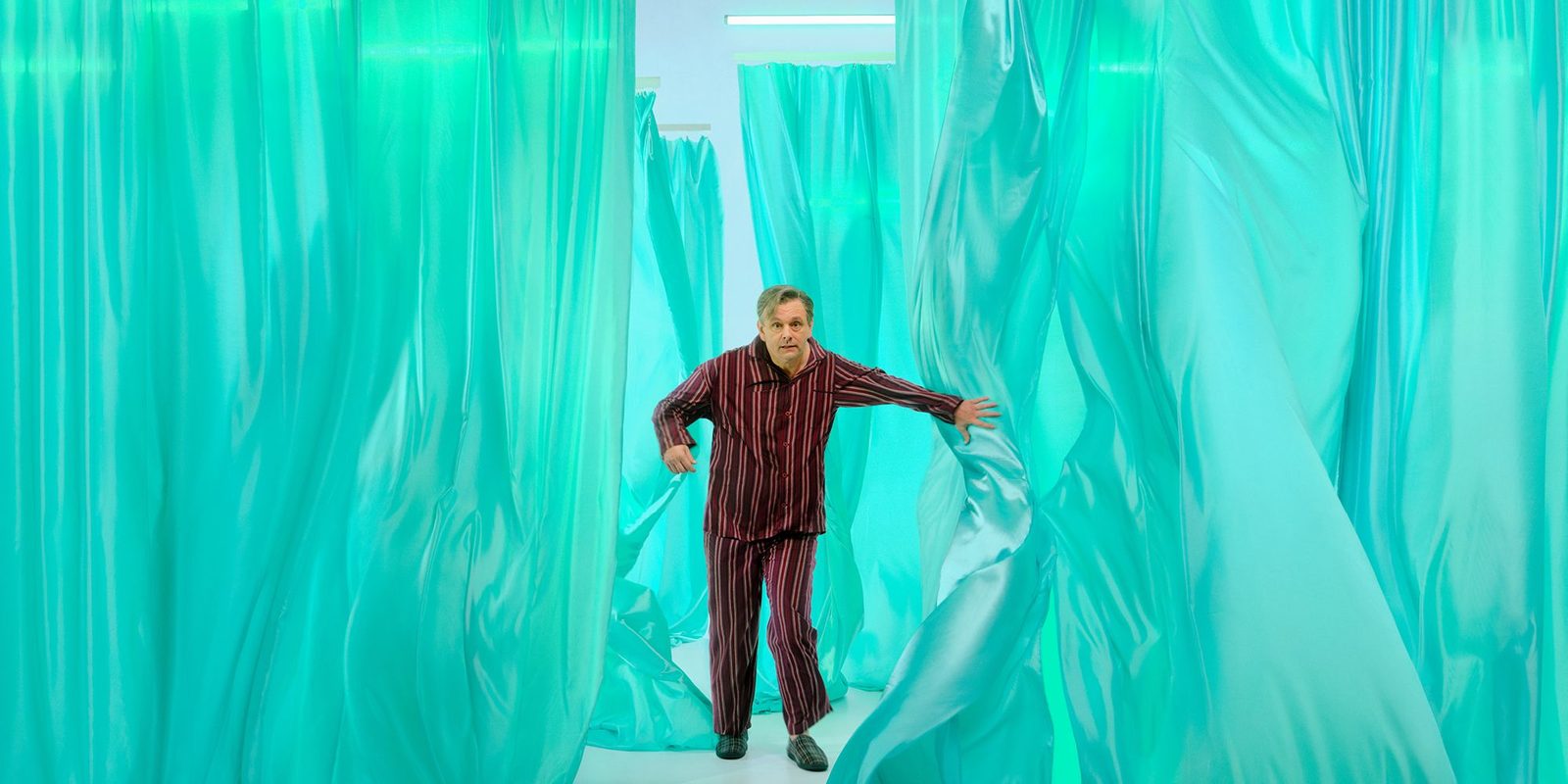
I’m not a fan of theatre as some of my friends know. It is all a bit too representational for me. I’ve understood the purpose of theatre. I think. But here I was attracted to the combination of my own history (the NHS), Michael Sheen (left) and the National. Michael Sheen I have seen in films. The National – I always remember many BBC programmes ending with the statement that x and y were both National Theatre players. I did not really know what that meant. But it must have been important. 50 years on, I have an answer.
Not being a fan of theatre, I was additionally anxious that the performance took the best part of 3 hours. But in the end, I need not have worried. There was not a moment of boredom or anxiety. Nye Bevan is depicted honestly by Sheen. Sheen is in every scene wearing pyjamas even when making a speech in Parliament. See what I mean about being representational?
The play traces Bevan’s journey from being bullied by teachers in school because of his stammer – Sheen handles the stammer brilliantly – to the local council, to Parliament, to the Health Ministry and death. In hospital. There were for me three standout scenes. Getting over the stammer was facilitated by access to libraries – and books. There’s the realisation that if some words are unpronounceable, others with the same meaning are perhaps not. Focus on what is possible rather than what is not possible. The library scene is uplifting (literally). Those National Theatre Players show why all of those years ago they got an additional mention. The second scene was an exchange with Churchill, his parliamentary nemesis. Churchill taught him that compromise was sometimes needed to get what you want. Sometimes MPs have to go through government or opposition lobbies against their better judgment. And finally the scene where he takes on the doctors (supported by Tories in the Parliament, including Churchill) that are vehemently against the nationalisation of their profession. He wins them over through compromise. The NHS is founded. We now reflect on the extent to which the Tories of the 2020s have systematically undermined the service because of their seeming hatred of public provision of services that make our society and define civilisation.
There is a much more to this play than these three scenes, of course. My sixtieth birthday present from the NHS was a letter inviting me to provide them with some “poo” to test for bowel cancer. Bevan died of stomach cancer at the age of 62.
Burtynsky – Extraction/Abstraction (Saatchi Gallery, April 2024)
Filed under: Environment, Photography | Tags: Burtynsky, Saatchi Gallery
Comments (1) I am not a little impressed by photographers that work at scale. I have been the subject of one such photographer, Spencer Tunick, in London. His subjects were always without clothes. It was late April 2003. There were thousands of us. It was quite an experience. And for the exhibitionists amongst us, it was possible to visit the adjacent Saatchi Gallery (then in the old County Hall building) before re-robing.
Then there is the wife-and-husband couple of Hilla and Bernd Becher who spent their careers taking black and white photographs of industrial sites and machinery such as mines, steel plants, water towers, etc. I suppose what really impressed me was the fact that they hit on recording something that I, as a child, thought would be there forever and they, not being children, knew they would not. Hence I regret not taking more photographs of buses, trains and shops in my home town when I was growing up. But there you go.
And then there is American photographer, Edward Burtynsky. His father worked in a steel plant. Burtynsky himself funded his studies by working in that very same plant for a sufficiently long time for him to latch on to the idea that such plants may provide a subject for his photographic career. As it turned out, his most influential work is not the plant itself, rather the extraction of the raw materials that ended up in those plants – iron ore, copper, coal, etc. For that reason, this exhibition was a must (subject to my busy schedule).
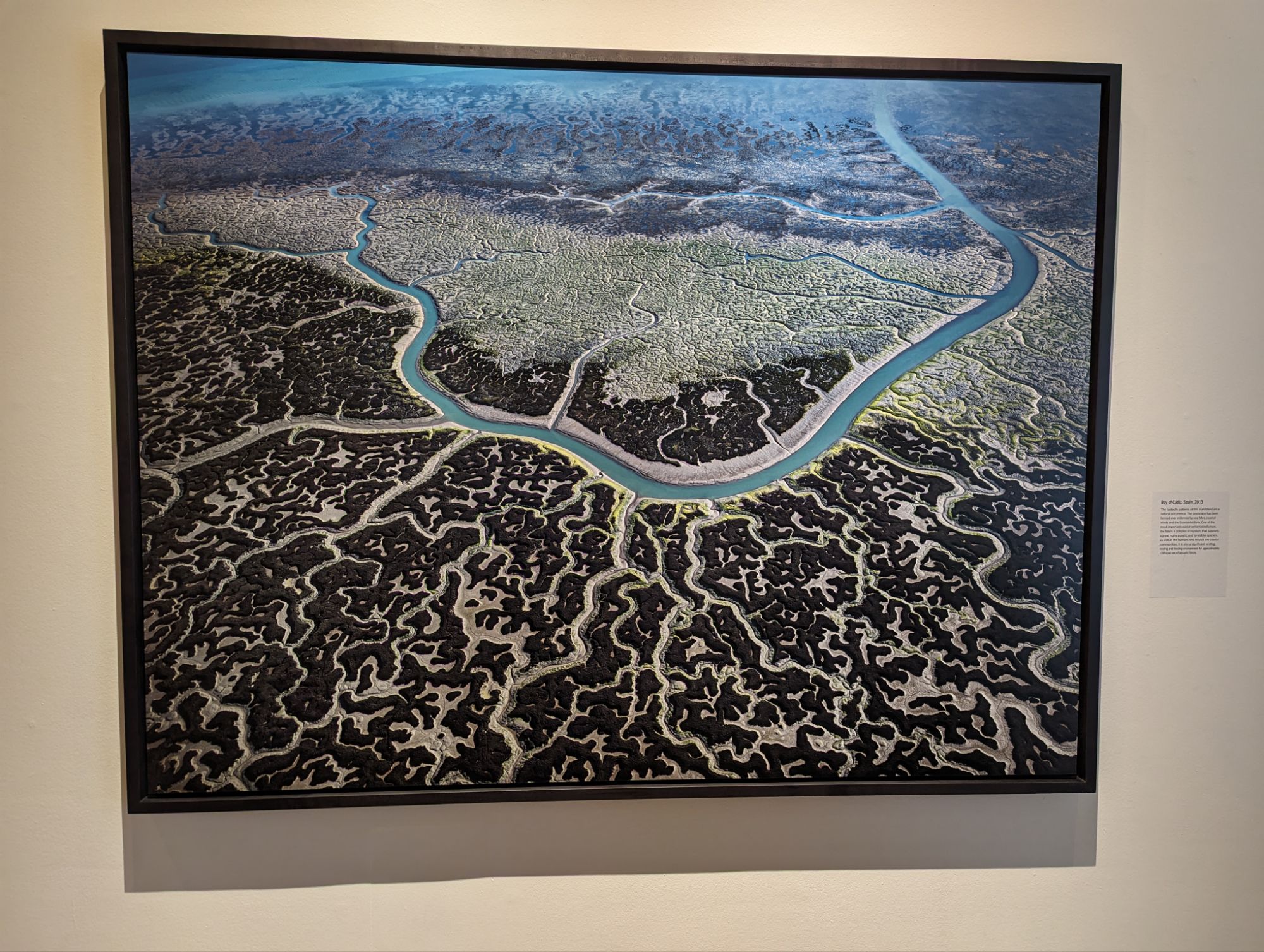
I’ve now been and the images are extraordinary. They are presented in very large format and, mostly, as aerial shots, look nothing like what they depict. They come across as abstract art – hence the title of the exhibition. On the whole, however, they are not art, they are a record of environmental destruction. There are a few exceptions where the extraordinary patterns actually record profuse wildlife habits such as the landscape around Cadiz in Southern Spain (above left).
Like most artists Burtynsky has a team working for him. The drone technology he uses relies on an expert to make them fit-for-purpose. For example, high altitude photography creates a challenge to get sufficient lift to get the drone in the air (there is a part of the upstairs gallery that reveal his methods, equipment and projects).

By far the most interesting galleries show the scale of the impacts on the landscape of mining – whether it be the scars of the opencast mines themselves, or the spoil heaps or tailing ponds. With the possible exception of coal, the ores and minerals are not neatly packaged by nature for extraction. They require significant refining, often with toxic chemicals that tend to be dispersed into the natural environment. At scale.
So, anyone with a diamond may well have contributed to the large deposits of “waste” displaced to find diamonds. The picture (above right) is of the Wesselton Diamond Mine, Kimberley, Northern Cape, South Africa (2018). If readers look closely a conveyor belt can be seen on which the tailings are transferred to the pond.

A metal that we hear so much about for the necessary electrification of our world is lithium. There are a number of extraction methods for lithium; however, one mine in the Atacama Desert in Chile (left) pumps up a liquid from beneath a salt flat into ponds. The ponds are exposed to the sun, the liquid evaporates and the lithium carbonate is then harvested, before being processed. And then there’s agriculture.

Do readers ever go to the supermarket and see that broccoli or some other vegetable is from Spain and think, “ah, that’s fine”? Well, maybe it is not fine. Burtynsky shows the true scale of such operations and their impact on the environment (right). The greenhouses on the Almeria Peninsular harvest between 2.5 and 3.5 million tons of fruits and vegetables annually, including “out-of-season”. These greenhouses require huge amounts of precious water along with a heavy use of chemicals. Climate change is making the water situation more difficult.
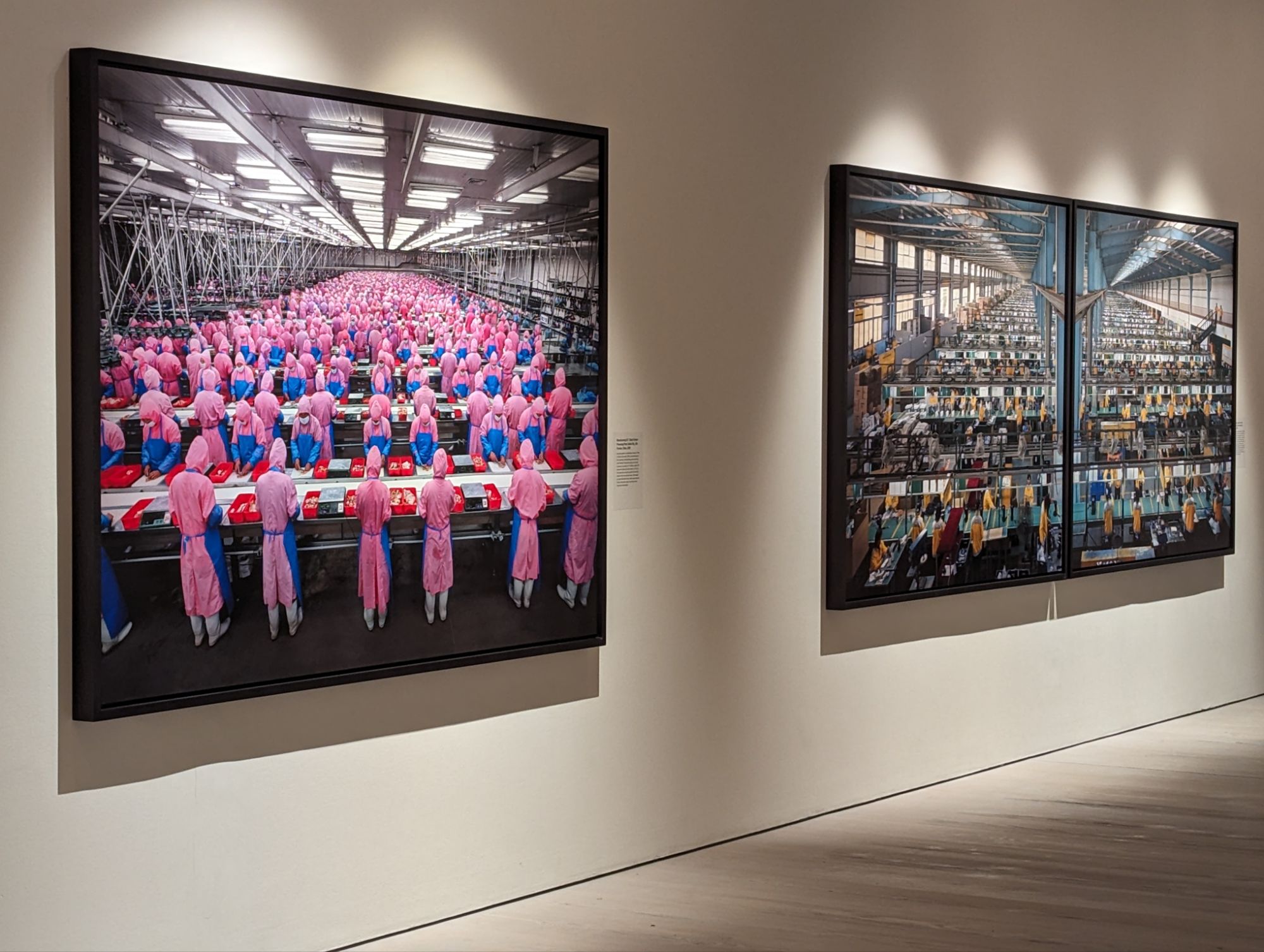
I could go on. I have one last thought. Scale is a problem for us as humans. Burtynsky has taken some revealing pictures of people at work (left) of particular alarm is a picture showing people working in a chicken processing factory in China (everyone wears pink, left). The scale here is twofold really. First, the people. The thought of 8/10 hours per day chopping up chickens is hard to comprehend. We try to present work as something that offers meaning to humans and the opportunity to work with others and exchange ideas, thoughts and stories. There is not much of that going on in this factory. And then there is the chickens. The sheer scale of this one factory tells of the huge number of chickens slaughtered daily to keep these people employed (and presumably fed).
This is an exhibition at scale. Bigger than I thought it would be. It took about 21/2 hours to get through and that included a 30 minute film at scale (worth the visit, for sure). It is thought provoking. There’s a big chalk board to write one’s thoughts – mostly about human stupidity. And then there is a shop in which visitors can contribute to the further exhaustion of finite resources. I had a poster in my hand. And then I put it down and left.
Nothing in this exhibition is human scale. Arguably the Bechers’ work in the 1960s was a little more human scale. Spencer Tunick’s work is by definition human scale.
If readers want to know more about extraction, I suggest Ed Conway’s book, The Material World.
Electrifying UK railways and climate change
Filed under: Politics, Railways, Transport, Travel | Tags: Battery train, Great Western Railway, GWR
Leave a comment I use the case of the electrification of the railways as an example of climate mitigation. Diesel trains are hugely polluting, particularly in the context of carbon dioxide; electric trains much less so. Seemingly a switch from car to diesel train can cut an individual’s carbon emissions by 70 per cent and a whopping 90 per cent if the train is electric.

The electrification of the network has always been rather piecemeal. The East Coast Mainline was electrified in the 80s, but missed out key towns and cities such as my home town, Hull. Diesel trains still run under the wires from London to the city. More startling, but not surprising is the account given by Aneurin Redman-White, a railway design consultant, of the mess that is Brunel’s original railway Paddington to Bristol/Cardiff and Penzance. The Penzance bit was abandoned by Chris Grayling, the former secretary of state for transport, even though it had been used as a reason for price increases! It’s like watching a mini-series on TV but not watching the concluding episode. But, actually, it is not like that at all.
Unfortunately, the current British Government, like many before it, believes that private mobility – cars – are still the future and perennially electorally popular. Notwithstanding the fact that governments should always lead rather than follow, especially on global challenges such as climate change, the decision not to electrify the railways on cost grounds, whilst continuing to build roads, is short sighted and wrong.

There is another option, instead of electrifying the infrastructure – at least for short or middle distance routes – battery trains are becoming an option. Great Western Railway in England has now publicly trialled such a train (right – with Mark Hopwood, MD). This train is giving 86 miles (138km) per charge. And charging takes – wait for it – 31/2 minutes.
There are hybrid electric trains, too. Hitachi Rail runs 20 so-called tribrid trains across Italy. The battery is charged when the train decelerates by braking or when it is collecting charge from an overhead wire. There is only 10 miles manageable per full battery, however.
Network Rail, the owner of the UK infrastructure such as track and signalling, has a net zero carbon target for 2050. To meet that target about 500kms of new electrified railway is needed each year. At the moment, a mere 38 per cent of the UK rail network is electrified. The German railways, by contrast, are reported to be 90 per cent electric operation (slightly different terms, I appreciate, but even then, a significant difference).
The argument that the UK railways contribute only about 2 per cent of greenhouse gases across all sectors is a classic response. What is 2 per cent? For that amount, it is not cost-effective. Investment in public infrastructure can be cost-effective, especially if we consider wider social returns in terms of employment and mobility more generally (just look at what CrossRail/Elizabeth Line has done for the Capital). Moreover, maintaining the capability to design, build and maintain infrastructure is, arguably, a requirement of a post-carbon (aka civilised) world.
Banksy’s artworks
Filed under: Art, Environment, Politics | Tags: art and climate, Banksy, Islington
Leave a comment Gio Iozzi asks, why does it take an artist to expose the assault on our urban trees? This in light of Banksy’s latest addition to his portfolio recently found in Finsbury Park, London. It is an interesting work, and slightly different from his usual work, as it requires a significant prop. A tree. The tree is special because it has been “pollarded” – severely pruned in normal parlance. It has been pollarded because, according to the Council (the owners of the land on which the tree stands) it was diseased. It is a cherry tree, and they do not, it seems, respond well to radical pruning. There is also a question of whether diseased trees need to be pruned or felled. Many of us are a little diseased, but we do not lob off all of our limbs to deal with it. Or at least not as the first option.
It seems that Banksy, whoever he is, saw the opportunity to provide this sad tree with leaves by painting them – or spray painting them – onto an adjacent side wall. Viewed from one angle, the tree looks healthy and with full plumage. And like all Banksy artwork, there’s a message.
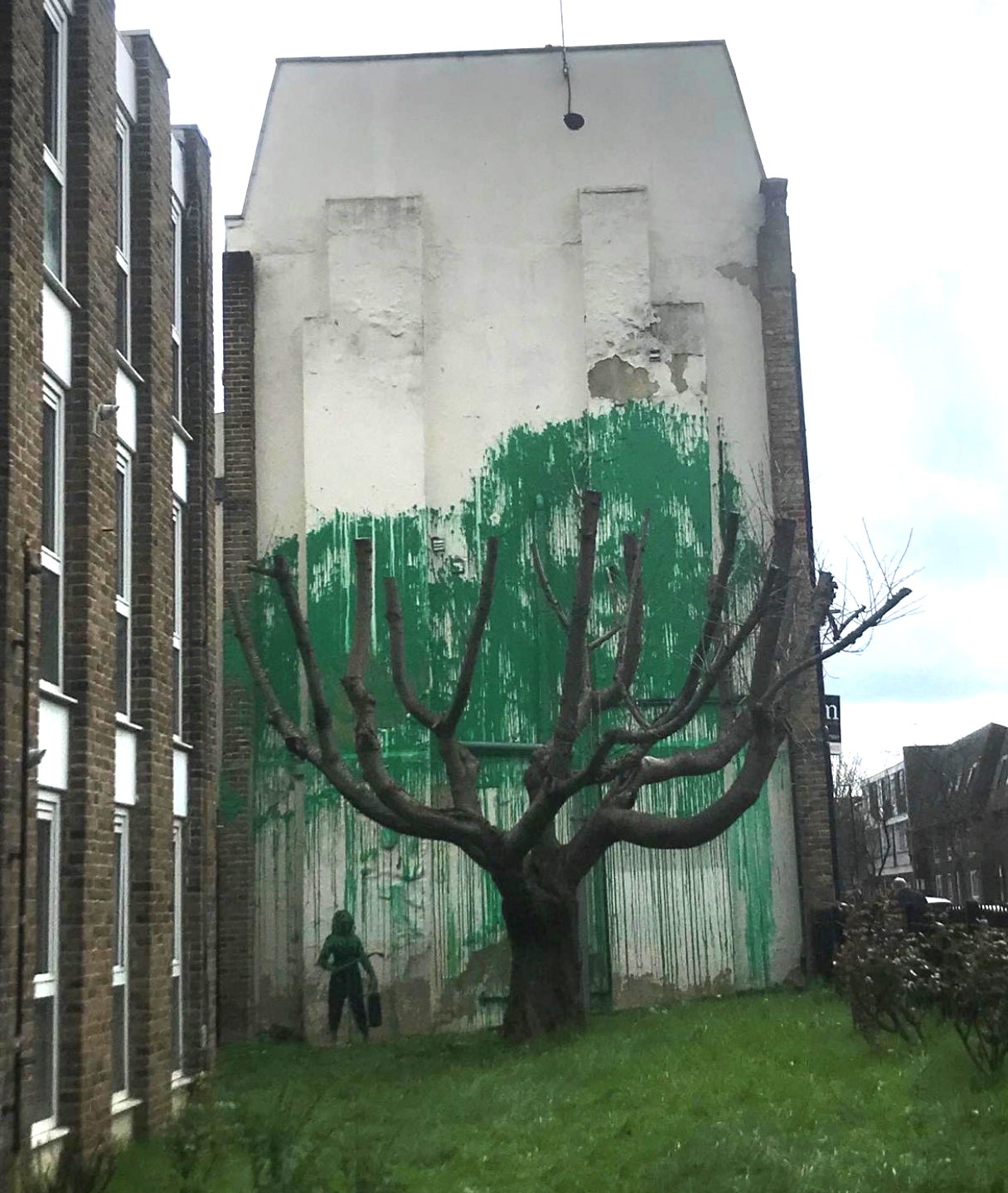
Art is there for the receiver to interpret, even if the artist provides the artwork with their own meaning. So we take liberties – rightly – with interpretations. So let us interpret this widely. This is a dual statement about the state of our urban trees and about climate change. Urban trees are under threat, just at a the time when we need them most. Our cities are getting hotter. Trees provide shade, for sure. But they also cool the air. Even diseased ones. So much urban landscape is devoid of trees. Devoid of ways of cooling and, increasingly, draining.
More broadly the onslaught against the planet’s forest ecosystems is relentless. The cutting and burning of the Amazon has slowed, but not stopped. Forests elsewhere in Indonesia and Africa are also in retreat. In Brazil particularly to provide land and feed for cattle. So not only do we lose carbon-capturing trees, we also increase our emissions through bovines, notorious methane producers. All because we want to eat large quantities of beef.
In response to Iozzi’s opening question about artists, I respond simply by saying, it is what artists do. It is why they are an essential part of the democratic process. Throughout history artists (not all, for sure) have made statements about society, power and morals. Degenerate art in Nazi Germany was degenerate for a reason. Artists have been subtle sometimes in their representations. Messages that eluded the censors because they were unable adequately to understand what they were actually looking at. Even Picasso, not known for his political statements, produced his masterpiece, Guernica, to say something to the perpetrators of the destruction of the Spanish town in 1937. Famously when asked by a Nazi Officer at his Paris studio whether he had “done” this painting, his reply was “no, you did this”.
To add value to the picture and to the metaphor, Islington Council put a protective fence around the work, but within 48 hours it had been defaced. I am pretty sure that Banksky was smiling. I rest my case.
Original picture source: https://twitter.com/IslingtonBC/status/1769722470355828821/photo/1
The Garrick Club
The Guardian’s recent exposé on the Garrick Club in London is troubling. It took a data breach for us to know who the club’s members are.

Not only is this a “gentlemen’s” club, it is also an elite club where state/government policies are discussed and made. As a man I do not have the resources to join and even if I did, I think it is unlikely that existing members would nominate me. I could at least try; but if I was female, it would be harder despite David Pannick KC’s best efforts to justify its existence. There is, argues Pannick, nothing in the language that bars women – even the word “gentleman” seemingly has a defence. Here is Pannick quoted in the Guardian article: “[t]he term ‘gentlemanly’ is plainly being used here in the sense of the meaning ‘[o]f a pastime, behaviour or thing’ that is ‘of high quality; excellent’”. I’m not about to buy that. It is not surprising that lawyers can offer such a defence as we discover that a large tranche of senior [read influential] figures in the profession are members. Many environmental campaigners, for example, have found themselves judged by them. And that raises bigger questions about the profession itself.
Picture: By Cambridge Law Faculty – https://www.youtube.com/watch?v=fxB59qEi6i0, CC BY 3.0, https://commons.wikimedia.org/w/index.php?curid=104993515
Fossil fascism
Filed under: Environment | Tags: Andreas Malm, climate change, climate change ad nationalism, Climate change denial, climate scepticism, Fossil Capital
Comments (1) 
When I came to write my textbook on business strategy in the age of climate change, it was not until I had read Andreas Malm’s book, Fossil Capital that I felt I had a proper foundation. Malm’s thesis was relatively simple: the mechanisation underpinning the industrial revolution did not need to be a fossil-driven revolution. Water would have done (I understand why that is contested). But, the capital owners saw a number of benefits (to them) of steam power (fuelled by coal). Many of the early mills in the North of England and Scotland required the owners not only to build factories, but also villages for employees (one example, Saltaire, West Yorkshire (right). Villages with schools, sports, places of worship, etc. These were expensive, they also promoted labour power. The steam engine was not geographically hidebound. The fuel could come to the factory rather than the other way around. More expensive, maybe, but the plutocrats no longer needed to provide housing and labour power was neutralised.
This realisation enabled me to frame my book in terms of the continued burning of fossil fuels as a choice. It did not need to be that way in the past, and it does not need to be that way in the future. We can have a zero carbon economy. We choose not to.

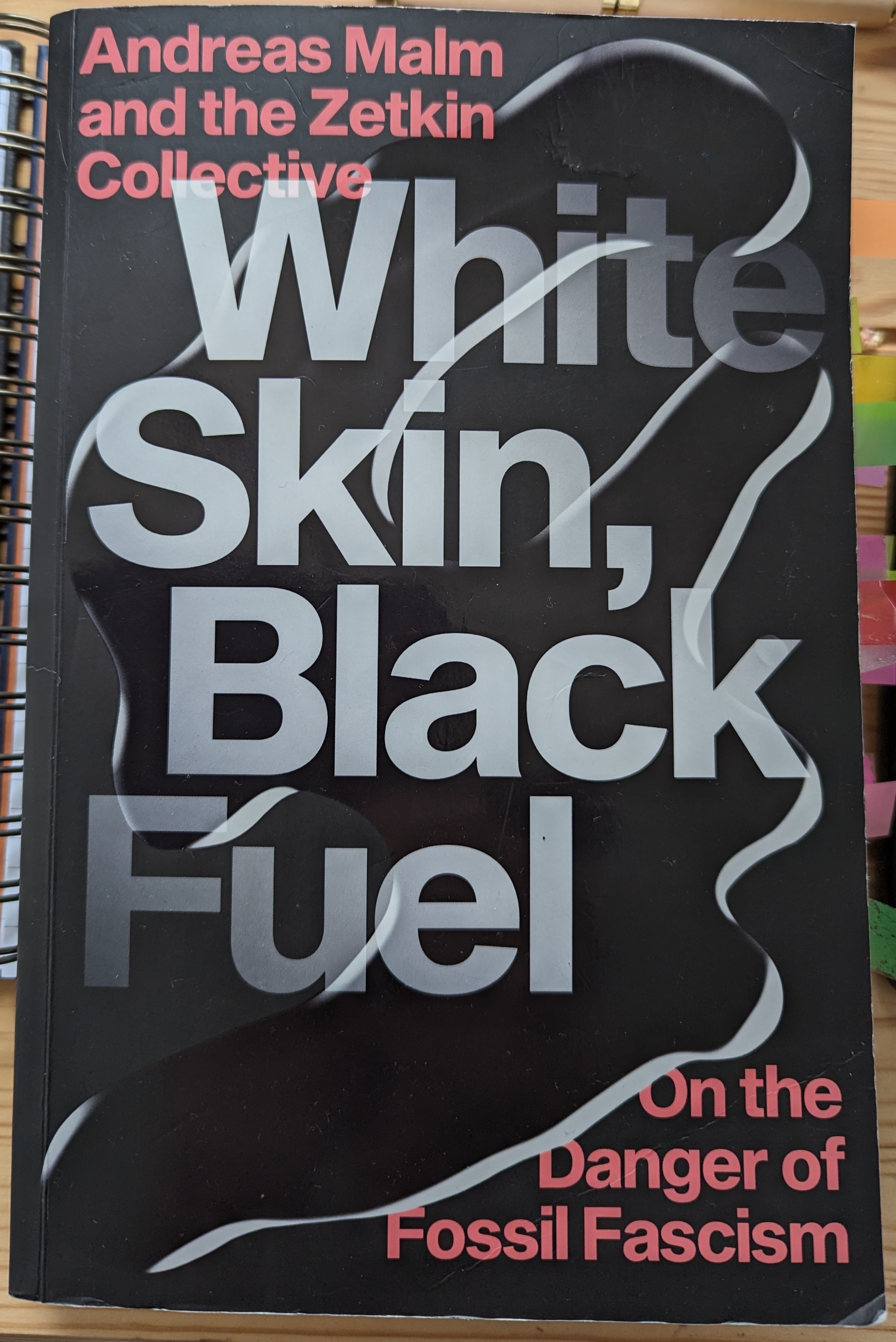
Many writers and thinkers may have stopped there, but Malm is driven. He followed that up with a book about climate and Covid and, controversially, enlightened us on how to blow up a pipeline. In between all of that, Malm, along with the Zetkin Collective, wrote an extraordinary book entitled White Skin, Black Fuel about the relationship between climate change denial/scepticism and fascism. It is like his earlier book, Fossil Capital rather sprawling. Readers need to persevere, it is easy to say that it is too difficult. Malm takes us through time and space locating as he does the origins of fascism, its contemporary manifestations (Europe, North America and South America) and, crucially, why fascism and climate scepticism/denialism are aligned.
Consider this (which I had not done before), why has no far-right party ever endorsed renewable energy? Indeed, why do far-right parties commit to dismantling renewable energy installations, particularly wind? Now this is only a small part of the book, but for me it is the most intriguing and the one that augments my own understanding of the challenges ahead – maybe not absolutely for my generation, but certainly for anyone under 50.
Malm’s plausible hypothesis rests on an understanding of ultra-nationalism (he takes close to 260 pages to tell us what that is). Let me stick with nationalism, the sense that the homeland and its authentic peoples should be prioritised over so-called invaders, immigrants, alien faiths and, basically, anyone with a dark skin. Not only prioritised, but cleansed. We see it in today’s politics. Fossil fuels, argues Malm, fit a nationalist narrative. The is “our” oil. It is independent and we use it for our own development and wellbeing. Of course, oil usually belongs to oil majors that trade it in global markets, so that argument is flawed, but it is surprisingly potent when it comes to electioneering/power grabbing. The sun and the wind cannot be appropriated in the same way even though it provides energy security that no fossil fuel can match (in terms of availability and price). I hear readers now asking, what about countries that do not have a store of fossil fuels in their territory, why are nationalists in those countries so opposed to renewables?
Malm is clear. Colonialism and whiteness! Particularly rich whiteness. For it is the rich off the back of colonial exploitation that have so much to lose from decarbonisation. Their assets are sunk – literally – in the ground. Their lifestyles are high carbon. They fly so much more than most of us, and often in their own planes. Carbon is so much a part of who they are that to decarbonise is to lose their very identity. And what is more, decarbonisation (for them, a Marxist plot) is to enforce an unfair (to them) equality. How else do we explain a global carbon budget that is shared between countries representing some element of fairness? For example, the USA and Europe (particularly the UK) have a tendency to deny historic emissions, and cannot countenance coming down to the level of developing countries. How fair is that?
Malm argues that such an approach by the right (not even the far-right) can be traced back to the fall of the Berlin Wall and the loss of a tangible enemy – communism – that imposed equality in places where it was the dominant ideology. (Arguably not, as the Soviet Leadership and acolytes seemed not to be too constrained in their consumption.) To prove the point, Earth Day (22 April) is the the birthday of Lenin – no coincidence. So, those proclaiming a climate crisis and the need for action became the new targets of the right. Denialism and then a rejection of mitigation (cutting carbon emissions) in favour of a West-friendly adaptation (the West/North is better able to cope with temperatures of 2, 3 and even 6 degrees of warming so much better than other less-developed regions). Malm is thinking about people like Jordan Peterson and William S Lind. The attacks on Greta Thunberg feature in the analysis, too. The picture of her wearing an antifascist “Allstars” t-shirt, for critics, was proof that she was both Antifa and in the pocket of George Soros.
There are some other interesting elements to this approach. Denialists do not present counter evidence (largely because there is none), rather they present their narrative over and over again. The more it is repeated, the more it is liked and re-tweeted, the truer it becomes. Repetition is key. Our media tend to allow them to repeat their lies at will and without challenge. With this in mind, argues Malm, if one can lie about climate change, anything can be successfully lied about. Despite the evidence to the contrary, the lies carry more currency. That is partly because white people, increasingly turning their territories into fortresses, will survive it longer than people of colour in vulnerable countries.
This is not the end of the book at all. The race discussion occupies the subsequent chapters. But just like Fossil Capital, perseverance pays off. The reader is rewarded with insights (you do not have to agree totally with them). Malm has plenty of critics. By goodness, though, he does a lot of heavy lifting for us.
 Be informed