The easyJet cancellation approach
 Leave a Comment
It is the first cancellation that I have experienced this year with easyJet on the Munich route. EasyJet got through all of last winter’s snow only to be felled this time by an English summer. I was due to fly on Wednesday 11 July at 1835. It had been rather a stormy day and this had impacted on Gatwick Airport. The pilot said that the ‘Terminal’ had been closed for some of the day. Suffice to say, we had to take a bus from South Terminal to North Terminal where the plane was parked. Certainly out of position.
Once on board, the pilot told us that we did not have permission to fly. But clearly as an old hand on this route, he knew that if he did not get the plane in the air by 2030 we would not be going because of Munich airport’s strict night closures. Intriguingly, the pilot took us to a holding position near to the start of the runway. He communicated his thinking and his communications with both air traffic control and easyJet control in Luton. 10/10 for initiative and communication. It was not enough. We were cancelled.
Unfortunately, easyJet are a bit like their planes – great in the air, not very versatile on the ground. I opted to go home, a luxury most people do not have. They had to join a queue of around 200 people or so to try to get on another flight and find a hotel. In all, I counted 8 easyJet cancellations that evening.
By the time I had got home, the cancellation was confirmed and I was able to get on a flight on Friday 13 July. So not so bad. Unfortunately, my partner had attempted to book me on another flight and – in the heat of the moment – got the wrong direction (Munich – London). Changing bookings with easyJet is not difficult, unlike other airlines, but they do charge for the pleasure. In this case 86 Euros (changing name and date so that she can fly to me next month). All credit to easyJet on this occasion, they have refunded the charges, having accepted the ‘heat of the moment’ decision-making. Always worth writing to them.
Protecting the Olympics (2)

Source: Holger.Ellgaard, Wikipedia
The Olympic debacle continues. Not only are there missiles ready to shoot down unauthorised aeroplanes over East London housing estates, but now army personnel are checking bags as people enter the Olympic village. G4S – a company to which the state has outsourced a lot of public sector work over the years – cannot meet its contractual obligations to supply 10,000 ‘guards’; though waits until 2 weeks before the event to tell anyone.
Its chief executive, Nick Buckles, went on the Today programme yesterday to answer some benign and straightforward questions from Justin Webb. Clearly, over the preceding 24 hours he had had some media training. The advice was – “tell your story and stick to it. Repeat it and then repeat it again; go for the sympathy thing, the company will take a big hit, maybe £50m.”
We wait to see if Keith Vaz, chair of the Home Affairs Select Committee – can get any more out of him next week when he appears before them.
The interview can be heard here.
Protecting the Olympics

Swiss Rapier Missiles. Source Wikepedia: Nirazul
The Guardian newspaper today reports “Mr Justice Haddon-Cave said the residents of the Fred Wigg tower had expressed “shock, anxiety and worry” over the prospect of missiles being stationed on top of their building, but they had been under “something of a misapprehension” about the nature of the equipment to be deployed and the risks deployment would bring.
“Yesterday David Forsdick, representing Philip Hammond, said the defence secretary was under no statutory duty to consult the residents, although an impact assessment had been carried out and the tenants’ human rights taken into consideration. Residents had no legitimate expectation that they would be consulted on issues involving the defence of the realm and national security.”
So, can we see the impact assessment? What kind of misapprehension about missiles on the roof might the residents have? To what extent is protecting the IoC and the Olympic event a defence of the realm?
Chumbawamba split
 It probably comes as no surprise that I have consistently been a fan of Chumbawamba. I think that I have half of their 15 albums. I dumped all of my vinyl 15 years ago, keeping only 5. Never Mind the Ballots was one of the five. I saw them perform Never Mind the Ballots at the De Grey club in Hull. They were a little late turning up I recall, but they were sensational. Their shows were always spectacles and they stayed true to their radical left position (even when their followers strayed). Some great lines.
They have been a shadow of their former selves for a number of years in the absence of Danbert Nobacon, Dunstan and Alice Nutter.
I recommend the touching documentary on youtube “Well Done. Now Sod off” in two parts: http://www.youtube.com/watch?v=hiyy3dace2M&feature=related; http://www.youtube.com/watch?v=ioTwFNu4Cdo&feature=relmfu
Whatever current and former band members wish for, I hope they get it. Thank you.
Royal Blue run 2012
Some of my closest friends know that I have some interest in buses. I have a bit of a collection of model buses, but those who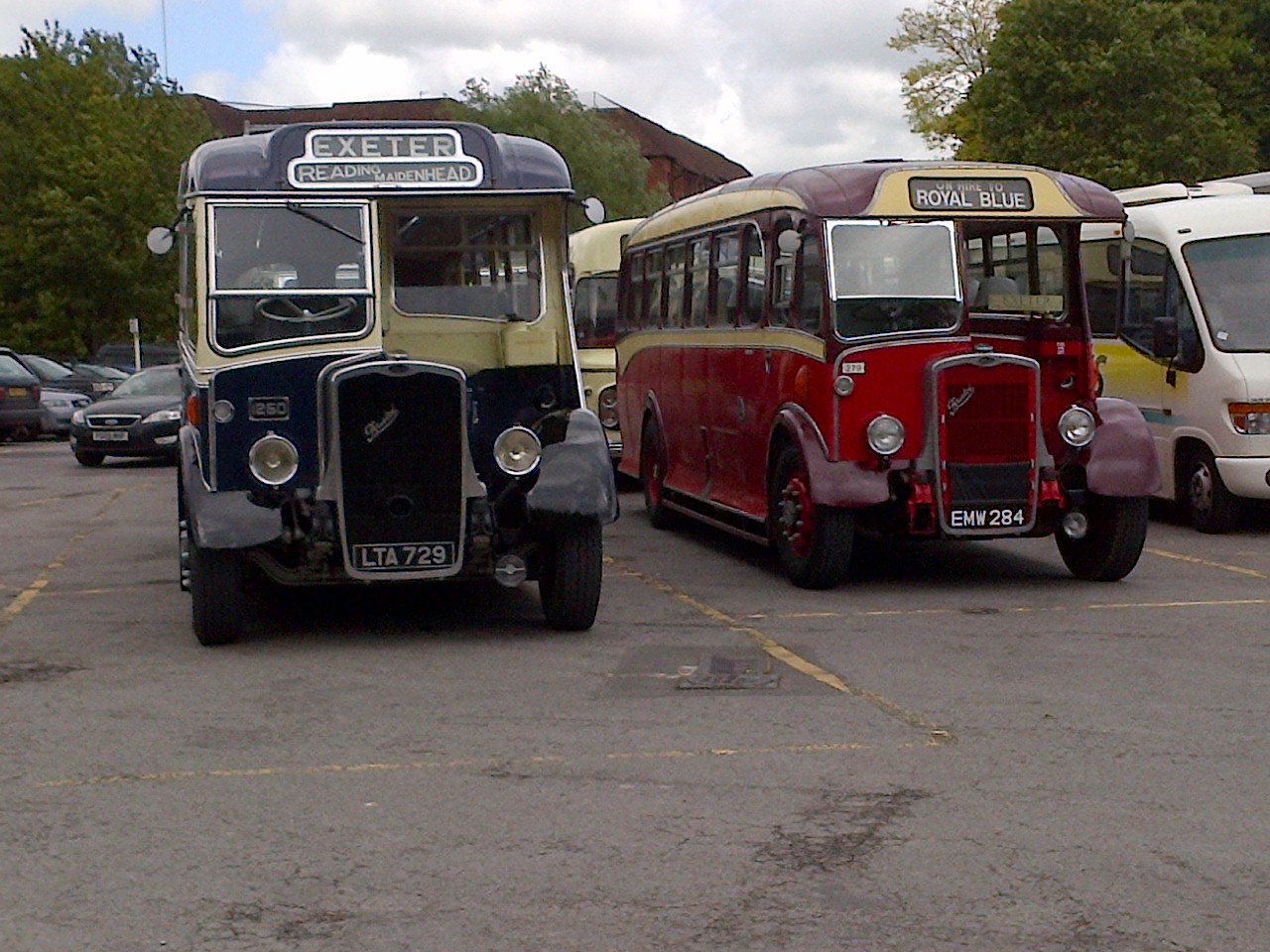 have the real thing are special. I have never been a passenger on a bus run. The opportunity to join this year’s run was too good to let pass. So, we boarded a colleague’s 1961 Bristol MW on Friday morning (29 June) and headed out to Salisbury to meet up with a fleet of vehicles that once plied their trade between the South West and London.
 It did turn out to be a bit of a tour of bus stations; notably Exeter and Plymouth. The drive through the villages and small towns with their tight bends and narrow entries and exits (the buses sometimes fitted these roads like the tube trains fit the tunnels) was delightful but more often than not frustrating. Whilst the vehicles in their heyday had the roads to themselves, modern tourism meant that we encoutered a lot of traffic in the opposite direction generating tight passing and a lot of reversing.
To illustrate the specialness of some of the owners, one has set up his own museum on his farm near Aveton; this was one of the stops on the tour – and memorable it was, too. Not only is there a collection of memorabilia with suitable descriptions and narrative, but also more buses. Hidden at the back of one of the barns was a truly immaculate Bristol Lodekka. Those in the know, know what I mean.
British design exhibition at the V&A
 It is a little pricey at £12.50, but certainly interesting at a number of levels. There is the nostalgia surrounding design epochs and the objects that came to symbolise them. There is the learning – largely historical – about the objects and/or movements that encapsulate British design. And there is a great shared experience – I talked to more people at this exhibition than at any other I can remember. For example, at the balsa model of my former university, I met someone who recently visited with potential students and a former student who also went on to work at the university whilst I was there. A very nice encounter.
The exhibition is housed in three galleries. The first is a bit of a mish-mash of epochs, events and artefacts (e.g. the 60s, the Festival of Britain, transport/architecture). The second gallery revolved around popular culture – Bowie, Mary Quant, Factory records, etc. The final gallery, loosely representing innovation, had Concorde, the E-Type Jaguar, The Gherkin, Video Games and Dyson.
I thoroughly enjoyed my journey through the galleries (it took me over three hours) but I was left wondering what the point was. What was the narrative? Why these artefacts and not others? Even more disturbing, however, is the question, where to now? The innovation gallery was surprisingly uninspiring. It was rather sterile. On leaving the gallery, rather than walking into a new world of opportunity, one walks into the gift shop. Rather unfortunate, I thought.
The exhibition continues until 12 August. The exhibition’s video includes interviews with a number of designers featured, including Margaret Calvert who worked on the road signs and who admits that the little girl featured on the ‘children crossing’ road sign is her own image of herself as an eight-year old girl (with her little brother). The video can be seen from the exhibition’s website http://www.vam.ac.uk/content/exhibitions/exhibition-british-design/
The case for lawyers to head up the banking inquiry
‘Bob’ – we are all on first name terms now – Diamond wrapped the MPs on the Treasury Select Committee around his little finger yesterday. Despite it taking 3 hours, it was an incoherent tame affair largely because there was no strategy to the questioning by the MPs. To be fair, they are not trained interrogators, but there were some rudimentary errors made. For example, Robert Peston on yesterday’s World Tonight programme asked, when did Diamond actually learn about LIBOR fixing – when he first read the report last week as he claims or earlier when he in 2008 claimed that all banks were busy fixing the LIBOR? If he knew in 2008, why did he not intervene? And why did he say to the Committee that he learned only last week? And why did the MPs not pick him up on that contradiction? The now infamous Tucker exchange was also unsatisfactorily investigated.
Click on Peston above to hear the interview.
If ever there was a case for a lawyer led investigation, yesterday’s hearing made it.
Diamond resigns, Cameron announces limited inquiry
Bob Diamond has this morning resigned as CEO of Barclays. Clearly, the reputation of Barclays is under some pressure over this LIBOR-fixing scandal. That said, one is still incredulous to hear shareholders this morning defending him – or at least his aggressive banking style that they think suits their dividend requirements.
Yesterday, David Cameron announced a parliamentary review of banking – or rather professional and cultural standards in the banking industry to be chaired by Andrew Tyrie. Tyrie is now doing some back peddling in light of Labour’s call for a more substantive review of banking presided over by a lawyer similar to Leveson currently investigating phone hacking.
Emirates and the London Underground
So, Emirates airline has invested £36m on a cable car across the Thames between the O2 and the ExCel Arenas. Notwithstanding the fact that at the moment there are unlikely to be too many passengers for this piece of public infrastructure (the property of TfL) on the basis of price (£3.60 with an Oyster card) and, more significantly, a shortage of population between these two points. Though it may have some utility during the Olympics as both arenas are hosting events.
More worrying is the concessions that go with this £36m. Seemingly, Emirates can now tag their logo with the Underground map. This corporate image creep – which Emirates Airlines seems to be particularly good at – should have its limits. As a clean work of art, that map should not be besmirched with any other logo other than the Roundel.
Barclays and the LIBOR
 On 6 November 2011 (see below), I reported on Bob Diamond’s Today lecture and his subsequent appearance on the programme the following day (that interview was uploaded to this blog). Well, now we find that Barclays made a lot of money from manipulating the inter-bank lending rate at the expense customers and citizens. The corporate price to pay is roughly £290m with £60m as a straight fine. Job done!
Well, not quite. Was this illegal? The suggestion is that this practice was systematic; i.e. orchestrated by the senior managment of the bank in which CEO Bob Diamond, at the time, was certainly a player. If so, surely it is time for a criminal prosecution? Giving up a bonus will not do.
Some of the reporting from this morning’s Today Programme, including a clip from Bob Diamond’s lecture on corporate culture, an interview with a former Barclays CEO, Martin Taylor, and the inevitable Robert Peston comment can be heard here.
 Be informed