Postscript to travelling during a pandemic
About 3 hours ago, the British Covid-19 surveillance service (or whatever it is called), phoned me to check that I was behaving myself; i.e. self-isolating. I was also asked to confirm my year of birth and reminded of the symptoms of Covid-19. If you get a call from a 0300 number, probably worth answering it to limit the badgering. I do not usually answer such numbers, but I just had a feeling.
Travelling during a pandemic
Filed under: Easyjet, Hotels, Terminals, Transport, Travel |
 Leave a Comment
 Hopefully most readers are not travelling at the moment. Staying put is safer and, frankly, much less stressful. I am a frequent traveller to Europe for family reasons and have experienced most things – delayed trains and planes due to failed infrastructure, sick or unregistered passengers and luggage, unruly passengers, theft of my possessions, dodgy hotels, the lot. And then there is Brexit – my passport no longer seems to get me through eGates in Germany (we’ll see if that is a one-off or permanent) and, of course, as a non-EU citizen, I can only be a country for 90 days in every 180 and am barred from working.
Now before I get ripped to shreds on my hypocrisy flying as I do but also constantly banging on about climate change, let me state the following. Travelling is for family reasons, and whilst 15 years’ ago when I first established family connections in Germany, my ignorance – despite friends warning me about my carbon footprint – meant that flying was a viable option. Clearly things have changed, but my family has not. I need to travel to be with them. During the pandemic, I have been travelling less for three reasons. First, it is quite difficult; second, it is dangerous and inappropriate (lockdowns are lockdowns after all); third, I have the privileged of being able to work from home. With regard to flying, I am an advocate of a frequent-flier levy – the more one flies, the more you pay. And exponentially. That would hit me hard financially, and rightly so. I am also hopeful now of structural changes that will enable me to travel more often – or always – by train. The pandemic has demonstrated that we can work remotely. I am healthier and less stressed because of it. We will see how committed employers are to the permanent change in the future. I am hopeful, but not convinced. There is also talk of a new Trans-Europe Express to help people to move across Europe without planes.
What follows is an account of my experience to help others. Having travelled for many years, there are many like me who have family on the continent.
 I passed through Heathrow airport on Sunday evening (14 February). I travelled with British Airways – currently offering 2 flights per week Munich – London. Originally I was scheduled to come back the previous day with easyJet, but that plane was cancelled, with the next scheduled option being sometime in March. On 18 January, the British Government imposed a requirement of a negative Covid test on all arrivals. That was fine, but an extra task to fulfil prior to travelling. Travelling on a Sunday meant that I took the test on the previous Thursday giving enough time for the result to be notified assuming that weekend lab work is not likely. Sunday was, hence, the last day of validity for the test. If the plane did not go on Sunday, I’d have to take another test (€130).
The plane arrived at its stand an hour before departure. The plane was fully boarded (busy but not full) at the scheduled departure time, 1745. But we were 45 minutes late pushing back from the stand due to an administrative error at the gate. Munich Airport would not allow the plane to go until everything was in order. Fair enough, I suppose. After being pushed back we waited motionless for about 10 minutes before the pilot announced that the plane had been damaged in the pushback. Engineers were called. 2 hours later, authorisation was given to fly.
I do not live anywhere near Heathrow Airport, and it being Sunday, the UK railway network enjoyed its usual scattering of engineering works, including on my routes home. If I was able to catch the last train/bus home, I expected to be back about 0300 – not a great prospect. But UK borders are never straightforward, and particularly with the need to demonstrate a negative Covid test and a valid passenger locator form (which includes payment of £210 for two Variant tests to be delivered to one’s home 2 and 5 days after arrival). Even though the arrivals are few, the border area was full and a long queue that snaked its way back and forth was created. Familiar image. Mingle, mingle, mingle.
The eGates were open as additional security staff were checking the documentation. My passport was rejected by the eGates and I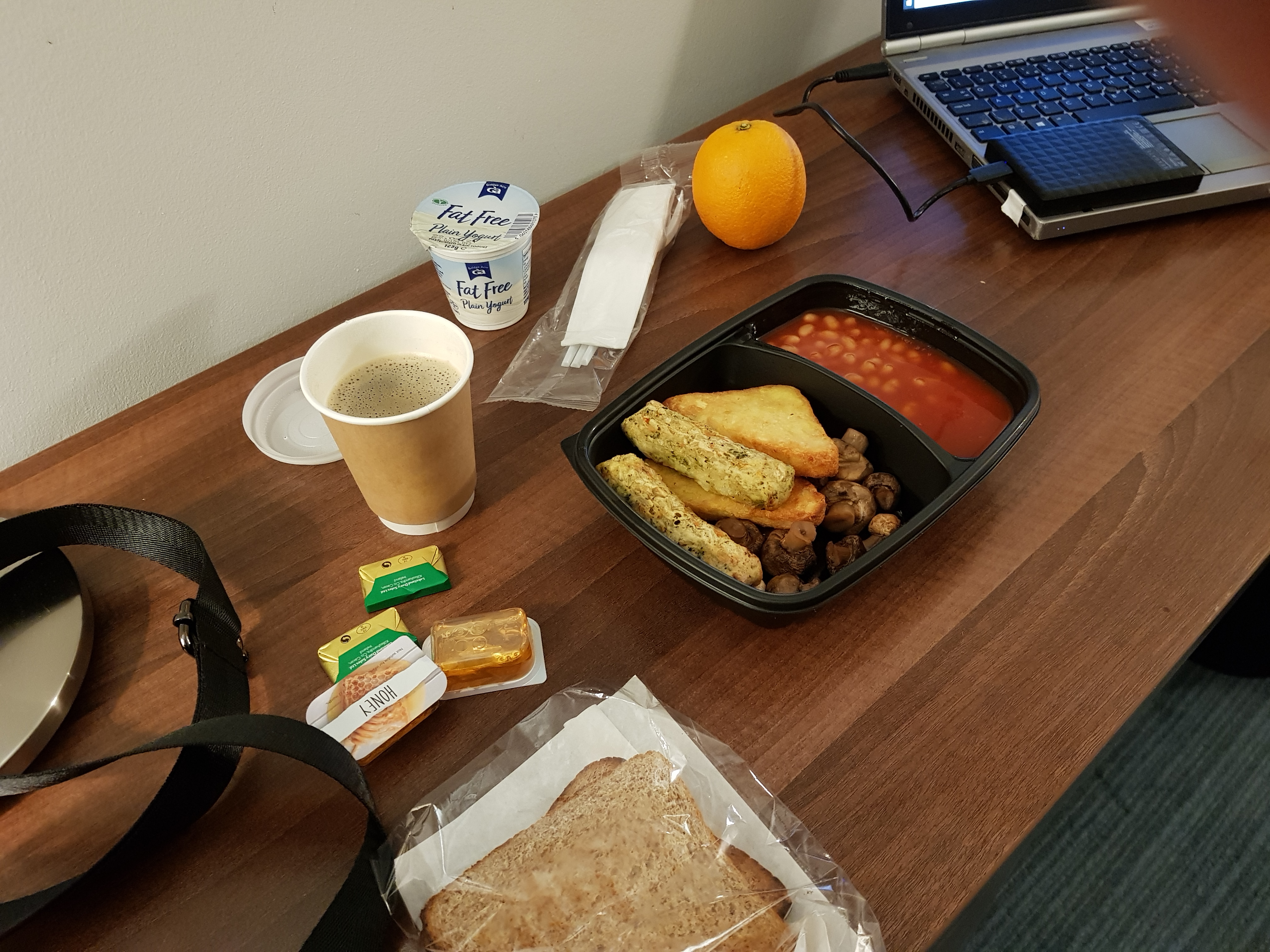 had to stand in another queue to be approved by a border official – there was only one on duty. In total, I was about 1 hour getting across the border. I decided to take a hotel rather than attempt the journey home. I stayed at the Hilton Garden Inn Hotel at Hatton Cross (close to the Tube Station). Hotel prices are half of what one would normally pay, so that was not too onerous, though still a cost. The view (above left) was a shade dystopian, however. But I recommend the hotel if readers are ever in the same position. I bought breakfast – one retrieves it from the kitchen and consume it in one’s room. It was fine (right).
On Monday (15 February 2021) I was able to travel to the South Coast of England. The Tube and overland trains were largely quiet. I am now observing an obligatory 10 days’ quarantine. I stocked up on non-perishables before I departed, so I have most of what I need for the duration. Safe travels.
Bill Gates and climate change

 As if he was not rich enough already (the richest man in the world until Jeff Bezos supplanted him in 2018), he wants me to buy his book as well. So this is based on what I have read about the book in interviews and bits published in newspapers. I think he owes us a free copy, especially if what he says is important for life on the planet.
There are so many contradictions in the man and what he says. Notwithstanding the fact that he became super-rich (not just rich, a concept that I can cope with) off the backs of others and not paying tax, he admits to flying private jets – and indeed has investments in a private jet company – and eating beef burgers. Lots of them. Seemingly the farting and burping of bovines amounts to 4% greenhouse gas emissions – so stopping eating them is not going to make much difference. He offsets his conscience by investing in Beyond Meat, a plant-based tech company that makes burgers that taste and act like meat. But tell me, Mr Gates, what about the contribution of beef to deforestation? Those trees as so important for carbon capture, but the more meat you eat, the more forest is destroyed to graze cattle and grow soya for them to eat. So it is not just about emissions, it is about the loss of natural carbon capture and, by consequence, biodiversity. Not to mention, human health. But maybe that is somewhere in the book that I have not read?
Being rich, his offsetting – a dodgy concept at the best of times – is in paying an Icelandic technology carbon capture firm to neutralise his emissions. That is beyond most of us. Moreover, he is also investing in nuclear fusion, the holy grail of energy generation. Good for him.
Of course, like most of these rich people who have become converts to addressing climate change, they are trying to do so as believers in capitalist management. The problem, arguably, has its roots in capitalist management. The solution is in a different paradigm. That does not suit super-richness.
He’s not a fan of Extinction Rebellion, which is fair enough. But his reason is quite bizarre. When Extinction Rebellion is blocking roads in pursuit of its agenda, there are people in the traffic jam who are innovators (like himself). They are having innovation time stolen from them by ER people, making climate change worse. Yeah, right.
He does not think kindly also about Greta Thunberg. In his interview in the Guardian newspaper he said “you can’t have a movement without high-visibility figures. I hope she’s not messing up her education. She seems very clever.” It was pointed out that he himself dropped out of Harvard to set up Microsoft – so messing up an education is okay for some. It is the point of many politicians criticising young people who support Fridays for Future. They are messing up their education. When the young people are actually saying, “you are denying me a future”. And yes, she’s clever. Despite her sojourn to the USA last year, she still managed to win a school prize for performance.
By contrast, he is an admirer of the father of one of the most destructive corporations on the planet, Charles Koch. Moreover, not only are Koch Industries companies huge greenhouse gas emitters (big on fossil fuels), the Koch brothers have donated possibly billions of dollars in climate denial propaganda in the US and also in the UK. The contrarians in the UK are supported by Koch money.
So, an 18-year old fighting for her/a future with no corporate money behind her is misguided; but a rich owner of a planet damaging corporation is a friend.
What is worth considering in what he is saying? Here is a short list:
- visiting manufacturing factories, sewage works and farms is a good thing (he took his son to various plants to show him how things are done)
- cement is a problem
- steel manufacture is a problem
- electric cars are not a solution – hydrogen is the fuel of the future for mobility
- it’s not the temperature that is the problem, rather the rate of change (outstripping evolutionary adaptation)
- education is important
- Gates is not conspiring to insert microchips into us all through Covid vaccines. Vaccines are and have been, transformative in human civilisation, saved many lives and much suffering. On that we can agree.
Picture: – https://www.flickr.com/photos/hhsgov/39912162735/

Free Ports
Today (5 February 2021) is the date for submissions for applications for Free Ports are customs-free areas where “value” is added to products before being re-exported without ever actually entering the country. So, all of that paperwork that is currently crippling domestic business due to Brexit will not be due by the businesses operating inside free port areas. The fear is that it is not just paperwork that will be excluded – workers rights and environmental protections may also be excluded.
On the former, the RMT Union General Secretary, Mick Cash, has said that “Without strong employment rights, automatic trade union recognition and tax laws that make sure international owners of UK ports contribute, free ports are doomed to fail the communities they are designed to help.”
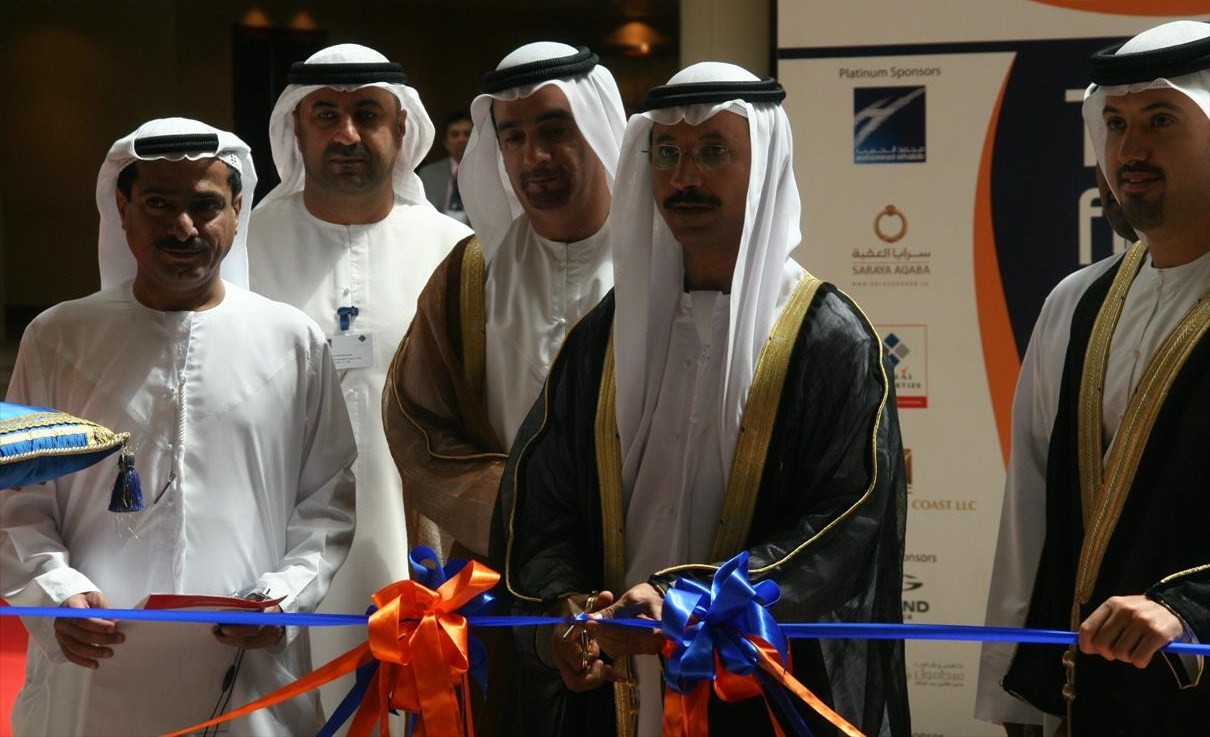
Another big player will be DP World. This company is owned by the State of Dubai and chaired by Sultan Ahmed bin Sulayem (bottom right). The free port there operates a tax-free operation area – indeed, firms can be incorporated there to operate untaxed.
On environmental issues, the case case of Bristol is of concern. The port company is owned by Terence Mordaunt and David Ord. Notwithstanding their affiliation to the Conservative Party, they are supporters of the climate-change-denying lobby Group, Global Warming Policy Forum. The science of climate change is now fact. Free ports should not be a vehicle for undermining the decarbonisation of the economy.
Picture: Imre Solt, CC BY-SA 3.0 http://creativecommons.org/licenses/by-sa/3.0/, via Wikimedia Commons
Book review: Yanis Varoufakis, Another Now
Filed under: Book reviews, Environment, Housing, Politics, Privatisation, Reviews |
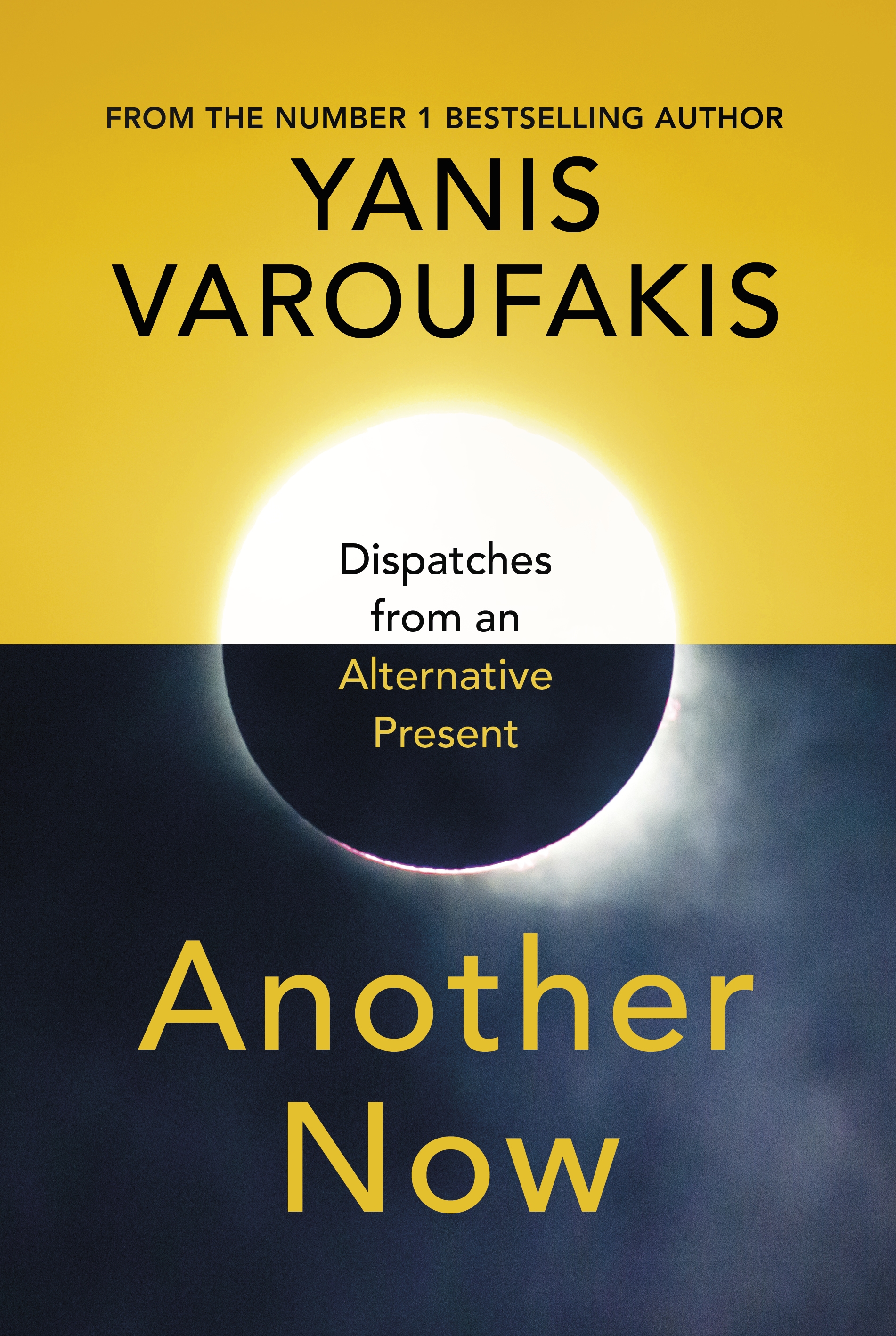
Leave a Comment I did not start reading this book (below left) as a piece of science fiction, I actually thought it was a straight political and economic manifesto by a radical thinker. Bless him (not in a God sense), he has tried another route into our consciousness.
His construct is the following – three different people, all disaffected by the present, meet or are introduced to one another with the express – and contrived – purpose of “trialogueing” the ideas that are obviously keeping Varoufakis awake at night. One of his characters, Costa, is an IT expert liberated from daily work by having anticipated 2008 and bet against it (or for it, whichever way one thinks). Costa was working on an alternate reality that one could choose to enter but only in the Hotel California sense (“you can check out any time you like, but you can never leave”). Having created his new reality in a game called Freedom, he finds that holed up in it is another being, Kosti (also from Crete), who shares Costa’s DNA and past. Kosti inhabits a world know as the Other Now, in contrast to that which Costa inhabits; namely, Our Now.
Kosti engages with Costa until he becomes bored, at which point Costa visits once again his two other protagonists, an ageing Marxist academic who gave up on politics to create tapestries (Iris) and a libertarian banker (Eva) who became disillusioned about finance after the collapse of Lehman Brothers bank in 2008. This is the date, conveniently, that the fork in the realities occurred. So, these three characters interrogate the alternate future and its mechanisms.
So what is the alternate system that so successfully functions in Other Now that Our Now should aspire to? And how? I am loath to be a spoiler, but the object of the book is to achieve a mobilisation and create a coalition for change. Unless blogs like this share the ideas, then it really is just a limited work of science fiction. So here goes.
- elimination of retail and investment banks
- universal basic income (UBI)
- employee ownership of firms and the elimination of hierarchies
- socialisation of land
1 and 2: The elimination of retail banks is linked to the form and function of the UBI. The UBI in this alternate world has three components in a Personal Capital (PerCap) account. First, Accumulation made up of basic pay and democratically-allocated work bonuses; Second, Legacy – which is paid on birth, but not redeemable until adulthood and a plan for using it! Third, Dividend, which is the UBI element funded by a tax on corporations at 5 per cent of gross revenues. The payments are stored in an electronic wallet and transfers are made independent of retail banks. Borrowing is replaced by a peer-to-peer lending scheme rather than by banks as we currently know them. That does not quite amount to the elimination of the need for retail banks, but comes close. Investment banks disappeared because they no longer trade their complex derivatives and create fictitious money. They are reduced merely to lenders and have no advantage over peer lending.
3: Each employee is given one share of equal value to all other shares in the company on Day 1, or when they join. The stock market has been dispensed with by the radical activists who brought about the change (see below). Firms become democratic with no senior bosses telling others what to do. And the surpluses created by firms are allocated by peer assessment on a points system. Those who are particularly creative and/or productive are recognised by their peers and given credit points that equate with a portion of the excess. These points can also be used by future employers to assess the suitability of a candidate.
4: Landlords received inflated unearned income. The socialisation of land in Other Now resulted in a new commons being created through Ground Trusts/Commons (gComms). By law all freehold land passed to the gComms. Leases were awarded to landlords and democratic businesses were also privileged. Two zones – one for commercial housing, the other for commercial businesses, enable communities to extract maximum rents in these areas to pay for social housing.
Getting there
The mechanisms for getting there are radical. In the Other Now, movements such as Occupy Wall Street were not defeated as they were in Our Now. They were transformed into a guerrilla groups that organised successful payments strikes (delaying instalment payments on bank loans and utilities such as water and electricity) that brought down the banks and caused the nationalisation of the utilities. Guerrilla groups targeted firms with poor employee relations and environmental records sufficient to get pension funds to divest. Another guerrilla group set about big tech – succeeding in bringing down Facebook and gaining property rights over data for users of social networks. Those companies that avoided attack by these guerrilla groups did so only by investing in green technologies, leaving stock markets and transferring full voting shares to their employees.
International organisations such as the IMF were completely reformed. Instead of being an organisation that gave loans to defaulting nations in exchange for the privatisation of public assets, the International Monetary Project (IMP) has a remit to stabilise the world economy and invest in countries or regions without indebting them. The resources for this come from levies on exports and capital transfers.
Core to the success of the system and the security against exploitation and a return to some oligarchical system is transparency. The very systems that were turned on citizens to monitor and punish were instead directed at the powerful. An appropriately-named piece of software, the Panopticon Code, developed by a guerrilla group of coders, infected every computing device on the planet. Suddenly everyone could see everything about one another and particularly those “clinging to power”. As a reader, one can see that Varoufakis is perhaps not so keen on this as an absolute (everyone’s secrets are exposed with the negative impacts that would entail), but the longer-term impact on the Other Now was a democratisation of society on a global scale. Corporations were held in check by their internal democracy and Citizens’ Juries (with the power to dissolve bad companies). These, of course, required a high-level of engagement by the population to enact and maintain. A socialworthiness index (as a replacement for credit ratings and the agencies that generate them) helped to divert resources towards the good things in life that were not captured by GDP (a real bugbear of mine).
On immigration, states in the Other Now recognised the contribution of immigrants to host economies and also supported the communities in which they lived including providing sufficient school places, healthcare services and housing (the latter helped by the socialisation of land and management by gComms).
Other Now is a modern app-based world. There’s an app for PerCap and its funds. There’s an app for social media data trading – after all users of social media services were given property rights over their data. They now trade data with social media firms and receive payment for them. This had tragic implications – which are for readers of the book to discover (p169). Using an app and receiving the payment in the PerCap app! The proliferation of apps is an indicator of a vibrant digital sector, freed from the constraints of the former Techno-feudalism endured by Our Now citizens.
Why Other Now is not better than Our Now
Other Now is no Utopia. Varoufakis uses Iris to detail its residual failures that the elimination of capitalism did not banish. And in 2022, Other Now does have its own financial crisis caused by imperfections in the regulatory framework around gComms and PerCap. Again, I will not spoil it because this is the part where Varoufakis loses himself in his story telling. There is nothing original in what happens next – I am pretty sure that any seasoned SciFi fan would work this out before Varoufakis had written it, after all, he’s an academic economist. But we are asked, through his characters, whether we would elect to transfer to Other Now or stay in Our Now. This is an existential question. The identity of the characters prepared to transfer and which not, and their reasons for the choice, again, are not a surprise.
I bought the book without reading the cover. Fortunately. Readers know that fiction – and particularly science fiction -are not my thing. Varoufakis demonstrates that they are not his either, but he has a fair shot at it – and certainly his main points about the nature of change – and critically the process of change – are well made. Probably better in this format than a straight monograph, of which there are many. I come away with some ideas of my own. But also with a dilemma. Not only should I go to Another Now if I had the chance; but seeing as though I don’t have that option, should I try to create Another Now? Now. The answer…I am not into tapestry.
Picture: Twitter
I walked out of a speech by George Monbiot
Filed under: Brexit, Environment | Tags: Chrs Grey, George Monbiot
Leave a Comment 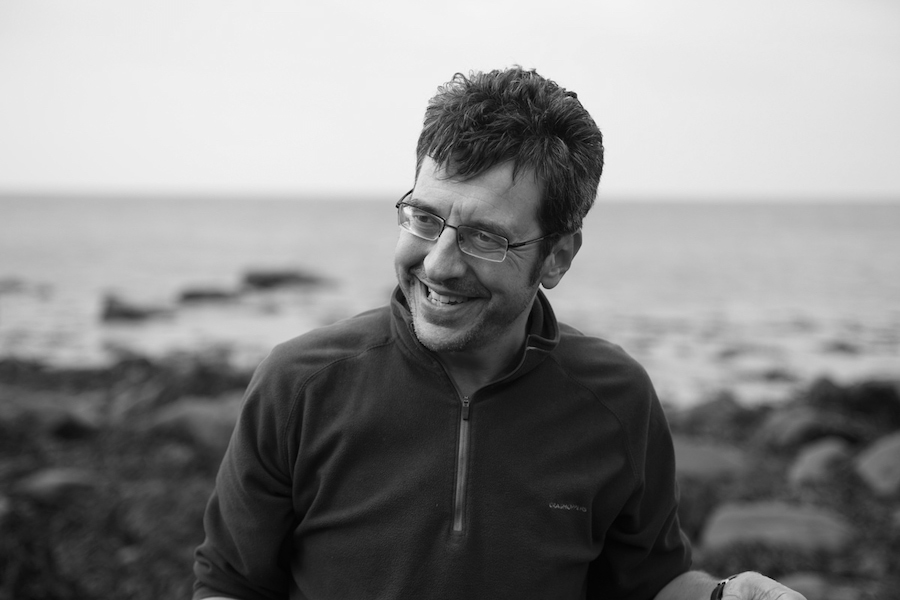
Many years ago when I first migrated to the South Coast, I joined the Green Party. It was, I thought not unreasonably, a quick and easy way to meet some like-minded people, one of whom became a close friend, now sadly deceased. I canvassed a number of local elections and proudly watched the party increase its support and eventually run the Council.
The party had few famous inspirational leaders, but I believed in localism and supported the local nominee for the parliamentary seat against the Party’s eventual decision to nominate its biggest name, the then MEP, Caroline Lucas. I’m still not reconciled to that. En route to the constituency being the first to elect a Green to the Westminster parliament, the local party organised many events and invited speakers, one of whom was George Monbiot. I regarded Monbiot as being a windbag with a platform in the Guardian newspaper. I helped set up the event on the day and then left immediately prior to his arrival on the stage.

I am someone who spent his formative years on demos. Every weekend I was somewhere – outside a factory farm, animal experimentation laboratory, and most memorably a weekend at Porton Down in Wiltshire. The overnight demo (right) was outside the Reckitt factory in my hometown of Hull. At these events, particularly the mass gatherings in London and other cities around the country, I heard many – what I thought were – inspirational speeches. The late Richard Adams, author of Watership Down, was a regular and particular favourite.
As I grew older, I began to get bored with speeches. If I attended a demo – whether it be against war in Iraq, the Pope’s visit, Fridays for the Future or more local industrial disputes – I have not stayed for the speeches.
In recent years, I started reading Monbiot’s Guardian columns again. My new-found environmental zeal directed at climate change extended my reading. Monbiot is an advocate of re-wilding, unloosening the shackles of the National Curriculum to enable flexibility in the classroom and an opportunity for children to experience the outdoors and flora and fauna. He’s also a Marxist, which brings me to the point of this blog entry.

I’m a regular reader of Chris Grey’s Brexit Blog. It is classic, longhand academic musings about the labyrinthine journey to Brexit. This week, Grey (left) takes on Monbiot using his highly effective academic spray that puts the targets to sleep before killing them painlessly. The article in question this week was Monbiot’s “follow the money” piece, published in the Guardian on 25 November 2020. Monbiot argues that there are two types of capitalists: warlords (disaster capitalists as well as the zealous free-marketeers/deregulators) and the housetrained (one-nation, post-war consensus Tories). Brexit is being defined by the Warlords and the campaign was funded by offshore, dirty money such as that supplied by Robert Mercer, Christopher Harborne and Jeremy Hoskin. The piece flows with allusions to “false consciousness” but, according to Grey, leads to a cul-de-sac. That is because the remain side also received money from the likes Morgan Stanley, Goldman Sachs and Sainsbury’s. With Sainsbury’s being exposed this week as contributing to deforestation in Brazil, this money is hardly clean, housetrained or otherwise.
What really caught my attention, however, was Grey’s reference to Stuart Hall, the hugely influential cultural sociologist writing in the 70s and 80s. Hall’s contribution is to point out that the follow the money approach, whilst not invalid, is not causal. Grey quotes Hall: “material interests … are not escalators which automatically deliver people to their appointed destinations, ‘in place’, within the political ideological spectrum”. It is the culture war, the tangibility of the intangible “sovereignty”. If Monbiot is right, Biden might have defeated Trump by something more than he did.
Grey concludes: “So whilst the debate about the relationship between economics and culture is a perennial one, and discussing…in general I think of them as inextricably bound threads, not base and superstructure. I prefer both/and explanations to either/or explanations, prefer contingency to determinism, and see as much cock-up as conspiracy.”
Monbiot is a journalist. His epistemology – through training and the graft of weekly newspaper column writing – is different from that of the academic. I cannot speak for Monbiot, but I doubt that he is in too much of a disagreement with Grey; but Grey’s argument would be subject to some editorial scrutiny. Monbiot does well to get “false consciousness” into an opinion column in a liberal newspaper, let alone trying to introduce Stuart Hall. Grey’s critique demonstrates two different epistemologies – those of journalism and academia.
There is no revolution coming. The housetrained capitalists are the best we have – and may be re-asserting themselves in the United States. We should focus on the Green economy, not the economic system. We need somehow to inspire youth. Get them interacting with nature and help them develop a desire to dig down, literally and metaphorically, into the knowledge of these complex systems, by whatever means. Taking on Chris Grey is a bit of a cul-de-sac.
Climate watch: if you don’t think it matters to you, think again
Filed under: Environment, International, Trump | Tags: Arthur Snell, climate change, Michael Stephens, Middle East
Leave a Comment Trying to introduce climate change into a business degree curriculum is not easy. One of the motivations for business students is to make money – lots of it – when they leave university. And the programmes sell themselves, understandably, on that dream. This is amusingly detailed by Martin Parker is his book, “Shut down the Business School“.
 So, I was interested, during one of my morning engagements with a podcast, The Bunker Daily, that has successfully displaced the BBC’s Today programme from my listening diet. The Daily on 26 November 2020, was anchored by the erudite Arthur Snell, who interviewed Michael Stephens (left) from the Foreign Policy Research Institute. They talked about the Middle East and how President Biden is going to engage with the region, especially in light of Trump’s and Kushner’s new relationship with Mohammed bin Salman of Saudi Arabia. All very interesting.
Snell tried to wrap up the interview with a question about the future. Interviewees often shy away from predictions of this kind, but Stephens did not. He talked about climate change in the region. 7 million people live in the Nile Delta and are in danger of being flooded out of their homes within 10 years’. He went on to say that across the region, critical infrastructure – oil production, for example – is exposed to extreme and unsustainable heat. Temperatures in Israel, he said, are now averaging 37 degrees Celsius in the summertime. 37 degrees is, seemingly, a temperature that tourists determine is too hot and choose other destinations, impacting directly on tourist economies.
There are population movements in poorer countries where rainfall is in decline and the land is unable to sustain its populations. This migration inevitably involves Europe’s borders. The relatively modest numbers of migrants so far have led to ugly far-right nationalists taking power in some countries and regions. More can be expected if climate change is not arrested. That is not me saying that migration is bad; only that bad people can use it in their culture wars to claim power and sustain it.
Critical, argues Stephens, is that the countries of the Middle East diversify their economies away from fossil fuels. And we, in the West, need to help them do it. Though our Finance Minister has just cut the UK aid budget in solidarity.
Pic: FPI
Book Review: Banking on it by Anne Boden
Filed under: Book reviews, Business, Co-operatives, Environment, Finance and Economics | Tags: Anne Boden, Starling Bank
Leave a Comment 
Anne Boden, a 50-something female banker with a long career at RBS decides to leave. She gets headhunted to work at the failed Allied Irish Bank (one of the major casualties of the financial crisis in 2008). Whilst she is terribly excited about the innovations in technology deployment at the bank, as chief operating officer, actually, her day job was making people redundant. She left after 18 months.
Boden comes across as someone who doesn’t sit still for long. She mused over her future and decided to set up her own retail bank. Only this one would not have any legacy systems, branches, and crucially, it would not have an IT department. It would be an IT department. The bank would be, as the book cover suggests, an industry disruptor – a business that would strip down products to the basics. No frills. And what it did do, it would do better than any other retail bank. It would interface with customers through a mobile phone app. The core product would be the notoriously unprofitable current account; rendered profitable by a low cost base and intelligent rates for borrowing and saving.

There is much to recommend in this book. We know the ending – Starling Bank was launched and is on the cusp of profitability. It is award winning – though I am never really sure what that means. And as we might expect, the journey to this point has been fraught, involved near bankrupting herself, two unexplained burglaries and a big fall out with the core team about strategy. As a 50-something bloke, the idea of a 50-something becoming a successful entrepreneur is inspiring. I am myself embarking on ventures that perhaps should have been done a number of years ago. But there you go. What this story tells us that there is never a wrong time, but don’t expect to have a life if you try. And if one is going to set up a bank, expect to have to do a deal with the Devil (more of this later).
Here are a few things of note for budding entrepreneurs:
- Silicon Valley’s investors may not be receptive to non-Silicon Valley start-ups;
- contingency fees from consultancies and lawyers may not be honoured by investors;
- even if one thinks that the idea is original, it is not. Someone else is working on it simultaneously and they may be competing for finance with you;
- scalability will be important – can the business be expanded/grow without adding costs? (p33);
- build a network full of goodwill (being 50-something can help, providing one has not hacked people down on the way up in a previous life) – (p63)
- if the business is a disruptor, the incumbents will not sit back and watch (p66); but in mature industries – like banking – they might not know how to respond (p251-2);
- watch out for a coup attempt – those brought in to develop the business may see themselves as better able to build the business and launch. The leader of the coup will require the rest of the team to choose between you and them (pp125-6);
- the media will pounce on stories about a coup/disagreements. PR needs management;
- failure is normal for entrepreneurs. Investors value experience. In Silicon Valley, recording failure is part of the culture. The place where this is done is medium.com (p138);
- it is possible to lose a whole team, be close to ruin, but start again and learn from the mistakes – primarily, getting the right people. The signs are there if one cares to look;
- it is staggering how much can be done just using email;
- so-called Real Options are revealed sooner than expected, but must be embraced. Setting up the businesses is only the start;
- the team that launched the product is not necessarily the team to see it in to the future;
- potential stakeholders/investors are watching – keep an eye on the email. Unfamiliar names may not be all bad.
Talking of bad. The bank got approval from the UK banking regulator to trade. I’m not quite sure how this works, but it does involve a lot of meetings, paperwork, disappointment and finance. It may not matter where the finance comes from. In Starling Bank’s case, Boden got an email from a mysterious investor, Harald McPike. Austrian, apparently. The eventual deal was done in the Bahamas on board a 92 metre yacht. £48m was pledged in exchange for 2/3 of the equity. So, essentially, Starling Bank is owned by a secretive financier based in the Bahamas.
That led me to a wider question about motives. Boden sees her core customers as younger types who live largely from their mobile phones. I get that. But why did the bank need to ape existing ownership models; namely venture capital based in the Bahamas? In these post-financial-crisis days, surely more of the same, albeit on a mobile, is falling short of truly disrupting? Why not a co-operative or other mutual model? Democratise banking and roll back the bank-as-an-end-in-itself principle.

There is absolutely no sense that Boden (left) might have had any reservations about the source of her capital, and that the profits would be offshored. It is not only McPike, she also sounded out Jared Kushner’s brother, Josh, in New York and John Thain famous seemingly for spending $141k on rugs for his office whilst he was at Merrill Lynch.
And what about ethical standards? The only mention of ethics was in a discussion as to whether it was ok to buy a competitor’s domain name (p197)! The website does have an ethics statement which explicitly excludes certain business customers such as arms traders. There is a commitment to planting trees, some reference to energy and supply chains. Nothing, though, that says, “this is the bank for me”.
Pic: Anne Boden, Charlottelorimer
The welcome return of a pack of 20
Filed under: Cigarette advertising | Tags: Gauloises, vive le moment
Comments (2) 
It is not entirely clear why cigarette advertising in Germany has been absent for most of the year. Obviously the pandemic has been significant – fewer people out-of-doors to see the posters. The marketing of e-cigarettes, too, is part of the story. The new modes of delivery are often owned by the same companies and the campaign budgets are being redirected.
So, it was a absolute delight – and surprise to see that Gauloises, the French brand owned by Imperial Tobacco – back on the streets. And what is more, still marketing under the Vive le Moment tag. And normal packets, too.
Of course the poster is the tried-and-tested. An attractive young woman (not yet with the mouth ulcers, discoloured teeth and diseased skin) sits with her feet up in a yard to an urban apartment – in Paris obviously. She is holding a cigarette that has just been lit. The tagline is “Für Momente, die dir gehören” – roughly translated as “for the moments you own”.
Classic advertising. But I tell you, for those moments, my thoughts do not turn to products that have a concentration of toxic chemicals in them. With the virus around there is enough trying to kill me without cigarettes adding to it. Or is it that the relatively young, need a helping hand with this death thing as the virus does not seem to be enough?
 Be informed