Archive for the ‘books’ Tag
The Sheep Look Up by John Brunner, book review
Filed under: Book reviews, Environment | Tags: book review, Book reviews, books, dystopia, Ecocide, John Brunner, science-fiction, The Sheep Look Up
 Leave a comment
 Background
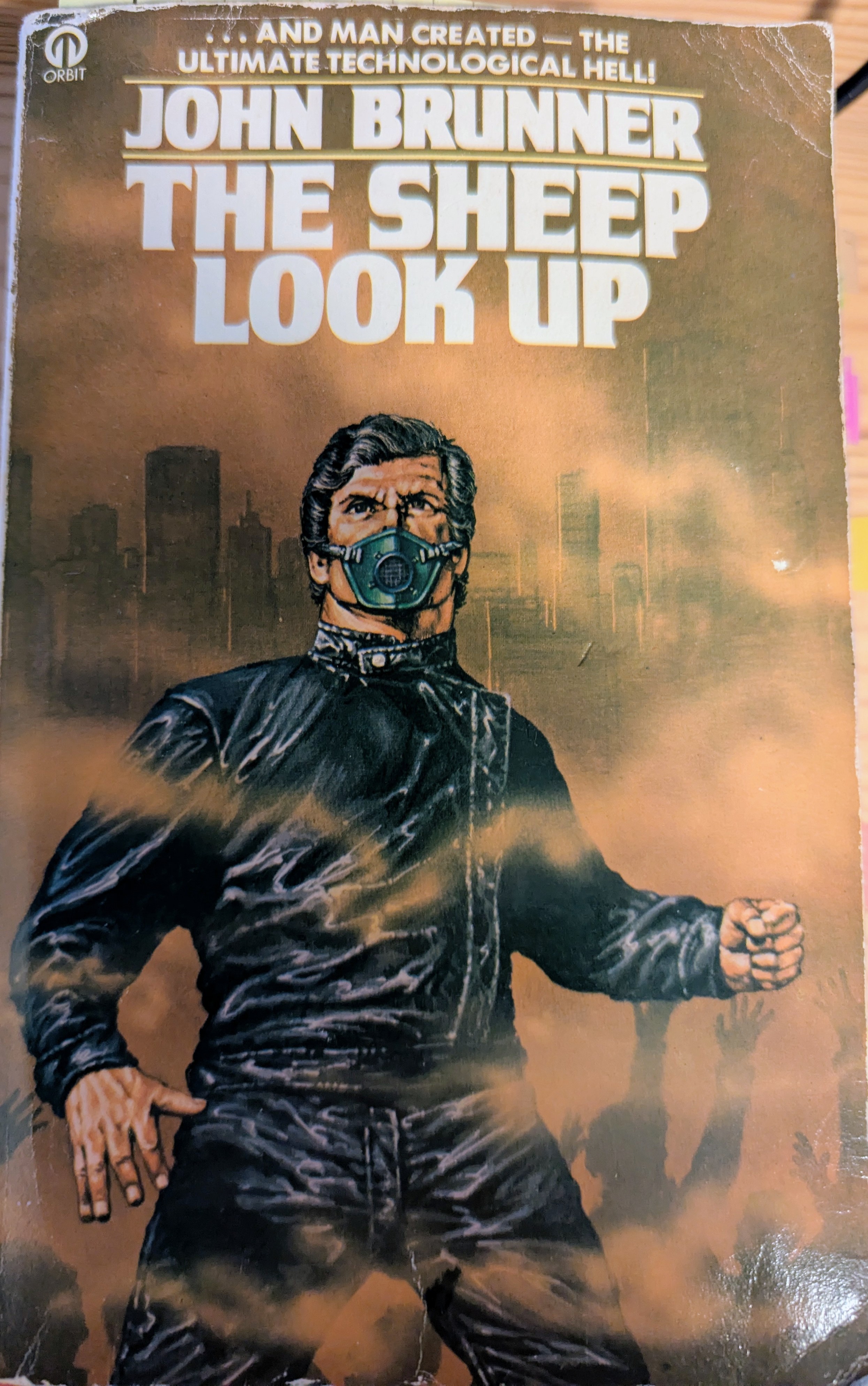
This book dates from 1972 and my copy is the paperback published in 1974 (left). It is just short of 500 pages and has 12 substantive chapters, each one focusing on one month in the not-too-distant future (from 1972 – now probably the past). The first two or three chapters are difficult to get into. There are a lot of characters, too many really, and each chapter flits between characters, places and events. Notes may be needed to keep abreast of characters and their fates.
The setting is the USA and some of the main action takes place in Denver (Colorado). It is worth considering what might have influenced Brunner (originally from Cheltenham, UK). The Vietnam War, for example, where both deadly defoliants were use and there was a draft. Both of these feature in this book. Moreover, on the defoliants issue, Rachel Carson’s book, Silent Spring, from 1962 clearly was within Brunner’s purview. Brunner does miss a trick on considering future communication technologies. There is no internet, for example. And no mobile phones. There is, however, problematic technology. A microwave oven cooks a baby in its mother’s womb arising from poor manufacturing and safety (unlikely, but in 1972 microwaves were not widespread).
Corporatism
The main import into the USA is oxygen. The key technology is owned by a conglomerate called Bamberley Trust and its core product is Nutripon. Nutripon was exported to “Africa” (a town called Noshri) to avert a famine. Instead of liberating inhabitants from famine it caused madness and mass killings arising from a mysterious contamination by a hallucinogen, Ergot, with a similar molecular structure to LSD. It had also been sent to Honduras. In later chapters, Ergot contaminates Denver’s water supply and violence ensues.
Bamberley Trust is headed up by the Bamberley family whose final patriarch, Roland, won’t even negotiate with the captors of his youngest son, Hector, for fear of profit loss despite being a proto-not-for-profit. It is technological determinism: “I don’t see why we shouldn’t improve on nature” Bamberley proclaims (p33). Nutripon is a hydroponically-grown, high protein cassava and is handled by Globe Relief, the world’s largest aid agency. Under the cover of Bamberley Oil, the company also makes napalm which is dumped on US citizens for no discernible reason. However, Bamberley Trust is a company that holds the population ransom. Very soon, Nutripon will be needed by American citizens as food shortages start to bite (p227). Incidentally, the president is a captured figure, familiarly known as Prexy. When the going gets tough, he declares martial law.
We learn also that insurance is a problem when the world moves from stability to insecurity/uncertainty (just as we are moving from the stable Holocene to the unstable Anthropocene). A major player in the insurance industry, Angel City Interstate Mutual, whose key character is Philip Mason, is sold after a series of environmental disasters, an enteritis epidemic as well as an avalanche caused by a sonic boom, overstretch its resources. Or maybe an earthquake. Mason failed to re-insure the Apennine Lodge (p79) and other buildings in Towerhill, exposing the company to $50m in costs – quite a sum at that time. Mason gets away with being fired for his incompetence. But this is America, fail in one thing and start again is the norm. He is approached by Alan Prosser, a water, sewerage and plumbing man looking for another business partner after the former had gone to Puritan, a food retailer selling pure foods (or at least uncontaminated ones, it is difficult to tell). Puritan is a Syndicate operation (p177). Mason may have been incompetent in reinsurance, but he was always a good salesman, a skill that Prosser does not have. If one can sell insurance, water filters should be a cinch. There is one supplier, in particular, Mitsuyama, a Japanese company. Everyone wants a franchise. But the filters fail and the franchisees struggle.

Typhus, measles, polio, gonorrhoea and enteritis are endemic not because of a reluctance to vaccinate as in the current scenario, but rather because antibiotics no longer work due to their exploitation, particularly in agriculture. People suffer lice, too. There is plenty of scratching going on. Phillip Mason visits the VD clinic for treatment for gonorrhoea only to discover that traces of antibiotic from his meat diet have rendered his strain resistant (p122). Vegetarians eating organic foods fare better. Care is needed not to cut oneself shaving; they can fester. The city rains are acidic. Notwithstanding gonorrhoea, everyone is sick which leads to labour shortages and limited public services.
Internationally, other continents do no better. The Mediterranean is close to collapse. As is the Baltic. There is bottom trawling to catch the deepest sea creatures that might still be fit to eat (p177) – though the trawlers bring up barrels of toxic chemicals as well, just add a few more to the death toll (p180).
There is also an imminent food crisis. A pest known as a jigra is blighting key crops such as potatoes. They too are resistant to known pesticides. It is not clear whether their resistance is evolutionary or the product of some genetic manipulation. Worms are bought in for soil conditioning. One supplier is Plant Fertility. Suspicion is rife about the jigras’ origins. In any case, it is difficult enough growing things when the sun does not shine.
The resistance
Fred Smith is the alias of Austin Train, the notional leader of an environmental movement – the Trainites – fighting the corporate poisoning of the USA. Their calling card is a scull-and-crossbones. He is the author of Handbook for 3000 AD. Some Trainites live in communes known as Wats. They also enjoy khat, a recreational drug that also acts as a natural bacteriacide (p152). It also has constipation as a side-effect. Good for dealing with the symptoms of enteritis, though (p198). Train goes to ground playing dead in LA living as a garbage collector (pp96/7), though 200 other people take on his name, not least Ossie, the brains behind the kidnap of Bamberley’s son and various bombings, one of which actually kills the real Train in a courtroom where he is being tried for the kidnapping! And the motive for the kidnap? In this world, clean water is the most highly desired and valuable of resources. Certain companies hold a near monopoly over water dispensing machines and filters. Bamberley is one of them and the kidnappers want him to install 20 thousand water machines with filters (presumably in places accessible to all). Bamberley is also rumoured to be behind a bombing of the Denver wat (p343)
Another flank of resistance comes from the Tupas, described as US black militants (p228). It seems ok to poison black Africans, less to black Americans.
The lessons to take

I am writing this the day after the current US Prexy, with his zealous head of the now-misnamed Environmental Protection Agency, Lee Zeldin (right), rolled back the Endangerment Finding that enabled the US Congress to legislate to tackle climate change. The Endangerment Finding is based on the scientific determination that carbon dioxide and greenhouse gases are a danger to human health. It dates from 2009.
In Brunner’s USA there is no Endangerment Finding, but there has been little regulation at all when it comes to air and water pollution. There are EVs and “steam” cars; on the latter we are not quite sure how they work, but they do represent alternatives to petrol/gas powered vehicles.
Brunner warns us against the abuse of antibiotics, particularly in factory farming. Bacteria become resistant because of the pervasiveness of antibiotics in common, largely meat-based, foods. Humans’ ability to fight common disease, including sexually-transmitted ones (good to see that infidelity remains a feature of the future). There is no discussion in the book about vaccines and so-called “antivax” sentiment. But the inability to fight common, particularly childhood diseases, should worry us all (at the time of writing, London is now suffering an outbreak of measles due to low vaccination rates). There is actually a point in the book, where it becomes clear that there is perhaps a children problem. It is not about a shortage of them necessarily, but the child mortality rate is increasing. This will become an issue going into whatever future remains.
Brunner’s modern-day billionaires, represented in the book by the male members of the Bamberley family, appear to be philanthropists, but behind their charitable ventures (Nutripon Hydroponics) is the real money makers, oil and war (napalm). Protecting those interests is paramount. There is also “the Syndicate”, characterised as a mafia-type operation that owns Puritan, the organic – or at least uncontaminated – food retailer. Increasingly we learn that what it says on the label is not what is inside, despite paying a premium for the product. There are also some death squads. Men turning up with guns and killing key characters in cold blood. There does not seem to be too much law and order, or maybe just law, in this USA. The billionaires themselves, however, are not protected. The bad air affects all, it is just that they live in airconditioned gated communities. The majority, as Hector found out during his captivity, live in squalor.
The book has three instances of carnage: Noshri, Honduras and Denver. All three have the same source. The contaminant is a thing called “Ergot”. It is a nerve gas that drives people crazy. It is enough to get a boy to murder his sister. Ergot is stored in an abandoned silver mine, but the drums have become rotten and leak. The leakage seeped into the nearby watercourses used for Nutripon production, hence the contamination. The effects are then exported with the product. The Denver riot is caused by the contamination of the drinking water supply. We can extrapolate from this our own predicament. Our water courses are contaminated with PFAs, so-called forever chemicals (they do not degrade when released to the natural environment). UK water courses are also contaminated with both human and animal waste. The human and animal waste both contain antibiotics. The routine use of antibiotics on farm animals and humans undermines the effectiveness of these wonder drugs when we need them.

Food security is another thread throughout the book. Nutripon itself is a famine-busting product specifically designed to feed people facing starvation, or at least malnutrition. In the end it will provide nutrition for millions of Americans as the jigras spread and humanity’s ability to feed itself declines. Fanciful it may seem, but it is not so. Any reader wanting to investigate further can read the work of Tim Lang (left), and in particular his book, Feeding Britain (2020). Lang has long warned of a food crisis, but policymakers do not seem to listen or care. They will, of course, when hunger sets in. But it will be too late by then. A new report from a consortium of academics including those from York and Anglia Ruskin universities have run scenarios on food security. They confirm that social unrest is a very real possibility arising from climate change, war, cyber attacks and supply chain disruption.
The Sheep Look Up does not end on a happy note. The one man thought to be able to challenge the corporate and political powers is dead, murdered by a man who takes his name. The Prexy goes on and presumably also the Bamerberley Trust albeit without the patriarch and his son. Train, before his death, was about to proclaim a solution to the planetary challenges. But before he was able to, the cameraman focused on Train for the live TV transmission was ordered to stop by Prexy. It is rather like Douglas Adams in the Hitch Hiker’s Guide to the Galaxy where a young woman had the answer to humanity’s problems but before she could announce it, the planet was “unexpectedly” demolished to make way for a hyperspace bypass. By the Vogons.

It is difficult not to see Brunner’s book as a prescient warning to humanity, way back. A crazy American president in hoc to powerful corporate interests making money out of suffering and planetary collapse. It is in this sense breath-taking. There are few characters worthy of admiration. Peg Mankiewicz, the investigative journalist, perhaps (though she too dies from the courtroom bomb). Maybe policeman Pete Goddard, the rescuer of the children from the Towerhill avalanche, achieves credit. He seriously injures himself in the rescue. Maybe that is the point, everyone is complicit by virtue of consumption and a failure to act collectively in the interests of a future potential for life on the planet. Maybe the Nutripon madness is what comes to all when society breaks down and food becomes scarce as seen in The Road.
I leave this review with an extract from Prexy’s speech (pp409-411):
…Friends and fellow Americans, no president of the United States has ever had a more melancholy task that I have at this moment. It is my sad duty to inform you that our country is in a state of war. A war that is none of our choosing. And, moreover, not a war with bombs and tanks and missiles, not a war that is fought by soldiers gallant on the field of battle, sailors daring the hostile sea, airmen streaking valiant through the skies – but a war that must be fought by you, the people of the United States.
We’ve been attacked with the most cowardly, the most monstrous, the most evil weapons ever devised by wicked men.We are the victims of a combined chemical and biological attack. You are all aware that our crops have failed disastrously last summer. We, them members of my cabinet and I delayed the release of the truth behind that story in the vain hope that we may contain the threat of the jigras. We can no longer do so. It is known that they were deliberately introduced into this country. They are the same pest which ruined the entire agriculture of Central America and led to the sad and unwished for conflict in Honduras.
That by itself we could endure. We are resilient, brave, long suffering people, we Americans. What is necessary, we will do. But alas there are some among us that bear the name ‘American’ and are traitors, determined to overthrow the legitimate government, freely elected, to make the work of the police impossible, to denigrate and decry the country we love. Some of them adhere to alien creeds, the communism of Marx and Mao; some detestably adhere to a creed equally alien yet spawned within our own borders – that of the Trainites, whose leader, thank God, is safely in jail awaiting his just punishment for kidnapping an innocent boy and imprisoning him and infecting him with foul diseases that endangered his life.
We are fighting an enemy already in our midst. He must be recognised by his words as well as his deeds. Ome of the great cities of our nation today writhes in agony because of the water supply, the precious diamond stream that nourishes our lives, has been poisoned. You may say: how can we resist an enemy whose weapon is the very faucet at the sink, the very water-cooler we go to for relief in the factory or the office? And I will say this! It is you, the people of our great land, who must provide the answer!
It is not going to be easy. It is going to be very hard. Our enemies have succeeded in reducing our stocks of food to the point where we must share and share alike. Following my speech, you will be informed of the emergency arrangements we are putting in hand for equal and fair distribution of the food we have. You will be informed, too, of the plans we have for silencing known traitors and subversives. But the remainder is up to you. You know who the enemy is – you met him at work, you heard him talking treason at a party, you heard about his attendance at the commie-front meeting, you saw the anti-American books in his library, you refused to laugh at his so-called jokes that dragged the name of the United States in the mud, you shut your ears to his anti-American propaganda, you told your kids to keep away from his kids who are being taught to follow in his traitor’s footsteps, you saw him at a Trainite demonstration, you know how he lied and slandered the loyal Americans who have built our country up until it is the richest and most powerful nation in history.
My friends, you elected me to lead you into the third century of our country’s existence. I know you can be trusted to do what is right. You know who the enemy is. Go get him before he gets you!
John Brunner picture: original source unknown, taken from https://www.goodreads.com/photo/author/23113.John_Brunner
Lee Zeldin picture: By Unknown author – https://www.epa.gov/aboutepa/epa-administrator, Public Domain, https://commons.wikimedia.org/w/index.php?curid=159082104
Tim Lang picture: By The British Library – Food Futures: The Choices Facing Us Now at 2:51 and 4:21, cropped, brightened, CC BY 3.0, https://commons.wikimedia.org/w/index.php?curid=125626647
Book Review: Kim Stanley Robinson, The Ministry for the Future
Filed under: Book reviews, Environment | Tags: book review, Book reviews, books, climate change, fiction, Kim Stanley Robinson, Ministry for the Future, Review, science-fiction, wet bulb
Leave a comment People have different ways of coping with the climate crisis. Quite a few people just ignore it. Others deny it and actively seek to make it worse. Others expect someone or something else to fix it; surely there is a technological fix? I wake up each morning with the challenge in my head. What can I do more to change things?
A response has been to seek solace in art, theatre and music. Indeed, I have a playlist. Every visit to a gallery or exhibition is filtered through the climate lens. And now it is novels – not a medium that I have indulged much. I was never a great reader of novels as a child. When I grew up I immersed myself in non-fiction and newspapers. There is a point to my sudden interest. I have an objective. But first I have to read what are seen as the significant books of fiction that deal with the climate crisis. I also have to learn how to critique literature. This is not a skill that I currently possess. Please bear that in mind when reading. Also note, there are countless spoilers in this text.
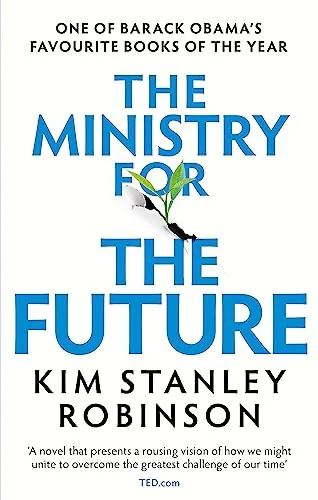
My first book to review is Kim Stanley Robinson’s, The Ministry for the Future. It is an epic. The paperback has a small font and has 563 pages. There are two main characters. There is a lot of implicit violence. It is also a book unusual in explaining economic and innovation concepts; for example, discounted cash flow (p 131); the Jevons Paradox (p 165); Gini Coefficient/equality measures (p73); MMT (Ch73); Bretton Woods (Ch50) and the International criminal court (Ch56), etc. There are also free lessons in glaciology and geoengineering amongst other scientific concepts.
The first of the book’s two main characters, Frank May, is an aid worker in Uttar Pradesh. It is 6am and the temperature is already 38 degrees and the humidity 35 per cent. We know that heat and humidity are a lethal combination. And so it proved. When the power failed all life-saving air conditioning shut off. During the course of the next few hours 2 million people died. What we learn from this is that 2 million people is the trigger for action. No state can sit back when 2 million of its citizens die from what is not a natural disaster.
The Indian Government’s near first response was to execute a programme of geoengineering – depositing particulates into the upper atmosphere to deflect the sun and cool the surface. This contravened the Paris Agreement of 2015. No state should unilaterally undertake a programme of geoengineering where the impacts are unknown and cross-border. But they did it.
Frank May improbably survives, but his whole life is haunted by the experience. His post traumatic stress disorder impacts on those around him. His focus is on bringing about change by whatever means. He makes contact with an organisation called The Children of Kali, a direct action grouping that targets the world’s climate villains; namely, those who caused climate change and those who perpetuate it. The bosses of oil companies require 24 hour protection. The owners of private jets do not sleep easy. Diesel ships and aeroplanes will sink or crash on the so-called “accident day”. That, at least, sees an end to mass aviation.
Rejected by the Children of Kali, Frank kidnaps the book’s second main character, Mary Murphy, the head of the recently established UN entity, The Ministry for the Future based in Zurich. He is not very good at kidnapping since he allows the kidnapping to take place in her own apartment, one which is monitored by the local police, she being a target – by the right for threatening their profits or the left for not doing enough to threaten their profits. Before the arrival of the police, Frank confronts her with the “left” position. The Ministry is not doing enough to change things. It is incremental, transparent and easily captured. He tells her about the Children of Kali and the kind of action needed to bring about real change.
On the arrival of the police, Frank disappears through a back window and goes underground until he is eventually apprehended by the police after defending migrants from an attack by local fascists – naturally, immigration is a real flashpoint, and immigrants very much a target. Frank is sent to prison for the kidnapping and his involvement in the death of a man on the beach whom he hit with a large piece of wood.
Scary though the the kidnap experience was, Mary knew that Frank was right. She discussed with her Chief of Staff, Badim Bahadur, whether the Ministry had any black ops, not dissimilar to the Children of Kali. He was not about to disclose any activities of the sort, but the very reticence suggested that the Ministry had such an arm. This, of course, leads to questions about who is responsible for what? Is the Ministry sinking ships or the Children of Kali, or some other radical outfit with little faith in mainstream politics?
A core vehicle for change is the carbon coin. It is discussed extensively in the book. It has key features; for example it has to be supported by central banks, is securitised by the creation of long-term bonds, it is rendered by blockchain technology. It works whereby: “Every ton [sic] of carbon not burned, or sequestered in a way that would be certified to be real for an agreed-upon time, one century being typical…you are given a carbon coin…the central banks would guarantee it at a certain minimum price, they would support a floor so it couldn’t crash. But also it could rise above the floor as people get a sense of its value, in the usual way of currencies in the currency exchange markets.” (p174). It is a form of carbon quantitative easing. And it is a market-driven mechanism.
The carbon coin is based on a paper (actually a series of papers/essays) by Delton Chen (p172 – https://tinyurl.com/4c27dj9a) author of the key paper: Chen, D. B., van der Beek, J., & Cloud, J. (2017). Climate mitigation policy as a system solution: addressing the risk cost of carbon. Journal of Sustainable Finance & Investment, 7(3), 233–274. https://tinyurl.com/5ervkk74
The cover brands the “Ministry…” as “one of Barak Obama’s favourite books of the year”. We all know how important that endorsement has been in recent years. Whilst this may be good for sales, I am not sure if the scenario presented has the legs the author and Obama think and hope for. The first part of the book is apocalyptic, for sure. Lots of bad things happen to people; obviously the heatwave that starts the book results in mass death, but the terrorism/state-sponsored terrorism takes its toll, too. We do not ever get to know who did what. Curiously, the terrorism seems to go without investigation. We do find out who may be behind much of the terror, however; namely, brown people.
The second half of the book simply reassures. Yes, the climate crisis remains present, but the trajectory starts to go in the right direction. Global emissions are cut seriously, not least by the incentive provided by the carbon coin. The scientist innovate in ways that give hope. Though this part is difficult for lay readers like myself to judge relative to the carbon coin initiative (which has at least been subject to peer review). Some of the glacier adaptations do seem fanciful not just scientifically, but also geopolitically. Admittedly, the book was written before the second Trump administration and the current phase of the Ukraine conflict, but even before then, it would have seemed optimistic.
I suppose my biggest misgiving is Robinson’s belief/hope that already-occurring warming can be reversed. Tipping points are recognised, but they do seem to be glossed over. Migration is recognised, of course, but it is still a “problem” to be handled by efficient bureaucracy. There is, equally, not much thought given to food security, biodiversity and shifting global alliances. Without the security of world order, much of what is described in the second half of the book is unlikely to be feasible. And I have no confidence that that world order will be maintained. For example, I worry particularly about food security, centred as it is now around global value chains, limited genetic diversity of core foodstuffs such as grain, rice, bananas, etc. Interested readers should read Tim Lang. Hungry people do not play be the rules. And because of the trajectory, the second half of the book loses its momentum, suspense and mission. For the final few chapters I was waiting for something to happen. But it did not because the author had already determined that the world had been saved and that one of the main characters can actually retire and travel the world in an airship! The book, therefore, has a very long and unrewarding tail.
Anyone needing more – and there is more – should read clever review using an ideal-type approach to criticism, see the work of Solarpunk – Hacker. Worth a good few minutes of your time.
 Be informed