Archive for the ‘Ishmael’ Tag
Ishmael, A Novel by Daniel Quinn, Review
Filed under: Book reviews, Environment | Tags: Daniel Quinn, Ishmael, Leavers, Takers
 Leave a comment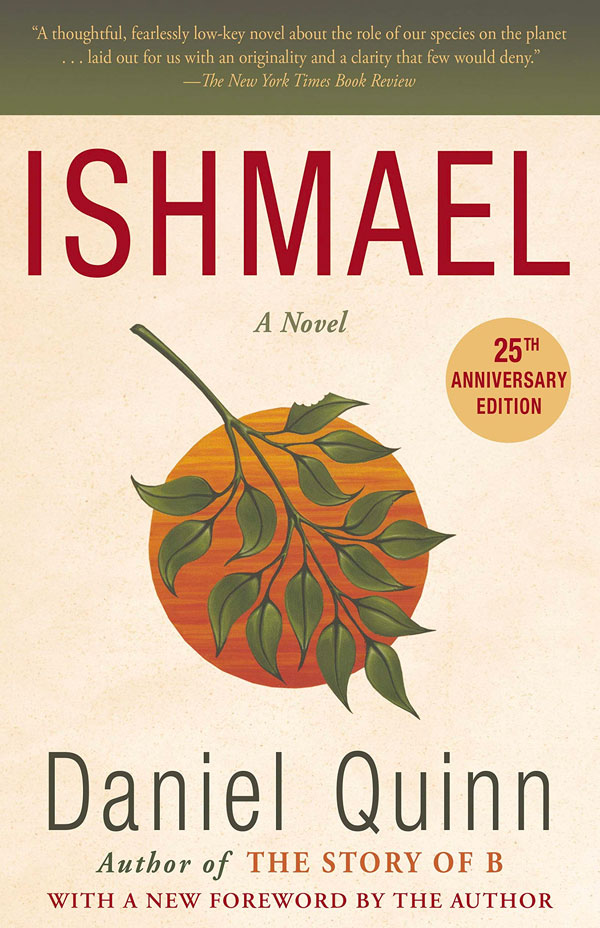
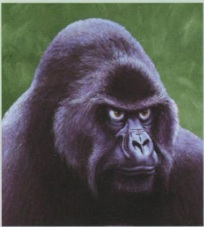
My dystopia reading progresses onto something less graphical and more philosophical, though no less fantastical. Fantastical because the lead character, the eponymous Ishmael, is a gorilla. A talking gorilla. And intellectual with it. Ishmael’s task is to reveal to us humans, through a series of lessons for pupils (the narrator) with an “earnest desire to save the world”.
Note from this point on, there are series spoilers. Read no further if you consider reading the novel. And as in all of my reviews, I have not referred to any existing writing relating to the book ahead of this blog post. I have read the 2017 paperback 25th anniversary edition (left). It was originally published in 1992. This edition does have a foreword by the author that reflects on the original text.
Ishmael had his own story of captivity to tell. He was captured from the wild from humans after his mother was shot. He lived out the first part of his life in a zoo which corrupted his sense of being a gorilla, in a family, in the wild. Just because there were other gorillas, that did not compensate for the loss of the wild and the social structures that it promoted. There are no mealtimes in the jungle.
The zoo fell upon hard times and Ishmael was sold to a travelling menagerie. The lone gorilla. A pattern developed as he realised that human visitors talked to him. This was different to the zoo experience. There humans only spoke to one another. Ishmael asked himself, why this would be. Visitors instinctively called him Goliath. He identified that eventually as a name. His name. Given to him by humans.
And then one day a lone man visited. After some observation he said “You are not Goliath” (p18) and then walked away. Ishmael considered this for a while and reasoned that he had not said that his name was not Goliath. Rather he had just said that he was not Goliath. That had a different meaning.
One morning he woke up in a different place. Much nicer. A garden of some kind. “[a] charming belvedere”. (p20) It belonged to the visitor to the menagerie and very soon he was beside his new gorilla telling him that he was not Goliath. Rather he was Ishmael. It turns out that his rescuer, a man named Walter Sokolow, was a successful Jewish merchant who’d lost his whole family in the holocaust. His relatives had been caged, just like Ishmael. His duty was to free Ishmael. Sokolow told his story to Ishmael not expecting a response. He was shocked when Ishmael stroked his knuckles in recognition of his pain.
On realising Ishmael’s intelligence, Sokolow taught him to speak. Through this process, together they healed. Sokolow married, had a child and acted as her (Rachel’s) mentor, much to the chagrin of the child’s mother, Mrs Sokolow. Mrs Sokolow eventually tired of the gorilla in their midst and slashed the funds available for his upkeep. But out of it, Ismael had realised a vocation; namely, to teach. And in particular, to teach captivity. For humans, notes Ishmael, “You’re captives of a civilizational system that more or less compels you to go on destroying the world in order to live.” (p28). It also works the other way around. The Earth is a captive of humans. Momentarily.
Ishmael then turns the table and asks the narrator to tell his story. The narrator’s story is somewhat shorter and revolves around a philosophy paper he wrote as a student dealing with epistemology. The premise was that the Nazis had won the war and gone on to erase all race from Earth apart from its own Ayranism. History then became a simple linear narrative. One a student, known as Kurt, in conversation with his friend, Hans, expressed some doubts. Doubts such that he was being lied to. The narrator’s own teacher then asked him whether he felt lied to as well. The narrator now is in search of the lie.
Takers and Leavers
Through the eyes of a gorilla, there are two types of humans – those who take and those who leave. Leavers are the original humans who did not question their lives as hunter gatherers or agriculturalists. As long as they had enough, they were happy to transfer between generations their knowledge, culture and natural wealth. They continued to evolve as they interacted with their environments and one another. They live in the hands of the gods (p255).
The takers split from the leavers around 8,000 bc. Takers – and they are very much still with us today – know no limits. For them growth is purpose. And what is more, the Earth belongs to them. It is there to be exploited and it does not matter if species become extinct because of this exploitation. There is always another species or habitat to exploit in pursuit of growth. Moreover, they do not care if they destroy the lives of leavers, particularly if they occupy land which can be used to grow more food to support their their ever-increasing population. The difference was agriculture that enabled humans to lay down roots, create civilisation, develop technology and engage in trade and commerce (pp72-3). With these came mathematics and literacy.
A barrier to growth had been lifted. It also brought about the idea that in order to progress humans needed not just to tame the Earth, but to conquer it. All of the limiting factors could be overcome with application of technology and dominion over the Earth and its web of life. The epitome of a Taker lifestyle is city life. Examples of Leavers are the African Bushmen or the Kreen-Akrone in Brasil. Takers live like Chicagoans or Londoners (p255). It it that lifestyle – a prison (remember, Ishmael is a teacher of captivity – his own and man’s) – of which “Mankind” becomes the enemy of the world” (p80). Indeed, Takers seek to end evolution and to do that they have to end the world, and least for man. “The whole thing is going to come to and end with us. In order to make their story come true, the Takers have to put an end to creation itself – and they are doing a damn good job of it” (p257). Man is the end product (p107).
Mother Culture
Underpinning the world views of Takers and Leavers is mother culture. Culture is defined as “…a people enacting a story” (p43). In this context, “[t]he Leavers were chapter 1 of human history – a long and uneventful chapter. Their chapter of human history ended about ten thousand years ago with the birth of agriculture in the Near East. This event marked the beginning of chapter two, the chapter of the Takers. It’s true, there are still Leavers living in the world, but these are anachronisms, fossils – people living in the past, people who just don’t realise that their chapter of human history is over” (p44).
Good and Evil
Whilst the debate is philosophical, the philosophy is grounded in religious faith. These sections are deep and take us to the book of Genesis. It is important to note that Ishmael – as a Leaver – sees the earth as a garden, not unlike the garden of Eden. Adam and Eve were leavers until the forbidden fruit incident. It is the knowledge of good and evil that takes “mankind” on the exploitation journey.
The Gods thought long and hard about Adam. Whether he has eternal life in the garden, whether he should seek the Tree of Life for himself or be guided to it (p172). If he spent too much time searching, perhaps he would be tempted to go to the Tree of the Knowledge of Good and Evil instead. Should he eat from that tree, he may think that he has the knowledge to rule the world. It is possible, then, that Adam might think that because he has eaten from the Gods’ own tree, whatever he could justify doing would be good and what he could not justify would be evil. For example, lions take the game that Adam could have taken had they not done so. On that basis he could justify killing lions as being good when in actual fact, it is evil. Put another way, what the lions do is evil and to kill them is good. Essentially, Adam convinces himself that he is equal to the Gods. Limitless growth is good and to accept the limits of the law (of finite growth) is evil.
The Gods’ Dirty Tricks
Ishmael’s approach had up to a certain point been one of Socratic dialogue with the student (the narrator). He strayed from that approach to highlight three dirty tricks the Gods played on man (pp107-8). First, man was disappointed to learn that he/the Earth was not actually the centre of the universe. That the Earth orbited the Sun, not the other way around. Man, however, could still believe that he was “the central figure in the drama of creation” (p107).
The second dirty trick was the nature of creation. Man would expect to have been a separate act of creation distinct from all other creatures. As Ismael says “[i]nstead they arranged for him to evolve from the common slime, just like ticks and liver flukes” (p108). The Takers really hated this but reconciled it with the belief at least that it remains man’s destiny to rule the world.
The final dirty trick is unreconcilable. “Though the Takers don’t know it yet, the gods did not exempt man from the law that governs the lives of grubs and ticks and shrimps and rabbits and mollusks and deer and lions and jellyfish. They did not exempt him any more than they exempted him from the law of gravity, and this is going to be the bitterest blow of all to the Takers. To the gods’ other dirty tricks they could adjust. To this one, no adjustment is possible” (p108).
Summary
Ishmael is a captive talking gorilla, taught to do so by a benevolent captor. He was an observer of human exceptionalism and takes on students with a view to “training the trainers”. If you were once a pupil you have a responsibility to do the same with others – 100 actually. A gorilla gives us a Leaver perspective on the world and our place in it. He reminds us – unnervingly – that other creatures with sentience and intelligence share the planet with us. They have needs and we – humans – have responsibilities not to impede or disrupt their Leaver and evolutionary lives.
The book ends with the question about what the pupil (narrator) is now going to do with his new knowledge. He is a pessimist and Ishmael makes clear that it is not good enough. He has to be a change agent. It is also the case that one cannot have had the experience of an education from a captive gorilla and not be affected by the experience. And not to feel that the duty has been transferred. The gorilla is a captive of human Takers in two senses. He has a physical cage and a metaphorical cage – that of the story made by the Takers. The narrator has a single cage which he now realises he is in and needs to liberate himself and humanity more widely from it. We see this in the demands of his editor. It is also true, now, that readers recognise that they are in the cage, too. So what is to be done?
Anyone wanting a more linear summary, this from Tom Murphy should do the trick.
A significant rebuttal from Joe Grins is here.
Contemporary insights

In the first instance, we perhaps need to recognise just how trapped we are. Takers have certainly been in the ascendant. The election of Donald Trump as president of the USA on top of Jair Bolsonaro in Brasil has shown Takers to be intent on ending evolution by destroying the life support system for “mankind”. Bolsonaro sanctioned extensive destruction of the Amazon rendering it a carbon emitter rather than a sink. In the US, the gutting of the Environmental Protection Agency under Lee Zeldin (right), the opening up of forests to loggers, rampant oil exploitation in pristine environments and subjugation of all conservation measures such as marine reserves speak to Ishmael’s greatest fears.
With Trump, there is more to be evaluated. Although he does have a genetic stake in the future, his narcissism is such that he seems to care little for their welfare. Arguably, as an old man, he sees perhaps his greatest “achievement” to be the end of a habitable world? If he will soon depart the Earth, then perhaps everyone else should go down with him? I do not sense that Ishmael envisaged such a nihilistic narcissist in charge, but collectively he saw the Takers inexorably heading towards the apocalypse, unable to stop themselves, convinced that the world is infinite in its bounty. And now ruled by a man who is truly evil.
Ishmael cogently expresses the interdependencies between living things and why, perhaps, the gods are not a good idea. Throughout the book the gods are considering the intended and un-intended consequences of their actions and decisions (particularly in the context of Adam and the Garden of Eden). Crucially, evolution – a Leavers concept – does not have un-intended consequences. Some creatures embed random mutations to their advantage. This does have consequences for other creatures that may or may not embed their own mutations in response. For example, some trees under attack can secrete chemicals that are toxic to the attackers. Clearly if they do not evolve, they will become extinct.
We then ask, is a hybrid possible? Can we be a mix of Takers and Leavers? We cannot deny that Takers have used their intelligence and technology to make their – and that of millions of others – lot much better: health, education, science, etc. The book does discuss the dichotomy in terms of civilised and primitive, but the author must surely be advocating a hybrid approach for a few reasons. Takers cannot go back to a primitive state. We cannot uninvent the Takers’ world. But we can use those inventions to reverse some of the damage caused by the Takers’ actions. This could be carbon capture, energy efficiency and clean tech more generally. But the narrator has a point with his pessimism, how do you get extreme Takers or narcissistic Takers to move back from the brink? One answer is that bearing in mind everyone reading this is a Taker, we are all doing something that we think is “good” – and good in the sense of the gods rather than the Takers. We have not eaten from the Tree of Knowledge of Good and Evil. That we do listen to the gods and we do determine what is good and evil not by believing in god(s) but by interpreting collectively from the knowledge that we do have what constitutes good (getting us to net-zero, for example). And the evil? The list is long: murder, violence, theft, war, corruption, etc.
Ishmael’s Destiny
This is at least one part of the story that I will not reveal. But let me put it this way, Ishmael’s destiny is locked into the very same laws from which man is not exempted.
Picture credits
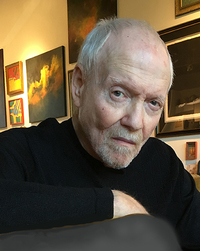
Daniel Quinn: By https://www.goodreads.com/author/show/10330. Daniel Quinn, Fair use, https://en.wikipedia.org/w/index.php?curid=58724088
Ishmael: https://www.ishmael.org/books/my-ishmael/
Lee Zeldin: By Unknown author – https://www.epa.gov/aboutepa/epa-administrator, Public Domain, https://commons.wikimedia.org/w/index.php?curid=159082104

