The Drowned World, JG Ballard, book review
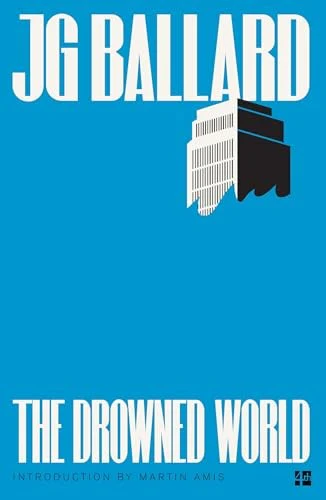
This book is not a modern climate change novel (I read the 4th Estate paperback published in 2024). First published in 1962, the same year as Rachel Carson’s Silent Spring was published, Ballard envisages severe climate change caused by “[t]he succession of geophysical upheavals which had transformed the Earth’s climate…a series of prolonged solar storms lasting several years caused by a sudden instability in the Sun had enlarged the Van Allen belts and diminished the Earth’s gravitational hold upon the outer layers of the ionosphere. As these vanished into space depleting the Earth’s barrier against the full impact of solar radiation, temperatures began to climb steadily, the heated atmosphere expanding outwards into the ionosphere where the cycle was completed.” (p21) The polar ice caps melted and civilisation’s cities were submerged under water and silt. Children are a rarity.
Temperatures began to rise steadily. Quite a bit of the story takes place as temperatures are heading towards those that cannot sustain human life. The people have gone north (though the terms of the migration are only scantily discussed). Declining fertility has reduced the human population to around 5 million. A residual population of biologists and scientists are studying/surveying the territory after London – or was it Berlin or Paris? – flooded and became a series of fetid lagoons populated by aquatic reptiles, notably caimans and iguanas as well as delightful malarial insects. There were also some remainers to be rounded up by Colonel Riggs and his team of former military operatives occupying a test ship.
The story focuses, however, on Robert Kerans (who lives in the top floors of the abandoned Ritz Hotel a penthouse suite complete with ready-to-wear wardrobe bizarrely left in place after the exodus) and his possible girlfriend, Beatrice Dahl. Beatrice is an independent-minded woman who refuses to leave when the authorities say they should (because it is going to get hotter and wetter). Beatrice lives in a block with a swimming pool and balcony and tends to her appearance assiduously, despite the apocalypse around her. The accommodation had once been her grandfather’s pieds à terre. He had been in money and had brought her up after the death of her parents soon after she was born.
Beatrice Dahl lay back on one of the deck-chairs, her long oiled body gleaming in the shadows like a sleeping python. The pink-tipped fingers of one hand rested lightly on an ice-filled glass on a table beside her, while the other hand turned slowly through the pages of a magazine. Wide blue-black sunglasses hid her smooth sleek face, but Kernans noted the slightly sullen pound of her firm lower lip. Presumably Riggs had annoyed her, forcing her to accept the logic of his argument. p.25
I say this because she is the only woman in the story. Not quite only a love interest, but her role is to be Kerans’ almost girlfriend and to the the desire of the true villain of the story, a character called Strangman. She reminds us of civilisation’s narcissism (actually, I mean capitalistic narcissism) in the sense of a simple definition of human female beauty and obsession.
Riggs wants to leave with the full team; notwithstanding Kerans’ and “the Dahl woman”, a character called Dr. Bodkin, Kerans’ assistant at the station, remains and Hardman who was the subject of a lively chapter as he was hunted down by Riggs’ men, only to slip away. He does reappear in the final chapter symbolising perhaps what can rapidly happen to us when we experience de-civilisation in combination with severe climate change; the two are not unconnected, of course.
The de-civilisation is best seen in the arrival of Strangman and his band of machete wielding looters. Their raison d’être is to loot what has been left behind as the cities flood, in this case, London. By some jiggery pokery, he manages to deploy pumps and dam walls to drain the lagoons, reveal the buildings, including museums, and take what is valuable such as jewelry, historical artefacts and equipment. He becomes increasingly meglomaniacal throwing lavish parties, entrapping Beatrice and wearing down and eventually torturing Kerans. Bodkin tries unsuccessfully to blow up the walls that keep out the water. His punishment is death.

Kerans is eventually saved from the machetes by the unexpected return of Colonel Riggs, along with his “dour conscientious Scotsman called McCready”, a troop of unnamed soldiers and weaponry. Within hours, though, Kerans has himself determined that the lagoons should be returned to leave alone the flooded cities and their secrets – basically, undo Strangman’s work and looting project. Whilst he does manage to blow up the walls, Colonel Riggs is not happy and shoots at Kerans injuring him in the leg. Kerans escapes, says farewell to Beatrice and achieves a getaway south (into the heat and storms). It is here that he is reunited with Hardman to reflect on a return to a world from the past – the primeval soup, effectively.
Shanghai
Most novelists draw on their own experience, at least for their first novel – as this was for Ballard. Ballard’s experience was one of 3 years in an Japanese internment camp and the huge floods that came down the Yangtse River. Ballard had a background in science – he was an editor of a scientific journal. He had also been a medical student practised in cutting up cadavers. So the extraordinary science behind the solar storms that precipitated his climate change made sense. The descriptions of the lagoons and their unfriendly inhabitants may be grounded in that, too.
Meaning

I have to admit, this is my first JG Ballard novel. Well, not quite. I read Crash many years ago, and I remember none of it! What I might be able to say is that Ballard has a particular view of human nature. Whether it be de-civilisation or sexual pleasure derived from road accidents. There is a sense of existentialism. None of the characters in The Drowned World seem overly interested in making things better. They live very much in the present and are highly individualistic – Beatrice with her appearance and stubbornness on the leaving question, Hardman and Bodkin, equally rejecting a flight to the North and some other kind of life, and Kerans himself finally and inexplicably leaving Beatrice with Riggs and fleeing into the abyss.
Here is existentialism on one side, and surrealism on the other. Beatrice’s penthouse is adorned with original works of Salvador Dali, Paul Delvaux (above left, picture taken from our recent visit to Vienna’s Albertina Gallery, Landscape with Lanterns) and Max Ernst. Surrealism propels us into fantasy world with new configurations of the familiar to unnerve us and push us towards deep reflections about what we understand by reality. They have a dream-like quality. And one dream in particular is recurring (and possibly haunting) the team. Beatrice’s so-called jungle dream briefly described on page 50 where she also reassures Kerans, “[d]on’t look so stern, you’ll be dreaming them too, soon.” And so he does.
As the great sun drummed nearer, almost filling the sky itself, the dense vegetation along the limestone cliffs was flung back abruptly, to reveal the black and stone-grey heads of enormous Triassic lizards. Strutting forward to the edge of the cliffs, they began to roar together in the sun, the noise gradually mounting until it became indistinguishable from the volcanic pounding of the solar flares…As the dull pounding rose, he felt the barriers which divided his own cells from the surrounding medium dissolving, and he swam forwards, spreading outwards across the black thudding water…” (p71)
The dream – in particular Kerans joining the ranks of those suffering them – is a trigger for some form of acceptance that humanity cannot survive in this de-evolution. The Drowned World is one that is returning to one that is dominated by reptiles, best adapted to the new reality of heat, swamp and flood. It might be feasible in the North to survive. but with a declined birth rate, the prospects are not good. So what is the point?
Picture: JG Ballard, http://www.zarez.hr/124/kritika1.htm


Interesting. Had never heard of this book..
Hopefully my spoilers do not prevent you from reading!