Climate Watch: “EU green washing”
 The UK has now left the EU just as a seemingly progressive new president, Ursula von der Leyen, sets out her plan for addressing the climate emergency. According to Yanis Varoufakis (left), Greece’s former Finance Minister, and unwelcome interlocutor during the currency and debt crises that nearly saw Greece default, it all amounts to Green washing.
Varoufakis asks us to compare the intervention by the EU in the banking crisis to that “committed” for climate change. He notes that €1.6tn was channelled to Europe’s bankers, “while imposing stringent austerity upon the European citizens they pledged to serve. When in 2015 they realised that more support was necessary, the European Central Bank printed €2.6tn”. The European green deal is worth €1tn over 10-years “to reduce the EU’s greenhouse gas emissions by at least 50% compared with 1990”. The contrast is not all it seems. The money used to bail out banks was new money, of the Green Deal budget only €7.5bn is new money, the rest comes from existing budgets and is designed to trigger a private-sector investment boom. Moreover, the EU Commission is is providing €29bn for gas projects.
The EU Commission itself estimates that annually it should commit €260bn to meeting its own emission targets. Varoufakis argues that the EU remains committed to its austerity package at a time of need (for drastic emissions cuts) and opportunity (to transform the economies of European member states). There is a thing called the “just transition mechanism” which recognises that some member states’ economies are more locked into fossil fuels than others; for example, Hungary and Poland, both of which have overtly populist governments, themselves not on message when it comes to climate change. For Varoufakis, the “just transition mechanism” is anything but – but it might just go some way to at least prevent these member states from making too much noise.
Picture:
Climate Watch: the Johnson record so far
 The Guardian newspaper in the UK is doing some pretty good cataloguing of the UK Government’s climate change record in contrast to the declared commitments. The latest – from which I draw prose – further develops the Prime Minister’s record.
First of all, Johnson has an unenviable record when it comes to voting for policies to tackle climate change. He has opposed policies for onshore wind subsidies, emissions-based vehicle taxes and carbon capture and storage. Indeed, he is on record as referring wind turbines as “white satanic mills”. He is reported as being in receipt of donations of £5,000 from Michael Hintze and £25,000 from Terence Mordaunt (via First Corporate Shipping), who fund the climate science denying Global Warming Policy Foundation whose honorary president is Nigel Lawson.
When he was foreign secretary he oversaw a 60% cut in the UK’s team of climate attaches across the world from 165 to 65 charged with furthering the Paris Accord.
We all recall that he said that he would lie down in front of the bulldozers starting on the Heathrow third runway. However, he was absent from the vote in Parliament that sanctioned it and we also recall his own preferred option, a hugely environmentally damaging project to build a new airport on the Thames in East London. He has written in his newspaper columns about his support for shale gas fracking and has argued that warming has more to do with solar activity than carbon dioxide emissions.
Notwithstanding all this, he still seems to be squabbling with the Scottish Executive about the venue for COP26 rather than finding a viable and respected president to get a result come November.
Picture: – User:AlbanGeller received this from the Cabinet Office.
COP26 – it gets worse
 Today was the day of the Prime Minister’s big speech on the climate emergency. This quote from the Guardian: ““I hope that we can as a planet and as a community of nations get to net zero within decades.” “We’re going to do it by 2050, we’re setting the pace, I hope everybody will come with us. Let’s make this year the moment when we come together with the courage and the technological ambition to solve man-made climate change and to choose a cleaner and greener future for all our children and grandchildren.” Ah yes. The Children.
The Independent quotes him as saying: “Even the aviation industry has now committed to being carbon-neutral by 2050. We are on the verge, I am assured, within a couple of years, of having viable electric passenger aircraft. And we will get there. That is the lesson of that electric taxi. The sceptics are wrong to doubt the Promethean genius of humanity to solve these problems.” This kind-of confirms that he does not get it. Or anything, for that matter. Boeing and Airbus are still building regular planes. Planes are long-lived.
Talking of the Aviation industry. They have a plan, too. The CEO of Heathrow Airport was on the radio this morning arguing that black is white (more runway capacity leads to less carbon dioxide, that 70 per cent growth and carbon neutrality are possible with new planes, new fuels (that still cause carbon emissions) and the already-discredited “offsetting”). The interview can be heard here:
The Prime Minister did announce that the manufacture of diesel, petrol and hybrid cars and vans will be ended by 2035. And that seems to be it for how carbon neutrality is going to be achieved. The Times is additionally reporting that the Prime Minister asked David Cameron and William Hague to replace the sacked Claire O’Neill as COP president. Need I say more?
Climate Watch: COP26 farce and contraditions
The most important meeting the planet has ever had, COP26 is in trouble. COP25 in Madrid was a failure. No new substantive plan to achieve carbon neutrality by 2050 was agreed. From that moment on, the focus moved to COP26 in Glasgow, possibly the last chance to prevent catastrophic warming (above 2 degrees celsius).
Meetings like this are not about the day, there is a whole diplomatic effort required ahead of the arrival of the world leaders. Essentially, the substantive papers making up future agreements are rubber stamped at these events. They are not negotiating fora. But we learn this morning from the newly-sacked Chair of COP26 Claire McNeill, that the venue has not even been confirmed because of a “stand-off” with the Scottish Executive – “playground politics” as she called it. And we now learn that the Prime Minister “does not get climate change”. This bizarre interview can be heard here .
Then we need to put November into context. The UK will be one-month away from not agreeing a Free Trade Agreement with the EU. It is the same month as the US presidential election. The incumbent, as we know, is not only a denier, but also someone who is actively unpicking environmental protections and promoting fossil-fuel extraction and consumption. That was already going to be a tough ask, now it seems almost impossible. One wonders whether the UN will move it. As O’Neill said in her interview, the politics has got to be stripped out of this; there is too much at stake.
Then let us look at the UK Government’s own contradictions. I have been listing these over the past few weeks. So far we have reduced-energy efficiency regulations for house builders, and approval for dirty electricity generation. There’s more, it seems. Less than two weeks ago, The Prime Minister was at the UK-Africa summit announcing an end to the funding of coal-fired power plants in Africa. What he did not say was that the conference agreed £2bn of investment into African oil and gas.
Then at his 3 February press conference on a trade deal with the EU, Johnson said that he wants a deal on aviation, so “cheap flights can continue”. And then without even a hint of irony, that UK climate policy will be determined by science, not by “mumbo jumbo”. The science is clear, fossil fuels have to stay in the ground and that aviation has to be taxed, not promoted.
Climate Watch: the British Government being sued over new dirty electricity generating capacity
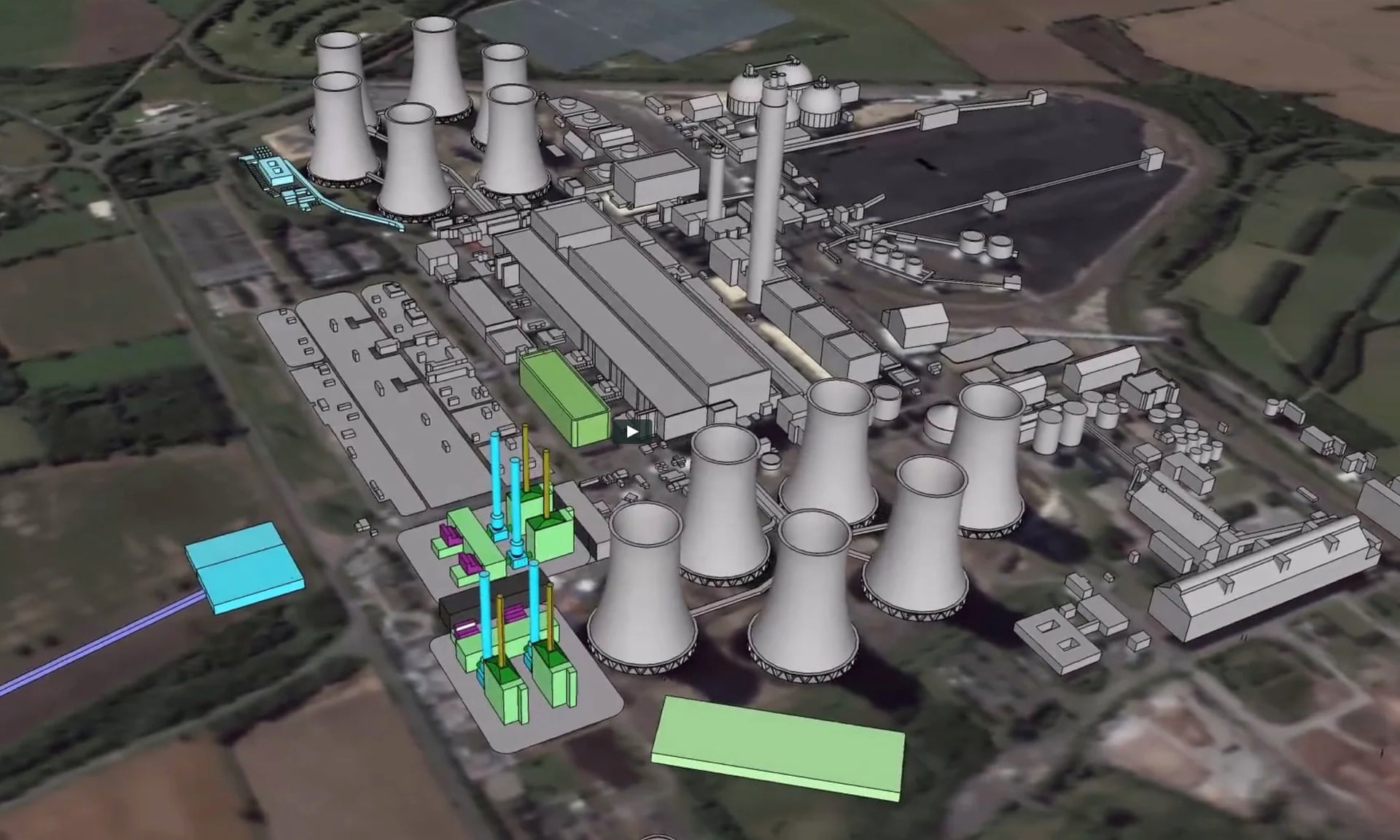 Simple – The UK has carbon targets to meet – though recent arguments suggest that these targets are increasingly irrelevant. The country cannot meet the targets with extra fossil-fuel generating capacity. The Government is advised and ignores. The capacity concerned is Drax power station in Yorkshire. Currently Drax has 2 coal-fired stations that should be phased out by 2025. The new station will use gas fossil-fuel and could be responsible for 75 per cent of UK power station emissions when fully operational. The 3.6GW plant would potentially contravene the Climate Change Act of 2008. There will be no carbon capture technology fitted to the plant. The electricity generated will also be more expensive than renewable sources.
In October 2019, Andrea Leadsom (right), Secretary of State for business, energy and industrial strategy, approved the plans against  advice. The High Court has now given permission to ClientEarth, a law charity, to sue the Government, with a possible hearing in the Spring. The Government does not have a good record on defending itself in the courts against environmental claims.
Pictures: Drax Plc, Andrea Leadsom, Chris McAndrew
Original reporting, The Guardian, 30 January 2020
Climate watch: vigilance
Filed under: Environment, Housing, Politics | Tags: Building regulations
 Leave a Comment
  That annual meeting of plutocrats at Davos this year, despite the dedicated theme being Stakeholders for a Cohesive and Sustainable World– let me shorten that to climate change – managed only to get “members” to plant 1 trillion trees. Greta Thunberg said, as one might expect, “not enough”. Offsetting is not the solution. The solution, again spelled out in capital letters for a global audience, is to keep carbon in the ground – no more mining investments, no more oil exploration. Oddly, there was no commitment on that.
What the 1 trillion trees commitment (I have no idea how this would be done) does – and this is forever clear in diplomatic endeavours – is make it possible for the denialist political leaders to sign up to it. I sense that if they are prepared to endorse something it probably suits them because they can be seen to be endorsing something meaningful, but they will not be held accountable for not doing it (apologies, two negatives there). What, for example, is the USA’s quota? It does not take into account current destruction – willful or otherwise. Are we in any way able to trust a president who is prepared to contaminate the drinking water of his people, as Trump is doing?
In Britain we have our own untrustworthy leader. I am going to use my blog to keep a record of any violations to commitments that I come across. So, let us start with energy efficiency in homes. The UK housing stock is generally poor, even when insulated. OK, there may not be much that we can do to improve that, but when it comes to new housing stock, surely builders should be building to the highest standards? Since 2013, new building projects have been judged against a notional (high) standard encompassing all aspects of building; for example, thermal efficiency of materials. Additionally, local authorities are planning authorities and set their own standards. Many have declared a climate emergency. This will no longer be an option for them. Any new law will override local preferences/standards.
With the built environment contributing 40 per cent of national carbon emissions, this is an obvious policy area where real cuts would make a difference. But obviously, the building industry seems to have been lobbying for a loosening of the regulations. That does not seem to be the case with architects who have grouped together to call for increased standards. As one noted in the above embedded article “From disregarding the performance of a building’s fabric to ignoring the embodied energy of materials, the proposals represent a total loosening of regulations. And it’s all hidden in a dense consultation document that seems designed to confuse.” Jo Giddings, from Architects Climate Action Network quoted in the Guardian (24 January 2020).
Expect much more of this.
Makers and Takers, review
Filed under: Book reviews, Environment, Finance and Economics |
Leave a Comment  There I am in the bookshop and the owner offers me Rana Foroohar’s lastest book, Don’t be Evil..., about the inherently evil Big Tech. He detects my interest, but not quite in this book at this moment. Then he reaches for Foroohar’s earlier work from 2016, Makers and Takers. In true Douglas Adams style I bought it because it was slightly cheaper, but unlike the Hitch Hiker’s Guide to the Galaxy, it did not have a reassuring title (Don’t Panic). Indeed, this book’s subtitle, How Wall Street Destroyed Main Street, could actually be re-titled, Panic. It is that troubling.
How does this book fit into my current reading? Regular readers know that climate change is occupying my thoughts  at the moment, indeed my current reading (right) is shockingly pertinent (also used by my bookseller to cause an exchange of money from me to him). The finance industry is both a cause and solution to the climate crisis. To understand how it might solve the crisis, it is worth knowing – or at least reminding oneself – about the dark side of finance. How, despite the financial crisis of 2008, in Jarvis Cocker’s words, The cunts are still running the world. And indeed, ruining it.
This is a gripping book. I know most of the story, but here it is nicely sewn together. Essentially as a Financial Times journalist – unusually so – Foroohar has been a chronicler of the story in bite-sized chunks, in real time. She reminds us about the banking industry’s original functional purpose for capitalism, to provide the funds for investment in the productive economy. She takes us through the deregulation of the industry in both the USA and the UK that crucially broke the separation of boring, low-return retail and business banking and lending and the riskier investment, speculative and hedging activities. Moreover, the central banks in those countries are both lenders of last resort (always reassuring when engaged in risky trading), regulators and, in tandem with the state, secure a compliant civil society and the system of law that favours capital over labour.
Wall Street is also complicit in the financialisation of business. Faroohar reminds us how large firms avoid tax by offshoring their earnings abroad; how they increase the value of their firms by share buy-backs financed by lending (for example, Apple) at the expense of innovation in product and services; and how the executives of these firms remunerate themselves not on the basis of salary like their employees, but rather by shares attracting capital gains tax rather than income tax. This provides the incentive to inflate the value of the firm independent of its products. Here Faroohar cites the case of Pfizer, so desperately short of innovative products, but rich nonetheless.
We see how the finance industry thrives on private and public debt, itself fuelled by low interest rates. The lower the interest rates, the more lending (and hence money generation) becomes feasible. The lower the interest rates, the more money there is to buy property which squeezes out of property ownership a good percentage of private citizens – or at least gets them to overstretch themselves in pursuit of loans. And when whole neighbourhoods become bankrupt, the finance sector provides the money for equity funds to buy up swathes of cheap properties, rent them out, often supported by the state and tax payers, and take rather than make.
The finance sector steals our pensions, ensures the high price of commodities, including essential foodstuffs. And, particularly in the USA, personnel enjoy the revolving door between Government and Banking and vice versa, over and over again. We see how the banks, private equity, and their customers monetise public goods like research and development executed in publicly-funded universities and research centres but privatise the benefits. By offshoring their profits, they return only a fraction of the value generated to source.
Where does the environment come into this? The climate crisis that is ramping up can be still solved by investing in zero carbon technologies, infrastructures, public procurement, education and lifestyle changes. It does not. The finance sector has become an end in itself rather than the means by which an economy can be radically changed in a relatively short space of time. Not only do they not lead in investment in green technology, but they actively lobby against it. And because of the revolving door, a bubble is generated whereby business-as-usual – that is, making money – remains the priority. Challenging this is the struggle of the century. And if we do not win it, the climate will change. Badly.
UK General Election, 2019
Back in 1983 I recall the disappointment of seeing the Labour Party under the (then) EC-sceptic, Michael Foot, heavily defeated in the polls. I admired Foot’s intellectualism, but his programme – once billed as the “longest suicide note in history” – was too backward looking. The past it referred to was never going to cut it. My early 20s, then, were haunted by Thatcher “reforms”. It seemed like every evening I came home from work and listened to the radio some new regressive policy was being announced by some ugly minister. In particular, Nicholas Ridley and Norman Tebbit. But there were more ugly ministers than them.
Finally, in 1997, the egregious Tory Governments imploded and the fresh Tony Blair led Labour to victory. Many of us had hoped to see John Smith as a Labour Prime Minister; but his sudden death on 24 May 1994 – I shed a rare tear on hearing the news – paved the way for Blairism. Blair was elected on a platform to accept the early Thatcher neo-liberal “consensus”; for example, not rolling back anti-trade union law. Indeed, the Labour Government furthered the project. In not putting a check on many of the Thatcher excesses, it made it very easy for Cameron to take over in 2010 where Thatcher and Major left off. Even worse, in deregulating financial services, a Labour Government enabled the financial crisis of 2008 and the wicked austerity that followed, the Brexit referendum, and now, with the election of a majority Conservative Government packed with characters that would make Thatcher’s Cabinets blush, an assault on all public services, institutions and the fragile constitution that so outmaneuvered May and Johnson as they attempted to get dodgy legislation through the Parliament in the face of far smarter people than themselves – here I think of Dominic Grieve and Hilary Benn, but again, there were others.
I’m not going to reflect further at this point. At a personal level, where we are now is quite the most frightful and positively scary place we could be. A demagogue now sits on a very large majority who can – and will – do what he wants. In the face of a climate emergency where every month counts, I am particularly concerned. But as I have written before, democracy is a process, not an event. I am part of the process. Come with me.
Al Gore – What if

By Erik Charlton from Menlo Park, USA
When I am home alone, I usually eat with some video accompaniment. At the moment that is dominated by Trump’s impeachment hearings and the commentaries by Seth Meyers, Stephen Colbert, Jimmy Kimmel, Samantha Bee and Trevor Noah. Meyers has his near-daily, ten minute “Closer Look” monologue (search through Youtube). Funny, interesting, intelligent. And when it ends, the algorithm directs me to more of the show which is quite show-biz focused. Not my bag. Last night, however, it took me to clips of him interviewing Al Gore, the former US Vice President who almost became President in 2000. We got Bush instead. In light of my previous reading of Rob Hopkins’ book, What if? What if? But we are where we are.
OK, it seems that I’m now bingeing on Al Gore. Back in 2008 he did a TED talk. I watched it this morning over my lonely breakfast. Two observations to share with my readers. First, When Gore was VP, he had to deal with conflicts which he classified as local, regional and global/strategic. Each level requires different skills, organisational forms and resource allocation. This is the essence of decision, to reference the title of Graham T. Allison’s famous book. Environmental issues, argues Gore, fit into three categories, too. Climate change, however, is global/strategic. That means global organisational forms, global resource allocation and a pooling of skills and knowledge.
Second, investments in tar sands and shale oil are “sub-prime carbon assets”. Remember, this was just at the time of the financial crisis. On reflection, he is wrong. Sub-prime mortgages nearly brought down the the global economy; in the end it enriched those who had caused the crisis. No bankers went to prison, austerity was inflicted on the victims of the crimes not the perpetrators. The bankers were rewarded with positions in Government (Trump administration, for example). By contrast, climate change will bring down civilisation. Those investing in the extraction of carbon from the earth and burning it will not be rewarded this time around. Economics is within our control, it is a human construct. Climate change is physics. We’ve got 10 years. We’ve got the technology.
In the UK there is a general election next month. Let us start there. Let us make GE 2019 the climate election, not the Brexit election.
Post script: Gore says, I paraphrase, let us make it that in the future great orchestras, poets, playwrites are able to create their art with the knowledge that the current generation of leaders did indeed do the right thing.
Hopkins on imagination and What If?
 I’ve been working my way through Hopkins’ book (left) over the last few days. It has left me thoughtful. As readers already know, this book prompted me to end my addiction to Twitter – without which I would currently be reading tweets rather than writing and reflecting.
But what is “what if”? It is predicated largely on the realisation that things have to change. There is one thing the climate emergency absolutely forces us to do, that is to conceive of a climate catastrophe. We cannot avoid it. It makes “what iffing” so much easier. We can get roads closed – albeit temporarily – and turn them into green spaces, play areas, spaces to meet, discuss, choose, decide. This is what happened in Tooting High Street in London, the bus terminus turning circle, was closed on Sunday in July 2017; the A259 trunk road through Hastings, where I live, was closed for a day in September 2019 and transformed into a music stage, a bicycle repair workshop, an arena for a wheelie competition and a political discussion and debating area, amongst other things.
“What if every university declared a climate emergency and all of its courses were taught through that lens? What if we created a fossil-fuel-free energy system within 20 years? What if every new house built generated more energy than it consumed? What if urban agriculture became utterly common place? What if our cities became huge biodiversity reserves? What if single-use plastics were something we only saw in museums?” Schools are perhaps more aware of climate change than are universities, but they maintain a pedagogy that, according to Hopkins, suppresses imagination in their forced pursuit of grades, regulatory approval and attendant rankings.
Hopkins takes us to various places where examples help with our often depressed imaginations: Totnes in Devon (not so revealing); Liège in Belgium (ever so revealing). Liège, a city I pass through frequently on my way to Munich by train, set itself a challenge back in 2013 to create the means to grow the majority of the City’s food on the land in the immediate surrounding area. Liège now has mass co-operative food projects, vineyards, organic mushroom growing off coffee waste, a brewery, sustainable distribution and restaurants. There is a Co-operative of Co-operatives that has political and economic bargaining power. What if?
The book is not just about climate change. Readers are asked to consider wider issues mediated through liberated imagination, but that itself requires major structural changes to education and the reversal of trends against art in schools. Unrestricted play – play of the imagination, unmediated by technology – argues Hopkins, needs to start in school and migrate to the workplace and community.
Another major inhibitor of “what if-ism” is our own health. Modern life is stressful and society itself is plagued by anxiety and deeper mental health issues. These block imagination in a way, perhaps, that is functional for the economic and political forces of inertia that at best shape our lives, at worst, destroy our humanity and with it the environment that sustains us. But stress is also a chemical process that impacts on the Hippocampus – our “hub of memory” in the brain. We damage it at our peril, affecting both long- and short-term memory. It is the interaction between the two, notes Hopkins, that facilitates imagination – and with it, future scenarios.
Then there is nature; actually, we are at our least stressed when with trees and listening to birdsong, it seems. From my own experience, I know my own blood pressure is reduced by contact with nature. Here in Hastings, a walk along the beach is only matched by half a bottle of wine in efficacy. One of these is healthier and indeed cheaper than the other. This realisation makes the transformation of our towns and cities into green zones logical and politically feasible: parks, playing fields, city farms, swimming pools and gardens are all exploitable in this respect.
We have a general election imminently in the UK. There are rumblings of alternative models – the leader of the opposition, Jeremy Corbyn, was laughed at when he suggested that we should work only for four days per week rather than five, despite there being plenty of evidence that such working arrangements do not come at the expense of productivity. Working longer does not benefit society. To be laughed at over this is bizarre. The PM, Boris Johnson, was laughed at when he claimed trust was important in government and society. That I can more understand as a response.
We have to get smart.

