Paris, 14 April 2012
 Leave a Comment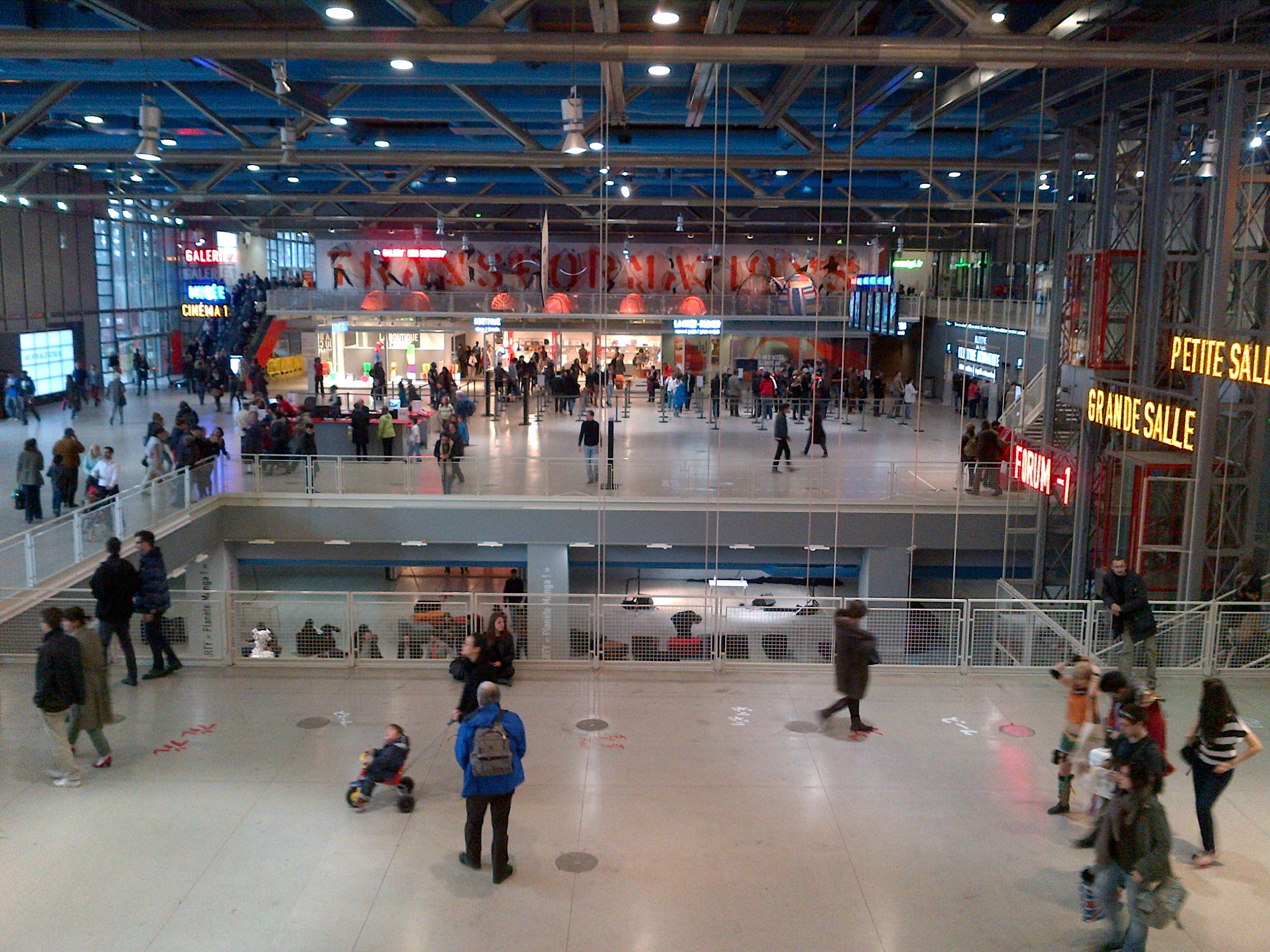
Foyer of Pompidou Centre
The Pompidou Centre contrasts very nicely with the Louvre. It is brash, loud, bright with a somewhat different clientele. It is open later – on Saturday’s the gallery at the top (where until next month the Matisse paintings can be found) is open until 2300). We managed only to get to the 3rd floor which houses the permanent painting collection up to the mid-1970s. There one finds a wealth of Picasso, Ernst, Miro, Kandinsky and even Pollock.It is vast, with each theme explored in small versatile cubicles. There are lots of little alleys each displaying surprises and examples of the moving image from the period, too. Statues adorn the many terraces (unfortunately so do the smokers).

Terrace, Pompidou Centre
The staff are also extremely knowledgeable and friendly. For example, when viewing the delightful piece by Raymond Duchamp-Villon, Le Chat, we learned about his brother and their involvement in WWI.

Duchamp_Villon
Paris, 13 April 2012
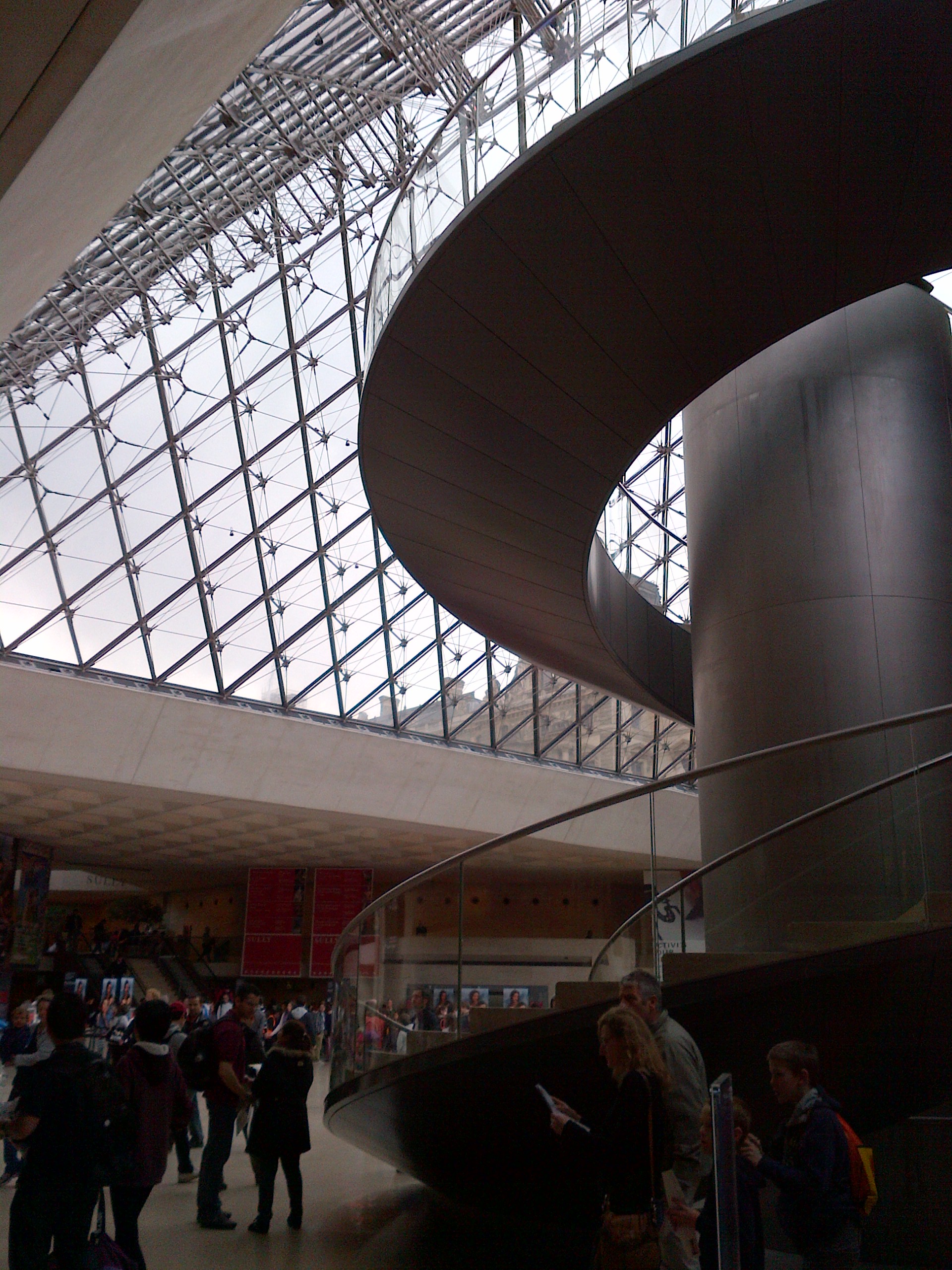
Louvre entrance area
One objective for this trip was to go to the Louvre. My two previous trips have either been too busy or the weather has seemed to be too nice to go inside. This time in we went on a Friday, mid-afternoon. The Louvre is open until 2130 on Fridays, so by mid afternoon it is a little quieter, but only a little. The main entrance area under the Pyramid is heaving.
The Denon Wing houses the Italian and Spanish paintings from the 15th and 16th Centuries. This includes the Mona Lisa and many other masterpieces. It is a tough wing to explore. The paintings are sometimes 3 high and the lighting hardly ideal especially if one’s eyesight is as poor as mine becomes.
The Mona Lisa is appropriately displayed in the middle of a large room. There are  a lot of people trying to get to see her, made all the more difficult by the fact that the painting is so small. In Leonardo terms, we should be grateful that he finished the painting and it survives. The other Leonardo painting in the Louvre – The Lady from the Court in Milan, La Belle Ferronnaire – had no visitors when we passed by. Though it may be that it was actually done by an apprentice. Equally beguiling, from my own untrained eye.
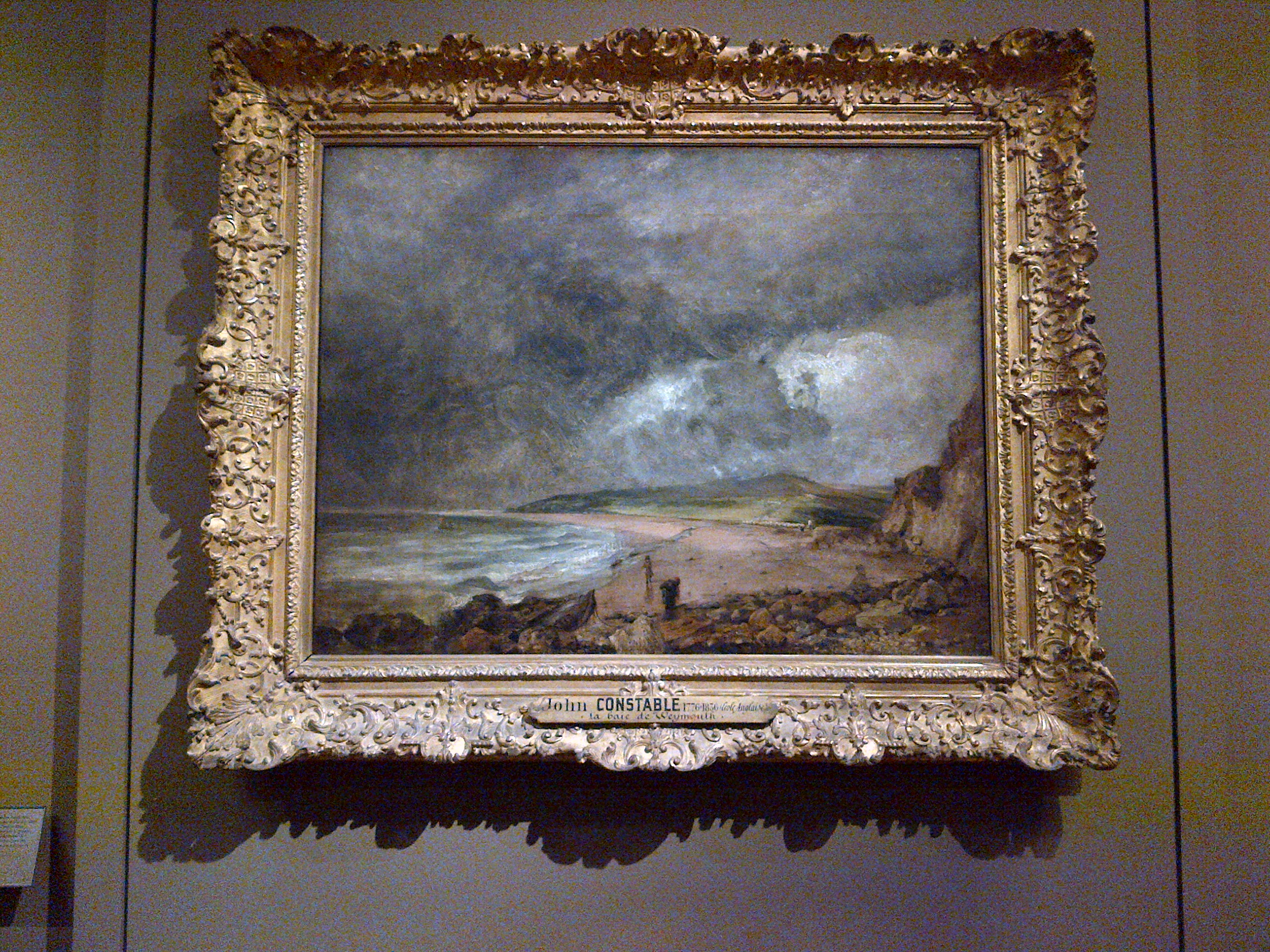
Constable's Weymouth Bay
The gallery containing the Italian and Spanish art is long, very long. Right at the bottom, unexpectedly, one finds a small English enclave. There are two Constables nestling there. I took a picture of Weymouth Bay whilst no one was looking.
Paris,12 April 2012
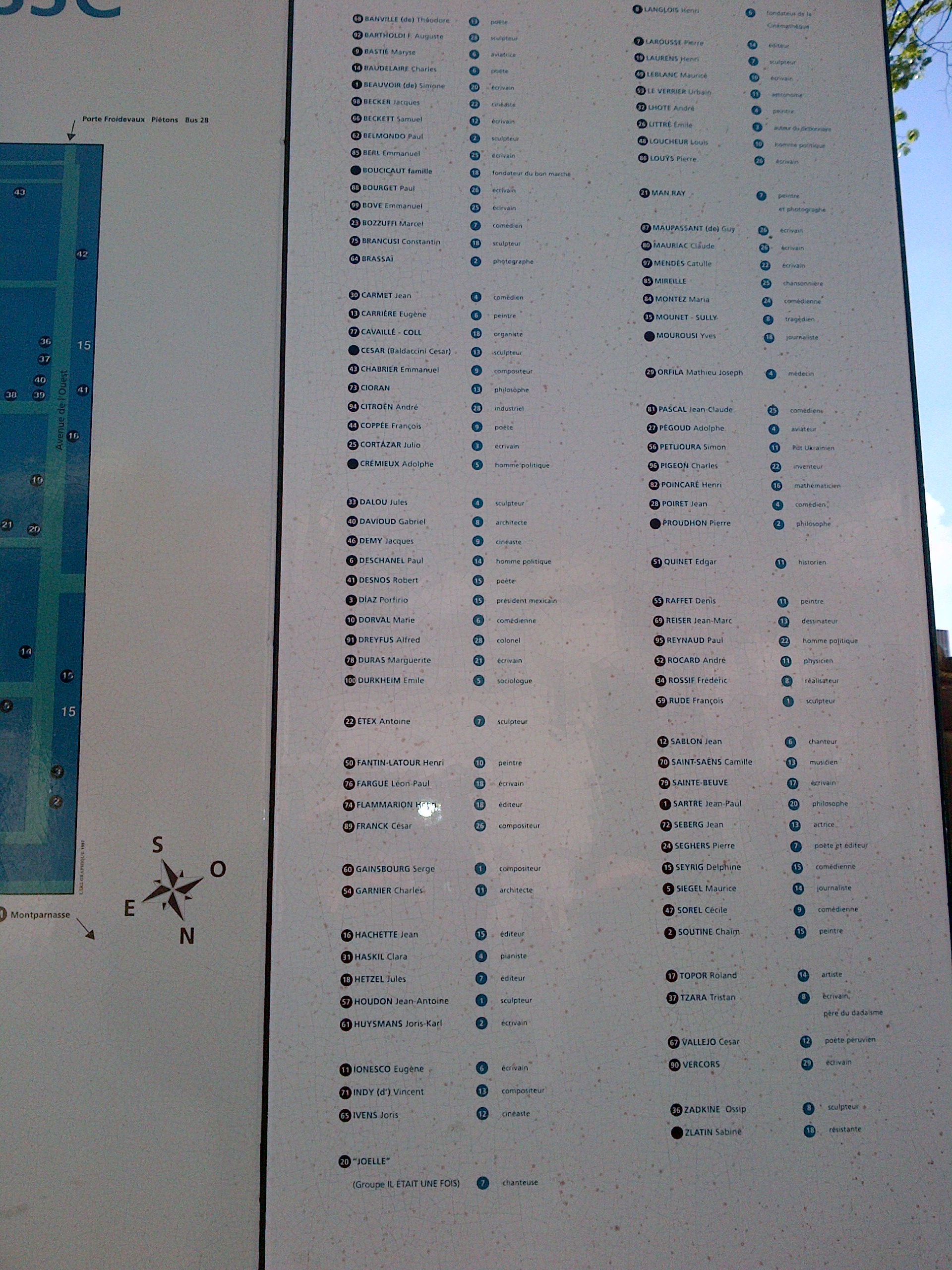
 Paris in the Spring has a lot to recommend it. I’m staying in Montparnasse, a district to the south of the Seine. It is full of boutiques, cafes and theatres. The cemetery is packed full of the dead famous and not so famous but rich. The grave of Jean Paul Sartre and Simone de Beauvoir is suitably spartan. Visitors here leave behind their metro ticket held down with a small pebble.
The grave of Serge Gainsbourg is an altogether more riotous affair. There are lots of trinkets left on the stone or hanging from  some suitably disreputable bushes growing at the rear. The inevitable portraits of the man are there also.
This is not an overtly religious place, though the majority of the gravestones, sarcophagi and sculptures 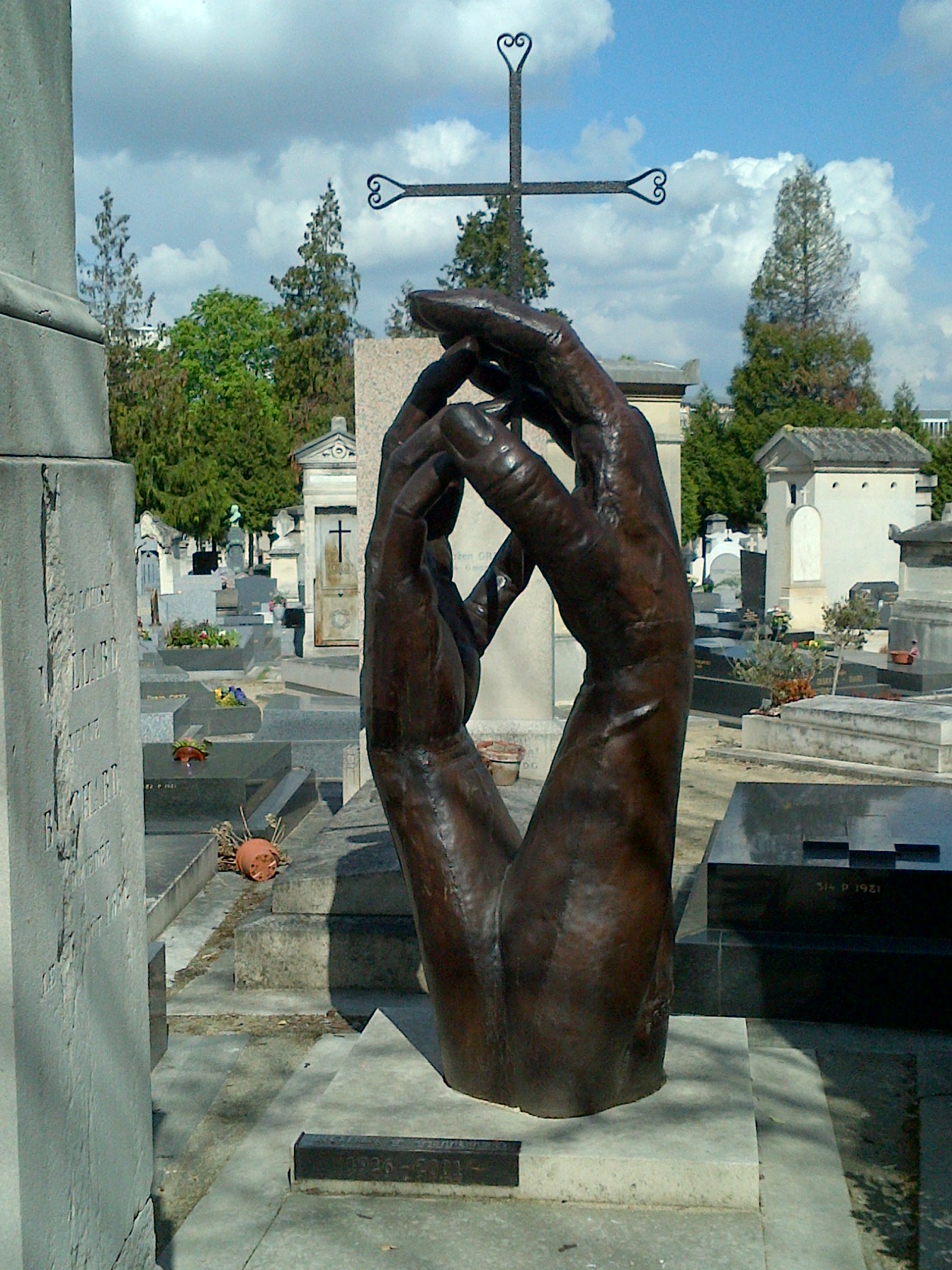 have some religious symbol. These hands, for example, are beautifully sculptured, though they clasp a cross. The occupant is Robert Thibier.

Lacoste
The other notable that we witnessed, was Bernard Lacoste whose stone is relatively simple, with a little bit of greenery. A photo of the man adorns the headstone, as well as the company logo, the instantly recognisable crocodile. Nice bit of marketing.
A full list of the famous housed is available at the entrance to the cemetery.
Privatising schools
I have written many times about Michael Gove; but whilst most have been preocuppied by NHS reforms, Gove has continued his assuault on comprehensive education. The march of the Academies has carried on relentless with over half of the country’s high schools converted on the promise of higher budgets, albeit independent of the local education authority that often brings economies of scale to works and procurement.
The motivation is, of course, selection – a return to grammar schools. Elitism. But there is a light in all of this. Local education authorities may be a thing of the past, but schools may still need to organise themselves co-operatively, as there are genuine benefits to be achieved by collective provision. Let us see how it develops.
Marlboro get in on the act
 Young people are directly targeted by the cigarette firms. The latest Pall Mall ad – which I don’t have a snap of yet – features a group of young people on a rooftop enjoying the spring with alcohol and cigarettes. There are some curiousities here. In most of the Pall Mall ads featuring young people, it only seems to be one of them actually smoking.
Marlboro’s latest advertisement features young people in a night club. There are no explicit images of individuals smoking, but being thrown in the air is certainly fun. The slogan MAYBE NEVER WILL defeats me. Any help on this would be appreciated. However, the text at the bottom indicates that the tar that one receives in smoking the cigarette may vary depending on how one smokes it; i.e.  inhaling or not. That’s reassuring.
Anyone interested more widely on global trends in the cigarette industry might care to visit: http://www.cigarettezoom.blogspot.com
For more pictures visit: https://www.facebook.com/media/set/?set=a.3099817648662.2141196.1060779322&type=1
Vauxhall Vivaros and their gearboxes
 My delightful Vauxhall Vivaro has – since I bought it last July – had a reluctant 2nd gear. On Friday this reluctance became obstinance. It ceased to be co-operative. Moreover, it had equally convinced 4th and 6th to join the club.
A quick look on the internet demonstrates that this is not an uncommon problem with these vehicles. Maybe I should have stuck with the Transit and not listened to the salesman? Oh well. It looks like my wallet will need to be opened pretty widely to compensate for this poor engineering.
See new post from 24 July, 2012.
Privatising roads
Not content with the National Health Service, now the Conservatives want to privatise the roads on the grounds that we do not have enough money to build or repair the network. Some thoughts.
First, governments, even indebted ones, can raise money for infrastructure cheaper than the the private sector (as the Private Finance Initiative demonstrates only too well). Second, tapping into sovereign wealth funds means ceding infrastructure to the Gulf States? Third, we know it is not about raising money, rather it is about paying big business well to run services that we can manage better – cheaper – inside. The railways are a case in point, nomatter how the Transport Secretary thinks she can reorganise the railways, the private sector has milked and will continue to milk the public coffers because they can. Because we let them. And every time the Government offers more assets, not surprisingly they accept them and get fatter.
Privatisation of the NHS
Why do the Conservatives hate public provision of services so much? The Guardian reported this week the privatisation of NHS Devon and Devon county council’s frontline services for children including some child protection services, treatment for mentally ill children and adolescents, therapy and respite care for those with disabilities, health visiting, and palliative nursing for dying children.
Who are the two front runners in this £130m contract? Serco and Virgin. Seemingly fallen by the wayside is a joint bid between Devon Partnership NHS trust, bidding along with Barnardo’s and other local charities.
I’m no fan of poor NHS management and care. But it does matter who runs the NHS. It does matter that those running it are not subject to shareholder pressure. Money is tight enough as it is, adding another shareholder dimension is unhelpful or even unethical. Virgin branded healthcare is in bad taste.
http://www.guardian.co.uk/society/2012/mar/15/devon-nhs-childrens-services-privatisation?INTCMP=SRCH
American assassin of Afghanistan
A lone man with personal problems was responsible for the massacre of 16 civilians in an Afgahn village on 11 March. The soldier, a 38 year old staff sergeant, we are told, was under stress, had himself been injured and had recently seen some of his own comrades seriously injured resulting from Taliban attacks. It was too much for him, seemingly. He left his compound, found some houses in a nearby village and then shot 16 people in the head. Now in custody in the USA, we’ll see what justice is meted out.
The story needs unpicking somewhat. Robert Fisk, writing in the Independent, reports that something like this was anticipated. General John Allen addressed the soldiers a mere three weeks before against taking revenge against Afghans for American losses arising from the riots generated after American soldiers foolishly burned copies of the Koran. ‘Now is not the time…’ etc (not sure if any time is the time for murderous revenge, but we take the point).
The media has, however, bought into the the lone deranged madman story, rather than reporting that he was in actual fact a cold-blooded murderer of Afghan civilians.
At best, this is shocking news reportage – across the board. At worst, collusion. This is not what the news media are for. Shameful.
The special relationship
So David Cameron is now in The USA shoring up the special relationship. The speeches yesterday on the Whitehouse lawn were  somewhat over-the-top with respect to how fabulous the Camerons and the Obamas are. The description of beacons of liberty, freedom, justice, etc. from both sides seemed to have a certain other worldliness quality. Where does constant regime change, interference in other countries’ affairs, Guantanamo Bay, assassination squads, privatisation, bank bailouts….fit into all of this.
Nice clothes.

