Author Archive
Graduate Show, University of Brighton 2014
The graduate show always delights and infuriates in equal measure. Thematically, some portfolios are a shade generic, hackneyed, even. However, originality can be seen. As well as pure aesthetic beauty and delight.
 First, then, the originality. The work of Samuel Woodman, No Ark, seems to fit the bill.
  Here as part of a video loop, the animals as skeletons walk past us (left). And then us (right).
 Hannah Mary Kynoch’s work has originality in terms of subject matter. She has a thing about bathrooms, in particular student bathrooms. She uses colour to capture the fetid nature of student bathrooms. Green seems appropriate. More salubrious bathrooms have a lilac shade (left).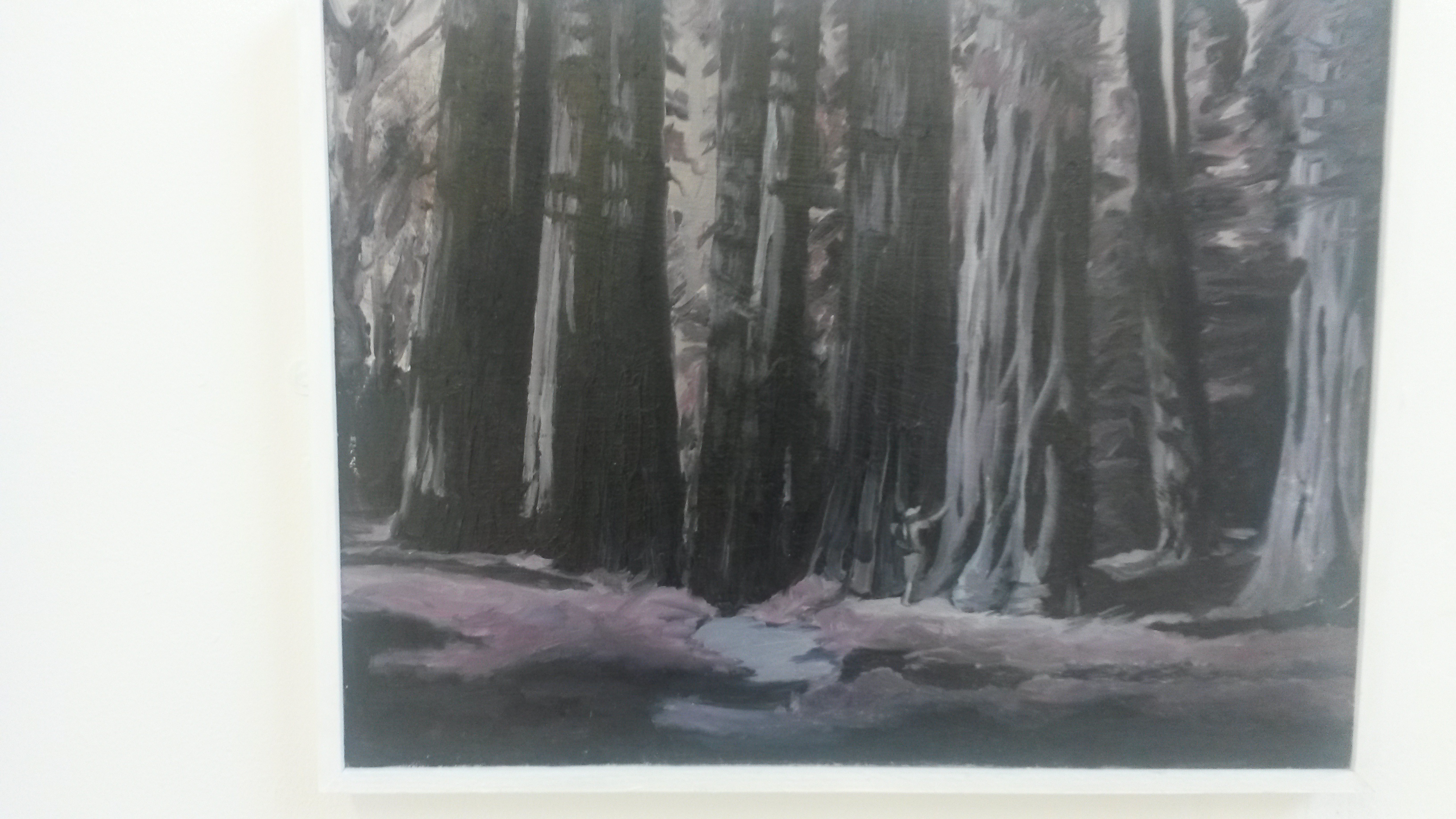
There is something this year about lilac and purple. I am seduced that by looking at the haunting forest scenes by Emily Hillier (Dark Trees, right), that lilac adds a bit of melancholy. It reminds me of the poems of Robert Frost.
 Wood features also in the work by William Wade (left). The wood this time is not forest, but rather wood found in urban settings, most particularly in parks in Brighton and Hove. At his stand at the exhibition are nice photographs of his very large works resting against their subjects saying ‘nice likeness’.
Next on my list was the striking portraiture by Charlie Schaffer. This is Dave. The creases in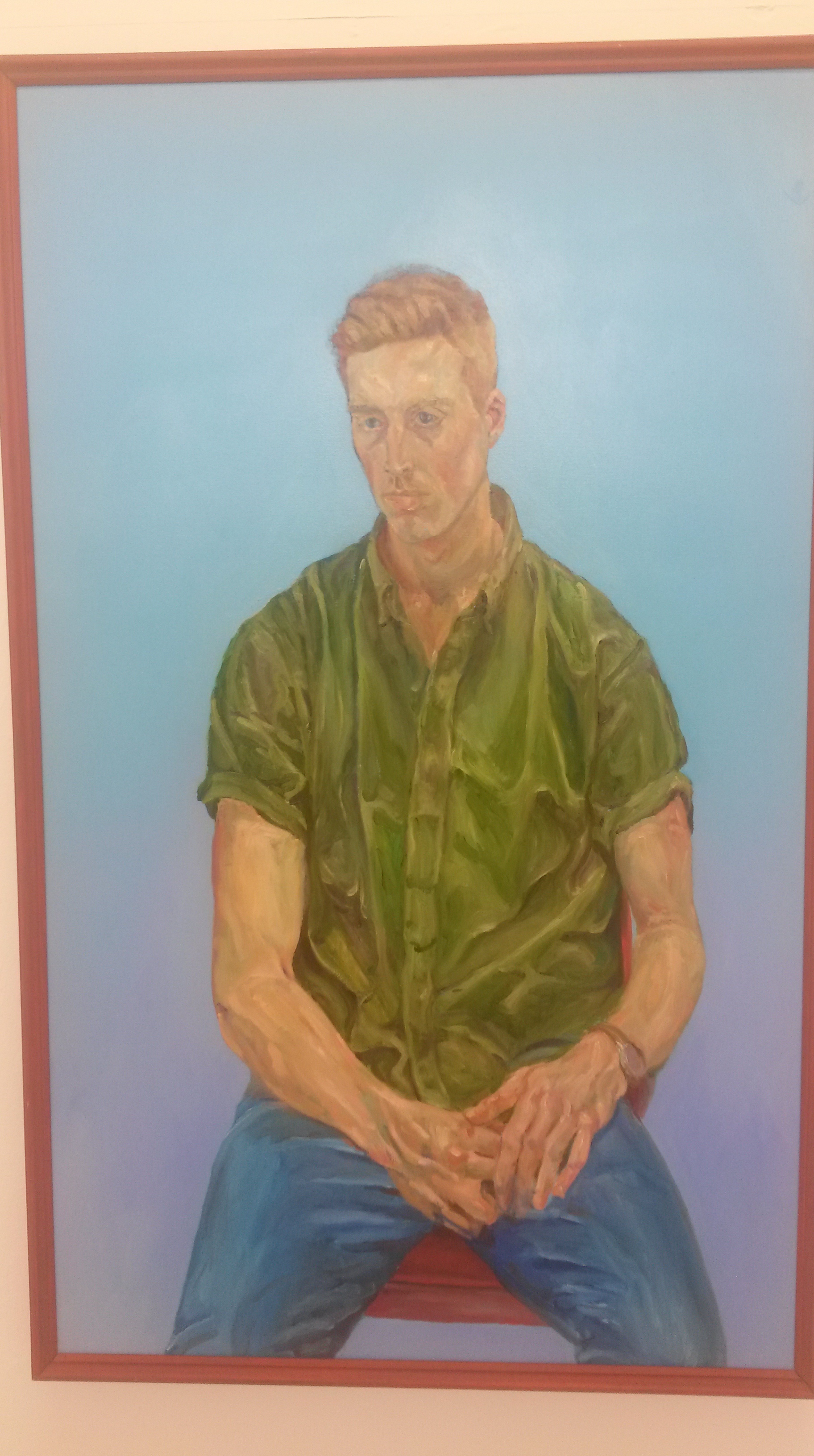 the clothes are juxtaposed with equally creased arms. There is a lot of primary colour in his work. I felt that I could actually talk to Dave, though I am not sure what we would talk about.
 There is one room that has the obligatory ‘explicit content’ note on the door. Often these rooms are a little disappointing. Often the work includes a lot of collage and does not, for those of us in mature years, have much to say. This year I found one portfolio that at least challenged my eyes. Emily Franklin presented a group of self-portraits, largely untitled (for example, left). These are large, colourful and ambiguous. Franklin’s explanatory panel is not too helpful in dealing with this.
Rosie Hancock’s work has a disconcerting familiarity with it. Elements of the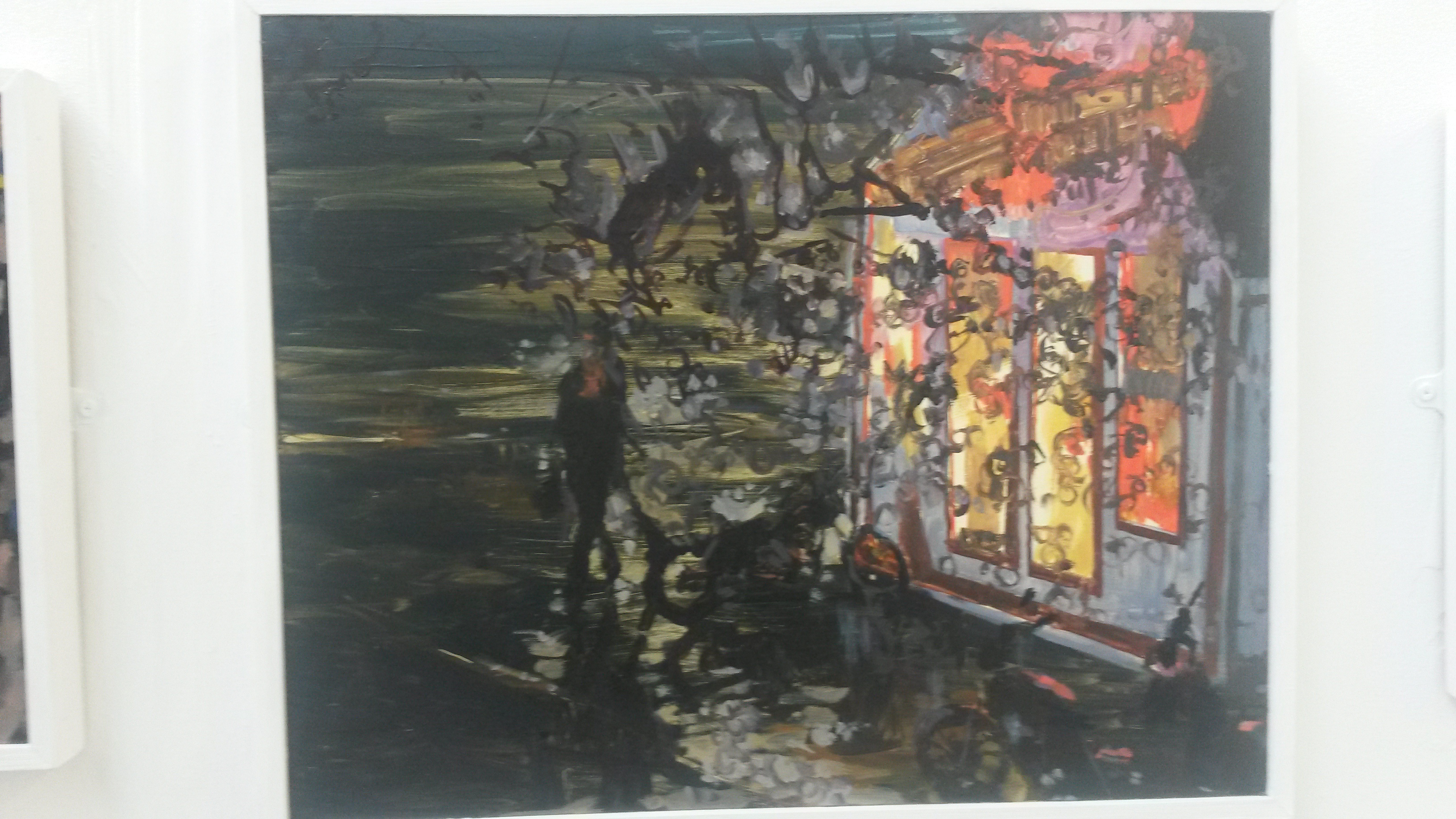 pictures have warmth, others menace. Put together, the pictures’ narratives need a bit of work by the viewer. The picture on the right has happy home feel about it; though the figure approaching is of indecipherable character?
 Sacha Pratt’s figurative work bears a certain ordinariness that is easy to recognise and feel at home with. I grew up in an industrial town. I think I know this place.
With art there is always room for romance. The portfolio from Francesca Salisbury was spot on. Using colour, visual 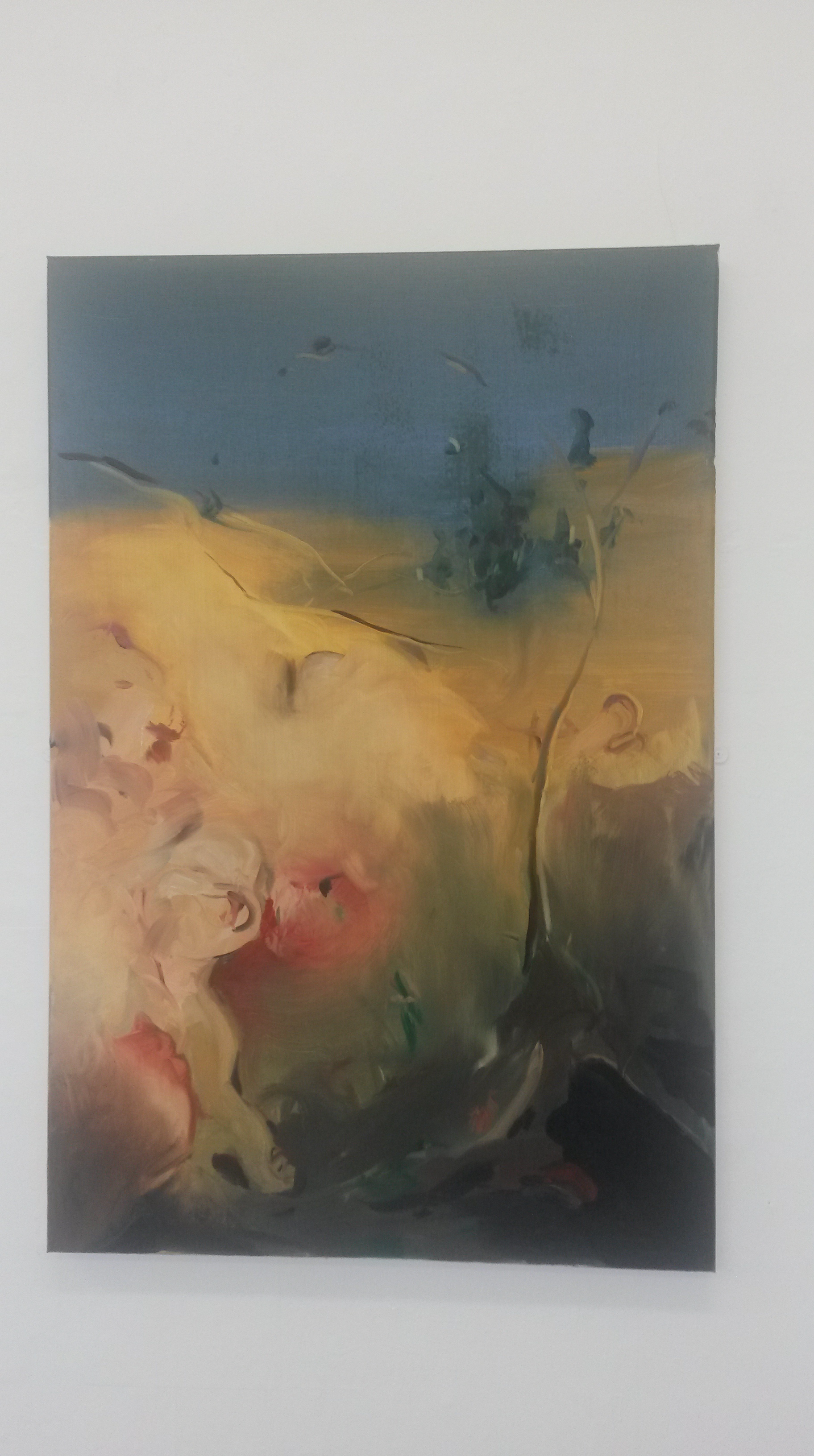 trickery and size, I fell in love immediately.
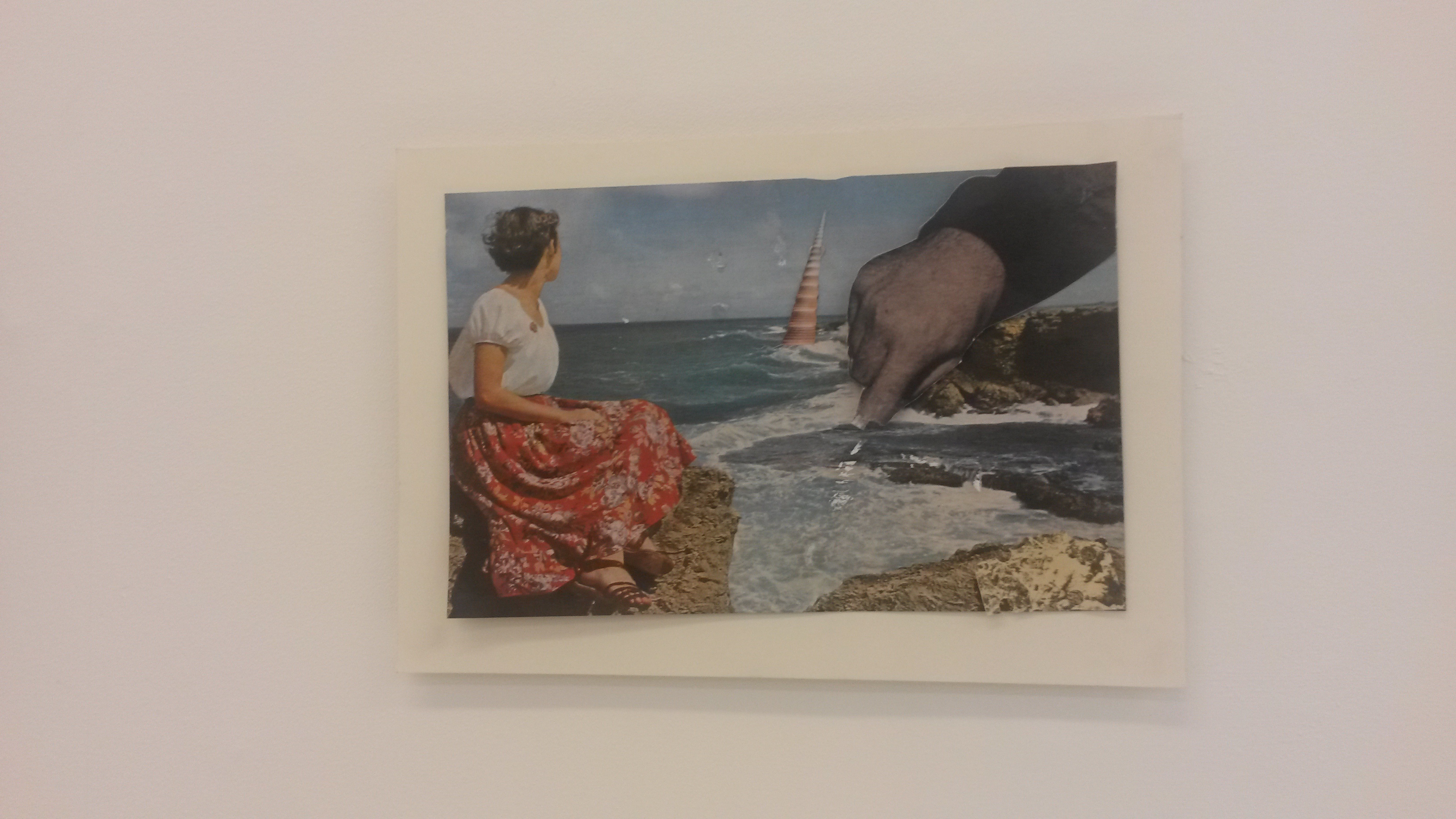 Finally, I have a favourite postcard called “The idea of marriage never appealed”. The collage work of Mica McDonald is equally other worldly. And unlike most of the other pieces in the show, this is tiny (left).
Lucky Strike out Marlboros Marlboro
Filed under: Cigarette advertising | Tags: Lucky Strike, marlboro
 Leave a comment
  Since Marlboro’s controversial Maybe campaign (various examples on this blog), Marlboro has been pursuing a “without additives” approach. Dull if nothing else. Meanwhile Marlboro’s traditional territory, men in farming landscape with cigarettes, seems to have been reoccupied by Lucky Strike. Lucky Strike is still perfecting its strike-through approach (left). So we go from the main point of everything being right (Hauptsache-recht), to everything being real (echt), including the lung cancer.
To save on budget, as I imagine these fantastically clever strike-through slogans must cost a fortune to compose, they are using them twice (right).
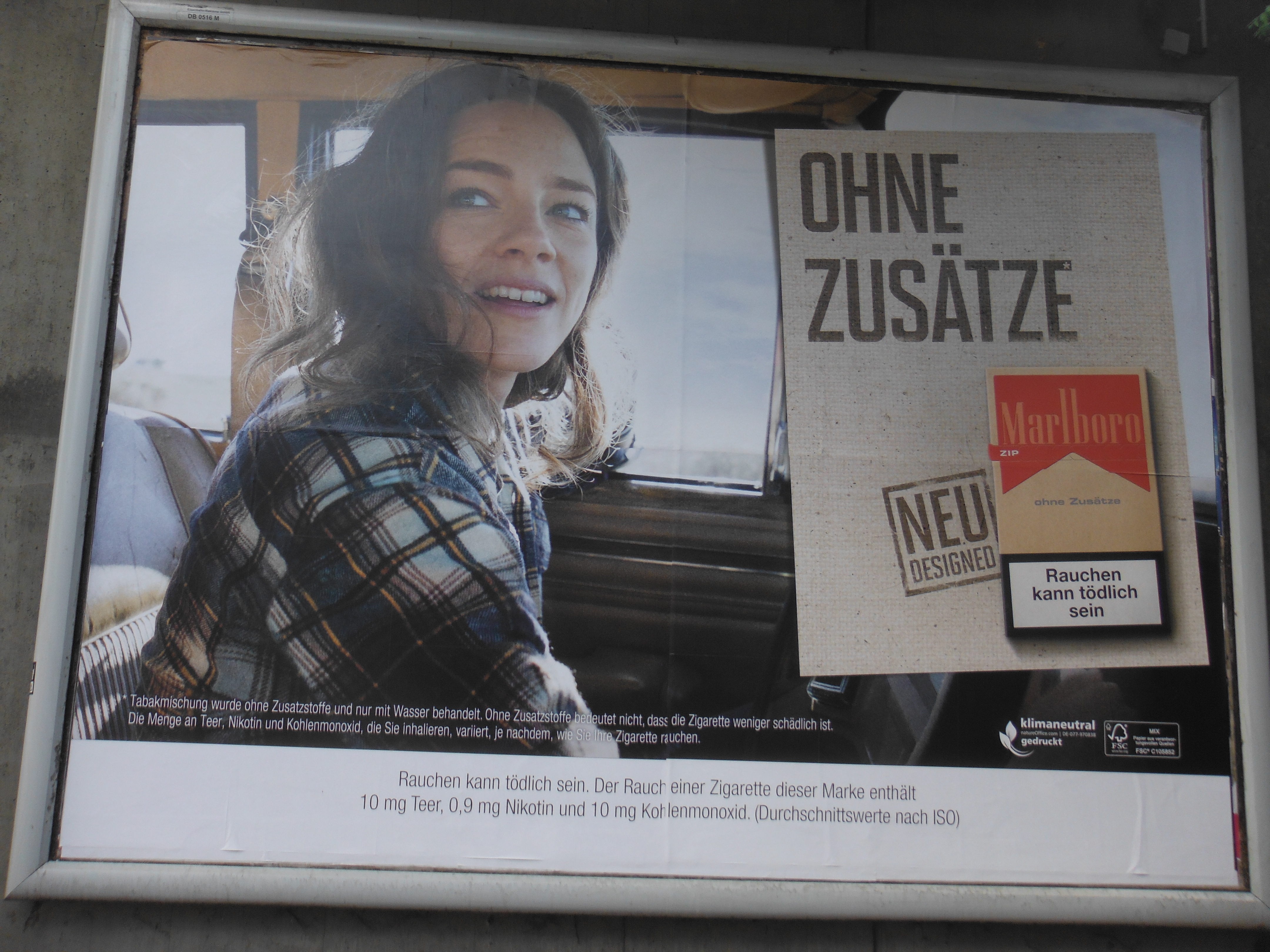 Poor old Marlboro. But wait a minute, there is now a fight back (left). It is the Marlboro Frau wearing the lumberjack shirt, in a vehicle in the countryside with added no additives. Take me to the tobacconist.
After the elections…
 …back come the cigarette advertisement posters. Currently we find Pall Mall with its summer love theme. Young people enjoy life (see also post 19 April 2014), this time with a camper van that does not quite seem to be a VW. If I read it correctly, the van has broken down, but it does not matter because there are three women and two blokes with beards and/or cigarettes. Who needs travel?
Cooking kohlrabi
 I’ve never cooked kohlrabi before. Probably because it looks too much like a turnip. I have never liked turnips.
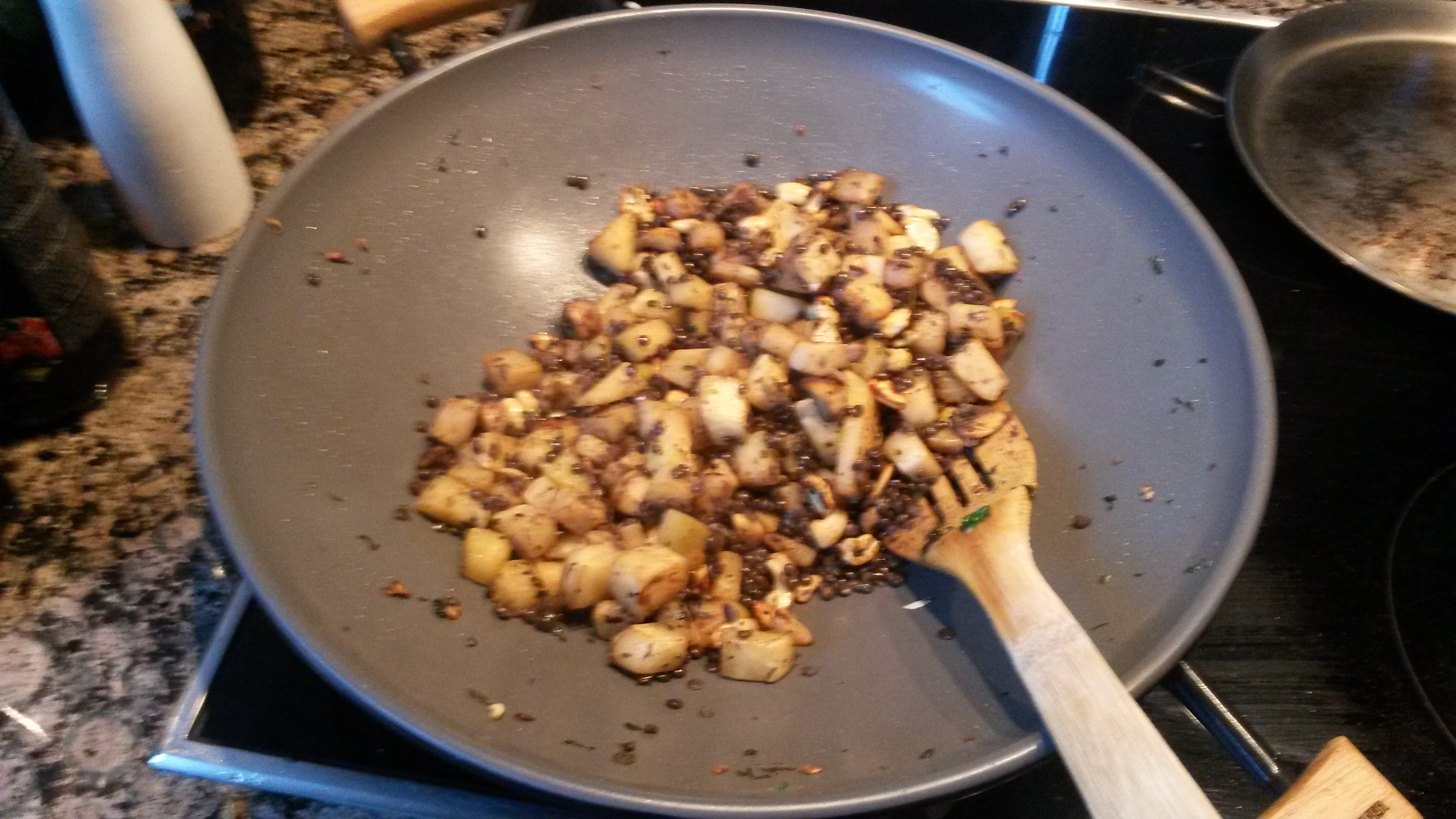
So, to find one in the refrigerator required some action. I diced it and sautéed it in olive oil in a wok along with a few mushrooms, cooked black lentils and cashew nuts (left). I seasoned the mixture with black pepper and fresh parsley. I then wrapped the mixture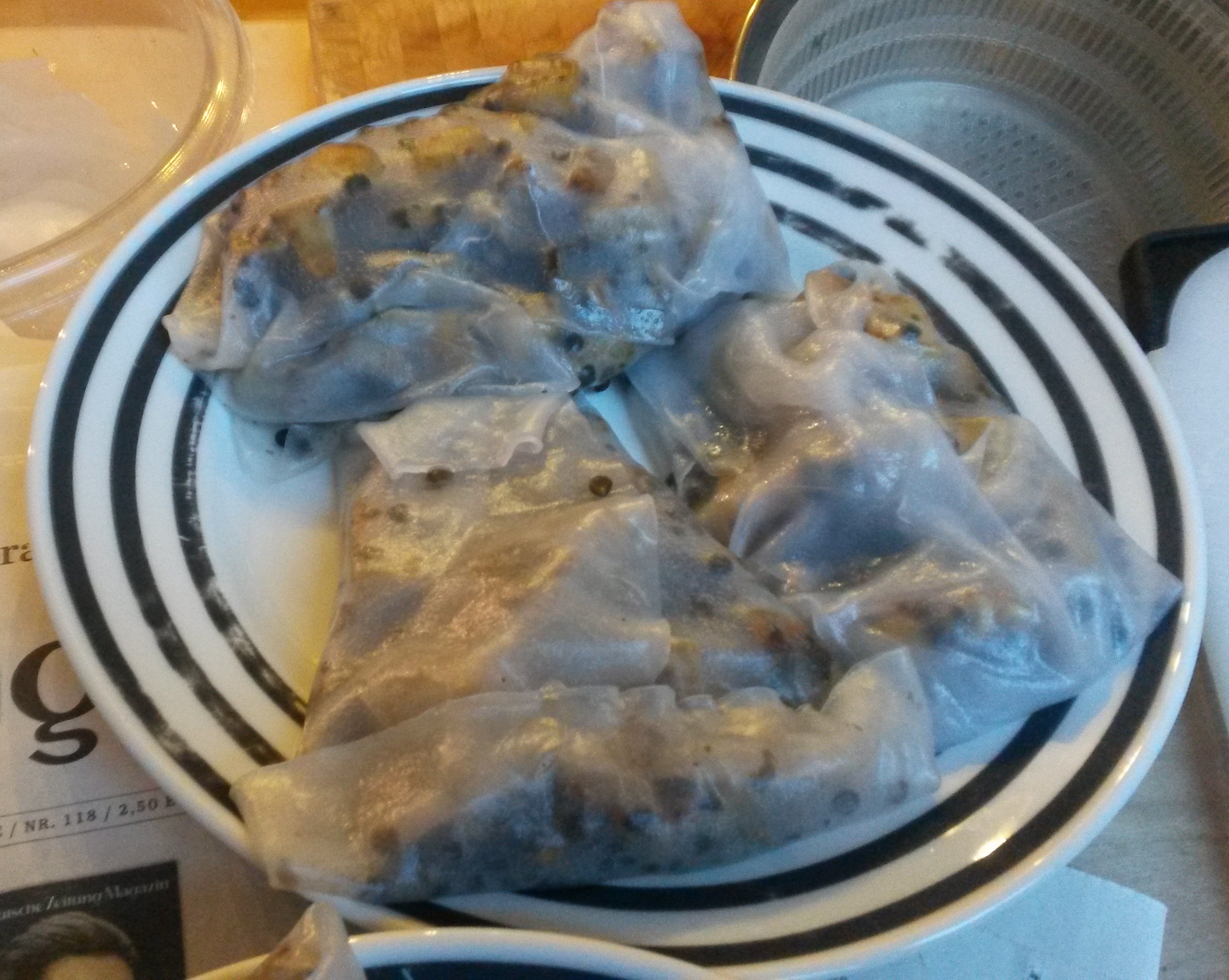 in rice paper (right) and fried until crunchy. Not entirely successful. Rice paper needs to be dampened to use but, if it is too wet, it will not fry very well. In fact, not at all.
I think my rolling needs to be better, but as for the taste, not bad.
Halal meat
 Recent revelations that most UK supermarkets are selling unlabelled halal meat is not really a surprise. Supermarkets respond to demand – the halal market in the UK is huge (estimated to be something in the order of £1bn). Not to be in that market, with so much money at stake, would breach of most supermarkets’ responsibilities. That is, to make money for shareholders.
From what I understand, halal slaughter – which usually involves no pre-stunning of animals – is allowed in the UK under religious exemption. As an atheist, I have a problem with that. But the arguments made by some that too much attention is given to slaughter and not enough to the quality of life, has some merit. But as an atheist vegetarian, I’m inclined to reject that, too. Too much meat is eaten. It is unsustainable in terms of ‘production’, and not so good for the human population generally consuming too many saturated fats.
With respect to the argument about too much attention is given to the moment of slaughter, I have this to say. So often I hear that halal slaughterers are skilled and make their incision with precision such that the animals lose consciousness almost instantly and hence do not suffer. Now it is quite some time since I have had intimate experience of animal slaughter, what is clear is that animals remain commodities. Slaughter is an industrial process. Slaughter is not a craft profession. It is a volume business.
Finally, where animals are stunned, they are unconscious when they are strung up and bled. Correct me if I am wrong, but where animals are not stunned, they will be hung upside down prior to throat cutting. That seems unnecessarily cruel and offensive.
The tidiest dump in England
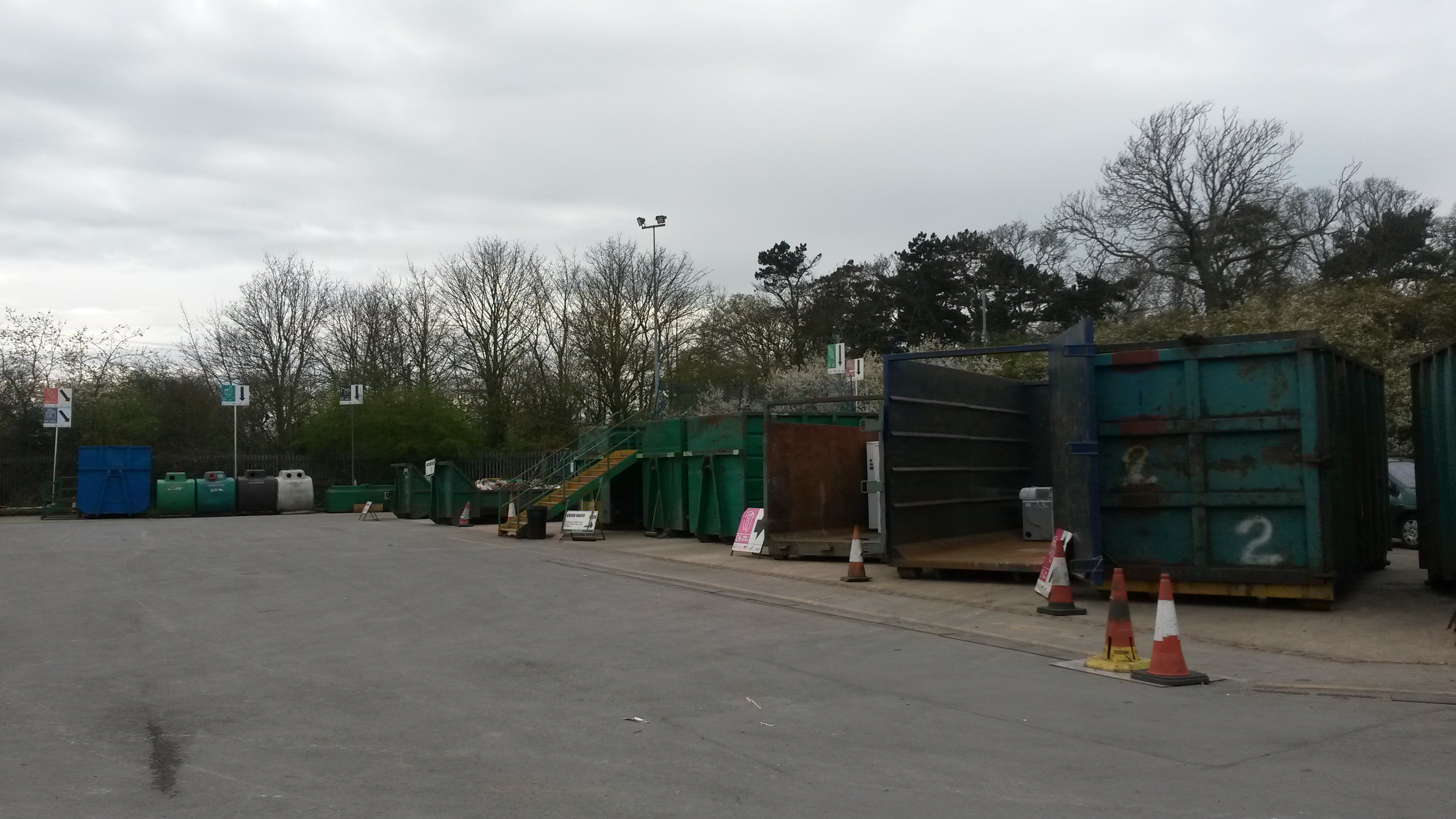 I visit quite a few public dumps around the country (and in Germany). I am not alone in this. It is one of the rituals of urban living. Some of them are endearingly chaotic. What I do notice, however, is that those who work there are supremely proud of their facility.
Recently I visited a facility in East Yorkshire (Preston, near Hull, pictured). I ask, is this the tidiest public waste facility in the country?
Keeping cats at bay
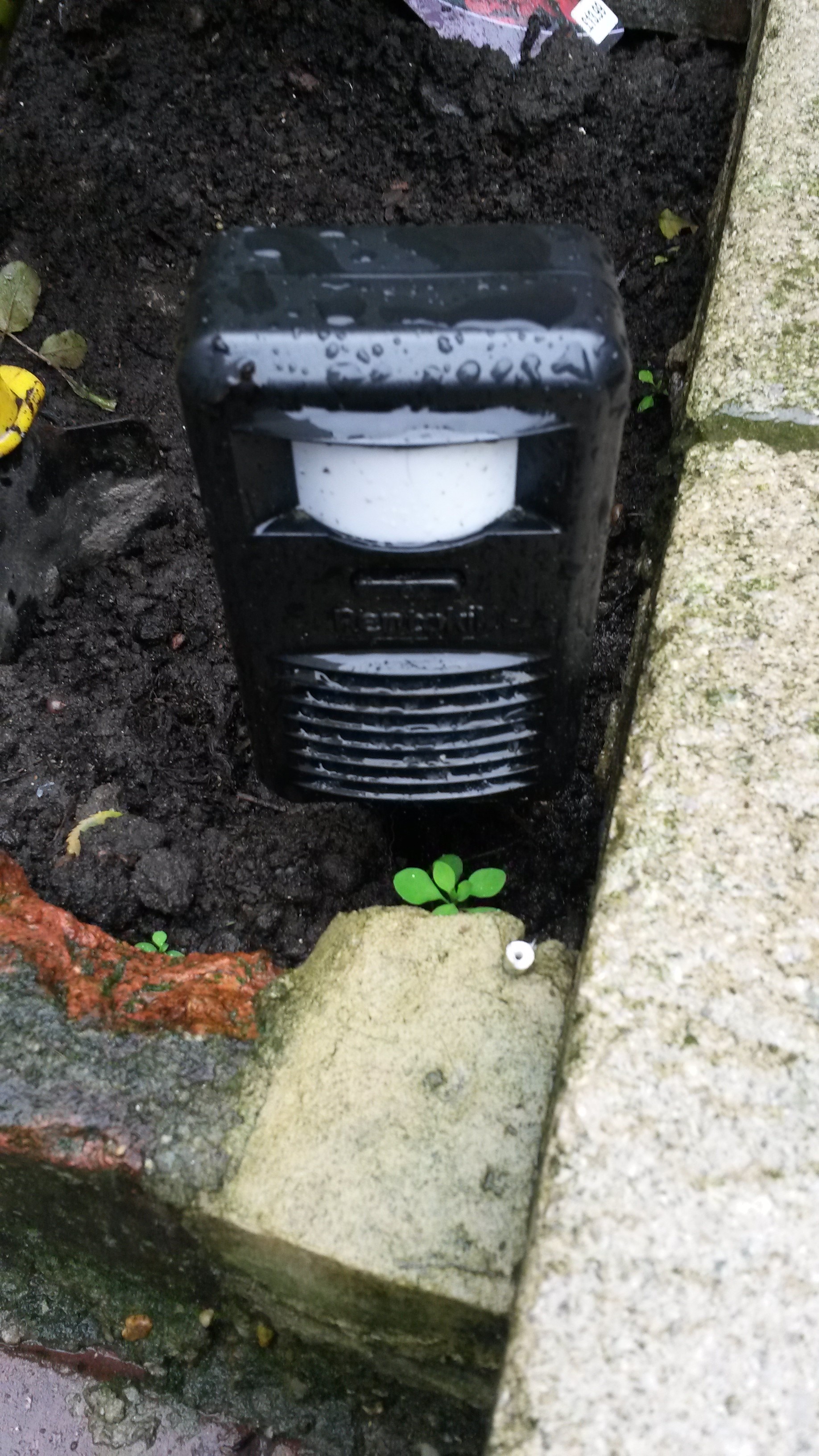 Since moving into our new house we have been plagued by cat bowel movements. There are at least five culprits. Some are sweeter than others. However, they use the yard as a toilet. Cat poo is not pleasant. We decided to act.
The solution we investigated might be a sonic device that emits a sound frequency that they simply cannot bear. Apparently.
So, here it is (left). It is branded as Rentokil and made in the UK. It worked for the first two days. However, the cat poo returned.
We are currently procuring a new weapon against them:
European election results
 There is an uncanny resemblance between this graphic and opinions that I have been listening to on the radio this morning after the release of the European Election results in the UK.
Unemployment – get out of Europe. Housing – get out of Europe. Stop immigration. Recession – get out of Europe. Stop immigration. Etc.
Europe as an entity and a ‘project’ is a mess, for sure. It is expensive. There is a lot of free riding. It is dangerously expansionist, as the crisis in the Ukraine demonstrates. And it does fuel some of the economic excesses of globalisation. However, the opinions that I have been listening to are bigoted, ill-informed and dangerous.
Some basic knowledge about economics might help. And a look at the expenditures made by the Swiss and Norwegians in complying with European legislation in order to trade in the EU, indicate that leaving the EU is not an answer. Most of our trade is with Europe. I trust that in the event of a vote to leave the EU, the hundreds of thousands of ex-pats living and working in Europe will be asked to return to the Isle?
Moreover, as ex-commodities trader, Nigel Farage, leader of the UK Independence Party, ought to know the recession is not the fault of the people, it is his class that caused it. And the mainstream ‘professional’ politicians that allowed them to do it. So, I can understand the need for change and some honest talking over a beer. But surely the future should come from the left, not the fascist right?
Picture: http://www.hopenothate.org.uk/blog/nick/archive/1/2014
The entrepreneurial state
 Professor Mariana Mazzucato’s book, the Entrepreneurial State, contains some interesting observations about the role of the state in fostering innovation and hence creating wealth. It is evident that the private sector relies on public sector investment in research for its ideas, frameworks and technologies. The internet is a good example. Many drugs have their origins in publicly-funded laboratories (recent discussions around AstraZeneca and Pfizer have been caught up in this). Google is built on it. And even if the ideas, prototypes, patents do not originate in public research/educational establishments, the minds behind them do. The problem is, it seems, the private sector’s ability to appropriate these public goods for itself.
Professor Mazzucato’s recent lecture on this topic can be seen here: http://www.sussex.ac.uk/newsandevents/sussexlectures/2014?lecture=116&fmt=youtube; it was one of the best professorial lectures I have witnessed in recent years (notwithstanding Jonathan Chapman’s at the University of Brighton on Sustainable Design, 22 January 2014: http://www.youtube.com/watch?v=iBECx-L55Fg). Mazzucato demonstrates a number of indicators of disingenuousness on the part of knowledge-rich firms. One of the most startling and worrying is buy-backs. Large firms that spend their cash on buying back their own shares rather than investing in research are painted as villains. In the past, the exemplars were Xerox and Bell with their investment programmes that brought us spinouts such as Adobe, 3-Com and Lucent amongst many others in technology.
Buy backs take out investment from the economy. They put the burden on the public sector to do the risky stuff. Firms have become increasingly ‘financialised’. Pfizer, she argues, is just one example. There are many more spanning hi-tech industries across the globe. She explains this around 24 minutes into her lecture.
And so to remedies. Professor Mazzucato argues that states should be able to claw back some of the benefits accruing to firms when they win on the basis of public funding. Professor Mazzucato’s recommendations include: “golden shares of IPR and a national innovation fund”, “income-contingent loans and equity” and “development banks”. Stian Westlake of NESTA, the UK innovation investment fund, by way of critique, notes the following:
- Essentially, they all involve the government retaining a financial interest in companies that develop innovations based on public funding, with the idea that this money can be recycled to back more radical innovations. As far as I can see there are three problems with this idea: It would be nightmarish to administer It imposes costs on exactly the wrong businesses, creating both a presentational and a practical problem It’s worse than an already existing option – funding innovation from general taxation.
The full debate can be accessed here: http://www.nesta.org.uk/blog/how-not-create-entrepreneurial-state#sthash.eJoHD7wz.dpuf
The Co-operative’s new era
 So, the members have voted to accept the Mynors recommendations for a new structure that will limit the influence of the regional societies. Hence the CEO of the largest of the regional societies, Ben Reid of the Midcounties, has resigned from the national board (now leaving three vacancies). Despite the criticism of Reid, his own society has recently reported revenues of £1.2bn, suggesting they are doing something right and against the trend in the national society with its £2.5bn loss. Reid received particular criticism by Mynors as a member of the Audit Committee of the Co-operative Bank when the £1.5bn shortfall was revealed.
So, we may ask, what is about to happen? Already it is clear that the local societies will no longer occupy their 30 per cent or so of seats. Instead, the intention is to ‘professionalise’ the Board. The new members will be professional executives and no longer voluntary. This business is so big, goes the argument, it cannot be managed by non-professional co-operators. It is indeed they that got the Co-operative into its fix in the first place (see post 24 April 2014: https://weiterzugehen.net/2014/04/24/what-is-going-on-at-the-co-operative/).
The proposals are, according to the Guardian newspaper, the following: the creation of a board of directors that is qualified to run a business the size of the Co-op; the creation of a structure that holds the board to account; the principle of one member one vote; and provisions to avoid demutualisation.
The latter is quite interesting. It confirms that asset strippers – or carpet baggers as they were known in the era of building society demutualisations in the 1980s- will not be tolerated and will not gain advantage by such conversion. That is inherently a good thing. One-member-one-vote also has merit, though professional Boards do not always practice such equivalence. Structures clearly should be such that executives are held to account. However, more important is the skills mix on a board to know what that means. (As we have seen from Banking, some executives are ‘infallible’ and charismatic, professional or not.) But being a co-operator should not disqualify one from membership of the Board of the Co-operative.
Image and further details about carpetbagging: http://news.bbc.co.uk/2/hi/special_report/1999/02/99/e-cyclopedia/297982.stm
 Be informed