Archive for the ‘Easyjet’ Category
Gran Canaria – over land and sea, November 2024
Filed under: Easyjet, Environment, Transport, Travel | Tags: Cadiz, europe, European ferries, Eurostar, ferry, Gran Canaria, low-carbon travel, Madrid, Paris, Refre, SNCF, spain, Travel
 Leave a comment
 OK, here we go. Low carbon travel. Train and ferry. Some facts.

Cost
Journey starts Saturday 17 November 2024. To fly from Gatwick Airport on that day would have come in at £45.00 (no luggage) – probably double that with the luggage I have taken that would need to go in the hold. Such pricing in the age of a climate emergency is obscene. By train:
London-Paris – £69.00 (standard class – average of return fare in November/December, considerably more in the summer or ahead of public holidays)
Hotel Paris – I was too late booking this for a Saturday evening. Overall cost £135. Hotel was Ibis Styles, Bercy. Breakfast included, and it was not bad. The room was tight but comfortable.
Paris – Madrid – £175.00 (standard class) – TGV to Barcelona and then Renfe to Madrid. The double-decker TGV is not particularly generous in terms of space, but not uncomfortable. The single-deck Renfe train was much more spacious but with no table (drop down rests were adequate for a laptop). We could not use the wifi because we could not see our ticket number (needed to register).
Hotel Madrid (Ibis Ventas) – £96.33 (incl. breakfast)
Madrid – Cádiz – £80 (standard class)
Hotel Cadiz (Soho Boutique Cadiz) £80 (incl. breakfast)
Cádiz – Gran Canaria – £91.10 (ferry – no cabin)
Taxi – Las Palmas de Gran Canaria – San Augustin – (£75.71) – Why taxi you ask? See below
Being in my sixties, I am not up for hostels, although I know that some budget travellers do so. Good for them, but I think I have reached a milestone. That said, in not selecting a cabin for the journey, we effectively slummed it, but the cost so far have been significant.
There are two of us so we need to double transport costs and share the hotel costs.
First leg
I’m pretty familiar with Eurostar. I travelled standard class on 16 November 2024 on the 1758 (retimed from 1801). I was able to work (the new drop down rests for stuff are now a bit wider). There are power sockets – UK and European. I have my own modem/internet for security reasons. The signal was pretty good throughout, including in the tunnel. In the past when I have connected to the Eurostar wifi, it has been pretty unreliable.

It cost me €2.15 to use the Paris Metro/RER to get from Gare du Nord to Gare de Lyon/Bercy. One can buy a card to load and reuse. Ticket machines take cash and cards.
Second leg
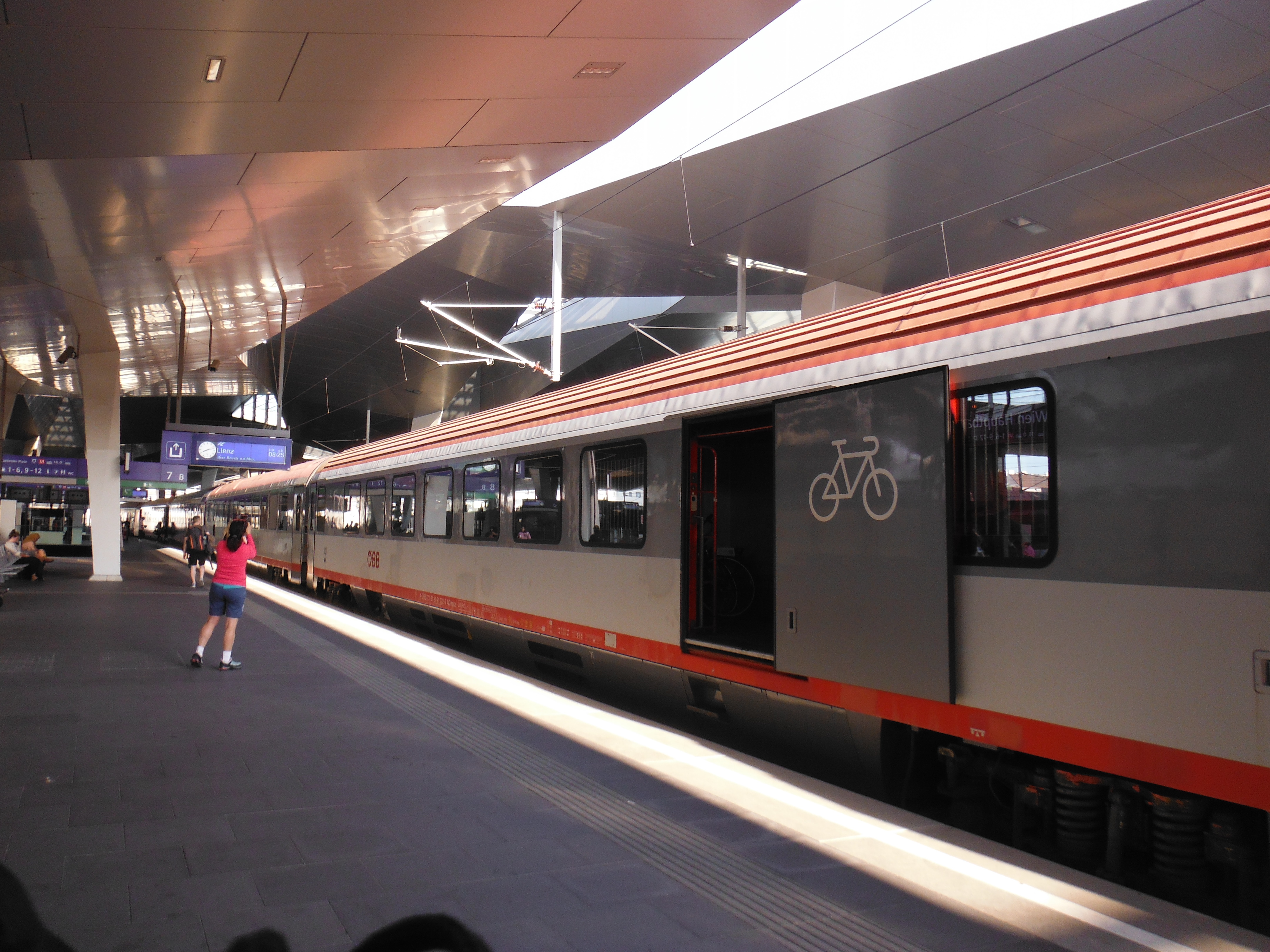
The next day (17 November 2024) we walked for 10 minutes from the hotel to Gare de Lyon and went to Hall 2 from where the trains depart. The QR codes on our phones or paper did not read. There was someone at the barrier to scan using their own reading machine. All good. We had two seats on the upper deck with a collapsible table usable only for the people sat closest to the window. There is a socket and wifi (below left).

The route taken by the train is pretty much rural France, but on reaching the Mediterranean, the scenery changes to on of salt marsh as it precariously meanders through the Parc Naturel Regional de la Narbonnaise (below right). The train is probably the best vantage point for seeing it as the train runs over what seems to be a causeway.
Warning, however, whilst writing this blog entry my case located by the entrance to the carriage was stolen. My advice is either to chain it to the bars or locate your case inside the carriage – there are some internal luggage racks.

The RENFE train to Madrid was directly opposite the arrival platform of the incoming TGV. It was that simple. Though there are a few challenges. We bought our tickets on RailEurope.com. The pdf that is made available on the app is unreadable by anyone with less-than x-ray sight. The train manager had a record of the ticket, so we were fine. It seems also possible to print tickets from ticket machines providing one has a PNR number that was clearly stated on the itinerary confirmation.
We then looked to buy tickets for the next leg, Madrid – Cádiz. We tried the machines – ticket buying by non-Spanish citizens is not so easy. Each traveller needs to insert their passport number. We got so far in the process (give yourself 10 minutes) before we were thrown out of the system whilst trying to pay. We did then find the staffed Renfe ticket office on the first floor and bought them in the traditional way, but passports are still needed. And the ticket office sales person found the system equally cumbersome. Our passport details had to be put in twice!
Then on to the Metro. Two lines, first 1 (blue) to Sol and then 2 (red) to Ventas. Buying tickets is easy, but you have to buy a card and load it with as many journeys as you need. In our case one centre ticket. Each centre area ticket cost €2.50 with the card. For the first charge, I think the card costs €2 (extra). On the way back to the station the following day, 18 November, we just loaded the cards. Note the machines are cashless. We ate in a nearby Lebanese restaurant. Portions were huge – salad, falafel, spicey patata and vegetal mousaka.

The hotel is next to the bull ring (left) – a constant reminder that there are some residual bloodthirsty passions in Europe. (The British as much as the Spanish – though not in such grand areas.)
Third leg
Monday 18 November is another train journey – about 4 1/2 hours to Cádiz. There is a fast and direct service roughly every 3 hours. It think it can also be done in two legs if needed: one to Seville and then Seville – Cádiz. The trains are spacious (standard class). Each seat has a socket (though mine did not work). There is room for a laptop to be opened and used. The wifi on the train is not working. Though my modem is fine. Similar to Paris, Madrid has distinct boarding gates. Passengers are advised to get there 30 minutes before departure – all baggage is scanned (unlike Paris). It takes about 10 minutes to pass through.
Incidentally, I bought a new case at the station, a t-shirt, shirt, a pair of socks and a sweater to keep me going. I discovered that I did have some underwear in my rucksack.
For a change we arrived at our destination in daylight. We checked into our hotel – probably one of the best we have ever enjoyed – the Soho Boutique Hotel. We had a suite. It was sensational. The breakfast was additional, but worth it. The spread was varied ranging from breads, pastries, cereals, cheeses, meats and fruit.
We bought a few more items in the town:
- food to take onboard – correctly assuming that the onboard catering might be a little unapetising
- Some eye protection (my prescription sunglasses were in the stolen case)
- some trousers and a gilet from a male clothing retailer and shorts, leggings, t-shirts and underwear at an unexpected-to-find branch of Decathlon.
We ate in a Latin-inspired restaurant in the town. The restaurant – Más Que La Cresta – is not exclusively vegan, but the options are good. We took a selection of starters as tapas; though the vegan burgers were certainly enticing, burgers are not quite our thing.
Fourth leg
The ferry terminal is about a 15 minute walk from the entrance to the port. Foot passenger enter the office through which they pass security control and then enter a taxi to drive to- and then in-to the ferry. We did not take a cabin – trying to keep down the costs somewhere – so slept in the reclining seat area on deck 7. For the first part of the journey we sat on the deck in the sunshine. The ferry crosses the shipping route from the Mediterranean west. I trust they have some communication and understanding that ferries operate against the dominant shipping route. It is a reminder that the seas are equally colonised by humans. And on the deck, the exhaust from the ferry reminds us that there are still greenhouse gases being expelled into the environment.
The ferry has a small shop that sells the basics – cigarettes and soap. There is a bar/café and then the self- service restaurant. Not much more. It is unlike the ferry to Rotterdam from Hull which has cinemas and a casino (not that a casino is of much interest to us).

Sleeping – without a cabin, there are rows (2-3-2) of reclinable seats on decks 5 and 7 (right). Deck 7 is the quiet level. What we have realised is that this ferry carries some very seasoned travellers, many of them young, who bring mattresses, airbeds, sleeping bags and food to microwave (the restaurant has a public microwave for use). There is no washing up area, though. So the seasoned travellers often sleep horizontally on any available floor (there are signs all around forbidding this, of course). It is, I think, also the case that this is not a party ship. People are here to sleep, not to party (that is probably saved for the islands).
Did I sleep…yes. It was quiet. People slept. Though in the summer it might get more chaotic with so many floor sleeepers. The reclinables are least comfortable, I found, when reclined (they do not recline too much). I reverted to normal position. A pillow of some kind is needed. That doesn’t mean that I am not looking forward to a bed on arrival.

For the day, I was on deck for much of the time (left). The sun was warm and I had a book. Working is not so easy as the ship is really not geared up for business. The sockets are few – and in demand for mobile recharging. There is a small cordoned-off area in the restaurant that could act as a business space. It does have sockets, but I only counted four, and they were not well spaced around the room either. In the end I went to work in the restaurant in-between sittings (breakfast, lunch and dinner). Talking of which, we did take breakfast. It was not bad actually. And not expensive. For €12.50 we had cereal, bread, egg, yoghurt, tortilla and coffee. We are not sure whether it was accurately calculated. But hey.

We were scheduled to dock at midnight…in the end it was 0130 GMT. We were out by about 0200. But what then? Cadiz is easy, the port is adjacent to the town and walkable. Las Palmas de Gran Canaria port is quite large, not walkable and relatively deserted at 0200. There was no shuttle bus, no taxi rank. My beloved was armed with a taxi phone number but more than once – without perfect Spanish – they just put the phone down on us. I walked back to the ferry to ask one of the personnel if they could speak for us. We had a volunteer whose intervention magically summoned a taxi that arrived after about 10 minutes. Uber is on the island – download the app before you travel. Anyway, the drive was approximately 45 minutes – fast because there was little on the roads (which are superior to anything in the UK – not a pothole to be seen). The fare was €90 to San Augustin – 55km. Journey end.
Reflections
I wanted to test the feasibility of getting to the island by land and sea and be productive in the process. Whilst I may be on holiday, I still want to engage in some academic work – I am an academic after all. All travel raises questions that warrant answers. I have never regarded travel time as a waste. I do think my efforts here were thwarted by the transport operators – notwithstanding the theft of a bag. Here are the key challenges:
- Cost – it is significantly more expensive to travel overland than by air. The journey cost overall was £802.14. That is at least eight times what it would cost to fly. We could cut out the hotels – do Paris to Cadiz in a single day starting very early in the morning. That is a tough day and all the connections need to work.
- Time – I wanted to be productive and connected. It was ideal for reading books and academic papers, not so good for writing. Observations:
- I could not connect to the internet on Renfe between Barcelona and Madrid because users need their ticket number. This was unreadable on my ticket from RailEurope. That said, for security, I use my own dongle with European roaming, which worked fine. I did use about 21/2 Gb.
- The (un)complementary internet on the ferry was very poor. And because we were sailing, there was no mobile signal (I feared, too, that if there was, it would be Moroccan, and therefore elicit extra roaming costs). I could have bought a better internet package from the operator, though. I did not because I had lost my credit card in the bag theft.
- As noted, there is no dedicated workspace onboard.
- Foot passengers on ferries are poorly served. The situation at the port of Las Palmas de Gran Canaria was a problem. There was absolutely no provision for us at the port. And being so late, it leaves stranded passengers vulnerable. This is not universal. Other ferry journeys that we have taken have been better served. Hoek van Holland has its own railway station! Europoort had coaches to take passengers to Rotterdam (or used to).
What needs to be done
- Sort out ticketing…
- Buying European train tickets is way too complicated, especially across borders. We used Rail Europe, but the tickets issued were unreadable by station and train staff.
- Adding to that, buying tickets in Spain either by machine or at a staffed ticket office is slow and cumbersome. Passports are needed for non-Spanish travellers and it can take an inordinate amount of time to get issued with a ticket. On the machines, we twice got ejected and had to start again.
- Wifi…
- I am happy to use my dongle for security reasons, but the ferry wifi was poor by any standard. Even basic searching was difficult or impossible. The wifi would shut off in any case after 30 minutes or so and it was necessary to log in again, including reading the terms and conditions.
- Make provision for work – dedicated space, sockets, reliable wifi. I know the argument – there is no demand. But there is no demand because there is no provision, arguably. Equally, the ferry would be an ideal place for a conference, workshop, briefings, etc.
- Treat foot passengers with respect. Ensure that they can embark and disembark safely. And do not leave them stranded at a port in the middle of the night. That is truly shocking.
Getting back
We flew back! It was not the original intention, for sure. I made the decision when we got on the ferry from Cádiz. I am not advocating flying – my overland and sea days are not over, far from it. Indeed, the flight was long, cramped, hot and involved airports. However, three key things swung it for me (a further two factors made me feel slightly more sanguine).
- The timings of ferries back relative to my need to be at my desk on 9 December meant that the time on the island would be much shorter. In order safely to get back by 9 December, I would need to leave the island on 1 December 2024. That ferry is scheduled to be 43 hours. Having taken 5 days to get to the island, to leave after just over a week seemed rather punitive (bearing in mind I am working throughout the period January to August inclusive and this is my summer holiday).
- The experience getting here was not the best – from having my bag stolen to the facilities on the ferry and the restaurant menus.
- Cost – I had to spend quite a bit of money replacing some of the things I had lost particularly my clothes.
- Carbon – I am trying to be a good citizen, but I am not perfect. Though I am reminded by some pioneers of low carbon working of studies relating to carbon generated by flying, in particular the contrast between short haul and long haul. That is not to say that I am going suddenly to start flying again as I had done prior to Covid (i.e. every week). Here is a quote based on work by Frédéric Dobruszkes, Giulo Mattioli and Enzo Gozzoli “flights of less than 500km account for 26.7% of flights, but only 5.2% of fuel burnt; while flights of 4000km or more account for just 5.1% of flights, but 39% of fuel burnt. This tallies with AEF’s (The Aviation Environment Federation) findings that shows that in terms of carbon emitted from flights from the UK to destinations around the world, the worst offenders are indeed long-haul – in top place is the US with 23.6% of the UK’s international flight emissions (10.6Mt), and Dubai with 6.7%.” You can read the summary article, “The Elephant in the Middle Aisle” here.
- Finally, I picked up an injury in the final week on the island (see later entry) that would have made overland very difficult, painful and dangerous. On that basis, too, I can safely say that disabled travellers are much better served by airlines (though there are some horror stories) than overland across borders and modes.
Easyjet and climate change

Regular readers know that I have been a major customer of easyJet over the years. So much so that they enrolled me on their frequent flyer special privileges list, known as Flight Club. However, when I could, I took the train; but this was rare, because most of my flights were for weekends only. I did not have two days to commit to travel and still work. I was not alone in this; at least ten of the people at the front of the boarding queue were weekend travellers with family in Munich. We were familiar to one another.
When Covid struck, easyJet took most of their aeroplanes out of service. The British Government compounded the whole thing by forbidding Britons from leaving the country unless they had a funeral to attend or, oddly, some property to sell!
When borders opened up again, easyJet’s flights remained few in number. But post-lockdown, many things had changed, not least my ability to work more flexibly and hence take the train more often. It takes about 11 hours or so to make the journey from London to Munich, connections permitting. I am hoping that I never need to fly this route again. The train is way superior.
But easyJet’s CEO, Johan Lundgren, is looking forward to services returning to pre-Covid levels for the summer. With the requirement for PCR and LTF tests being removed to enter the UK, mobility becomes easier and cheaper (both tests are expensive because they are only valid if undertaken by a private company/laboratory). The implications for aviation returning to pre-Covid levels are significant. Aviation contributes about 3.5 per cent of annual emissions of greenhouse gases. That does not sound much, but with a diminishing annual global carbon budget, that is 3.5 per cent the planet could do without.
Lundgren has an answer (of sorts). He claims that, whilst we are waiting for hydrogen-fuelled planes in 2035 (promised by Airbus), we can offset carbon. He does not tell us how the company is offsetting. Though the website states the following: “we offset all the carbon emissions from the fuel used, by supporting projects that protect against deforestation, plant trees or drive the uptake of renewable energy. These projects either avoid the creation of new carbon elsewhere, or directly remove carbon from the atmosphere.”
Offsetting is a flawed concept. The company knows it. Why else would they state on the website that it is not a long-term solution? The principle is that we calculate how much carbon dioxide is emitted per flight and then match that with something that absorbs or compensates that amount of carbon dioxide. Compensation takes the form of investing in solar and wind energy and projects that prevent deforestation.
The most obvious offset mechanism in the absorption category is provided by trees. Unfortunately, even if trees are planted to offset the emissions, many more trees are being destroyed to enable cash crops to be grown, particularly palm oil and soya, despite offsetting funded by airlines such as easyJet. The Amazon is under hourly attack sanctioned by the Brazilian government of Jair Bolsonaro. He is not the only one.
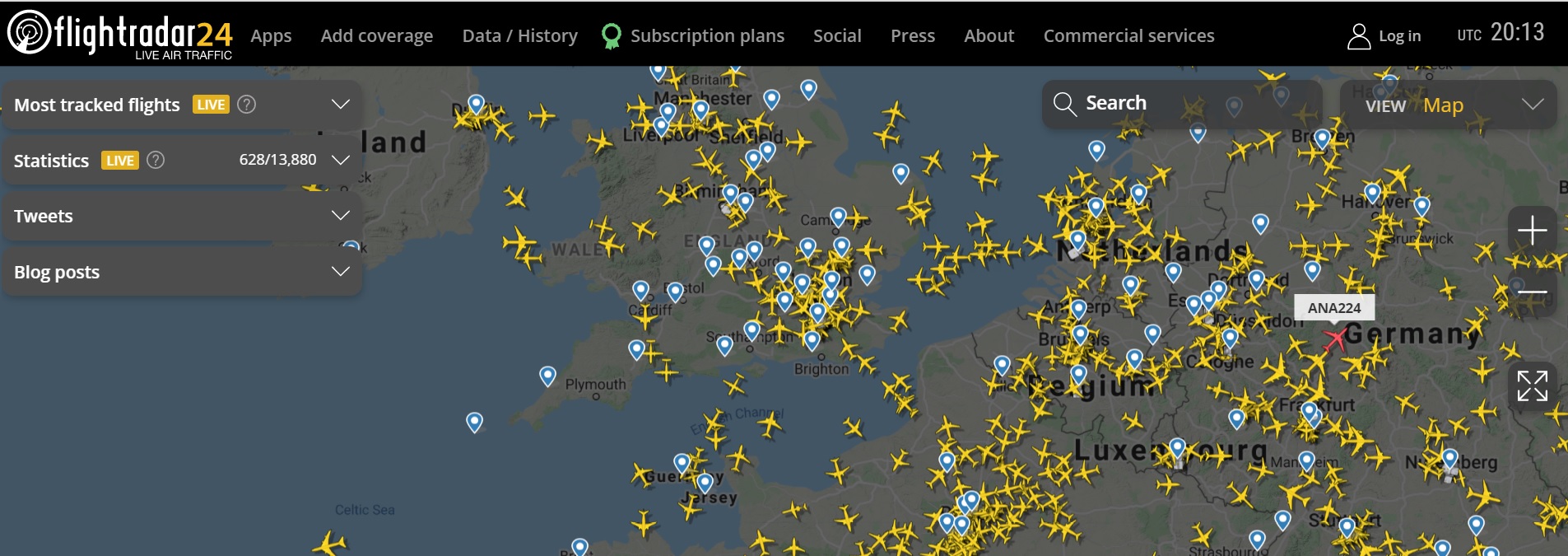
I calculated that to offset the emission caused by 100 desktop computers, we need to plant nearly 5 football pitches of trees per year to absorb the carbon. Imagine that scaled up to airlines. Just see how many aeroplanes are in the air currently – February when volumes are low and even lower because of reduced demand and capacity (right).
Offsetting by planting trees is not credible. What about carbon capture? Well I, probably stupidly, pay to sequestrate carbon dioxide from the atmosphere by a company called Climeworks. Climeworks charge US$1100 per tonne to sequestrate carbon dioxide. From my understanding, a round trip flight from London to New York (economy) generates 1.8 tonnes CO2. The price to sequestrate, therefore, becomes $1980 (€1680) on top of the ticket price. In the case of easyJet, a low-cost airline is unlikely ever to offset in this way, even if the capacity to do so existed.
There is another problem with Mr Lundgren’s approach. It is echoed by climate change deniers. And that is, there is a technological fix (hydrogen powered planes) just around the corner, or 2035. Even if easyJet can offset its emissions, I’m pretty sure the rest of the aviation industry will not. And the chances of Airbus delivering planes to all airlines by that date, is unlikely. Moreover, Airbus is working on planes that are ok for short haul, but not feasible for longer flights. There will remain a gaping hole in the carbon neutral aeroplane portfolio. We might ask, also, whether the airports will have in place the infrastructure to service these new planes. In addition, Boeing is going for biofuel and retrofitting existing planes. These are not carbon neutral and threaten to contribute to deforestation because the fuel needs land on which to grow.
There is one more dimension to Mr Lundgren’s arguments. While train travel is feasible – albeit with extended journey times – Mr Lundgren indicates that the European rail networks are insufficiently developed and have capacity constraints. Unlike with airlines, it is not possible just to commission a new aeroplane to meet demand. New trains and supporting infrastructure take time.
All of these airlines – but many more companies besides – are looking for business-as-usual when that is simply not possible if we are to stay within the planetary boundaries. The world has changed. It has heated up. Mr Lundgren, your planes have to stay on the ground.
easyJet plane Pic: Adrian Pingstone
Travelling during a pandemic
Filed under: Easyjet, Hotels, Terminals, Transport, Travel |
Leave a comment Hopefully most readers are not travelling at the moment. Staying put is safer and, frankly, much less stressful. I am a frequent traveller to Europe for family reasons and have experienced most things – delayed trains and planes due to failed infrastructure, sick or unregistered passengers and luggage, unruly passengers, theft of my possessions, dodgy hotels, the lot. And then there is Brexit – my passport no longer seems to get me through eGates in Germany (we’ll see if that is a one-off or permanent) and, of course, as a non-EU citizen, I can only be a country for 90 days in every 180 and am barred from working.
Now before I get ripped to shreds on my hypocrisy flying as I do but also constantly banging on about climate change, let me state the following. Travelling is for family reasons, and whilst 15 years’ ago when I first established family connections in Germany, my ignorance – despite friends warning me about my carbon footprint – meant that flying was a viable option. Clearly things have changed, but my family has not. I need to travel to be with them. During the pandemic, I have been travelling less for three reasons. First, it is quite difficult; second, it is dangerous and inappropriate (lockdowns are lockdowns after all); third, I have the privileged of being able to work from home. With regard to flying, I am an advocate of a frequent-flier levy – the more one flies, the more you pay. And exponentially. That would hit me hard financially, and rightly so. I am also hopeful now of structural changes that will enable me to travel more often – or always – by train. The pandemic has demonstrated that we can work remotely. I am healthier and less stressed because of it. We will see how committed employers are to the permanent change in the future. I am hopeful, but not convinced. There is also talk of a new Trans-Europe Express to help people to move across Europe without planes.
What follows is an account of my experience to help others. Having travelled for many years, there are many like me who have family on the continent.
 I passed through Heathrow airport on Sunday evening (14 February). I travelled with British Airways – currently offering 2 flights per week Munich – London. Originally I was scheduled to come back the previous day with easyJet, but that plane was cancelled, with the next scheduled option being sometime in March. On 18 January, the British Government imposed a requirement of a negative Covid test on all arrivals. That was fine, but an extra task to fulfil prior to travelling. Travelling on a Sunday meant that I took the test on the previous Thursday giving enough time for the result to be notified assuming that weekend lab work is not likely. Sunday was, hence, the last day of validity for the test. If the plane did not go on Sunday, I’d have to take another test (€130).
The plane arrived at its stand an hour before departure. The plane was fully boarded (busy but not full) at the scheduled departure time, 1745. But we were 45 minutes late pushing back from the stand due to an administrative error at the gate. Munich Airport would not allow the plane to go until everything was in order. Fair enough, I suppose. After being pushed back we waited motionless for about 10 minutes before the pilot announced that the plane had been damaged in the pushback. Engineers were called. 2 hours later, authorisation was given to fly.
I do not live anywhere near Heathrow Airport, and it being Sunday, the UK railway network enjoyed its usual scattering of engineering works, including on my routes home. If I was able to catch the last train/bus home, I expected to be back about 0300 – not a great prospect. But UK borders are never straightforward, and particularly with the need to demonstrate a negative Covid test and a valid passenger locator form (which includes payment of £210 for two Variant tests to be delivered to one’s home 2 and 5 days after arrival). Even though the arrivals are few, the border area was full and a long queue that snaked its way back and forth was created. Familiar image. Mingle, mingle, mingle.
The eGates were open as additional security staff were checking the documentation. My passport was rejected by the eGates and I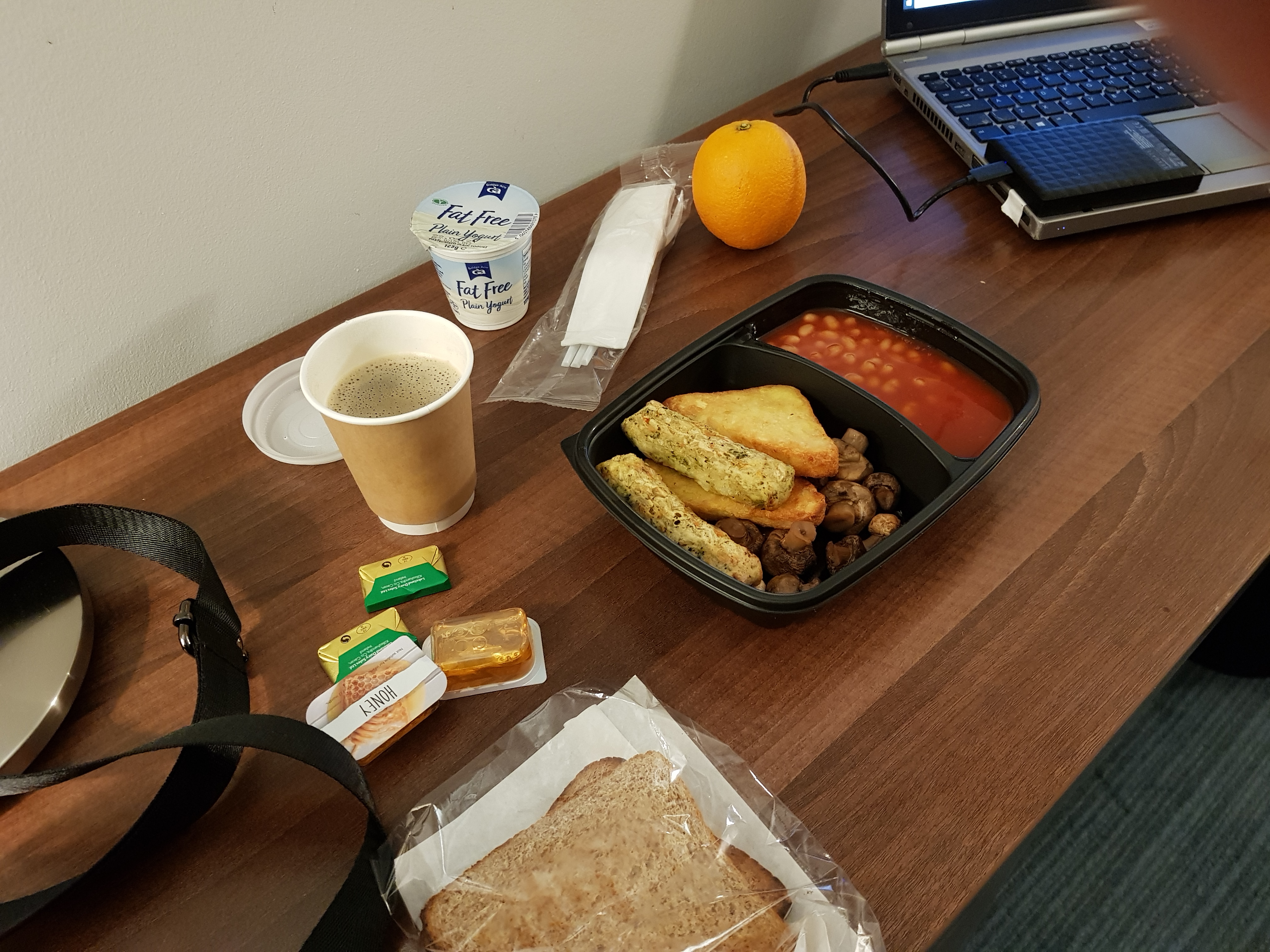 had to stand in another queue to be approved by a border official – there was only one on duty. In total, I was about 1 hour getting across the border. I decided to take a hotel rather than attempt the journey home. I stayed at the Hilton Garden Inn Hotel at Hatton Cross (close to the Tube Station). Hotel prices are half of what one would normally pay, so that was not too onerous, though still a cost. The view (above left) was a shade dystopian, however. But I recommend the hotel if readers are ever in the same position. I bought breakfast – one retrieves it from the kitchen and consume it in one’s room. It was fine (right).
On Monday (15 February 2021) I was able to travel to the South Coast of England. The Tube and overland trains were largely quiet. I am now observing an obligatory 10 days’ quarantine. I stocked up on non-perishables before I departed, so I have most of what I need for the duration. Safe travels.
Climate Watch: update on airlines
Filed under: Easyjet, Environment | Tags: Easyjet, ICAO, Stelios Haji-Ioannou
Leave a comment As predicted, the airline industry is now trying to wriggle out of its commitments on carbon emissions and climate change. Only last month, the industry agreed a protocol whereby airlines would pay to increase  carbon emissions (through offsetting) based on some sort of average for 2019 and 2020. As we now know, 2020 will be a record low carbon year, and the airlines, many of which have all planes grounded because of Covid-19, are now saying that committing to this new level would make them bankrupt, notwithstanding that many of them are already.
To be fair, the industry body, ICAO, has not yet shifted, but it is being lobbied hard – understandably – by airlines to re-evaluate the threshold. Seemingly, it was already going to cost the industry between £4bn and £18bn (not much of a difference there, is there?) – which just goes to show how much more carbon they intended to put into the environment on growth projections (now, of course, unlikely).
And then there is easyJet. Readers may already have been following the story of how founder and major shareholder, Stelios Haji-Ioannou, wants the firm to cancel its order for 107 Airbus A320 Neos, planes that are necessary if easyJet is to meet its targets for carbon reduction. However, for Haji-Ioannou, that is no longer viable. By which he means under the current easyJet and industry business model and not under an ICAO – or other – environmental commitment. At what point does he smell the coffee?
Pic: Adrian Pingstone
Shareholders against the planet – knowingly or unknowingly
Filed under: Covid-19, Easyjet, Environment, Politics | Tags: Easyjet, Stelios Haji-Ioannou
Leave a comment  Stelios Haji-Ioannou (right) is founder and major shareholder (about 34 per cent) in easyJet, the budget airline. When he established the airline that challenged incumbent “full-service” airlines back in 1995, climate change was not well understood in business circles (though as we know, the science was maturing and the Earth summit had taken place 3 years’ earlier in Rio). Easyjet is now a very large airline with over 300 aircraft and a market capitalisation of £4bn.
In recent times airlines have become environmental villains responsible for almost 3 per cent of all carbon emissions (and about 12 per cent of all emissions from transport). The low-cost model of easyJet and others has encouraged travel and made it possible to commute over long distances. This has been regarded as a good thing economically. A global pandemic, however, sees airlines at the forefront of a new battle against another invisible enemy, Covid-19. That market capitalisation has collapsed, and the 300 aircraft grounded indefinitely. Easyjet – along with other airlines – may well seek state aid to support the business through the crisis.
The question of state aid for airlines – major contributors to climate emissions and hence climate change – puts the Government in a difficult position. Neo-Liberal Governments like that in the UK are generally opposed to state support. Indeed they do not even protect strategic industries and businesses from foreign buyers. So any support eventually given to scheduled airlines serving a free market (I accept that some airlines serve niche, fragile and social markets such as Logan Air) will challenge neo-liberal ideology and raise questions about ministers’ proximity to business leaders in the industry. Cash transfers to easyJet would lead to Richard Branson’s Virgin Atlantic receiving similar. That would be difficult to countenance.
The management at easyJet now has an added problem. Knowing full well that their industry is a problem in the carbon economy, there are two – what one calls – mitigating policies. One is more effective that the other, but neither are a solution. The first is offsetting; in the easyJet case, that involves committing to planting trees, though there are many offset schemes that involve investing in developing countries’ own mitigation policies. The second is buying a fleet of more efficient aeroplanes. Easyjet has opted for a fleet of Airbus A320 Neos and they are arriving in batches.
Stelios Haji-Ioannou is not, seemingly, very happy with this. He is now calling for the whole order to be cancelled. He believes, with some justification, seemingly, that the order threatens the solvency of the company. Moreover, as Nils Pratley in the Guardian writes, the company may need to be recapitalised: “Haji-Ioannou says he would support a rights issue – as he should given that his family has collected £620m in dividends since 2011, including £60m this month – but he is vowing to make his backing dependent on an Airbus cancellation. Given the size of his shareholding, he has some clout.”
So here is the conflict of capitalism laid bare. Without the new planes the company will see carbon emissions increase and probably be subject to some regulation or tax (or both). The company will also lose considerable customer credibility on anything it says in the future about caring for the environment. But with the planes, at best shareholders will have to recapitalise, at worst, the company goes under. Plus, very rich man determines the future of the planet. Which side are you on?
Picture: Audiopedia
The easyJet cancellation approach
It is the first cancellation that I have experienced this year with easyJet on the Munich route. EasyJet got through all of last winter’s snow only to be felled this time by an English summer. I was due to fly on Wednesday 11 July at 1835. It had been rather a stormy day and this had impacted on Gatwick Airport. The pilot said that the ‘Terminal’ had been closed for some of the day. Suffice to say, we had to take a bus from South Terminal to North Terminal where the plane was parked. Certainly out of position.
Once on board, the pilot told us that we did not have permission to fly. But clearly as an old hand on this route, he knew that if he did not get the plane in the air by 2030 we would not be going because of Munich airport’s strict night closures. Intriguingly, the pilot took us to a holding position near to the start of the runway. He communicated his thinking and his communications with both air traffic control and easyJet control in Luton. 10/10 for initiative and communication. It was not enough. We were cancelled.
Unfortunately, easyJet are a bit like their planes – great in the air, not very versatile on the ground. I opted to go home, a luxury most people do not have. They had to join a queue of around 200 people or so to try to get on another flight and find a hotel. In all, I counted 8 easyJet cancellations that evening.
By the time I had got home, the cancellation was confirmed and I was able to get on a flight on Friday 13 July. So not so bad. Unfortunately, my partner had attempted to book me on another flight and – in the heat of the moment – got the wrong direction (Munich – London). Changing bookings with easyJet is not difficult, unlike other airlines, but they do charge for the pleasure. In this case 86 Euros (changing name and date so that she can fly to me next month). All credit to easyJet on this occasion, they have refunded the charges, having accepted the ‘heat of the moment’ decision-making. Always worth writing to them.
Where are we going?
Whilst on the subject of Easyjet, a couple of weeks ago I got on the plane to the usual cabin announcement. Except this time it was a shade uncertain. “Welcome aboard this easyJet flight shortly departing for….Germany.”
Can you be more specfic?
Their convenience?
Look, I am a big big user of Easyjet services. It is a complex business, running an airline. I know. I fly most weeks out of London Gatwick on a Friday evening and return late on a Sunday evening. The return journey is always an issue. I now park my repaired Vivaro at the airport at great expense because Sunday rail services are unreliable and inadequate.
Easyjet have taken to dropping me off at the wrong terminal. The flight is scheduled to arrive at South Terminal (where the van or trains are), but the pilot parks up at North Terminal. That despite the fact that I have received an email from Easyjet telling me that I will be arriving at South Terminal and if I have any friends or family intending to meet me, that I should tell them that I will be arriving at South Terminal. Fortunately, I have no friends or family to meet me. Had I, I am sure they would think the plane was lost.
I actually spoke to the pilot on Sunday (6 May). He told me that it was not Easyjet’s fault, rather that of Gatwick Airport who allocate the gates.
 Be informed