Archive for the ‘Travel’ Category
Maybe in Australia
 Leave a comment
So, it is now not possible in Australia to brand cigarettes. From today, cigarettes can only be sold in packs that are olive  green in colour and depict images of the consequences of smoking; for example, blindness (see right). The industry has, of course, objected to this – even at one point claiming that it was an infringement of trading law. Essentially the argument goes that states cannot restrict firms from using their brands. The role of the state is to maintain fairness in trading, not restrict it.
In going to law, the tobacco industry lost the case. In response the industry then claimed that the new rules would draw in counterfeiters, particularly from Asia. This is a nice but flawed relativist argument. By definition, counterfeited products are potentially more dangerous – brand owners, even cigarette brand owners – do not try to poison consumers in any acute sense (over time, they knowingly do so). But there is no safe level of cigarette consumption. And the explicit aim of the Australian government is to stop people from smoking. One has to assume that the Australian government does have a contingency for the counterfeiters.
Good on the Australian government.
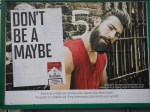 By way of contrast, cigarette advertising – brand promotion – goes on in every German high street. Today I shot the latest in the ongoing Marlboro ‘Don’t be a Maybe’ campaign (left). The campaign requires some insider knowledge fully to understand. The notion of being a ‘maybe’ is not clear from any one poster, but I have seen the associated video in shops; chilling in their association with glamour and success. Indeed, the campaign has been criticised and deemed to be in breach of the law. Cigarette companies cannot target young people in advertising. Frankly, most of the brands glamorise smoking for young people (see elsewhere in this blog copious examples, particularly Pall Mall). I think it needs to be turned around. ‘Don’t be a maybe cancer sufferer’?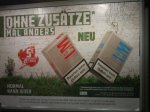
L&M have a new poster for the run up to Christmas (right). There is no glamorisation of smoking as the brand pursues its additive free nature. Different and a standard, if my translation is correct.
The Rhine Route by tandem – the experience (3)
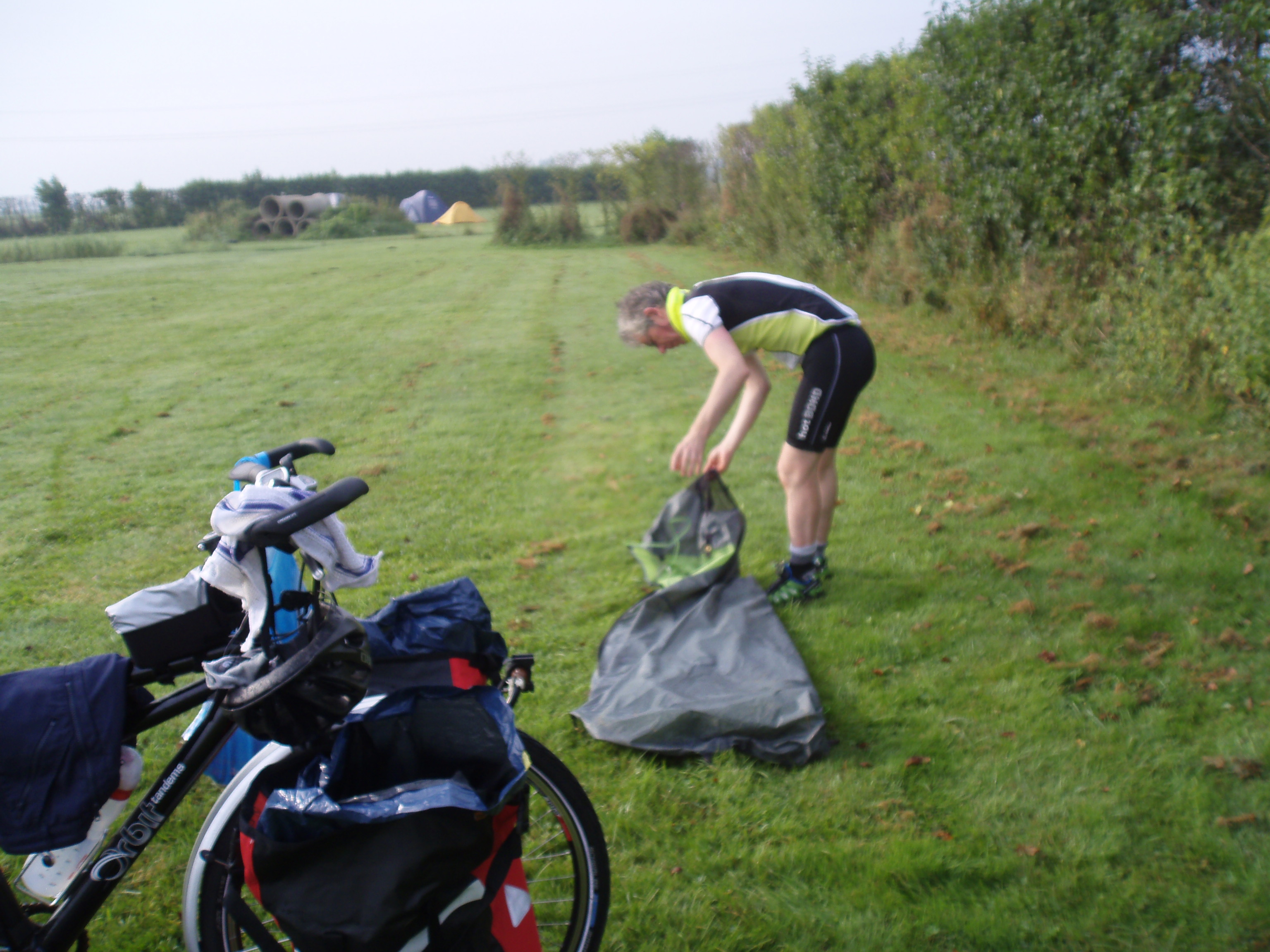 Through Utrecht, the landscape becomes a shade lonely. We stopped at Bunnik, a small town to the east of Utrecht; the campsite (left) was a good metaphor for the area. Getting to the campsite involved scaling a daunting bridge over the railway with the loaded tandem (see below right). Although there is a ridge for the bicycle’s wheels, the weight and length of the tandem made it a challenge.
A very pleasant 20 kilometers further one encounters Rhenen where the river becomes more familiar – it is navigable and the barges ply their trade. We bought some food at a nearby deli and took it to the river to eat – it was also an opportunity to dry the tent (which can be seen in the foreground of the picture, left).  The Rhine path, however, remains sporadic, with frequent detours that, in some cases, take cyclists some distance away from the banks.
The Rhine features are sometimes other-worldly, or at least other timely (see below right). The features that facilitate the management of the river, its flows and direction, are many and interesting subjects. The feature below right is to the west of Arnhem approached here on the south bank  which we selected in order to avoid the centre of Arnhem at peak time (a bit of learning from our experience in Utrecht – albeit with the consequence of not seeing the city itself). It is a lonely approach and is the precursor to a lot of loneliness punctuated by many seemingly lost villages.
The long night of museums, Munich
Each year – for one Saturday evening – the museums in Munich stay open late. For 15 Euros one can purchase a ticket that gets access to the majority of museums and galleries in the city and ‘free’ travel on the buses that visit the museums split into four groups – Central, West, Schwarbing and East.
 This year – 2012 – we decided to join in. There is a certain serendipity as to where one ends up. Having tried the Max Planck Institute, we opted for the Schwarbing bus and the BMW museum. My first time.
This museum is pure marketing – or propaganda. With that in mind it can be enjoyed. The building clearly borrows from the Guggenheim in New York in its bulbous appearance and interior walkways. The artefacts inside are immaculate. These range from cars, motorbikes, engines, film footage and marketing/advertising materials.
Whilst the museum says little about the company’s history in terms of its Nazi affiliations, some of the film footage of racing success in the 1930s cooly displays the Nazi symbols and sentiments of the time.
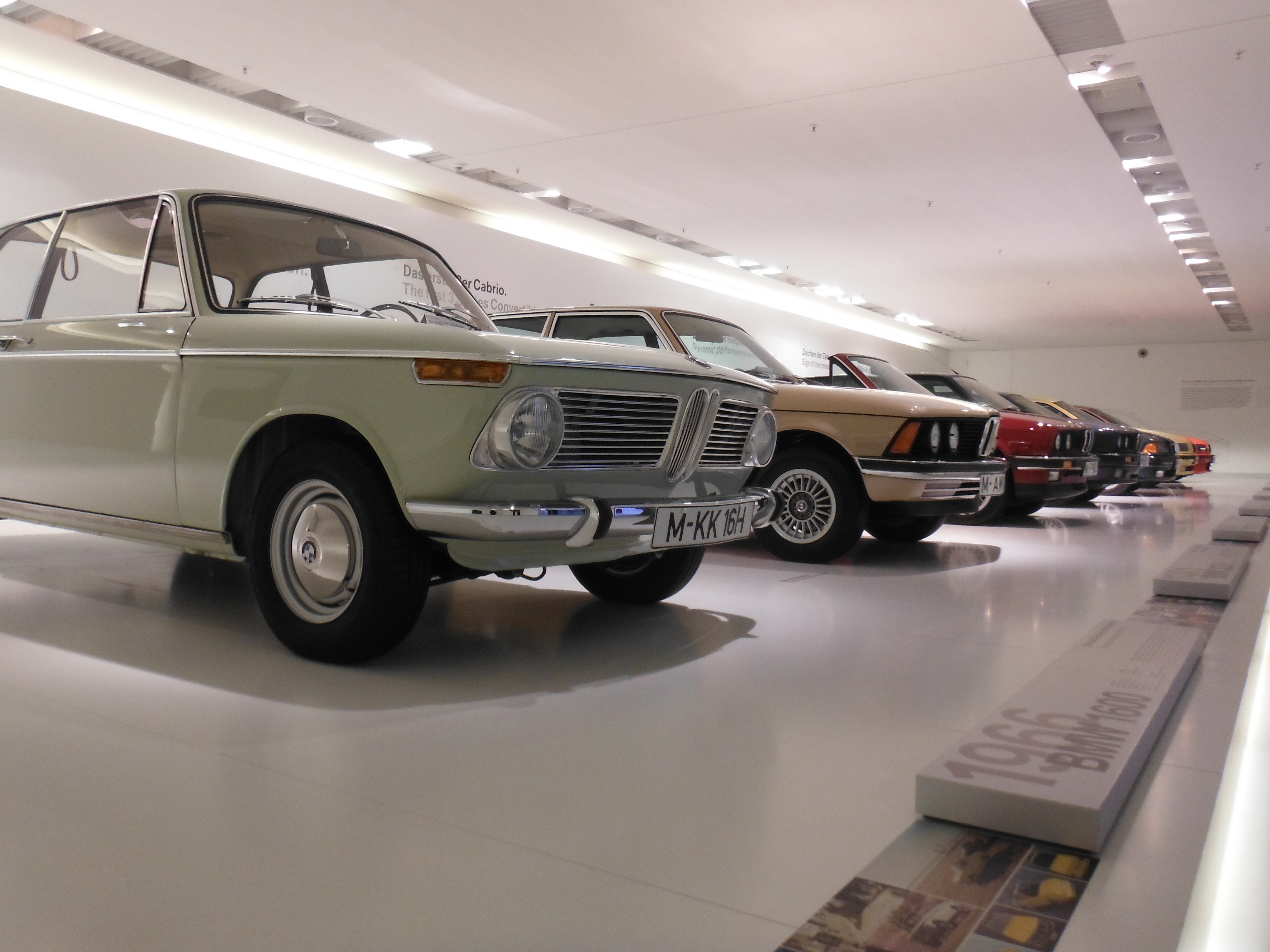
Modern era
The museum does not try to over display. There are some fine examples of vehicles, but the displays are not exhaustive. The room on the left is a good example of the museum’s approach. It is almost a case of the designers believing – probably rightly – that the exhibits speak for themselves. They are instantly recognisable – distinctive. Unmistakably BMW.
However, some of the vehicles seem out of line – though a BMW narrative is wrapped around their 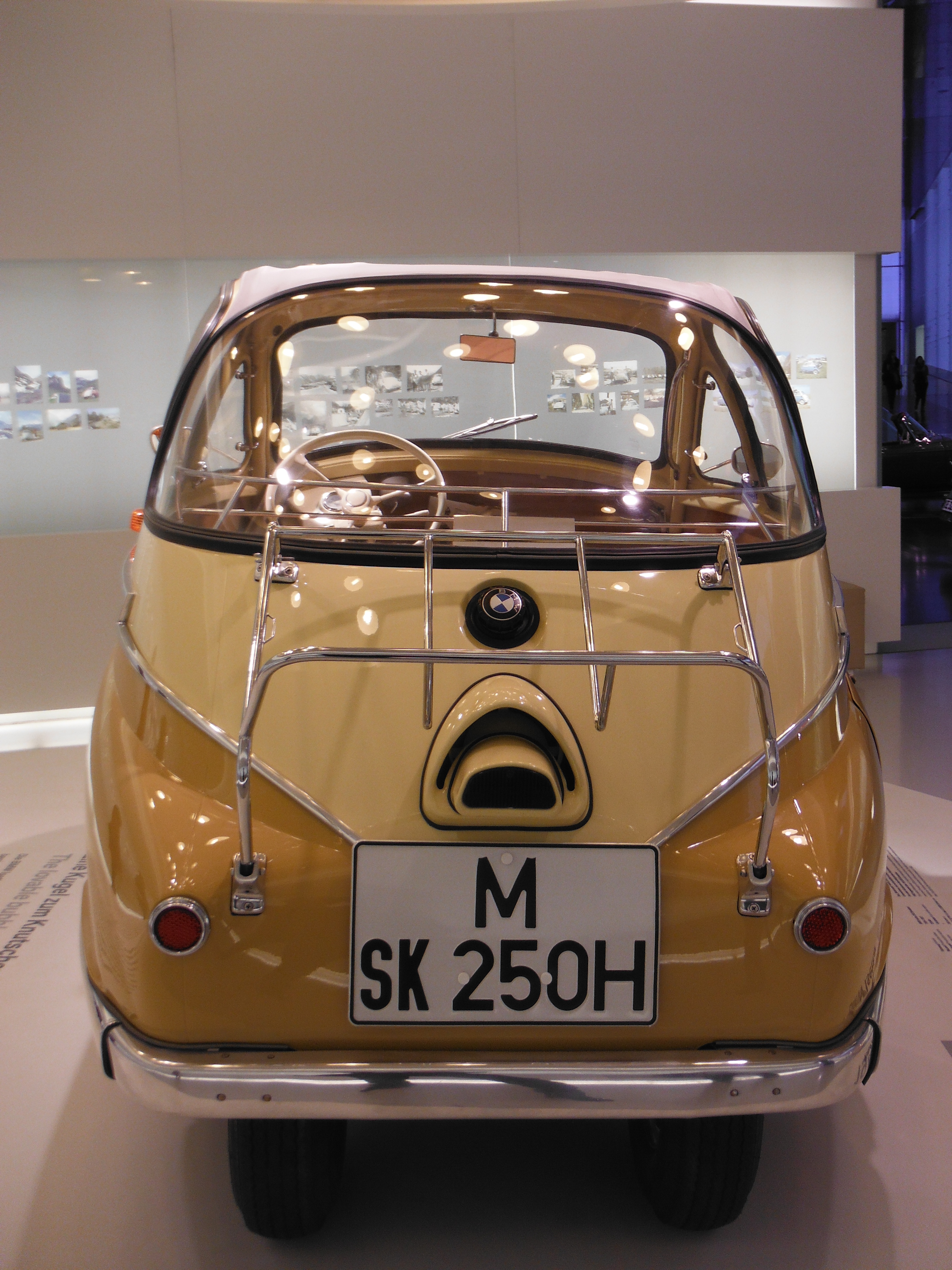 inclusion. For example, the Isetta bubble car. Far away is this vehicle from the high performance BMW products that preceded and succeeded it. Manufactured under licence from the Italian firm, Iso, which also designed and manufacturered refridgerators (see http://en.wikipedia.org/wiki/Isetta), the Isetta apparently buffered the company against hard times in the 1950s. The gallery’s walls are decorated with splendid period photographs of the German public taking their Isettas to places they presumably were not designed for; for example, the Alps. Television advertising footage is also to be seen.
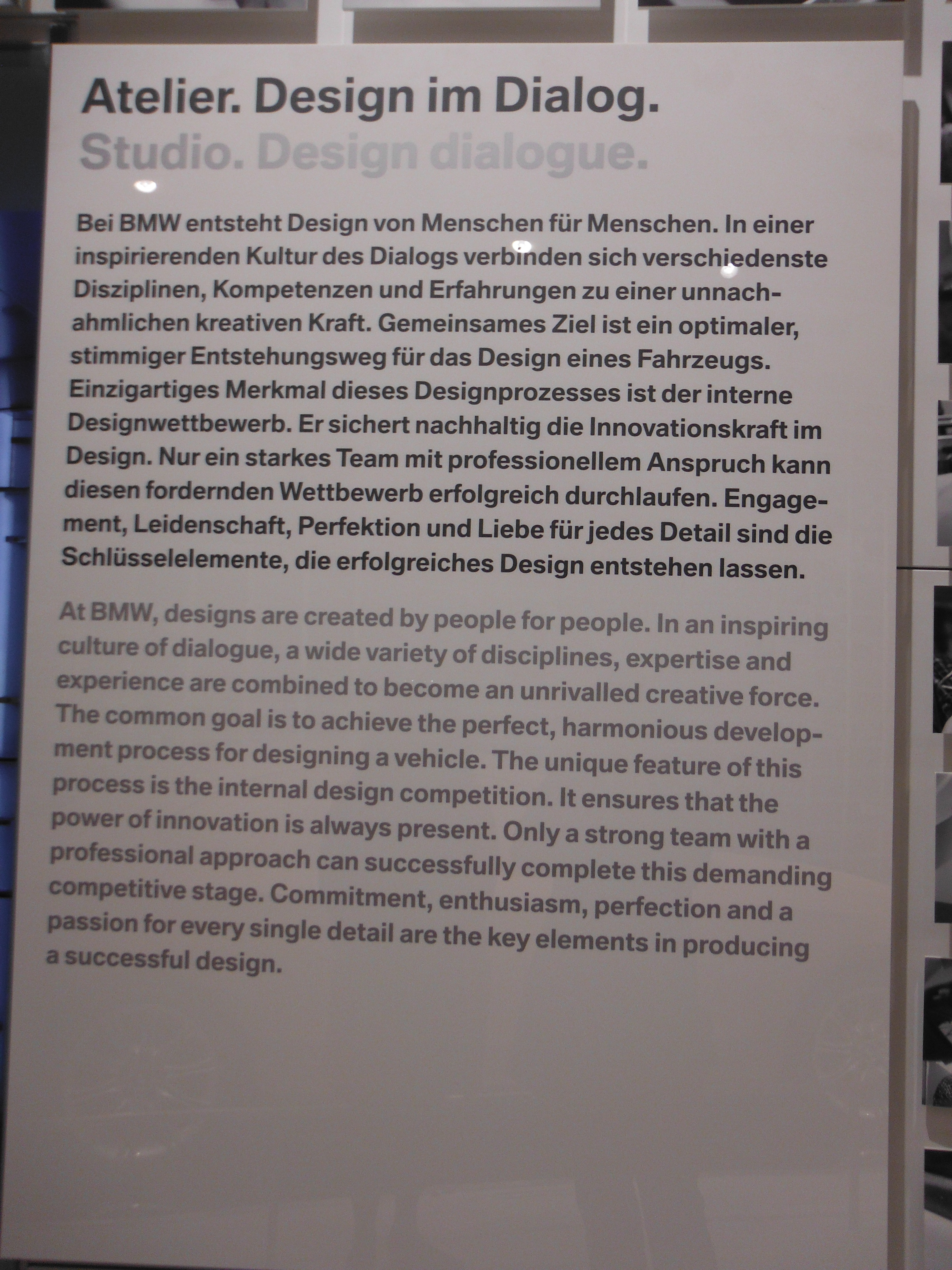 The museum goes to great lengths, however, to spell out its design philosophy. They heap it on, just in case it was missed. The panel on the left is typical – written in German and English, the design philosophy is spelled out – ‘power of innovation’; ‘strong team’, ‘professional approach’ and ‘perfection’ are used to capture its essence. There are also many references to emotion engendered by careful selection and use of materials and colour in the interior.
The museum is only one part of the complex that constitutes what one might call the BMW quarter of the city. Opposite is BMW Welt – housed in a post-modern building that successfully conveys power, influence and intent.
The bendy Daimler bus took us swiftly back into the city. BMW never got into buses, oddly. The S-Bahn had a signal failure. Being stuck in a crammed stationary train for 30 minutes in the early morning brought us back to reality.
Pall Mall summer
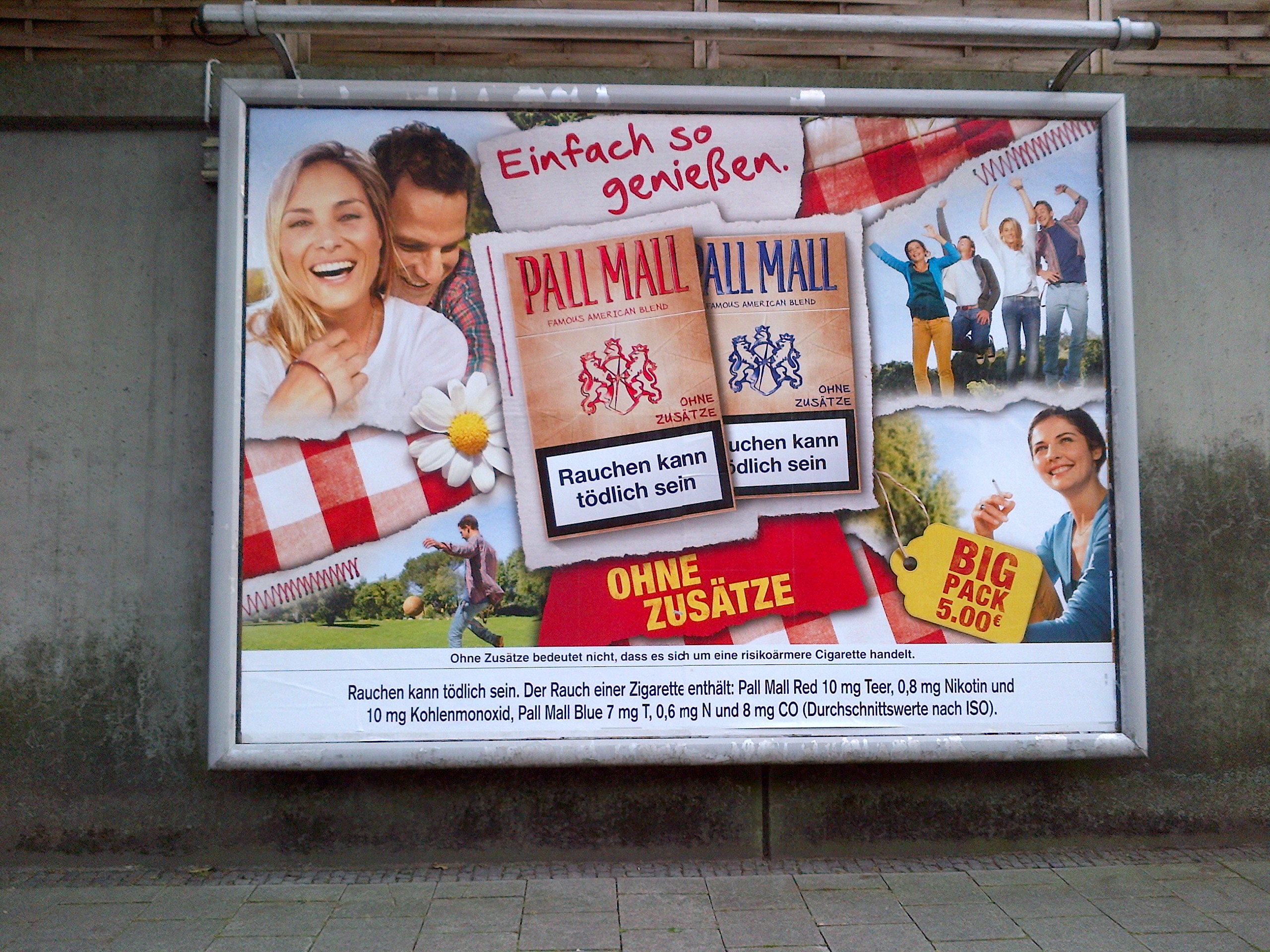
Pall Mall summer campaign
The cycle continues for Pall Mall cigarette advertising. It is our carefree bunch of 20 somethings enjoying life and now the summer to the full, including smoking. I almost feel that I know these characters now.
Vauxhall Vivaros and their engines
 These vehicles are bad news. Having just got the gearbox fixed (see post 1 April, 2012), the engine suddenly malfunctioned. I lost power, sometimes altogether whilst driving, and the engine warning light kept coming on.
My regular garage was unable accurately to diagnose the problem. I then booked myself into a diesel specialist. I had to wait two weeks to get a slot. The day I took it in, there was another Vivaro in there with the same problem. Diagnosis? I know not too much about vehicles, but I was told that it was an ‘injector’ of which there are four. Replacing one does not mean that the other three will not also fail. The bill was in the region of £500.
John Player Special innovation
 In England the cigarette companies are lobbying hard against the proposal to force standard packaging. Their defence is that standard packaging would make counterfeiting easier and make the consumption of cigarettes even more dangerous than it already is. However, the current campaign for JSP in Germany shows how important the packaging can be. JSP packs now have an interesting innovation, GLIDE TEC. The poster (left) indicates that cigarettes are ‘dispensed’ when the pack is pressed at a particular point. The implication here is that this makes smoking even more sociable – seductive – as can be seen in the face of the woman on the billboard.
The easyJet cancellation approach
It is the first cancellation that I have experienced this year with easyJet on the Munich route. EasyJet got through all of last winter’s snow only to be felled this time by an English summer. I was due to fly on Wednesday 11 July at 1835. It had been rather a stormy day and this had impacted on Gatwick Airport. The pilot said that the ‘Terminal’ had been closed for some of the day. Suffice to say, we had to take a bus from South Terminal to North Terminal where the plane was parked. Certainly out of position.
Once on board, the pilot told us that we did not have permission to fly. But clearly as an old hand on this route, he knew that if he did not get the plane in the air by 2030 we would not be going because of Munich airport’s strict night closures. Intriguingly, the pilot took us to a holding position near to the start of the runway. He communicated his thinking and his communications with both air traffic control and easyJet control in Luton. 10/10 for initiative and communication. It was not enough. We were cancelled.
Unfortunately, easyJet are a bit like their planes – great in the air, not very versatile on the ground. I opted to go home, a luxury most people do not have. They had to join a queue of around 200 people or so to try to get on another flight and find a hotel. In all, I counted 8 easyJet cancellations that evening.
By the time I had got home, the cancellation was confirmed and I was able to get on a flight on Friday 13 July. So not so bad. Unfortunately, my partner had attempted to book me on another flight and – in the heat of the moment – got the wrong direction (Munich – London). Changing bookings with easyJet is not difficult, unlike other airlines, but they do charge for the pleasure. In this case 86 Euros (changing name and date so that she can fly to me next month). All credit to easyJet on this occasion, they have refunded the charges, having accepted the ‘heat of the moment’ decision-making. Always worth writing to them.
Royal Blue run 2012
Some of my closest friends know that I have some interest in buses. I have a bit of a collection of model buses, but those who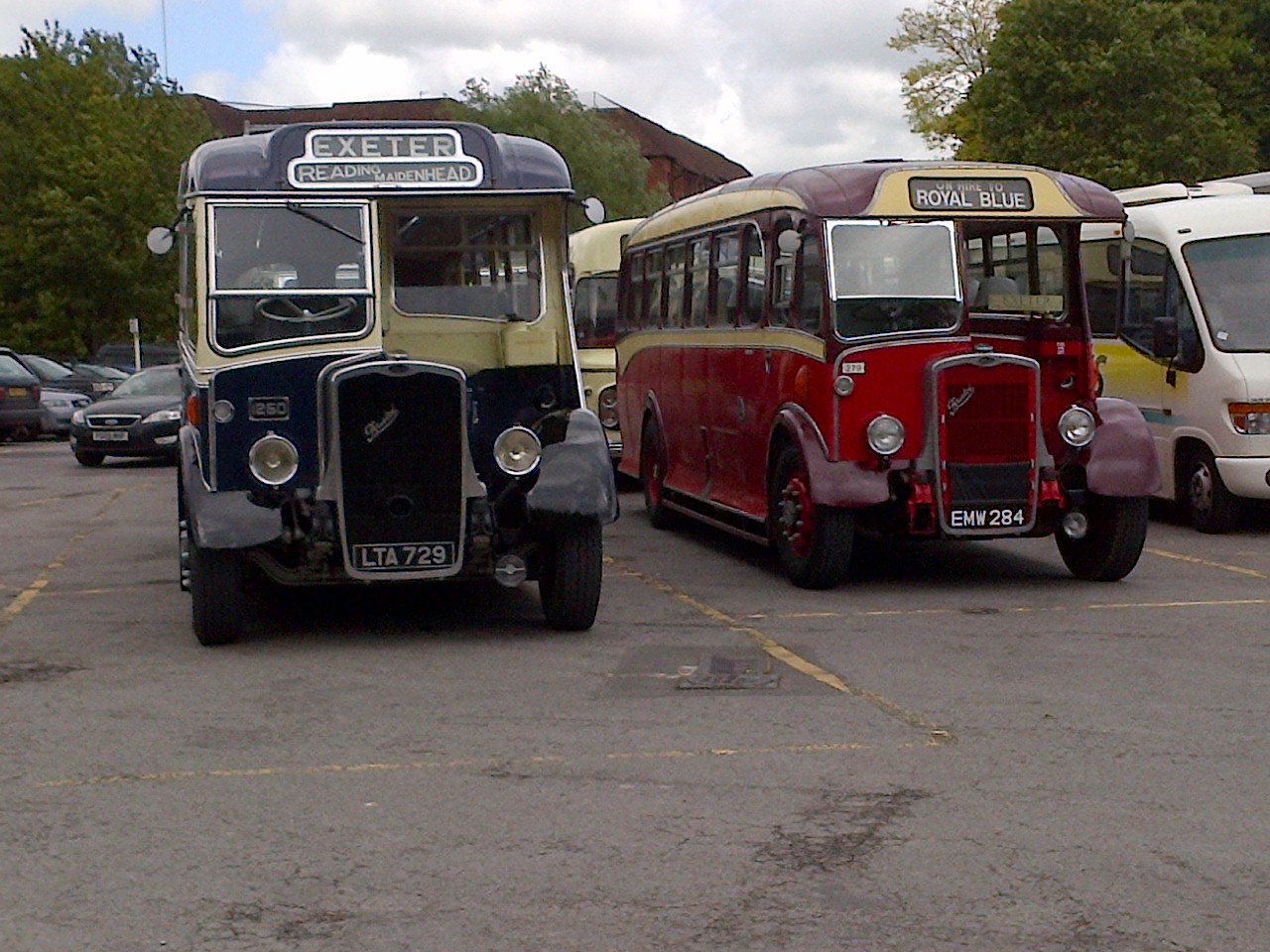 have the real thing are special. I have never been a passenger on a bus run. The opportunity to join this year’s run was too good to let pass. So, we boarded a colleague’s 1961 Bristol MW on Friday morning (29 June) and headed out to Salisbury to meet up with a fleet of vehicles that once plied their trade between the South West and London.
 It did turn out to be a bit of a tour of bus stations; notably Exeter and Plymouth. The drive through the villages and small towns with their tight bends and narrow entries and exits (the buses sometimes fitted these roads like the tube trains fit the tunnels) was delightful but more often than not frustrating. Whilst the vehicles in their heyday had the roads to themselves, modern tourism meant that we encoutered a lot of traffic in the opposite direction generating tight passing and a lot of reversing.
To illustrate the specialness of some of the owners, one has set up his own museum on his farm near Aveton; this was one of the stops on the tour – and memorable it was, too. Not only is there a collection of memorabilia with suitable descriptions and narrative, but also more buses. Hidden at the back of one of the barns was a truly immaculate Bristol Lodekka. Those in the know, know what I mean.
Emirates and the London Underground
So, Emirates airline has invested £36m on a cable car across the Thames between the O2 and the ExCel Arenas. Notwithstanding the fact that at the moment there are unlikely to be too many passengers for this piece of public infrastructure (the property of TfL) on the basis of price (£3.60 with an Oyster card) and, more significantly, a shortage of population between these two points. Though it may have some utility during the Olympics as both arenas are hosting events.
More worrying is the concessions that go with this £36m. Seemingly, Emirates can now tag their logo with the Underground map. This corporate image creep – which Emirates Airlines seems to be particularly good at – should have its limits. As a clean work of art, that map should not be besmirched with any other logo other than the Roundel.
Cigarette advertising, Summer 2012
 On this ongoing topic, two new players have entered the advertising space with two different types of campaign. First the Parisien brand goes for the wacky, happy, let the packets say it all approach (left). Parisien is one of the British American Tobacco brands which is particularly popular in Switzerland. The advertising reflects the brand’s alignment with non-mainstream film directors such as Jean-Luc Goddard, David Lynch and the Coen Brothers. (Most of this detail is drawn from Wikipedia as I had never come across the brand before. I will see what else I can find.)
The second new brand has a very male image.  This image shows five men enjoying themselves in some indoor dark place, perhaps some bar or club. Though there is light suggesting that they have come from a bright outside to be there. However, the headlines defy my german. Normal ist Montags Mädelsabend. Normal kann jeder. My translation would have it that Monday is girls’ night. Perhaps there is an accompanying campaign that would make the whole thing clearer as the Malboro ‘Maybe’ campaign has become?
Wikipedia notes that L&M is a product from the Altria Group, Inc., formally Philip Morris. It is an American brand that is very popular in Asia. It clearly has remarkable properties if this youtube advertisement from 2009 is anything to go by: http://www.youtube.com/watch?v=DoFlb3UsMJk Oddly, terminal cancer is not mentioned.
 Be informed