Thinking very aloud – Laurie Taylor at the University of Brighton
Filed under: The Academy | Tags: Erving Goffman, Laurie Taylor, Michel Foucault
 Leave a Comment
 I’ve been listening to Laurie Taylor on the radio for many years. Originally earmarking my Sunday evenings as must listen nights. More recently I have just downloaded the podcasts of his social science review show, Thinking Aloud (http://www.bbc.co.uk/programmes/b006qy05/episodes/downloads). On 11 June I saw him in the flesh speaking on the theme of ‘escaping academia’ – something that us modern-day academics dream about.
The 45 minutes – which seemed like 10 – were packed full of often amusing anecdotes. But like all the best speakers that I know, the anecdotes were woven into the speaker’s more profound and less accessible conceptual points, drawing in the audience in the process.
Taylor talked at length about his early career at York University – a world apart from the reality of working in a university in 2015. More significantly he identified some of his most influential texts/theorists. In particular, Erving Goffman (whom he met in a restaurant in the US and who disrupted the situation by ordering dessert first to make a point about ritual); Michel Foucault’s ( particularly, it seems, Order of Things, 1965), Ernst Bloch and Anthony Giddens.
This made me briefly think about the key texts that had most influenced me. These are indisputably Steven Lukes’ Power: A Radical View; Stewart Clegg’s Frameworks of Power and Germaine Greer’s The Female Eunoch.
But how does one get into radio? In Taylor’s case, he received a phone call from an unnamed BBC person who asked him whether he agreed with, if I recall, an increase in postal charges. His answer swiftly captured ideas about the art of writing being lost if charges for letters increased. The enquirer then asked him to make the opposite case. Bemused, Taylor proceeded to talk about how telephones provide opportunities for real-time communication and ideas development, discourse, etc. The enquirer then asked if Taylor would care to come on his radio show later that week. Seemingly the enquirer was Robert Robinson and the programme was Radio 4’s Stop the Week.
I will not publish my phone number on this blog; but interested radio show hosts, please email me.
Picture: BBC
Das Gewitter
 35 degrees heat has been imposing itself on central Europeans over the past few days. It is not to my liking as a English bloke from the north used to fog in the middle of summer. I do, however, love a good electrical storm. From a safe distance.
The weatherman on the TV on Friday night promised some activity on this front. First the clouds came over, then a breeze got up. Finally the flashes and thunder. Not a classic, but I did manage to capture a lit-up sky on my phone. It required a little patience.
Actually tonight, I got some real lightening!
Tandem Tour 2015 – early thoughts
 It is time to start thinking seriously about this year’s tour. We have decided to stay quite close to home this year and take on Northern Bavaria (or more precisely, Franconia). The aim is to start from Regensburg and follow the Tauber Altmühl Radweg (left), skirt around Nürnberg, head up to Coburg and finish up in Leipzig.
Early days. A couple of guides have been purchased, but because our plan does  not form a part of a registered long-distance route, we have to mix and match the maps (and make one or two of our own).
Camping last year was a decidedly damp and cold affair. The long-range weather forecast for August is not yet out…
Too hot to smoke
 Munich early summer is hot this year. Cigarette advertising is in a bit of a lull. I have to say that collecting these images is getting a bit boring and predictable, but readers predominantly visit this site to see them.
So, Camel is focusing on its colourful “untamed” (since 1913) angle.  Certainly the camel is iconic and does not need the name to be recognisable. I have no idea how valuable it is as a brand in Germany. Very, I imagine, if these images are anything to go by.
Small things to do as a means of resistance to regressive Conservative policies
Filed under: Politics | Tags: Carphone Warehouse, Charles Tyrwhitt, Conservative Party, Hermes
Leave a Comment I write this while “Stand down Margaret” by the Beat, plays on my turntable. Contemporaries will understand the significance.
I t is time to be a shade more discerning with whom I transact. First on my list, Carphone Warehouse. I’ve been customer of CW for 15 years or so. The customer service was always good. The largely male sales assistants were always knowledgeable and had solutions. Sorry, the boss, Charles Dunstone is a signatory to one of those deceitful letters in support of the Conservatives in the election campaign. End of business. That goes for Dixons as well.
Second, Charles Tyrwhitt, great shirts. I’ve written about this company before because of its use of Hermes couriers. Now it turns out that its boss, Nick Wheeler is also a Conservative signatory. Never again will they get my business.
Anyone interested in a comprehensive list, please follow this link: http://www.gmb.org.uk/newsroom/telegraph-bosses-list-of-shame
Those pesky railway workers
Filed under: Politics, Privatisation, Railways | Tags: National Express, privatisation, Southern Railway
Leave a Comment  The strike by UK rail infrastructure workers scheduled for next week has been called off, but the train operators (private companies using the rail infrastructure) had their plans for dealing with the lack of infrastructure. Obviously, not run trains. But it was worse than that. This was going to be a 24 hour strike straddling two days. Never helpful, but this is industrial action, it is supposed to be disruptive. Starting at 1700 on Monday and finishing 1700 Tuesday. Presumably then, trains will run on or near to 1700 on Tuesday? Er…no. Not worth it, it seems. Trains would have restarted the next full day.
 Maybe someone can correct me on this, but it seems on the face of it that the costs associated with restarting train services at 1700 are too high and the key passengers – season ticket holders – were unlikely to have travelled in to London or other principal cities in the UK earlier in the day and would, therefore, be unlikely to need the train home. So the rest of us who might want to use a train for non-work travel can go stuff ourselves.
It is easy to say that pre-privatisation (1994) it would have been inconceivable that the trains would not recommence after the ending of strike action. This really does seem to be a case of profit coming first.
Incidentally, I will arrive at Gatwick Airport at 1800 on Tuesday with a view to getting back home on the South Coast. I checked nearby hotels and airport parking. Extortionate. £140 pounds to park at Gatwick. These organisations seem to have had a service bypass!
The one unexpected good business was National Express which planned to put on extra coaches to cater for the stranded passengers at not-inflated prices from what I could see. Top marks. I’ll remember that.
When comedy comes into its own
Filed under: Art, Politics | Tags: Frankie Boyle, UK General election 2015
Leave a Comment Still reeling from the election result, I turned again to comedy to try to manage the situation. I have not been a great fan of Frankie Boyle (below left) in the past. I have found his comedy a bit close to the bone and unnecessarily  offensive. Until last night.
His latest show, Election Autopsy, helped me understand why offence is necessary. It was not a belly laugh, but it was funny. And there is one scene where a Conservative voter, in the audience, shows herself to be crass and is only mildly embarrassed. If at all. Rather like the Tory leadership, I thought.
However, this was not just about the Conservatives. Boyle’s position is one of non-voter advocacy because, ultimately, the system is broken. To vote would be to endorse, or at the very least, patronise the system. His audience and guests did not wholly agree with him, but it was as informative as any of the leaders’ debates I witnessed in the campaign.
The best ‘joke’. “Some of my best friends are racist. First of all they are black…and they have got a point.”
For readers in the UK, the show is for a short while available to stream on the BBC website. I recommend it: http://www.bbc.co.uk/iplayer/episode/p02qs82x/frankie-boyles-election-autopsy
The exceptional contribution of Akala on structural racism in the UK is embedded in the Guardian newspaper’s review of this show: http://tinyurl.com/off94bx
By contrast, I started watching Rory Bremner’s equivalent, Election Report. Everyone loves an impersonator. He’s not bad.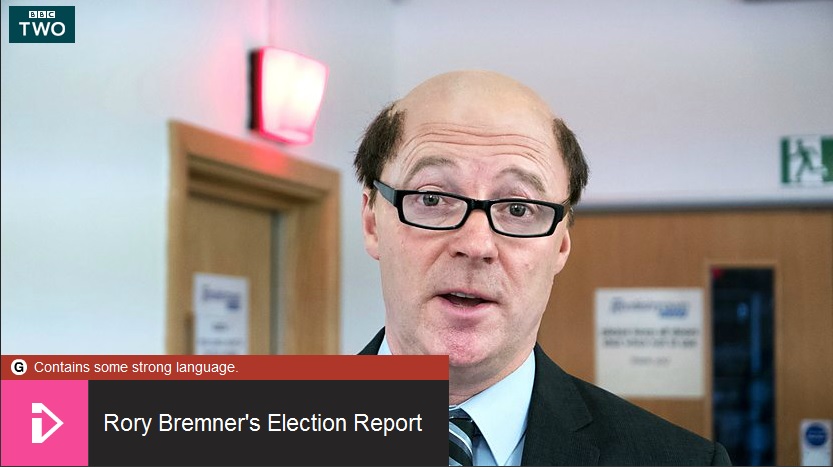 Some of his observations were also cutting. And in the spirit of BBC balance, aimed at all parties. However, unlike Boyle, Bremner accepts the system and makes fun of it on its own terms. So, whilst one may chuckle along with it, one is left feeling underwhelmed. With Boyle, I felt emboldened.
Bremner’s programme is also available on the BBC: http://www.bbc.co.uk/iplayer/episode/b05vjft9/rory-bremners-election-report
Pics: Channel 4 through Wikipedia
BBC screen grab
Charles Windsor’s letters
Filed under: Politics, Royal Watching | Tags: Black Spider Memos, Charles Windsor, Freedom of Information, Theresa May
Leave a Comment  The ‘black spider memos’ were finally released yesterday. Successive governments have spent hundreds of thousands of pounds trying to stop their release over ten years. Mr Windsor seemingly makes a habit of writing to ministers – including the Prime Minister – giving advice on anything from architecture, quack medicine to the mass slaughter of badgers. The ministers write back in fawning deference, ‘your most humble servant’ etc.
Well, it will not happen again. Seemingly. The Government has already changed the law to guarantee the secrecy surrounding Mr Windsor’s (and no doubt his family’s) communication with what he probably thinks are his mother’s ministers. His communications are now, therefore, exempt from Freedom of Information requests, however banal they may be. On the other hand, Theresa May, the Home Secretary, is going to prioritise the return of the ‘Snooper’s Charter’ – legislation to enable the security services to monitor all of our electronic communication. Nice.
5 Years
The result of the UK General Election was deflating (to put it mildly). Managing the feeling of deflation is not easy and sometimes a distraction can help. Football often works for me. Distraction this time came from some cabaret at the Brighton Fringe Festival (Spiegeltent).
 So, we tried the show by Bourgeois and Maurice (left), a self-declared neo-cabaret act, whatever that is. They are flamboyant, camp, funny and entertaining. Clearly they did not have too much time to put this show together after the election, so naturally they incorporated material from their repertoire as well as new songs and sketches. They started with what seemed to be a new and funny song called ‘move to the right’ capturing the dynamic of the election – people who look to keep what they have ‘move to the right’ and those who swallow the anti-immigration bile ‘move to the right’. We were treated to their ‘depressing poem’. Oddly funny. It was just what was needed.
The conclusion of the show was genius. They did a rendition of David Bowie’s apocalyptic vision of the future, 5 Years. As we inappropriately say, never has a song seemed more appropriate.
The Government’s priorities say it all
The sense of deja vu associated with early reporting of the UK election results early on Friday morning was surreal. Back in 1992 when Labour under Neil Kinnock was expected to oust John Major’s Conservative government, assembled friends reeled as the results came in. Clear that it was not going to be a good night. Sleep does not come easily, either.
Major’s great contribution to human welfare was to privatise the railways; a legacy that stays with those of us who rely on the railway and know something about how it works. This new Tory Government will prioritise the abolition of the Human Rights Act and withdrawal from the European Convention on Human  Rights (ECHR). What kind of people abolish an act written, albeit imperfectly, to protect the interests of vulnerable citizens? And withdrawal from the ECHR has many implications, not least being in breach of one or more European treaties, the foundation of the UK’s very membership of the EU. It is also written into the Good Friday agreement with the Irish Government. Any change would need to be ratified by the Scottish Parliament. That might be challenging.
David Cameron announces that his party in government will be the true party of working people. So much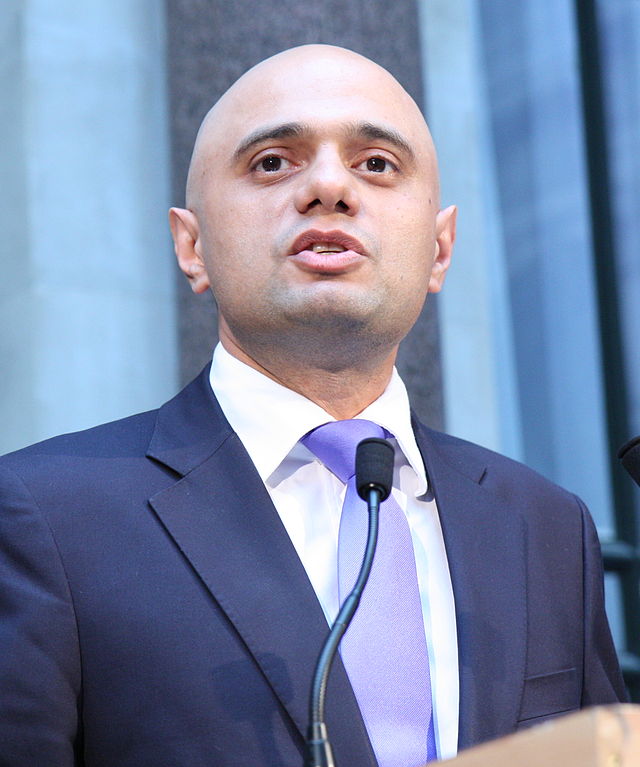 so that the new Business Secretary, Sajid Javid (right), will look to make it very difficult for employees to withdraw their labour by raising the threshold of participation in ballots. Therefore, for some classes of employees, for example, public sector workers, it is proposed that 50 per cent of members will have to participate for it to be valid. However reasonable that may seem, ballots already have to be postal and cannot be held in the workplace. Postal ballots are well known to have lower response rates than workplace ballots. Getting 50 per cent participation is unrealistic and constitutes an effective banning of strikes. The new party of working people seeks to give employers absolute power over employees.
Picture: European Court of Human Rights:
Picture: Sajid Javid through Wikipedia

