Reflections on my home town
Keeping a meaningful blog up-to-date is not trivial, I find. In recent weeks I have been busy moving house (some reflections to come) and dealing with the sudden death of my father. The latter has clearly taken up much mental space rendering most other issues less significant.
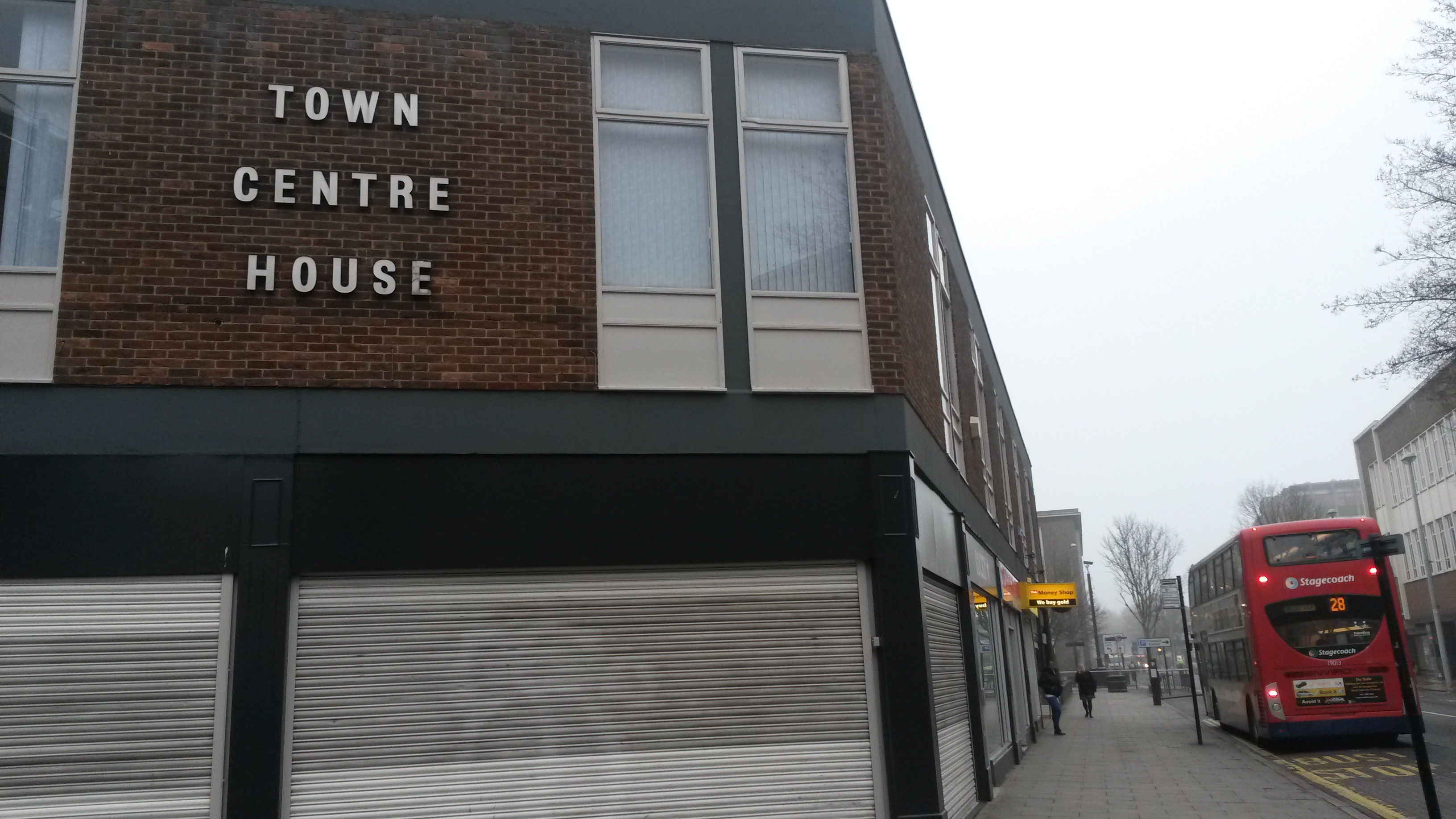 I find myself writing now from my home town, Kingston-Upon-Hull in the East Riding of Yorkshire in the UK. It is not a pretty town. It was heavily bombed during the war – it was and is a significant port – and the rebuilding was not the most sensitive. Take this picture (left) for example. This is Prospect Street in the City Centre at 0815 on a weekday morning. This is a utilitarian 1960s building showing considerable creativity with respect to naming. Actually, the name is fit-for-purpose. The shutters are ubiquitous as are the pawnbrokers and betting shops.
That said, Hull, as it is known locally, has a historic quarter and grand buildings to demonstrate its former significance and power.![20140403_224345[1]](https://weiterzugehen.net/wp-content/uploads/2014/04/20140403_2243451.jpg) The Guildhall (right) is one of the most impressive in the county which boasts both York, Leeds and Sheffield. It was designed by Edwin Cooper and completed in 1916. It was damaged in the war but restored fully in 1948. Nikolaus Pevsner, the architectural writer and critic, not a man to be easily impressed, described its Baroque Revival style exterior and interiors as a ‘tour de force’. Nearby are the Town Docks buildings – as grand as Liverpool’s waterfront, arguably – the City Hall (concert hall) and the Ferens Art Gallery, bearing the name of one of the City’s great benefactors.
The Guildhall (right) is one of the most impressive in the county which boasts both York, Leeds and Sheffield. It was designed by Edwin Cooper and completed in 1916. It was damaged in the war but restored fully in 1948. Nikolaus Pevsner, the architectural writer and critic, not a man to be easily impressed, described its Baroque Revival style exterior and interiors as a ‘tour de force’. Nearby are the Town Docks buildings – as grand as Liverpool’s waterfront, arguably – the City Hall (concert hall) and the Ferens Art Gallery, bearing the name of one of the City’s great benefactors.
![20140403_224200[1]](https://weiterzugehen.net/wp-content/uploads/2014/04/20140403_2242001.jpg) Hull’s relative isolation delivered over the years a number of quirks. For some reason, British Telecom – and its predecessor, the General Post Office (GPO) – did not swallow up Hull’s Corporation-owned and run telephone service, epitomised most visibly by the cream public telephone boxes (left). These two fine specimens are located next to the equally grand GPO office on Lowgate, now a Wetherspoons pub.
Hull’s relative isolation delivered over the years a number of quirks. For some reason, British Telecom – and its predecessor, the General Post Office (GPO) – did not swallow up Hull’s Corporation-owned and run telephone service, epitomised most visibly by the cream public telephone boxes (left). These two fine specimens are located next to the equally grand GPO office on Lowgate, now a Wetherspoons pub.
In recent years there has been much regeneration in the Town Centre. Ferensway – named after the benefactor – has been completely redeveloped; it is dominated by a shopping centre, though nearby is the splendid Hull Truck Theatre and the Albermarle Music Centre – an upgrade of the former youth centre on the site. That said, the shopping centre reaffirmed the railway station area as the centre of the city. Over recent years, the heart of the city had shifted slightly East. But such is the poverty in this city, the new focus has just caused the existing 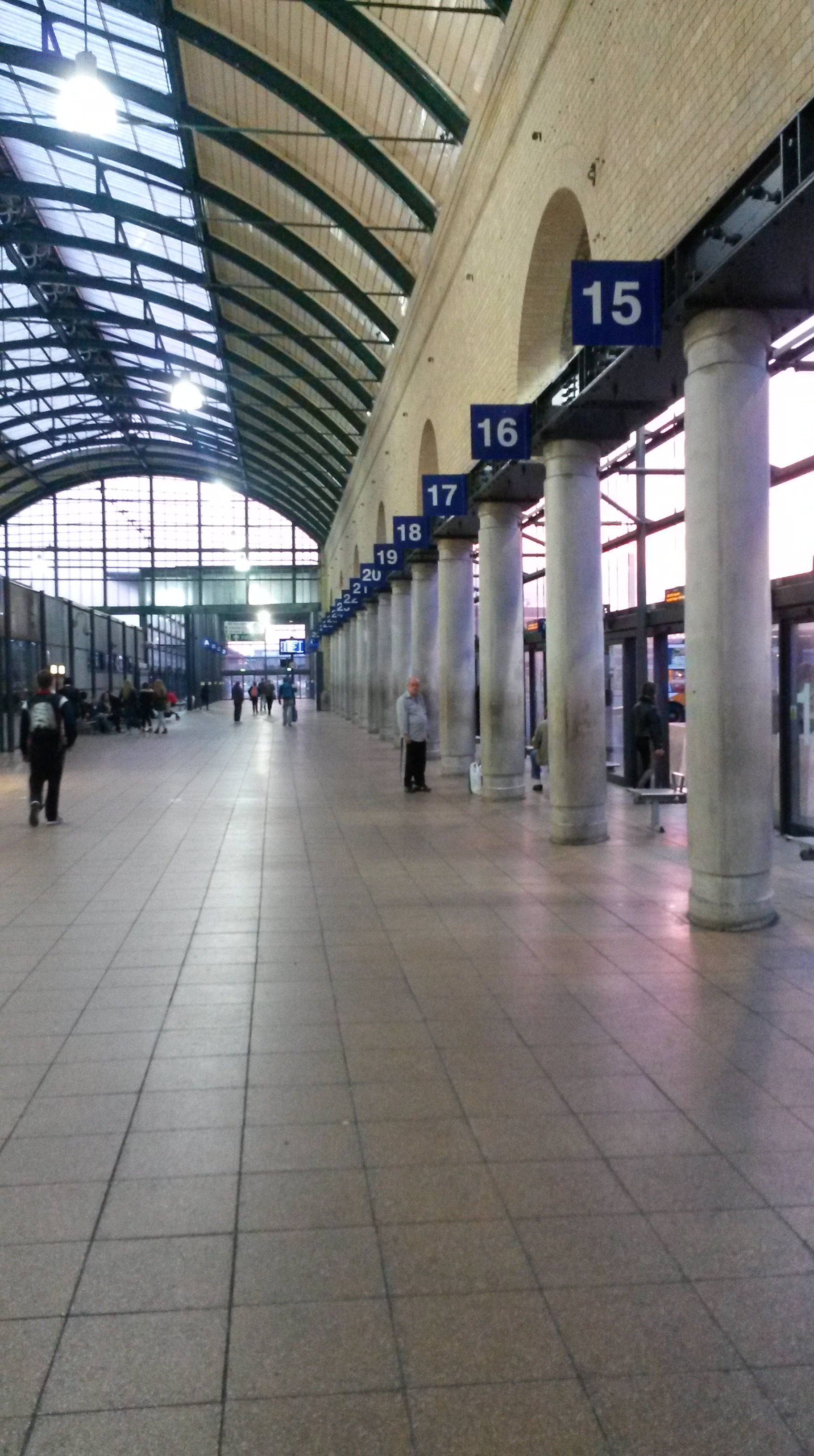 shopping areas to fall into disrepair, with those shops/chains able to do so, moving.
To my eyes also, there was a missed opportunity. The grand Paragon railway station had its stone façade re-instated (in the 1960s another utility office block was parked in front of it). The old bus station was demolished and an ‘interchange’ built. Not before time, but the result is less-than satisfactory (right). It straddles the side of Paragon Station. With 40 stands it is long, cold, echoey and slightly threatening.
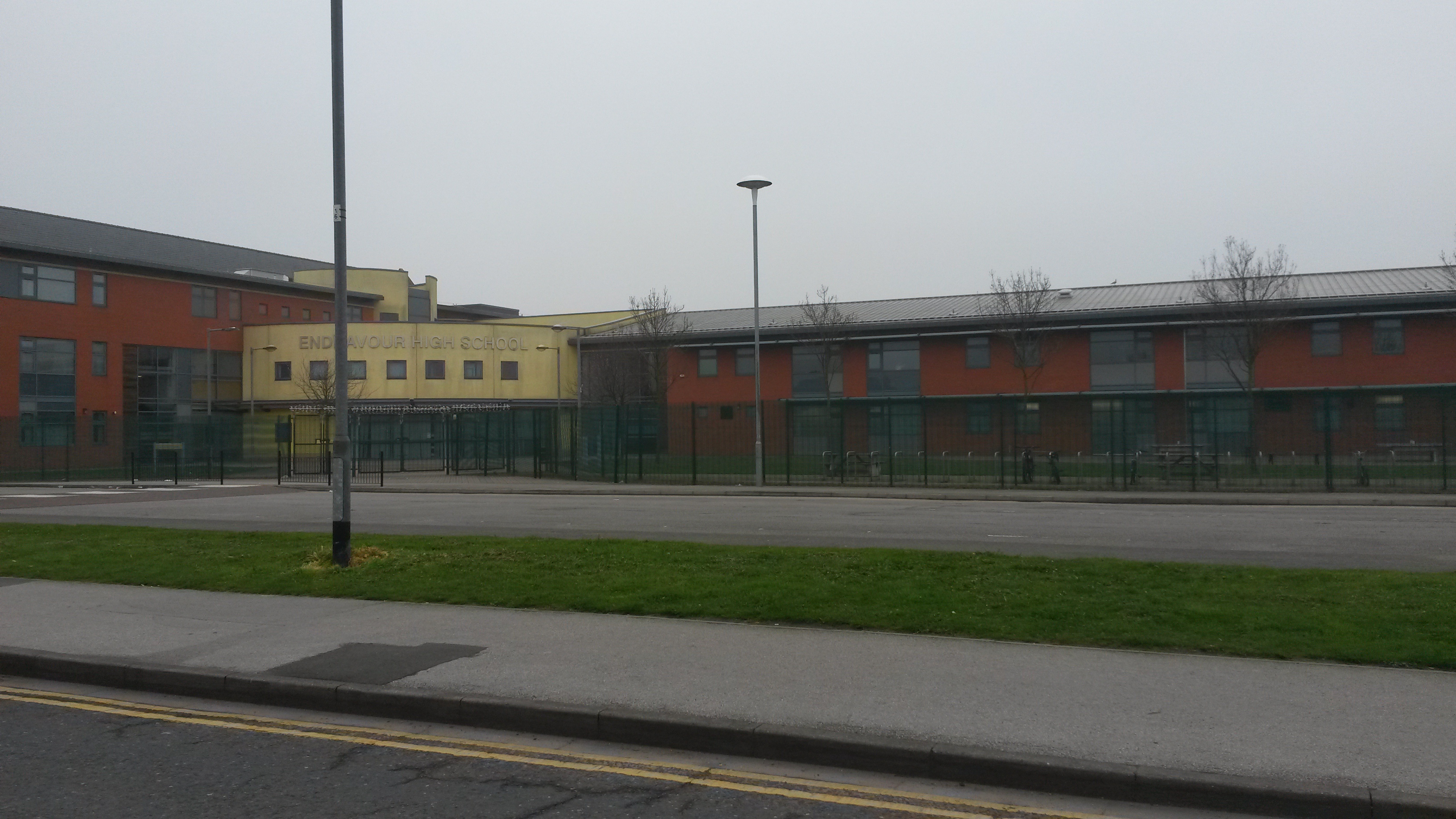 New architecture is appearing all over the City. I cannot help feeling that the errors of the 1950s are being repeated. Take the Endeavour School on Beverley Road (left). The naming is what one might expect (and in contrast to the ‘Town Centre House’, above). But it really looks like a ‘secure’ facility rather than a place of learning, youth and endeavour.
I will return with my camera and a copy of Pevsner for some more reflections about this City. There are things to be optimistic about. Siemens is investing heavily in a Wind Turbine manufacturing facility here. It will be City of Culture in 2017. And the football team (right) are in the Premier League. That quirky telephone company provided the funds to build the stadium that enabled improved fortunes for the club.
Further reading on the architecture of the Guildhall available from English Heritage: http://list.english-heritage.org.uk/resultsingle.aspx?uid=1279708
Joan as Policewoman, Norwich Arts Centre, 15 March 2014
 Joan Wasser’s fourth album, The Classic, formed the core of this exceptional sell-out gig. Accompanied by her stalwart band featuring Parker Kindred on drums and Tyler Wood on keyboards and sax, she was spellbinding. I’d heard the album only once prior to the gig, but Joan justified its soul-oriented theme, something that seemed unconvincing on first listen.
Joan herself is a multi-instrumentalist. Adorned in her trademark leathers and Stella McCartney wedge shoes, she introduced us to her spangly violin augmenting her regular keyboards and guitar.
The show started with ‘What would you do’, from the new album, with its punishing drums, wailing keyboards and punctuating saxophone. Joan never underestimates herself in her song writing. ‘Magic’ from ‘The Deep Field’ was one of only three old songs featured bearing the classic line, ‘I am divine’, which reflected her good sense of her self worth after a couple of darker albums riddled with tragedy in her personal life. ‘Good Together’ is in that tradition. A tale of not settling for less. the first time “it wasn’t so special” topped off with, “Don’t wanna be nostalgic…for something that never was”. Say it Joan!
That said, the new album is full of yearning. ‘Get Direct’ is a seductive invitation to a new love. “Don’t take the tangle from my past, I left that ruin long ago” she sings. “it’s elementary, if you would be mine, we could be happy…” With her intonation, one knows it is true.
There is even room for concept. ‘New year’s day’ is epic in duration, instrumentally repetitive, lyrically oblique and rambling. And compelling. ‘You won’t find me here this new year’s day’. Time for a change in life.
The encore was promised before the set was even half way through. There was never any doubt that the band would be called back to play the acapella single, The Classic (http://www.youtube.com/watch?v=ldYODNL8GtY). It worked well.
Have I undersold the show?
Cigarette industry – grim prospects?
For a number of years this blog has reported, as irreverently as possible, cigarette advertising in Germany. Germany is one of the few places in Europe where it is still possible to advertise cigarettes. The contrasting campaigns are a source of endless fascination as the brands pit themselves against one another.
However, cigarette advertising is one thing, the continuation of the industry more generally is now in some doubt. I say this after reading an article in the Economist magazine (link below). Apparently, it is fifty years since the US Surgeon General declared smoking to be a ‘health hazard’ requiring appropriate ‘remedial action’. This remedial action led to a decrease in cigarette consumption from 43 to 18 per cent in the American adult population. Still, 20 million Americans have died from smoking-related diseases since then. The current Surgeon General has declared smoking deadlier than previously thought and has promised ‘end game strategies’.
 What does this mean for the tobacco companies? Traditionally, they have found new markets, particularly in Asia. But here, also, the regulatory environment is becoming hostile. Arguably, too, the firms have not seen the e-Cigarette phenomenon coming – dominated at the moment by new firms, a selection of which are represented on the panel (left). Perhaps they have failed to understand fully what is their business? The customer craves nicotine, not tar: e-cigarettes seem to be efficient deliverers of nicotine, and less riskily. Though this may well be scrutinised closer in coming months and years.
Another approach seems to be cigarettes that do not actually burn the tobacco. Rather they heat it to deliver their nicotine payload.
Picture: http://www.eciguserguide.com/promising-e-cigarette-brands-2014/
Giraffe Euthanasia
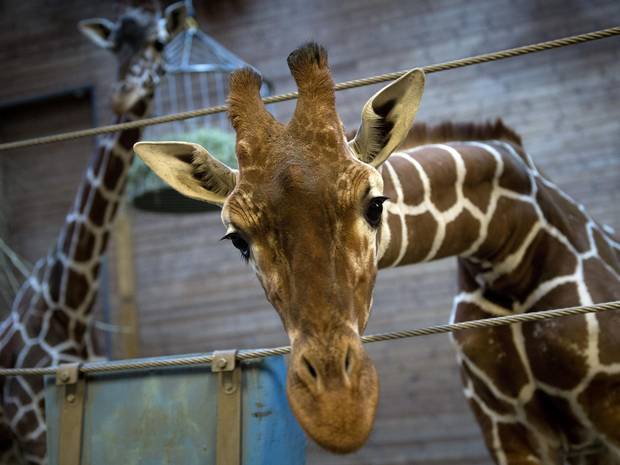 Marius, the 18-month old giraffe captive in Copenhagen Zoo was killed yesterday and fed to the captive lions. In the public gaze. A bizarre spectacle from a British perspective, but not necessarily elsewhere. The justification for the killing was, scientifically, logical. Captive animals tend to breed with one another and this puts pressure on the gene pool.
It also seems not helpful to Copenhagen Zoo for alternative homes to be offered. The ‘value’ of the animal had been calculated. First of all it was valuable as an attraction when it was young. Baby animals are much more remunerative than older animals. Essentially, they are cute. It also seems clear that the animal’s body – in terms of meat – had been factored into the calculation. There are some hungry lions nearby who infrequently eat giraffe. The costs associated with moving the animal far outweighed its immediate value as a food source for the lions.
And there is the problem. Animals are commodities. They have value and no value at different times in their own lives. Just like farm animals. The problem is not what the Danes did to Marius. The problem is zoos.
Picture and story: http://www.independent.co.uk/news/world/europe/the-killing-of-marius-the-giraffe-opens-an-important-debate-about-genetics-animal-rights-and-zoo-inbreeding-9120219.html
Making trains
 Finally, some good news for UK manufacturing. Bombardier, the Canadian engineering firm, which owns the former British Rail train factory in Derby, has won the competition to supply 66 units to Crossrail opening in 2017 (impression, below right). They beat off competition from Siemens and Hitachi. The former recently won the contract to make the Thameslink trains. Hitachi trains can be seen running on HS1 between St Pancras and Dover.
Whilst I understand that competition is necessary when placing orders for expensive long-lived kit to ensure some  degree of value-for-money and quality (British Rail supplied to itself a lot of over-priced un-tested stock in the 1950s that very quickly found itself decommissioned), I despair at the ease with which much of the UK’s supply comes from abroad. The train building capacity and capability in the UK has been lost.
I despair even more, however, at the madness that the structure of the railway industry in the UK. This week, we learned who were the preferred bidders for the re-privatisation of the East Coast Mainline ‘franchise’ between London, the North of England and Scotland. The current operator, 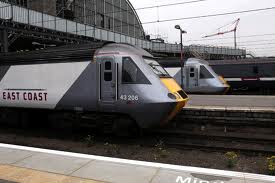 Directly Operated Railways (DOR), has been running the route successfully and profitably since National Express handed back the keys, so-to-speak, in 2009 after they failed to deliver the returns to the UK Treasury pledged in the contract (DOR has returned some £600m to the Treasury so far). National Express replicated the error made by its predecessor operator, GNER, that equally over-stretched itself and delivered those very same keys back to Department for Transport a couple of years earlier.
Three private-sector charlatans will slug it out in a race to the bottom. Here they are:
East Coast Trains Ltd/FirstGroup the very same that submitted an unsustainable bid for the West Coast route leading to a collapse in the bidding and its re-run at our expense (see post, 15 August 2012) .
Keolis/Eurostar East Coast Limited (Keolis (UK) Limited and Eurostar International Limited) – a nice little pairing of the soon-to-be-sold off British bit of Eurostar – the remainder is SNCF oddly publicly owned but allowed to run trains in the UK – and Keolis, a global French-owned public transport operators that ‘thinks like a passenger’. Apparently. They have a stake in the Southern Franchise that I use. If that is thinking like a passenger, this route is destined for exemplary bad service.
Inter City Railways Limited (Stagecoach Transport Holdings Limited and Virgin Holdings Limited) – ah yes, Richard Branson who is currently carving up a nice slice of the UK National Health Service for his ‘health’ business as well as good at picking up cheap banks that once were mutual (now Virgin Money). A favourite of a succession of UK  governments. And the brother and sister partnership of Brian Souter and Anne Gloag (right), the Perth-based tycoons who peeled off (allowed by the UK Government) much of the UK bus industry when it – or rather the land that housed depots, workshops and bus stations – was given away in the 1980s. It’s not their fault, we invited them to do it. But should they win, they will control all services to north of Border as they already command the rails on the parallel West Coast, at least for the time being.
Readers interested in DOR’s performance can get a summary here
Pictures: Bombardier Trains: www.crossrail.co.uk; East Coast trains: www.rail.co.uk; Souter/Gloag: This is money: http://www.thisismoney.co.uk/money/article-1201254/Stagecoach-pair-18m-court-battle-disappearing-fortune.html
What is this about?
 In my search for cigarette advertising today in Munich, I had the mis-fortune to come across this explicit piece of advertising for a local radio station. Just in case any readers are wondering what it is, it is a naked woman with her breast covered by the hand of some disembodied man. The strapline, I think, translates as ‘close-up on the hearing’.
I do not know this radio station. A quick visit to the website suggests it is a subsidiary of a group of stations with the same name in various cities pumping out pop music – old and new – and news. This photo was taken at a busy transport interchange in Munich! It is difficult to explain to adults what this is about. I’d be hard pressed to say much to a child who might notice it.
Spring campaigns
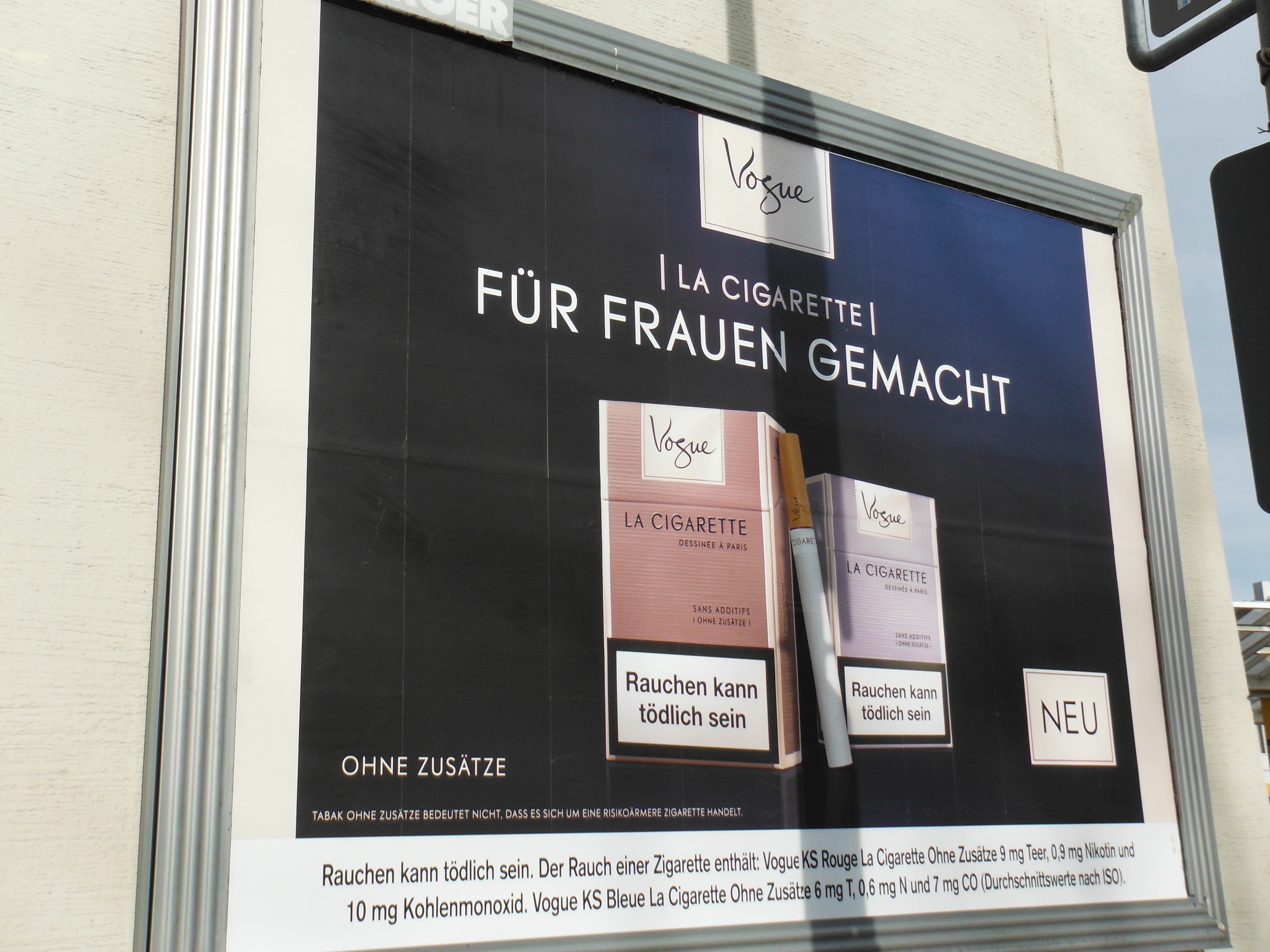 The winning spring cigarette advertising campaigns in Germany are Vogue ‘made for women’ (pictured left – see also post 7 December 2013) and new to the competition, Camel, with their curious descent into primary colour packaging (below right). The recent Lucky Strike campaign is clearly having an interregnum.
Camel’s slogan translates literally, I think, as ‘now becoming colour’; though it may better translate into ‘now colourful’ with red, orange, yellow and green packets. Unfortunately, I’m not sure what the colours represent – they could be random colours or relate to a blend (I think it is the former). I suggest, however, that the packaging relates to how quickly or nastily the content will kill the consumer – with red being acute and green giving the smoker more time alive, though enjoying chronic ill-health?
Paul Smith exhibition – Design Museum, London
Filed under: Design | Tags: design museum, London, Paul Smith
 Leave a Comment
 ![20140122_125739[1]](https://weiterzugehen.net/wp-content/uploads/2014/01/20140122_1257391.jpg) The Paul Smith exhibition is packed full of the man, his ideas, influences and artefacts. It runs only until 9 March 2014.
The Paul Smith exhibition is packed full of the man, his ideas, influences and artefacts. It runs only until 9 March 2014.
He is an inveterate collector of prints, a selection of which greet the visitor on arrival (see left). I tried to establish a theme for the prints; it is an eclectic mix. Bicycles are very much part of his life as is Patti Smith (unrelated). Colour (even a photo of post-it notes make it), music (particularly the Beatles and David Bowie), dogs (his wolf hound was a feature of his first shop), travel and romance (his wife, Pauline, is consistently credited). His camera goes everywhere with him. His favourite places are street markets.
Visitors are invited into a mock up of his office (right). Cluttered it might be, but he keeps a rosewood table free for work.![20140122_130509[1]](https://weiterzugehen.net/wp-content/uploads/2014/01/20140122_1305091.jpg)
There is also a studio space filled with materials – fabrics – and patterns for suits and dresses (below left). Much more ordered than the office and with a selection of Mac computers, clearly his favoured brand.
![20140122_131449[1]](https://weiterzugehen.net/wp-content/uploads/2014/01/20140122_1314491.jpg)
I am not personally convinced by his clothes – one gallery is dedicated to his clothes. He is more than a tailor. The trademark stripes have been applied to a number of familiar objects such as the mini (below right) and a teapot (Thomas Goode fine bone china, below left). He also designed the case beautiful for a limited edition Leica digital camera. Finally, to cement his British credentials, he put the stripes on to the label for HP sauce for Harrods.
![20140122_132105[1]](https://weiterzugehen.net/wp-content/uploads/2014/01/20140122_1321051.jpg?w=180&h=101)
Naturally, this exhibition is a huge marketing exercise for Paul Smith. There is a small gallery devoted to his shops. Each one is different. This potentially has the effect of turning them into tourist destinations in their own right. Unfortunately, one could clock up a huge carbon footprint visiting them. Destinations would include Tokyo, New York and Nottingham, to name but three.
![20140122_132258[1]](https://weiterzugehen.net/wp-content/uploads/2014/01/20140122_1322581.jpg) Elsewhere, there is a wonderfully produced and presented HD film of one of his Paris menswear catwalk shows. He says that he does not like shows but they are a necessary part of the business. The media and industry buyers use them. Watching the film, one gets the impression that he makes the best out of it.
Elsewhere, there is a wonderfully produced and presented HD film of one of his Paris menswear catwalk shows. He says that he does not like shows but they are a necessary part of the business. The media and industry buyers use them. Watching the film, one gets the impression that he makes the best out of it.
The artefacts are beautiful and worthy of exhibiting. However, visitors also get insights into creativity and the business of creativity. I will iron my partner’s Paul Smith blouse now with a little more care.
The photographs are all mine. Apologies for the poor quality. I was not able to use my camera because I had not charged it! I had to use my phone. The results are not so good.
It breaks my heart
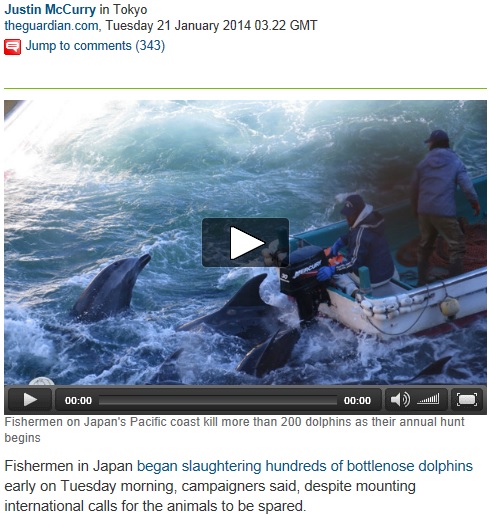 This blog has been a shade quiet since Christmas. I really did not want to reawaken with this post, but the image on the left has been haunting me since I saw it yesterday. My earlier years were dominated by my campaigning against animal abuse. Large aquatic mammals, especially. I even bought a Praktica SLR camera rather than support the Japanese optics industry back in the 1980s when the Japanese persistently blocked a moratorium against whale hunting; particularly humpbacks that were endangered at the time.
I knew that the Japanese had an annual barbaric killing of pilot whales, but this slaughter of dolphins had escaped me. It is the dolphin on the left that haunts me. It will soon be speared by the ‘fisherman’. It will drown. At the risk of anthropomorphism, I ask myself what is going through its head. On the one hand, it knows what its fate will be. But as a higher mammal with quite developed communication, not only is it trying to communicate with its rapidly diminishing peers, it is saying to humanity, ‘why are you doing this to us?’
The process is not random, it seems. The dolphins are rounded up and herded into coves. They are left for four days and then released. In the video, men in wetsuits are seen in the water securing the animals by their tails before they are speared. And so orchestrated is this slaughter, the ‘fishermen’ have built a very large screen to keep away the cameras.
This is not to feed people who are hungry. It is not even fishing. This is a crime against nature. And it breaks my heart.
Picture: The Guardian – http://www.theguardian.com/world/2014/jan/21/japanese-fishermen-begin-annual-slaughter-of-hundreds-of-dolphins
The Christmas getaway
![20131224_195446[1]](https://weiterzugehen.net/wp-content/uploads/2013/12/20131224_1954461.jpg) It is not often that I judge travel options well. But I think this year I got something right. I write this sat on ICE611 heading to Munich (picture left) having escaped on the 0858 Eurostar London to Brussels this morning and then joining a slightly delayed Thalys from Brussels to Köln. I took the decision on Sunday evening to abandon my plan to travel to London on the 0620 Victoria bound train this morning and book myself into a Travelodge hotel close to St. Pancras station in London. On waking up this morning I discovered that all trains into London from the South Coast are subject to cancellation arising from a landslip near East Croydon, amongst other obstructions caused by a major storm that crossed the UK during Monday and into Tuesday with considerable force.
It is not often that I judge travel options well. But I think this year I got something right. I write this sat on ICE611 heading to Munich (picture left) having escaped on the 0858 Eurostar London to Brussels this morning and then joining a slightly delayed Thalys from Brussels to Köln. I took the decision on Sunday evening to abandon my plan to travel to London on the 0620 Victoria bound train this morning and book myself into a Travelodge hotel close to St. Pancras station in London. On waking up this morning I discovered that all trains into London from the South Coast are subject to cancellation arising from a landslip near East Croydon, amongst other obstructions caused by a major storm that crossed the UK during Monday and into Tuesday with considerable force.
I’d like to thank those people who helped me get away yesterday evening. As a regular flyer to Munich, I can sympathise with those people stuck at Gatwick Airport suffering from severe delays and cancellations due to a weather-related power failure. This is the second year that I have taken the train to Munich for my Christmas visit having suffered previously from delays and cancellations caused mainly by fog. And airlines.
Fröhe Weihnachten.

