Archive for the ‘climate change’ Tag
Capitalism is the problem
Filed under: Environment, Politics, Privatisation | Tags: Capitalism, Circularity, climate, climate change, Decoupling, Dutch East India Company, energy, environment, Erald Kolasi, GDP, renewable-energy, sustainability
 Leave a comment
 I have been reading some excellent books recently. You know the ones that you wish you had written? I have written a book, and I have just read The Physics of Capitalism by Erald Kolasi. It is brilliant and takes no prisoners. It also a book that I will need to incorporate into the next edition of my textbook if the publisher ever gets round to inviting an update. I know my book needs revision, not least because we’ve all been on generative AI catch-up. My bio needs an update, too.

Back to Kolasi. He’s a physicist. A physicist taking on economists in a way that economists should have been taking on economics in the 21st Century. Back to me. My book starts with a statement about the finite planet and argues that business strategy has to be devised and executed so as not to breach the planetary boundaries, of which there are nine. Kolasi’s genius (at least for me) is to use his knowledge of physics to critique arguments by economists (and others to be fair) about technological “solutions” in the context of climate change. It is hugely effective and it tells it bluntly and with humour (though totally unfunny if you are an economist).
At its bluntest, Kolasi likens economists to people who simply cannot accept that we cannot make light go faster than the speed of light (3×10⁸ m/s) or go below absolute zero (currently -273.15oC). More realistically, in terms of the efficiency of the stuff we use and rely on, internal combustion engines struggle to be more efficient than 35 per cent (conversion of liquid fuel into kinetic energy/Carnot cycle). 70 per cent is a theoretical maximum, but such an engine is unlikely to be put into a car; photovoltaics, 15 per cent (though theoretically possible, but never achieved, 90 per cent). And so it goes. As Kolasi notes, too, even if we could get 90 per cent conversion of solar energy to electrical energy we would still struggle to meet demand for panels and electrical energy as they need an energy source to extract raw materials and manufacture. There are limits (that neo-classical economists will not accept).
GDP and decoupling

The likes of Hannah Ritchie have been making a strong case for decoupling as a sign that capitalism can survive a climate crisis. We can grow economies (as defined by GDP) and reduce carbon emissions simultaneously and absolutely. It’s a dangerous myth.
Some definitions first: relative decoupling is simple reduction in carbon emissions whilst experiencing an increase in GDP. Absolute decoupling is a kind of safe zone where decline in carbon emissions outstrip growth and head towards zero. From what I can see, and have read, there is no absolute decoupling even using current measures of GDP. For Kolasi, the current measure is the problem as it does accurately measure change in the biophysical scale; namely, the use of natural resources in production and reproduction.
Then there is the question of permanence, assuming GDP is a fair measure of output. Kolasi tells us that with this perspective, economic growth and life expectancy have decoupled as Americans die earlier than previously. Where we thought there was a positive relationship between growth and life expectancy, that seems not to be the case. But no one is saying there has been a decoupling.
Then we can consider the data on emissions. They are to some extent estimates. We might have a handle on carbon dioxide, but we certainly do not have measures of methane, nitrous oxide, synthetic and fluorinated gases, all of which are more potent greenhouse gases than carbon dioxide. Even before the Trump administration, the Environmental Protection Agency in the USA relied on self reporting by corporations! Now it is unlikely that any degree of self-reporting will be needed.
Finance
Talking of changes in direction, up to 2021, banks had been reducing (not eliminating) lending for fossil-fuel projects. That has now changed. The Guardian newspaper has reported that “Two-thirds of the world’s largest 65 banks increased their fossil fuel financing by $162bn from 2023 to 2024.” The US Treasury has withdrawn from the Network of Central Banks and Supervisors for Greening the Financial System, essentially giving a green light to private banks to start lending again. Indeed, JP Morgan, Citigroup, Bank of America, Morgan Stanley, Wells Fargo and Goldman Sachs all withdrew from the net zero banking alliance. Here is a table of the worst offenders (apologies for the poor resolution, but if you download it, it is fine):

Be rest assured, banks have not changed.
The steam engine
A book that opened my eyes to the non-inevitability of industrial fossil economies was Andreas Malm’s, Fossil Capital. The argument was threefold: first, capitalists were not prepared to share resources such as flowing water. Second, flowing water was located in areas that required investment by capitalists in infrastructure such as housing, schools, medical. Thirdly, where this infrastructure existed, labour militancy was difficult to manage – wages were going down and work rates increasing. Capital is best optimised if it is mobile. The steam engine enabled capital mobility despite being less efficient than water, at least until major improvements were made to the design of steam engines (to stop them from exploding if nothing else). All this being true, it is not the whole story. Kolasi has helped me to refine this argument.
Let us compare changes over time (Kolasi 2025: 290):
| Year | Steam HP | Water HP | Wind HP |
| 1800 | 35,000 | 120000 | 15000 |
| 1830 | 160,000 | 160,000 | 20,000 |
| 1870 | 2,060,000 | 230,000 | 10,000 |
That brings us to two additional concepts that I did not get from Malm: exergy and spectralization. Exergy is a thermodynamic system’s maximum capacity for useful work (p290); spectralization is the “diversification and variation in the conversional methods of existing technologies in response to changing social and ecological conditions” (p222). And so…
“…Boosting the spectralization of conversional technologies was the main causal vector for the corresponding improvement in the efficiency of industrial devices. The Industrial Revolution in England and virtually everywhere else as well, followed a path of exergy-driven efficiency gains that spurred additional gains and butterfly effects in economic productivity. The English achieved this incredible growth through a huge increase in the aggregate output of mechanical work a process spearheaded by the spectralization of high-pressure steam engines, and eventually the spectralization of other types of engines as well.”
Kolasi, 2025: 290-1
Let me unpick that, probably imperfectly. Efficiency per se is not the point. It is exergy efficiency. And curiously, Kolasi demonstrates that steam engines had a negative impact on aggregate efficiency across the English economy as a whole. Indeed in their early days they were highly inefficient relative to water and wind. The more steam engines that were installed – at least until 1770 – the lower the efficiency of the economy in aggregate. My head hurts trying to get it around this idea.

In the 19th Century it is a different story. But steam’s impact is not that it could be used to power textile factories. Rather it is this spectralization whereby if became a significant component of the economy as a whole, not least in transportation (shifting coal to factories and shifting product to markets). And if we think that steam power is a thing of the past, we must remember that it is steam power that generates most of the world’s electricity.
Steam power does something else, too, which I had not considered. Steam enables capital to be used harder. By which we mean, it enables us to hit things harder – in a foundry, for example, that is useful.
That leaves a question as to why coal? Well here’s a thing, the answer lies is that great British phenomenon of the enclosures. Back in the sixteenth and seventeenth centuries, the aristocracy displaced many people from their traditional lands by enclosing it – fencing it off and turning it into private property. This displacement led to a rapid urbanisation. People were concentrated in towns and cities and used wood to heat their homes. More rapacious, though, was the state’s need for timber for warships. The nation’s forests disappeared. Coal was a suitable substitute and, as Kolasi writes, “…the northern parts of England were full of it”. Full of it for sure, but it was under ground. The mines were established but they needed pumping. That was first significant industrial use of steam power – to pump mines.
The steam engines then went through spectralization – the addition of condensers to improve thermodynamic efficiency; new gear configurations that allowed the engines to generate rotary motion and to power machines in factories; and the transition from low- to high-pressure machines as the driving motive force. Kolasi (p281) argues this was the “breakthrough moment of the entire industrial revolution”.
Colonialism

The English enclosures displaced many and created a work-hungry proletariat. International colonialism resulted in mass slaughter, disease and slavery. Kolasi (pp300303) goes into great detail about the activities of the Dutch East India Company (VOC). Most brutally, the company slaughtered the majority of the people of the Banda Islands (modern day Indonesia) because they had a monopoly in nutmeg growing. On discovering exactly where the fabled trees grew in 1621, 15,000 people lost their lives through brutal acts of beheading and being pushed over cliffs. These people were substituted for by slaves. The VOC set the stage for the Amsterdam Stock Exchange becoming the first publicly-traded company; but as is ever, the company declined as the secret of nutmeg was demystified and grown in other regions with suitable climates. The Dutch Government nationalised the assets in 1799.
The Circular Economy
We hear a lot about the circular economy…it is essentially another attempt at saving capitalism from itself. In its purist form, the waste from one cycle of production becomes the raw materials for the next. A weakness here is the issue of recycling. Many of us are asked to recycle our waste – my weekly doorstep collection is a case in point. I separate out my plastic, card, glass and metals to be collected. Notwithstanding the fact that turning glass and metals into reworked materials requires energy. Plastic…to much cannot be recycled, and even if it can, the capacity is rarely there to enable it. So, recycling is not realistically part of the circular economy – energy is lost in the circularity.

For circularity to be meaningful, materials have to be reusable or re-purposable. A glass bottle needs to be reused as a glass bottle (energy is required for transportation and cleaning. Textiles need to be re-tradable, up-cyclable and volumes need to come down, drastically. A recent story in the Guardian newspaper illustrates once again just how much textile materials find their way dumped in habitat and wilderness because we cannot absorb the volumes being disposed of.
Sources: Decoupling Chart – Hannah Ritchie (2021) – “Many countries have decoupled economic growth from CO2 emissions, even if we take offshored production into account” Published online at OurWorldinData.org. Retrieved from: ‘https://ourworldindata.org/co2-gdp-decoupling’ [Online Resource]
Bank investment table – Banking on Climate Chaos: Fossil Fuel Finance Report, 2025: https://www.bankingonclimatechaos.org/?bank=JPMorgan%20Chase#fulldata-panel (accessed 21 June 2025)
Steam Engine: Chris Allen / Steam engine, Nortonthorpe Mills, Scissett
VOC Plaque: By Stephencdickson – Own work, CC BY-SA 4.0, https://commons.wikimedia.org/w/index.php?curid=72939415
Ghana Wetlands – source unknown. Taken from Guardian story.
Ocean – David Attenborough
Filed under: Business, Environment | Tags: biodiversity, climate change, conservation, David Attenborough, environment, nature, Oceans, Oceans movie
Leave a comment 
Thee weeks ago, along with my beloved and my sister I visited Bempton Cliffs in East Yorkshire. It is a colony of seabirds clinging to steep chalk cliffs. I took the photograph (left) of gannets, one of my favourite birds for their sheer seabird-iness! Many of the other people there were trying to see, quite rightly, some early-arrived puffins who normally breed at the top of the cliff in burrows.
In recent years, the colony has been deeply affected by bird flu. I was concerned that so devastated they may have been that the colony would not recover; but alas, they were there and as amazing as ever. Gliding, diving, hollering.
About the same time, we were trying to find a cinema that was showing Ocean featuring David Attenborough. You can count on one hand the number of people in the UK that have known a world without David Attenborough. It is also true that there is no-one alive who has not been witness – whether consciously or not – to the wholesale destruction of the world’s oceans. It is not about over-fishing. It is about the wanton destruction of marine eco-systems. Largely invisible marine eco-systems.
David Attenborough has come a long way. He started with a show that traced the capture of animals for incarceration in zoos, Zoo Quest, between 1954 and 1963. Of course he later fronted some of the most memorable natural history documentaries of the 20th Century. He worked with teams that constantly innovated film technique, sometimes encountering real risk in order to do so. However, in most of those films he did not – or was not allowed to – juxtapose the wonder with the destruction that was happening in parallel. In some cases they filmed simply metres away from organised and illegal logging in rain forests, and the destruction of many other habitats through pollution and resource exploitation.
This one-sided storytelling became increasingly intolerable for Attenborough. Habitat and species loss seeped into the films; but they were never central. It has taken a collaboration with National Geographic for him to tell the story that was not told in Blue Planet. And it is devastating.
My family has its origins in the fishing industry in my home town of Hull. They were trawlers – dragging a net along the ocean floor to pick up cod and haddock, fish that fed on the ocean floor. But that trawling literally destroyed everything in its wake. And 3/4 of the “catch” was discarded. Over and over again, these trawl nets destroyed eco-systems and emptied the seas. I – along with everyone else, probably – have never actually seen a trawl in action. Now you can in graphic detail. You can see the devastation. And you can understand why the oceans are dead or dying. Oh, and the process of trawling releases huge volumes of carbon dioxide locked into the seabed.
There is not an ocean anywhere not now being exploited by factory ships. In Antarctica, the ships have come for krill, a small crustacean that feeds penguins and whales amongst other to be processed into fish food (for all of that harmful salmon fish farming) and, wait for it, pet food. These are international waters being exploited by a select few corporations.

The film is in three parts. We start with the wonder of the oceans – in particular the bits we know the best (though seemingly only recently have we bothered to look), kelp forests and coral reefs in particular. Then the grim bit – probably 30 minutes of hell on Earth. And finally, the hope. There is hope. Kelp forests regenerate super quickly if left; so too, the fish species, even those thought to be lost. Coral can recover as some fish species remove the algae that effectively suffocate the coral and prevent regrowth. It is particularly salient at the minute because the film was released to coincide with the UN Ocean Conference (Nice, 9-13 June 2025). At that conference, the future of the oceans were being decided. You can read the communique here. on 15 June 2025, the Guardian newspaper published a summary. We need to protect 1/3 of the oceans the regenerate the rest. That is an amazing thought – just one-third can result in the rest of the Earth’s oceans recovering to once again provide a living for shore fisher communities globally. These communities have been subject to an ocean colonialism (Attenborough’s words).
Or we can turn the oceans into chronic deserts.
Why banks do not invest in renewables
Filed under: Environment, Privatisation, UK | Tags: climate change, Electricity markets, energy, environment, Feed-in-tariffs, investment in renewables, renewable-energy, renewables, spot prices, sustainability
Leave a comment 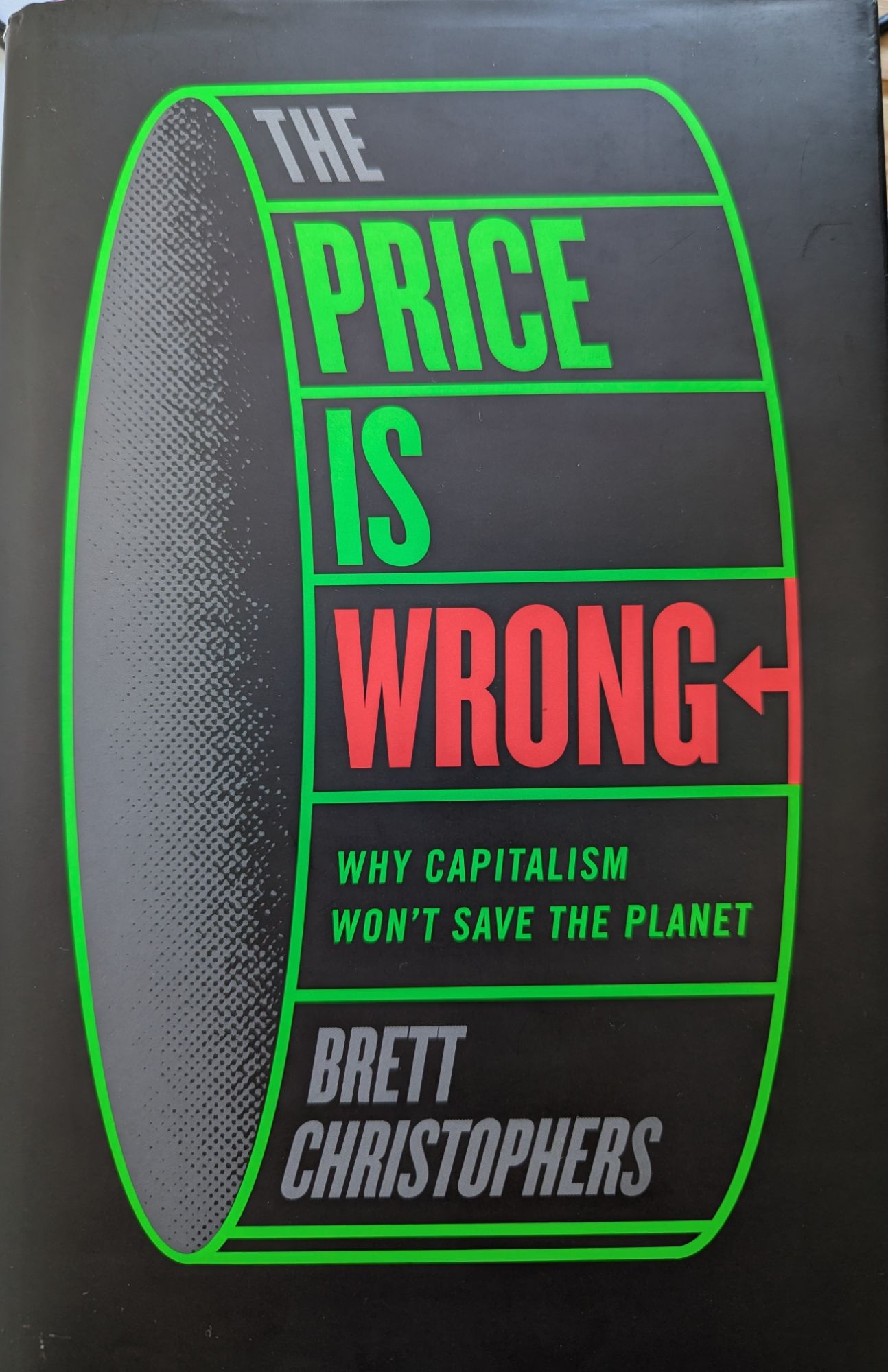
I wrote last month on Andreas Malm and Wim Carton’s book, Overshoot. Like all arguments – and their book is full of them – there are weaknesses. Or in my case, a failure fully to understand. In pursuit of that understanding, I have turned to an extraordinary book by Brett Christophers, the Price is Wrong – Why capitalism won’t save the planet (right).
Christophers waits until chapter 6 – appropriately entitled, The Wild West, to broach the point of why. It is not because the previous chapters were superfluous – far from it. Rather it is because electricity is complex, and despite out belief that all electricity is the same, Christophers has to make the case that not all electricity is the same.
First, we have to look at the structure of the liberalised (i.e. non-vertically integrated markets), of which the UK is a prime example after privatisation in the 1980s. Let me break down some of the stakeholders in the system:
- Generators – owners of power plants (some located outside of the country)
- renewables
- wind
- solar
- hydro
- non-renewables
- gas
- coal
- biomass
- nuclear
- renewables
- Last-mile suppliers.
- Buyers of wholesale electricity for supply to end users (domestic and businesses)
- Electricity System Operators (ESOs)
Markets
Increasingly the industry’s liberalisation has led to regulated markets being constructed by policy makers. In the UK there two distinct routes to market by generators.
- spot markets (electricity for immediate use)
- corporate – Power Purchase Agreements (PPAs) – generator contracts directly with corporate entity which is often a large user of electricity. There can also be PPAs between generators and utilities (retailers).
Spot markets trade in blocks of time, 30 minutes in the UK, for example. There is a base load, usually supplied by renewables and then a top-up, usually coming from the most flexible of supplies; namely, gas. In the UK the last coal-fired power station closed in September 2024.
Spot markets and volatility – why renewables are unattractive to investors and fossil-fuelled plant is attractive
The prices of electricity on spot markets are volatile. They are volatile over each day – demand can vary widely from the peak of the early evening to the overnight lull. But volitivity over a month…that seems to be more scary to investors. For example (p 170) in February 2022, spot market prices in Germany ranged from under €50 per MWh (day 19, Saturday) to just under €250 per MWh (day 25, Saturday). Demand is difficult to predict; indeed, we might ask, are there any other (commodity) markets with such pronounced volatility?
If you are an investor – a bank, for example – such volatility instils a sense of unease. It does not make investment impossible, but it makes it more expensive. Christophers’ research suggests that interest rates for renewable energy projects can be as much as 3x that of non-renewables.
We should then ask, why would a gas-fired power station – that sells into the same volatile market – not also be high risk? There are two things to be aware of here. First, banks have been investing successfully in fossil fuel projects for many years. Successfully. It is a known and tangible entity that has largely been low risk. Bankers, however, when making investment/loan decisions ask one simple question, will the client be able to pay back the loan on any terms agreed? The banker wants to know how much income the project will be generating to service the debt. The project owners will, of course, not be able to answer that question because of the volatility. It seems to be insufficiently adequate for the loanee to say that they are 100 per cent certain that all electricity they generate will be bought by suppliers because what they generate will always be cheaper than electricity generated by gas. The spot markets always include the lowest-priced electricity in a merit hierarchy.
There seems to be other issues here for investors. The returns on renewables is lower than that for fossil-fuelled plant. Typically, noted by Christophers (pp 211-221), fossil-based investments can generate returns of up to 20 per cent. Renewables come in at between 4 and 9 per cent. If we consider oil company shareholders, they are offered by the executive investments that will bring in double-digit returns, or equivalents that will deliver at best half of that. What will they choose? And what if the executive takes the decision to go with the renewables, knowing that their returns will be lower? Most will be out on the ears at the next shareholders’ meeting. These are so-called opportunity costs. Investing in renewables means that the investment will not be made elsewhere; i.e. something that brings in a higher return. But, argues Christophers, the shareholder concerns are minimal in comparison to that of the banks. Banks are looking for double-digit returns. It is also the case that many investments in renewables are made by companies that are not fossil-fuel based. They specialise in renewables. They will only deliver across their portfolio single digit returns to a market that is volatile, that exhibits the so-called merchant risk. Added to that, renewable plant is part of a “transition” – an energy transition. That transition, argues Christophers, has two elements. The first adds to the uncertainty. Transitions by definition are uncertain. The second is transition has no history. Generators are asked to project into the future with no historical data on which to make the calculations.
We might then ask, what about owners of plant fired by fossil fuels, how do they make the case to investors if they sell into the same volatile electricity market (because new gas-fired power stations are still being built)? Well, it seems quite simple, a traditional fossil-fuelled power plant is not part of a transition. It is proven technology and can demonstrate historical returns on investment. It is eminently bankable.
And here is another scenario. If the spot price of electricity (say in the UK) falls, so does the price of gas. The spot price is determined by the gas price (or the highest bid price in the bidding round, usually 30 or 60 minutes in each 24 hour period). In that scenario, the price of gas falls and the bid posted for electricity generated by a gas-fired power station is at a lower price because the primary cost of the power station is its fuel. If the gas price falls, so does the cost base of the plant. There is a hedge at work in the eyes of the bankers (p180).

The same is not true of wind-based renewables plant. The fuel – wind – is a gift of nature. It is free. The cost base of the plant, in the event of the spot price decreasing, does not decrease. That seems to indicate to bankers that there is a point where there is no return, and hence the ability of the plant owner to service the debt. In other words, finance cannot be secured because the fuel is renewable, meaning that even if the turbine is turned by the wind it can still be used by another wind turbine. But non-renewables once used are used. It is counter-intuitive that this is a positive and hence a challenge to bankers. In essence, then, there is a significant merchant risk; namely, “the risk associated with selling renewably generated electricity exclusively or predominantly at volatile merchant (wholesale) prices.” p174
Work arounds – how renewable plant owners can hedge the risk
Christophers offers three ways around this problem.
- Option 1: the futures contract. This is a situation whereby the electricity will be bought and sold at a predetermined price. The fear/danger is that the spot price falls such that revenue is flat and threatens not to cover liabilities. This is a balancing act where an option to sell (short) on the electricity futures contracts means that if the spot price does fall, the negative outcomes in terms of income “earned” in the spot market are compensated for by a gain in the futures market. Essentially, the trading value of the contract enables the sale to be transacted at a fixed future price which typically rises as the spot price declines. This is a common mechanism for hedging in liberalised electricity markets.
- Option 2 – swaps. These are more common in North America and Texas in particular. Swaps act as substitutes for futures contracts. The principle is that a party averse to risk relating to falling electricity prices can offset the risk by entering into a swap that pays out even if electricity prices fall.
Hedging, though, is complex. Only the largest producers have the so-called competence to hedge at scale. There are at the very least significant cash flow challenges. For example, if the spot market does decline, one party has to put up considerable cash to cover the decline. There is even a bigger challenge to contemplate. Christophers asks fairly, what happens if the renewable electricity supplier cannot supply the amount of power it is contracted to supply to the futures or swap markets? The above relate to Christophers’ arguments on pages 178-183.
- Option 3 – PPAs – these reassure banks that there will be a return sufficient for loan repayments.
- Option 4 – government subsidy/support. Such support has its own hazards.
- investment grants do not help in pricing
- Investment Tax Credits can help reduce the level of break-even spot price
- Price controls/Feed-in Tariffs (FiTs) – compensating generators when the spot market “reference” price drops below the contract “strike” price; though when the strike price climbs above the reference price, generators pay back into the pool. The net price is always the strike price.
Price controls stabilise markets and satisfy investors. But then introduces yet another source of uncertainty. Will governments – especially when they are fiscally stressed – honour or extend FiTs rates? Unless they do, renewable generators are back to spot price volatility. Christophers offers examples of state withdrawal in China and India (pp.
Notwithstanding problems with subsidies (option 4), markets can bankrupt renewables generators. In Texas in February 2021, a bolt of cold air caused a number of generators to cease as their equipment, not used to such extreme conditions, seized up. This was not just renewables generators. Fossil-fuel plant also seized up. As a result of the limited supply, electricity spot prises went up considerably. Renewables generators were supplying into a market with spot prices below $100 per MWh (as low as $50). During the crisis, prices were $9000 per MWh. Now if renewables generators were selling into that market, then there was money to be made (assuming the turbines were working, of which many were). But if the generators had PPAs at fixed prices, if they were unable to supply they had to go into the spot market to meet the terms of their PPA. That was enough to bankrupt generators (p310).
Why renewables will not supplant fossil fuel investments
Filed under: Environment, UK | Tags: Andreas Malm, climate, climate change, energy, Overshoot, PV cells, renewable-energy, sustainability
Leave a comment Overshoot
For us non-economists there seems to be a logic that should prevail. If renewables are significantly cheaper than non-renewable fossil fuels, then why do banks and financial institutions continue to provide capital to the fossil fuel industry to extract more oil and gas, despite climate change?

For an answer, I return to the work of Andreas Malm and a recent book (2024), Overshoot (co-authored with Wim Carton). We experience overshoot when policy makers conclude that we can afford to spend our carbon budget in the (mistaken) belief that we can bring back 1.5 degrees by carbon capture and storage. Or even more problematically, reduce the surface temperature of the Earth through geoengineering. It is propagated by fossil-fuel industry lobbyists in order to maintain business-as-usual. Business-as-usual is important because sunk assets of the industry are long-lived and the value of the oil over which they have extraction rights is high.
Commodification
For Malm and Carton (pp209-218) an answer is the inability to commodify sun and wind. We can commodify the equipment that converts the sun’s energy into electricity. We can commodify wind turbines. But because the sun and the wind are renewable – i.e. tomorrow’s sunshine is independent of the sunshine from the previous day – it has not been used up. Moreover, using Marxist theory, Malm and Carton argue that value can only be ascribed to products if human labour is required in its exploitation. Even in the most efficient mining operations, humans are still directing the operation. Wind, sun and water are labourless. That makes them valueless in the eyes of economists. There is no “surplus value”.
By contrast fossil fuels are commodities. They are traded, stored and consumed. The sunshine cannot be traded. There is no world market. There is no OPEC equivalent in renewables. It has no economic value in the capitalist mindset. It is costless. But costlessness may be valuable to consumers, it really is not to capitalists because they are unable to maximise profit – or indeed generate profit at all. Consequently there is only so much renewable energy that any national energy system can support – Malm and Carton suggest about one-quarter to one-third. Above that, costless electricity is so abundant that the price drops to zero or below. It is in Marxist terms, a “labourless void”.

This phenomenon can be illustrated indirectly by asking, name and ascribe a capitalisation to the world’s biggest manufacturer of PV cells or wind turbines. Likewise the owners of the world’s largest PV farms. We can all name the top 10 oil majors and easily find a capitalisation. For those who think Tesla may be a candidate – notwithstanding the current crisis within the company – it is an automobile manufacturer, not a renewable energy company. Essentially, renewable energy technologies (of the flow) have “no talent for providing the accumulation of capital”. (Malm and Carton, 2024: 215).
Competition
Other explanations are available, of course. Is it that there is perfect competition in solar, wind, etc. Barrier to entry are not high and hence there are too many players in the industry (a very Porterian approach). As Malm and Carton argue, if that was the case, then the whole industrial revolution would not have happened as the textile industry was just that, highly competitive.

What is particularly interesting in these technologies is their disruptive potential that could be led by consumers. No amount of consumer demand for fossil-fuel-free electricity, as we have seen, will see off the producers of electricity from fossil fuels. The profit motive blocks this. But it is possible for consumers to become their own generators. And whilst the majority of citizens own little in the way of land, homeowners do have roofs – house, sheds, etc., And in those houses they have space for storage – batteries. Most consumers remain indifferent to this. Even better would be whole neighbourhoods pooling their roofs and generating electricity for collective consumption. The question here is just about the design of the delivery system. For the time being at least, the grid is optimised for national distribution, and as such does not accommodate collective consumption.
Why then has there been any investment in renewables. Malm and Carton offer five reasons.
- Government subsidies – paying someone to do it
- End consumers not needing to make a profit (whilst reducing their own bills)
- Early profit – first movers, for example
- Low rates of profit can still be justified up to a point
- Fossil fuel companies have invested in renewables to fuel their own plants because, like all end users, it is valuable to them
Ultimately market capitalism cannot deliver transition, a mixed economy can.
Fossil fascism
Filed under: Environment | Tags: Andreas Malm, climate change, climate change ad nationalism, Climate change denial, climate scepticism, Fossil Capital
Comments (1) 
When I came to write my textbook on business strategy in the age of climate change, it was not until I had read Andreas Malm’s book, Fossil Capital that I felt I had a proper foundation. Malm’s thesis was relatively simple: the mechanisation underpinning the industrial revolution did not need to be a fossil-driven revolution. Water would have done (I understand why that is contested). But, the capital owners saw a number of benefits (to them) of steam power (fuelled by coal). Many of the early mills in the North of England and Scotland required the owners not only to build factories, but also villages for employees (one example, Saltaire, West Yorkshire (right). Villages with schools, sports, places of worship, etc. These were expensive, they also promoted labour power. The steam engine was not geographically hidebound. The fuel could come to the factory rather than the other way around. More expensive, maybe, but the plutocrats no longer needed to provide housing and labour power was neutralised.
This realisation enabled me to frame my book in terms of the continued burning of fossil fuels as a choice. It did not need to be that way in the past, and it does not need to be that way in the future. We can have a zero carbon economy. We choose not to.

Many writers and thinkers may have stopped there, but Malm is driven. He followed that up with a book about climate and Covid and, controversially, enlightened us on how to blow up a pipeline. In between all of that, Malm, along with the Zetkin Collective, wrote an extraordinary book entitled White Skin, Black Fuel about the relationship between climate change denial/scepticism and fascism. It is like his earlier book, Fossil Capital rather sprawling. Readers need to persevere, it is easy to say that it is too difficult. Malm takes us through time and space locating as he does the origins of fascism, its contemporary manifestations (Europe, North America and South America) and, crucially, why fascism and climate scepticism/denialism are aligned.
Consider this (which I had not done before), why has no far-right party ever endorsed renewable energy? Indeed, why do far-right parties commit to dismantling renewable energy installations, particularly wind? Now this is only a small part of the book, but for me it is the most intriguing and the one that augments my own understanding of the challenges ahead – maybe not absolutely for my generation, but certainly for anyone under 50.
Malm’s plausible hypothesis rests on an understanding of ultra-nationalism (he takes close to 260 pages to tell us what that is). Let me stick with nationalism, the sense that the homeland and its authentic peoples should be prioritised over so-called invaders, immigrants, alien faiths and, basically, anyone with a dark skin. Not only prioritised, but cleansed. We see it in today’s politics. Fossil fuels, argues Malm, fit a nationalist narrative. The is “our” oil. It is independent and we use it for our own development and wellbeing. Of course, oil usually belongs to oil majors that trade it in global markets, so that argument is flawed, but it is surprisingly potent when it comes to electioneering/power grabbing. The sun and the wind cannot be appropriated in the same way even though it provides energy security that no fossil fuel can match (in terms of availability and price). I hear readers now asking, what about countries that do not have a store of fossil fuels in their territory, why are nationalists in those countries so opposed to renewables?

Malm is clear. Colonialism and whiteness! Particularly rich whiteness. For it is the rich off the back of colonial exploitation that have so much to lose from decarbonisation. Their assets are sunk – literally – in the ground. Their lifestyles are high carbon. They fly so much more than most of us, and often in their own planes. Carbon is so much a part of who they are that to decarbonise is to lose their very identity. And what is more, decarbonisation (for them, a Marxist plot) is to enforce an unfair (to them) equality. How else do we explain a global carbon budget that is shared between countries representing some element of fairness? For example, the USA and Europe (particularly the UK) have a tendency to deny historic emissions, and cannot countenance coming down to the level of developing countries. How fair is that?
Malm argues that such an approach by the right (not even the far-right) can be traced back to the fall of the Berlin Wall and the loss of a tangible enemy – communism – that imposed equality in places where it was the dominant ideology. (Arguably not, as the Soviet Leadership and acolytes seemed not to be too constrained in their consumption.) To prove the point, Earth Day (22 April) is the the birthday of Lenin – no coincidence. So, those proclaiming a climate crisis and the need for action became the new targets of the right. Denialism and then a rejection of mitigation (cutting carbon emissions) in favour of a West-friendly adaptation (the West/North is better able to cope with temperatures of 2, 3 and even 6 degrees of warming so much better than other less-developed regions). Malm is thinking about people like Jordan Peterson and William S Lind. The attacks on Greta Thunberg feature in the analysis, too. The picture of her wearing an antifascist “Allstars” t-shirt, for critics, was proof that she was both Antifa and in the pocket of George Soros.
There are some other interesting elements to this approach. Denialists do not present counter evidence (largely because there is none), rather they present their narrative over and over again. The more it is repeated, the more it is liked and re-tweeted, the truer it becomes. Repetition is key. Our media tend to allow them to repeat their lies at will and without challenge. With this in mind, argues Malm, if one can lie about climate change, anything can be successfully lied about. Despite the evidence to the contrary, the lies carry more currency. That is partly because white people, increasingly turning their territories into fortresses, will survive it longer than people of colour in vulnerable countries.
This is not the end of the book at all. The race discussion occupies the subsequent chapters. But just like Fossil Capital, perseverance pays off. The reader is rewarded with insights (you do not have to agree totally with them). Malm has plenty of critics. By goodness, though, he does a lot of heavy lifting for us.
Michael O’Leary is right and very wrong, mischievously so
Filed under: Uncategorized | Tags: aviation, carbon-emissions, climate change, sustainability, sustainable-aviation-fuel
Leave a comment 
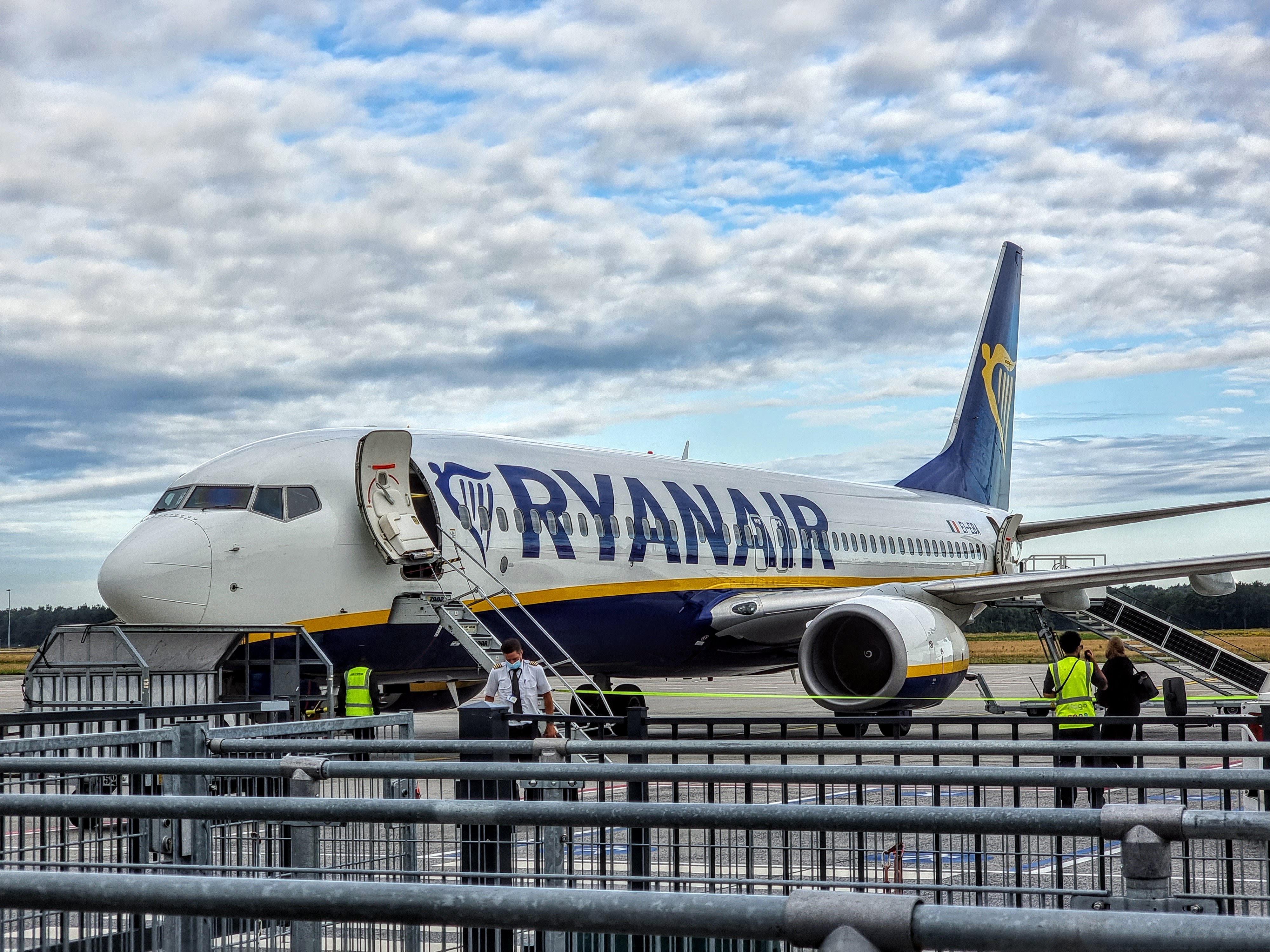
Michael O’Leary (left) is the boss of RyanAir. He has spent much of his life at the helm and took it from limping Irish airline to Europe’s biggest. As he says himself, RyanAir was early into the low cost business after the skies were deregulated and have kept the advantage over rivals. He’s fabulously wealthy off the back of that success.
So, on 26 December 2023 O’Leary proclaims that there is not enough used cooking oil in the world to fuel the world’s airlines for one day, let alone a year. on that he is right. But he has made many other claims that are not defendable with even a cursory analysis. Let’s take them one by one.
O’Leary argues that air travel contributes just 2pc of carbon dioxide. Ships contribute 5pc, but no-one is shouting about global supply chains. Here are 10 points to consider.
- We do not measure greenhouse gases as a percentage, we measure in absolute terms. That 2pc is equivalent to 800 Mt CO2 per year. If we are to get anywhere near even 2 degrees of warming (let alone 1.5 degrees), all GHGs have to be eliminated, Even a fraction of 1pc is too much. In meeting the 1.5 degree Celsius target, the atmosphere can absorb, calculated from the beginning of 2020, no more than 400 gigatonnes (Gt) of CO2. Annual emissions of CO2 are estimated to be 42.2 Gt per year, the equivalent of 1,337 tonnes per second (https://www.mcc-berlin.net/en/research/co2-budget.html). At this rate, at the time of writing, we have 23 years before that budget is used up at current levels, but we have seen clearly how projections are changing – climate change is happening faster than expected. The models are being revised. And we continue to grow demand for fossil fuels whilst destroying carbon sinks such as oceans, forests, bogs, etc. For something most of us do not need, flying is disproportionately expensive in terms of carbon budgets.
- Whilst O’Leary might say that 2pc is not much, carbon emissions overall have doubled since the mid-1980s. Aviation has just kept up with the average increase in emissions across the board. Absolute emissions from aviation are increasing.
- Carbon generated by aeroplanes is not the same as that emitted by land-based activities. Indeed, if we consider aviation’s full impact it is more like 3.5pc. Aviation emits other greenhouse gases, and the release of water vapour at altitude significantly increases its warming impact. Accounting for this, its contribution increases by around 70%.
- CO2 emissions arising from aviation are not globally fair (equitable). It is the relatively rich who fly. 1 per cent emit half of GHG emission from aviation. Business class is more carbon intensive than economy. Private jets…let’s not go there. Most people on the planet have never flown (estimated between 80 to 90pc) and have not contributed to aviation-generated carbon emissions. Put another way, only 5pc of people fly in any one year (less than that for international travel). The average air traveller takes just over 5 flights per year (1).
- We do not adequately count all emissions. Domestic flights are ok – they are factored into national emission-counting, but international/long haul belong to no one (though airlines to count them). Incentives are not in place to reduce emissions from long-haul flights. This we must get to grips with, but recent stunts like those from Branson do not help.
- O’Leary seeks to distract attention – forget aviation, much better and easier to electrify cars and vehicles. Vehicular emissions are 20pc of the total with cars alone producing 3bn Mt CO2e annually. Another diversion – Air Traffic Control – if they could be more efficient there would be no need to spend hours circuling airports in stacks (the fact that there may be too many planes in the air is not considered).
- There is the technological fix – O’Leary has them all up his sleave. Seemingly he is “generally a believer that technology and human ingenuity will overcome climate change”. He goes on “I have no doubt that we will not decarbonise because we tax people more” So belief will get us there; though at this point in time, there are no viable electric planes in sight. Or any other fuels, for that matter.
- O’Leary argues that “[p]eople will absolutely not stop flying because of concerns about climate change”. This may, of course be true, but that is why we have Governments, regulations and tax to provide the incentives. What O’Leary is doing at RyanAir is expand capacity with the purchase of new fuel-efficienter aircraft. But they are not sustainable.
- So. let us look at the low cost base and the subsidies airlines get to maintain them. Fuel (tax) is a huge subsidy not open to land-based services. Some old data – but in 2012 the lack of tax on fuel amounted to an annual subsidy of £5.7bn. No VAT on tickets add 4bn to the total. In the UK, the Government actually reduced air passenger duty on domestic flights. Seemingly there is another £200m subsidy to the industry. And then there is the infrastructure provided by the state such as roads and rail links. Did Heathrow really need a fourth rail link to the airport with CrossRail?
- And on ships, there is a lot of discussion both amongst engineers, campaigners and industry about decarbonisation. Try these:
Pictures:
Michael O’Leary, World Travel & Tourism Council
RyanAir Boeing 737, By Dylaaann – Own work, CC BY-SA 4.0, https://commons.wikimedia.org/w/index.php?curid=114958876
References:
(1) Stefan Gössling, Andreas Humpe, The global scale, distribution and growth of aviation: Implications for climate change, Global Environmental Change, Volume 65, 2020;
Book Review – Super Charge Me: Net Zero Faster by Eric Lonergan and Corinne Sawers
Filed under: Book reviews, Environment | Tags: book review, climate change, Super Charge Me
Leave a comment 
If you have a spare evening, buy this book and join the conversation between two wonderful dinner guests, Eric Lonergan and and Corinne Sawers. That said, I’m not sure that you’d get a word in edgeways, even if you wanted to. I suggest just listening and learning.
In the first instance, the format spooked me. It genuinely is written as a dialogue. The two conversationalists flesh out their arguments – they do not challenge one another, rather they develop one another’s points – or invite further development: “go on…” says Sawers, to avoid a cliff hanger. Unless one is paying absolute attention, it is not clear who is speaking, such is the mutual expertise revealed in the exchanges. The book can be read in one sitting.
This is not, be rest assured, one of those “I’ve read this so that you do not have to” reviews. I have been known to write these. Readers are invited into a conversation that needs full engagement (my copy has plenty of page markers for future reference, top left). In addition, if we are in luck, the shelf life of this book will be short. If we, our governments, and the global community more widely, make the transition, the book will have served its purpose and become a cherished museum exhibit.
I’ve reviewed some other books – Alice Bell’s wonderful, Our Biggest Experiment, for example – that reveal how we got to where we are. What we could have done; how we could have avoided the precipice that humanity has now perched itself upon. Those perspectives inevitably lead to despair and inaction. Lonergan and Sawers are future-oriented. There is little dwelling on the past. They discuss a bright future: one that is fair and safe. Readers do not even have to have that much knowledge about climate change because a couple of to-the-point sentences – to paraphrase Douglas Adams – “avoid all that mucking about in hyperspace” and gets readers up to speed. There is no time to waste. It is just better to start using the language of Super Charge Me straight away: appropriately-named EPICs (extreme positive incentives for change) and Mini Musks (those intractable problems – aviation and cement, for example).
What are EPICs? They are extreme because moderate does not change behaviour. They are positive because the behaviour change cuts carbon emissions. They incentivise (never think about something else when you should be thinking about the power of incentives, says Charlie Munger, Warren Buffett’s long-standing business partner, p172). It is all about change. In particular, change that reduces carbon emissions.
But what are they in reality? I have been led astray, it seems. It has been known for me to advocate carbon taxes. My dirty vehicle is taxed – the vehicle licensing cost is high for that reason and it costs more for my on-street parking than for cleaner vehicles. But I still have it. The incentive to ditch is not sufficiently extreme. I’ve learnt recently, that keeping it is potentially better for the environment than buying a new electric vehicle, thanks to a recent BBC show, Sliced Bread. But this is the wrong thinking. I should not be replacing it, I should be using a substitute. I do not because there is no incentive provided by the relative price of that substitute. For example, to visit my family tomorrow using the train would cost me £153. Even with the high price of fuel, my dirty vehicle could do it for half that cost, and I could take two people and unlimited luggage (it is a van) with me. The substitute, if I read the authors right, needs the EPIC treatment by Government. It is their job to fix the relative price and provide the incentive to switch. More generally, it may need investment in infrastructure to do it (more trains/capacity), a change in work practices allowing slower and shared commutes or fewer and, ultimately, a change in the norms of behaviour – actually it is a bit passé to drive a dirty white van rather than take the train. What, no photovoltaics on your roof?! Etc.
These are obviously EPICs for individuals, but there are EPICs for states. EPICs are responsible for the collapse in the cost of solar/photovoltaics and wind power. My new favourites that are going straight into my curriculum are captured in the Green Bretton Woods and Green Trading Agreements. The institutions of the Bretton Woods post-war agreement include the IMF and the World Bank. In the context of the transition, Lonergan cheekily says that “I am not sure that the World Bank is up to the task” (p144), but credits the designers of the post-war economic system with bestowing upon the IMF a “magic power” that was apparently leveraged in the banking crisis of 2008 and more recently in the global response to Covid-19. This power is manifested in a “special drawing right” (SDR). Readers can discover the magic for themselves, but I would entirely concur with Lonergan that the designers of the Bretton Woods institutions covered all bases insightfully and provided utility well into the future.
Thanks also to the conversation, I now also know about Export Credit Agencies (they’d somehow passed me by). These agencies mitigate credit risk for banks lending to low-income countries. The authors argue that they can be repurposed towards carbon-reducing investments. They have served the fossil-fuel industry well in the past and can serve transition economies well, too, into the future.
The book also provides an strong argument for countering the “stranded assets” challenge. Stranded assets are long-lived assets that, if economies transition to net zero with haste, will lose their value and become redundant before their time. Shareholders will lose money. It is true, they will, but it is not really an argument against stranding them if it makes the difference between a liveable and non-liveable planet. Rather, the losers will be an energy elite who have made lots of money from the carbon economy in the past. Being an elite, they are so few in number and the impact overall is small. There is about $4 trillion locked up in fossil-related assets. A lot to us, but small in relation to overall assets in the global economy.
Be prepared to be (re)educated about how money is created, interest rates, why China is cleaner than it may seem, how to stop free-riding, leveraging state borrowing capability, why inflation is good (within reason), contingent carbon tax, sovereign wealth funds, border taxes and why activism is not futile. And trees.
An evening well spent. And no one noticed the food was vegan.
Climate revisionism
I am a subscriber to the Economist; not because I like it – though the writing is excellent – but because its free-market ideology is a constant reminder of the challenge the ideology presents for those looking to foster progressive change. So, when I opened this week’s copy, I was hoping to see one dominant factor, climate change. Note it was hope, not expectation.
The Economist is struggling with climate change. The writers/editors know that it is a challenge to business-as-usual. The IPCC report published earlier this week (9 August 2021), has given the the magazine’s editors a way out: sulphates. Every cloud has a silver lining, and sulphates – or more generically, aerosols – are showing themselves to be a way to justify not changing the system that delivers ever-greater climate change.

The IPCC report shows that in burning fossil fuels, sulphates are released into the atmosphere – the lower atmosphere to be precise. These particles actually reflect heat away from the planet and have contributed something in the order of 0.4 degrees Celsius of cooling. Actually scrubbing fossil fuels when they are burned, takes out the sulphates and, hence, makes warming worse (though the benefits to air quality and hence mortality from air polution are significant but peripheral in the argument). Even more interesting is the discernible decrease in sulphates that occurred after 2015 and is detailed here by James Hansen – a colossus in climate science (left). In other words, without sulphates the planet would have already reached 1.5 degrees Celsius warming since pre-industrial times. Readers may well be able to see where this is going?
The sulphates “solution” is at the heart of solar geo-engineering thinking (see Elizabeth Kolbert’s account). If human beings scatter the upper-atmosphere with sulphate particles, the heat would be reflected and the planet cooled. It seems that geo-engineering is back on the agenda for free-market thinkers, even though it is unthinkable for many reasons: political, unintended consequences (some of which are known), etc. Solar geo-engineering is not a solution for the IPCC, however.
In addition, the Economist has gone for another easy option, methane. Methane is a greenhouse gas, something-like 10 times the potency of carbon dioxide. However, it stays in the atmosphere for a much shorter time. The logic, then, is for methane to be targeted rather than carbon dioxide. Moreover, methane can be monetized (it has a market price), therefore it is easier to attract private investment than simple carbon capture. Here is a question, methane can be captured from human industrial processes, but one of the growing sources of methane is that released from melting ice and permafrost. How is that captured? I think the answer is not to release it in the first place. Zero carbon has to be the target. End.
Pic: By NASA – nasa.gov, (archived), Public Domain, https://commons.wikimedia.org/w/index.php?curid=71506555
IPCC report reply to letter
Filed under: Environment, Politics | Tags: climate change, Sally-Ann Hart
Comments (1) Yesterday I sent an email to my MP, Sally-Ann Hart with some questions regarding climate change. Seemingly, there is nothing to worry about as the UK is a world leader and it’s China’s fault! And I don’t think I mentioned the weather.
Dear Mr Grantham,
Thank you for contacting me about climate change and weather.
Tackling climate change is crucial and I am proud of the significant efforts underway to reduce carbon emissions. As the first major economy to legislate to achieve net zero emissions by 2050, the UK is a world leader when it comes to tackling climate change and it is important that we as a country continue to take action to help mitigate its effects, which include flooding, costal erosion and other issues caused by extreme weather.
When we achieve net zero, the UK will have eliminated its contribution to climate change, which as of December 2019 accounted for 1.2 per cent of global emissions. Many other countries will hopefully follow our ambition, particularly those with a much larger share of global emissions, such as China which accounted for nearly 30 per cent. Since 1990 the UK economy has grown by 75 per cent while cutting emissions by 43 per cent.
As we transition to clean energy, there will still be some role for fossil fuels in the medium term. However, this is not sustainable in the long term and I am pleased that steps have been taken to speed up the transition. In the Energy White Paper, it set out the Government’s future plans for the oil and gas sector. This includes transforming the UK Continental Shelf to be a net zero basin by 2050. In addition, the North Sea Transition Deal creates new business opportunities, jobs and skills as the oil and gas sector works to transition to clean, green energy. I am pleased that the Government will provide opportunities for oil and gas companies to repurpose their operations away from unabated fossil fuels to abatement technologies such as Carbon Capture Usage and Storage (CCUS), or clean energy production such as hydrogen.
Ultimately, the Government is clear that the licensing of domestic oil and gas exploration and production must continue to be compatible with our climate change ambitions. While the Government has supported the sector through the pandemic, which has protected jobs and livelihoods, there can be no ‘return to normal’ due to the context of the UK’s net zero recovery. I am encouraged that oil and gas companies are already responding positively to this challenge. For example, Shell is investing in CCUS technology which acts to capture Carbon Dioxide from fuel combustion and Industrial Process.
Kind regards,
Climate watch: if you don’t think it matters to you, think again
Filed under: Environment, International, Trump | Tags: Arthur Snell, climate change, Michael Stephens, Middle East
Leave a comment Trying to introduce climate change into a business degree curriculum is not easy. One of the motivations for business students is to make money – lots of it – when they leave university. And the programmes sell themselves, understandably, on that dream. This is amusingly detailed by Martin Parker is his book, “Shut down the Business School“.
 So, I was interested, during one of my morning engagements with a podcast, The Bunker Daily, that has successfully displaced the BBC’s Today programme from my listening diet. The Daily on 26 November 2020, was anchored by the erudite Arthur Snell, who interviewed Michael Stephens (left) from the Foreign Policy Research Institute. They talked about the Middle East and how President Biden is going to engage with the region, especially in light of Trump’s and Kushner’s new relationship with Mohammed bin Salman of Saudi Arabia. All very interesting.
Snell tried to wrap up the interview with a question about the future. Interviewees often shy away from predictions of this kind, but Stephens did not. He talked about climate change in the region. 7 million people live in the Nile Delta and are in danger of being flooded out of their homes within 10 years’. He went on to say that across the region, critical infrastructure – oil production, for example – is exposed to extreme and unsustainable heat. Temperatures in Israel, he said, are now averaging 37 degrees Celsius in the summertime. 37 degrees is, seemingly, a temperature that tourists determine is too hot and choose other destinations, impacting directly on tourist economies.
There are population movements in poorer countries where rainfall is in decline and the land is unable to sustain its populations. This migration inevitably involves Europe’s borders. The relatively modest numbers of migrants so far have led to ugly far-right nationalists taking power in some countries and regions. More can be expected if climate change is not arrested. That is not me saying that migration is bad; only that bad people can use it in their culture wars to claim power and sustain it.
Critical, argues Stephens, is that the countries of the Middle East diversify their economies away from fossil fuels. And we, in the West, need to help them do it. Though our Finance Minister has just cut the UK aid budget in solidarity.
Pic: FPI

