Author Archive
Some final thoughts before the end of the year
I spen t New Year’s Eve last year in Seville. At the stroke of midnight we drank wine and ate grapes – twelve are required to do it properly. Not sure we quite managed that. Maybe that is why the year has struggled to live up to its potential. I’ve always been a shade reticent with “celebrating” the new year; not only is time – as Douglas Adams would say – “an illusion” (in particular with reference to lunchtime) and hence not particularly meaningful, but also it was clear that 2018 was going to be a disappointment. I certainly had no expectation relating to the competence of the British Government to deal with Brexit, and so it proved. Celebrations for 2019, therefore, are likely to be strained as, once again, the expectations are low. Even lower.
That does not stop me from trying to understand what is going on. We are being assaulted in so many directions and not dealing with it. As I write, drones are disrupting the operation of Gatwick Airport. It is an attack and the “authorities” are finding it very difficult to deal with it, despite the resources at their disposal. Moreover, last evening I read that a senior, well published and prize-winning journalist, Claas Relotius, working for Der Spiegel amongst other mainstream news outlets, has been faking his stories for 8 years without editors noticing. These stories and investigations have been covering important issues, but it turns out to be fake news. These are supposed to be the people that we rely on to inform us. Undermining to say the least.
But how do I understand Brexit and the rise of the Right? I have turned to the work of Roger Eatwell and Matthew Goodwin (above left) in my ongoing book reading – which is one of the positives of 2018 after I committed to buying books from a local independent bookshop rather than buying from the destructive behemoth, Amazon.
It is not easy reading, despite being written in the classic, accessible style of Pelican Books. It is not easy reading because there are some truths that are demonstrated empirically that prick the bubble that I live in, working in a university as I do. First of all, populism and fascism are not the same thing. However much I want to label Viktor Orbán, the Hungarian Prime Minister, a fascist, he’s not (currently). He is a national populist, the distinctions are real and important.
Equally disturbing is the realisation that liberal democracy is not the norm and not necessarily desirable (certainly not for the majority who are not particularly well-served by it). I recall after the Brexit referendum a series of short talks by intellectuals on BBC radio reflecting on the causes of the result. I remember John Gray providing a particularly troubling insight making this very point. Human history is not defined by liberal democracy and is not humanity’s end point.
Eatwell and Goodwin also provide a useful history lesson of the 20th Century. In particular, they trace the development of the EU from its initial foundations, expansion (for example, the UK in 1973) as the EEC, the Maastricht and Lisbon treaties and further deepening with proposals for shared foreign policy and possibly armed forces. What is clear from this history is that the people, the citizens, did not get much of a say in the key decisions and treaties. In just six cases were referendums held, and even then, they provided only tepid endorsement. Elites have indeed run the EU. The European Parliament, we must remember, does not initiate legislation. Not surprising then that it has been held in contempt by national electorates when its members are chosen every five years.
Hence the backlash from the disenfranchised, goes the argument, was inevitable. Aided and abetted by some rather opaque finance being spent by avowed racist populists using social media platforms, the outcome is lose-lose apart for the very few who specialise in disaster capitalism and bigotry. Moreover, the calibre of politicians that we have in a time of crisis such as the British in particular are in, is risible. Liberal democracy is culpable here. On the one hand it is the democratic form that underpins capitalism. It is – possibly counter-intuitively – captured by elites and perpetuates the inequalities that are currently tearing societies apart.
I read on. No grapes this year, as I will not be in Seville. The weather is looking good, though. Happy new year!
Theresa May’s letter to the nation
 I’ve never received a letter from the Prime Minister before. So, I could hardly contain my anticipation when it arrived in my Twitter feed this morning. I should have known better. I honestly read it aghast. OK, I have not read the 500 pages of the withdrawal agreement. I have left that to others, such as Tory MP, Grant Shapps. But I have read a lot about it from those who have and, who, I trust.
As I went through the letter, I was waiting for the first truth to emerge, but I was disappointed. There were no truths. Even the Brexiters, like Dominic Raab, are coming clean and saying that this withdrawal agreement is poor in comparison to the only remaining option; i.e. remaining. But the PM borrowed again from Trump: put sugar on it to make is seem appetizing.
The best critique/demolition job that I have found is here: Steve Bullock.
Thinking about options, try Jon Worth’s Euroblog
Alte Pinakothek, Munich
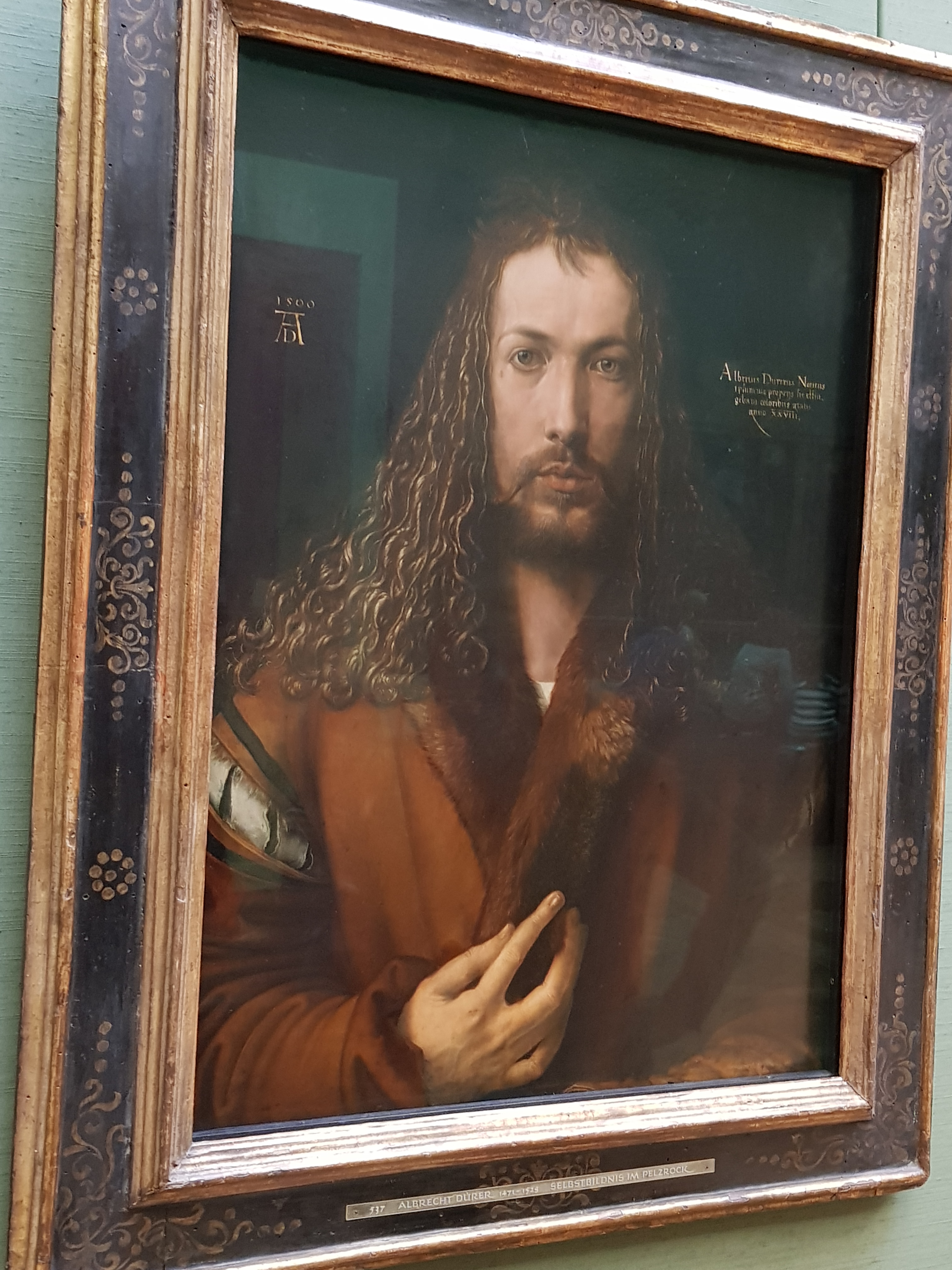 It is only when one is a regular visitor to galleries that one discovers just how much time they spend being refurbished. Sometimes it is a big-bang approach where the gallery itself is just closed. The most recent extreme example was the Rijks Museum in Amersterdam with its 10-year extended closure (originally scheduled for 3 years). More subtly, bits of museums get refurbished, such was the case with the Alte Pinakothek in Munich. The previous attempt at meeting up with the 15/16 Century german artist, Albrecht Dürer, was thwarted. Last weekend we got to make eye contact through this exquisite self portrait. What a figure he makes. I have always liked his personal logo, seen here on the top left. Brand Dürer, 1500.
Naturally, at this time much of the art is on religious figures, not always the most sophisticated. For example, instead of making up a likeness to John the Evangelist, Dieric Bouts (right), here paints a picture of a sculpture of him. This is probably common, but I have not noticed it before. Bizarre.
 Another of the delights of this period in German art is the nature of the nasties. As Andrew Graham Dixon insightfully noted in his documentary, The Art of Germany, no-one paints ghouls quite like the Germans. For example, this thing supporting a meeting between St John and Margarethe (Meister des Bartholomäusaltars). I love the way they carry on as though it is not there!
Then there’s (Meister der heiligen Sippe, right) – what might the collective noun be? – club of demons ha ving a real go at some poor bloke against the setting of the Legende des Heiligen Eremiten Antonius. Great picture, lots going on, mostly fantastical. Very scary.
 Finally, I must discuss angels. Naturally, of course, they are everywhere. The visit of the three kings (left), impeccably choreographed, has two angels above the child and parents. Now flight has always intrigued and scared me in equal measure, but I do realise that there are some physics needed to fly. These two do not really seem to have it. The physics, that is.
My favourite angels, from this particular collection, come from Meister der Lyversberger Passion dating from about 1460. The wings of these angels are unconvincing. Rather more convincing as musicians, I sense.
Great day out – and only €1 on Sundays.
Another way of getting your five-a-day?
Filed under: Cigarette advertising | Tags: Lucky Strike, Pall Mall
 Leave a comment
 The virtues associated with e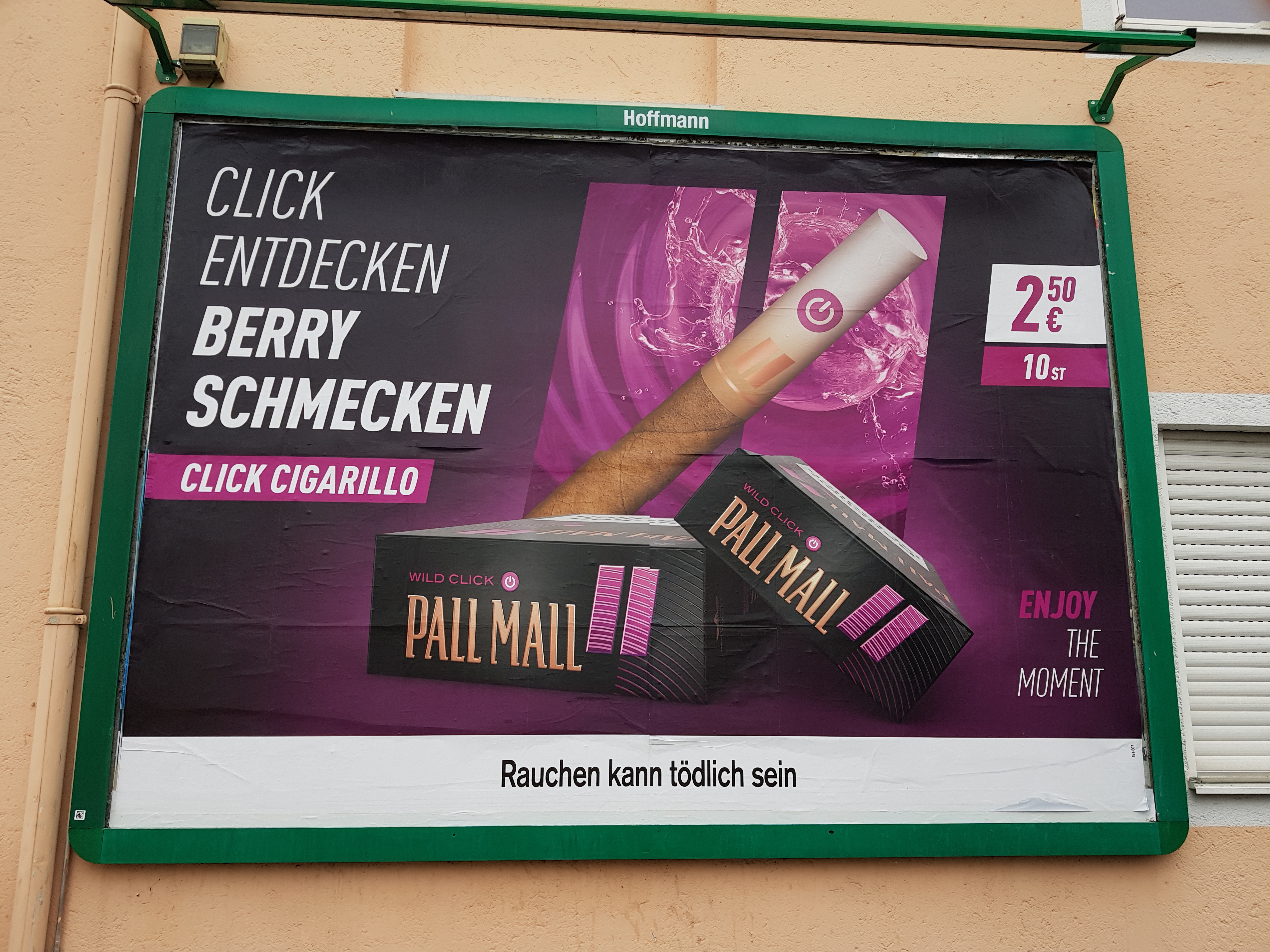 ating vegetables and fruits are well known. It can be a bit messy all of that peeling, cooking, etc.
But at last the cigarette industry has come up with a much easier way of doing it. By smoking it. Or have I again misunderstood the meaning of BAT’s Cigarillo concept? Probably.
Even my football team is at the bottom of the league
My home team, Hull City, have twice competed in the English Premier League, and twice through incompetence been relegated. The team is now working hard to get relegated to the third league. Conceding a 93rd minute goal against a relegation challenger on Saturday sums it up.
As Douglas Adams might have said, “but that’s as nothing compared to Brexit” (he actually likened the dimensions of space with a walk down the road to the chemist/pharmacy). Talking of which, if the incompetence of the government and the paralysis of the UK Parliament persists, there will be no point in walking to the pharmacy because there will be no drugs. Or the supermarket, for that matter, as there will not be any food. It is coming a bit of a cliche on Twitter to say things like, “I cannot believe I am saying this in 2018” in the context of food and drug shortages.
But of course, we are.
Not in my lifetime have I experienced the British political system so dysfunctional. I was well aware – if not of voting age – when the IMF bailed out the UK economy in the 1970s. I remember the limited excitement of the 3-Day week and power cuts. We had a gas fire with an electrical timer without which the fire would not work. How nuts was that? I lived through Thatcher, the miners’ strike. I was there with the million others trying to prevent war in Iraq. But I never felt that the polity was in crisis, only that I was on the wrong side. This time is different.
Camel tries to make its people more palatable?
Filed under: Cigarette advertising | Tags: Camel, Do your thing
Leave a comment I have  been reporting that Camel’s “Do your Thing” campaign was all about putting some of the most unpleasant looking people on a poster smoking a cigarette – or threatening to. The campaign slogan could just as well have been “bollocks to you”.
The latest that I have found seems to be softening that with a woman sporting flowing long hair and who is either vigorously shaking her head or being confronted by a wind machine. Either way, “smoking is deadly” as the warning at the bottom maintains.
Tandem Tour 2018 Part 5: Dürnstein to Klosterneuburg/Vienna
 I reluctantly observe that very large cruisers have replaced the barges along the Danube. They have their own particular bulky cargo that is decanted at points along the way. The towns and villages adjacent to the berths have spikes of activity as the visitors arrive en masse. So it was with Dürnstein, across the river from our campsite at Rossatz. It looked gorgeous at night illuminated, but the central area at peak time is congested. There are gift shops galore. And plenty of attempts at flogging of the local wine. We did find a bakery for breakfast, but even parking the tandem safely and out of the way was a bit of a task. Incidentally, just a little way out is a cyclists’ cafe, probably a better option.
We’d also been advised that the path on the north side was really nice. We can confirm that the south is probably better through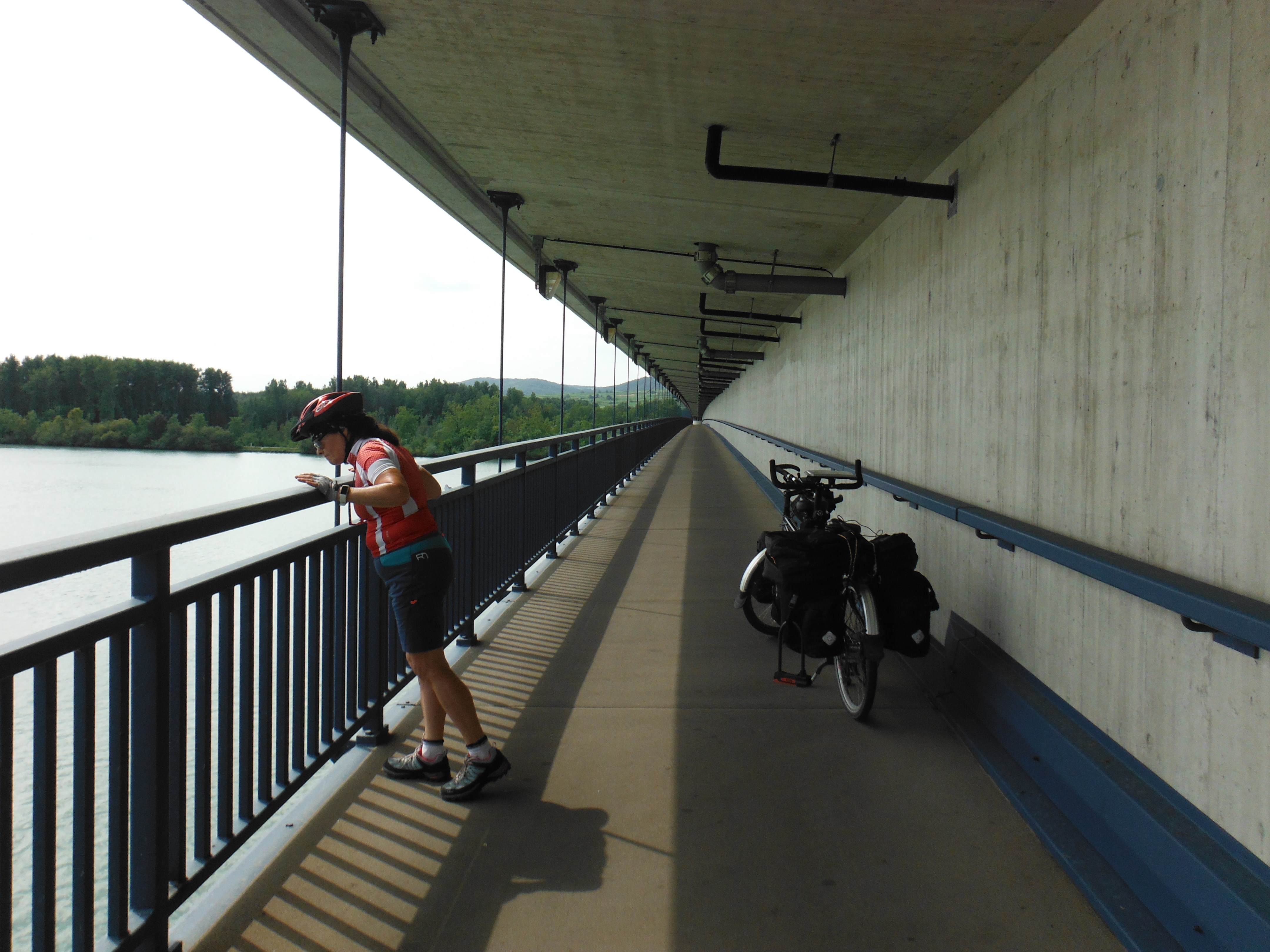 Mautern rather than Krems. Krems has a historic western approach, but once the path reaches the prison (which riders cannot miss), then it is downhill from there. The path is incoherent and actually quite difficult to follow. We took the first post-Krems opportunity to cross the river back to the southern path over a relatively new bridge in the direction of Wagram where the cycle track is built under the roadway (right).
We think we were right to revert to the southern path. We found ourselves in a riverside restaurant at Traismauer, suitable for lunch. 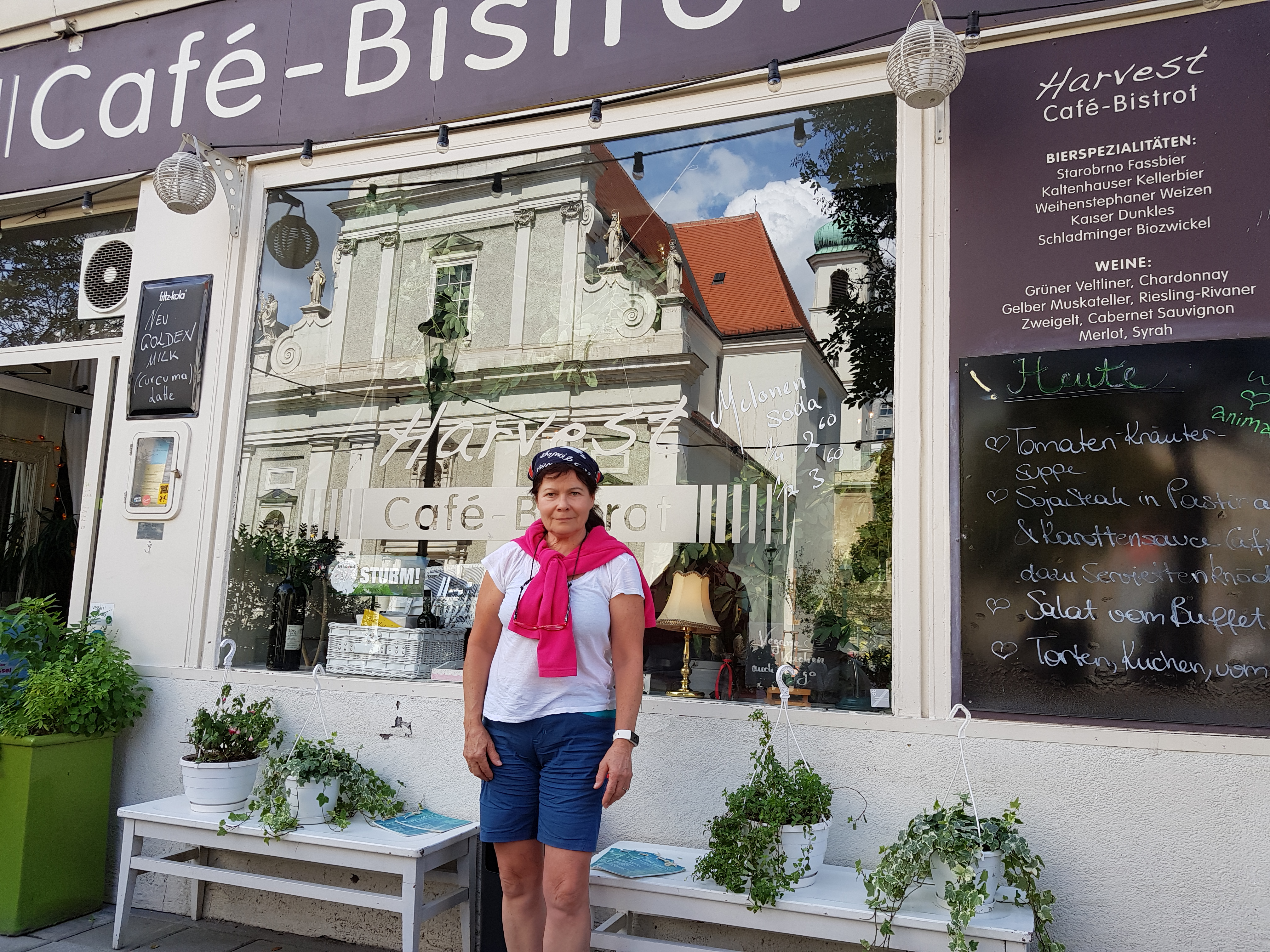 Then all very quiet until Tulln which is quite a resort. There is a camping site, a live stage floating on the river and a multi-activity park. As well as a bakery, naturally. It is also, as we noted, at the end of the S-Bahn to-and-from Vienna. It might not be a bad place to base oneself. However, we decided to go further to Klosterneuburg which is very much a suburb of Vienna. Another 20kms further and, by this time, we were feeling it. But Klosterneuburg has a great camping site, frequent trains to Vienna, and its own very particular brand of restaurants and cafes (including an icecream parlour where ridiculous quantities of icecream are loaded onto a way-too-small wafer cornet). It is fun to watch and delicious to eat. But impractical.
 We took two days out in Vienna. The tickets by train to – and around – Vienna currently cost €9.30 (taking in trains, Underground, tram and bus). We visited a cafe that we had failed to get in during previous visits; namely Harvest (above left). We also visited the Jewish quarter and came across Rachel Whiteread’s holocaust memorial (right). A signature concrete construct with books to symbolise both knowledge and, of course, the Nazi penchant for book burning. It is fitting and just-about works. All of the Nazi death camps are listed around each of the four sides. Chastening.
 Vienna is truly a gift for anyone interested in architecture. Whilst there are plenty of examples of imperial architecture associated with the Habsburgs, there is also quite a bit that is – and was at its time – rather challenging (particularly to the establishment). But eventually became accepted and then celebrated in the city. Take, for example, the Postsparkasse (left) built in 1904-12 by Otto Wagner. It is an imposing building and is not fancy apart from very small nodules being placed perfectly in vertical and horizontal lines. To see them, readers will need to click on the photograph and then enlarge. It should not work, but it does.
Wagner’s art nouveau and modernist architecture is not in short supply in the city. Wagner was a founder member of revolutionary artists’ association, Vienna Secession. I suspect our next visit will take in all of these buildings in turn. Apparently we will be hunting down a number of residential properties, railway stations (U-Bahn) and the Danube Weir. The Postsparkasse is, clearly, not art nouveau, but apparently it is a masterclass in modernist interior as well as exterior. Seemingly everything from radiators, counters to desks and door handles are worthy of note.
For readers wanting to get back to Munich, we can report that the operator of the rail route between Vienna and Salzburg (Westbahn) does not 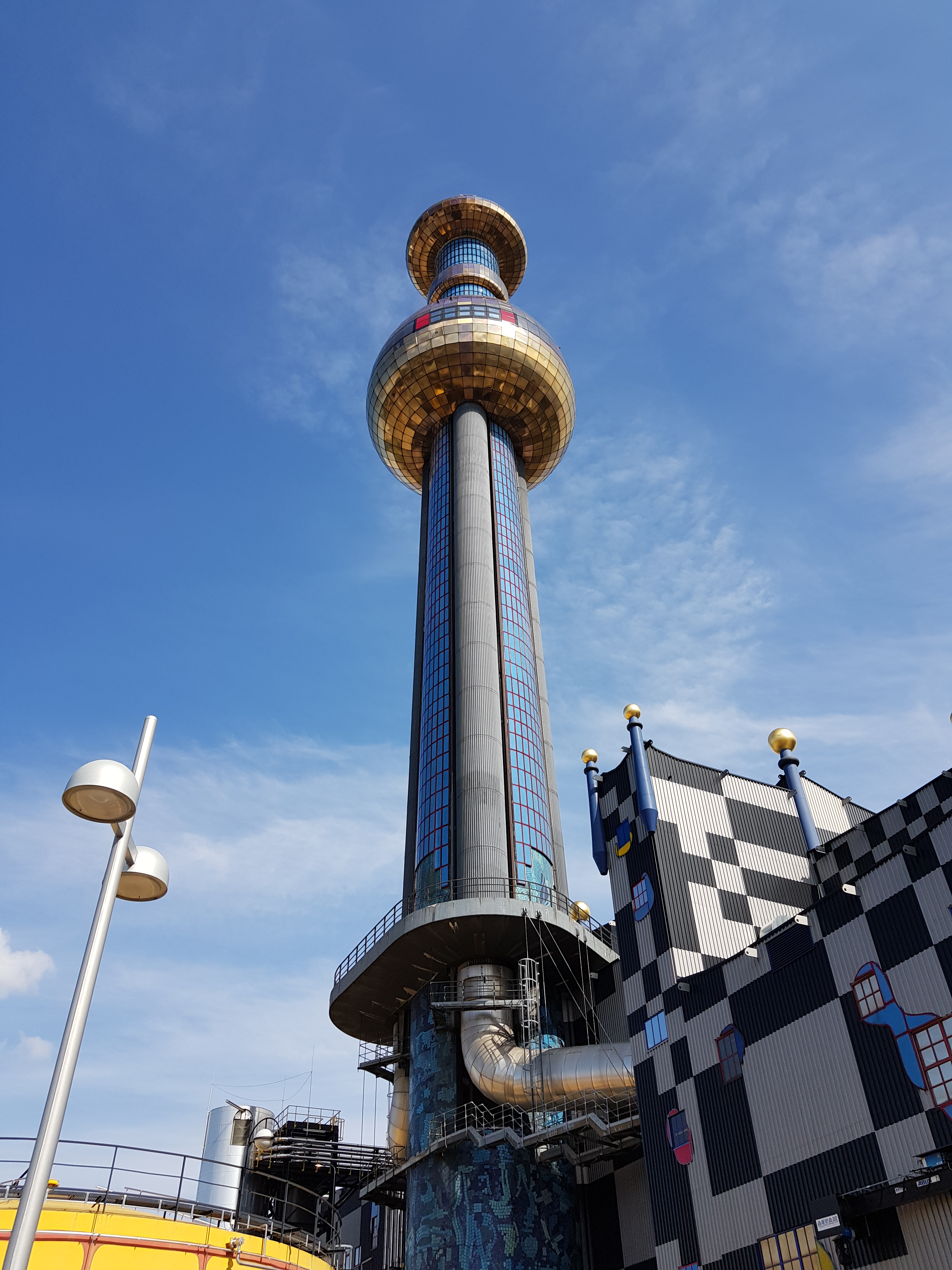 accept tandems. So we had to come back with OBB and Deutsche Bahn via Leoben. Not the most direct route, and certainly not cheap. There is dedicated cycle space, however. It was wonderfully scenic. The ride in to Vienna to get to Hauptbahnhof took about an hour. The path takes riders past Hundertwasser’s power station (right) and then further along the Danube canal to Schweden Platz. From there one needs help as Hauptbahnhof is not well signposted. We resorted to Google Maps.
Tandem Tour 2018 Part 4: Ottensheim to Dürnstein
 In light rain we continued along the north path towards Linz. We decided not to cross the river into the city, but rather to shelter under the entrance to the Information centre in Urfahr (the partner town to Linz on the north bank). An hour later we moved on in light rain.
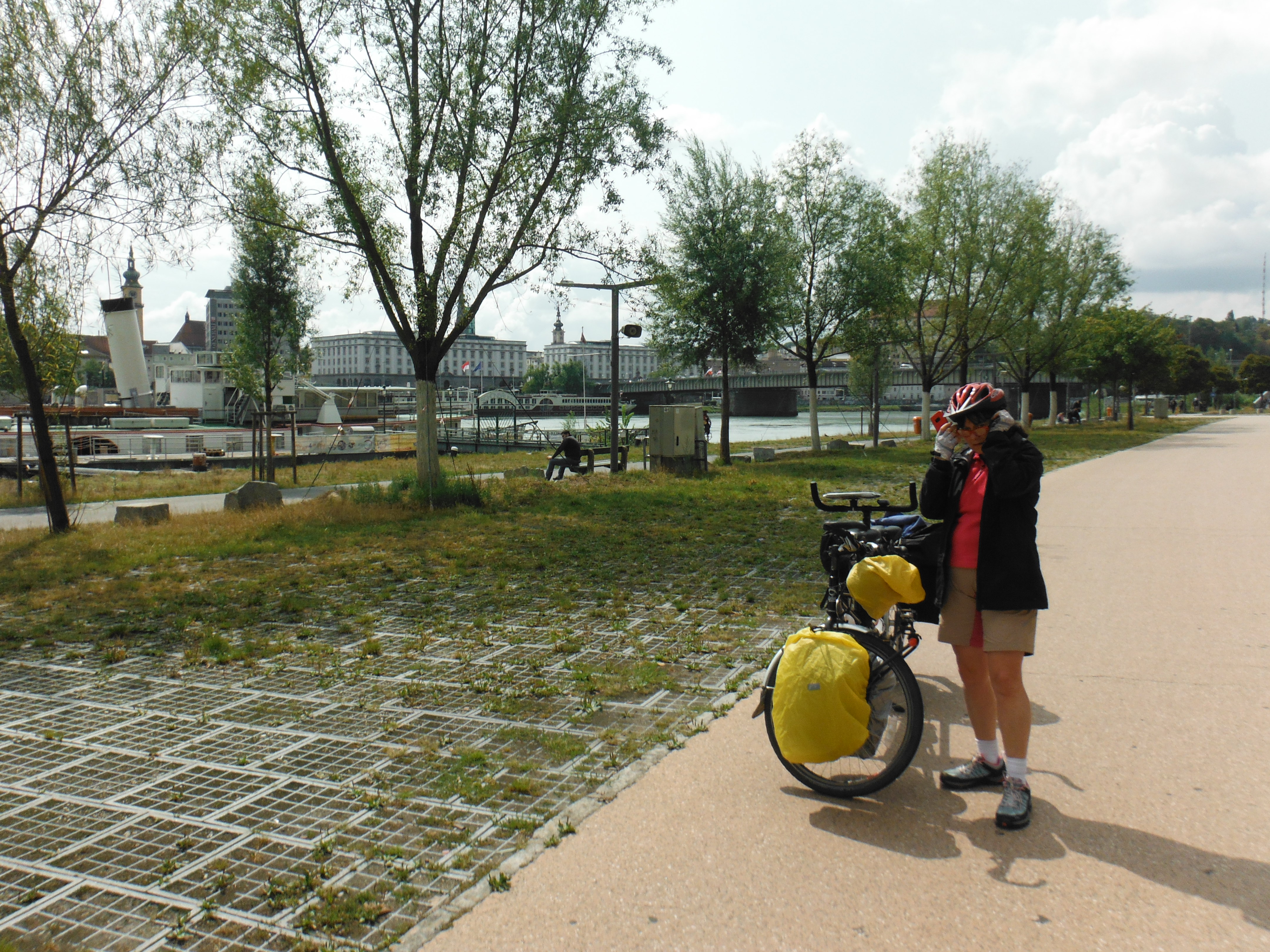
Deceptive sun, Linz
There is no functional path on the south because of a sizeable industrial area. It can be viewed from the north for those interested in such areas (myself included; the river’s frequent hydro plants are extraordinary constructions). As we hugged the bank of the river the weather improved. At Abwinden the path moves inland for a short way, through St Georgen and rejoining the river at Langenstein.

Rural idyll. A quiet Danube
We took a break at Mauthausen; the town’s Nazi history – large labour camp and its satellites – is confronted in memorials, activities/seminars, etc. Austria was annexed by the Nazis in 1938. This part of Austria had a significant cluster of labour camps where prisoners (many of them non-German) were worked, in many cases, to death in quarries, mines, munitions and aircraft factories.
Then on to Au, where there is a campsite, with “Badesee” and other water attractions. The tranquility of this stretch is wonderful: the Danube at its best. It is easy to make progress on the dykes. Inland again through Mitterkirchen. The sun was by this time dominant, though on the approach to Grein we met both a road and railway. The campsite is located on the path to the south side of the town.
Grein is a lovely town. In the market square one finds the Town Hall and a host of cafes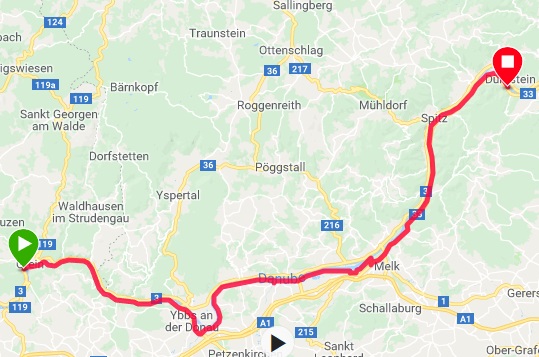 and restaurants. Sunday night is a shade limited. We went to a sort-of-Italian restaurant (with significant Greek influence on the menu, Pizzaria La Vita) frequented by locals and campers. We had not fully accounted for the Austrian laws that do allow smoking in restaurants. This place was like going back in time in the UK. The fug was extraordinary and the environment unpleasant. Sitting outside was not an option because the temperature had dropped significantly.
For breakfast we started at the bakery in the marketplace (smoke free) and then to the Konditorei on the bank of the river for a second coffee. There is in the town a fantastic bicycle shop. It reminded me of childhood. Everything had a place and it smelled of oil – bicycle oil, that is. Marvellous. My beloved bought a new cycle jersey that smelled, until it met with some soapy water, of that bicycle shop.
Across the ferry to the south side where the track was again dedicated. Beautiful in the sunshine, tree-lined and hugging the river. Not too many refreshment options before Ybbs. There we found another baker’s shop and ate outrageous (by which I mean large and full of gooey nice stuff) pastries and coffee in the sun.
 23 kilometers further through the vineyards and orchards is Melk. This is always a reminder that, whilst I may be on holiday, many people are not, especially the migrant workers who harvest the grapes. Lots of migrant labour is in evidence, trying to earn money for their families, let alone a holiday. I should not need to be reminded.
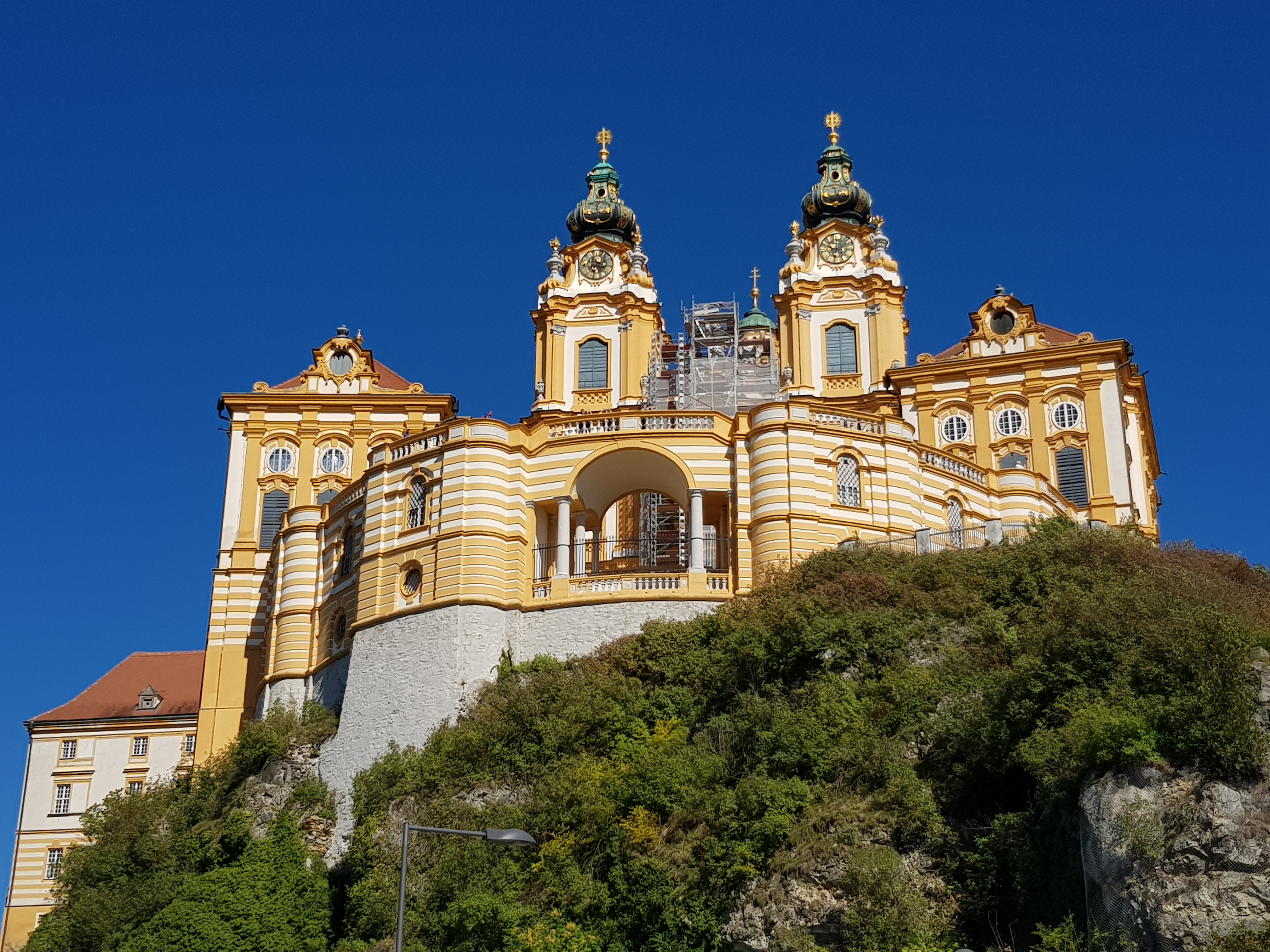
We half had a mind to stay there at a campsite on the river just short of Melk. We were slightly put off by its location, adjacent to a mooring for large cruise ships – industrial scale holidaying – of which there were five already decanting their load on to waiting coaches. Plus, we were feeling fit and up for a little further in what turned out to be a sunshine-blessed day. From a distance, the monastery at Melk is visible; it is imposing and against the backdrop of blue sky, worth a photo (above left). But we were soon on our way.
The path is quite challenging at this point. The valley becomes very steep – there is a bit of climbing to do on the road close to Schönbühel. Slightly beyond that is Aggstein. The Gasthaus there has a nice garden. We stopped for more food (locally-grown pumpkins are very much a feature of Gasthaus menus in the area, so I opted for Kurbis soup). Then finally on to Rossatz which really just emerges along the route. It is a curious campsite – patches of grass on the roadside, but it was a suitable end to the day, and the night-time view across the river to Dürnstein (right) seems justification enough.
Tandem Tour 2018: Part 3 – Passau to Ottensheim
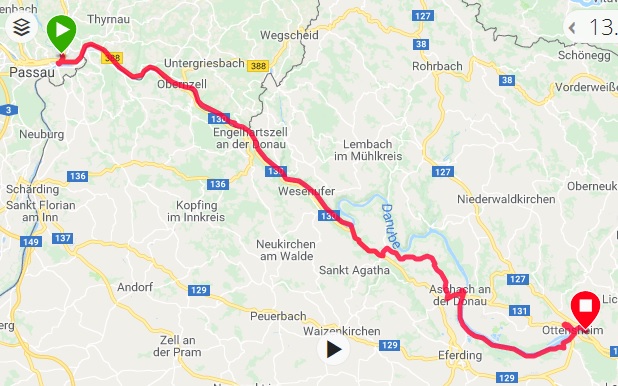 We had breakfast in Passau Market Square before recrossing the Danube to follow the track on the North side. It follows the main road until Obernzell. One needs to be patient. From there it is dedicated cycle track to – and beyond – the border (right).
We stopped at Niederranna at a dedicated cycle station (cafe) and did a bit of tent drying in the breeze after  overnight rain. We decided to stay on the north path and take the ferry over the river to Schlögen (below left). The north path beyond this point is converted into a ferry ride as the river bends back on itself in what is a particularly picturesque spot. We thought that, because of the distance for the day, we would try to do a shortcut from Schlögen to Haibach ob der Donau and cut this section. Shortcuts area always good in theory, never so good in reality. Out of Schlögen we had to climb 300m on the relatively main and bendy road. With our tandem that was quite a challenge. We then missed the road back to the river at Haibach. We carried on towards Hartkirchen and then eventually to Aschach. We saved kilometers, but probably not time.

View from ferry to Schlögen
From Aschach the path is again dedicated. It began to rain heavily. There was a marked campsite on the south side of the river near Ottensheim. It turned out not to be there. We were forced, then, to seek shelter in Ottensheim itself. We used to car ferry to do so. A great ferry that uses minimal fuel by using the current and a cable slug across the river. The motors are intermittently powered to provide momentum. Our guide recommended a hotel in the marketplace. It was full. We carried on out of the town for a couple of kilometers to Rodl where we found a campsite with a Gasthaus opposite. The landlady was brilliant. She made us some veggie pasta supported by a glass of Zweigelt.
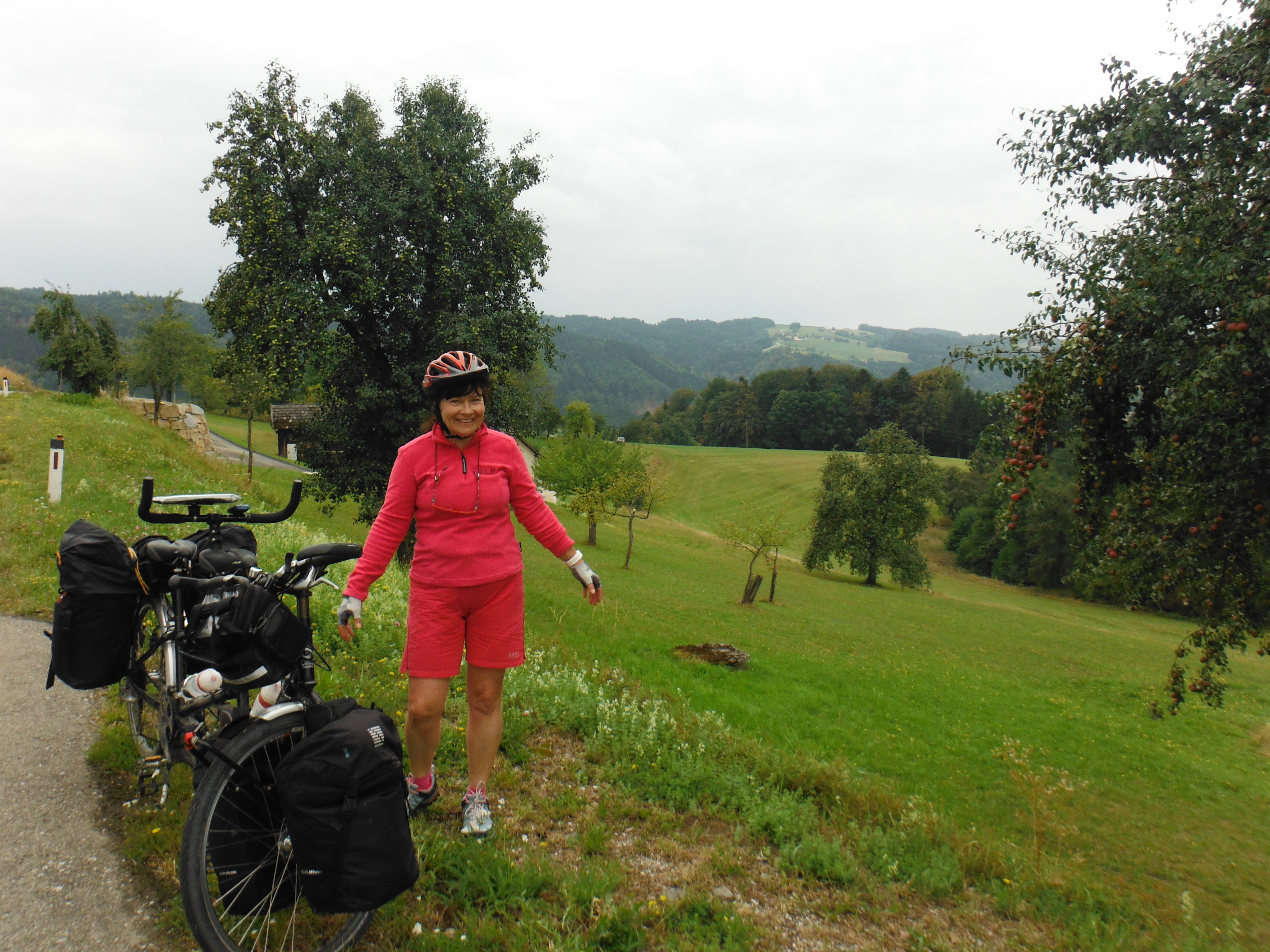
Finally at the peak near Haibach ob der Donau
The site provided cover in a hut with electricity, sufficient for us to sit and read for a short while. The rain continued into the morning. It lightened whilst we showered.
Tandem Tour 2018: Part 2 Marktl to Passau
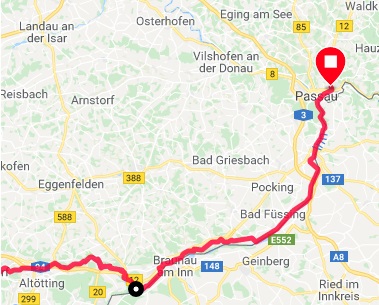 The first night under canvass is often not the best. A working farm, of course, invites an early cockerel, bleeting sheep and, of course, tractors. But after breakfast in Marktl we followed the Inn cycle track to Passau; a curious place where three rivers meet, often too enthusisatically (right).
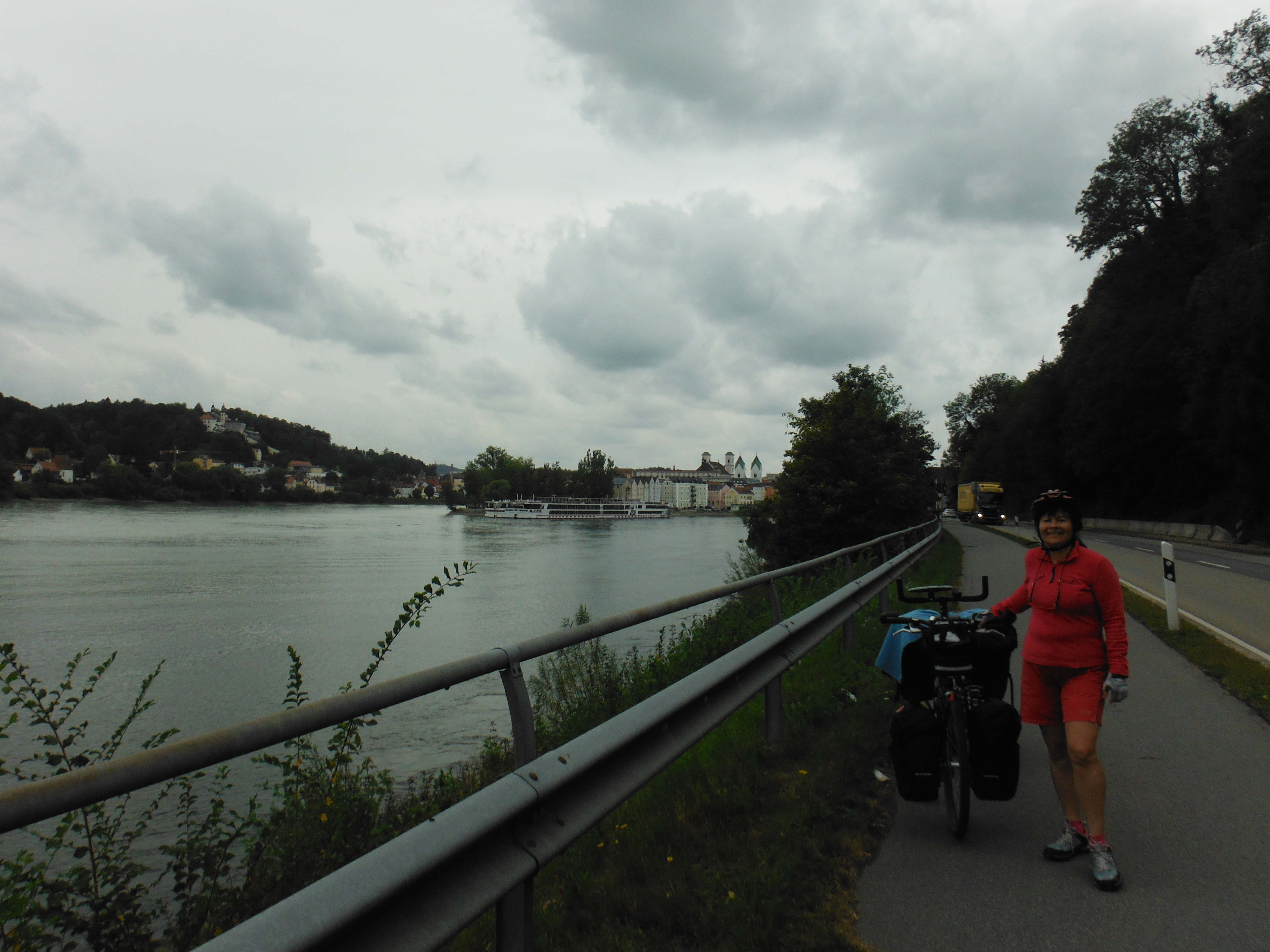
View of Passau heading east along Inn
The route itself is quite rough in places. There are long stretches of shingle on dykes zapping energy. The river also has many tributaries. This makes it an ideal river in which to swim; and indeed, there are frequent “Badesee” – areas for swimming, sunbathing and having lunch. This contrasts very much with the Danube where we found few places to swim safely.
We stayed on the north side of the river in Gemany. The river forms to border with Austria. At these times of tension around migration, this is significant. At Simbach, for example, there is a border check on the German side. And yes, brown people were being checked.
The route takes in few towns and villages, so if refreshment is needed, the south – Austrian – side may be a better option. For example, we were getting a shade hungry and thought we might find something in Neuhaus (about 20km short of Passau). We rode 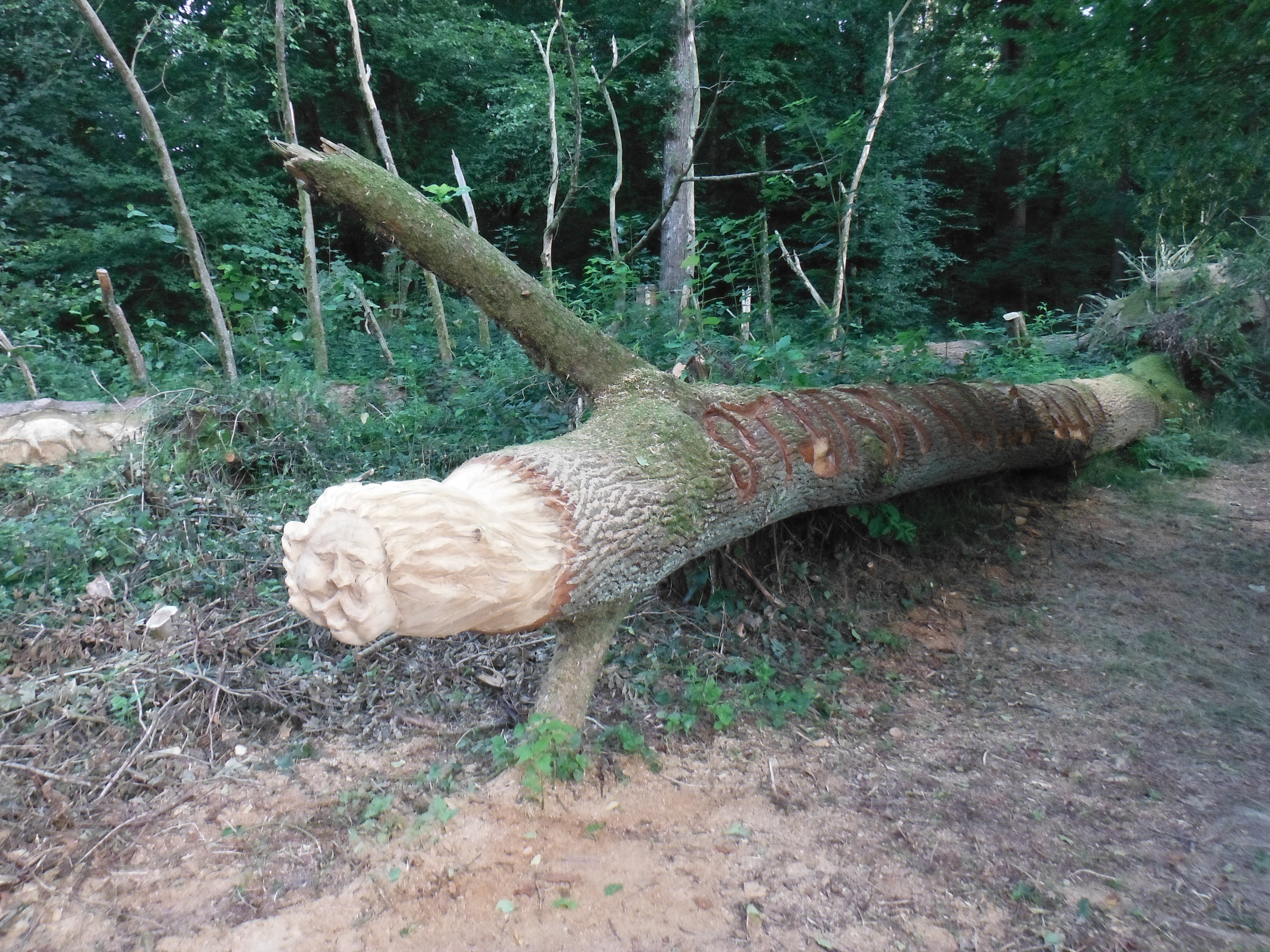 through finding nowhere. We think that we would have been successful if we had crossed the river in the Austrian town of Schärding. Actually, a little further on we found a welcoming bakery in the village of Vornbach (there were lots of cyclists already there). It is also worth stopping there because the final few kilometres into Passau are quite challenging. There is a climb into a forested area; it is
  bendy, dangerous (steep drops are possible) and rough under the tyres. It is also exquisite. Some creative soul has carved some faces into felled trees (left). There is also a wonderful wooden bridge (right) over the Rott at Weihmörting.
On arrival in Passau, we immediately had to work out which river was which. The campsite is on the Ilz to the North. The route to the campsite in the end was quite simple (and signposted), but when one is tired, it does not seem so. There is a significant road that leads towards Hals which has been carved out of the rock; it is certainly not designed for cyclists, but it’s the only way.
We ended up with a day of 80kms. We decided to pause for a day in Passau. It is not a big town. It has an old town – the Danube cruise ships offload in this part) – with a fine cathedral, squares and cobbled streets. The regular town with the familiar retailers isfurther to the west. We ventured there really only to find a bank.
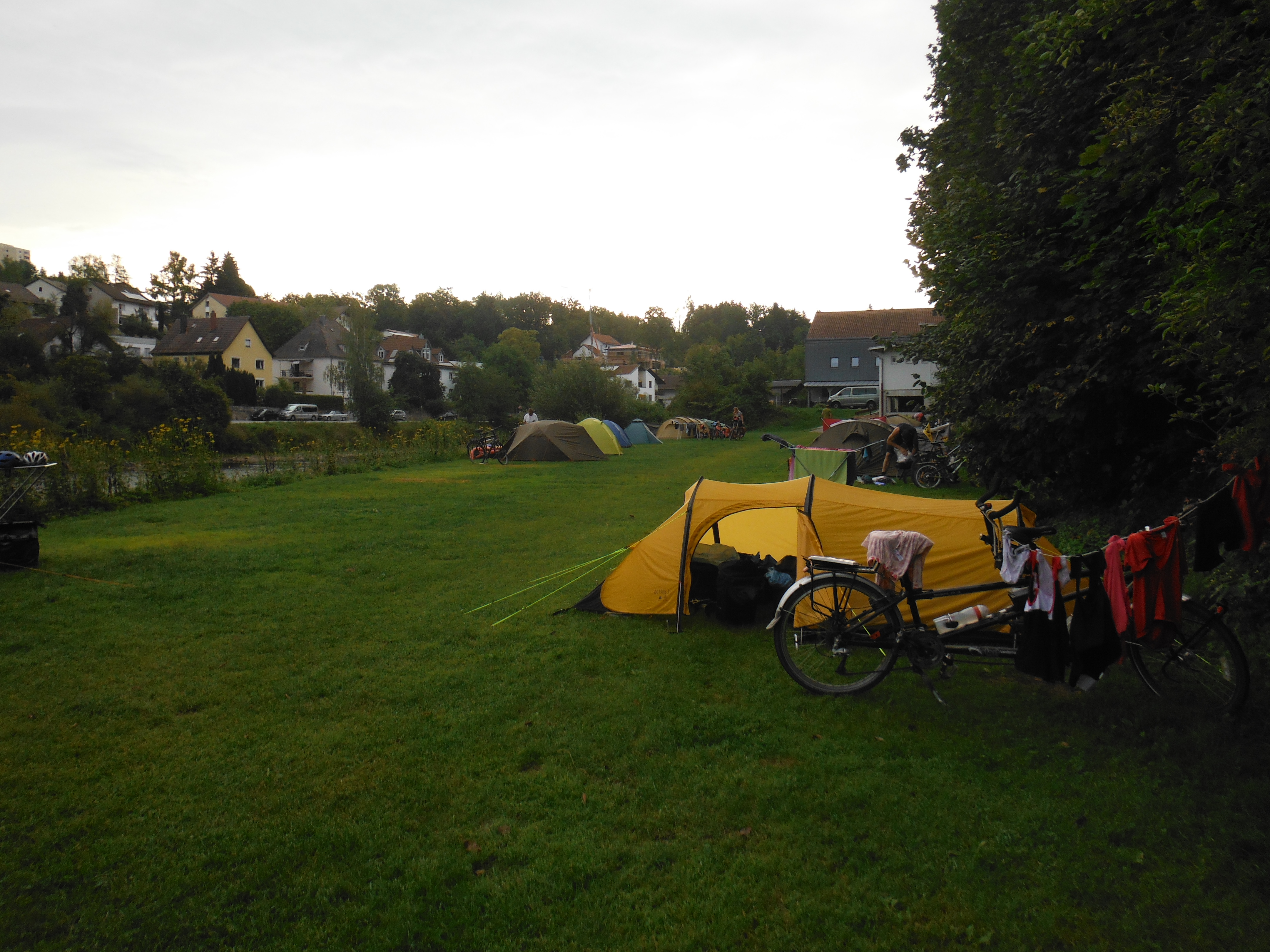
Campsite, Passau
The campsite (left) is directly on the river Ilz. It has a good toilet block with a washing machine. Dotted around the site are clothes drying frames. At first we thought that a lot of people had somehow brought them with them! However, the true gem is the “restaurant” adjacent to the reception. It looks like a takeaway, but dig a little deeper and one finds some brilliant authentic Italian cuisine. It is so good, that we ate there twice, despite the opportunities in Passau.
 Be informed