Author Archive
Spring cigarette advertising campaigns in Germany
Filed under: Cigarette advertising | Tags: Camel, Gauloises, Pall Mall
 Leave a comment
  Cigarette advertisements in Munich are sprouting like spring flowers. Three brands are slugging it out on the streets, Pall Mall, Camel and Gauloises (making a welcome return to the narrative).
Pall Mall has gone monochrome with a set of posters featuring people who have amazing lives. Seemingly. These two loveable men, according to the caption, as I understand it, have very colourful lives already (hence the monochrome picture). The cigarette seems to help their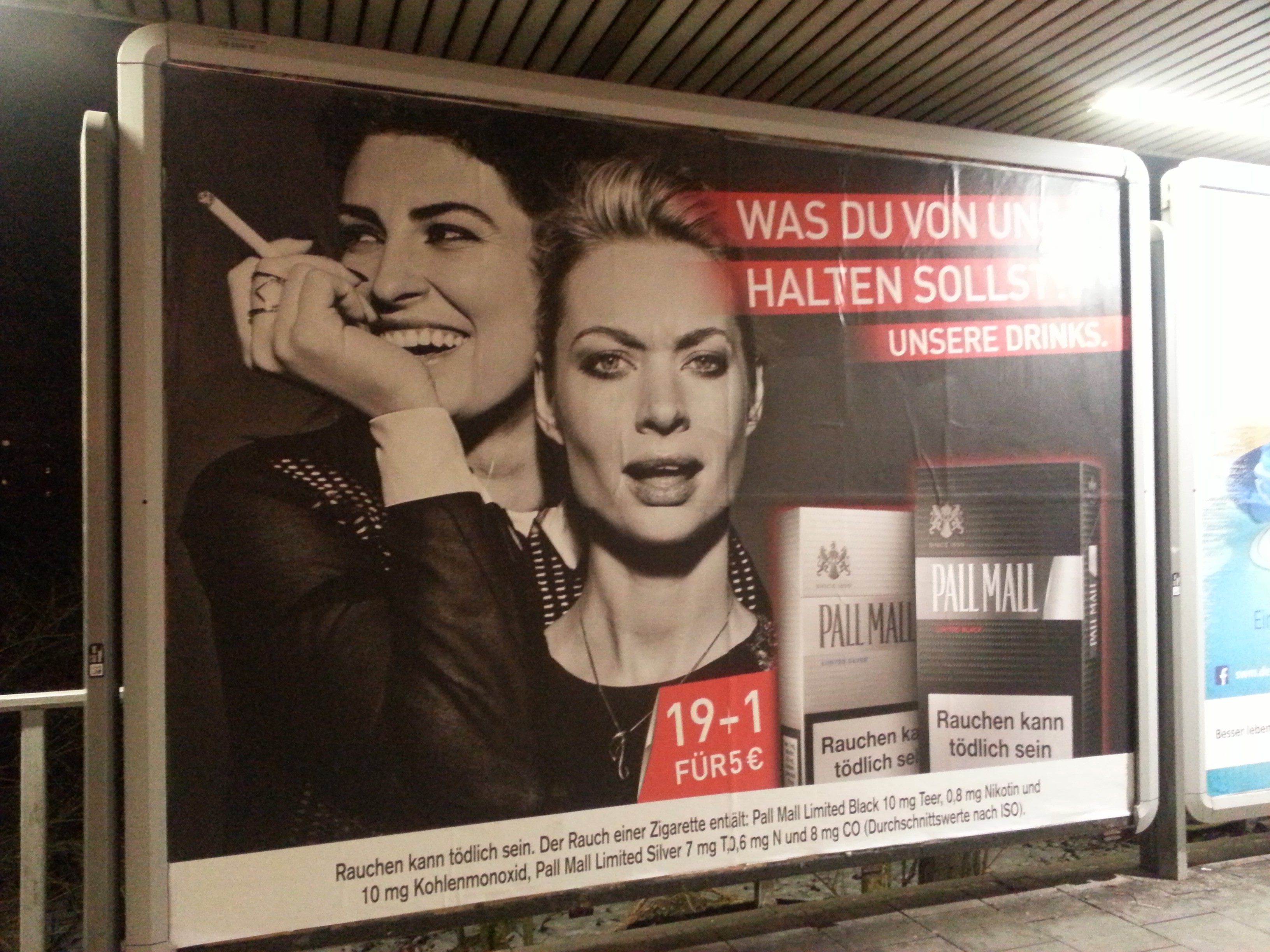 masculinity.
There is an equivalent for the women (right). These two sophisticates ask what are we to think of them? Not much. Really.
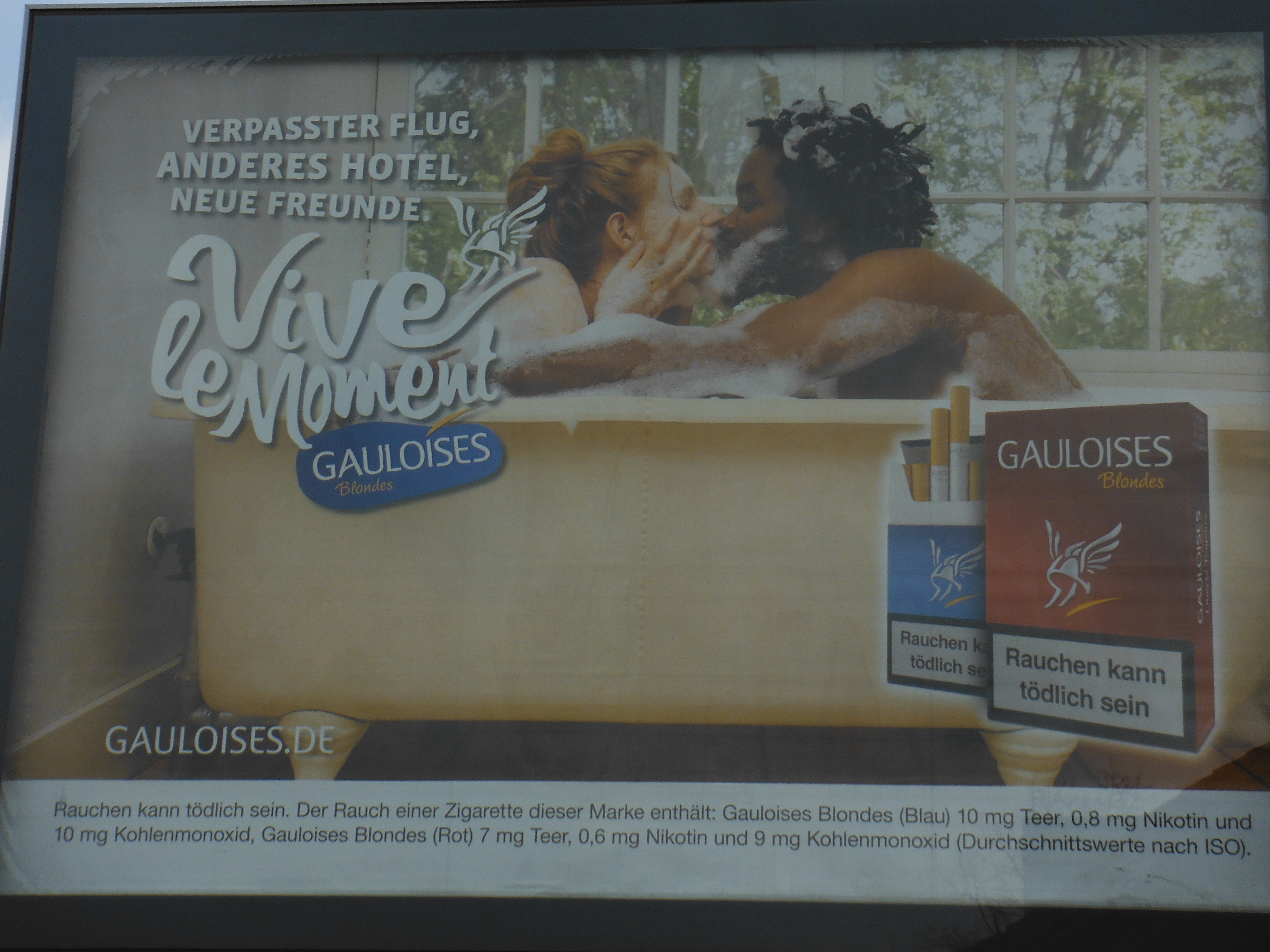 The French brand, Gauloises, has a similar approach with its ‘Vive le Moment’ campaign. Of course, this involves, like the competitors, living life to the full with cigarettes, a seemingly contradictory idea. Here we have two people having fun in a bath – though the cigarette is unsurprisingly absent. Somehow they have ended up in this situation having missed a flight and checked in to a different hotel. As you do. Both of them seem to have overcome their nicotine addiction and predilection to cancer in favour of sexually transmitted diseases.
There is an exclusively female take on this. Here they use their long tresses to create moustaches. Why would they do this? Not sure. Maybe they should get to know the hairy men in the Pall Mall ad. Could be a good night of tobacco exchanges. Or not.
 And then there is Camel, ‘untamed since 1913’. Colourful. A bit like gravestones. Quite fitting really.
Reflections on Barcelona (4)
Filed under: Travel | Tags: Arc de Triomf, Casa Batllo, El Born, Hàbaluc, water fountains
Leave a comment 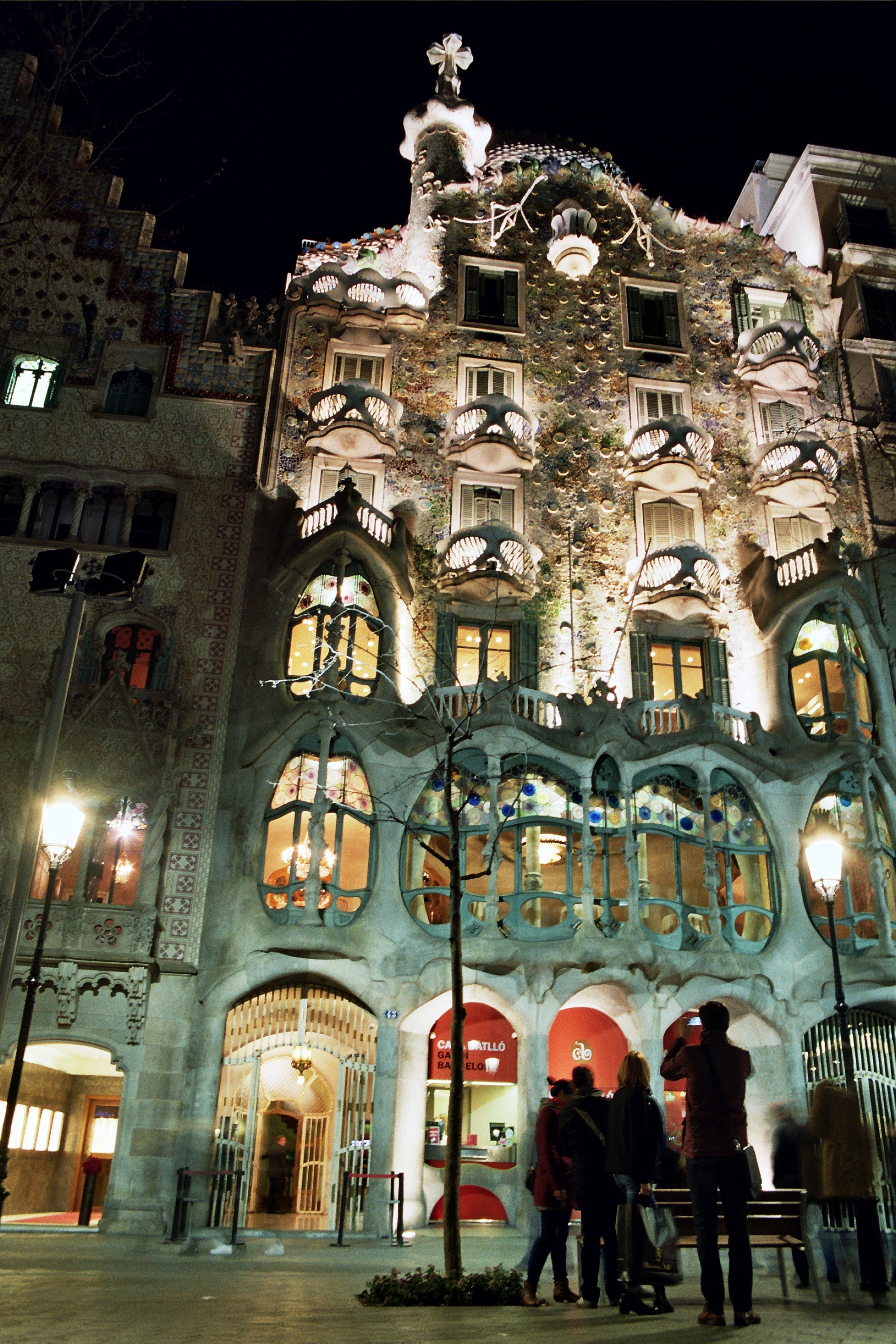 We resolved quite early to come back to Barcelona later this year. There is more Gaudi to do, not least the Casa Batllo – http://www.casabatllo.es/en – (left) – although not built by the man, he certainly appropriated it and gave it his signature makeover. We are keen also to visit Casa Vicens.
Barcelona, however, is more than Gaudi. There is a waterfront, for those who like  those kinds of things. Equally, there are so many quirks. It has its own Arc de Triomf (right). A short way further walkers encounter
 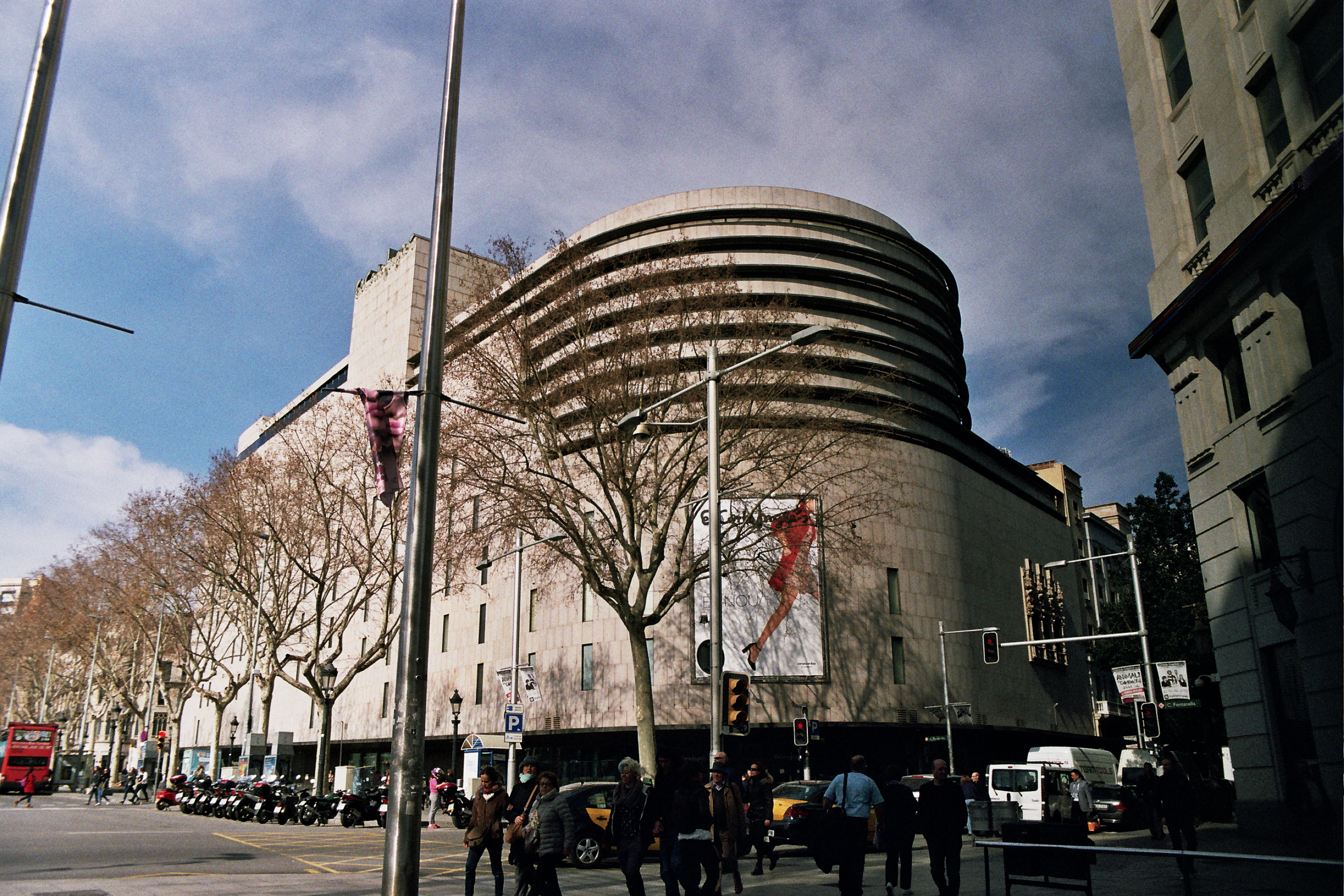 Plaça Catalunya at the top of La Rambla where the El Corte Inglés department store flirts in its alluring modernist building (left). There are numerous secluded squares on which to sit, some more peaceful than others, all have access to coffee. As a rule.
I always judge cities by their drinking fountains. I think it is one of the indicators of civilisation. Towns and cities in hot countries are generally the most generous in their provision, but even in the UK it gets warm in the summer; unfortunately, local authorities in the UK seem to have decomissioned most of them in favour of over-priced and unsustainable bottled water. Barcelona, suffice to say, by this definition is civilised.
 Civilisation can also be measured through access to history. Barcelona is a great trading city of old, and it has a number of 19th Century markets. One of these is El Born, a former fish market (left). However, it now acts as a cover for an excavation of the old city
 (right), a part of which was destroyed in the War of Succession in 1714. It is just an extraordinary space and costs nothing to visit.
And then there is always food. As vegetarians we are always seduced by eateries that either cater for us on the menu or are willing to adapt the menu for us. We 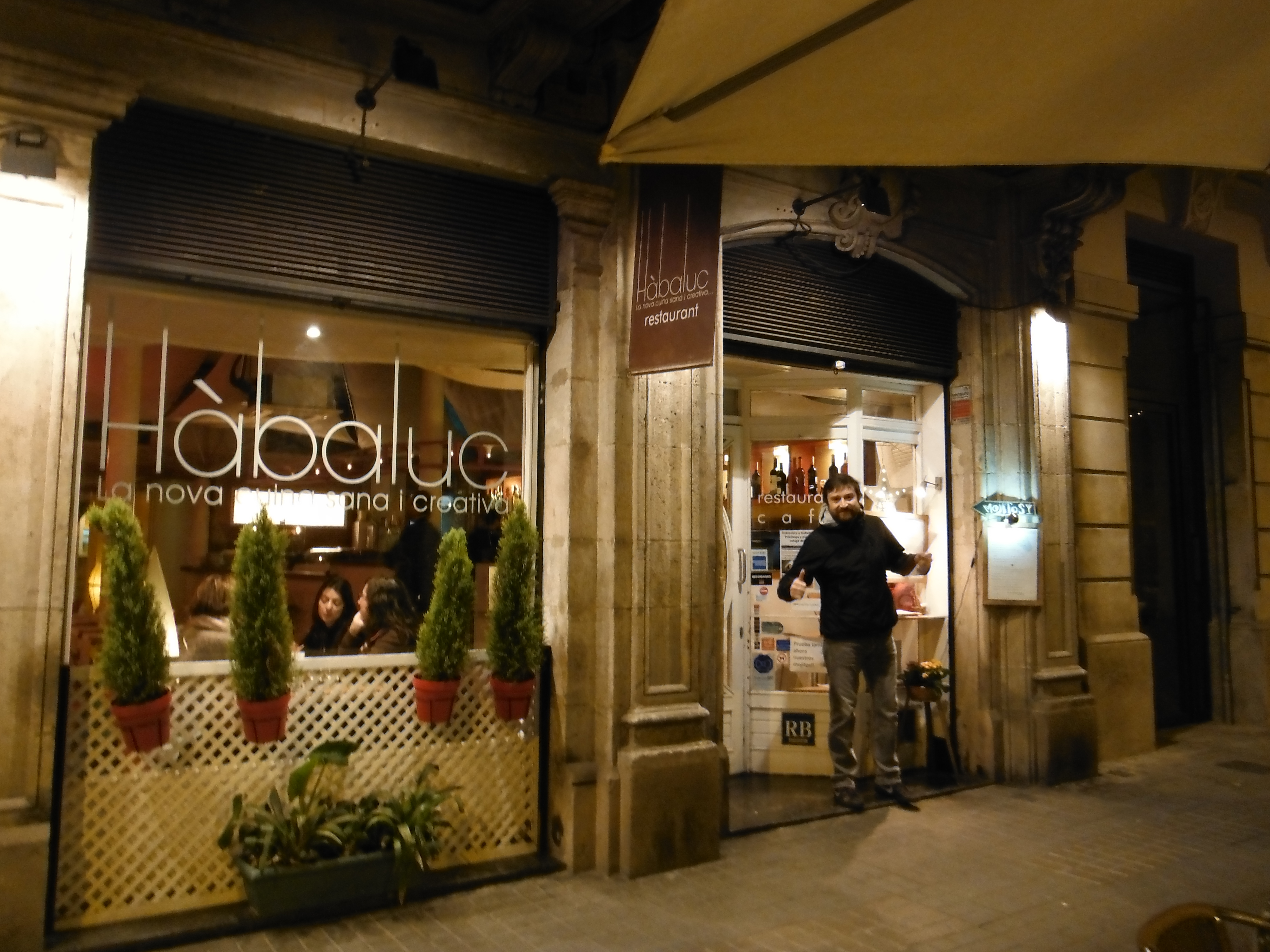 ate three times in a restaurant called Hàbaluc (http://restaurantehabaluc.com/). It is cheap, cheerful, has a menu in English and a good selection of intelligent vegetarian main courses allowing us to visit three times without eating the same option more than once. They sell wine by the glass and their desserts are crafted almost to pudding perfection.
More generally in the city, service is very good. We found that, essentially, one can have whatever you want. Pizza, for example, can be bought by the strip and p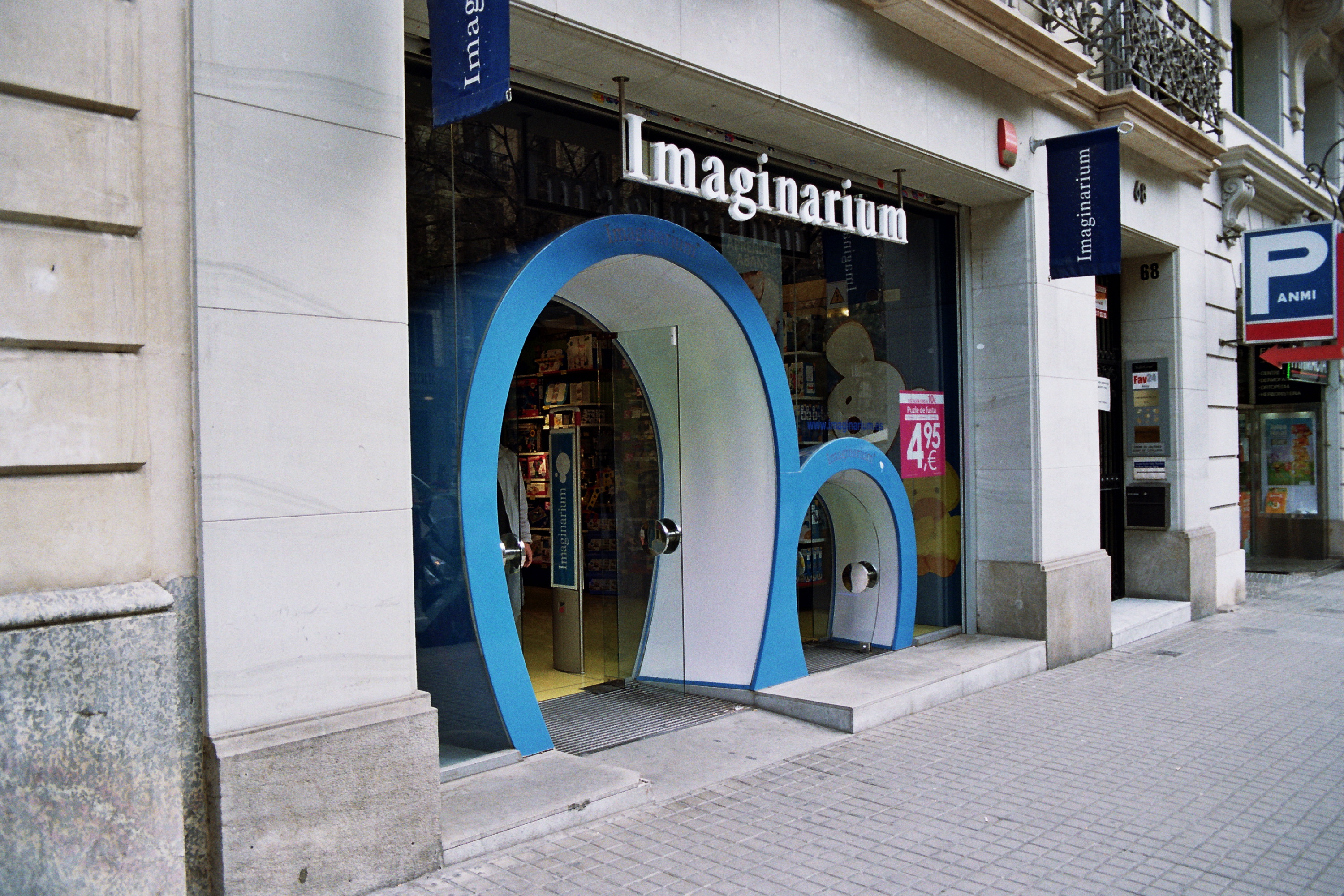 aid for by weight. Shop keepers – and there are many – like to solve problems. My analogue camera’s battery failed in the Sagrada Familia. A nearby hardware store put the combined effort of three assistants to the task of finding a substitute. No problem.
It is also a city that loves children. So much so that one toy shop gives them their own door (above right).
Reflections on Barcelona (3)
Day 3 – Park Güill
Pa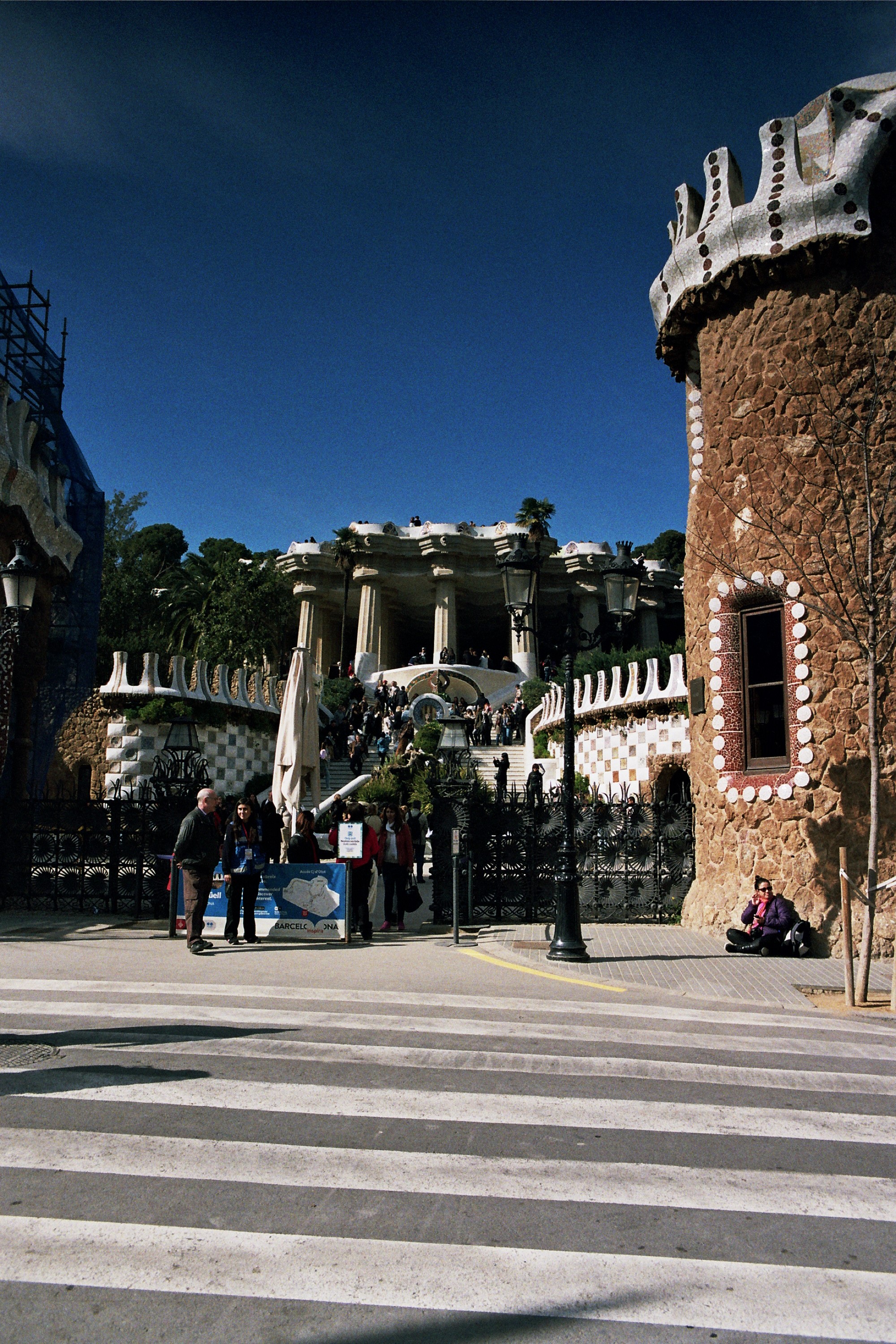 rk Güill is in the north-west of Barcelona and can be reached using the Metro Line L3 (direction, Canyelles) alighting at Vallcarca. The route to the park is well signposted for pedestrians who are treated to a most unusual set of outdoor escalators to aid mobility to the elevated Park. The main entrance is flanked by a visitors pavilion with a mushroom chimney and a tower with a cross pointing in 6 directions. In essence, the entrance is one great puzzle full of references to the architect’s childhood (elephants in Montserrat, apparently) and piety. One could easily spend the day interpreting the
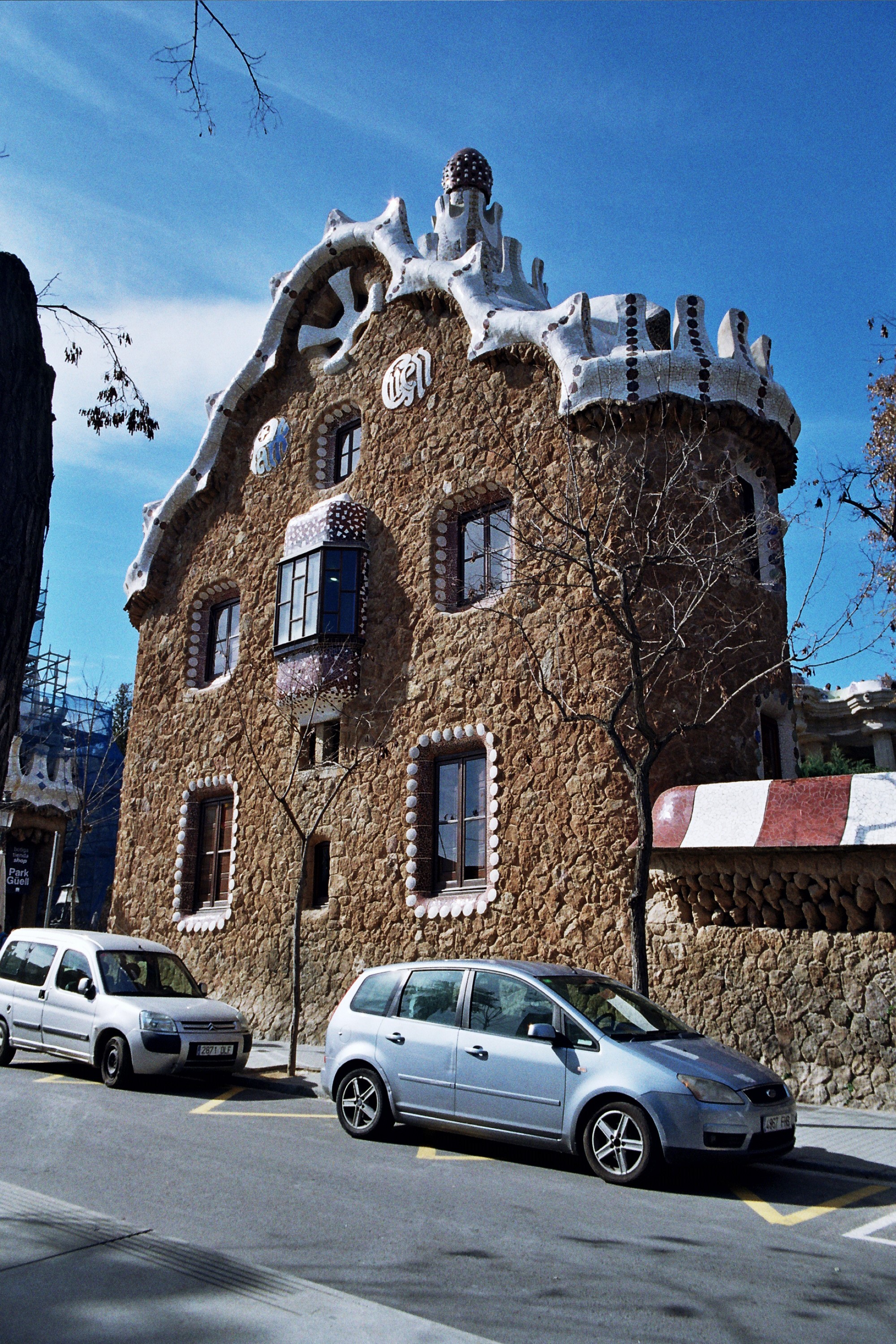 design; a good book is helpful, however. The references to nature represent a common theme with Gaudi, here illustrated by ceramic salamanders and serpents amongst others.
Park Güill is the site of a one-time walled housing project, the brainchild of the eponymous industrialist, Eusebi Güell, with Antoni Gaudi as the chief architect. The whole site has an area of 15 hectares most of which is now public parkland with a fraction of it designated as a world heritage site by the UN. We did not actually visit this area, but it is the location of his mock temple and some signature ceramic animals and seats.
 With respect to houses, only 2 were completed, neither of which were designed by Gaudi, out of an anticipated 60 before the project collapsed. Gaudi himself bought and lived in the show house (left) from 1906 to 1926 (originally with his father and niece) when he moved into his workshop at the Sagrada Familia. His house is now a museum and well worth a visit. It is here were one can see into the soul of the man. His frugality can be seen in the simplicity of his
 living quarters – a single bed with a shrine at its foot, an exquisite non-en suite bathroom (right) and a balcony from which to observe his emerging cathedral. There is also a video featuring a commentary from one of the nuns who basically looked after him in these years. Without them, one gets the impression, he would slip completely into the alternative reality world of his imagination. Maybe that is where he was when he collided with the tram that killed him?
One feature of Gaudi’s internal decor is the way either he decorates his ceiling so that they are not flat, as in La Pedrera, or appear not to be flat by optical illusion (left).His wooden furniture are pieces of ergonomic art which despite that seem not to be overly comfortable. Some cushions would be a good start, but one does not get the sense that comfort was his thing (right)
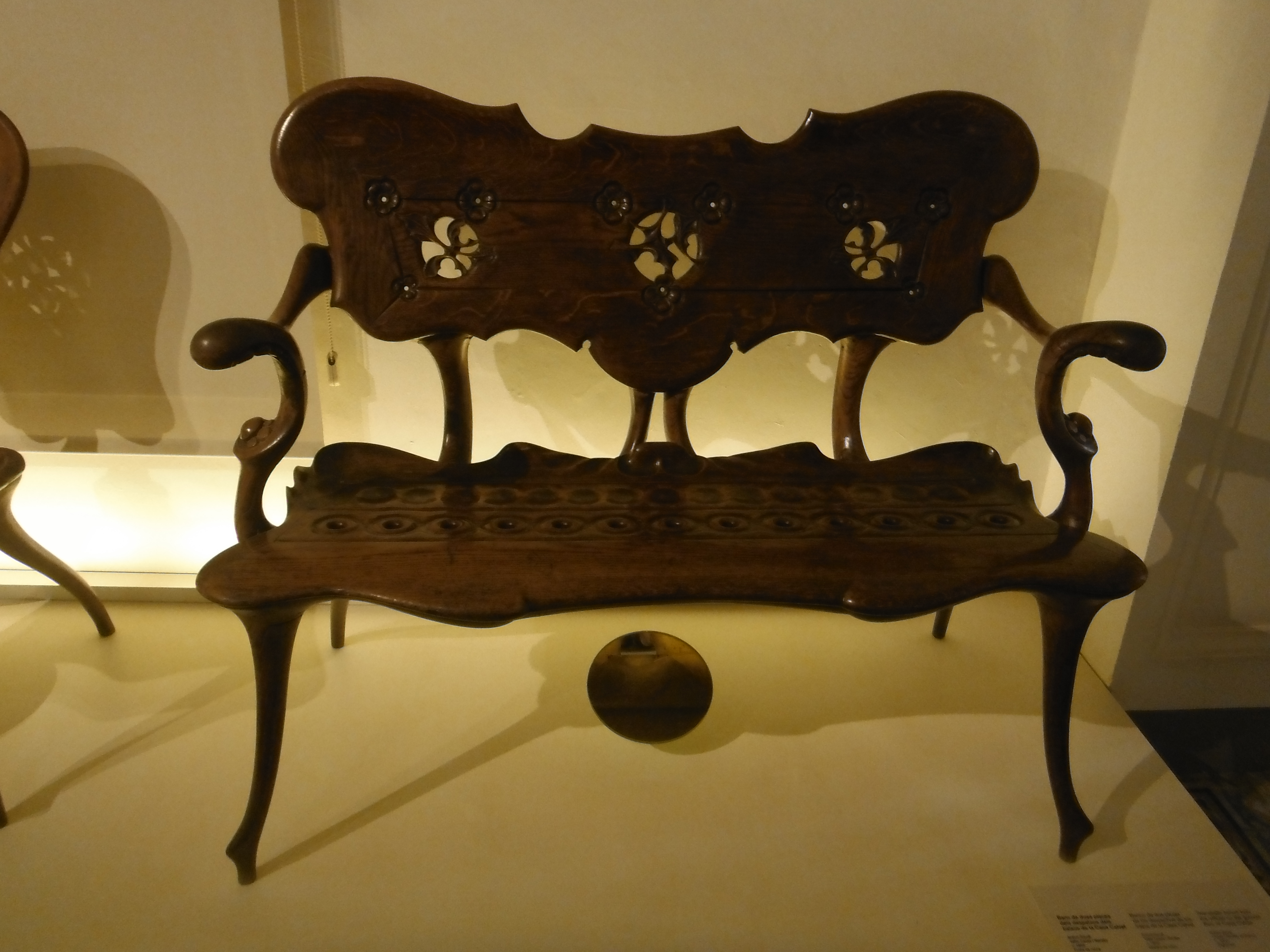 .
.
The park is beautiful, but busy. It is not peaceful, despite it being designed to be so. If the sheer numbers of people do not disconcert, then the non-native parrots in the palm trees will.
Reflections on Barcelona (2)
Day 2 – La Pedrera  Andrew Graham Dixon, a favourite art historian, produced a series called The Art of Spain back in 2010 (http://www.bbc.co.uk/programmes/b008wthr). There was no doubt for him of Gaudi’s importance, but he believes that the Sagrada Familia is being ruined by ‘Disney-like’ embellishments to the exterior. I am liable to disagree with him, and what’s more he did not actually go inside – at least for the programme – where those embellishments are
 rendered somewhat irrelevant. However, he did say that La Pedrera (above left), Gaudi’s signature apartment block, was an architectural marvel. To demonstrate this, Graham-Dixon got himself invited into an apartment occupied by a long-time resident of the block (sixty years) to witness its unique charm. Those of us who visit without a film crew have to make do with visiting the show apartment featuring period furniture and state-of-the-art gadgets such as water heaters and bidets in the bathroom (right). Like the Sagrada Familia, light dominates the design and hence functionality of the
  building. Designed for rich-ish bourgeois families, these
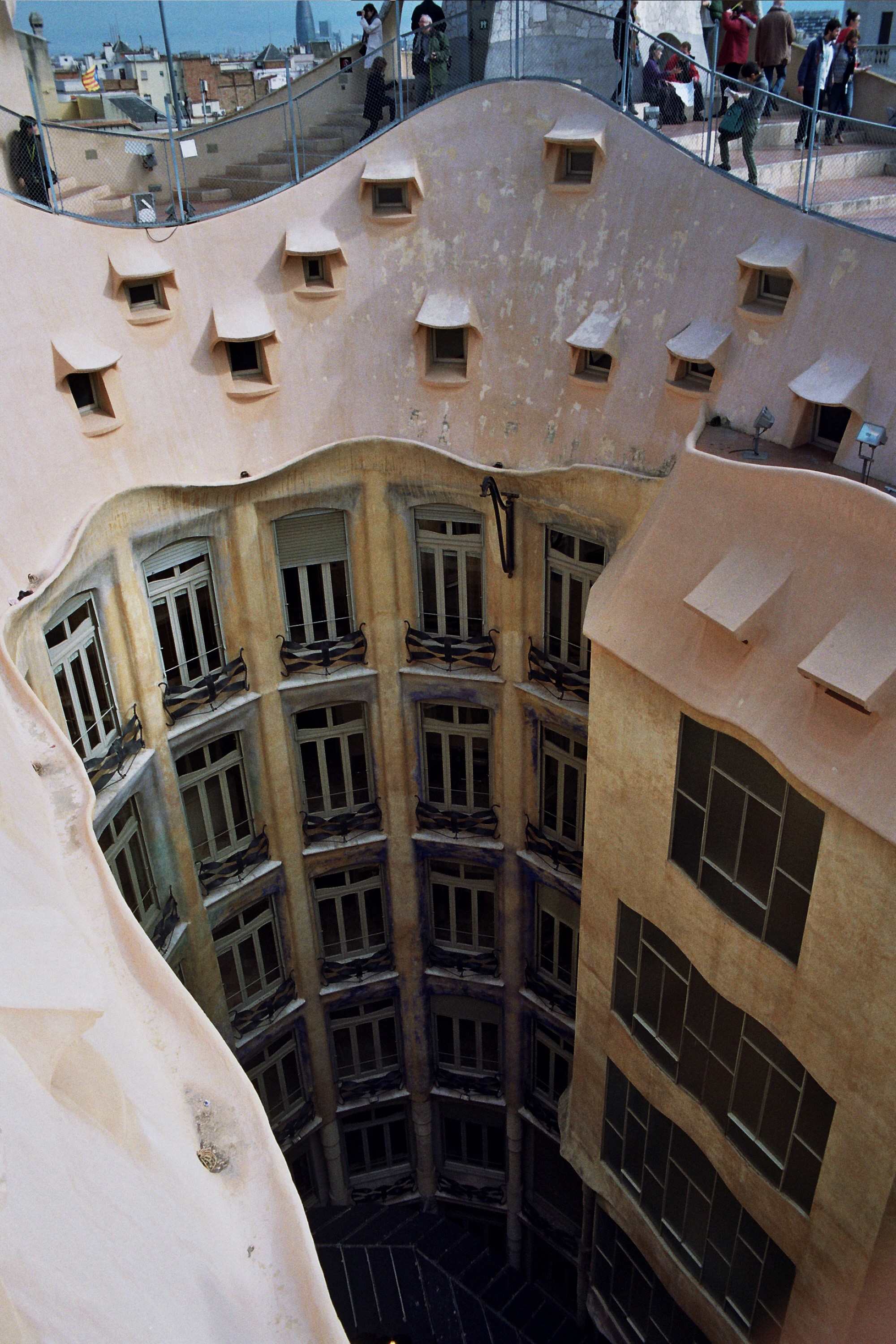
 apartments keep the childrens’ rooms to the rear away from the sun and the street leaving the study, ‘drawing room’, master bedroom and lounge bathed in sunlight. The maid’s room, kitchen (right) share an inner-courtyard view with the children (below left). The show apartment features original wooden and tiled floors, exquisite art décor lamps, curious ceiling mouldings (below right) and unique door and cupboard handles said to have a unique Gaudi ergonomy. They are themselves objects of considerable beauty (below left).
 On arrival, visitors are sent immediately to the roof. This is an extraordinary space. The view across the city is a good enough reason to go; however, Gaudi saw chimneys and ventilation shafts as opportunities to introduce sculpture to his architectural creations. The roof then becomes an exclusive sculpture park. Andrew Graham-Dixon posited that it was curious that this celibate, frugal man (who was also a vegetarian, we discovered) should adorn his roof with sculptures of phallic and other sexual forms (below left). One could argue that it is difficult to make chimneys anything other than phallic. Surely? Whatever they represent, this is a roof like no other.
 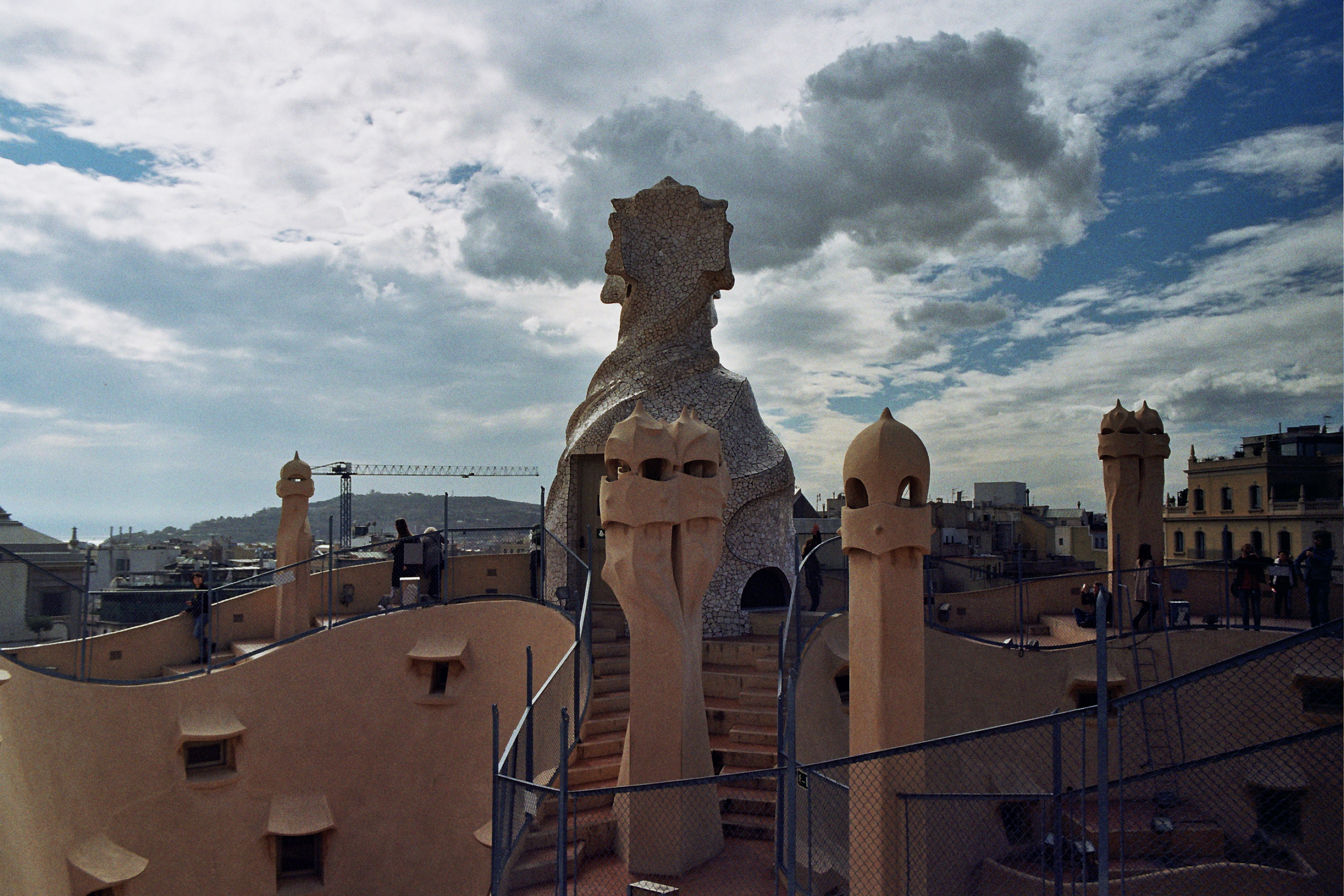 Some of the sculptures have trademark ceramic patterns, others are just plain stone (left). One then moves into the attic space (right). Originally this was the utility space for residents, but it now
 houses a wonderful exhibition detailing the history of the building, architectural influences (largely nature), method (similar to the cathedral using catenary arches) and furniture (Gaudi designed some extraordinary furniture for the apartments that were allegedly ergonomic). Day 3 – Park Güell.
Reflections on Barcelona (1)
What can one say about Barcelona? My first visit left me in awe. Ok, it was largely a Gaudi fest, but the City has many quirks that perhaps amount to the difference between an enjoyable city and a great city. First, let me say that late February is a good time to go. It is not too busy, nor is it too hot. And by definition, not too expensive. Our 3* hotel in the University district came in at under 300 Euros for 4 nights.
Day 1
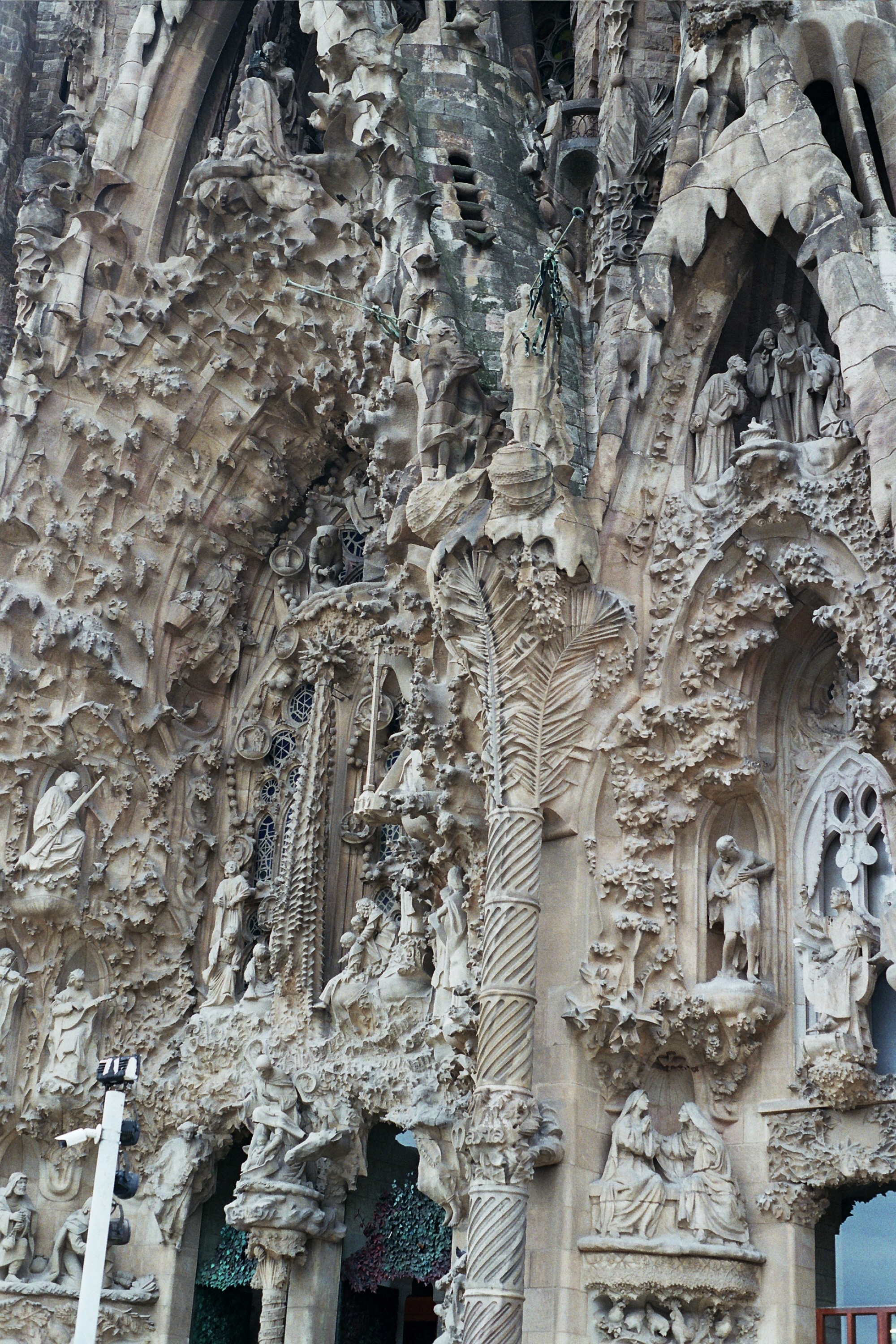 We planned a little ahead on the advice of friends. So, to visit the Gaudi UNESCO sites, booking ahead online is advisable. The Cathedral, the Sagrada Família is quite the most extraordinary unfinished building I’ve ever seen. Adopted by Antoni Gaudi in 1883, it became his life’s work where he eventually lived (in his workshop) and died (being hit by a tram immediately outside). The Nativity façade has, what Douglas Adams’ character Slartibartfarst might have called, all of those fiddly bits. The classic icons of the life of Christ in fine gothic detail (left). It took 41 years to complete. The sculptor was a friend of Gaudi’s, Lorenc Matemala. He too, like Gaudi, died a decade before completion of the façade.
The opposite side, the Passion Façade, is much more austere, and unfortunately whilst we were 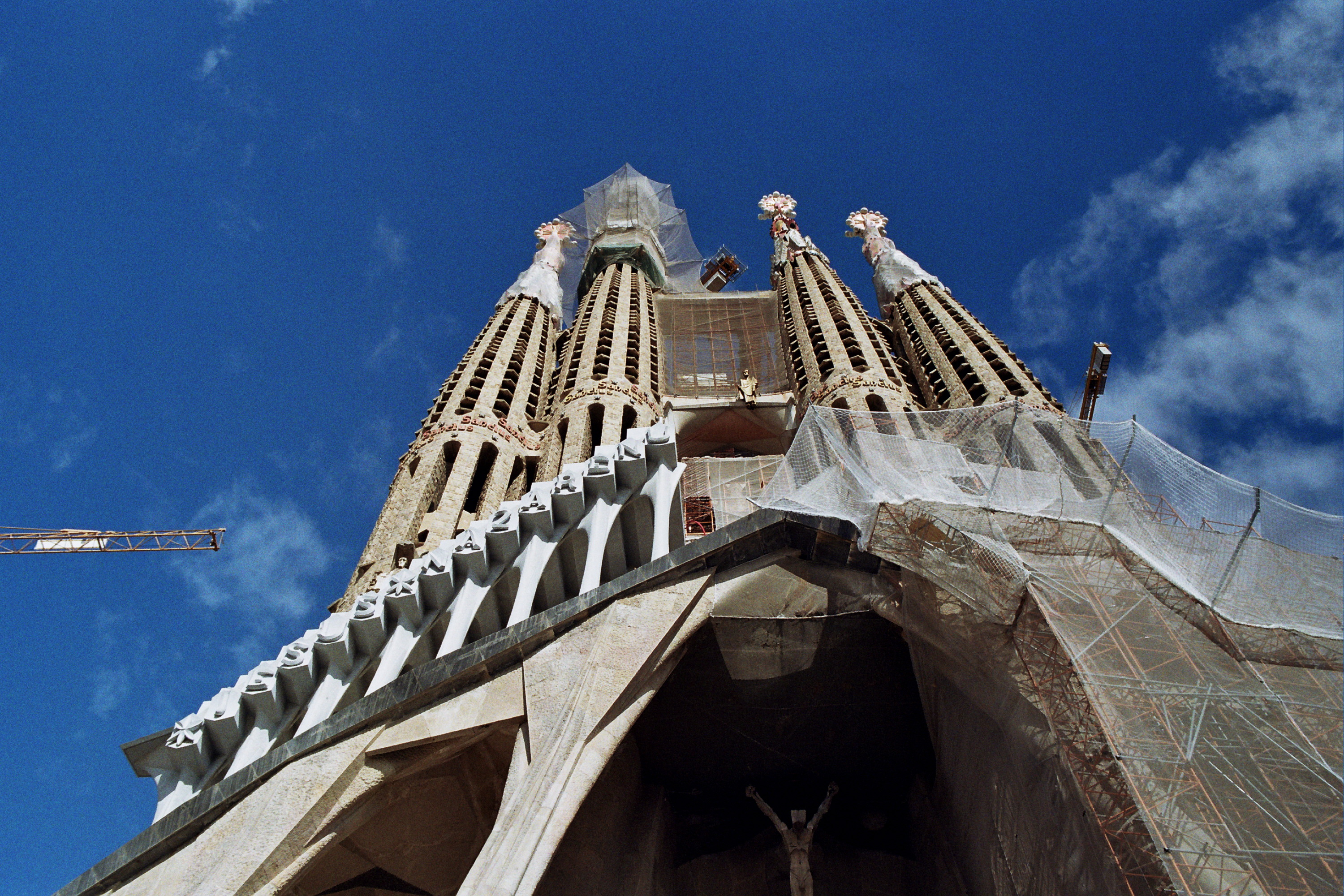 there undergoing some work rendering part of it under covers. However, it features the crucifixion in a bold cubist representation (right). It was started in 1956, 30 years after Gaudi’s death, but under his instruction! The bell-towers rise 60m or so, like wicker fences. Another bell tower is under construction to rise 100m or so. Closer to heaven, no doubt.
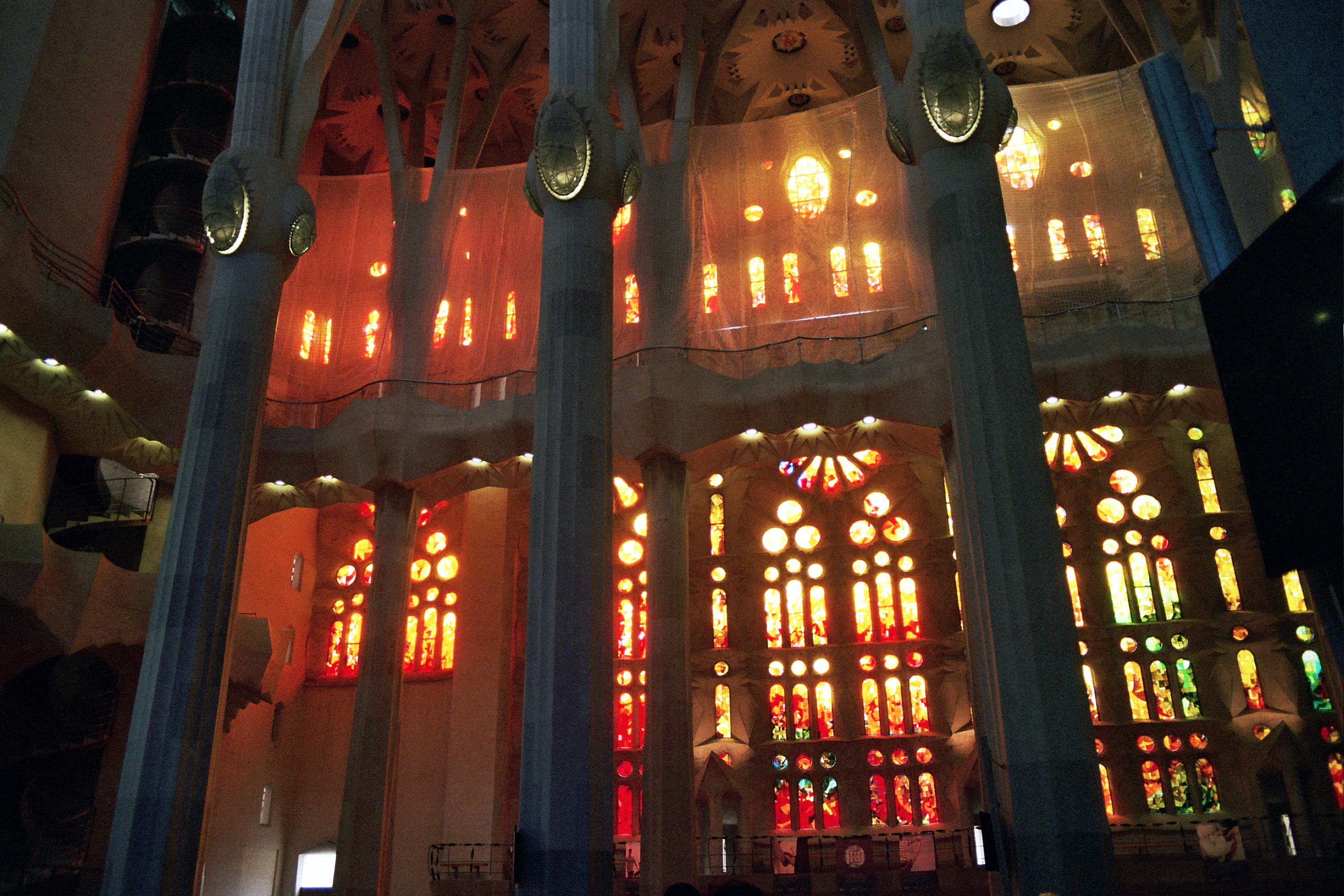 Whilst the outside is spectacular, it is in the inside where the genius is evident. The windows radiate coloured light that changes during the course of the day. Blue in the morning from the East, and red/orange in the afternoon as the sun moves to the West. The windows bear the names of the saints from across the globe. Because of this, it is a space like no other.
The pillars ape tree trunks. They are not straight, they twist as they rise. The ceiling (right) depicts the heavens like a warm forest canopy looked over by the apostles. The light from the stars draw one up.
 The cathedral is not yet complete. The next milestone is 2026 when the ‘glory gate’ will be completed. At present it is represented as a photograph with a strange angular figure over it (left).
The cathedral is paid for entirely by donation so the visitor numbers are important. However, the museum housed partially in a basement is spectacular. Here one gets a history lesson, exposure to many of Gaudi’s models – he was a prolific model maker – and get to understand his innovative architectural methods. His buildings generally are defined in terms of catenary arches. These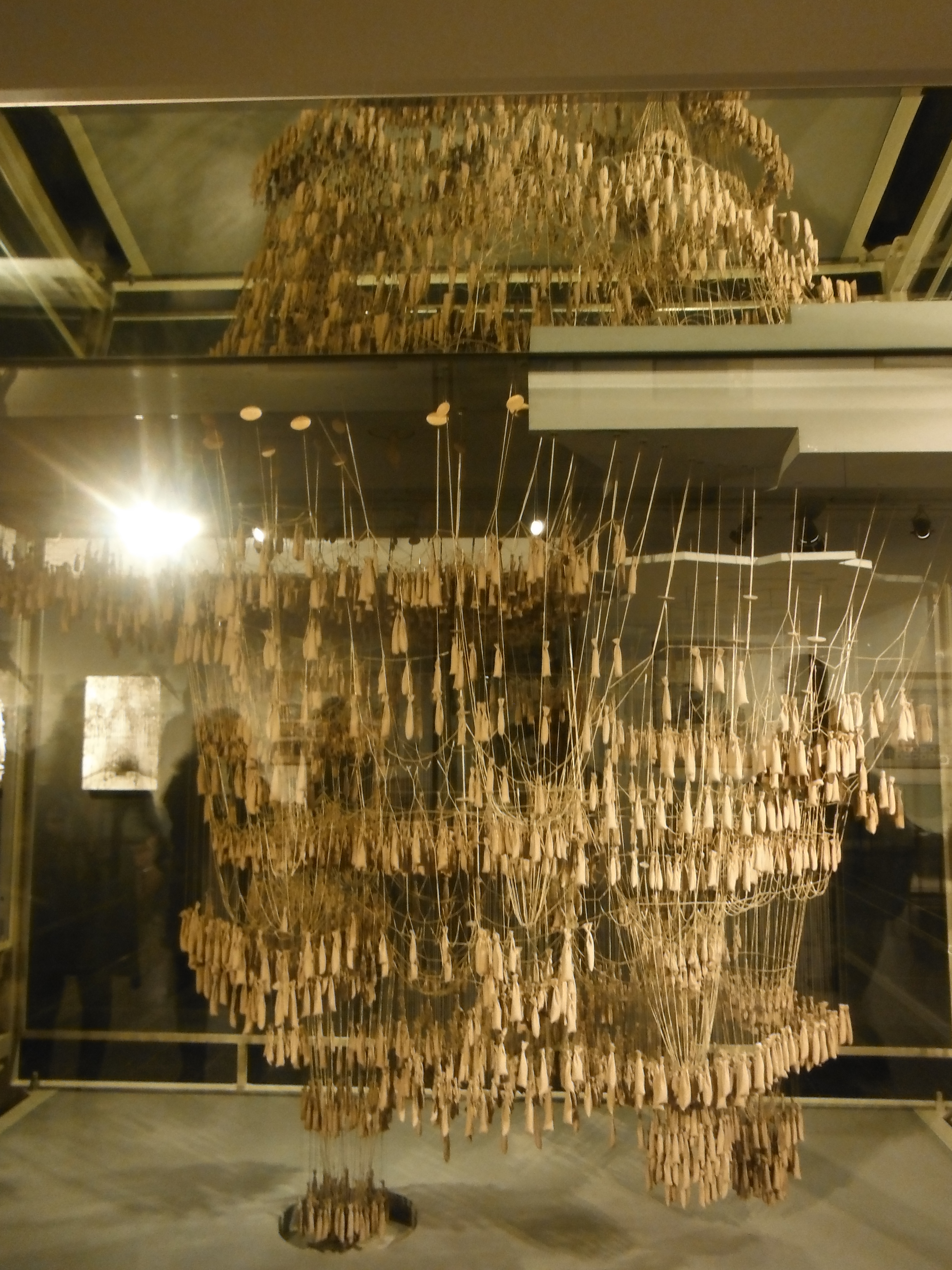 days, computers do the calculating, but for Gaudi, his method involved strings and tiny lead weights. The strings suspended from above are pulled by the weights. The strings then naturally create strong arches that can be incorporated into the building. It took ten years, apparently, to get the tensions right.The method is demonstrated in the museum, and a mirror allows one to see what the exterior would look like (right). All you have to do is invert the model. Ingenious.
L&M go green. Literally
 Not a great picture taken across a railway line at day break, but this poster is the only thing that appears green at the minute in Munich. L&M battle it out across that railway line with Pall Mall and Marlboro. Strapline rather curious: cigarettes for purists and delicious. In a way that asbestos in buildings is for purist architects, no doubt. Tödlich, as they say.
Petty people
There is a pub adjacent to the office I used to work in on the campus of the University of Sussex, England, that had more “do not…” signs on the wall than it had items on its food menu. I was waiting for the sign that would say “do not come in if you do not like ‘do not…’ signs”. But essentially, it was already there, I suppose.
One person who was not offended by the signs told me that he liked the pub because the barman – the owner – was able to calculate the bill in his head! Others told me just to ignore them. I was an infrequent visitor, in any case.
 Here is an example of a series of friendly signs by someone in Hove, UK. They are laminated, as well, so the author has invested quite a bit in making clear his/her preferences. Though the technology clearly does not help with the grammar.
My response: I’ll park in your driveway and dump my rubbish on your front door.
Avoiding tax avoiders
 The UK Labour Party is under pressure, apparently, because big business is not endorsing tax policies. The most recent criticism has come from Stefano Pessina (left) the boss of Boots, the iconic British pharmacy-cum-drug store. Boots was founded in Nottingham, England, in 1849. It is now privately owned and has its headquarters is in Zug, Switzerland, to avoid UK corporation tax.
Now out of the woodwork are the fickle Simon Woodroffe, he of Yo! Sushi fame, who has funded both Labour and the Conservatives simultaneously just to hedge his bets, and Charles Dunstone, founder of Carphone Warehouse, now part of the Dixons empire. Both of these supported Labour under Blair. Arguably, Labour under Blair was conservative, and hence not a risk. Actually it would have been a risk not to support them in the run up to the 1997 election. Even Murdoch did that.
Labour under Miliband has targeted inequality as a key economic factor much to the chagrin of so-called ‘business leaders’ who took us in to recession and are unwilling to contribute to the state infrastructure that enables them to trade in the country safely and predictably.
Enter Price Waterhouse Coopers (PwC) the accountancy firm has been chastised by the UK Parliament’s Public Accounts Committee, Chaired by Margaret Hodge, for its speciality in advising firms on tax avoidance strategies on an ‘industrial scale’. Denied, of course.
Which other firms offend? We know well about Starbucks, Facebook, Top Shop, Amazon, Google, Apple and Virgin. That said, it is ok for Richard Branson because he is a philanthropist. Maybe we can define a philanthropist as someone who gives away part of their fortune to rectify the ills caused by their own business practices?
Other tax avoiding firms include: Dyson and Wolseley UK, owners of Plumb, Pipe, etc, Centers.
Celebrities have always moaned about tax. Michael Caine went off to the US, albeit when tax rates were somewhat higher than they are today (but even then, the high rate was a marginal rate). Unfortunately, Paul Daniels did not go when he threatened to back in the 1990s, let us hope that the likes of Griff Rhys Jones and Ray Winstone do leave as they threaten. Gary Barlow, Anne Robinson, the Arctic Monkeys, Katie Melula, George Michael and comedian, Jimmy Carr (I could go on) have all been exposed as intentional tax avoiders.
Picture: Stefano Pessina – Alliance Boots, available through Wikipedia
Pall Mall and mature couples
 Is this the new Pall Mall couple? The ageing hipster with his oh-so stylish beard. The 30 something woman with perfect teeth and nail-barred fingers wonderfully hosting a newly lit cigarette. And the strapline? Erm…more is not enough for us?
Is death not enough?
Syriza and the Greek response to austerity
Filed under: Finance and Economics, International, Politics |
Leave a comment Increasingly, it is clear that globalisation has globalised wealth in the hands of a number of elites – from  oligarchs in Russia, bankers in the UK and land speculators in Bombay. When the crash came in 2008, the perpetrators – the financial services elites – ‘hoovered’ up the public money pumped into the system to obviate a capitalist meltdown. No one went to jail; but Europe’s people were handed down a dose of austerity in return for their support. What is perplexing is how any sane policy-maker can sustain an argument that austerity helps declining economies. In Greece, for example, something in the order of 70 per cent of the country’s under 25s are unemployed. They are neither economically active nor productive. In the UK, unemployment goes down not because the economy is growing and the demand for labour is increasing; rather because people are taking zero-hour jobs or, indeed, taking jobs for an hour through ‘freelancer’ websites. Or, most disturbingly, if unskilled – at the unconnected end of the labour market – ads in supermarkets and shop windows.
Syriza’s victory in the Greek general election last week represents something positive. It is populist, but from the left rather than the right. The rhetoric is one of alternative, fairness and equality. It is a David and Goliath story in the making. The new Greek Prime minister, Alexis Tsipras (left), takes his secular oath, appoints radicals to his government (such as Yanis Varoufakis as Finance Minister), halts privatisations, reappoints the cleaners who were sacked from their jobs in the finance ministry, initiates tax reform and targets corruption. They have even put up all of the ministerial BMWs up for sale.
https://twitter.com/Oireachtas_RX/status/561578575057666048
We learn that the first port of call is not the IMF, the European Commission or even the German government in Berlin, rather opposition parties in Italy and Spain – next up on Europe’s election merry-go-round. I wait and see what happens, but there is optimism about Europe’s prospects and the rightness of Syriza’s approach to the crippling debt that they have inherited. I trust the elites do not share my optimism.
Flag: Fry1989, Wikipedia
Photo:
 Be informed