Author Archive
Privatisation watch: the lingua franca (2)
Filed under: Politics, Privatisation | Tags: child protection privatisation
 Leave a comment
  Plans to privatise child protection services in the UK have been revealed. The proposal in a leaked document is for the Department for Education to allow local authorities – councils – to outsource children’s services. These powers include making decision to remove children from their families.
Private providers, reports the Guardian newspaper this morning, “will allow authorities to ‘harness third-party expertise’ and ‘stimulate new approaches to securing improvements’ for safeguarding services outside ‘traditional hierarchies’…”. Ah yes, there is that ‘expertise’ again. Along with securing…improvements and replacing ‘traditional hierarchies’ with presumably non-traditional private hierarchies.
On an interview on Radio 4 earlier, the word ‘innovation’ was used by a defender of the proposal. Again, only the private sector can innovate. G4S, one of the innovation-led private sector companies thought to be lobbying for this market to be opened up, has innovated in not providing security for the Olympics and overcharging for its offender tagging services. Actually making up some tagged offenders. Another company, Serco, innovated in manipulating figures showing it had met targets in outsourcing family doctor services. Let’s also talk about Atos which in March this year pulled out of its £500m capability assessment contract after evidence of widespread incorrect ‘judgements’ on claimants’ fitness-for-work, leaving many without benefits.
Picture: politicalscrapbook.net
Privatisation watch: the lingua franca
 For what is it worth, here are the phrases that justify the privatisation of public assets. Fill the gaps with the name of the organisation/agency earmarked for treatment:
The objective is to: “protect and enhance its [***] scientific capabilities in the long term” – Owen Patterson, UK Environment Minister on the proposed sale of the Food and Environment Research Agency.
It always seems to be the case that public agencies lack expertise, such that “[p]rocuring the right external partner, with the necessary commercial expertise and experience will help [***] to maximise its market potential and grow its non-government revenue”.
Let’s not forget the career prospects for the employees, should critics ask: “I am also confident that a joint venture would offer new opportunities to [***] staff.” That is reassuring from Owen Patterson.
And of course, according to Vince Cable, the Business Secretary talking of the privatisation of the Royal Mail last year, share ownership “energise[s] everyone … allowing employers and employees to share in the company’s future success”. My post is usually delivered by a man who looks newly energised. I’m sure he is also energised by the fact that 6 ‘priority’ investors made £750m out of the sale of shares on the first day of trading. But as Mr Cable told a select committee of the UK Parliament, “that is the market”.
Politicians and increasingly civil servants always tell us not to worry because: “[we] would only take forward specific measures where there was a clear public benefit and subject to suitable safeguards.” (official statement from UK Revenue and Customs regarding the sale of ‘anonymised’ tax data).
More to follow.
Privatisation watch – Land Registry
 After yesterday’s post on railways, I’ve concluded that the present British Government is again engaged in a scorched-earth policy of selling the remaining state assets to corporate interests in anticipation of losing the next election whilst ensuring, as the Thatcher/Major Governments did before them, that a subsequent Labour Government (if it is to be such) cannot reverse the transfers.
Next on the list – reported today in the Guardian newspaper – is the Land Registry. The land registry is the state body that records ownership of land and its value. It also adjudicates on disputes. Its clients are conveyancers (Law Society) and mortgage providers (Council of Mortgage Lenders).
In terms of financial performance, justification for privatisation is not based on improvement. According to the Guardian, “…it made a surplus of £98.7m in 2012-13, up from £86.1m the previous year, while revenue slipped by 3% to £347m.” Likewise with customer satisfaction, seemingly, very high. This translates into an estimation of its value as £1.225bn.
In order to get round the conflict of interest that may arise from a private company adjudicating on disputes, the Government plans to set up an “Office of the Chief Land Registrar” to manage this part of the portfolio. I’m reassured.
Rail nationalisation – think it through
 I woke up yesterday morning to a news story that 30 or so candidates for the Labour Party in the UK are arguing for a partial nationalisation of the railways in line with Ed Miliband’s indication that a new Labour Government would seek not just to ‘run’ the country but to ‘change’ it. In order to avoid paying compensation to incumbent franchise owners, franchise contracts will simply not be re-let when existing contracts expire. The East Coast franchise, they argue, having been run by DOP (a public-sector company) for four-and-a-half years after it was abandoned by National Express after failing to meet targets, has been a ‘success’. There is a better way to run the railways, seemingly. And one that will see a reduction in ticket prices.
Let us just examine this in a shade more detail.
First, what is success? DOP delivered returns to the Treasury (£208.1m last year according a Guardian Newspaper report, 26 October 2013), but did not match the National Express contract commitments; not least because they were flawed. Though customer satisfaction levels were, it seems, at a record high (2-3 percentage point higher than the Intercity averages).
Second, the railway is a capital intensive: infrastructure (already in the public sector as Network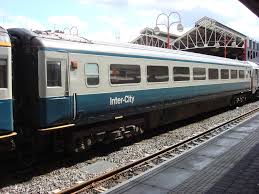 Rail) and rolling stock (trains – all privately owned by Angel Trains; Porterbrook; Eversholt Rail Group and QW Rail Leasing).
The Franchises own virtually nothing over and above a few ticket machines. The costs, therefore, are largely fixed. They pay track access charges (to Network Rail) and rental charges (to one of three rolling stock leasing companies). The profit comes from a margin between fares, subsidy and operating efficiency.
Should the franchises be transferred to the public sector, those costs will not change significantly. Certainly not significantly enough to see a reduction in ticket prices.
 Third, under the present structure of the transport industry, who benefits from reduced ticket prices? The unfortunate reality is that the main beneficiaries are the relatively wealthy middle classes. The routes in the South East of England – in and out of London – attract the most attention for this reason. Also because the routes encompass some of the most sensitive electoral constituencies. And richest. The least wealthy areas, even in London, do not enjoy links with either the national rail network or the Underground. Actually, these areas are much more dependent on buses than trains. On that basis, it makes much more sense to nationalise the bus industry than the railway industry.
Now I am not arguing against nationalisation. It is clear in the years before privatisation, the railway industry was efficiently managed. Privatisation was at best a scorched-earth policy by the outgoing Major Government and, at worst, asset stripping by foreign and national ‘operators’. Any nationalisation programme will need to find a way to bring back all of the assets, including the rolling stock, back into public ownership.
 However, the issue is not about the ownership of the railways, rather transport policy more generally. What are the railways for and how do they link into the provision of mobility ‘rights’ for citizens, by whatever mode? And what is that worth in terms of transfer payments from the taxpayer to operators whether public or private? Let us not also forget the role of public transport in meeting environmental protection targets, such as CO2 emissions. It is cheaper, in many cases, to use private motor vehicles, particularly over longer distances.
Then there is the question of demographics. So much public money goes into servicing passengers in the South East of England because of the London effect. Government policy surely has to consider equalising wealth and opportunities across the country rather than concentrating it in the Capital which perverts demand for transport services.
In essence, then, a radical policy is not about the ownership of a few railway franchises. A radical policy requires new thinking about transport, its function, value and impact on other policy domains such as housing and economic development (beyond the capital).
Picture:
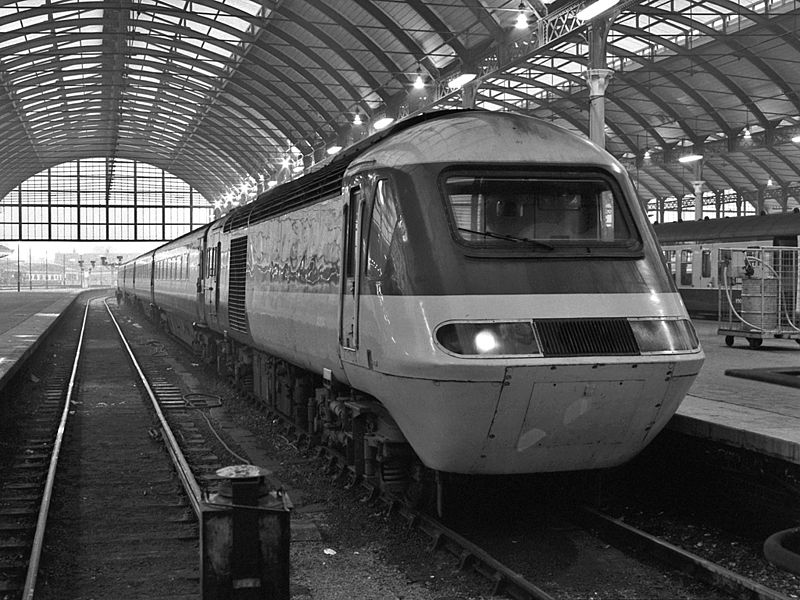
InterCity coach and 125 in Hull Paragon Station: Oxyman/Wikipedia
Nationalisation graphic, Bring back British Rail: http://www.bringbackbritishrail.org/news/page/2/
The Pall Mall couple
 Pall Mall’s spring advertising campaign goes into overdrive with the Pall Mall couple. (see posts 18/19 April) What is unusual about this campaign poster – in contrast to the others – is its lack of subtly. Here we have a young couple with intent. They share the source of ignition. Those cigarettes will be lit and smoked. And what’s more, there’s plenty more where they came from. Packs now have 30 sticks full of toxic chemicals. All for 7 Euros.
There is a certain double meaning – the strapline translates as ‘the taste victory’. I suspect the brand owners view this as a pact for life by the couple. There is no accounting for taste.
What is going on at the Co-operative?
 When I was growing up there was the local Hull Co-operative Society with its flagship department store (left) in the centre of the City. Local supermarkets were dotted around the suburbs. All rewarded customers with dividend stamps. My grandmother collected them – I built a record collection out of them. The insurance company functioned through agents. As a family, we had various policies. There was even a soft drinks delivery service. The ‘pop man’ ca
 me on a Monday and delivered a bottle of something chosen by my mother.
The Hull Society basically collapsed in the early 80s. The department store closed leaving a building to fall into dereliction. The supermarkets also closed.
My time in South Yorkshire was punctuated by visits to department stores in Barnsley. And in 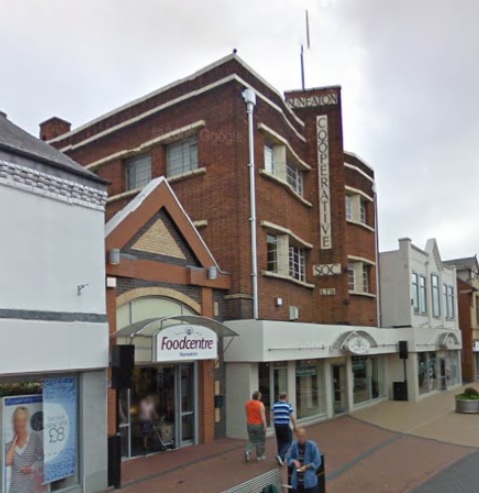 Norwich, the East of England Society plodded on. Not so good in Brighton where the department store closed a few years ago. The shop was eccentric. Land in Brighton, however, is highly prized. The empty shop has not lingered too long. The façade has been retained with student accommodation being built on the land. From what I can see, the most powerful regional society, The Heart of England, still manages department stores. For example in Nuneaton (above left).
It has often been quite difficult to be with the Co-operative. The food shops were always lacking something. The bank, despite its ethical mission, ripped off savers. I left. When I bought a van, the insurance company was one of the few that would insure van as a non-commercial vehicle, but I still needed the endorsement of the agent. A bit of a nuisance.
The Co-operative’s difference was its ownership and management structure. It is notionally owned by the members (I am a member, though clearly insufficiently active) and managed by them. To quote John Harris in the Guardian, “At the base are around 48 area committees, each with 10 to 12 elected members who put in three-year terms. These people, in turn, elect seven regional boards – which duly elect 15 of the 21 members of the national group’s board of directors. Of the remaining six, five come from big regional Co-ops, and there is also an independent director.” (http://tinyurl.com/n3yjznb) In recent years, the governance structure has failed.
 There seems to be something about size. In 2002 retail and wholesale were merged and housed in a hubristic new HQ in Manchester (left). Growth had traditionally been organic – from within rather than by acquisition. Both the bank and the supermarkets seem to have cast that principle aside. The bank failed its due diligence on buying the Britannia Building Society. Had someone looked closely they would have seen ‘sub-prime’ bad debts and walked away. So far the bank has been bailed out to the sum of £1.5bn with another £400m needed. It is now 70 per cent owned by hedge funds and private equity.
The supermarket in 2009 financed a takeover of the failed Somerfield supermarket chain. Somerfield had been a basket case for many years, but for some reason the Co-operative’s chief executive, Peter Marks (right), convinced the board that speedy expansion was necessary and a takeover of Somerfield the right vehicle. The Somerfield assets have been written down by over £260m and a percentage will be sold.
Last week the Co-operative announced a loss of £2.5bn. Whilst the bank claims a good part of that, the other parts of the group are also ‘underperforming’. Turning this around is not going to be easy. I for one am not convinced that it will survive as an entity. Some of the more influential local societies such as the Heart of England Society have rejected such a plan put forward by Paul Mynors, now himself resigned from the Board. The AGM on 17 May 2014 will be one to watch.
Ironically, the analogue for the Co-operative, the John Lewis Partnership, is built on department stores and food retailing. Its management structure is very different. It is run as a PLC with the employees, as partners and members, sharing in the profits rather than managing the generation of profits.
Picture credits
Hull store: http://hullvalley.blogspot.co.uk/2011_10_01_archive.html
Stamps: http://150.co-operative.coop/150-to-150/our-collegues-113
Peter Marks: http://en.loadtr.com/Peter_Marks-493978.htm
Co-op HQ: Walter Menzies

Pall Mall und Frauen
 Five women spend time together outside in the sunshine. One reclines on a chaise loungue with a cigarette reading a magazine. The other four seem to be in conversation. One wonders if there is a relationship between the lone woman with cigarette and the others. Has she been isolated? The others seem to prefer water or nothing.
This particular Pall Mall product has a mild taste, whatever that is. But clearly it reflects the moment. Presumably, if they were doing something more edgy, they may choose a minty one (see post 18 April 2014)?
Pall Mall gets minty
 How refreshing. Cold water and minty cigarettes. Pall Mall leads the way.
It takes a devoted woman to relish being sprayed with water, not only damaging her new leather jacket, but that cigarette is not going to light after this. At a fiver a pack, that’s at least 25c down the drain. And if the full packet is in a pocket, even more. Not forgetting the matches.
Working with a professional chef
The birthday of my beloved, Ilonka, demanded this year a special celebration. Friends, family and others were invited to the house for music (a piece of Cabaret – Rotraut Arnold; a four-piece jazzy ensemble – Vobbs, and a violin duet – Alex and Daniella) and food.
The food needed to be good for some of Bayern’s most sceptical carnivorous palates. We bought the recipe book from our favourite restaurant in Brighton, Terre-a-Terre and proceeded to convert the words and pictures into the real thing. We employed the services of a professional chef, Jana Bezold, to help manage the process. Her sheer food and team management skills were invaluable.
 Anyone familiar with Terre-a-Terre knows only too well the complexity of the menu, ingredients and jiggery-pokery needed to pull off each dish. The dishes are the work of creative chefs who primarily understand vegetarian food and take risks to create the unexpected by mixing textures, flavours and colours. Ultimately, one goes to a restaurant to eat food that is not so easy to make at home. This was our challenge: to convince 50 guests from different backgrounds, of various ages and tastes feel they are having a memorable food experience.
It took us over four hours to buy the ingredients from three shops. The ingredients ranged from potatoes to powdered mango, Papaya to Peanuts and pickled ginger. We opted for a couple of utility dishes, vegetable lasagne and spinach pie, not least because we had some children visiting who are not so adventurous and forgiving.
So, on the menu was: Chana Chaat, minty mushy peas (on toast), rice paper blankets (filled with salad), rice noodle salad, marinated tofu kebabs, samosas, quinoa and beetroot salad, aubergine parcels.
Our chef, Jana Berzold trained in one of Munich’s traditional Gaste Houses. Very meaty, very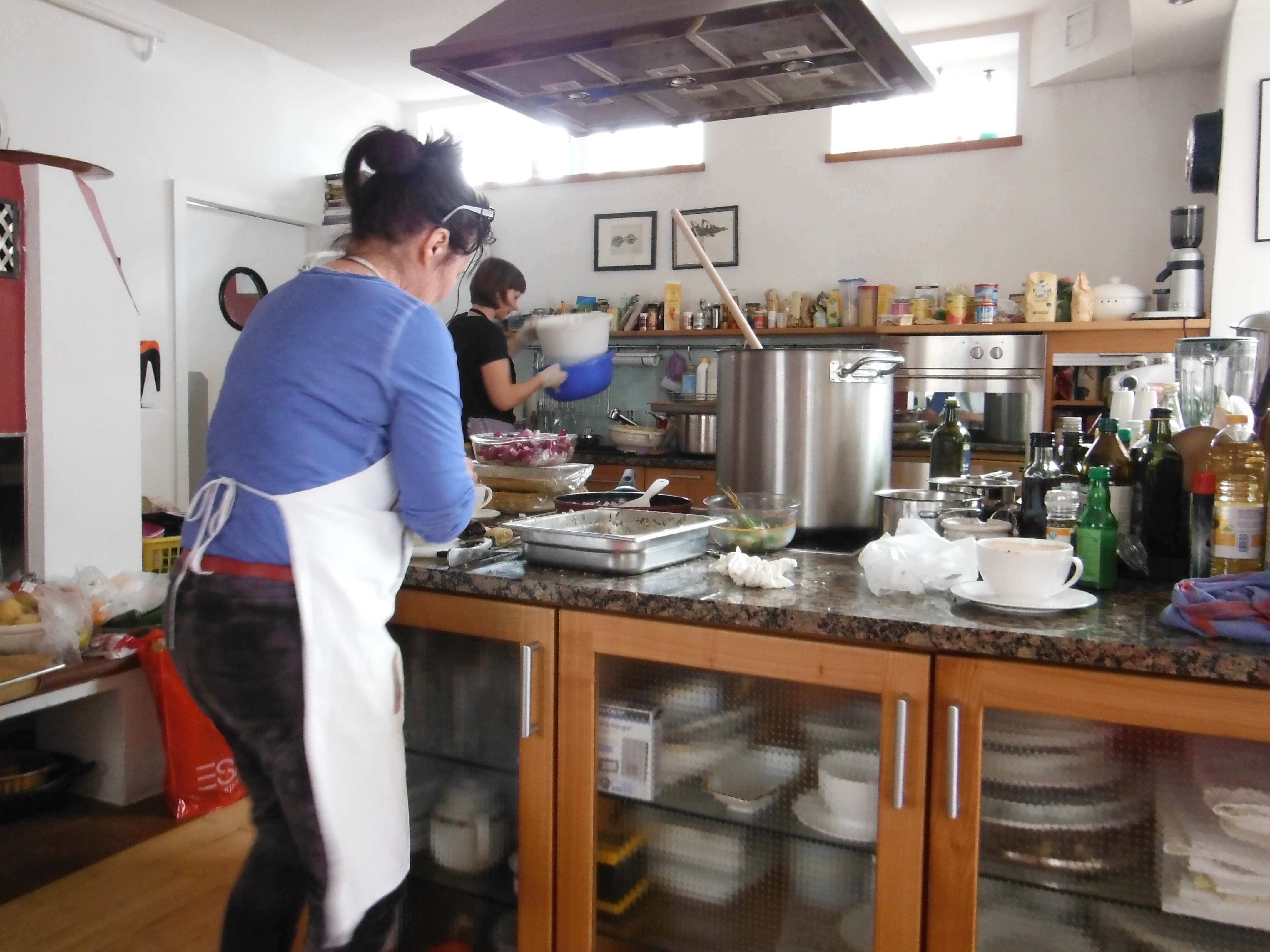 hectic. She then graduated to a Michelin starred restaurant in the city. She now works at a vegetarian café/restaurant in the city called Gratitude (http://www.gratitude-restaurant.de/). She worked through our menu and visited the kitchen to check that it was suitably equipped. She fielded our questions about ingredients as we struggled to identify and differentiate all that we needed. And then she turned up at 0830 on the morning of the event ready to cook.
Not all was in order, I sensed. She arrived with a box of own utensils, bowls and pans. Of particular importance were knives. Sharpe knives. It is a bit of a cliché, but our knives just were not up to the job. Onions do not get rapidly cut, sliced or diced with a blade anything less than razor sharp. Lesson one.
I also sensed that the training delivers a competence beyond reading recipes. The authors of the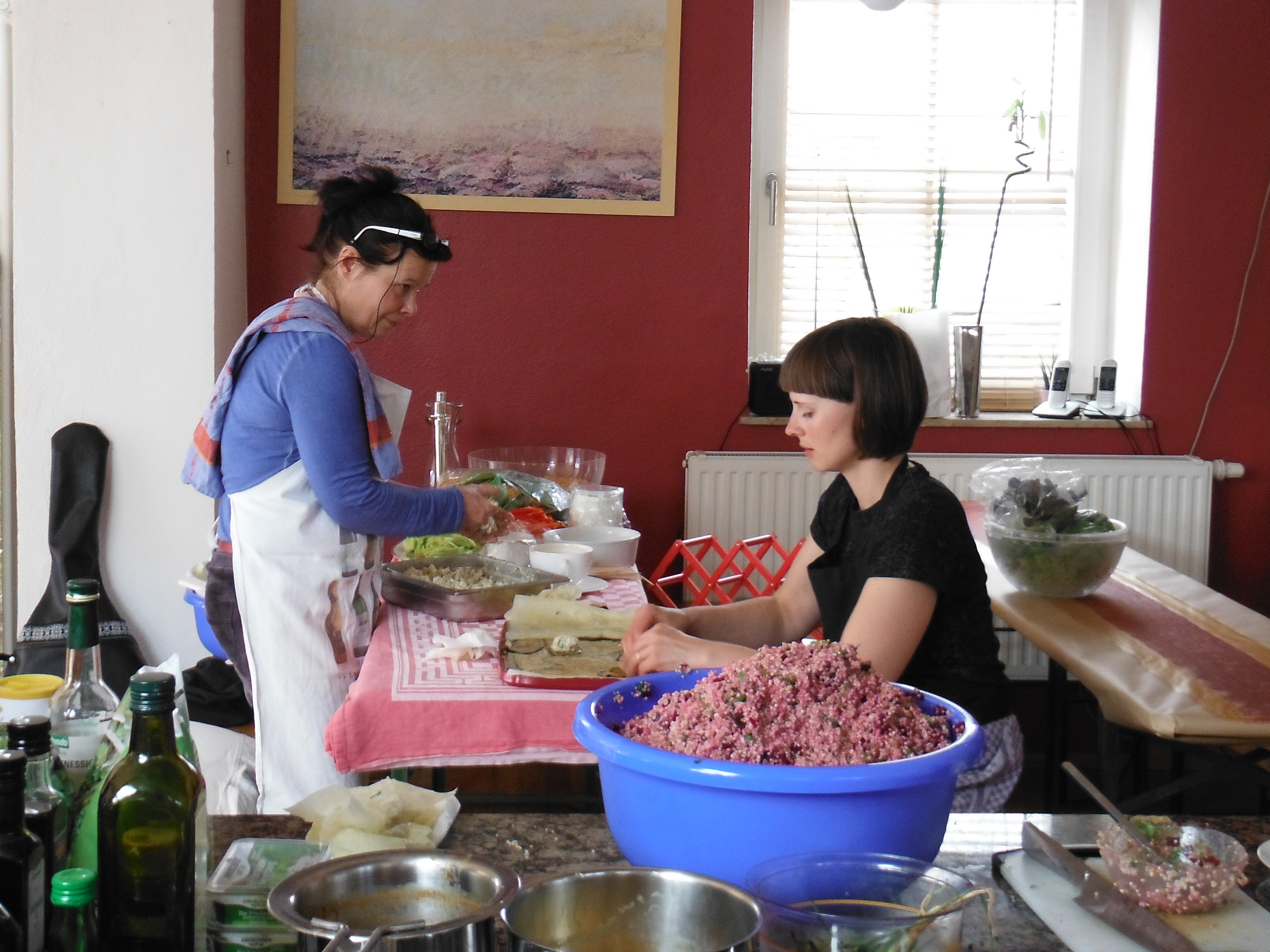 recipe book note in the introduction that they were reluctant to publish the recipes because the alchemy required to make them work requires a skill that most amateurs do not have. We had the alchemist. She instinctively knew the balance of ingredients, herbs and spices. Taste is everything. If it does not taste right – or even taste, as was the case with the rice noodle salad – then add…something. It is that something that eludes many of us. Lesson two.
Cooking is a team pursuit. And most in the team are kitchen assistants who take orders from the authority figure. Some TV chefs thrive on authority derived from fear. Jena demonstrated a more subtle authority. She inspired participation. The opportunity and willingness to learn demonstrated by the passing helpers was derived absolutely from Jena’s sense of mission. Lesson three.
When it came to serving, the snack food on arrival was appreciated not least because it was late in the day. Guests were actually hungry. More than nibbles, less than a main course. Colour. Also, when there are a variety of unfamiliar dishes, guests like to try them all. Rightly so. And finally, it seems wholly appropriate to ask guests to bring dessert. Desserts are utilitarian – everyone can do dessert, whether it be a cheese selection, cheesecake or pralines. And certainly we were not let down. The array was impressive. And again, everything had to be tried.
A final Observation, seating. Guests do like to sit down and talk. We hired and borrowed benches and tables. These were decorated and well used, I suspect also that guests stayed longer because eating was not so hurried. And clearing was also easier.
For the labourers like myself, the enjoyment came from seeing guests relaxing, experimenting and anticipating what was next. There was enough to see off even the most seasoned partygoer.
Lucky Strike’s ever curious campaign
![download_20140413_221610[1]](https://weiterzugehen.net/wp-content/uploads/2014/04/download_20140413_2216101.jpg) Lucky Strike’s approach to marketing its products in Germany is as curious as any. Take a statement, cut out some superfluous words (by putting a line through them so as not to render them illegible) and celebrate the outcome.
Lucky Strike’s approach to marketing its products in Germany is as curious as any. Take a statement, cut out some superfluous words (by putting a line through them so as not to render them illegible) and celebrate the outcome.
So the latest one – excuse the poor picture, but I take them, or ask others to take them when spotted – goes from zweifel, dass die anders schmecken? (doubt the difference in taste?) to zwei die anders schmecken (two that are different in taste). From a question to a statement. How clever.
See earlier post: 15 June 2013
 Be informed