Archive for the ‘global-warming’ Tag
William Nordhaus’legacy
Filed under: Environment | Tags: climate, climate change, Climate economics, CoP31, DICE, environment, Genevieve Guenther, global-warming, sustainability, William Nordhaus
 Leave a comment
Nobel Laureate, William Nordhaus died on 30 October 2026 at the age of 85. He remained to his death a Yale professor seemingly packing out lecture halls. Not surprisingly the Economist (7 November 2026) lauds him and his economics as a “triumph of pragmatism” that curiously produced “numbers that were useful” Usefulness came at a cost of precision, but he is forgiven for that.
I think it is fair to say that, despite what the Economist says, most progressives engaged in climate change scholarship – natural scientists, social scientists including economists and those from the humanities are more on the side of the British economist, Nicholas Stern, Nordhaus’ nemesis on the case for valuing the lives of those in the future a little bit more and respecting the science. Nordhaus makes the case for adapting to 3 degrees Celsius of warming (around the year 2100). We are confident that such temperatures are not tolerable and that civilisation will be challenged by such increases.
His work was picked up by policymakers because, essentially, it makes the case for business-as-usual. With numbers and equations and the maintenance of GDP as the main measure of welfare. What is more, DICE makes clear that rising temperatures will only have a marginal impact on GDP, 2 per cent, for example, for an increase of 3 degrees Celsius. That can be offset by more growth, bizarrely.
At this point I defer to the work of Genevieve Guenther and her book, The Language of Politics: Fossil fuel propaganda and how to fight it (2025). In this book she devotes nine pages to his notoriety. She credits him with almost inventing climate economics on the publication of his Dynamic Integrated Climate Economy model (DICE). That is as far as the credits go. Nordhaus published his work just at the right time when the United Nations, on establishing the Framework Convention on Climate Change, was looking for something to work with. DICE was it. Nordhaus cautions against too rapid decarbonisation because that could render capital unproductive. Capital should be deployed against climate change only when it becomes urgent. In the meantime capital should continued to be invested productively and in ways that rewards investors today. The growth driver will remain, largely, fossil fuels.
It seems that Nordhaus’ could not see that productivity will be impacted (already is) by heat, extreme weather, flood and desertification. Guenther notes that Hurricane Harvey in 2017, intensified 15 per cent by global warming (at just over 1 degree Celsius of warming) that hit Texas and Louisiana had a greater impact on GDP than Nordhaus’ model predicts and that was below 1.5 degrees Celsius of warming. Whether on his death, policymakers will revisit DICE remains to be seen. With CoP31 starting imminently (November 2026) we will get a flavour of his longevity.
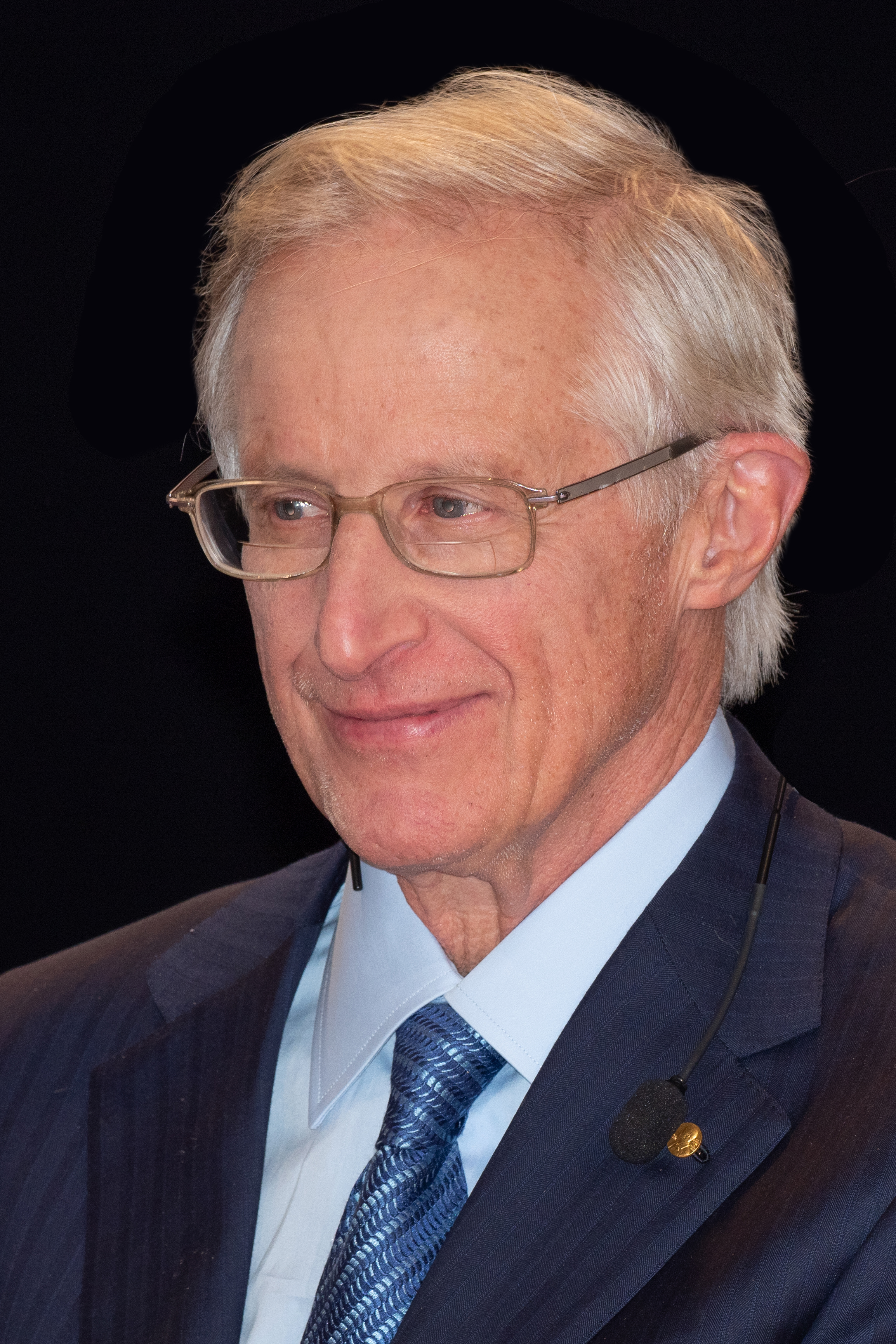
Photo of William Nordhaus: By Bengt Nyman – Flickr, CC BY 2.0, https://commons.wikimedia.org/w/index.php?curid=74934773
Bonfires
Filed under: Environment, History | Tags: bonfires, climate change, environment, global-warming, Guy Fawkes, Hastings, pallets, sustainability
Leave a comment I have come to realise in 2026 that the challenge of climate change means that lives and lifestyles have to change if we are to survive. But all around I see business-as-usual, with the odd bit of recycling and kitchen waste collections. I have to start saying things that are unpopular. So here goes…
It is bonfire season in the UK. We mark the foiling of the so-called gunpowder plot to blow up the British Parliament and see off the Protestant king. In a nutshell. We do this by adding huge amounts of carbon dioxide into the atmosphere along with a cocktail of other toxic chemicals and with explosives. Usually there are casualties, but they are either unlucky or stupid. It is worth it.
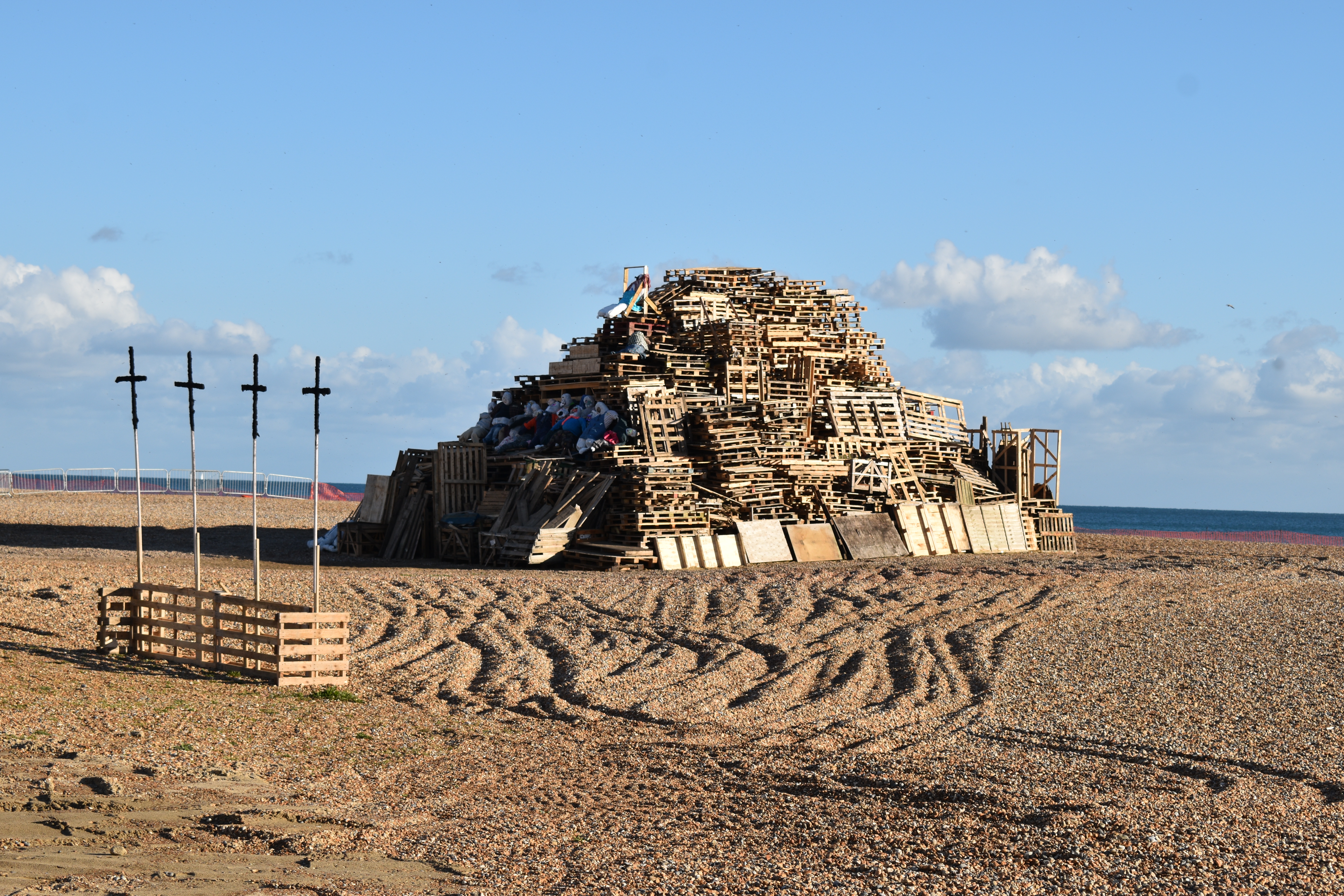
I took a late stroll on 15 October, in my adopted town of Hastings, UK. I came across an area of the beach that had been cordoned off and some pallets piled up inside the cordon. The next day I ventured back in daylight to take a photograph (left).
What is going on? The Council has declared a climate emergency but is allowing the release of c29 tonnes of carbon dioxide – the most abundant of the greenhouse gases – currently locked into the wood from trees that captured it from the atmosphere when they were growing. The Council enables this for no reason at all (of course, this is disputable). In addition to carbon dioxide, the burning of the wood released potentially toxic chemicals (wooden pallets are treated with a range of chemicals such as fumigants and preservatives), and dangerous particulates. It stresses wildlife and pets.
It does not come cheap, either. There is an opportunity cost here. Let us add up the costs: security, fencing (even the fountain is cordoned off), pallets, fireworks, litter clearance (strewn everywhere), medical support, use of resources to manufacture and sell tat…
How much carbon?

I assume 800 pallets. Each pallet weighs approximately 20kg. Each pallet is, again, roughly, 50 per cent carbon. That is 10kg carbon per pallet and 8000 for 800 pallets. When it burns it oxidises. The formular is CO2=C×44/12. So that is 8000x(44/22)=29.3 tonnes. If the calculation is incorrect, please let me know.
Incidentally, the average per capita emission is 7,000 kg. The average Briton, estimated by Mike Berners-Lee, has a footprint of 13,000 kg. It is not negligible. Every kilo matters because every fraction of a degree Celsius of warming matters.
For all of the official events, there is always a fringe. Descending on the town are the “tat” sellers. I do not know if they are licensed, but they seem very organised. They sell toys that are irresistible to children as they are brightly coloured and glow very much in the dark (right). They are single use. They will be thrown away. And my goodness, do they shift this tat. Behind this stuff is a climate disaster in the making, notwithstanding the cheap labour exploited to make it and the addition carbon generated in shipping.
You are stopping people from having fun – get a life
At this time of the year, these bonfire events are taking place across the country ahead of the climax on 5 November. As a kid, of course, I loved this night of the year. November 5th would fall on the week after our school half term. That whole week would be spent collecting wood to build the bonfire. (Pallets were not an option at the time.) Children would go house-to-house with their “Guy” (Guy Fawkes, one of the plotters who managed the explosives) to collect money to buy fireworks. We would have to defend our wood from other gangs who were looking to steal it for their own fire. The idea that we might collaborate did not come into the equation. It was pre- (knowledge about) climate change.
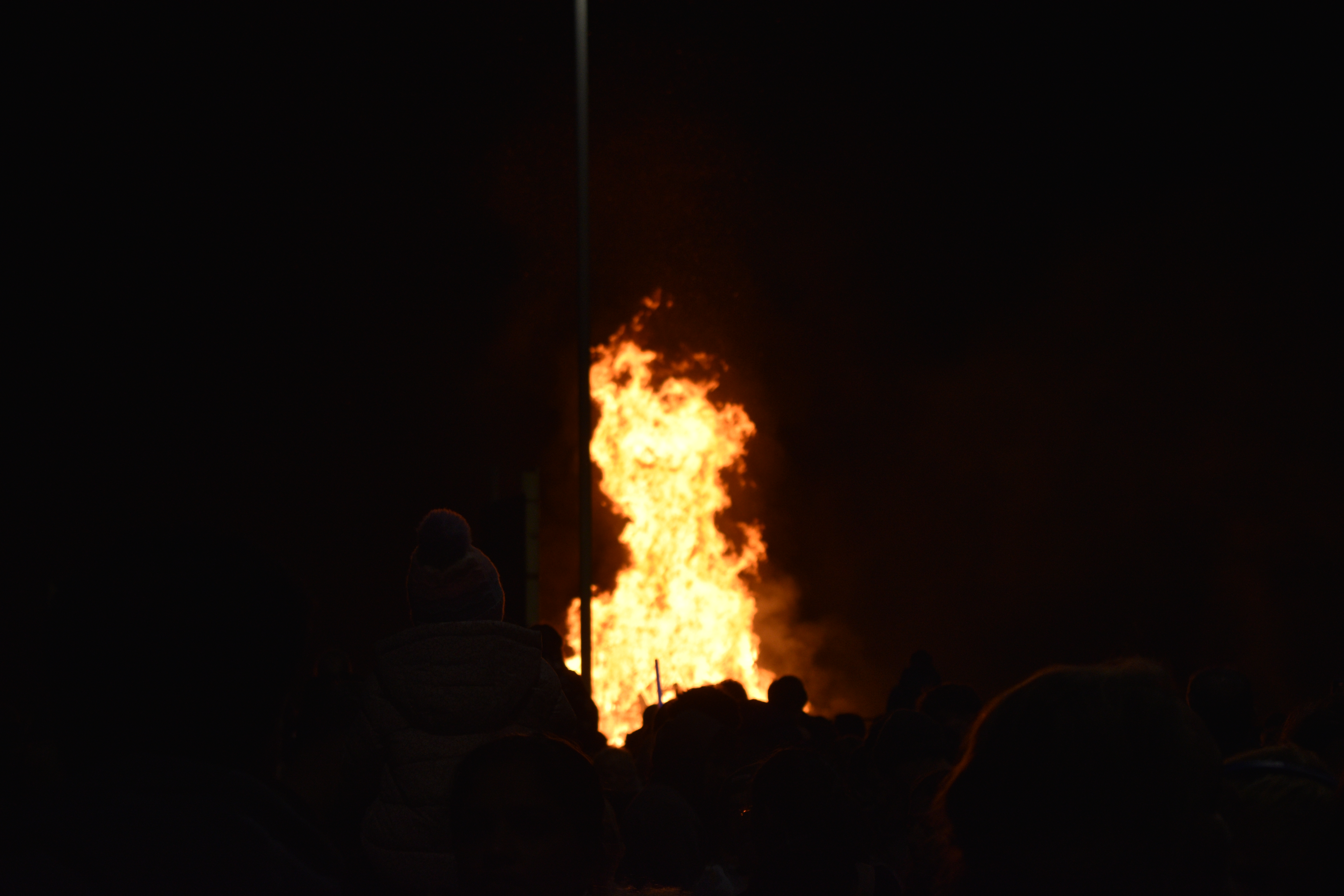
The event in Hastings is a major attraction. It brings in welcome extra money for businesses in the centre of the town, in particular hospitality. The downside is the observation that the streets around the centre of the town were choked with illegally parked cars. Huge ones, all consuming fossil fuels for their motive power. Not a single parking ticket to be seen. I have also been criticised for seeming to be petty – “it is only one bonfire once a year” and “what about the conflagrations taking place currently in France?” I tried to respond politely, but people are naturally defensive and most miss the point that I am making. I am not attacking a particular bonfire or people having fun. I am trying to make the case for improving awareness of the climate emergency and our response to it in our daily lives.

