Archive for the ‘Nausicaä’ Tag
Nausicaä of the Valley of the Wind and Wall-E compared
Filed under: Art, Environment, film | Tags: Disney, Douglas Adams, Ghibli Studios, Hayao Miyazaki, Nausicaä, Pixar, Valley of the wind, Wall-E
 Leave a comment
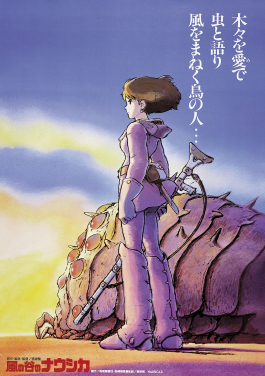
I really do not like Disney. I was haunted as a child with The Wonderful World of Disney and a raft of characters that I really did not like when compared to Looney Tunes and Tom and Jerry. And now with Disney even more commodified, I was not keen on re-entering even through a Pixar production. By contrast Hayao Miyazaki tells adult stories using animation. Nausicaä of the Valley of the Wind predates Studio Ghibli but very much fits into the portfolio of imaginative and challenging stories that are told in this Manga style. I have a DVD copy of his 2004 masterpiece, Spirited Away. It may be time to revisit it (though I will have to find a DVD player first). What Nausicaä and Spirited Away have in common is the central character: a courageous young female (reminds me very much of Lyra Belacqua in Philip Pullman’s Dark Materials trilogy). Strong, fearless, imaginative. Wall E’s central character, by contrast, is a waste eating robot.
Plots
Read no further if you have any inclination to watch these films. The spoilers here are real.
Nausicaä of the Valley of the Wind is set in a post apocalyptic world where toxic forests, insects and red-eyed Ohm encroach on the dwindling territory of human habitation. To walk into the forest, without a filter mask, is fatal. The Valley of the Wind is one such habitable area – it is a kingdom, and Nausicaä is the ailing king’s daughter. She is extraordinary and loved by her subjects who largely work the fields in a sort-of, but not totally, pre-industrial world. Nausicaä has a magical jet/gliding machine that she maneuvers with skill and daring. On her shoulder is her constant companion, Teto, a hybrid fox-squirrel. He is a symbol of Nausicaä’s affinity with the non-human world.
Nausicaä’s affinity with nature means that even the toxic nature responds to her pleas for forgiveness, particularly towards the ohm that have huge destructive capabilities, particularly when they rampage en masse. Interestingly, the English edition released by Disney in 2005 has Lord Yupa, one of the elders of the valley, voiced by the now deceased Patrick Stewart.
As ever, the threat is not ultimately from the forest, it is from humans’ attempts to tame nature and, in this case, destroy the forests and their toxicity. Nausicaä takes time to explore the forests and, by good or bad fortune, finds herself below the forest and begins to understand the toxicity and the ultimate protective nature of the trees and plants that purify the soil and water. Those that seek to destroy the forests are blind to the interdependency of themselves, the forests and the habitable land.
The most powerful empire is that of Tolmekia which has a formidable army and lumbering aeroplanes (or airships as they are called). There is another force to be reckoned with, also with planes, Pejite. The Tolmekians kidnapped its princess, Lastelle. The plane carrying her crashes in the valley. Princess Lastelle, who survived the crash, tells Nausicaä to destroy the cargo containing the Giant Warrior, a lethal, gargantuan humanoid bioweapon that caused the ecocide in the first place. The Tolmekians, led by the deceitful Princess Kushana, plan to develop the warrior to destroy the forest once and for all.
Meanwhile the Pejite anger the insects and ohm as they trample their way through Tolmekian communities and head for the Valley lured there by an injured young ohm made captive by the Pejite. In a defensive operation, Princess Kushana calls prematurely on the giant warrior to destroy the insects and ohm. But he is not ready and disintegrates. Meanwhile, Nausicaä liberates the young ohm but her red clothing is transformed into blue by the blood of the ohm. The ohm stampede is halted and Nausicaä returns as the long-awaited saviour “clothed in a blue robe, descending onto a golden field”. As a sign, a new tree grows in the subterranean uncontaminated forest.
Wall-E is, in 2805, the single remaining functioning waste eating robot on Earth. He has a sole organic companion, Hal, the cockroach. He is solar powered and programmed to collect up, compress and stack all of the waste left by humankind in its apocalyptic descent into oblivion by consumption. Humankind left the Earth to live the the spaceship Axiom until it is safe to return. The indicator of safety is evidence of new growth on the planet. Axiom sends down a robot, EVE, to search for just such life. EVE is nothing like Wall-E. She is white, sleek, fast moving with a curious disembodied head. Initially she ignores Wall-E, but he is smitten and seeks to impress her with his findings including light bulbs, a Rubic cube and recordings of human musical entertainment films, largely of couples serenading one another in song and dance. It is the human emotion and hand holding that Wall-E yearns for and sees EVE as his beloved.
In his effort to impress her, he shows her a green plant that he retrieved from a corner during one of his waste crushing days. It is just what she was programmed to find, on doing so she is collected by the shuttle ship and transported back to Axiom. Wall-E, desperate not to lose her, hangs on to the space craft as it departs. Improbably, he enters Axiom with shuttle and follows EVE as she is delivered to a processing plant where her find can be validated.
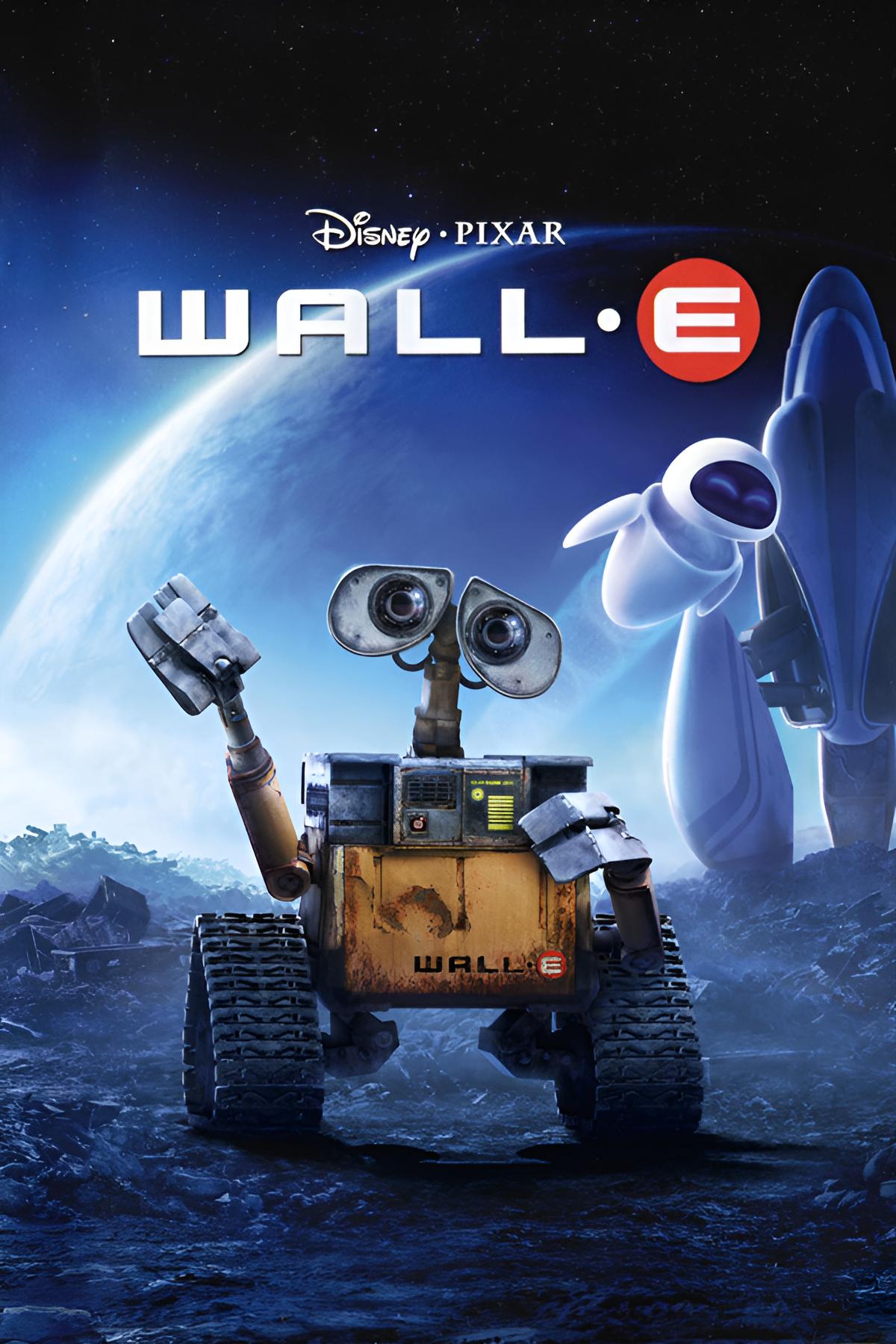
It is in this fantastical space world that we meet the humans and the first really English dialogue. We discover that on leaving Earth humans had continued their consumptive lives. Humans are, naturally, all American, white, obese and unable to walk as they live their lives on hoverbeds, for want of a better word. Their every needs are provided for by robots. It is leisure, but leisure with no feelings. No serenading. No love. Behind all of this is, of course, a mega corporation, Buy n Large.
Axiom’s captain is as immobile as everyone else on the ship. However, he realises that it is time to return to Earth. He is given the manual for what to do with the plant (as it is literally the key to programming the ship to return). But in fine 2001 A Space Odyssey style, the ship’s computer, Auto, cannot sanction a return to Earth. The visuals that accompany the battle between Auto and the Captain, Wall-E and EVE are stunning; though Wall-E is electrocuted and crushed in the process. With the aid of mutinous robots, the plant is suitably placed in the Holo-Detector and the ship returns to Earth where Axiom’s inhabitants learn how to walk and farm under the Captain’s tutelage.
Meanwhile, EVE tries to repair Wall-E from a spare parts cupboard in Wall-E’s shelter. Initially unsuccessful as Wall-E reverts to garbage crushing labourer. EVE has one last attempt to bring her Wall-E back. She holds his hand.
Analysis
Wall-E is an incidental climate change themed movie. It is basically Robinson Crusoe without Friday. Essentially it asks what happens on a planet devoid of life but where a single lonely robot remains? It is a love story, of course. It seems also that it was an exercise in making a film largely without dialogue. It is on the one hand a film about consumption, and on the other about over-consumption. It can act as a critique of corporate capitalism. It is over-consumption that leads to the planet being evacuated whilst Wall-Es clean the place up. That very same consumption is replicated on Axiom, so much so that humans lose the ability to walk. And fall in love. In Auto, moreover, we see a computer that does its utmost to prevent a return to Earth (Auto pays homage to Hal of 2001: A Space Odyssey). The ultimate irony, of course, is that Wall-E is made by one of the largest corporations in the USA. A company that lives off over-consumption (anyone travelling by Eurostar from Lille will see just how much corporate junk is sold at the company’s nearby theme park). It is a project of digital technology with its zeros and ones saved on energy-intensive servers. It also seems to be just white. Even the robots are white.
Nausicaä of the Valley of the Wind by contrast has much to say about climate and the impact on the life support systems of the Earth arising from conflict. It says much about human arrogance: there is always a way forcefully to defeat an enemy, even if that enemy is the natural world. This is the mentality of Princess Kushana of Tolmekia. Nausicaä is, by contrast, someone who believes in working with nature and cooperation between peoples to overcome challenges. She shows us that we can avoid conflict even with those we do not fully understand (ohm, for example). She is also a scholar. By entering the toxic jungle and investigation it reveals its secrets to her, not least the reason the land is toxic. It is also a story about the future. Nausicaä has youthful fearlessness, curiosity, vision and a stake in that future. She shows emotional strength and leads by example.
That is not to say that Hayao Miyazaki and his Ghibli Studio is not corporate. It actually has its own theme park in Japan. Maybe one is seduced by the hand drawn characters that tell human stories rather than corporate ones? Maybe the film’s finale is one of hope (reconciliation, cooperation, trust and discovery) unlike Wall-E where a trash-eating robot falls in love with a now redundant organic plant finder (albeit made by the same corporation). What purpose does this serve? And of course the humans re-learning how to farm reminds me very much of the Golgarfinchems from Douglas Adams’ Hitch Hikers Guide to the Galaxy. Humanity prepares to repeat itself.
What I will not deny is that both films are great story telling. Wall-E’s Earth is a red hot wasteland made so by us. Nausicaä’s world is fantastical, a long way from a pre-apocalypse world that is familiar to us. The world has evolved. The toxic forests remind us that the habitable world was not always so, and there is no reason for it to remain so. I suppose a test is whether you can watch both with children. Animation is often associated with children’s entertainment, but both of these films have serious adult themes; though I suspect Nausicaä probably needs more explanation than Wall-E that can be watched by all ages on their own terms. Ultimately Nausicaä gives me hope, Wall-E dread.

