Das Brauneck from Lenggries
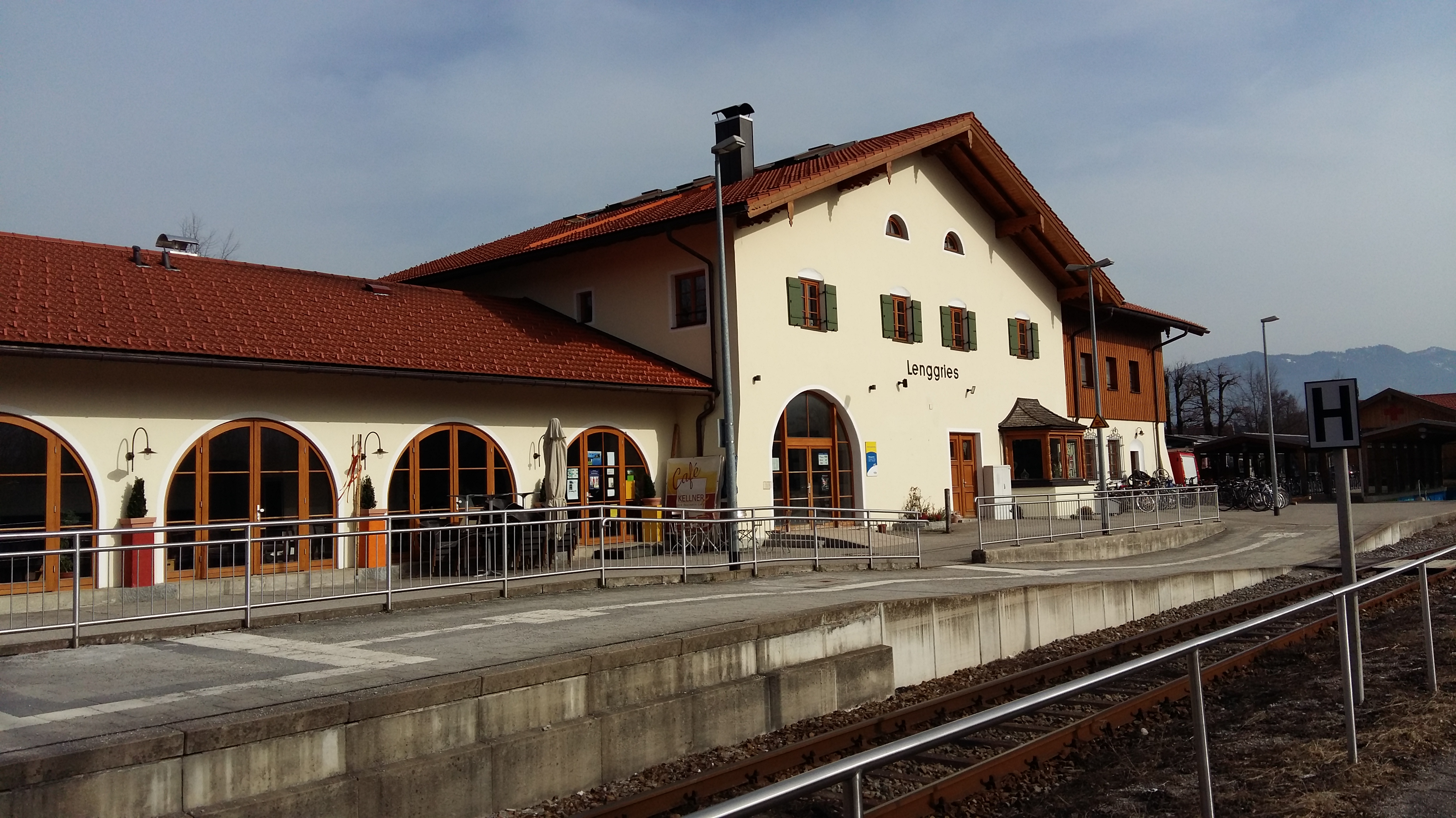 Das Brauneck is a mountain of 1540m accessed from Lenggries (left), a classic wealthy rural town in southern Bavaria. It does not have a pointy peak but in the winter it hosts a ski slope. And in the spring it persists as a ski slope, facilitated by snow-making machines dotted along the piste.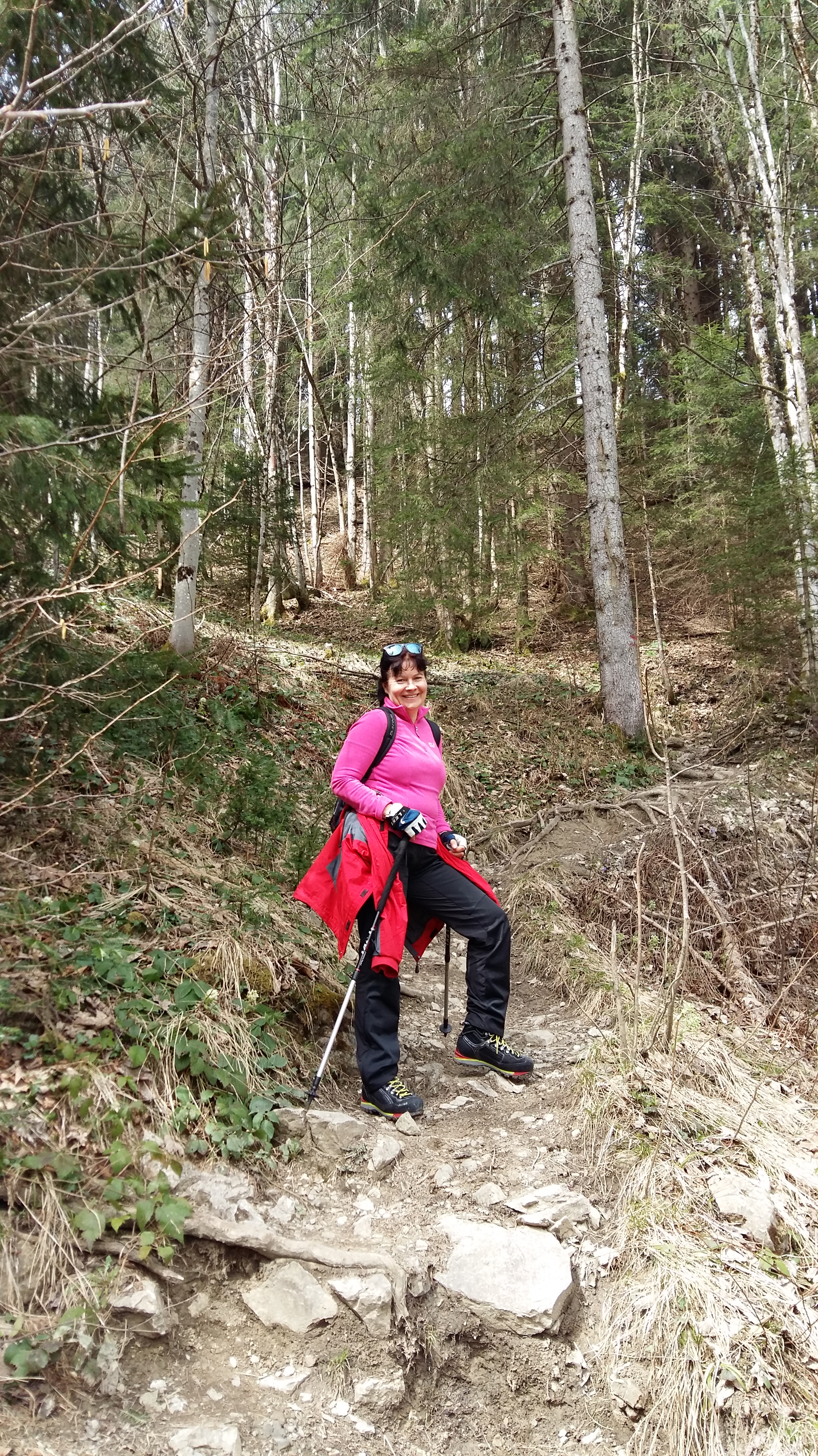
Ask at the cable car ticket office and they will tell you that there is no open path to the summit. Walk the 30 minutes to the Reisealm (910m), a delightful eatery and hotel through the forest, and they will advise the same. My advice, ignore them, but be prepared. There is the false sense of security when one leaves the  Reisealm. It all seems benign (right). But the snowline is around the corner. Unlike our walk on Monday, the gradient is starker. At various points one essentially has to climb the piste (left) and that takes considerable energy, poise and a bit of nerve (at least for a novice like me). It is also clear that there is no way back! And the signage is largely non-existent. There are yellow signs at the top and base, but the route is made up as one goes. Fortunately at this time of year, the piste is quiet. Seemingly the snow is just a little too wet. This is the time of year for higher altitude skiing.
Talking of which, it makes a difference. A number of years ago I hiked in the Moroccan Atlas  Mountains. We peaked at 4000m. I suppose on that basis I thought 1500m would not cause a problem. I was wrong. The photo on the right is a relieved hydrated man at the peak with a sandwich inside him.
 Getting back is a cinch, though not cheap. We took the cable car, itself pretty spectacular (left).
Equipment wise, I am wearing North Face Northotic Pro boots. My partner wears Salewa Blackbird Evo GTX (both bought as last year’s model – North Face from Millets in England,  Salewa from TK Maxx in Gemany).
A couple of sticks are essential kit. Crampons maybe next year.
Privatising schools by stealth
 Here we go again. George Osborne (left), the UK Chancellor of the Exchequer – otherwise known as the finance minister – took it upon himself to announce in his budget last week that all Schools will be forced to become academies. This is to rid them of fiendish local bureaucracy and hand them over to private-sector “trusts” where no such bureaucracy can get in the way of delivering first class education to children across the country.
First of all, I was a little confused as to why the finance minister rather than the education minister would make the announcement. Even the Prime Minister is a more likely bearer of such policy news. Who is making policy here? Oh, and while we are at it, let us abolish the right of parents to be governors on school boards. They seem to be part of that unnecessary bureaucracy that gets in the way…
Let us look at the rationale. First, Osborne links local bureaucracy and poor global performance of schools (on very limited instrumental metrics). Simply not demonstrated. Not only are local authority-run schools high performers in some cases but academies also fail – take AET, as just one example. Second, centralisation is an attempt to micromanage education. The national curriculum does not hold in academies, but the testing regimes do. And less-than-exemplar exam companies such as EdExcel (a subsidiary of Pearson) run the show. A far cry from my own secondary education certificate from the Joint Matriculation Board, a lofty university accredited outfit.
The local authority monitoring – sorry, bureaucracy – will be replaced by a highly efficient and non-bureaucratic schools commission. Conveniently accountable to some oblique central authority, not locally-elected representatives or accountable local civil servants.
More pertinent, it seems, is money. There is money to be made for academies not possible under local authority control. So, Knight of the Realm Sir Greg Martin – boss of Durand academy chain, apparently notched up a tidy salary of £390k and management fees of £508k while also running a dating website, a health club and an accommodation business (as if running schools was a part-time business opportunity).
Then there is the land. Oh yes, now we are getting to the nub of the matter. Local authority schools occupy public land. Academy schools’ assets are handed over to a “trust” (if ever the word trust was misused it is here, surely?). Wait and see the terms of use of land held in “trust” change.
Then there are the children who have learning difficulties or behavioural problems. Academies have to be target driven and non-conforming children are removed and ultimately become the responsibility of local authorities, those democratically-controlled entities that bureaucratically hinder educational achievement.
And then there are the teachers. Academies are not bound by national terms and conditions. The current Education Secretary’s predecessor, Michael Gove, already freed up academies to employ non-qualified staff and to replace them with software programs. Really. Now there will be no national negotiations over pay. That is another attack on organised labour and another good reason for conversion.
Talking of which, The BBC reported recently that to date conversion has cost local taxpayers £32.5m. According to Michael Rosen writing in the Guardian, 2,075 out of 3,381 secondary schools and 2,440 out of 16,766 primary schools are academies. That is a lot of conversion money still to be found.
The rationale now makes sense!
Hiking in the Alps
 Regular readers know that I frequently travel to Munich and elsewhere in Germany. But despite being only an hour on the train from the Alps, a hike has been elusive. That has now been rectified (left).
It is March and there is still snow at quite low levels. Our starting point w as Tegernsee,
south of Munich. An easterly path – nicely stepped – takes hikers up into the forest and to the snow. First stop conveniently timed on the ubiquitous route signs (right) is Neureuthaus; essentially a busy cafe 1200m up.
 Wander further (left) towards Gildenalm along a ridge that allows the view north towards Holzkirchen and Munich. On a clear day, that is. Gildenalm (1355m) was open, unexpectedly. Tea and cake and the experie
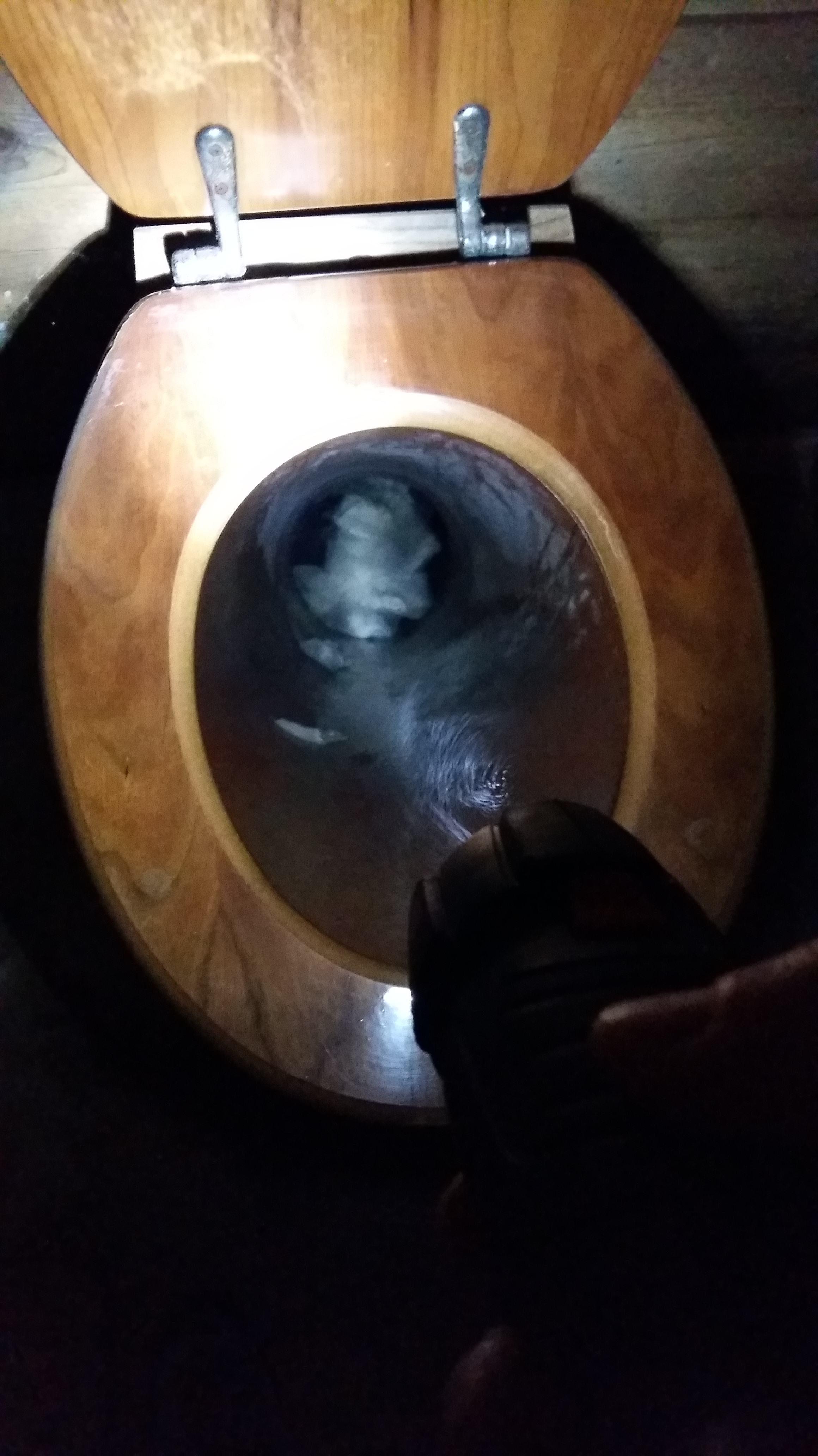 nce of a torch-lit gravity toilet (right) renders the ascent (left) to Kreuzbergalm (still closed) feasible. Whilst this is by no means mountain climbing, the ascent does feel
 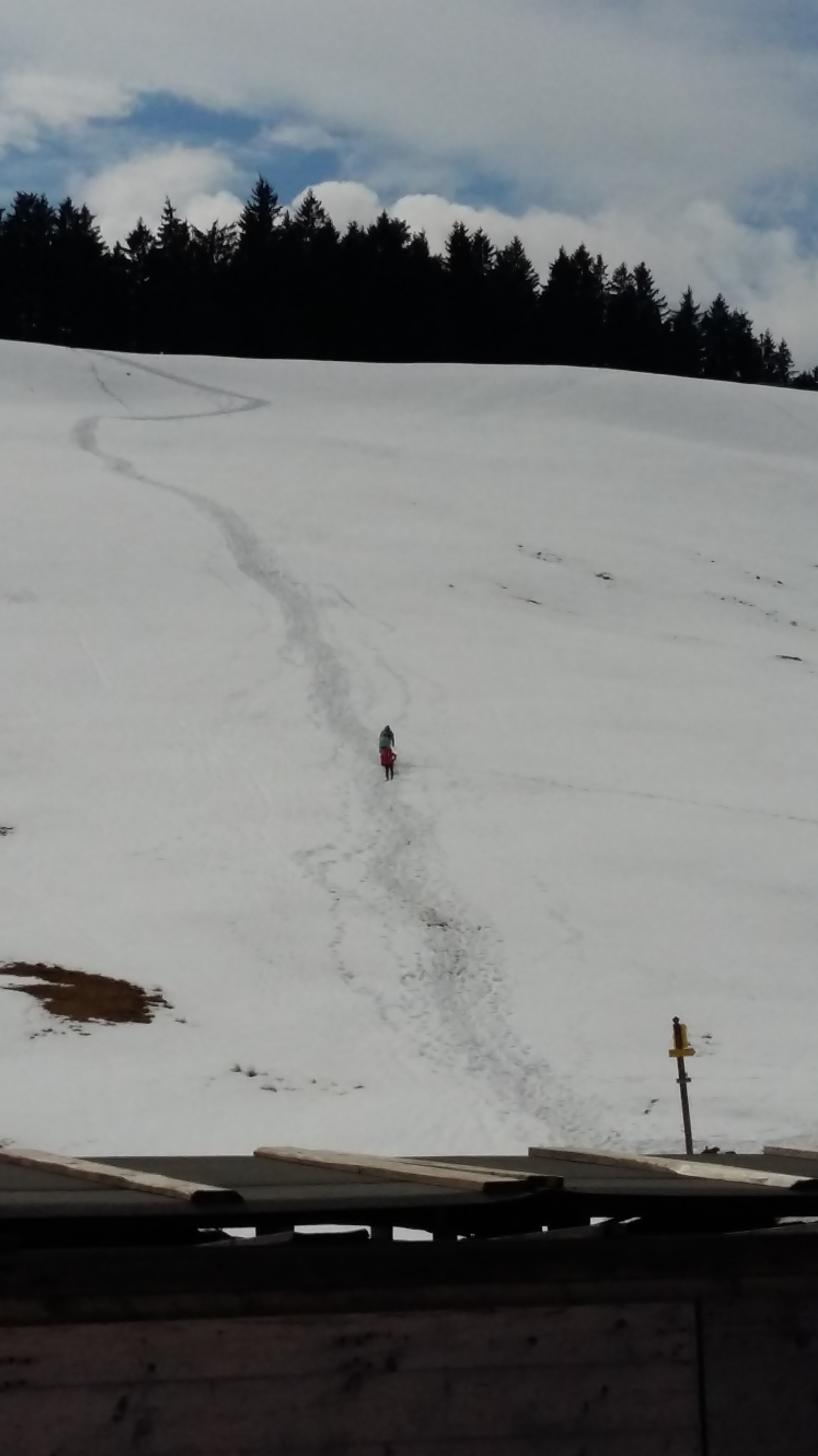 like it. One really has to strain one’s head back to see the top. The obligatory crucifix reassures hikers that the top has been reached. Safely.
From Kreuzbergalm the path descends and enters the Alpbach valley. At first a stream, by the time Tegernsee is again reached, somewhat more swollen.
It is only about 12km in all, but it is not to be rushed for novices. Having just bought some new boots, feet were returned dry. Signs are regular enough to navigate without detailed map. Out again on Saturday. Hopefully.
You Decide, the new Maybe
Filed under: Cigarette advertising, Uncategorized | Tags: marlboro, You Decide
 Comments (3)
 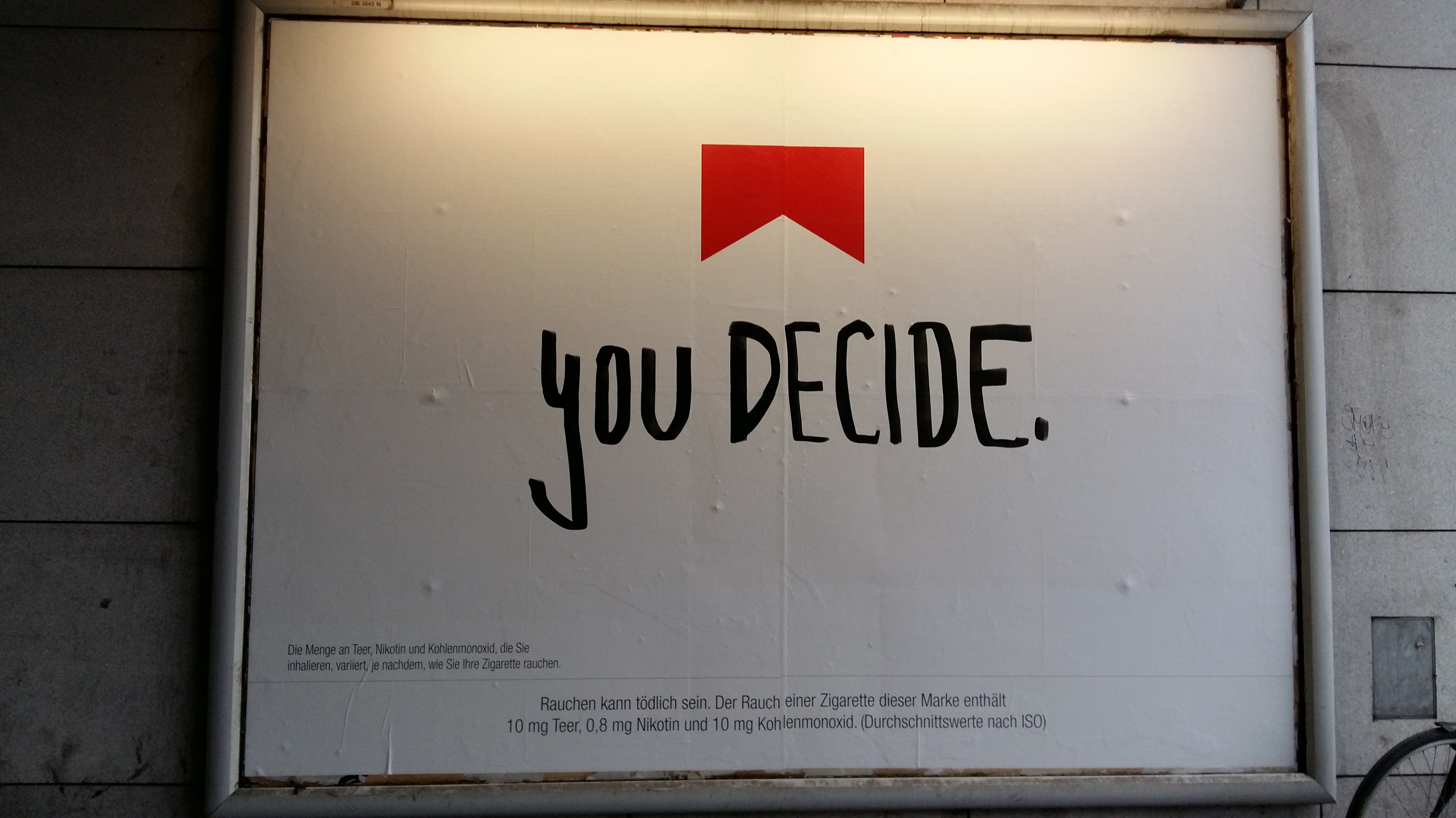 A few weeks ago Marlboro started posting up their blank You Decide. posters (left) in that marketing ruse to spark interest. You Decide. what? An urban mystery that is compelling. The next installment is then eagerly anticipated.
The theme is now developing well across Germany and presumably other territories where cigarette advertising is still permitted. Here are two examples. First, we are asked “Is up the only way?” in hand-written red letters. An image of a mature blond-haired woman accompanies the slogan.
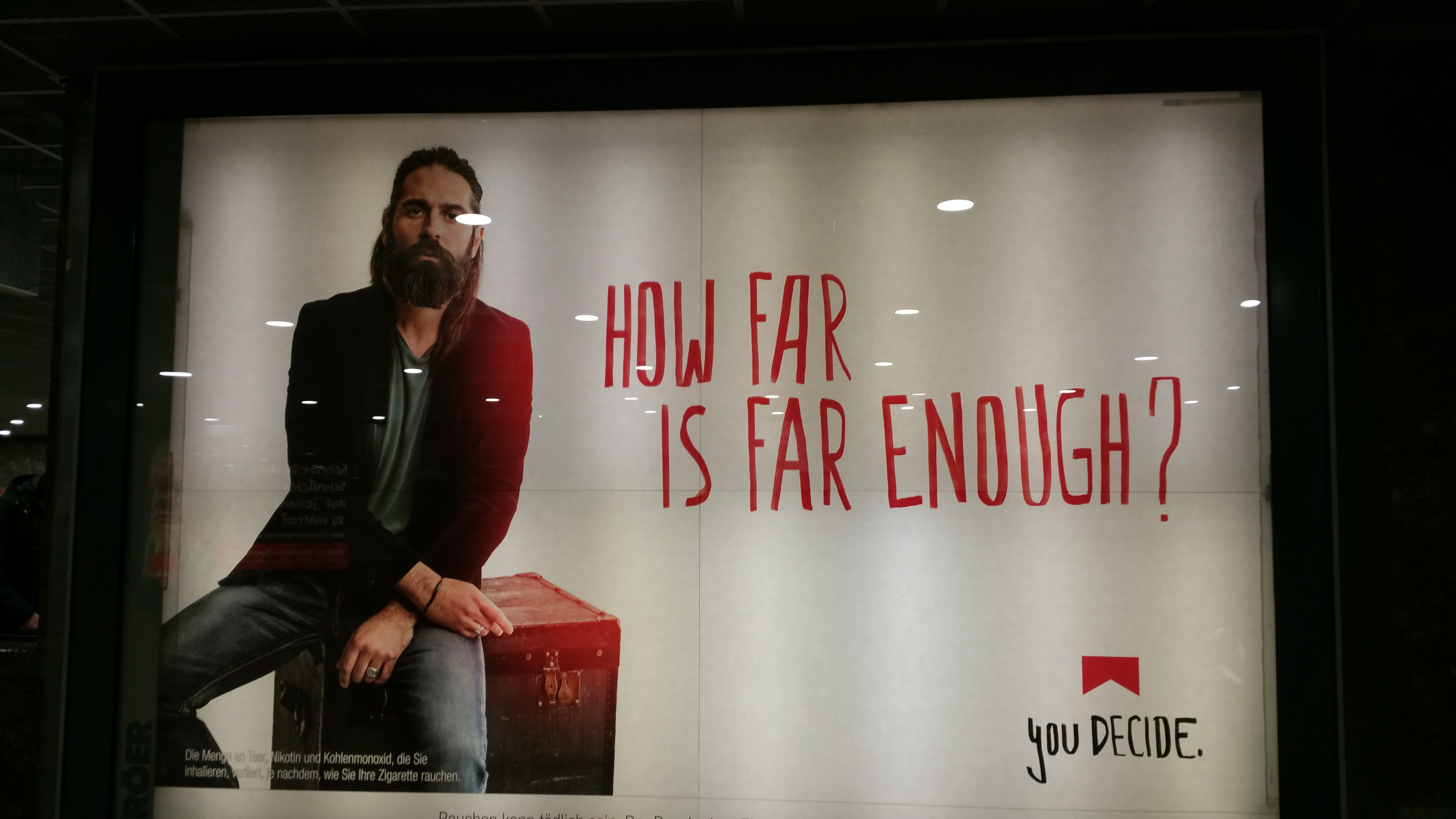 Men, by contrast, are asked “How far is enough?” in similarly fonted writing. The man is modern urban figure courting a beard and sitting on what seems to be a wooden box.
OK, this is an unfolding narrative. There are more to come, for sure. Though, let me re-iterate, there is only one direction for smokers and this point is far enough. Quit.
Camel’s own goal
Filed under: Cigarette advertising, Uncategorized | Tags: Camel
Leave a Comment  Camel’s more recent advertising campaign has celebrated its lethal qualities with primary colours and brand. With the “New Red and Blue” marketing it is back to the simplicity of presenting the product to camera. A man in a checked shirt holds a packet exposing the logo to the camera.
However, it seems that the marketeers have not been following this blog. The strapline “Next Camel Generation” beckons my normal scorn. Has the previous generation succumbed to cancer and heart disease?
Who wants to be Prime Minister of the divided Isle?
Filed under: Politics, Uncategorized | Tags: Boris Johnson, Brexit, Immigration
Leave a Comment  Here in the UK at the moment, we are being fed a daily diet of EU in-or-out gruel. Two camps vying for our vote in the referendum on 23 June. Cannot wait. The out side are particularly interesting because for neither camp is it about values – the values of sharing the planet, trading to stop us fighting against one another and protecting human rights.
So, in the red corner are the fascists who believe that immigration is at the heart of the country’s problems and exit would first of all stop all of the Poles, Romanians, etc. coming and taking our jobs, houses, schools, etc., but also make it easier for the country to stop the middle-eastern refugees from entering because the borders can again be controlled. Having just crossed a border today at Gatwick Airport, I cannot see that the border could be better ‘protected’ from the latter category. Frankly.
In the blue corner we find the renegade Tory ministers who are interested in being big fish in a small pool (England) rather than small fish in a big pool (Europe). Apparently, we make better laws than other Europeans. We are better at negotiating trade deals than Europeans, something to do with our imperial history. We could negotiate the necessary trade deals with key markets in the time it takes to say Xi Jinping or Donald Trump. And of course, these countries need the British market because they sell more things to us than we do to them – as if that was a good thing.
Leading this intellectually cat-brained movement is Boris Johnson (right) , the selfless Mayor of London. Johnson claims, of course,
that he did a lot of soul searching before opting for Brexit. He did not really want to oppose his own prime minister. But he just had to. He is not doing it as a springboard to being prime minister when a wounded David Cameron gives up after being found to be on the wrong side. No.
Choices, choices.
Pic: Boris Johnson, Mayor of London twitter
Gauloises spring campaign
 It is Gauloises’ spring in the cigarette advertising race now on in Germany. Two new posters have appeared, both extolling the virtues of being young, as youth hides the fact that the product is lethal and makes consumers chronically ill. So, exhibit one (left) has a bunch of millennials demonstrating how difficult things are at the moment for them as the can clearly only afford one set of clothes. Hence, in order to wash their clothes, they have to take them off and expose their youth, the women particularly. And because they cannot read (the normal thing to do in a Launderette), they have stolen a shopping trolley in order to play with it, costing me, the supermarket customer, more money because it has to be replaced at some point. Strapline-wise, stuff about being wet and having fun.
Exhibit two (right) is clearly set somewhere warmer than Munich at the moment; but shares 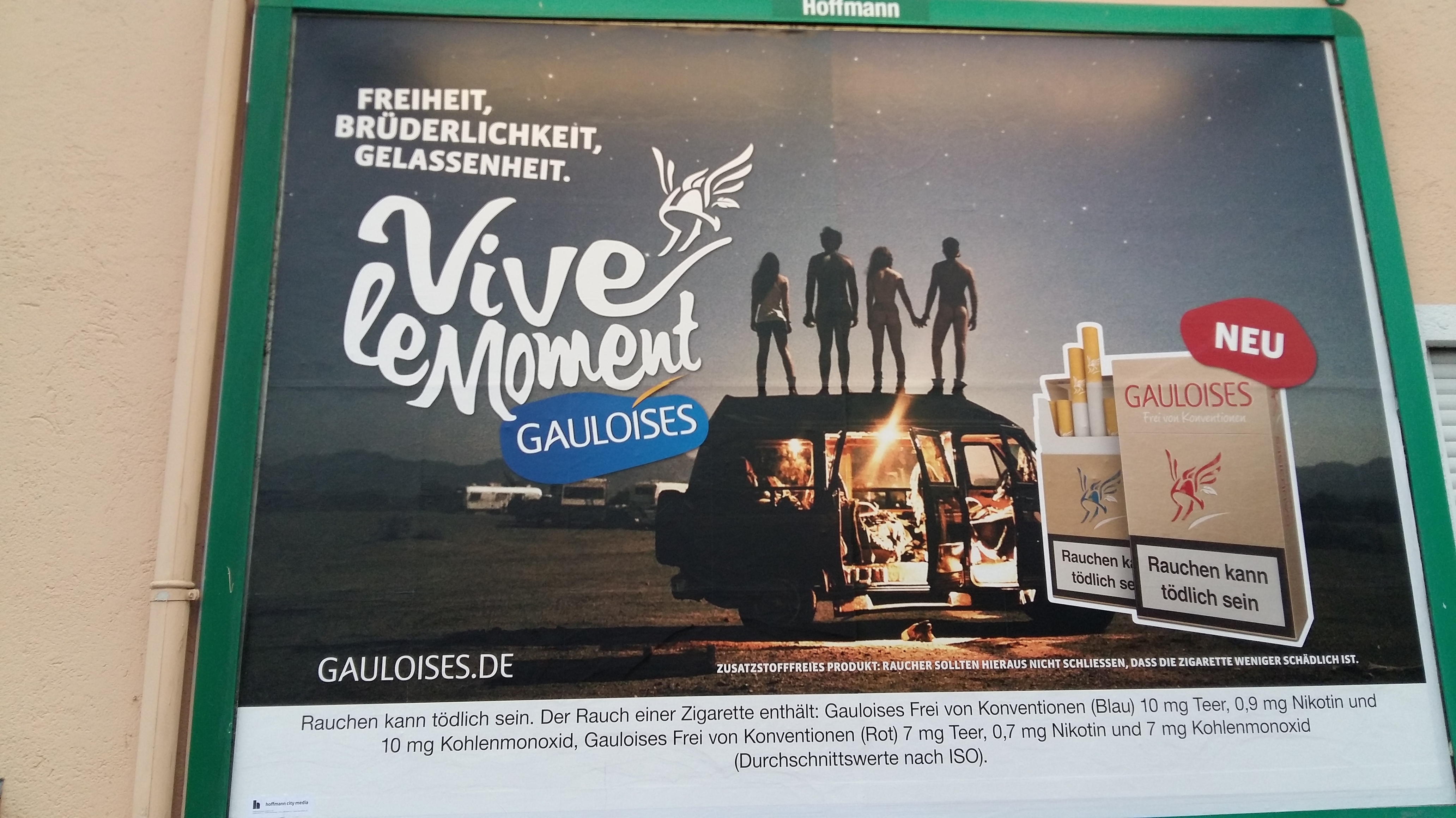 with its companion poster Millennials’ aversion to clothes. This time, two couples stand on top of a 4×4 with very little on. The light shining through the car windows suggests that they have parked close to an airport runway. They may well have a death wish? Better to be sucked into the engines of a landing airliner than succumb to chronic disease associated with the advertised product. If my hypothesis is wrong and they are actually in Munich, hypothermia will do the same trick for them. Strapline is something about freedom, brotherhood and serenity.
Finally, on the subject of death, Marlboro has come back strong with its You Decide campaign (left). Easy as ever. No!
Another attack on public housing
Pay to St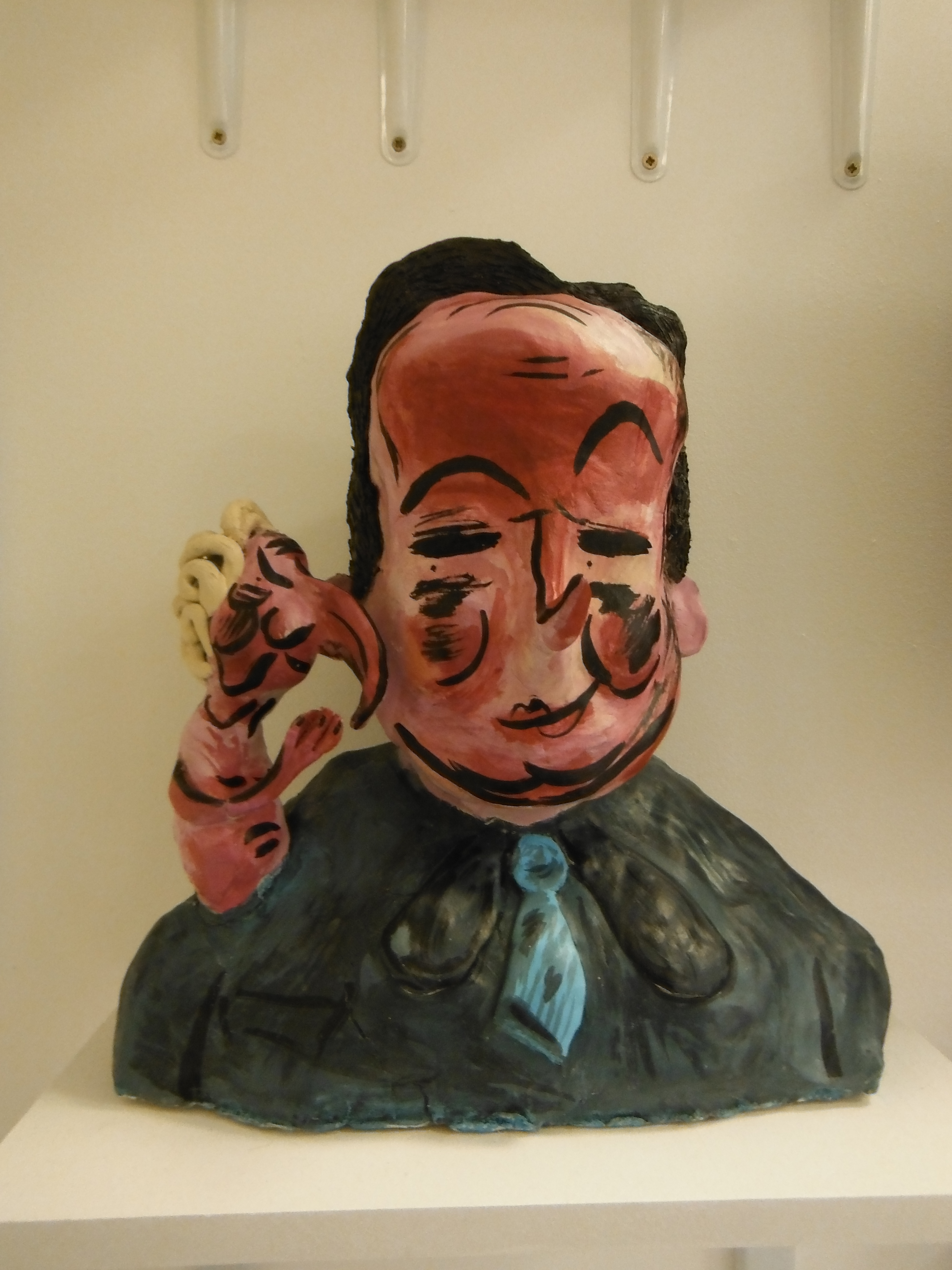 ay seems to be the latest attack on tenants of public housing in the UK. Proposals by David Cameron (left) and his Conservative Government to force tenants who earn more than £30K to pay market rents is the latest attack on ordinary people. The effect is thought to result in many more people being priced out of accommodation, particularly in London and other increasingly expensive urban centres. This comes on top of the forced sale of the most valuable council houses, right to buy against housing associations, and the end of permanent tenancies.
Let us unpick the argument. According to advocates of this proposal, people earning over £30K are being subsidised by the poorer tenants. The Department for Communities and Local Government has argued that in some cases these so-called high earners are being subsidised to the tune of £3,500 per year (the difference between what they pay in social housing vis-a-vis private-sector rents). Essentially those under the threshold have nothing to fear.
£30K can rarely be seen as high earning. For example, the sum may be a household aggregate. Two people may be working full-time to make the £30K. If they are additionally parents, I suspect, £30K does not go far. To have the ‘aspiration’ (a word we heard a lot of from David Cameron and his campaign guru, Lynton Crosby) during the election campaign) to earn more than £30K may be punished by homelessness. People paying different sums depending on their incomes is fairer, goes the Government argument. Fairer to the extent that these people will then end up subsidising Google.
Model of David Cameron: Holly MacDonald
More explicit street advertising in Germany
 Street advertisers are currently obsessed with selling online dating sites. The most in-your-face is c.date (left). It is clear enough without the strapline “sensual encounters make you happy”. What’s more, it is award winning (Testsieger, top right of poster). The awarding body is, of course, that fearsome tester, ‘singles comparisons market’. 5 Stars, no less. c.date has gone for the blanket approach. This example was found on a main route into the centre of Munich with smaller versions positioned every 50 metres, or so, next to the entrance to supermarkets, fuel stations and pharmacies!
Another dating site has taken a different visual approach, but equally blanketing in terms of positioning the posters (right). Parsh ip.de posts pictures of handsome people informing commuters that every 11 minutes a single falls in love through Parship! That is quite a claim if true. It does not seem to be award winning. But maybe the stat speaks for itself? If you are a man without perfect bone structures, straight teeth and a bit of facial hair, the stat goes down to every 11 years. Probably.
Yet another fatalist Pall Mall couple
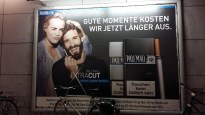 The couples Pall Mall campaign persists across one of only two European tobacco-friendly advertising countries, Germany (the other being Bulgaria, it seems). The latest example is compelling (left). Bearded man holding cigarette, woman with an eye partially closed tugging his hair with the tagline translating as ‘good moments savoured for longer’ (because the sticks themselves are longer than normal). She is really saying, I sense, “stop smoking and shave otherwise…” Before you know it, he’s in the cancer clinic.
 Be informed